I. The Prohibition
The Clean Water Act is not a complicated statute, at least in its central prohibition. Section 301(a), codified at 33 U.S.C. § 1311(a), provides: “Except as in compliance with this section and sections 1312, 1316, 1317, 1328, 1342, and 1344 of this title, the discharge of any pollutant by any person shall be unlawful.”1 The statute does not say “the discharge of large quantities of pollutants.” It does not say “the discharge of industrially significant pollutants.” It says “any pollutant.”
Congress chose the word “any” deliberately. The Supreme Court has recognized this. In South Florida Water Management District v. Miccosukee Tribe of Indians, 541 U.S. 95 (2004), the Court examined whether the movement of water between two bodies of water constituted a “discharge” requiring an NPDES permit. In doing so, the Court reaffirmed the breadth of the statute’s definitions. The word “any” is not decorative. It is operative.2
The only lawful pathway for discharging a pollutant into navigable waters is to obtain a permit under Section 402 of the Act, which establishes the National Pollutant Discharge Elimination System. An NPDES permit specifies the types and quantities of pollutants a permittee may discharge, the monitoring and reporting requirements it must follow, and the effluent limitations it must meet. The permit is the legal instrument that transforms an otherwise prohibited act into a lawful one. Without a permit, the discharge of any pollutant by any person is a federal violation.3
II. The Pollutant
Section 502(6) of the Clean Water Act, codified at 33 U.S.C. § 1362(6), defines “pollutant” with a list that is notable for both its specificity and its breadth. The full definition reads: “The term ‘pollutant’ means dredged spoil, solid waste, incinerator residue, sewage, garbage, sewage sludge, munitions, chemical wastes, biological materials, radioactive materials, heat, wrecked or discarded equipment, rock, sand, cellar dirt and industrial, municipal, and agricultural waste discharged into water.”4
A penny is a metallic disc 19.05 millimeters in diameter and 1.52 millimeters thick. Since October 1982, the United States Mint has produced pennies with a core of 97.5 percent zinc coated with a thin plating of 2.5 percent copper. The coin weighs 2.5 grams. Before the 1982 composition change, pennies were struck in an alloy of 95 percent copper and 5 percent zinc and weighed 3.1 grams.5 In 1982 alone, the Mint struck over 16.7 billion pennies across two compositions and two minting facilities. The Mint continued producing between five and fourteen billion pennies per year for the next four decades, until it suspended production for circulation in November 2025 due to manufacturing costs that had, for the better part of two decades, exceeded the coin’s face value. The penny remains legal tender.6
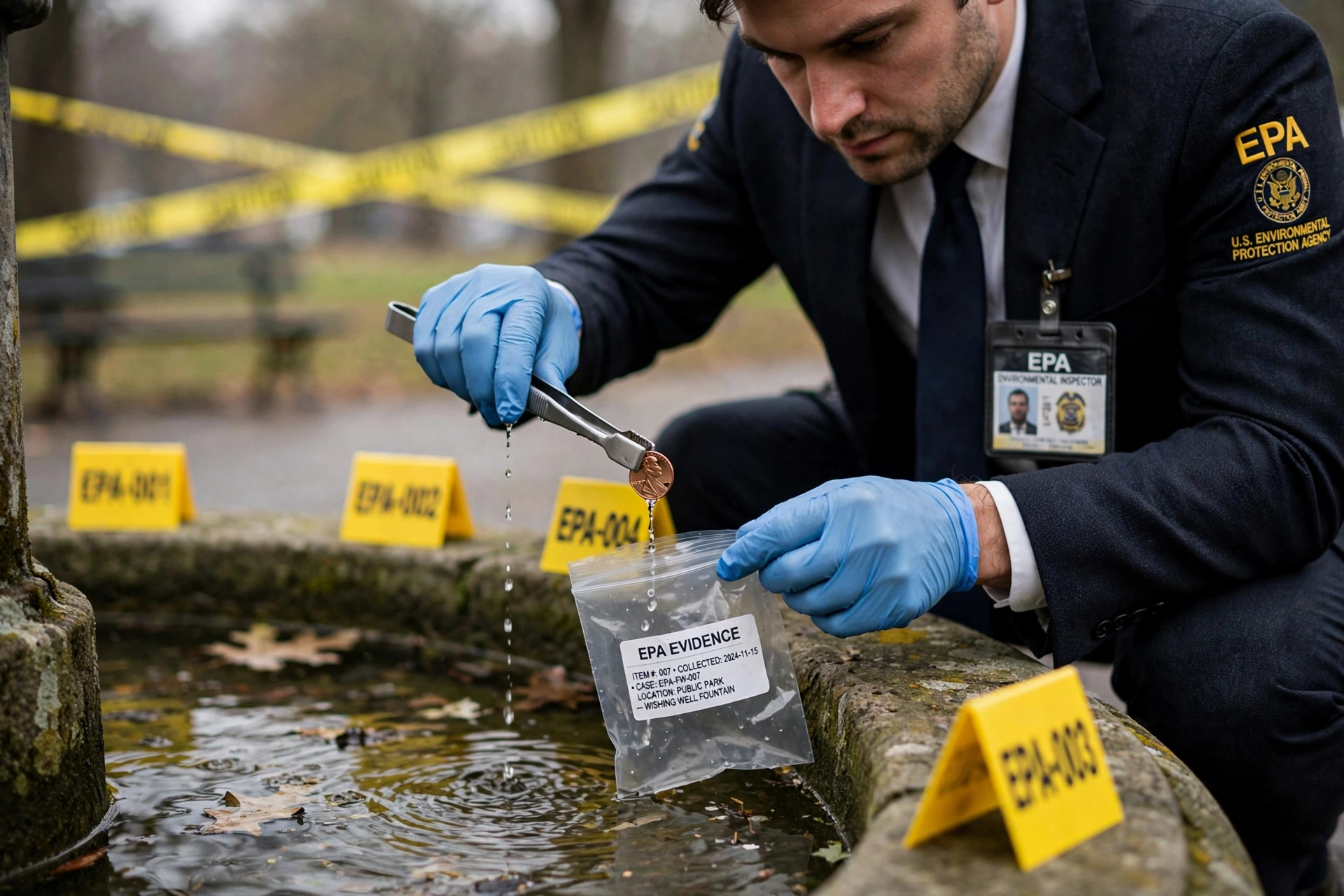
When a person throws a penny into a fountain with the express intention of never retrieving it, that penny has been discarded. The person does not intend to reclaim it. The person does not expect a return on it. The person has, by the physical act of propelling a metallic object through the air and into a body of water, converted a unit of legal tender into solid waste. The coin is, at the moment of submersion, simultaneously a piece of wrecked or discarded equipment (it can no longer function in commerce, as no vending machine accepts submerged currency) and a chemical waste (it is composed of two regulated metals that leach into solution upon prolonged contact with water).
III. The Priority Pollutants
The Clean Water Act does not treat all pollutants equally. Section 307(a), codified at 33 U.S.C. § 1317(a), directs the EPA to publish a list of toxic pollutants subject to the most stringent effluent limitations. The EPA’s implementing regulations at 40 CFR § 401.15 identify sixty-five classes of “toxic pollutants” subject to this enhanced regime. Number twelve on the list is copper and compounds. Number sixty-four is zinc and compounds.7
Copper is not merely regulated. It is among the most intensively studied aquatic toxicants in the EPA’s inventory. In 2007, the EPA published revised aquatic life ambient freshwater quality criteria for copper, replacing the previous hardness-based formula with the Biotic Ligand Model, a site-specific computational approach that accounts for the bioavailability of dissolved copper as a function of ten water chemistry parameters. The saltwater criteria maximum concentration for copper is 4.8 micrograms per liter. The saltwater criterion continuous concentration, the four-day average not to be exceeded more than once every three years, is 3.1 micrograms per liter.8
Zinc is similarly constrained. The EPA’s ambient water quality criteria for zinc establish freshwater acute and chronic thresholds that, when exceeded, produce measurable mortality and reproductive impairment in aquatic organisms. Peer-reviewed research published in Ecotoxicology and Environmental Safety has demonstrated that binary combinations of copper and zinc at concentrations individually below their respective water quality criteria produced statistically significant chronic reproductive effects in Ceriodaphnia dubia, a freshwater crustacean used as a standard EPA bioassay organism. The interaction was more than additive.9
A single post-1982 penny contains approximately 2.4375 grams of zinc and 0.0625 grams of copper. These are small quantities. They are also, under the Clean Water Act, the same two metals for which the EPA has pursued enforcement actions against industrial dischargers across the country.
IV. The Point Source
The Clean Water Act does not prohibit all pollution. It prohibits the discharge of a pollutant from a “point source.” Section 502(14), codified at 33 U.S.C. § 1362(14), defines “point source” as “any discernible, confined and discrete conveyance, including but not limited to any pipe, ditch, channel, tunnel, conduit, well, discrete fissure, container, rolling stock, concentrated animal feeding operation, or vessel or other floating craft, from which pollutants are or may be discharged.”10
The phrase “any discernible, confined and discrete conveyance” has been interpreted expansively by the courts. In United States v. Plaza Health Laboratories, Inc., 3 F.3d 643 (2d Cir. 1993), the Second Circuit considered whether a human being could constitute a point source. The defendant, the owner of a blood-testing laboratory, had been convicted of discharging vials of blood and other medical waste into the Hudson River by personally carrying them to the riverbank and throwing them in. The court reversed the conviction on the ground that Congress did not intend the term “point source” to encompass a human being, but Judge Oakes, dissenting, argued that the statute’s text plainly encompassed “any discernible, confined and discrete conveyance” and that a human arm holding a container of waste and propelling it into navigable waters met that definition.11
The majority’s holding in Plaza Health was narrow. It did not foreclose the possibility that a human being acting as a conduit for a pollutant could satisfy the point source requirement in all circumstances. And even under the majority’s more restrictive reading, the analysis would arguably differ when the person is not the sole conveyance but is instead introducing a pollutant into a constructed water feature: a fountain with an intake pipe, a recirculation pump, an overflow drain, and, in many cases, a connection to the municipal stormwater system. The fountain itself is a container. A container is a point source by statutory definition.
V. The Waters
The Clean Water Act’s prohibition applies to the discharge of pollutants into “navigable waters,” which the statute defines at Section 502(7) as “the waters of the United States, including the territorial seas.”12 The scope of this term has been the subject of fifty years of regulatory definition, Supreme Court litigation, and executive action. In Sackett v. Environmental Protection Agency, 598 U.S. 651 (2023), the Supreme Court held that the CWA extends to bodies of water that are “waters of the United States” in the traditional sense and to wetlands with a “continuous surface connection” to such waters.13
A decorative fountain in a public park is not, on its face, a traditionally navigable waterway. One cannot operate a barge in a wishing well. But the Clean Water Act’s jurisdictional reach does not depend on navigability in the commercial sense. It depends on hydrological connectivity. And the majority of public fountains in the United States are connected, by design, to the municipal stormwater infrastructure. Overflow drains carry fountain water into storm sewers. Storm sewers discharge, in most American cities, into rivers, streams, lakes, and eventually the ocean. A pollutant introduced into a fountain connected to a storm drain is a pollutant that will, by the ordinary operation of gravity and plumbing, reach navigable waters.
The EPA has taken precisely this position in the context of stormwater regulation. Under 40 CFR Part 122, the agency requires NPDES permits for municipal separate storm sewer systems on the ground that pollutants entering those systems ultimately reach waters of the United States. The logic is the same. The only difference is that the pollutant in this case is a 2.5-gram disc of zinc and copper rather than a plume of industrial effluent.
VI. The Scope of the Violation
The scale of unpermitted coin discharge into water features worldwide is not trivial. The Trevi Fountain in Rome collects approximately three thousand euros per day in thrown coins, totaling an estimated 1.5 million euros annually. The coins are collected by workers from the regional utility ACEA using long brooms and suction hoses under police supervision and donated to the Catholic charity Caritas.14 In February 2026, the City of Rome implemented a two-euro access fee for non-resident visitors to the fountain, but the coin-tossing tradition continued unabated. More than ten million people visited the Trevi Fountain in 2025.15
Domestic figures are harder to quantify because no federal agency tracks coin deposition in decorative water features. The National Park Service operates more than four hundred sites across the United States, many of which contain fountains, reflecting pools, and other water features into which visitors routinely throw coins. The Lincoln Memorial Reflecting Pool, the National World War II Memorial fountain, and the fountains at the National Mall collectively receive unknown but presumably substantial quantities of coins each year. The Las Vegas Strip alone contains dozens of public fountains. Shopping malls across the United States contain hundreds more.
A 2002 survey conducted by Coinstar, Inc. estimated that 10.5 billion dollars in coins sat idle in American households. Two percent of Americans reported in surveys that they throw pennies in the trash.16 If even a fraction of the coins exiting circulation each year are deposited in water features, the aggregate mass of zinc and copper entering those water features annually is measured in tons, not grams.
VII. The Enforcement Precedent
The Department of Justice has demonstrated no reluctance to prosecute discharges of copper and zinc into waters of the United States when the discharger is an industrial facility. In December 2020, Libertas Copper, LLC, doing business as Hussey Copper, a copper-processing company headquartered in Leetsdale, Pennsylvania, pleaded guilty in the United States District Court for the Western District of Pennsylvania to three felony counts under the Clean Water Act. The charges arose from a multi-year pattern of submitting false discharge monitoring reports to conceal 140 NPDES permit violations, unauthorized discharges of oil into the Ohio River, and the failure to report those discharges. Judge William S. Stickman IV ordered the company to pay a criminal fine of $550,000 and serve three years’ probation. A subsequent civil settlement in 2021 imposed additional remedial obligations and penalty payments.17
In 2014, the EPA reached a consent agreement with U.S. Silver–Idaho, Inc., the operator of the Coeur and Galena Mines in Idaho’s Silver Valley, for exceeding discharge limits for copper and lead at outfalls discharging to Lake Creek and the South Fork of the Coeur d’Alene River. The company paid a $75,000 penalty.18 In 2021, the EPA settled with Emhart Teknologies LLC in Danbury, Connecticut, for $29,658 for discharging a mixture of water and coolant containing copper and lead into Sympaug Brook.19
The legal theory underlying each of these enforcement actions is identical: the introduction of copper, a priority pollutant, into waters of the United States without authorization, in violation of Section 301(a). The difference between Hussey Copper and a shopping mall fountain is not legal. It is atmospheric.
VIII. The Arithmetic
CWA civil penalties, as adjusted for inflation under the Federal Civil Penalties Inflation Adjustment Act, currently stand at a maximum of $68,445 per day per violation.20 Criminal penalties under 33 U.S.C. § 1319(c)(2) for knowing violations include fines of up to $50,000 per day and imprisonment of up to three years, doubled for repeat offenders.
Each coin thrown into a fountain is a separate discharge event. Each discharge event is a separate violation. A single family visiting a shopping mall, distributing one penny to each of three children, and watching those children throw those pennies into the atrium fountain has committed three violations of Section 301(a) of the Clean Water Act. At the maximum civil penalty rate, the family’s aggregate exposure is $205,335 for an afternoon outing that cost them three cents.
The Trevi Fountain receives approximately three thousand euros in coins per day. At a conservative estimate of one thousand individual coin-toss events per day (many visitors throw multiple coins), the daily violation count at a single fountain exceeds one thousand. At $68,445 per violation, the aggregate daily penalty exposure at the Trevi Fountain alone exceeds sixty-eight million dollars. The annual penalty exposure exceeds twenty-four billion dollars. For a fountain. In a foreign country.
IX. The Exemption That Does Not Exist
The Clean Water Act contains numerous exemptions. Section 502(14) excludes “agricultural stormwater discharges and return flows from irrigated agriculture” from the definition of point source. Section 402(l) exempts certain silvicultural activities and stormwater discharges from the NPDES permit requirement. Section 404 establishes a separate permit program for the discharge of dredged or fill material, administered by the Army Corps of Engineers rather than the EPA.
None of these exemptions applies to the discharge of metallic currency into decorative water features. There is no recreational coin-disposal exemption. There is no numismatic exception. There is no de minimis threshold below which the prohibition ceases to apply. The statute says “any pollutant,” and it means any pollutant. Congress knew how to write exemptions. It wrote several. It did not write one for wishing wells.
X. The Regulatory Silence
The EPA’s NPDES permit database, maintained through its Integrated Compliance Information System, contains records of approximately 300,000 active and expired permits.21 These permits regulate discharges from wastewater treatment plants, industrial manufacturing facilities, concentrated animal feeding operations, mining operations, power plants, and municipal stormwater systems. They regulate discharges of copper, zinc, lead, mercury, arsenic, cadmium, and dozens of other pollutants at concentrations measured in micrograms per liter.
Not one of those 300,000 permits was issued to a wishing well. Not one was issued to a decorative fountain. Not one was issued to a mall atrium, a park pond, a hotel lobby water feature, or the coin-receiving basin at any of the thousands of restaurants that maintain a fountain near their entrance. The EPA, which maintains an enforcement budget exceeding $600 million annually, which operates a Criminal Investigation Division employing approximately 145 special agents with full law enforcement authority, and which has obtained criminal convictions against companies for discharging the same metals in the same concentrations into the same category of receiving waters, has elected not to investigate any of the millions of Americans who annually throw metallic objects containing priority pollutants into bodies of water connected to the nation’s hydrological infrastructure.
The pennies remain in the fountains. The fountains remain connected to the storm drains. The storm drains remain connected to the rivers. The rivers remain navigable waters of the United States. The statute remains in effect. The enforcement action has not been filed.