I. The Statutory Framework
26 U.S.C. § 5041(a) provides, in language that has remained substantively unchanged since the enactment of the Internal Revenue Code of 1954, that “there is hereby imposed on all wines (including imitation, substandard, or artificial wine, and compounds sold as wine) having not in excess of 24 percent of alcohol by volume, in bond in, produced in, or imported into, the United States, taxes at the rates shown in subsection (b).”1
The rates are explicit. Under § 5041(b)(1), still wines containing not more than 14 percent alcohol by volume are taxed at $1.07 per wine gallon. Wines exceeding 14 percent but not 21 percent are taxed at $1.57 per wine gallon. Wines exceeding 21 percent but not 24 percent are taxed at $3.40.2
The statute defines the taxable event broadly. Tax is imposed on “all wines…produced in…the United States.” It does not require that the wine be produced intentionally. It does not require that the producer hold a federal permit, file a tax return, or possess a Social Security number. It requires only that the product be wine, that it be produced, and that the production occur within the territorial jurisdiction of the United States.
26 U.S.C. § 5381 supplies the statutory definition of the product. “Natural wine” is “the product of the juice or must of sound, ripe grapes or other sound, ripe fruit, made with any cellar treatment authorized under section 5382 and containing not more than 21 percent of alcohol by volume.”3 The definition describes a chemical outcome: the fermentation of fruit juice into an alcoholic beverage. It does not inquire into the biological identity of the organism performing the fermentation. It does not ask whether the fermenter files quarterly reports. It describes a substance, sets a tax rate, and imposes a liability.
26 U.S.C. § 5351 requires that any person who produces wine lawfully must do so on “bonded wine premises”—facilities registered with and approved by the Alcohol and Tobacco Tax and Trade Bureau. The bonding requirement ensures that the federal government can collect the excise tax on wine before it enters commerce. The application for bonded wine premises is TTB Form 5120.17.4
The question, then, is straightforward. Is there an organism in the United States that is producing the product of the normal alcoholic fermentation of the juice of sound, ripe fruit, in volumes exceeding any conceivable de minimis threshold, on premises that have never been bonded, without filing a single federal form?
There is. It has been doing so for approximately 100 million years.
II. The Organism
Saccharomyces cerevisiae is a single-celled eukaryotic fungus of the phylum Ascomycota. It is the most economically significant microorganism in human history. The sequencing of its complete genome in 1996—12,068 kilobases across 16 chromosomes, encoding approximately 6,275 genes—represented the first complete genome of any eukaryotic organism ever assembled, a milestone published in Science by an international consortium led by André Goffeau.5
S. cerevisiae occurs naturally on the surfaces of ripe fruit across every continent except Antarctica. It has been isolated from vineyards, orchards, forests, and the skins of grapes, apples, pears, plums, figs, dates, and virtually every sugar-bearing fruit studied. Its natural habitat is the surface of the fruit it ferments. It does not require human intervention to reach its substrate. It was there first.
The metabolic pathway by which S. cerevisiae converts sugar to ethanol was first described quantitatively by Joseph Louis Gay-Lussac in 1810 and confirmed experimentally by Louis Pasteur in 1857: C₆H₁₂O₆ → 2 C₂H₅OH + 2 CO₂. One molecule of glucose yields two molecules of ethanol and two molecules of carbon dioxide.6 This is the same reaction that occurs inside every stainless steel fermenter in Napa Valley. It is also the reaction that occurs, without license, on every forest floor, in every orchard, and in every landfill where fruit enters the soil.
The distinguishing characteristic of Saccharomyces is the Crabtree effect: the capacity to ferment sugars to ethanol even in the presence of oxygen, an energetically wasteful strategy that most organisms avoid. This trait evolved approximately 100 million years ago, coincident with the diversification of angiosperms and the consequent abundance of sugar-rich fruit in terrestrial ecosystems.7 The evolutionary advantage was ecological: by producing ethanol as a metabolic byproduct, Saccharomyces poisons its microbial competitors, securing the fermentable substrate for itself. The strategy is effective. The organism has deployed it continuously for longer than the Atlantic Ocean has existed in its current form.
III. The Product
The question of whether naturally fermenting fruit contains ethanol at concentrations sufficient to constitute “wine” under the Internal Revenue Code is not a matter of speculation. It is a matter of published, peer-reviewed measurement.
Robert Dudley of the University of California, Berkeley, who in 2000 first proposed the “drunken monkey” hypothesis—that the primate attraction to ethanol evolved as a foraging cue for ripe fruit—conducted field measurements of ethanol concentrations in the pulp of the Neotropical palm Astrocaryum standleyanum. Ripe fruit contained ethanol at concentrations averaging 0.9 percent by volume. Over-ripe fruit averaged 4.5 percent.8
A 2022 study led by Christina Campbell of California State University, Northridge, collected fruit eaten and discarded by free-ranging black-handed spider monkeys (Ateles geoffroyi) in Panama. The researchers found that ethanol concentrations in the consumed fruit were typically between 1 and 2 percent by volume. They further collected urine from the monkeys and confirmed the presence of secondary metabolites of alcohol, demonstrating that the animals were metabolizing the ethanol—not merely passing it through their digestive tracts. “For the first time,” Campbell stated, “we have been able to show, without a shadow of a doubt, that wild primates, with no human interference, consume fruit-containing ethanol.”9
In 2023, researchers from the University of Calgary and the University of Exeter published results in Proceedings of the Royal Society B documenting ethanol concentrations across 37 species of wild fruit in Costa Rica, finding measurable ethanol in the majority of mammal-dispersed fruit species and a statistically significant positive correlation between ethanol content and the breadth of mammalian seed dispersal.10
Naturally fermenting fruit produces ethanol at concentrations ranging from less than 1 percent to well over 4 percent by volume. Under 26 U.S.C. § 5041(b)(1), still wine containing not more than 14 percent alcohol by volume is taxed at $1.07 per wine gallon. Every naturally fermenting fruit in the United States falls within this bracket. The product is wine. The tax rate is $1.07. The payments to date number zero.
IV. The Scale of Production
The Wine Institute, compiling data from the TTB’s own statistical reports, records that all licensed American wineries produced a combined total of 762,227,076 wine gallons in 2023. California accounted for 612,459,615 of those gallons—approximately 80 percent of the national total.11
This is the lawful production. The unlicensed production dwarfs it.
The USDA’s Economic Research Service estimates that 64.3 billion pounds of fruit enter the American food supply annually at the retail level. Of that total, 6.0 billion pounds are lost at the retail level and 12.5 billion pounds are lost at the consumer level—a combined 18.5 billion pounds of fruit, representing 28.8 percent of the available fruit supply, that exits the supply chain and enters decomposition.12 In landfills, in compost bins, in dumpsters behind grocery stores, and on kitchen counters across the country, this fruit ferments. The organisms responsible are the same Saccharomyces yeasts that operate inside bonded wine premises. The metabolic process is identical. The product is identical. The TTB forms are not.
And the USDA data capture only the commercial food supply. They do not account for pre-harvest losses. They do not account for wild fruit.
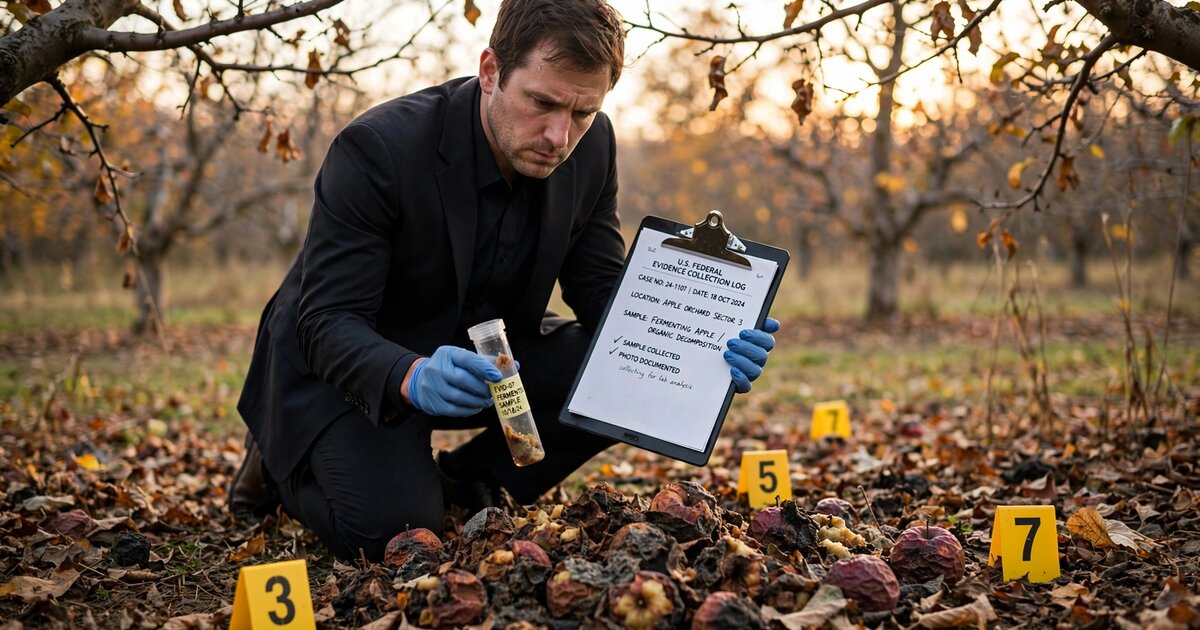
The United States Forest Service reports that total forested land in the United States—federal, state, and private—comprises approximately 766 million acres.13 These forests contain wild grape (Vitis spp.), crabapple (Malus spp.), wild plum (Prunus americana), American persimmon (Diospyros virginiana), pawpaw (Asimina triloba), serviceberry (Amelanchier spp.), wild blueberry, huckleberry, elderberry, and hundreds of other fruit-bearing species. Every autumn, their fruit falls. Every autumn, it ferments. The volume has never been measured. No agency has attempted to measure it. The TTB, which devotes considerable resources to tracking every gallon of wine produced on bonded premises across the country, has not counted a single gallon of the wine produced on 766 million acres of unbonded forest.
V. The Exemption Analysis
Congress anticipated that not all wine production would occur on bonded premises. Under 26 U.S.C. § 5042(a)(2), wine may be produced without payment of tax or bond “for personal or family use and not for sale.” The exemption permits production of up to 200 gallons per calendar year in a household containing two or more adults, or 100 gallons for a household with a single adult.14
The exemption is narrowly drawn. It requires: (1) production by “an adult member of a family”; (2) that the product be “for personal or family use”; (3) that the product not be “for sale”; and (4) that the volume not exceed 200 gallons per household per year.
Saccharomyces cerevisiae is not an adult member of a family. It is a single-celled fungus that reproduces by mitotic budding. It does not reside in a household. It does not file a federal tax return. It has not submitted TTB Form 5120.17 or any alternative documentation establishing its eligibility for the personal use exemption.15 The exemption, by its plain text, applies to persons who meet specific statutory criteria. No yeast colony in the United States has met those criteria. No yeast colony has applied to meet those criteria. No yeast colony is aware that those criteria exist.
Moreover, the volume threshold is routinely exceeded. A single mature apple tree produces approximately 800 pounds of fruit per growing season.16 At fruit densities typical of eastern deciduous forests, windfall from a modest woodland generates fermentable biomass sufficient to produce volumes of wine well in excess of the 200-gallon household limit. The yeast colonies responsible do not self-limit their production to comply with the statute. They ferment every available sugar molecule until the ethanol concentration reaches levels toxic to their own cells, typically between 12 and 18 percent by volume in pure culture—a ceiling that, it should be noted, falls entirely within the statutory definition of taxable wine. They have no compliance department. They have no department of any kind.
The result is that the personal use exemption is structurally inapplicable to the largest wine-producing population in the United States. Every gallon produced by wild yeast is produced outside the exemption. Every gallon is taxable. Every gallon is untaxed.
VI. The Historical Record
The Alcohol and Tobacco Tax and Trade Bureau was established in 2003, when the Homeland Security Act of 2002 transferred the regulatory functions of the Bureau of Alcohol, Tobacco, Firearms and Explosives to a new bureau within the Department of the Treasury.17 Its predecessor agencies had exercised jurisdiction over alcohol taxation since the Revenue Act of 1862. The federal excise tax on alcoholic beverages dates, in its earliest form, to 1791, when Treasury Secretary Alexander Hamilton proposed and Congress enacted a tax on domestically produced distilled spirits. The resulting enforcement effort—the Whiskey Rebellion of 1794—required the deployment of approximately 13,000 militiamen to suppress organized resistance in western Pennsylvania.18
Saccharomyces cerevisiae predates this entire regulatory apparatus by approximately 100 million years.
The evolutionary relationship between fruit-bearing plants and fermenting yeasts dates to the Cretaceous period. The diversification of angiosperms—the flowering plants that produce sugar-rich fruit—created the ecological niche that Saccharomyces and its relatives have occupied continuously since before the extinction of the non-avian dinosaurs. As Dudley and Maro documented in their 2021 review in Nutrients, “the association between yeasts and angiosperms dates to the Cretaceous, and dietary exposure of diverse frugivorous taxa to ethanol is similarly ancient.”19
In 2015, Matthew Carrigan and colleagues at the Foundation for Applied Molecular Evolution published a landmark study in the Proceedings of the National Academy of Sciences demonstrating that a single amino acid substitution in the ADH4 enzyme of the last common ancestor of African apes and humans, occurring approximately 10 million years ago, increased the enzyme’s capacity to metabolize ethanol by a factor of approximately 40.20 The mutation coincided with the transition from arboreal to terrestrial foraging—the moment when our ancestors began spending more time on the ground, where fallen, fermenting fruit accumulates. The implication is that wild yeast was producing ethanol in such quantities, and for so long, that it exerted measurable selective pressure on the primate lineage that would eventually produce the Congress that wrote the tax code.
The federal government has been attempting to regulate and tax alcohol production for 235 years. Wild yeast has been producing untaxed alcohol for approximately 100 million. The enforcement gap is approximately 99,999,765 years.
VII. The Enforcement Vacuum
The TTB maintains regulatory oversight of approximately 75,000 federal alcohol and tobacco permits nationwide. Its investigators enforce the excise tax provisions of the Internal Revenue Code against producers, importers, and distributors of alcoholic beverages. In fiscal year 2024, the licensed wine industry produced approximately 648 million gallons of wine and paid excise tax on every gallon removed from bond for consumption or sale.11
The TTB has not opened a single investigation into wild yeast fermentation. It has not issued a single notice of violation to a Saccharomyces colony. It has not assessed a single dollar of federal excise tax against any organism in any kingdom other than Animalia—and, within Animalia, only against the single species Homo sapiens.
This is not because the activity falls below a regulatory threshold. The statute imposes tax on “all wines.” It does not specify a minimum volume. It does not exempt production by organisms without bank accounts. The activity is ongoing, widespread, continuous, and produces the exact product—the alcoholic fermentation product of sound, ripe fruit—that the statute was written to tax.
The licensed industry paid tax on every gallon it produced. The unlicensed industry, which has been in continuous operation since the Cretaceous period, paid tax on none. Every year, the gap widens. Every autumn, another crop of fruit falls from American trees, and the organisms that have been fermenting it for 100 million years begin another production cycle that no federal agency monitors, bonds, or inspects.
VIII. Conclusion
The evidence admits of a single conclusion. Under 26 U.S.C. § 5041(a), a federal excise tax is imposed on all wines produced in the United States. Under 26 U.S.C. § 5381, natural wine is defined as the product of the juice of sound, ripe fruit. Wild Saccharomyces yeast colonies, distributed across every orchard, forest, and landfill in the country, produce exactly this product through exactly the metabolic pathway employed by every licensed winery. They produce it on unbonded premises, in volumes that exceed the personal use exemption by orders of magnitude, without filing a single federal form.
The product is wine. The location is the United States. The premises are not bonded. The tax is not paid. The exemption does not apply.
The compliance rate is zero. It has been zero for approximately 100 million years.
Ergo.
Sources
- 26 U.S.C. § 5041(a), Internal Revenue Code, Subtitle E, Chapter 51, Subchapter A, Part I, Subpart B. uscode.house.gov ↑
- 26 U.S.C. § 5041(b)(1)–(3), tax rates on still wines by alcohol content classification. uscode.house.gov ↑
- 26 U.S.C. § 5381, “Natural wine.” uscode.house.gov ↑
- 26 U.S.C. § 5351, “Bonded wine cellar.” See also TTB Form 5120.17, “Report of Bonded Wine Premises Operations.” uscode.house.gov ↑
- A. Goffeau et al., “Life with 6000 Genes,” Science, vol. 274, no. 5287, pp. 546–567, 1996. doi.org ↑
- L. Pasteur, “Mémoire sur la fermentation alcoolique,” Comptes Rendus de l’Académie des Sciences, vol. 45, pp. 1032–1036, 1857. See also J.L. Gay-Lussac, “Extrait d’un mémoire sur la fermentation,” Annales de Chimie, vol. 76, pp. 245–259, 1810. ↑
- S. Dashko et al., “Why, when, and how did yeast evolve alcoholic fermentation?” FEMS Yeast Research, vol. 14, no. 6, pp. 826–832, 2014. doi.org ↑
- R. Dudley, “Ethanol, fruit ripening, and the historical origins of human alcoholism in primate frugivory,” Integrative and Comparative Biology, vol. 44, no. 4, pp. 315–323, 2004. doi.org ↑
- C.J. Campbell et al., “Dietary ethanol ingestion by free-ranging spider monkeys (Ateles geoffroyi),” Royal Society Open Science, vol. 9, 2022. See also UC Berkeley press release, “Monkeys Often Eat Fruit Containing Alcohol, Shedding Light on Our Taste for Booze,” March 2022. vcresearch.berkeley.edu ↑
- A.L. Hoover et al., “Fruit ethanol content and dispersal ecology,” Proceedings of the Royal Society B, vol. 290, 2023. doi.org ↑
- Wine Institute, “California & US Wine Production.” Data compiled from TTB statistical reports (bw-166). wineinstitute.org ↑
- USDA Economic Research Service, “Food Availability (Per Capita) Data System — Food Loss.” Loss-Adjusted Food Availability data. Fruit supply at retail level: 64.3 billion pounds; retail-level loss: 6.0 billion pounds (9%); consumer-level loss: 12.5 billion pounds (19%). ers.usda.gov ↑
- U.S. Forest Service, “Forest Resources of the United States, 2017: A Technical Document Supporting the Forest Service 2020 RPA Assessment,” General Technical Report WO-97. Total forest land: approximately 766 million acres. fs.usda.gov ↑
- 26 U.S.C. § 5042(a)(2), “Exemptions.” Wine for personal or family use: up to 200 gallons per calendar year where there are two or more adults in the household, 100 gallons for a single adult. uscode.house.gov ↑
- TTB Form 5120.17, “Report of Bonded Wine Premises Operations.” ttb.gov ↑
- USDA National Agricultural Statistics Service, “Noncitrus Fruits and Nuts Summary.” Mature commercial apple trees produce approximately 800–1,000 pounds of fruit per season depending on variety and management. nass.usda.gov ↑
- Homeland Security Act of 2002, Pub. L. 107–296, § 1111, 116 Stat. 2135 (2002). congress.gov ↑
- W. Hogeland, The Whiskey Rebellion: George Washington, Alexander Hamilton, and the Frontier Rebels Who Challenged America’s Newfound Sovereignty (Scribner, 2006). See also Revenue Act of 1791, 1 Stat. 199. ↑
- R. Dudley and A. Maro, “Human Evolution and Dietary Ethanol,” Nutrients, vol. 13, no. 7, 2419, 2021. doi.org ↑
- M.A. Carrigan et al., “Hominids adapted to metabolize ethanol long before human-directed fermentation,” Proceedings of the National Academy of Sciences, vol. 112, no. 2, pp. 458–463, 2015. doi.org ↑