I. The Statutory Framework
The Federal Water Pollution Control Act Amendments of 1972, known as the Clean Water Act, established the comprehensive federal regulatory framework for the discharge of pollutants into the waters of the United States. Its stated objective, codified at 33 U.S.C. § 1251(a), is “to restore and maintain the chemical, physical, and biological integrity of the Nation’s waters.” Section 301(a), codified at 33 U.S.C. § 1311(a), provides the operative prohibition: “Except as in compliance with this section and sections 1312, 1316, 1317, 1328, 1342, and 1344 of this title, the discharge of any pollutant by any person shall be unlawful.”1
The Act achieves its regulatory purpose through a system of defined terms that interlock with mechanical precision. Section 502(12), codified at 33 U.S.C. § 1362(12), defines “discharge of a pollutant” as “any addition of any pollutant to navigable waters from any point source.” Section 502(14), at 33 U.S.C. § 1362(14), defines “point source” as “any discernible, confined and discrete conveyance, including but not limited to any pipe, ditch, channel, tunnel, conduit, well, discrete fissure, container, rolling stock, concentrated animal feeding operation, or vessel or other floating craft, from which pollutants are or may be discharged.” Section 502(6), at 33 U.S.C. § 1362(6), defines “pollutant” to include “solid waste” and “chemical wastes discharged into water.”2
The statute does not specify a minimum particle size for solid waste. It does not require that the waste be visible to the naked eye. It does not exempt waste that is small enough to pass through a mesh screen, or waste that is generated in a residential setting, or waste that the person discharging it did not know was present in the effluent stream. It defines the term, states the prohibition, and moves on.
A synthetic microfiber is a solid. It is composed of a polymer—polyethylene terephthalate, polyamide, acrylic, or polypropylene—manufactured from petrochemical feedstock. When it detaches from a textile during washing and enters the wastewater stream, it is waste. It is solid waste discharged into water. The statute has a word for that.
II. The Effluent Characterization
In 2016, Imogen Napper and Richard Thompson of the University of Plymouth published a study in Marine Pollution Bulletin that remains the foundational quantitative measurement of microfiber release from domestic washing machines. The researchers washed polyester, polyester-cotton blend, and acrylic fabrics in a standard domestic washing machine at temperatures of 30°C and 40°C, using various combinations of detergent and fabric conditioner. They extracted fibers from the waste effluent, examined them under an electron microscope, and counted them.3
The results were as follows. A single six-kilogram wash load of acrylic fabric released an estimated 728,789 fibers. A wash load of polyester released 496,030 fibers. A wash load of polyester-cotton blend released 137,951 fibers. The fibers ranged in diameter from 11.9 to 17.7 micrometers and in length from 5.0 to 7.8 millimeters. For scale, a human hair is approximately 70 micrometers in diameter. These fibers are thinner than a human hair by a factor of four to six. They are invisible individually. They are not invisible collectively.4
Subsequent research has confirmed and extended these findings. A coalition of over forty environmental organizations and twenty-eight scientists, in a letter supporting California Assembly Bill 1628, cited studies estimating that a single wash load can release up to 18 million microfibers, depending on fabric type, wash temperature, mechanical action, and garment age. Ocean Conservancy’s Associate Director of Plastics Research, Dr. Britta Baechler, testified before the California Assembly that if microfiber filters were installed in every household washing machine in the city of Los Angeles alone, it would prevent up to 468 trillion microfibers from entering wastewater every year—“the weight of over 5.5 million t-shirts.”5
The fibers are not the only pollutant in the effluent. Washing machine wastewater contains surfactants, optical brighteners, synthetic fragrances, phosphates, nonylphenol ethoxylates, and residual dye chemicals. But the fibers are the pollutant that distinguishes a washing machine from a sink. A sink discharges dissolved chemicals. A washing machine discharges dissolved chemicals and hundreds of thousands of solid polymer particles per cycle. It manufactures a new pollutant with every load.
III. The Industrial Laundry Precedent
The EPA is not unaware that laundry wastewater contains pollutants. In 1997, the agency published a proposed rule in the Federal Register establishing pretreatment standards for the industrial laundry subcategory under the Clean Water Act. The proposed rule, at 62 FR 66672, defined an “industrial laundry facility” as “any facility that launders industrial textile items from off-site as a business activity,” including “shop towels, printer towels/rags, furniture towels, rags, mops, mats, rugs, tool covers, fender covers, dust-control items, gloves, buffing pads, absorbents, uniforms, filters, and clean room garments.”6
The agency spent eight years developing the proposal. It conducted an extensive analysis of the industry. It sampled wastewater. It identified pollutants of concern. It estimated compliance costs at $136.4 million annually. The Government Accountability Office reviewed the methodology and found it reflected “an extensive analysis of the additional costs laundries would incur to comply with the rule.” The agency determined that industrial laundry wastewater required federal pretreatment standards because it contained pollutants that publicly owned treatment works were not designed to remove.7
The agency made this determination about facilities that wash shop towels. It has made no comparable determination about the approximately 110 million facilities that wash synthetic fleece jackets, polyester athletic wear, nylon stockings, and acrylic sweaters—the textiles that peer-reviewed research has documented as the primary source of microplastic fiber pollution in the aquatic environment.
The industrial laundry proposed rule was eventually withdrawn. The EPA could not finalize pretreatment standards for an industry that washes rags. It has not attempted to regulate the industry that washes everything else.
IV. The Point Source Analysis
The Clean Water Act regulates the discharge of pollutants through two mechanisms. Direct dischargers—facilities that discharge directly to navigable waters—must obtain a National Pollutant Discharge Elimination System permit under Section 402. Indirect dischargers—facilities that discharge to publicly owned treatment works—must comply with pretreatment standards under Section 307(b) and the General Pretreatment Regulations at 40 CFR Part 403.8
A household washing machine is an indirect discharger. Its drain hose connects to a standpipe or laundry sink, which connects to the sanitary sewer, which conveys wastewater to a publicly owned treatment works. The treatment works holds an NPDES permit. The washing machine does not.
The absence of a direct discharge to navigable waters does not place the washing machine outside the statute. The General Pretreatment Regulations exist precisely because Congress understood that pollutants discharged to a sewer can pass through a treatment plant and enter navigable waters. Section 307(b) of the Clean Water Act directs the EPA to establish pretreatment standards for pollutants that “are not susceptible to treatment by such treatment works or which would interfere with the operation of such treatment works.”9
Synthetic microfibers are not susceptible to treatment by publicly owned treatment works. The peer-reviewed literature is unambiguous on this point. A critical review published in Environmental Science: Water Research & Technology in 2020 examined microplastic removal rates across twenty-one wastewater treatment plants worldwide. Secondary treatment facilities removed an average of 88 percent of microplastics. Tertiary treatment facilities removed an average of 94 percent. These numbers appear reassuring until they are multiplied by the volume involved.10
A treatment plant that removes 88 percent of microplastics from its influent allows 12 percent to pass through to its effluent—the effluent that is discharged, under an NPDES permit, into a river, a lake, an estuary, or a coastal water of the United States. If each of the nation’s approximately 110 million household washing machines performs 300 wash loads per year at an average fiber release of 700,000 fibers per load, the annual discharge to publicly owned treatment works is approximately 23 quadrillion fibers. Twelve percent of 23 quadrillion is 2.76 trillion fibers per year entering navigable waters through NPDES-permitted outfalls. The treatment plant is not the solution. The treatment plant is the point source.
And the fibers that the treatment plant does capture are not destroyed. They are concentrated in sewage sludge. A study published in Environmental Pollution in 2022 estimated that the practice of spreading sewage sludge on agricultural land introduces between 31,000 and 42,000 tonnes of microplastics to European soils annually. The fibers the treatment plant removes from the water column are deposited onto farmland, where they enter terrestrial ecosystems and, through runoff, return to the aquatic environment the Clean Water Act was enacted to protect.11
V. The Downstream Evidence
The consequences of this unregulated discharge are no longer theoretical. In March 2022, researchers at Vrije Universiteit Amsterdam published a study in Environment International that detected and quantified microplastic particles in human blood for the first time. The study examined blood samples from twenty-two healthy adult volunteers and found microplastics in seventeen of them—77 percent. Polyethylene terephthalate, the polymer used in polyester textiles, was the most common plastic detected, present in approximately 50 percent of the samples. Dick Vethaak, the study’s lead ecotoxicologist, stated: “This is proof that we have plastics in our body—and we shouldn’t.”12
In July 2026, a study published in the European Heart Journal reported that micro- and nanoplastics were detected in the blood of 84 percent of patients who had survived a serious heart attack, compared with 40 percent of patients with chronic ischemic heart disease and 32 percent of patients with normal coronary arteries. The most common polymer was polyethylene. Professor Emanuele Barbato of Sapienza University of Rome stated that the findings “reveal a strong association between environmental exposures, microplastics in the blood, and cardiovascular disease.” An accompanying editorial noted that microplastics “are now detected in virtually all environmental compartments, including air, water, and soil” and “are also found within the human body, including blood, lung tissue, placenta, and breast milk, indicating systemic exposure.”13
Polyester fibers—the specific polymer that a washing machine sheds into wastewater by the hundreds of thousands per cycle—are appearing in human blood, in cardiac tissue, in placental tissue, and in breast milk. The pathway from the drain hose to the bloodstream passes through a treatment plant that captures most of the fibers and deposits them on agricultural soil, where they enter the food chain, and allows the remainder to enter surface waters, where they enter the drinking water supply. The Clean Water Act was enacted to interrupt pathways like this one. It has not been applied.
VI. The Exemption Is a Confession
The most instructive evidence that household washing machines discharge a pollutant comes not from the federal government but from the governments that have acted on the premise.
In 2023, California Assembly Member Tina McKinnor introduced Assembly Bill 1628, which requires all new washing machines sold for residential use in the state of California on or after January 1, 2029, to contain a built-in microfiber filtration system. The bill’s legislative findings state that “washing clothes is one of the primary pathways by which these microfibers are generated and enter the environment” and that “a single load of laundry can release up to 18 million microfibers.” The bill cites research showing that “full adoption of filters across washing machines in California decreased annual synthetic microfiber emissions to natural environments by almost 80 percent.”14
France enacted a similar law, requiring all new clothes washers sold in the country to be equipped with built-in microfiber filters by 2025, as part of the Anti-Waste for a Circular Economy Act. The California bill itself cites the French law as precedent. Illinois House Bill 1370 imposed similar requirements for residential and state-use washing machines effective January 2030, amended in 2025 to cover residential machines only.15
Ocean Conservancy drafted model federal legislation—the “Filtration in Laundry to Eliminate and Reduce Microplastic Fibers Act,” or FILTER Act—as a template for state adoption. The model bill includes certification requirements for manufacturers, enforcement provisions with civil penalties of up to $10,000 for a first violation and $30,000 for subsequent violations, and compliance timelines. The organization published the model legislation in November 2025.16
Each of these laws was enacted because the enacting legislature concluded that washing machines discharge a pollutant into the water supply and that a filter is necessary to reduce the discharge. You do not mandate a filter for a clean effluent stream. You do not appropriate enforcement resources and impose civil penalties to address a discharge that contains no pollutant. The filter mandate is a regulatory confession. The legislatures that enacted these laws understood what the EPA has not acknowledged: the drain hose on the back of a washing machine is a conveyance from which pollutants are discharged within the meaning of 33 U.S.C. § 1362(14).
VII. The Scale of the Noncompliance
The American Housing Survey, conducted biennially by the U.S. Census Bureau and the Department of Housing and Urban Development, reports that approximately 85 percent of occupied housing units in the United States contain a washing machine. The Census Bureau reports approximately 131.2 million occupied housing units as of 2023. Eighty-five percent of 131.2 million is approximately 111.5 million households with washing machines.17
The American Cleaning Institute estimates that the average American household performs approximately 300 loads of laundry per year. At 300 loads per year across 111.5 million households, the United States performs approximately 33.5 billion wash loads annually.18
At the University of Plymouth’s measured release rate of 728,789 fibers per load for acrylic fabric, the upper-bound annual discharge is approximately 24.4 quadrillion synthetic microfibers. At the lower measured rate of 137,951 fibers per load for polyester-cotton blend, it is approximately 4.6 quadrillion. These numbers are large enough to lose their meaning, so we will provide a comparison. The EPA’s Toxics Release Inventory, which tracks industrial releases of hazardous chemicals to air, water, and land, reported total on-site releases to surface water of approximately 197 million pounds in 2023 across all reporting industries combined. The estimated mass of microfiber discharge from residential washing machines—calculated from Ocean Conservancy’s estimate that Los Angeles alone generates a mass equivalent to 5.5 million t-shirts annually—is measured in the tens of millions of pounds nationally.19
The industrial facilities that report to the Toxics Release Inventory hold NPDES permits. They submit Discharge Monitoring Reports. They are subject to compliance inspections. They face enforcement actions for exceedances. The 111.5 million residential washing machines hold no permits, submit no reports, are subject to no inspections, and face no enforcement actions. They discharge a pollutant that is now found in human blood, and the regulatory apparatus of the Clean Water Act treats them as though they do not exist.
VIII. The Regulatory Asymmetry
Consider the regulatory treatment of two laundry facilities operating simultaneously in the same American city.
On the east side of town, an industrial laundry washes shop towels, uniforms, and mats for commercial clients. This facility is an “industrial user” within the meaning of 40 CFR Part 403. It must comply with the General Pretreatment Regulations. It must submit a permit application to the local control authority. It must conduct baseline monitoring and submit Baseline Monitoring Reports. It must install and operate pretreatment technology. It must submit periodic compliance reports. It must allow inspections. It must maintain records. If the EPA finalizes categorical pretreatment standards for industrial laundries, this facility must meet technology-based effluent limitations for specific pollutants. The facility washes items that are primarily cotton and cotton-polyester blend. Its microfiber discharge per load is at the lower end of the measured range.
On the west side of town, in a subdivision of three hundred homes, three hundred households operate three hundred residential washing machines. Each machine washes synthetic athletic wear, fleece jackets, microfiber cleaning cloths, nylon blouses, and acrylic sweaters—the textiles that shed the most fibers. Each machine performs approximately 300 loads per year. Each load discharges between 137,951 and 728,789 synthetic microfibers into the sanitary sewer. The three hundred machines collectively perform 90,000 loads per year and discharge between 12.4 billion and 65.6 billion synthetic microfibers into the same publicly owned treatment works that receives the industrial laundry’s wastewater. None of the three hundred machines is subject to any pretreatment standard. None has submitted a permit application. None has conducted baseline monitoring. None has installed any treatment technology. None has been inspected.20
The industrial laundry and the residential machines discharge the same category of pollutant—solid synthetic polymer waste suspended in wastewater—to the same publicly owned treatment works. The residential machines discharge a greater aggregate quantity of the pollutant. The residential machines discharge the pollutant in a form (microscopic fibers from synthetic consumer textiles) that peer-reviewed research has specifically identified as the dominant source of microplastic contamination in wastewater influent. The regulatory burden falls entirely on the facility that contributes less of the pollutant. The facility that contributes more is not regulated at all.
IX. The Pipe on the Back of the Machine
Section 502(14) of the Clean Water Act defines “point source” as “any discernible, confined and discrete conveyance, including but not limited to any pipe… from which pollutants are or may be discharged.” The statute lists “pipe” first among its examples.21
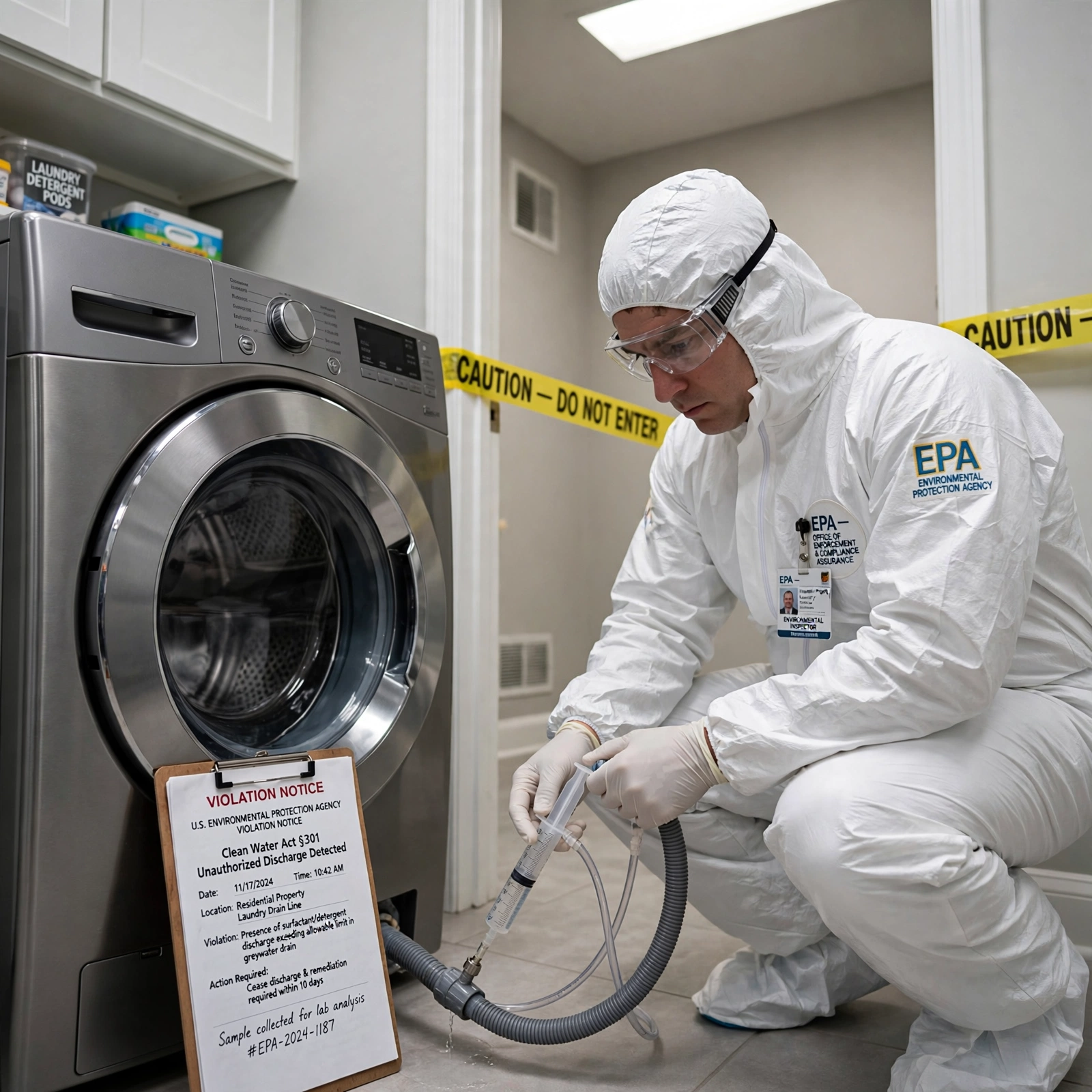
A household washing machine discharges its effluent through a corrugated rubber or plastic drain hose. The hose is a pipe. It is discernible: you can see it. It is confined: it has walls. It is discrete: it has a defined terminus where it enters the standpipe or laundry sink. Pollutants are discharged from it: 728,789 synthetic microfibers per load of acrylic fabric, as measured and documented in the peer-reviewed literature.
The pipe connects to a standpipe, which connects to a branch drain, which connects to a building sewer, which connects to the main sewer, which conveys the wastewater to a publicly owned treatment works. The treatment works processes the wastewater and discharges the treated effluent through its own outfall—a pipe—into a navigable water of the United States, pursuant to an NPDES permit. The permit authorizes the discharge of treated effluent. It does not specifically authorize the discharge of synthetic polymer fibers that the treatment process failed to remove, because the permit was written before anyone measured what comes out of a washing machine.
The regulatory framework of the Clean Water Act traces pollutants from pipe to pipe to pipe. The washing machine’s drain hose is the first pipe in the chain. The treatment plant’s outfall is the last. Between them, 12 percent of the fibers survive. The statute prohibits the discharge of any pollutant by any person. It does not contain a de minimis exception for pollutants that are very small. It does not contain a residential exception for pollutants generated in a home. It contains a prohibition and a system of permits designed to make the prohibition administrable. The permits have not been administered to the source.
X. Conclusion
The evidence presented in these pages requires no interpretive leap. Section 502(6) of the Clean Water Act defines “pollutant” to include solid waste discharged into water. A synthetic microfiber is a solid waste. Section 502(14) defines “point source” to include any pipe from which pollutants are or may be discharged. A washing machine drain hose is a pipe. Section 301(a) declares that the discharge of any pollutant by any person shall be unlawful except in compliance with the Act’s permit and standard provisions. No household washing machine in the United States operates under any such provision.
The University of Plymouth measured 728,789 fibers per load. Vrije Universiteit Amsterdam found those fibers in human blood. The European Heart Journal found them in cardiac tissue. The EPA found them in the wastewater of every treatment plant it has studied. California found them in its waterways and enacted a law. France found them in its waterways and enacted a law. Illinois found them in its waterways and enacted a law.
The EPA found them in the wastewater of industrial laundries and spent eight years developing pretreatment standards. It withdrew the proposal. It has not proposed any standard—categorical, pretreatment, effluent limitation, or otherwise—for the 111.5 million residential machines that discharge the same pollutant in greater aggregate quantity from every laundry room in every subdivision in every state served by a publicly owned treatment works that discharges treated effluent containing the remnant fibers into a navigable water of the United States.
The Clean Water Act was enacted to restore and maintain the chemical, physical, and biological integrity of the nation’s waters. Synthetic microfibers are altering the physical integrity of every water body into which treated wastewater is discharged. They are altering the biological integrity of the organisms that ingest them. They are now altering the physical composition of human blood.
The statute’s prohibition is unqualified. The discharge is continuous. The pollutant is documented. The conveyance is a pipe.
The EPA regulates the pipe that comes out of a factory. It regulates the pipe that comes out of a treatment plant. It does not regulate the pipe that comes out of the back of a Whirlpool.
Ergo.
Sources
- 33 U.S.C. § 1311(a): “Except as in compliance with this section and sections 1312, 1316, 1317, 1328, 1342, and 1344 of this title, the discharge of any pollutant by any person shall be unlawful.” law.cornell.edu ↑
- 33 U.S.C. § 1362(6), (12), (14). Full text of Section 502 General Definitions. epa.gov ↑
- I.E. Napper and R.C. Thompson, “Release of Synthetic Microplastic Plastic Fibres from Domestic Washing Machines: Effects of Fabric Type and Washing Conditions,” Marine Pollution Bulletin, vol. 112, nos. 1–2, 2016, pp. 39–45. DOI: 10.1016/j.marpolbul.2016.09.025. pubmed.ncbi.nlm.nih.gov ↑
- Ibid. Average fibre size ranged between 11.9 and 17.7 μm in diameter, and 5.0 and 7.8 mm in length. Acrylic: 728,789 fibers; polyester: 496,030; polyester-cotton blend: 137,951. ↑
- Ocean Conservancy, testimony of Dr. Britta Baechler before the California Assembly Committee on Environmental Safety and Toxic Materials, March 28, 2023. Letter from 40+ environmental groups and 28 scientists supporting AB 1628. oceanconservancy.org ↑
- 62 FR 66672 (December 17, 1997), proposed rule: “Effluent Limitations Guidelines, Pretreatment Standards, and New Source Performance Standards for the Industrial Laundries Point Source Category.” govinfo.gov ↑
- Government Accountability Office, “Water Pollution: Proposed Pretreatment Standards for Industrial Laundries.” GAO reviewed EPA’s compliance cost methodology ($136.4 million annually) and found it “reflects an extensive analysis.” ↑
- 33 U.S.C. § 1342 (NPDES permit program for direct dischargers); 33 U.S.C. § 1317(b) (pretreatment standards for indirect dischargers); 40 CFR Part 403 (General Pretreatment Regulations). law.cornell.edu ↑
- 33 U.S.C. § 1317(b)(1): The Administrator shall establish pretreatment standards for pollutants “which are not susceptible to treatment by such treatment works or which would interfere with the operation of such treatment works.” law.cornell.edu ↑
- S. Solís et al., “Microplastics Removal in Wastewater Treatment Plants: A Critical Review,” Environmental Science: Water Research & Technology, vol. 6, 2020, pp. 2758–2774. Secondary WWTPs removed an average of 88% of microplastics; tertiary WWTPs removed 94%. Majority of removed microplastics are in sewage sludge. pubs.rsc.org ↑
- M. Sherlock et al., “Microplastics Removal from a Primary Settler Tank in a Wastewater Treatment Plant and Estimations of Contamination onto European Agricultural Land via Sewage Sludge Recycling,” Environmental Pollution, vol. 304, 2022, 119198. Estimated 31,000–42,000 tonnes of microplastics deposited on European soils annually via sludge. pubmed.ncbi.nlm.nih.gov ↑
- H.A. Leslie et al., “Discovery and Quantification of Plastic Particle Pollution in Human Blood,” Environment International, vol. 163, 2022, 107199. Microplastics detected in 17 of 22 healthy volunteers (77%). PET found in ~50% of samples. phys.org ↑
- E. Barbato et al., study published in European Heart Journal, July 2026. Micro- and nanoplastics detected in 84% of STEMI patients. Polyethylene most common polymer. Editorial: microplastics “now detected in virtually all environmental compartments… including blood, lung tissue, placenta, and breast milk.” reuters.com ↑
- California AB 1628 (McKinnor, 2023). Legislative findings: “washing clothes is one of the primary pathways,” “a single load of laundry can release up to 18 million microfibers,” “full adoption of filters… decreased annual synthetic microfiber emissions to natural environments by almost 80 percent.” legiscan.com ↑
- France, Anti-Waste for a Circular Economy Act (AGEC), Art. 79, requiring built-in microfiber filters on new washing machines by 2025. Illinois HB 1370, amended April 2025 to cover residential machines only, effective January 2030. AB 1628 legislative findings cite France as precedent. laundryassociation.org ↑
- Ocean Conservancy, “Filtration in Laundry to Eliminate and Reduce Microplastic Fibers Act” (FILTER Act), model legislation published November 2025. Civil penalties up to $10,000 first violation, $30,000 subsequent. oceanconservancy.org ↑
- U.S. Census Bureau, 2023 American Housing Survey. Approximately 131.2 million occupied housing units; washing machine ownership approximately 85 percent. HUD and Census Bureau joint release, September 25, 2024. archives.hud.gov ↑
- American Cleaning Institute, laundry usage statistics. Average American household performs approximately 300 loads of laundry per year. ↑
- U.S. EPA, Toxics Release Inventory (TRI) Program, 2023 National Analysis. Ocean Conservancy estimates that Los Angeles alone generates a mass of microfiber discharge equivalent to over 5.5 million t-shirts annually. ↑
- Fiber release rates per load: Napper and Thompson (2016), 137,951 (polyester-cotton) to 728,789 (acrylic) fibers per 6 kg wash. Three hundred machines × 300 loads/year = 90,000 loads. At midpoint release (433,370 fibers/load): 39 billion fibers annually from a single subdivision. ↑
- 33 U.S.C. § 1362(14): “The term ‘point source’ means any discernible, confined and discrete conveyance, including but not limited to any pipe, ditch, channel, tunnel, conduit, well, discrete fissure, container, rolling stock, concentrated animal feeding operation, or vessel or other floating craft, from which pollutants are or may be discharged.” law.cornell.edu ↑