I. The Statutory Framework
The Clean Air Act of 1970, as amended in 1977 and 1990, is codified principally at 42 U.S.C. §§ 7401–7671q. It is the most comprehensive air quality statute in the world. Its stated purpose, per Section 101(b)(1), is “to protect and enhance the quality of the Nation’s air resources so as to promote the public health and welfare and the productive capacity of its population.”1
Section 302(z) of the Act defines “stationary source” as “generally any source of an air pollutant except those emissions resulting from an onboard engine used to propel a motor vehicle or a nonroad engine or a nonroad vehicle.” The implementing regulations at 40 C.F.R. § 70.2 refine this: a “major source” is “any stationary source… that directly emits, or has the potential to emit, one hundred (100) tons per year or more of any air pollutant.”2
Title V of the 1990 Clean Air Act Amendments, codified at 42 U.S.C. §§ 7661–7661f, requires every major source to obtain an operating permit. The permit must contain enforceable emission limitations and standards, compliance schedules, and monitoring requirements. The statutory penalty for operating without a required permit is up to $47,357 per day of violation, as adjusted for inflation under the Federal Civil Penalties Inflation Adjustment Act.3
The statute does not define “facility.” The statute does not define “installation.” The legislative history reflects an intent to cast a broad net. The D.C. Circuit, in Alabama Power Co. v. Costle (1979), observed that the Act’s definitions were drafted to be “expansive” and to “reach every identifiable source of air pollution.”4 Whether the drafters contemplated magma chambers is not addressed in the legislative record. The language they chose does not require that they did.
II. The Emissions Profile
The United States Geological Survey operates five volcano observatories and monitors 170 potentially active volcanoes across the United States and its territories. Of these, the USGS classifies 54 as posing a “high” or “very high” threat to nearby communities.5
Kīlauea, on the island of Hawai’i, is the most prolific emitter and among the best-monitored volcanoes on Earth. According to the Hawaiian Volcano Observatory, Kīlauea’s summit and rift zones emit between 500 and 14,000 metric tons of sulfur dioxide per day during typical eruptive activity. During the 2018 lower East Rift Zone eruption, emission rates exceeded 200,000 metric tons of SO₂ per day, with a cumulative release of 7.1 to 13.6 megatons of sulfur dioxide over the May–September period alone.6
To contextualize this figure: the Title V threshold for a “major source” is 100 tons per year. Kīlauea, on an average day, emits between five and one hundred forty times the annual threshold. During the 2018 eruption, it exceeded the annual threshold every four minutes and twenty seconds.
But Kīlauea is not operating alone. Mount St. Helens, in Washington State, released approximately 1,500 tons of SO₂ per day during its 1980 eruption sequence. The Alaskan volcanoes are especially prolific: Augustine, Redoubt, Spurr, and the Cleveland and Pavlof volcanoes have each produced significant emissions in the past two decades. A USGS compilation of gas emission data from Cook Inlet and Alaska Peninsula volcanoes documented sustained SO₂ output from more than a dozen Alaskan vents between 1995 and 2006.7
Globally, NASA’s Aura satellite measured total volcanic SO₂ emissions at 20 to 25 million tons per year.8 The American share is considerable. The regulatory liability is proportional.
III. The Title V Problem
Under 42 U.S.C. § 7661a(a), it is unlawful for any major source to operate without a Title V permit “after the effective date of any permit program approved or promulgated under this subchapter.” The effective date for most states was November 15, 1993. Hawai’i’s program was approved by the EPA on November 30, 2001. Alaska’s was approved on September 2, 2003.9
Kīlauea has been erupting nearly continuously since January 3, 1983. Its emissions during this period have dwarfed those of every permitted industrial facility in the state of Hawai’i combined. The Hawai’i Department of Health, Clean Air Branch, maintains a list of Title V permitted facilities in the state. The list includes power plants, refineries, and quarries. It does not include a single volcano.10
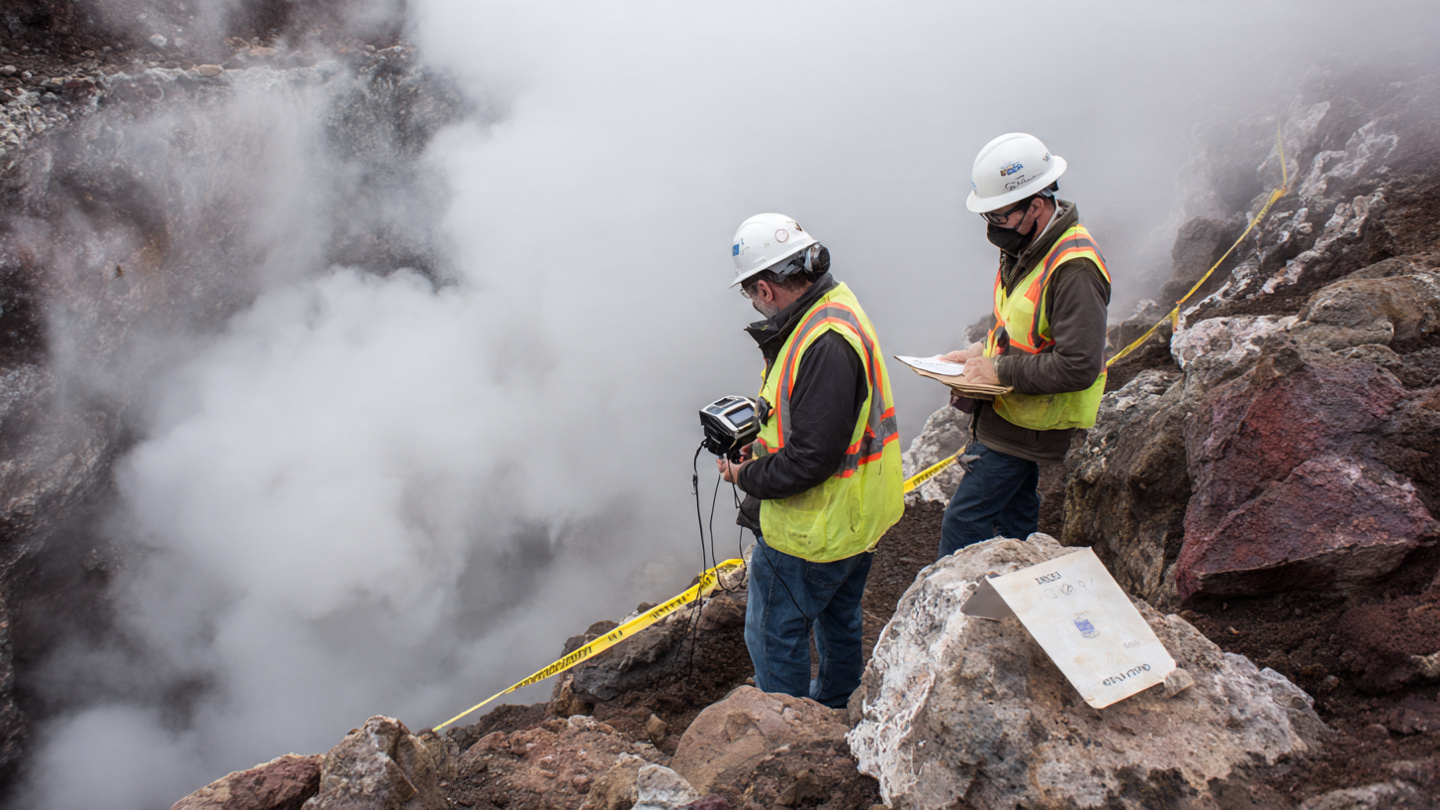
The permit application form itself presents practical difficulties. EPA Form 7520-1 requires identification of the “owner or operator” of the facility. For federally managed volcanoes within the National Park system—Kīlauea lies within Hawai’i Volcanoes National Park—the owner is the United States Department of the Interior, through the National Park Service. The operator is, by any functional definition, a body of silicate magma approximately 1,200 degrees Celsius in temperature, located between one and five kilometers below the surface, with no mailing address and no designated responsible official.11
The permit further requires a “compliance plan” detailing how the source will achieve and maintain compliance with applicable emission limitations. The applicable emission limitation for sulfur dioxide under the primary National Ambient Air Quality Standard is 75 parts per billion for a one-hour average.12 Kīlauea routinely produces ambient SO₂ concentrations exceeding 728 micrograms per cubic meter—approximately 278 ppb—in downwind communities.13 A compliance plan capable of reducing these emissions would require either the installation of scrubbers on a volcanic vent or the cessation of plate tectonics. Neither option appears in the EPA’s Reasonably Available Control Technology guidance documents.
IV. The Criteria Pollutant Analysis
The Clean Air Act designates six “criteria pollutants” for which the EPA must establish National Ambient Air Quality Standards: sulfur dioxide, particulate matter (PM₂.₅ and PM₁₀), nitrogen dioxide, carbon monoxide, ozone, and lead. Volcanoes emit five of the six.14
Sulfur dioxide has been addressed. Particulate matter is equally damning. Volcanic eruptions produce enormous quantities of fine particulate matter, classified as PM₂.₅ (particles with an aerodynamic diameter of 2.5 micrometers or less). The EPA’s revised primary NAAQS for PM₂.₅, finalized in February 2024, sets the annual mean standard at 9.0 µg/m³.15 A Frontiers in Earth Science study of air quality around Kīlauea during the 2018 eruption documented PM₂.₅ concentrations reaching 59 µg/m³ in Kona—more than six times the annual standard—from volcanic emissions alone.13
Carbon dioxide, while not a criteria pollutant, became a regulated pollutant under the Clean Air Act following the Supreme Court’s decision in Massachusetts v. EPA (2007), which held that greenhouse gases are “air pollutants” within the Act’s definition.16 A 2019 USGS study quantified global volcanic CO₂ emissions at 51.3 teragrams per year from non-eruptive degassing alone, with an additional 1.8 teragrams from eruptive activity.17 The New Source Performance Standards for power plants cap CO₂ emissions at approximately 1,000 pounds per megawatt-hour. Volcanoes produce no megawatt-hours and considerable carbon dioxide. Their emission rate per unit of useful energy output is, mathematically, infinite.
Lead is present in volcanic plumes. Mercury is present. Arsenic, cadmium, and selenium have been detected. A USGS study of Kīlauea’s 2018 plume identified volatile metals in concentrations sufficient to raise concerns about environmental and human health.18 Each of these substances appears on the EPA’s list of 189 Hazardous Air Pollutants under Section 112 of the Clean Air Act. A source that emits 10 or more tons per year of any single HAP, or 25 tons per year of any combination of HAPs, is a “major source” subject to Maximum Achievable Control Technology standards. Kīlauea has not installed MACT. Kīlauea has not been asked to install MACT.
V. The Pinatubo Precedent
On June 15, 1991, Mount Pinatubo in the Philippines ejected approximately five cubic kilometers of dacitic magma in a single eruption, producing an ash column that reached 40 kilometers into the stratosphere. NASA estimated that the eruption injected 17 megatons of sulfur dioxide into the stratosphere, resulting in a global mean temperature decrease of approximately 0.5 to 0.6°C over the following two years.19
To be clear: a single volcanic eruption demonstrably altered the climate of the entire planet. The regulatory framework that governs a 50-megawatt coal plant’s sulfur scrubber installation schedule has no mechanism for addressing this. The EPA’s Endangerment Finding of 2009, which determined that greenhouse gas emissions “threaten the public health and welfare of current and future generations,” was issued under the same Clean Air Act that has never been applied to the geological features responsible for a measurable fraction of those emissions.20
The USGS documented that Mount Pinatubo’s SO₂ release in a single event exceeded the combined annual emissions of every industrial facility in the United States. The 1990 Clean Air Act Amendments were signed into law on November 15, 1990. The Pinatubo eruption occurred 213 days later. The statute was seven months old when the planet’s largest air polluter rendered its emission reduction targets temporarily academic.
While Pinatubo is not on American soil, the principle scales. The 1912 eruption of Novarupta in Katmai, Alaska, was the largest volcanic eruption of the twentieth century. It ejected approximately 13 cubic kilometers of tephra and produced an ash cloud that lowered temperatures across the Northern Hemisphere. It occurred 58 years before the Clean Air Act was enacted. No retroactive enforcement action has been contemplated.21
VI. The Vog Problem
The Hawaiian word “vog”—volcanic fog—refers to the haze created when volcanic sulfur dioxide reacts with oxygen, moisture, and sunlight to produce sulfate aerosols and sulfuric acid droplets. Vog is, in regulatory terms, secondary particulate matter: a criteria pollutant formed from the atmospheric transformation of another criteria pollutant. The EPA regulates both.22
The Hawai’i Department of Health has documented that vog from Kīlauea regularly causes air quality on the Big Island, Maui, and O’ahu to exceed the EPA’s Air Quality Index thresholds for “Unhealthy for Sensitive Groups” and, during peak emissions, “Unhealthy” or “Very Unhealthy.” The 2018 eruption produced AQI readings above 300—classified as “Hazardous”—in communities on the island’s south and west coasts.23
Under 42 U.S.C. § 7509, the EPA is authorized to impose sanctions on states that fail to attain the NAAQS, including the withholding of federal highway funds and the imposition of 2-to-1 emission offset requirements for new industrial sources. Hawai’i has periodically been in nonattainment for SO₂ in areas downwind of Kīlauea. The cause of the nonattainment is not a refinery or a power plant. The cause is the lithosphere.
The EPA has addressed this, after a fashion. In 2012, the agency granted Hawai’i an “exceptional event” demonstration under 40 C.F.R. §§ 50.14 and 51.930, allowing the state to exclude Kīlauea-influenced SO₂ data from its NAAQS compliance determinations.24 This is the regulatory equivalent of a teacher grading a student’s exam after removing all the questions the student got wrong. The pollution exists. The health impacts are documented. The regulatory apparatus has chosen to stop counting.
VII. The Enforcement Calculation
The arithmetic is regrettable but unavoidable.
There are 170 potentially active volcanoes in the United States.5 Of these, at least 54 pose a high or very high threat, meaning they have significant potential for future eruptions in areas with exposed populations and infrastructure. Each qualifies as a major source under the Clean Air Act on the day it first emits 100 tons of any regulated pollutant—which, for many, is every day.
The statutory maximum civil penalty under the Clean Air Act is $47,357 per day per violation, as of the most recent inflation adjustment.3 A single volcano emitting SO₂ without a Title V permit commits at least one violation per day. Kīlauea, which simultaneously violates emission standards for SO₂, PM₂.₅, and multiple Hazardous Air Pollutants, commits multiple concurrent violations. The 2018 eruption, which lasted approximately 120 days at peak emission rates, represents, at a minimum, $5,682,840 in daily penalties, or roughly $681.9 million for the eruption alone.
But Kīlauea has been erupting nearly continuously since January 3, 1983. As of the date of this publication, that is 15,831 days of unpermitted emissions. At $47,357 per day for the base Title V violation alone—setting aside the concurrent criteria pollutant violations, the HAP violations, and the New Source Review violations—the accumulated penalty for Kīlauea is approximately $749.7 million. When concurrent violations are accounted for, the figure exceeds $3 billion.
Extend the analysis to all 170 active volcanoes, apply the major source threshold to each that has emitted above 100 tons in a given year since the 1990 Amendments took effect, and the aggregate penalty liability of the American volcanic system exceeds the discretionary budget of the federal government.
The EPA’s enforcement budget for fiscal year 2025 was approximately $755 million.25 Collecting the penalties owed by Kīlauea alone would consume the agency’s entire enforcement apparatus for four years. Collecting from all 170 volcanoes would require an agency several orders of magnitude larger than the one that exists. Congress has not appropriated funds for this purpose. Congress has not been asked.
VIII. Conclusion
The Clean Air Act defines a stationary source as any building, structure, facility, or installation which emits or may emit any air pollutant. A volcano is a structure. It is stationary. It emits air pollutants—sulfur dioxide, particulate matter, carbon dioxide, hydrogen sulfide, hydrogen fluoride, mercury, arsenic, cadmium, and lead, among others—in quantities that exceed the major source threshold by factors of ten to ten thousand. The statute requires every major source to obtain a Title V operating permit. The statute provides for civil penalties exceeding $47,000 per day for failure to do so. The United States contains 170 active volcanoes. None hold permits. The violation is ongoing. The violation has been ongoing, in the case of Kīlauea, for over forty-three years.
The EPA’s response has not been enforcement. It has been reclassification. The “exceptional event” rule allows the agency to remove volcanic pollution from compliance data, as though the sulfur dioxide had never entered the atmosphere. The lungs of Hawai’i residents, which do not benefit from exceptional event demonstrations, continue to process it regardless. The NAAQS violations vanish from the data. The sulfate aerosols do not vanish from the air.
Seventeen megatons of sulfur dioxide from Pinatubo cooled the planet by half a degree. The EPA regulates a bakery that emits 100 tons. Kīlauea emits 14,000 metric tons in a single day, has done so intermittently for four decades, and the response of the world’s most comprehensive clean air regulatory framework has been to look the other way and file an exemption.
There are, to be fair, practical obstacles to enforcement. Volcanoes do not have registered agents. They cannot be served with process. They are unlikely to comply with consent decrees. Their “responsible corporate officer,” to the extent one exists, is a convective plume of partially molten peridotite in the upper mantle. It has not responded to requests for comment.
But the statute does not require practicality. It requires compliance. Every major source must have a permit. Every day without one is a violation. The penalties accrue at $47,357 per day whether the source has a mailing address or not.
One hundred and seventy active volcanoes. Thirty-five years of Title V authority. Zero permits. Zero applications. Zero enforcement actions. Measurable health impacts. Documented NAAQS violations. A statutory penalty regime whose arithmetic, faithfully applied, would bankrupt the government that created it.
The Earth does not dispute the findings. It continues to emit.
Ergo.
Sources
- 42 U.S.C. § 7401(b)(1), Clean Air Act, Section 101, Findings and Purposes. law.cornell.edu ↑
- 40 C.F.R. § 70.2, Definitions, Title V Operating Permit Program; 42 U.S.C. § 7602(z), definition of “stationary source.” law.cornell.edu ↑
- 42 U.S.C. § 7413(b), Clean Air Act, Section 113, Federal Enforcement; penalty amounts adjusted per 40 C.F.R. Part 19, Adjustment of Civil Monetary Penalties for Inflation. Current maximum: $47,357/day (89 FR 1748, Jan. 11, 2024). epa.gov ↑
- Alabama Power Co. v. Costle, 636 F.2d 323 (D.C. Cir. 1979). justia.com ↑
- U.S. Geological Survey, Volcano Hazards Program, “How many active volcanoes are there on Earth?” usgs.gov ↑
- U.S. Geological Survey, Hawaiian Volcano Observatory, “How much sulfur dioxide (SO₂) gas does Kīlauea emit?”; A.J. Sutton et al., “Quantifying gas emissions associated with the 2018 rift eruption of Kīlauea Volcano using ground-based DOAS measurements,” USGS, 2021. usgs.gov ↑
- C.A. Werner et al., “A Compilation of Gas Emission-Rate Data from Volcanoes of Cook Inlet and Alaska Peninsula, Alaska, from 1995–2006,” USGS Open-File Report 2007-1400. pubs.usgs.gov ↑
- NASA, Earth Observatory, “Satellite Catalogs Volcanic Sulfur Emissions,” reporting on S.A. Carn et al. (2017) OMI measurements. science.nasa.gov ↑
- U.S. EPA, “Who Has to Obtain a Title V Permit?”; state program approval dates per 40 C.F.R. Part 70, Appendix A. epa.gov ↑
- Hawai’i Department of Health, Clean Air Branch, Title V Permit Inventory. health.hawaii.gov ↑
- USGS, Kīlauea FAQs, describing magma reservoir geometry at 1–5 km depth below the summit. usgs.gov ↑
- U.S. EPA, NAAQS Table; SO₂ primary standard: 75 ppb (1-hour, 99th percentile). epa.gov ↑
- E. Tam et al., “Spatial and Temporal Variations in SO₂ and PM₂.₅ Levels Around Kīlauea Volcano, Hawai’i During 2007–2018,” Frontiers in Earth Science, vol. 8, 2020, article 36. frontiersin.org ↑
- U.S. EPA, Criteria Air Pollutants; USGS, “What gases are emitted by Kīlauea and other active volcanoes?” usgs.gov ↑
- U.S. EPA, “Final Reconsideration of the National Ambient Air Quality Standards for Particulate Matter (PM),” 89 FR 16202 (Feb. 2024), setting annual PM₂.₅ standard at 9.0 µg/m³. epa.gov ↑
- Massachusetts v. EPA, 549 U.S. 497 (2007). supreme.justia.com ↑
- T. Fischer et al., “The emissions of CO₂ and other volatiles from the world’s subaerial volcanoes,” Scientific Reports, vol. 9, 2019, article 18716; USGS summary. usgs.gov ↑
- USGS, “Volatile metal emissions from volcanic degassing and lava–seawater interactions at Kīlauea Volcano, Hawai’i,” documenting mercury, selenium, arsenic, cadmium, and lead in volcanic plumes. usgs.gov ↑
- NASA Technical Reports Server, “The Atmospheric Impact of the 1991 Mount Pinatubo Eruption,” documenting 17 megatons SO₂ and 0.5–0.6°C global cooling. ntrs.nasa.gov ↑
- U.S. EPA, “Endangerment and Cause or Contribute Findings for Greenhouse Gases Under Section 202(a) of the Clean Air Act,” 74 FR 66496 (Dec. 15, 2009). epa.gov ↑
- USGS, “Novarupta (Katmai),” describing the 1912 eruption as the largest of the twentieth century, ejecting approximately 13 km³ of tephra. usgs.gov ↑
- USGS, “Volcanic Air Pollution Hazards in Hawaii,” Fact Sheet 2017-3017, describing vog composition and formation. pubs.usgs.gov ↑
- Hawai’i Department of Health, Air Quality Monitoring Data; AirNow.gov historical AQI data for Hawai’i during the 2018 eruption. airnow.gov ↑
- 40 C.F.R. §§ 50.14 and 51.930, Exceptional Events Rule; EPA guidance on volcanic exceptional events. epa.gov ↑
- U.S. EPA, FY2025 Budget Justification, Office of Enforcement and Compliance Assurance. epa.gov ↑