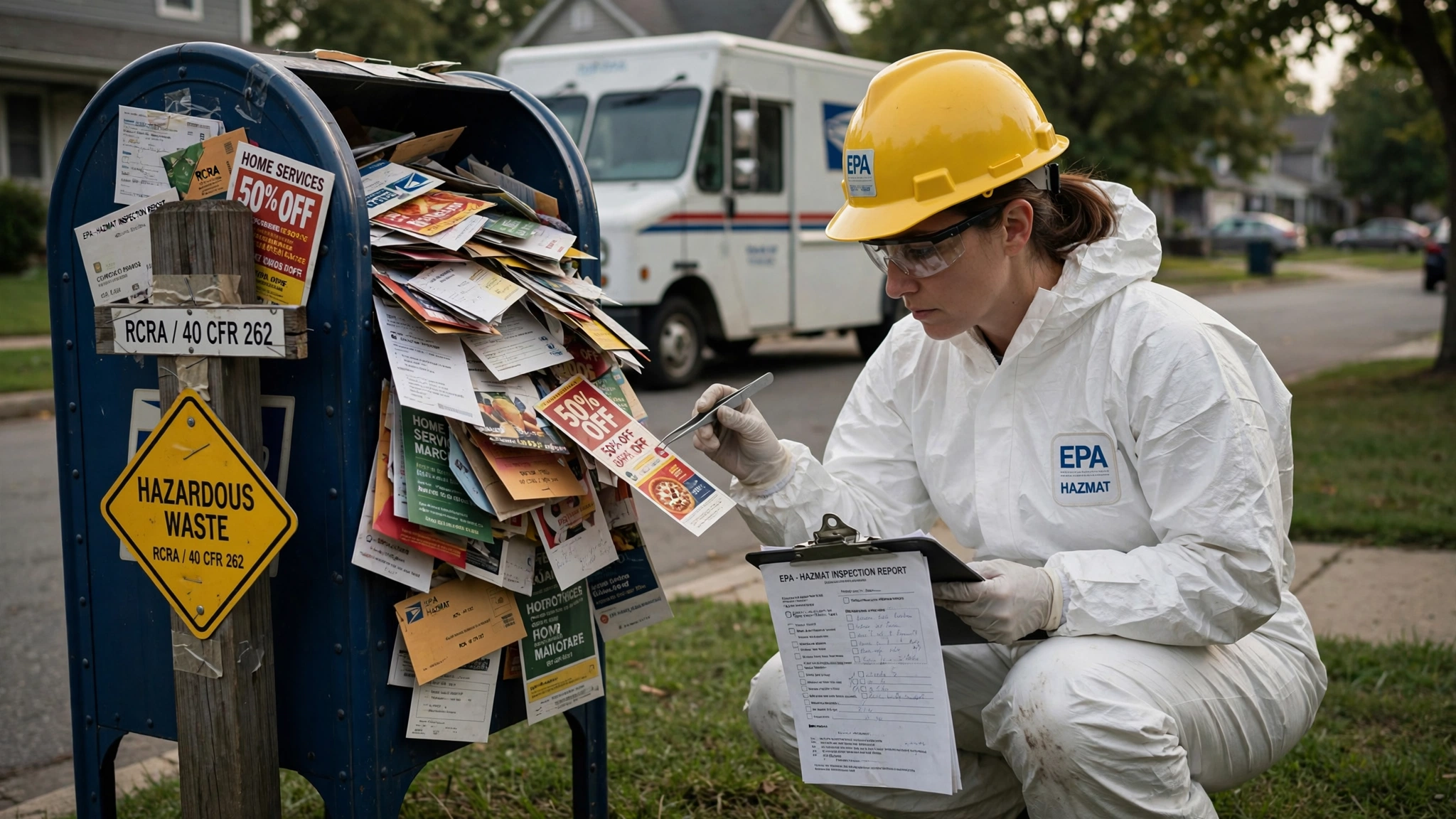
I. The Statutory Framework
The Resource Conservation and Recovery Act (RCRA) was enacted as an amendment to the Solid Waste Disposal Act on October 21, 1976, as Public Law 94–580. Its stated objective is “to promote the protection of health and the environment and to conserve valuable material and energy resources” through the regulation of solid and hazardous waste management.1 To accomplish this, Congress created a comprehensive regulatory framework governing the generation, transportation, treatment, storage, and disposal of waste materials.
Section 1004(27) of RCRA, codified at 42 U.S.C. § 6903(27), defines “solid waste” as “any garbage, refuse, sludge from a waste treatment plant, water supply treatment plant, or air pollution control facility and other discarded material, including solid, liquid, semisolid, or contained gaseous material resulting from industrial, commercial, mining, and agricultural operations, and from community activities.”2
The definition is expansive by design. The EPA’s own implementing regulations, at 40 CFR § 261.2, clarify that a “discarded material” is any material that is “abandoned”—and that a material is abandoned if it is “disposed of.”3 The regulations do not require that the generator intend the material to be waste at the moment of shipment. They require only that the material be discarded. The statute enumerates no temporal limitation on when discarding must occur. A material that is discarded upon receipt is still a material that has been discarded.
Congress further prohibited “open dumping” under Section 4005(a) of RCRA, codified at 42 U.S.C. § 6945(a), making it unlawful to engage in any solid waste management practice that constitutes the open dumping of solid waste except under a schedule for compliance.4 An “open dump,” as defined in Section 1004(14) at 42 U.S.C. § 6903(14), is “any facility or site where solid waste is disposed of which is not a sanitary landfill.”5 A residential mailbox has never been classified as a sanitary landfill.
II. The Volume
The United States Postal Service delivered 56,756 million pieces of USPS Marketing Mail in fiscal year 2025, ending September 30, 2025.6 This material weighed approximately 4,050 million pounds—more than two million tons.7 The Postal Service generated $15.734 billion in revenue from this service category alone, a 2.3 percent increase over the prior fiscal year.8
To place this figure in context: the total volume of all USPS mail and packages in fiscal year 2025 was 108,695 million pieces.9 Marketing mail constituted 52.2 percent of this total. More than half of every piece of mail carried by the United States Postal Service exists for the purpose of commercial solicitation.
The Postal Service processed an average of 361.1 million mailpieces daily in fiscal year 2025, or 250,773 pieces per minute, or 4,180 pieces per second.10 It delivered to an average of 22.7 million packages per day, but marketing mail did not arrive in packages. It arrived in envelopes, postcards, flyers, catalogs, and glossy inserts—loose, uncontained, and deposited directly into receptacles that no regulatory authority has ever inspected for compliance with solid waste management standards.
III. The Discard Rate
Forty-four percent of unsolicited marketing mail is discarded by its recipients without being opened.11 The material travels from commercial printing facilities to USPS processing centers to delivery vehicles to residential mailboxes to household trash receptacles in a closed loop that begins and ends at a waste stream. The recipient does not request the material. The recipient does not consume the material. The recipient disposes of the material.
Under RCRA’s own definitional framework, a material that is disposed of is abandoned. A material that is abandoned is a discarded material. A discarded material is a solid waste.3 The statutory syllogism is complete at the moment the envelope enters the trash can.
The average American receives approximately 41 pounds of unsolicited marketing mail per year, according to the Center for Development of Recycling at San José State University.12 Michigan State University Extension places the figure for the average household at approximately 69 pounds annually.13 Only 50 percent of all marketing mail is recycled. The remainder—representing the output of approximately 48 million trees per year—is landfilled or incinerated.14
“A material is abandoned if it is disposed of, burned, or incinerated.”
—40 CFR § 261.2(b)
The question is not whether marketing mail becomes solid waste. The EPA’s own regulations confirm that it does, at the moment of disposal. The question is whether the entity that transported the material to its point of disposal did so in compliance with the statute. The answer requires examining the transporter.
IV. The Fleet
At the end of fiscal year 2025, the United States Postal Service operated 262,740 vehicles—one of the largest civilian fleets in the world.15 The fleet maintained 236,347 delivery routes across the United States, the District of Columbia, and five major U.S. territories.16 The Postal Service employed 328,820 letter carriers.17 These carriers drove more than 1.8 billion miles in fiscal year 2025 to deliver mail and packages to 170.4 million delivery points.18
The fleet includes Long-Life Vehicles (LLVs) dating to the late 1980s, which cost more than $8,000 per year on average to maintain.19 It includes 8,700 Ford E-Transit electric vehicles and 612 Next Generation Delivery Vehicles built by Oshkosh Defense.20 It includes vehicles that deliver mail by conventional road, by boat, by dog sled, by donkey, and by bicycle.21 The nation’s longest rural route runs 195 miles out of Sidney, Montana, delivering to 305 mailboxes.22
None of these vehicles bears an EPA identification number. None has ever been enrolled in the EPA’s hazardous waste manifest system. None has been inspected by a federal or state environmental regulator for compliance with RCRA transporter standards. The fleet operates entirely outside the regulatory framework that governs every other entity in the United States that moves discarded material from its point of generation to its point of disposal.
V. The Chemical Composition
Marketing mail is not inert paper. It is a manufactured product printed with inks that contain hazardous air pollutants regulated by the EPA under the National Emission Standards for Hazardous Air Pollutants (NESHAP) for the Printing and Publishing Industry, codified at 40 CFR Part 63, Subpart KK.23
The EPA’s own NESHAP rule summary identifies the following hazardous air pollutants emitted during the printing process: toluene, xylene, ethylbenzene, methyl ethyl ketone (MEK), methyl isobutyl ketone (MIBK), methanol, ethylene glycol, and certain glycol ethers. The EPA states that “all of these pollutants can cause reversible or irreversible toxic effects following exposure.”24
The EPA’s own Toxic Release Inventory data reveal that the printing industry releases 99 percent of its total TRI poundage into the air. The single largest toxic chemical used by the printing industry is toluene, comprising approximately 70 percent of total chemicals released and transferred by the industry.25 Toluene is classified by the International Agency for Research on Cancer as not classifiable as to its carcinogenicity in humans (Group 3), but it is a well-documented central nervous system depressant, and chronic exposure causes damage to the liver, kidneys, and hearing.26
The material delivered to 170.4 million American addresses is not merely paper. It is paper saturated with the residues of an industrial process that the EPA itself has determined to require maximum achievable control technology to render safe. The ink dries. The regulatory obligation does not.
VI. The Transporter Requirements
RCRA Subtitle C, beginning at 42 U.S.C. § 6921, establishes a “cradle-to-grave” regulatory system for hazardous waste. Within this system, Section 3003, codified at 42 U.S.C. § 6923, directs the EPA to establish standards for transporters of hazardous waste “as may be necessary to protect human health and the environment.”27 The implementing regulations appear at 40 CFR Part 263.
Under 40 CFR § 263.11, a transporter must not transport hazardous waste without having received an EPA identification number from the Administrator.28 The regulation uses the word “must.” It does not say “should.” It does not say “may consider obtaining.” It says “must not transport.”
Under 40 CFR § 263.20, a transporter who accepts hazardous waste from a generator must sign and date the manifest, carry it during transport, and deliver it to the designated facility.29 The Postal Service maintains its own tracking systems—Informed Delivery, Intelligent Mail barcodes, USPS Tracking. None of these systems track the chemical composition of the material being transported. None classify the material under EPA waste codes. None identify the receiving facility’s RCRA permit status. The Postal Service has built, at enormous taxpayer expense, a tracking system that monitors every aspect of the material it moves through the nation’s roads except whether it is waste.
VII. The Open Dumping Question
RCRA Section 4005(a), codified at 42 U.S.C. § 6945(a), provides that “any solid waste management practice or disposal of solid waste… which constitutes the open dumping of solid waste… is prohibited.”4 Section 1004(14), at 42 U.S.C. § 6903(14), defines an “open dump” as “any facility or site where solid waste is disposed of which is not a sanitary landfill.”5
Consider the American residential mailbox. It is a receptacle. It is installed at a fixed location. Solid waste—material that will be disposed of upon retrieval—is deposited into it on a regular schedule by uniformed federal employees operating government vehicles. The receptacle has no liner. It has no leachate collection system. It has no methane monitoring equipment. It has never been permitted under any state solid waste management plan. It meets none of the criteria promulgated by the EPA under 40 CFR Part 258 for municipal solid waste landfill units. It is, under the literal text of the statute, an open dump.
There are 170.4 million of them.
VIII. The Generator Question
RCRA Section 3002, codified at 42 U.S.C. § 6922, directs the EPA to establish standards for generators of hazardous waste, including requirements for recordkeeping, labeling, reporting, and the use of a manifest system.30 A generator is any person whose act or process produces solid waste.
Who generates marketing mail waste? The commercial mailer designs the material, prints it, and pays the Postal Service to deliver it. The Postal Service accepts the material, sorts it, loads it onto its vehicles, and deposits it at recipient addresses. The recipient opens the mailbox and, in 44 percent of cases, transfers the material directly to the waste stream.
Under RCRA’s definitional structure, each actor in this chain bears a distinct regulatory identity. The mailer is the generator. The Postal Service is the transporter. The recipient’s trash can is the disposal facility. The mailer has never obtained a generator’s EPA identification number. The transporter has never obtained a transporter’s EPA identification number. The disposal facility—the sixty-gallon polyethylene bin at the end of the driveway—has never been permitted under state solid waste regulations.
The entire supply chain, from commercial printer to municipal landfill, operates outside the regulatory framework that Congress created specifically to govern it.
IX. The Municipal Solid Waste Contribution
The EPA’s own data confirm the scale of the problem. In 2018, the most recent year for which the EPA has published comprehensive municipal solid waste data, Americans generated 292.4 million tons of MSW.31 Paper and paperboard products constituted the largest single material category, at 23.1 percent of total generation—67.4 million tons.32 Of that total, 17.22 million tons were landfilled. An additional 4.2 million tons were combusted with energy recovery.33
The EPA categorizes marketing mail as a subcategory of “nondurable goods” within its materials characterization methodology. The agency notes that “the recycling of other paper products, such as books, magazines, office papers, directories, marketing mail and other commercial printing” occurred at an overall rate of 47.4 percent for paper nondurables in 2018.34 The corollary: 52.6 percent of paper nondurables, including marketing mail, were not recycled. They were disposed of.
The Postal Service is not incidentally connected to the municipal solid waste stream. It is the primary distribution mechanism for the largest material category in it.
X. The Enforcement Record
The EPA has never filed a RCRA enforcement action against the United States Postal Service for the transportation of solid waste without an EPA identification number. It has never issued a notice of violation to a mail carrier. It has never inspected a postal vehicle for compliance with 40 CFR Part 263. It has never required a manifest for a tray of marketing mail. It has never classified a residential mailbox as an open dump.
The agency’s silence is not for lack of jurisdiction. Section 1004(15) of RCRA, at 42 U.S.C. § 6903(15), defines “person” as “an individual, trust, firm, joint stock company, corporation (including a government corporation), partnership, association, State, municipality, commission, political subdivision of a State, or any interstate body.”35 The definition expressly includes government corporations. The United States Postal Service is an “independent establishment of the executive branch of the Government of the United States,” created by the Postal Reorganization Act of 1970.36 It is a person under RCRA.
Section 1004(4) of RCRA, at 42 U.S.C. § 6903(4), goes further: it defines “Federal agency” as “any department, agency, or other instrumentality of the Federal Government, any independent agency or establishment of the Federal Government including any Government corporation.”37 RCRA Section 6001, codified at 42 U.S.C. § 6961, subjects all federal agencies to “all Federal, State, interstate, and local requirements” regarding solid and hazardous waste management “in the same manner, and to the same extent, as any person is subject to such requirements.”38 Congress did not exempt federal agencies from RCRA. It expressly subjected them.
XI. The Exemption That Does Not Exist
RCRA contains specific exemptions. Section 1004(27) excludes “solid or dissolved material in domestic sewage” and “solid or dissolved materials in irrigation return flows” from the definition of solid waste.2 It excludes point-source industrial discharges permitted under Section 402 of the Clean Water Act. It excludes source, special nuclear, and byproduct material as defined by the Atomic Energy Act of 1954.
The statute does not mention the mail. It does not exempt commercial printed material. It does not carve out material transported by a federal agency for the purpose of advertising. It does not create a “mailbox exception” to the definition of solid waste. Congress enumerated the exclusions it intended. Mail was not among them.
The Postal Service might argue that marketing mail is not “discarded material” at the moment of transport because the sender intends it to be read, not disposed of. But intent is irrelevant to the statutory definition. RCRA defines solid waste by what the material is, not by what its sender hopes it will become. A material that is disposed of by 44 percent of its recipients without being opened is a material whose primary destiny is the waste stream. The sender’s intent does not alter the material’s fate. The statute does not ask what the sender wanted. It asks what happened to the material.
What happened to 25 billion pieces of it, every year, is that it was thrown away.
XII. The Accounting
The numbers, compiled entirely from the Postal Service’s own annual reports and the EPA’s own regulatory materials, describe an operation of extraordinary regulatory exposure:
- 56.8 billion pieces of marketing mail delivered in fiscal year 2025.6
- 4.05 billion pounds of marketing mail by weight—more than two million tons.7
- 44 percent discarded without opening—approximately 25 billion pieces per year.11
- 262,740 vehicles operating without EPA identification numbers.15
- 236,347 delivery routes traversed without hazardous waste manifests.16
- 328,820 letter carriers transporting material containing residues of toluene, xylene, and ethylbenzene.1724
- 1.8 billion miles driven annually in the service of distributing material that constitutes 23.1 percent of the nation’s municipal solid waste by category.1832
- 170.4 million delivery points, each one an unpermitted open dump under the literal text of RCRA Section 1004(14).5
- Zero EPA identification numbers issued.
- Zero manifests filed.
- Zero enforcement actions taken.
- Zero notices of violation served.
The United States Postal Service has been in continuous operation since 1775. The Resource Conservation and Recovery Act has been in effect since 1976. For forty-nine years, the agency that moves more discarded material to more disposal sites than any other entity in the nation has operated entirely outside the statute that Congress enacted to regulate exactly this activity.
The mail carrier arrives six days a week. The statute applies seven.
Ergo.
Notes
- Resource Conservation and Recovery Act of 1976, Pub. L. 94–580, § 1003, 42 U.S.C. § 6902. law.cornell.edu ↑
- 42 U.S.C. § 6903(27), Definition of “solid waste.” law.cornell.edu ↑
- 40 CFR § 261.2, Definition of solid waste. law.cornell.edu ↑
- 42 U.S.C. § 6945(a), Upgrading of open dumps. law.cornell.edu ↑
- 42 U.S.C. § 6903(14), Definition of “open dump.” law.cornell.edu ↑
- USPS, Fiscal Year 2025 Annual Report to Congress, Revenue, Pieces and Weight Statistics. Marketing Mail number of pieces: 56,756 million. about.usps.com ↑
- USPS, FY 2025 Annual Report to Congress. Marketing Mail weight: 4,050 million pounds. about.usps.com ↑
- USPS Employee News, “USPS reports year-end financial results,” November 14, 2025. Marketing Mail revenue increased 2.3 percent. news.usps.com ↑
- USPS, FY 2025 Annual Report to Congress. Total operating volume: 108,695 million pieces. about.usps.com ↑
- USPS Postal Facts, “A Day in the Life of the U.S. Postal Service.” facts.usps.com ↑
- Town of Exeter, New Hampshire, “Junk Mail Reduction”: “44% of Unwanted Mail is Tossed Out Unopened Into the Landfill.” See also Center for Development of Recycling, San José State University. exeternh.gov ↑
- Sierra Club, “Let’s Ban Junk Mail Already,” citing Center for Development of Recycling, San José State University: “an American adult receives 41 pounds of junk mail a year.” sierraclub.org ↑
- Michigan State University Extension, “Greening your future, part one: junk mail”: “The average household can receive as much as sixty-nine pounds of junk mail annually.” canr.msu.edu ↑
- MSU Extension, supra note 13: “Only 50 percent of all junk mail is recycled. The rest is thrown away to be landfilled or incinerated. That means 48 million trees are wasted to produce junk mail that is immediately thrown away.” ↑
- USPS Postal Facts, Size and Scope: “At the end of fiscal year 2025, the Postal Service had 262,740 vehicles—one of the largest civilian fleets in the world.” facts.usps.com ↑
- USPS Postal Facts: “The Postal Service maintained 236,347 delivery routes across the United States in fiscal year 2025.” facts.usps.com ↑
- Bureau of Labor Statistics, Occupational Employment and Wage Statistics, 2025. Postal service mail carriers: 328,820. bls.gov ↑
- USPS Postal Facts, “Surface transportation—miles traveled”: “To move mail using surface transportation, the Postal Service drove more than 1.8 billion miles in 2025.” facts.usps.com ↑
- Reuters, “US Postal Service using 2,600 EVs for mail deliveries,” December 2, 2025. “USPS’s older delivery vehicles dating back to the late 1980s cost more than $8,000 per year on average to maintain.” reuters.com ↑
- Reuters, supra note 19. USPS purchased 8,700 Ford E-Transit vehicles and 612 Oshkosh NGDV electric vehicles. ↑
- USPS Employee News, “USPS covers a lot of ground,” October 17, 2025. Delivery by dog sled, boat, donkey, and bicycle. news.usps.com ↑
- USPS Employee News, supra note 21. Longest route: 195 miles from Sidney, Montana, delivering to 305 mailboxes. ↑
- 40 CFR Part 63, Subpart KK, National Emission Standards for the Printing and Publishing Industry. law.cornell.edu ↑
- EPA, “The Printing and Publishing Industry: National Emission Standards for Hazardous Air Pollutants (NESHAP),” Rule Summary. HAPs include toluene, xylene, ethylbenzene, MEK, MIBK, methanol, ethylene glycol, and glycol ethers. epa.gov ↑
- EPA, Monitoring Information by Industry—Printing and Publishing. “[T]oluene comprises roughly 70 percent of the total chemicals released and transferred by the industry.” epa.gov ↑
- NIOSH, “Toluene,” Pocket Guide to Chemical Hazards. CNS depressant; chronic exposure linked to liver, kidney, and hearing damage. cdc.gov ↑
- 42 U.S.C. § 6923, Standards applicable to transporters of hazardous waste. law.cornell.edu ↑
- 40 CFR § 263.11, EPA identification number. law.cornell.edu ↑
- 40 CFR § 263.20, The manifest system. law.cornell.edu ↑
- 42 U.S.C. § 6922, Standards applicable to generators of hazardous waste. law.cornell.edu ↑
- EPA, “National Overview: Facts and Figures on Materials, Wastes and Recycling.” Total MSW generation in 2018: 292.4 million tons. epa.gov ↑
- EPA, supra note 31. Paper and paperboard: 23.1 percent of total MSW generation; 67.4 million tons in 2018. ↑
- EPA, “Paper and Paperboard: Material-Specific Data.” Landfilled: 17,220 thousand tons; combustion with energy recovery: 4,200 thousand tons (2018). epa.gov ↑
- EPA, “Nondurable Goods: Product-Specific Data.” Overall recycling rate for paper nondurables: 47.4 percent in 2018. epa.gov ↑
- 42 U.S.C. § 6903(15), Definition of “person.” law.cornell.edu ↑
- 39 U.S.C. § 201, United States Postal Service: “There is established, as an independent establishment of the executive branch of the Government of the United States, the United States Postal Service.” law.cornell.edu ↑
- 42 U.S.C. § 6903(4), Definition of “Federal agency.” law.cornell.edu ↑
- 42 U.S.C. § 6961, Application of Federal, State, and local law to Federal facilities. law.cornell.edu ↑