I. The Regulatory Framework
The Clean Air Act of 1970, substantially amended in 1977 and again in 1990, is the foundational federal statute governing air quality in the United States.1 Its stated purpose, set forth at 42 U.S.C. § 7401(b)(1), is “to protect and enhance the quality of the Nation’s air resources so as to promote the public health and welfare and the productive capacity of its population.” To accomplish this, the Act establishes National Ambient Air Quality Standards, requires state implementation plans to achieve and maintain those standards, regulates emissions from both mobile and stationary sources, and created the Environmental Protection Agency as the principal enforcement authority.2
The 1990 amendments, Public Law 101–549, added Title V, a comprehensive operating permit program modeled on the Clean Water Act’s NPDES permitting system.3 Title V requires operating permits for all “major sources” of air pollution, defined as stationary sources that emit or have the potential to emit 100 tons per year or more of any regulated air pollutant. In ozone nonattainment areas, the threshold drops: to 50 tons per year in serious nonattainment areas, 25 tons per year in severe nonattainment areas, and 10 tons per year in extreme nonattainment areas.4 The EPA estimates that approximately 15,500 industrial sources in the United States are currently subject to Title V.5
The number that should be subject to Title V, as this investigation will demonstrate, is somewhat larger.
II. The Definitions
Three definitions in the Act and its implementing regulations establish the regulatory framework relevant to this investigation. Each is clear. Each is broad. None contains an exception for photosynthesis.
First, the Act defines “stationary source.” Section 302(z) of the Clean Air Act, codified at 42 U.S.C. § 7602(z), provides that a stationary source is “generally any source of an air pollutant except those emissions resulting directly from an internal combustion engine for transportation purposes or from a nonroad engine or nonroad vehicle as defined in section 7550 of this title.”6 For purposes of Title V permitting and New Source Review, the regulatory definition at 40 CFR § 51.491 refines this to “any building, structure, facility or installation which emits or may emit any criteria air pollutant or precursor subject to regulation under the Act.”7
A tree is not a building, a structure, or an installation. But it is, by any common understanding, a facility. More to the point, it is a source, and it is stationary. It does not have an internal combustion engine. It is not a nonroad vehicle. It emits. It has been emitting for a very long time.
Second, the EPA defines “volatile organic compound.” The regulatory definition, codified at 40 CFR § 51.100(s), provides:
“Volatile organic compounds (VOC) means any compound of carbon, excluding carbon monoxide, carbon dioxide, carbonic acid, metallic carbides or carbonates, and ammonium carbonate, which participates in atmospheric photochemical reactions.”8
The definition then provides a list of specific compounds that the EPA has determined to have “negligible photochemical reactivity” and are therefore excluded. The list includes methane, ethane, certain chlorofluorocarbons, acetone, and approximately 80 other named compounds.9 Isoprene is not on the list. No terpene is on the list. No biogenic hydrocarbon emitted by any tree species has ever been exempted from the regulatory definition of VOC.
Third, ground-level ozone is one of six criteria air pollutants for which the EPA has established National Ambient Air Quality Standards under Section 109 of the Act.10 Ozone is not emitted directly by most sources. It is formed through photochemical reactions between VOCs and nitrogen oxides (NOx) in the presence of sunlight. VOCs are therefore regulated as ozone precursors. The causal chain is not disputed by any atmospheric chemist alive: VOC plus NOx plus sunlight equals ozone. The EPA knows this. It has known it since before the Act was signed. It regulates VOCs for precisely this reason.
III. The Compound
Isoprene (2-methyl-1,3-butadiene, C5H8, molecular weight 68.12 g/mol) is the single most abundant non-methane hydrocarbon emitted into the Earth’s atmosphere.11 Its global emission from terrestrial vegetation is estimated at approximately 500 to 600 teragrams per year, a figure that exceeds total global anthropogenic emissions of all non-methane volatile organic compounds combined.12
Isoprene is synthesized by the methylerythritol 4-phosphate pathway in leaf chloroplasts and emitted through stomatal pores in response to light and temperature.13 Emission rates increase exponentially with temperature up to approximately 40°C and scale linearly with photosynthetically active radiation. A single mature leaf of Quercus rubra (northern red oak) at 30°C and 1,000 μmol/m2/s of photosynthetically active radiation can emit isoprene at rates exceeding 50 micrograms per gram of dry leaf weight per hour.14 Under peak summer conditions, emission rates from high-emitting species can reach 100 μg g−1 h−1 or more.15
Once in the troposphere, isoprene reacts rapidly with hydroxyl radicals (OH) with a rate constant of approximately 1.0 × 10⁻¹⁰ cm3 molecule−1 s−1, giving it an atmospheric lifetime of roughly one to two hours under typical daytime conditions.16 The oxidation products include methacrolein, methyl vinyl ketone, formaldehyde, and organic peroxides. In the presence of nitrogen oxides, these intermediates undergo further reactions that produce tropospheric ozone. The process is not subtle. It is a standard topic in atmospheric chemistry textbooks. The EPA’s own assessment documents describe it in detail.
Isoprene participates in atmospheric photochemical reactions. It is a compound of carbon. It is not carbon monoxide, carbon dioxide, carbonic acid, a metallic carbide, a metallic carbonate, or ammonium carbonate. It is not on the EPA’s exemption list. It is, by every criterion the EPA itself has established, a volatile organic compound.
IV. The Emitters
Not all trees emit isoprene at the same rate. The genus Quercus (oaks) is among the highest emitters. The genera Populus (poplars and aspens), Salix (willows), Liquidambar (sweetgum), and Eucalyptus are also prolific producers.17 Conifers, by contrast, tend to emit monoterpenes (C10H16) rather than isoprene, but monoterpenes are also VOCs under the same regulatory definition, and they also participate in ozone formation and secondary organic aerosol production.18
The USDA Forest Service’s Forest Inventory and Analysis program, the federal government’s own tree census, estimates that the United States contains approximately 228 billion trees.19 The genus Quercus alone comprises the most abundant hardwood genus in North American forests, with over 90 native species spanning every state in the contiguous United States.20
To appreciate the scale of the regulatory noncompliance, consider a single forest stand. A mature red oak forest in the Appalachian region of the southeastern United States might contain 50 to 80 trees per acre. Each mature tree carries approximately 200 kilograms of foliage. At a conservative average emission rate of 50 μg g−1 h−1 during peak summer conditions, a single tree emits roughly 10 grams of isoprene per hour. Over a growing season of approximately 120 days at an average of 10 effective emission hours per day, one tree emits approximately 12 kilograms of isoprene. A 500-acre stand of 30,000 trees emits approximately 360 metric tons, or roughly 400 short tons, of isoprene per growing season.21
The Title V major source threshold is 100 tons per year.
The 500-acre oak forest exceeds it by a factor of four. No Title V permit has been obtained. No application has been filed. No permit fee has been paid. No annual compliance certification has been submitted by a responsible official of the source, because the responsible official weighs approximately 2,200 pounds per trunk foot, does not have hands, and communicates primarily through the redistribution of carbohydrates via mycorrhizal networks.
V. The Scale
The total flux of biogenic non-methane volatile organic compounds from North American vegetation has been estimated at approximately 84 teragrams of carbon per year, comprising isoprene (35 percent), other terpenoid compounds (25 percent), and non-terpenoid oxygenated VOCs (40 percent).22 More recent estimates from the Model of Emissions of Gases and Aerosols from Nature place annual biogenic VOC emissions from the North American continent at 34.5 teragrams of carbon from isoprene alone, with total biogenic VOC emissions several times that figure.23
For context, the EPA’s National Emissions Inventory reports total anthropogenic VOC emissions from all sources in the United States at approximately 18 million short tons per year as of the most recent complete inventory.24 This total includes emissions from highway vehicles, off-highway equipment, industrial processes, fuel combustion, consumer and commercial products, and waste disposal. It represents the combined output of every refinery, every chemical plant, every dry cleaner, every paint shop, every gasoline station, and every internal combustion engine in the country.
Biogenic VOC emissions from vegetation in the United States exceed this total by a factor of approximately four to five.25
The EPA regulates 18 million tons. It does not regulate the 80 million. The 18 million tons are emitted by approximately 15,500 Title V permitted sources plus millions of smaller regulated sources. The 80 million tons are emitted by 228 billion unpermitted sources that have never been inspected, never been monitored, never been issued a compliance schedule, and never been asked to install Best Available Control Technology. The enforcement gap is not a rounding error. It is the majority of the inventory.
VI. The Precedent
The factual basis for this investigation is not new. In 1981, President Ronald Reagan publicly stated that “trees cause more pollution than automobiles do.”26 He also stated, on a separate occasion, that “approximately 80 percent of our air pollution stems from hydrocarbons released by vegetation, so let’s not go overboard in setting and enforcing tough emission standards from man-made sources.”27
These statements were widely ridiculed. They were characterized as ignorant, anti-environmental, and scientifically illiterate. They became a staple of political humor for decades. Supporters of the Clean Air Act pointed out that while trees do emit hydrocarbons, the formation of ground-level ozone requires the interaction of those hydrocarbons with nitrogen oxides, which are overwhelmingly produced by combustion sources. Without anthropogenic NOx, biogenic isoprene would not produce significant ground-level ozone. The trees, in other words, are not the problem. The cars are the problem.
This is all true. It is also entirely beside the point.
The Clean Air Act does not regulate only compounds that are, in some holistic policy sense, “the problem.” It regulates volatile organic compounds. It defines volatile organic compounds as compounds of carbon that participate in atmospheric photochemical reactions. Isoprene participates in atmospheric photochemical reactions. It does not matter that it requires a co-reactant. Nitrogen oxides also require a co-reactant to form ozone. The EPA regulates both. The question is not whether trees are morally culpable for ozone formation. The question is whether isoprene meets the regulatory definition of a volatile organic compound. It does. The question is whether a tree is a stationary source. It is. The question is whether many forest stands emit more than 100 tons per year. They do.
President Reagan, for all the mockery he endured, had the facts approximately right. He merely drew the wrong policy conclusion from them. This investigation draws no policy conclusion at all. It merely reads the statute.
VII. The Atmospheric Chemistry
The photochemical production of ozone from isoprene proceeds through a well-characterized mechanism. In the presence of sunlight, isoprene reacts with the hydroxyl radical to form isoprene peroxy radicals (ISOPO2). In high-NOx environments, these peroxy radicals react with nitric oxide to form alkoxy radicals, regenerating NO2 in the process. The photolysis of NO2 then releases an oxygen atom that combines with molecular oxygen to form ozone.28
The reaction is not hypothetical. It has been measured in field campaigns across the southeastern United States, where high biogenic isoprene emissions coincide with anthropogenic NOx to produce some of the highest summertime ozone concentrations in the country.29 NASA satellite observations of formaldehyde columns, a major intermediate product of isoprene oxidation, reveal a signature of biogenic VOC emissions across the eastern United States that is visible from space during summer months.30
The EPA itself acknowledges the role of biogenic VOCs in ozone formation. Its own assessment documents note that “biogenic emissions of volatile organic compounds are a significant contributor to ozone formation in many areas of the United States.” Its own models incorporate biogenic emissions as inputs to air quality forecasts. Its own regulatory impact analyses account for the interaction between anthropogenic NOx reductions and biogenic VOC concentrations.
The Agency models them. It measures them. It publishes papers about them. It factors them into its regulatory analysis. It does not regulate them.
VIII. The Compliance Gap
The Title V operating permit program, as implemented by the EPA and delegated state agencies, requires the following of every major source of air pollution in the United States: a permit application identifying all emission units and applicable requirements; an annual emissions inventory; continuous or periodic emissions monitoring; semiannual monitoring reports; an annual compliance certification signed by a responsible official; and an annual permit fee sufficient to cover the permitting authority’s costs of administering the program.31
Permits are issued for five-year periods and must be renewed thereafter. They are enforceable by the EPA, by state agencies, and by citizens through the Act’s citizen suit provision at 42 U.S.C. § 7604.
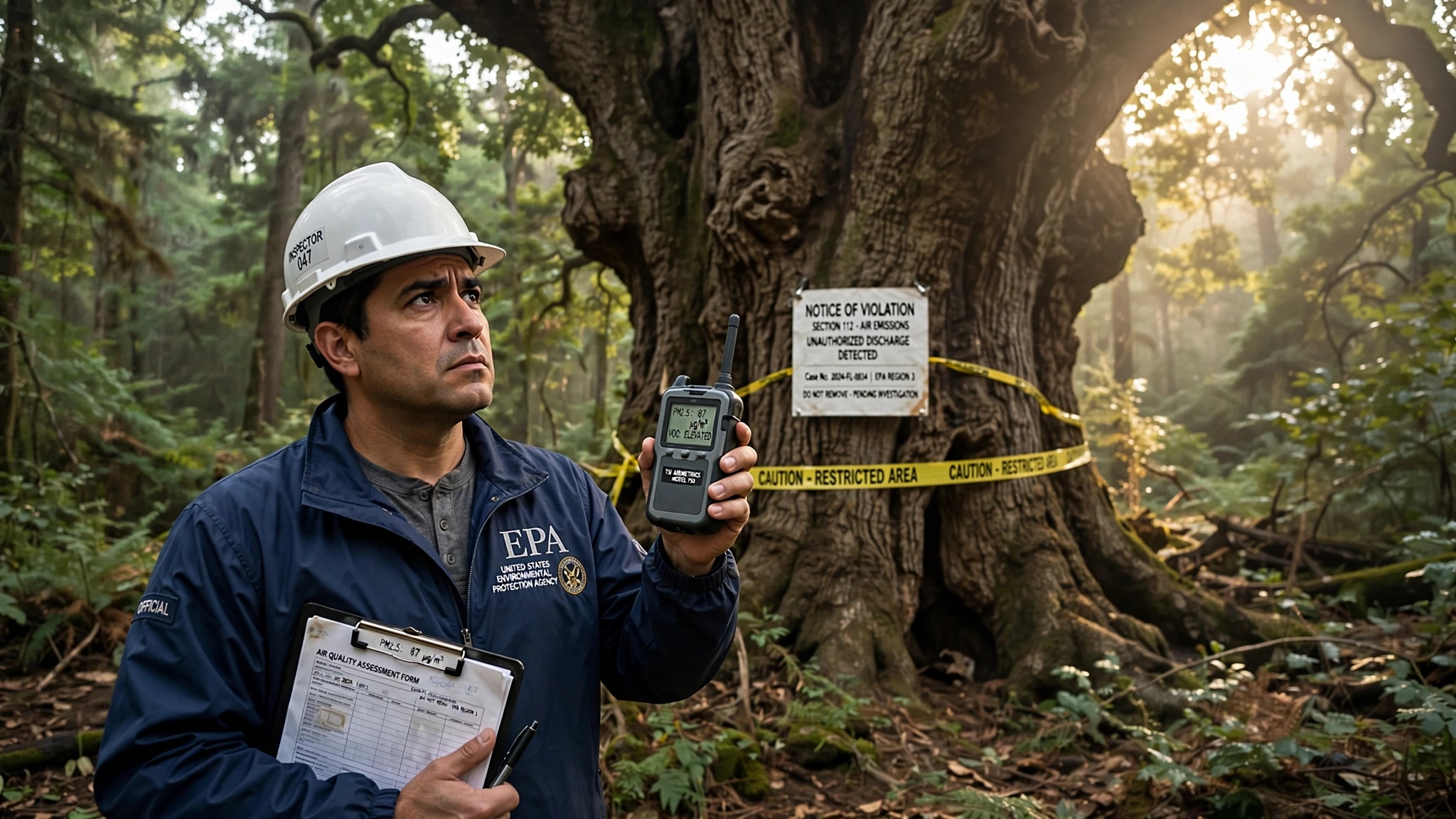
The number of trees in the United States that have obtained a Title V operating permit is zero. The number that have filed a permit application is zero. The number that have submitted an annual compliance certification is zero. The number that have installed continuous emissions monitoring systems is zero. The number that have paid an annual permit fee is zero. The number that have been inspected by an EPA enforcement officer is zero. The number that have been issued a notice of violation is zero.
The number that should have been issued one, based on the plain text of the EPA’s own regulations, is difficult to calculate precisely but is certainly in the hundreds of millions.
The potential penalties are also considerable. Under Section 113(d) of the Clean Air Act, 42 U.S.C. § 7413(d), any person who violates any requirement of a Title V permit or who operates a major source without the required permit is subject to a civil penalty of up to $37,500 per day per violation, as adjusted for inflation.32 The number of days that the forests of the United States have been in continuous violation of Title V since its effective date in 1990 is approximately 13,149, as of the date of this publication. The total potential penalty exposure for a single 500-acre forest stand operating without a Title V permit since 1990 is approximately $493 million. The total potential penalty exposure for all forest stands in the United States that meet the major source threshold is a number that, if written out, would itself require a Title V permit.
IX. Best Available Control Technology
Under the Prevention of Significant Deterioration provisions of the Clean Air Act, codified at 42 U.S.C. § 7475, new major stationary sources and major modifications of existing sources in attainment areas are required to install the Best Available Control Technology (BACT) for each regulated pollutant.33 BACT is defined as “an emission limitation based on the maximum degree of reduction of each pollutant” that the permitting authority determines is achievable “taking into account energy, environmental, and economic impacts and other costs.”
No BACT determination has ever been made for a tree. The EPA has never convened a BACT review panel to evaluate isoprene control strategies for Quercus rubra. No RACT (Reasonably Available Control Technology) guidance document has been published for deciduous hardwoods in ozone nonattainment areas. No LAER (Lowest Achievable Emission Rate) standard has been established for new plantings in extreme nonattainment zones.
This is not because control options do not exist. The biological literature identifies at least three mechanisms by which isoprene emissions from vegetation can be reduced: genetic modification of the isoprene synthase gene to suppress expression; application of fosmidomycin, an antibiotic that inhibits the methylerythritol phosphate pathway; and, most straightforwardly, replacement of high-emitting species with low-emitting species in urban and suburban plantings.34 Several cities, including Sacramento, California, have already adopted low-emitting species lists for municipal tree planting programs, not because they recognized a Clean Air Act compliance obligation but because they noticed that planting oaks downwind of freeways made the ozone problem worse.
The fact that a municipality has voluntarily adopted a control measure that the EPA has never required, for a pollutant that the EPA does not regulate from the source that emits the majority of it, is a detail that speaks for itself.
X. The Evolutionary Timeline
The capacity for isoprene emission has evolved independently multiple times across the plant kingdom, appearing in mosses, ferns, gymnosperms, and angiosperms across distantly related lineages.35 The earliest fossil evidence of isoprene-producing plant lineages dates to the Cretaceous period, approximately 100 million years ago, though the enzymatic pathway is likely older. The genus Quercus originated in the early Eocene, approximately 56 million years ago, and diversified across the Northern Hemisphere throughout the Cenozoic.36
The Clean Air Act was signed on December 31, 1970. Title V was added on November 15, 1990. The EPA promulgated the Title V implementing regulations at 40 CFR Part 70 on July 21, 1992.
The trees have been emitting volatile organic compounds into the atmosphere of what is now the United States for approximately 100 million years without a permit. The EPA has had jurisdiction over them for approximately 56 of those years. The Title V permit program has been in effect for approximately 34 of those years. In that time, the Agency has processed thousands of permit applications from refineries, power plants, chemical manufacturers, and cement kilns. It has conducted tens of thousands of compliance inspections. It has issued thousands of notices of violation and collected billions of dollars in penalties from anthropogenic sources responsible for less than one-fifth of national VOC emissions.
It has not issued a single enforcement action against the sources responsible for the other four-fifths.
XI. The Agency’s Position
The EPA has never formally addressed the question of whether trees are subject to Title V permitting requirements. It has not issued a guidance memorandum, a policy statement, an interpretive rule, or a frequently-asked-questions document on the topic. It has not published a Federal Register notice requesting comment on the question. It has not convened a Science Advisory Board panel to evaluate the atmospheric impact of unregulated biogenic VOC sources.
The Agency’s silence on the matter is total. This is not, in itself, unusual. Regulatory agencies routinely exercise enforcement discretion and decline to pursue technically valid violations when enforcement would be impractical, counterproductive, or contrary to the purposes of the statute. The EPA could, if pressed, likely articulate several reasons why it has chosen not to regulate trees: that trees are not “persons” subject to the Act’s requirements; that forests are not “facilities” or “installations” within the meaning of the Title V regulations; that regulating biogenic emissions would be absurd; that Congress did not intend the Clean Air Act to apply to photosynthesizing organisms.
These are reasonable policy arguments. They are not, however, arguments that the EPA has ever been required to make, because no citizen, no state, no regulated industrial source, and no environmental organization has ever filed a petition, a complaint, or a lawsuit demanding that the Agency enforce the Clean Air Act against a tree.
The reason is obvious. Everyone understands that the Clean Air Act was not meant to regulate trees. But “was not meant to” and “does not, by its own terms, apply to” are different statements. The first is a policy judgment. The second is a legal conclusion. The policy judgment is clearly correct. The legal conclusion is, at minimum, debatable. The EPA has chosen the prudent course of never having the debate.
XII. Conclusion
The facts are not in dispute. Trees emit volatile organic compounds as defined by 40 CFR § 51.100(s). Trees are stationary sources as described by 42 U.S.C. § 7602(z). Many forest stands emit VOCs in quantities that exceed the Title V major source threshold of 100 tons per year. Biogenic VOC emissions from United States vegetation exceed total anthropogenic VOC emissions by a factor of approximately four to five. No tree in the United States has ever obtained a Title V operating permit, filed an emissions inventory, installed continuous emissions monitoring, submitted a compliance certification, paid a permit fee, undergone a BACT review, or been the subject of an EPA enforcement action.
The noncompliance is total. It is universal. It spans all fifty states, all forest types, all tree species that emit isoprene or terpenes. It has been ongoing since the Clean Air Act was signed in 1970 and the Title V permit program was established in 1990. It encompasses an estimated 228 billion individual emitters, a number approximately 14,700 times larger than the total number of Title V permitted sources that the EPA currently regulates.
The trees have not retained counsel. They have not filed for a variance. They have not applied for a synthetic minor permit to cap their emissions below the major source threshold. They have not submitted a compliance schedule. They have not requested a case-by-case BACT determination.
They have, however, continued to emit. They will emit again tomorrow. The sun will rise. The temperature will climb. The stomata will open. The isoprene will flow. The ozone will form. The EPA will monitor it, model it, publish papers about it, incorporate it into its regulatory impact analyses, and continue to pretend that the sources responsible for the majority of the nation’s VOC inventory do not exist.
The statute says what it says. The definition includes what it includes. The trees emit what they emit. Everything else is enforcement discretion.