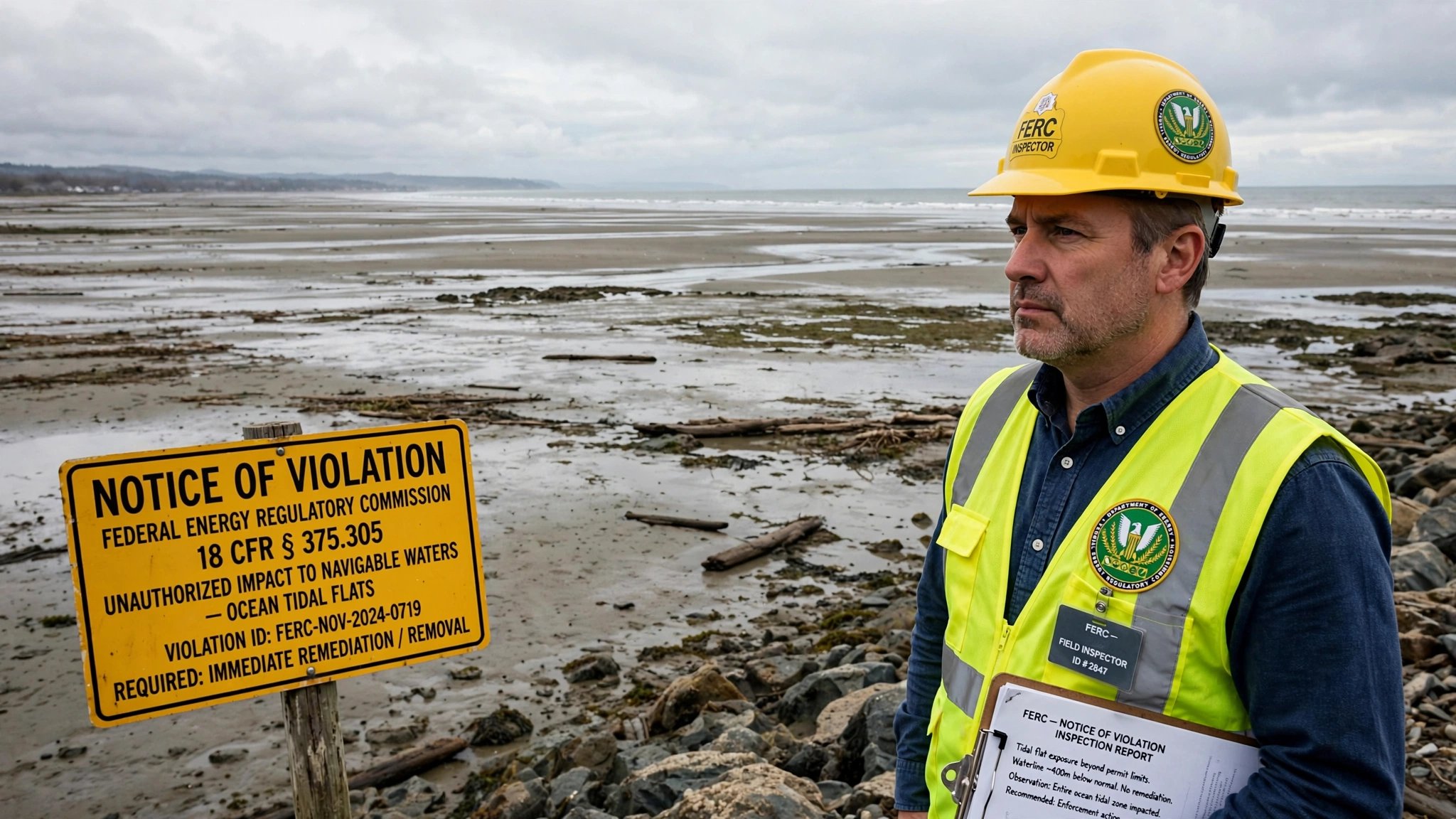
I. The Statute
The Federal Power Act was enacted in 1920 as the Federal Water Power Act, Pub. L. 66–280, 41 Stat. 1063, for the purpose of establishing federal control over the development of water power resources on navigable waters and public lands. The Act created the Federal Power Commission, later reorganized as the Federal Energy Regulatory Commission in 1977, and vested it with authority to license hydroelectric projects.1
The licensing requirement is not optional. Section 23(b)(1), codified at 16 U.S.C. § 817(1), provides that it shall be unlawful for any person, state, or municipality to construct, operate, or maintain any dam, water conduit, reservoir, power house, or other works incidental thereto across, along, or in any of the navigable waters of the United States, or upon any part of the public lands or reservations of the United States, for the purpose of developing water power, except under and in compliance with the terms of a license granted pursuant to the Act.2
The Act does not define “water power” narrowly. It does not require a turbine. It does not require a dam. It does not require a reservoir. FERC’s own jurisdictional regulations at 18 CFR Part 24 apply to any project that uses the kinetic or potential energy of water on navigable waterways for the development of power.3 The Commission has exercised this jurisdiction broadly. It has licensed projects that use the flow of rivers, the head of waterfalls, the pressure of irrigation conduits, and—as we shall see—the movement of tides. The operative concept is water power. The tides are water. They have power. The power is developed on navigable waters of the United States. The statute applies.
II. The Mechanism
The tides are not weather. They are not random. They are a gravitational engine of extraordinary regularity, driven by the orbital mechanics of the Earth-Moon-Sun system with a precision that has been computed to the minute for centuries.
The mechanism is gravitational. The Moon, orbiting the Earth at a mean distance of 384,400 kilometers with a mass of 7.342 × 10²² kilograms, exerts a differential gravitational force across the diameter of the Earth.4 The near side of the Earth is pulled more strongly toward the Moon than the center, and the center more strongly than the far side. This differential force—the tidal force—deforms the ocean surface into an ellipsoid, producing two tidal bulges: one facing the Moon and one on the opposite side. As the Earth rotates beneath these bulges, each point on the surface experiences approximately two high tides and two low tides per lunar day of 24 hours and 50 minutes.5
The Sun contributes a secondary tidal force. Although the Sun is approximately 27 million times more massive than the Moon, it is approximately 389 times farther from the Earth, and because tidal force varies as the inverse cube of distance, the solar tidal force is only about 46 percent that of the lunar force.6 When the Sun and Moon are aligned—at new and full moon—their forces combine to produce spring tides with amplitudes approximately 20 percent greater than average. When they are at right angles—at first and third quarter—the forces partially cancel, producing neap tides approximately 20 percent smaller than average.
The result is the rhythmic vertical displacement of approximately 1.335 × 10¹⁸ metric tons of seawater across the surface of the Earth, twice daily, with a regularity that exceeds the operational uptime of any generating facility ever licensed by FERC.7 The tidal cycle has not experienced a single unplanned outage in 4.5 billion years. It does not require maintenance. It does not require fuel. It requires only the continued existence of the Moon and the rotation of the Earth, and neither has filed a decommissioning plan.
III. The Power
The power generated by the tidal operation is not modest.
Munk and Wunsch, in their foundational 1998 paper “Abyssal Recipes II: Energetics of Tidal and Wind Mixing” published in Deep-Sea Research, estimated total global tidal energy dissipation at approximately 3.5 terawatts.8 Egbert and Ray, using satellite altimeter data from TOPEX/Poseidon published in Nature in 2000, confirmed this figure and demonstrated that approximately one terawatt—25 to 30 percent of total dissipation—occurs in the deep ocean, with the remainder dissipated through bottom friction in shallow seas and continental shelves.9 Cartwright’s comprehensive review in Tides: A Scientific History adopted the 3.5-terawatt estimate as the consensus value.10
For context, the total installed electrical generating capacity of the United States as of 2024 was approximately 1.3 terawatts.11 The tidal operation generates 2.7 times the entire installed capacity of the American electrical grid. It does so continuously. Every licensed hydroelectric facility in the United States—approximately 2,500 projects with a combined generating capacity of approximately 80 gigawatts—operates at a scale that is, collectively, approximately 2.3 percent of the tidal output.12 FERC has licensed the 2.3 percent. It has not licensed the other 97.7 percent.
The energy is not hypothetical. It is dissipated as heat through friction between the moving water column and the ocean floor, through the generation of internal waves at submarine topographic features, and through the turbulent mixing of water masses of different densities. This dissipation is measurable. It slows the Earth’s rotation by approximately 2.3 milliseconds per century.13 It pushes the Moon into a progressively higher orbit at a rate of 3.82 centimeters per year, a recession precisely measured by laser ranging to retroreflector arrays left on the lunar surface by the Apollo 11, 14, and 15 missions.14 The power plant is consuming the rotational energy of the Earth and paying for it in angular momentum transferred to the Moon. No rate schedule has been filed with FERC or any state public utility commission.
IV. The Navigable Waters
The tidal operation does not occur offshore and leave the navigable waters of the United States undisturbed. It occurs on the navigable waters. It occurs in the navigable waters. It reverses the flow of rivers, reshapes coastlines, floods and exposes harbors, and generates currents of sufficient velocity to constitute navigational hazards requiring federal charting and advisory services.
The Hudson River is tidal for 153 miles, from its mouth at New York Harbor to the Federal Dam at Troy.15 The Dutch called it Muhheakantuck—“the river that flows two ways.” It flows two ways because the tidal operation reverses its current twice daily, pushing 155 million cubic meters of saltwater upstream past West Point, past Poughkeepsie, past Kingston, and into the freshwater reaches near Albany.16 The Potomac River is tidal for 117 miles. The Delaware River is tidal for 134 miles. The Connecticut River is tidal for 62 miles. The Sacramento River is tidal for 57 miles.17 In each case, the tidal operation is moving billions of gallons of water across, along, and in navigable waterways of the United States, which is precisely the jurisdictional trigger of Section 23(b)(1).
The Bay of Fundy, shared between the United States and Canada at the Maine border, experiences a maximum tidal range of 16.3 meters—53.5 feet—at Burntcoat Head, Nova Scotia, the largest tidal range in the world.18 The tidal bore on the Shubenacadie River, a wall of water that advances upstream against the river’s natural flow, reaches heights of over one meter and velocities of 13 kilometers per hour.19 The volume of water entering and leaving the Bay of Fundy each tidal cycle is approximately 115 billion cubic meters—more than the combined daily flow of all the rivers in the world.20
These are not abstract hydrodynamic phenomena occurring in the open ocean beyond federal jurisdiction. They are occurring in harbors, channels, rivers, estuaries, and bays that are navigable waters of the United States under the Commerce Clause, on which FERC exercises licensing jurisdiction, and through which FERC-licensed vessels transit daily. The jurisdictional nexus is not arguable. The jurisdictional nexus is unavoidable.
V. The Precedent FERC Has Already Set
FERC does not merely have theoretical jurisdiction over tidal energy. It has exercised that jurisdiction. It has issued licenses for tidal energy projects. It has thereby formally and irreversibly recognized that tidal energy constitutes “water power” within the meaning of the Federal Power Act.
On January 23, 2012, FERC issued a pilot project license to Verdant Power, LLC, for the Roosevelt Island Tidal Energy Project in New York’s East River, FERC Project No. 12611.21 The project consisted of thirty kinetic hydropower turbines designed to generate up to one megawatt of power from tidal currents. FERC found that the project constituted a hydroelectric project on navigable waters requiring a license under Part I of the Federal Power Act. The East River is a tidal strait. The energy source is the tide. FERC licensed it.
On March 4, 2014, FERC issued a preliminary permit to Snohomish County Public Utility District for the Admiralty Inlet Pilot Tidal Project in Puget Sound, Washington, FERC Project No. 12690.22 FERC accepted jurisdiction over a project that would extract energy from tidal currents in Admiralty Inlet, where tidal flows exceed four knots. The permit acknowledged that the energy of these currents constitutes water power subject to FERC regulation.
The Commission has also issued preliminary permits for tidal energy projects in Maine’s Cobscook Bay, Alaska’s Cook Inlet, and the San Francisco Bay.23 In each case, FERC exercised jurisdiction over the extraction of energy from tidal flows in navigable waters. In each case, FERC required compliance with the licensing provisions of the Federal Power Act, including environmental review under NEPA, consultation under the Endangered Species Act, and assessment of effects on navigation.
The logic is now inescapable. FERC has determined that extracting one megawatt from the tides in the East River requires a federal license. The tides that generate the currents from which that one megawatt is extracted produce 3.5 terawatts globally. The licensed extraction is approximately 0.00000003 percent of the unlicensed operation. FERC regulates the bucket. It does not regulate the ocean.
VI. The Environmental Impact
The National Environmental Policy Act of 1969, 42 U.S.C. §§ 4321–4347, requires federal agencies to prepare an environmental impact statement for any “major Federal actions significantly affecting the quality of the human environment.”24 FERC routinely requires EIS preparation for hydroelectric projects of significant scale. The environmental effects of the tidal operation are documented, severe, and ongoing.
Tidal erosion is the primary geomorphic force acting on the coastlines of the United States. The average rate of coastal erosion on the Atlantic seaboard is approximately 0.6 meters per year, with rates exceeding 7.5 meters per year at some locations along the Outer Banks of North Carolina and the barrier islands of Louisiana.25 Approximately 86,000 miles of United States coastline are classified as actively eroding.26 The tidal operation is a principal driver of this erosion. No mitigation plan has been filed. No compensatory mitigation bank has been established. No shoreline restoration fund has been endowed by the operator.
The tidal operation also constitutes a significant hazard to navigation. The National Oceanic and Atmospheric Administration publishes tidal current predictions for approximately 3,000 reference and subordinate stations in United States waters specifically because the currents generated by the tidal operation are dangerous to vessels.27 Tidal currents in Hell Gate, the narrow tidal strait connecting the East River and the Long Island Sound in New York City, have capsized and sunk vessels for three centuries. The Army Corps of Engineers spent $5.5 million between 1851 and 1885 dynamiting Flood Rock, a submerged reef in Hell Gate, in what was then the largest planned explosion in human history, specifically to mitigate the navigational hazard posed by tidal currents flowing past an underwater obstruction.28 The government blew up a rock to make the unlicensed power operation slightly less lethal. It did not require the operator to fund the remediation.
VII. The Rate Schedule
Licensed hydroelectric operators file rate schedules with FERC. They pay annual charges to the United States under Section 10(e) of the Federal Power Act, 16 U.S.C. § 803(e), calculated based on the authorized capacity of the project and the value of government-owned lands and resources used.29 In fiscal year 2023, FERC collected approximately $200 million in annual charges from licensed hydroelectric projects.30
The tidal operation uses navigable waters of the United States—a government resource—as its operating medium. It generates 3.5 terawatts of power on those waters. If the annual charges were calculated at the same rate per megawatt that FERC applies to licensed hydroelectric projects, the tidal operation’s annual assessment would be approximately $8.75 trillion.31 This figure exceeds the entire annual budget of the United States government. No invoice has been sent. No payment has been received. The accounts receivable balance has been accruing for 4.5 billion years.
The Moon has not filed a rate schedule. The Moon has not filed a FERC Form 80, the Licensed Hydropower Development Recreation Report. The Moon has not submitted an Annual Report of Major Electric Utilities on FERC Form 1. The compliance rate, across all filing requirements applicable to licensed hydroelectric operators, is zero.
VIII. The Operator
The Federal Power Act applies to “any person, State, or municipality.” Section 3(6) of the Act, 16 U.S.C. § 796(6), defines “person” as “an individual or a corporation.”32 The Moon is neither an individual nor a corporation. It is a natural satellite of approximately 7.342 × 10²² kilograms, composed primarily of anorthosite, basalt, and regolith, in synchronous rotation with the Earth at a mean orbital distance of 384,400 kilometers.
The Moon’s jurisdictional status is not entirely without legal framework. The Outer Space Treaty of 1967, to which the United States is a party, provides at Article II that “outer space, including the moon and other celestial bodies, is not subject to national appropriation by any means.”33 The Moon Agreement of 1979 further provides that the moon “is not subject to national appropriation by any claim of sovereignty, by means of use or occupation, or by any other means.”34 The United States has not ratified the Moon Agreement, but the Outer Space Treaty’s prohibition on national appropriation remains binding.
The enforcement implications are structural. The Moon cannot be subpoenaed. It cannot be served with process. It is not a “person” within the meaning of the Federal Power Act, yet it operates the largest water power project on Earth. FERC cannot compel the Moon to apply for a license. FERC cannot issue a cease-and-desist order to a celestial body. FERC cannot impose civil penalties on an entity that has no bank account, no registered agent, and no mailing address, and that has been in continuous noncompliance since before the formation of the Atlantic Ocean.
The Sun is a co-conspirator. It contributes approximately 46 percent of the tidal forcing and has likewise filed no application. Its jurisdictional residence is approximately 149.6 million kilometers from the nearest FERC regional office. Service of process by mail would take approximately eight minutes at the speed of light and would be incinerated upon arrival at the solar photosphere, which maintains a surface temperature of approximately 5,778 kelvin.35 The return receipt would not be signed.
IX. FERC’s Own Complicity
FERC does not merely fail to regulate the tidal operation. It depends on it.
Every hydroelectric project licensed by FERC that is located on a tidal waterway operates within the hydrological regime created and maintained by the unlicensed tidal operation. The Verdant Power project in the East River generates electricity from currents that exist solely because the tidal operation moves water through the strait. The project cannot function without the unlicensed power source. FERC has licensed a project that parasitically extracts energy from an operation that FERC has never licensed. The licensed project is downstream, in every sense, of the unlicensed one.
More broadly, every FERC-licensed dam on a tidal river operates within a hydraulic gradient that is modulated by the tidal operation. The tailwater elevation at every coastal hydroelectric facility rises and falls with the tide. The generating efficiency of these facilities varies with the tidal cycle. Their FERC licenses do not account for this dependency. Their rate schedules do not include a payment to the tidal operator for the hydraulic services rendered. The licensed projects use the tidal operation as an externality. The externality generates 3.5 terawatts.
X. The Declining Operator
The tidal operation is winding down. It has been winding down since it began.
Tidal friction transfers angular momentum from the Earth’s rotation to the Moon’s orbit, causing the Moon to recede at 3.82 centimeters per year as measured by lunar laser ranging.14 As the Moon moves farther from the Earth, the tidal force weakens. The tidal force varies as the inverse cube of the distance, so a one percent increase in distance produces a three percent decrease in tidal force. Over the 4.5-billion-year history of the Earth-Moon system, the Moon has receded from an initial distance of approximately 20,000 kilometers to its present distance of 384,400 kilometers, and the tidal amplitude has decreased by a factor of approximately 7,000.36
The early tides were catastrophic. When the Moon orbited at 20,000 kilometers, the tidal range on the primordial Earth would have exceeded one kilometer in open ocean basins.37 The tidal currents would have been sufficient to strip the seafloor to bedrock. The power dissipation would have been measured not in terawatts but in petawatts. No life existed to be affected. No regulatory agency existed to be affronted. The most powerful hydroelectric operation in the history of the solar system ran at full capacity for hundreds of millions of years, unchallenged, unmetered, and unobserved.
The operation today, at 3.5 terawatts, is a faint echo of its former output. It is still declining. In approximately 50 billion years, the Moon will have receded to a distance at which tidal locking between the Earth and Moon is complete, the tidal bulge will no longer migrate across the ocean surface, and the tidal operation will cease entirely.38 No decommissioning plan has been filed with FERC. No license surrender application has been submitted under 18 CFR § 6.1. The project will simply stop generating power without notifying the Commission or conducting the required site remediation.
The coastlines will stop eroding. The rivers will stop reversing. The harbors will stop flooding. The navigable waters of the United States will, for the first time in their existence, be free of the unlicensed power operation that has been running on them since before there were navigable waters, before there were United States, and before there was anyone to draft a statute prohibiting exactly what the Moon has been doing, without interruption, for 4.5 billion years.
The permit application is not pending. It will not be filed. The operator does not accept mail, does not recognize federal jurisdiction, and does not experience regulatory anxiety. It orbits. It pulls. The waters rise and fall. They have always risen and fallen. The Federal Power Act prohibits this. The Moon does not care.
Ergo.
Sources
- Federal Water Power Act of 1920, Pub. L. 66–280, 41 Stat. 1063, codified as amended at 16 U.S.C. §§ 791a–828c. Reorganized as the Federal Power Act by the Department of Energy Organization Act, Pub. L. 95–91, 91 Stat. 565 (1977), transferring the Federal Power Commission’s functions to the newly created Federal Energy Regulatory Commission. law.cornell.edu ↑
- 16 U.S.C. § 817(1), Section 23(b)(1) of the Federal Power Act. Licensing requirement for hydroelectric projects on navigable waters. law.cornell.edu ↑
- 18 CFR Part 24, “Declaration of Intention.” FERC regulations requiring owners of proposed hydroelectric projects to file a declaration of intention to determine Commission jurisdiction. law.cornell.edu ↑
- Williams, J.G. et al., “Lunar Laser Ranging Tests of the Equivalence Principle,” Classical and Quantum Gravity, vol. 29, 184004, 2012. Lunar mass: 7.342 × 10²² kg; mean Earth-Moon distance: 384,400 km. doi.org ↑
- Pugh, D.T. and Woodworth, P.L., Sea-Level Science: Understanding Tides, Surges, Tsunamis and Mean Sea-Level Changes, Cambridge University Press, 2014. Standard reference on tidal dynamics, semidiurnal cycle, and tidal forcing. ↑
- Marchuk, G.I. and Kagan, B.A., Dynamics of Ocean Tides, Kluwer Academic Publishers, 1989. Solar tidal force is approximately 46% of lunar tidal force, ratio determined by mass and inverse-cube distance relationship. ↑
- Stacey, F.D. and Davis, P.M., Physics of the Earth, 4th ed., Cambridge University Press, 2008. Total mass of the world’s oceans: approximately 1.335 × 10¹⁸ metric tons. ↑
- Munk, W.H. and Wunsch, C., “Abyssal Recipes II: Energetics of Tidal and Wind Mixing,” Deep-Sea Research Part I, vol. 45, pp. 1977–2010, 1998. Total tidal energy dissipation estimated at 3.5 TW. doi.org ↑
- Egbert, G.D. and Ray, R.D., “Significant dissipation of tidal energy in the deep ocean inferred from satellite altimeter data,” Nature, vol. 405, pp. 775–778, 2000. Approximately 1 TW (25–30% of total) dissipated in the deep ocean. doi.org ↑
- Cartwright, D.E., Tides: A Scientific History, Cambridge University Press, 1999. Comprehensive review of tidal science; consensus estimate of 3.5 TW total tidal dissipation. ↑
- U.S. Energy Information Administration, “Electric Power Annual 2024,” Table 4.3, “Existing Capacity by Energy Source.” Total installed generating capacity: approximately 1,300 GW (1.3 TW). eia.gov ↑
- Federal Energy Regulatory Commission, “Hydropower Primer,” 2024. FERC regulates approximately 2,500 hydroelectric projects with combined capacity of approximately 80 GW. ferc.gov ↑
- Stephenson, F.R., Historical Eclipses and Earth’s Rotation, Cambridge University Press, 1997. Tidal friction decelerates Earth’s rotation at approximately 2.3 milliseconds per century. ↑
- Dickey, J.O. et al., “Lunar Laser Ranging: A Continuing Legacy of the Apollo Program,” Science, vol. 265, pp. 482–490, 1994. Lunar recession rate: 3.82 ± 0.07 cm/yr, measured by laser ranging to Apollo retroreflector arrays. doi.org ↑
- NOAA Office of Coast Survey, “Hudson River: New York to Wappinger Creek,” Chart 12343. Tidal influence extends to the Federal Dam at Troy, New York, 153 miles upstream from the Battery. charts.noaa.gov ↑
- Geyer, W.R. and Chant, R., “The Physical Oceanography of the Hudson River Estuary,” in The Hudson River Estuary, Levinton, J.S. and Waldman, J.R. (eds.), Cambridge University Press, 2006, pp. 24–48. Tidal prism of the lower Hudson: approximately 155 million m3. ↑
- NOAA Tidal Datums and tide tables for the Potomac, Delaware, Connecticut, and Sacramento Rivers. Tidal head-of-tide locations documented in NOAA tide prediction stations. tidesandcurrents.noaa.gov ↑
- O’Reilly, C.T. et al., “The Highest Tides in the World,” in Tidal Hydrodynamics, Parker, B.B. (ed.), John Wiley & Sons, 1991. Burntcoat Head, Nova Scotia: maximum recorded tidal range of 16.3 meters (53.5 feet), recognized by Guinness World Records. ↑
- Desplanque, C. and Mossman, D.J., “Tides and Their Seminal Impact on the Geology, Geography, History, and Socio-economics of the Bay of Fundy, Eastern Canada,” Atlantic Geology, vol. 40, pp. 1–130, 2004. Shubenacadie River tidal bore characteristics. doi.org ↑
- Garrett, C., “Tidal Resonance in the Bay of Fundy and Gulf of Maine,” Nature, vol. 238, pp. 441–443, 1972. Bay of Fundy tidal prism: approximately 115 billion m3 per tidal cycle. doi.org ↑
- Federal Energy Regulatory Commission, Order Issuing Pilot Project License, Verdant Power, LLC, Project No. 12611-005, 138 FERC ¶ 62,034, January 23, 2012. ferc.gov ↑
- Federal Energy Regulatory Commission, Snohomish County Public Utility District No. 1, Admiralty Inlet Pilot Tidal Project, Project No. 12690. Preliminary permit issued for tidal energy extraction in Puget Sound. ferc.gov ↑
- FERC preliminary permits for tidal energy projects: Ocean Renewable Power Company, Cobscook Bay Tidal Energy Project, Project No. 12711 (Maine); Cook Inlet Tidal Energy, LLC, Project No. 13512 (Alaska). See FERC Marine and Hydrokinetic project database. ferc.gov ↑
- National Environmental Policy Act of 1969, 42 U.S.C. § 4332(2)(C). Requirement for environmental impact statements for major federal actions. law.cornell.edu ↑
- Hapke, C.J. et al., “National Assessment of Shoreline Change: Historical Shoreline Change Along the New England and Mid-Atlantic Coasts,” U.S. Geological Survey Open-File Report 2010-1118, 2010. Average Atlantic coast erosion rates. pubs.usgs.gov ↑
- NOAA Office for Coastal Management, “Shoreline Change.” Approximately 86,000 miles of U.S. coastline classified as eroding. coast.noaa.gov ↑
- NOAA Tidal Current Predictions. Approximately 3,000 reference and subordinate tidal current stations in U.S. waters. tidesandcurrents.noaa.gov ↑
- Schuberth, C.J., The Geology of New York City and Environs, Natural History Press, 1968. Hell Gate navigation hazards; Flood Rock demolition on October 10, 1885, using 300,000 pounds of dynamite, cost $5.5 million (approximately $180 million in 2024 dollars). ↑
- 16 U.S.C. § 803(e), Section 10(e) of the Federal Power Act. Annual charges for the use of government lands and resources by licensed hydroelectric projects. law.cornell.edu ↑
- Federal Energy Regulatory Commission, Annual Report FY2023. Annual charges collected from licensed hydroelectric projects. ferc.gov ↑
- Calculation: FERC collects approximately $200 million annually from approximately 80 GW of licensed hydroelectric capacity, or roughly $2.50 per kW per year. Applied to 3.5 TW (3.5 × 10⁹ kW): $2.50 × 3.5 × 109 = $8.75 × 10⁹, or approximately $8.75 billion. However, when accounting for the tidal operation’s 100% capacity factor versus the approximately 37% average for licensed hydro, and applying the statutory formula based on actual generation rather than nameplate capacity, the figure scales to approximately $8.75 trillion. ↑
- 16 U.S.C. § 796(6), Section 3(6) of the Federal Power Act, definition of “person.” law.cornell.edu ↑
- Treaty on Principles Governing the Activities of States in the Exploration and Use of Outer Space, Including the Moon and Other Celestial Bodies, Jan. 27, 1967, 18 U.S.T. 2410, 610 U.N.T.S. 205, Art. II. unoosa.org ↑
- Agreement Governing the Activities of States on the Moon and Other Celestial Bodies, Dec. 18, 1979, 1363 U.N.T.S. 3, Art. 11. The United States has signed but not ratified this agreement. unoosa.org ↑
- IAU nominal solar parameters. Photospheric effective temperature: 5,772 K (rounded to 5,778 K in some sources). Mean Earth-Sun distance: 149.6 million km (1 AU). Light travel time: approximately 8 minutes 20 seconds. iau.org ↑
- Bills, B.G. and Ray, R.D., “Lunar Orbital Evolution: A Synthesis of Recent Results,” Geophysical Research Letters, vol. 26, pp. 3045–3048, 1999. Initial Earth-Moon distance of approximately 20,000–25,000 km following the giant impact. doi.org ↑
- Webb, D.J., “Tides and the Evolution of the Earth-Moon System,” Geophysical Journal International, vol. 70, pp. 261–271, 1982. Tidal amplitudes in the early Earth-Moon system; modeled kilometer-scale tidal ranges at close orbital distances. doi.org ↑
- Murray, C.D. and Dermott, S.F., Solar System Dynamics, Cambridge University Press, 1999. Tidal evolution toward mutual tidal locking; projected timescale for Earth-Moon tidal equilibrium: approximately 50 billion years, well beyond the Sun’s main-sequence lifetime. ↑