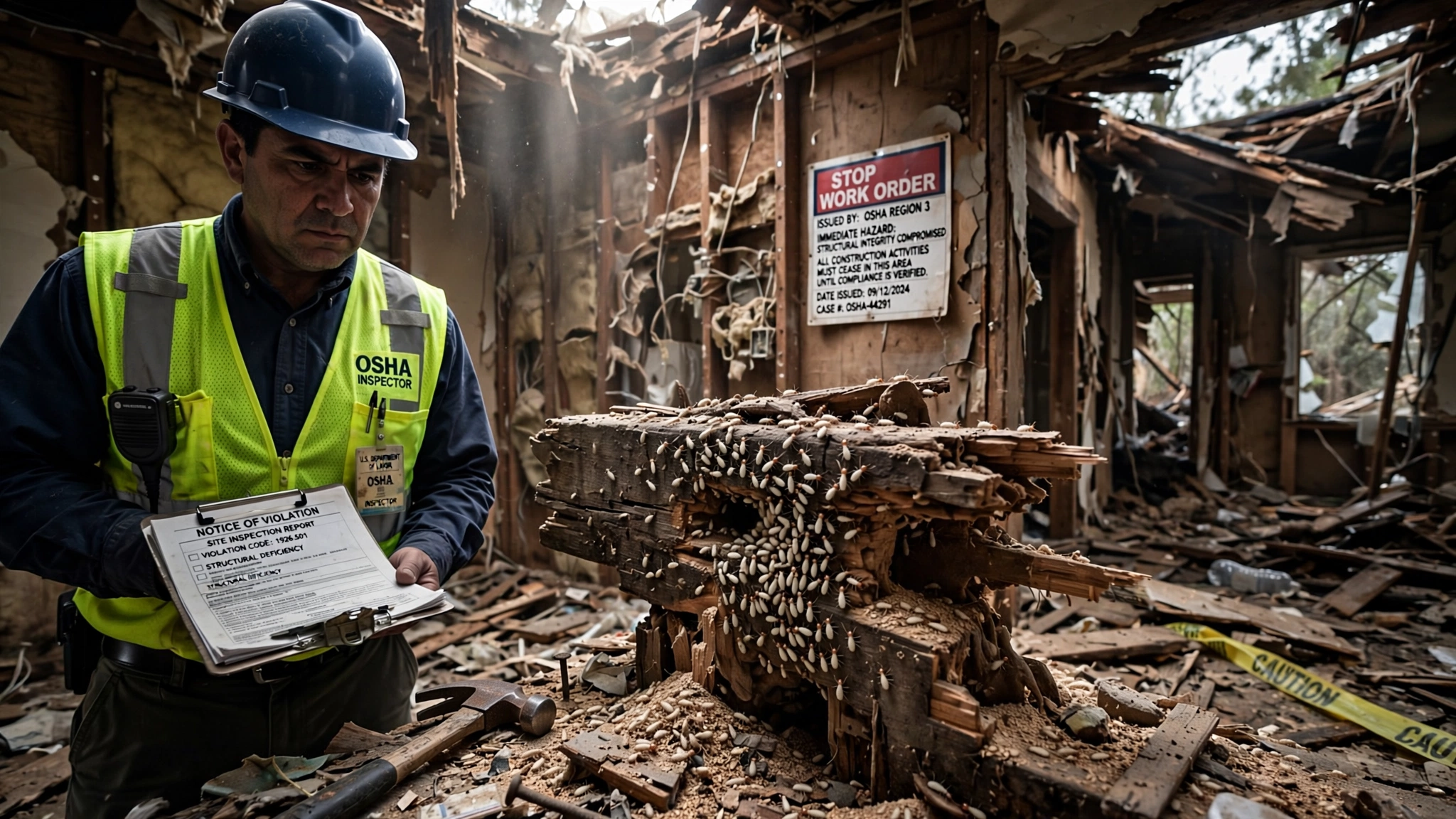
I. The Regulatory Framework for Demolition
The Occupational Safety and Health Act of 1970, 29 U.S.C. § 651 et seq., was enacted “to assure so far as possible every working man and woman in the Nation safe and healthful working conditions.”1 The Act created the Occupational Safety and Health Administration (OSHA) and charged it with promulgating and enforcing workplace safety standards across all industries, including construction. Demolition, by its nature, is among the most hazardous activities regulated under the Act.
OSHA’s demolition standards are codified at 29 CFR 1926, Subpart T (§§ 1926.850–1926.860). They are not suggestions. They are not best practices. They are mandatory federal workplace safety standards, violations of which carry civil and criminal penalties. The standards apply to every demolition operation in the United States, regardless of the operator’s phylogenetic classification.
Section 1926.850(a) is the gateway requirement. It provides: “Prior to permitting employees to start demolition operations, an engineering survey shall be made, by a competent person, of the structure to determine the condition of the framing, floors, and walls, and possibility of unplanned collapse of any portion of the structure.” The employer must maintain written evidence that the survey was performed.2
Section 1926.850(c) requires that “all electric, gas, water, steam, sewer, and other service lines shall be shut off, capped, or otherwise controlled, outside the building line before demolition work is started.” Each affected utility company must be notified in advance.3
Section 1926.850(e) requires that before demolition begins, it “shall also be determined if any type of hazardous chemicals, gases, explosives, flammable materials, or similarly dangerous substances have been used in any pipes, tanks, or other equipment on the property.” When such substances are suspected, “testing and purging shall be performed and the hazard eliminated before demolition is started.”4
These requirements exist because demolition kills people. The Bureau of Labor Statistics recorded 56 fatal injuries in the demolition and wrecking sector between 2011 and 2020.5 Every one of those deaths occurred during regulated demolition operations conducted by licensed firms. The question before us is what happens when the demolition is conducted by an unregulated workforce of approximately 10 quadrillion individuals that does not read English, does not retain counsel, and weighs approximately two milligrams per employee.
II. The Operator Identification
Termites are eusocial insects of the infraorder Isoptera within the order Blattodea. They are, taxonomically, cockroaches that developed a society.6 Approximately 3,000 species have been described worldwide. Roughly 50 of these are found in the United States, and approximately 20 are classified as structural pests, meaning they are known to invade and consume wooden structures.7 Termites are present in every state except Alaska, where their absence is attributable to climatic conditions rather than regulatory compliance.
The three principal categories of structural pest termites in the United States are subterranean, drywood, and dampwood. Of these, subterranean termites are the most economically significant. The eastern subterranean termite (Reticulitermes flavipes) is the most common species in North America, with mature colonies ranging from 20,000 to 5 million workers.8 The Formosan subterranean termite (Coptotermes formosanus), an invasive species introduced from southern China, is the most destructive single species, with colonies exceeding several million individuals and a consumption rate of approximately 13 ounces of wood per day, equivalent to roughly 300 pounds per year.9 A mature Formosan colony can severely damage a structure in as little as three months.10
Termites first appear in the fossil record approximately 130 million years ago, during the Early Cretaceous. Eusociality in the termite lineage is estimated to have originated approximately 150 million years ago, near the end of the Jurassic period.11 They have been in the demolition business since before the Atlantic Ocean finished opening. They predate flowering plants, primates, and the concept of a building permit by geological epochs.
There is no dispute that termites are demolition operators. They consume the structural elements of buildings: joists, studs, sill plates, subflooring, headers, and load-bearing walls. They do not renovate. They do not repair. They remove structural material until structural integrity is compromised. This is, by any definition used by OSHA, the building trades, or the insurance industry, demolition. The only unusual feature of their method is that they eat the debris.
III. The Damage Record
The National Pest Management Association (NPMA) estimates that termites cause $6.8 billion in property damage annually in the United States.12 The United States Department of Agriculture places the combined cost of termite control and repair at no less than $5 billion per year, with Formosan termite control alone accounting for $1 to $2 billion.13 When damage to both crops and man-made structures is included, the total annual toll reaches an estimated $30 billion.14
Approximately 600,000 homes are damaged by termites each year in the United States.15 The average homeowner who discovers an infestation spends $3,000 on repairs, though the figure can escalate into the tens of thousands for structures with extensive infestation. In extreme cases, termite damage has caused floor and roof collapse, rendering homes uninhabitable.16
For comparison, the CPSC recalls consumer products that cause individual-digit injuries. OSHA shuts down construction sites for missing guardrails. The EPA fines facilities for paperwork deficiencies in asbestos notification. Termites cause more annual property damage than tornadoes, fires, and earthquakes combined.17 No enforcement action has ever been initiated against any colony. The damage total for the past decade alone exceeds $60 billion, a figure that would have triggered a congressional investigation if the responsible contractor had a mailing address.
IV. The Engineering Survey Failure
Under 29 CFR 1926.850(a), no demolition operation may begin until a competent person has conducted an engineering survey of the structure and the employer has documented that survey in writing. A “competent person” is defined at 29 CFR 1926.32(f) as “one who is capable of identifying existing and predictable hazards in the surroundings or working conditions which are unsanitary, hazardous, or dangerous to employees, and who has authorization to take prompt corrective measures to eliminate them.”18
Termite colonies do not designate a competent person. The colony is organized into castes: workers, soldiers, and reproductives. Workers are responsible for foraging and feeding. Soldiers defend the colony. The queen produces eggs. None of these castes has been trained in structural engineering, hazard identification, or OSHA compliance. The worker caste, which performs all demolition activity, is blind.19 It navigates by chemical signal, not by visual assessment of structural load paths. It cannot read a blueprint. It cannot produce a written engineering survey. It does not, in any meaningful sense, know what a building is.
The standard does not exempt operators who are unaware of its existence. Ignorance of OSHA regulations is not a defense to an OSHA citation. When Yellow Stone Construction, Inc. failed to produce a written engineering survey before commencing demolition in Newark, New Jersey, in March 2019, OSHA assessed a serious violation penalty of $5,304.20 The penalty was imposed irrespective of whether the foreman had read the standard. The requirement is strict. The termite workforce has never read the standard. It has never produced a survey. It has never had authorization to take “prompt corrective measures,” because it has never identified a hazard. It is the hazard.
OSHA has cited human demolition contractors for this violation in every federal region. A survey of OSHA’s inspection database reveals hundreds of citations under § 1926.850(a) in the past decade, with penalties ranging from $1,200 to $9,054 per instance.21 The standard is actively enforced. It is enforced against every demolition operator in the country that happens to be a vertebrate. The invertebrate demolition industry operates in a regulatory vacuum that OSHA has not acknowledged and cannot close.
V. The Asbestos Problem
The EPA’s National Emission Standard for Hazardous Air Pollutants for Asbestos (the “Asbestos NESHAP”), codified at 40 CFR Part 61, Subpart M, requires a thorough inspection for asbestos-containing materials before any demolition of a covered facility. The regulation applies to demolitions of commercial, industrial, and institutional buildings, and to residential projects involving more than four dwelling units or those conducted for a commercial or public purpose.22
The inspection must identify all regulated asbestos-containing material (RACM) in the structure, including both friable and certain non-friable categories. When RACM is present, it must be removed before demolition in accordance with strict work practice standards, including adequate wetting, containment, and disposal in leak-tight containers. The owner or operator must notify the appropriate delegated entity, typically a state environmental agency, before any demolition begins.23
These requirements exist because demolition is the single most common cause of uncontrolled asbestos fiber release in the United States. Asbestos was used extensively in residential and commercial construction from the 1930s through the late 1970s, in insulation, floor tiles, roofing materials, pipe wrap, joint compound, and dozens of other building products. Any building constructed before 1980 is likely to contain asbestos-containing materials.24
Termites do not inspect for asbestos. They do not distinguish between materials containing asbestos and materials that do not. While termites primarily consume cellulose, their foraging activities damage and disturb a wide range of building materials as they tunnel through structures to reach wood sources. They penetrate drywall. They chew through insulation. They damage joint compound. All of these materials, in pre-1980 construction, may contain chrysotile, amosite, or crocidolite asbestos fibers.
No termite colony has ever filed an asbestos notification form with a delegated state agency. No colony has ever retained a licensed asbestos inspector. No colony has ever submitted a sample for polarized light microscopy or transmission electron microscopy analysis. No colony has ever prepared a work plan for the removal of regulated asbestos-containing material prior to commencing demolition. The Asbestos NESHAP has been in effect since 1973. Termites have been demolishing American structures since the first wooden building was erected on the continent. The notification rate is zero. The inspection rate is zero. The compliance rate, across all regulated facilities demolished by termites in the past 53 years, is zero.
VI. The Contractor Licensing Violation
Every state in the union, plus the District of Columbia, regulates contracting work through licensing requirements. The specific requirements vary by jurisdiction, but the universal principle is identical: an entity performing construction or demolition work must obtain a license, demonstrate competency, and carry insurance.
In California, Business and Professions Code § 7028 provides that “it is a misdemeanor for any person to engage in the business of, or act in the capacity of, a contractor within this state” without a license. A first offense is punishable by a fine of up to $5,000, imprisonment for up to six months, or both. Subsequent offenses carry mandatory minimum sentences of 90 days and fines of 20 percent of the contract price or $5,000, whichever is greater.25
In Florida, which ranks first in the nation for termite activity, the Construction Industry Licensing Board administers contractor licensing under Chapter 489 of the Florida Statutes. Unlicensed contracting is a first-degree misdemeanor on the first offense and a third-degree felony on the second.26 In Texas, which ranks third, the Texas Occupations Code requires licensing for all demolition contractors performing work in municipalities.27
Termites are present in 49 states. They perform demolition work in all 49. They hold zero contractor’s licenses. They have passed zero competency examinations. They carry zero dollars in general liability insurance. They have posted zero surety bonds. They maintain zero workers’ compensation policies.
The California Contractors State License Board (CSLB) operates sting operations targeting unlicensed contractors, issuing hundreds of citations per year. In fiscal year 2022–2023, the CSLB referred 489 cases for criminal prosecution.28 None of these cases involved a defendant from the order Blattodea. The CSLB’s online license lookup tool does not include an option for searching by genus, species, or colony identification number. The enforcement infrastructure assumes the contractor is a legal person with a Social Security number, a physical address, and the capacity to appear in court. Termites satisfy none of these administrative prerequisites. They do not have Social Security numbers. They do have Social Security, in the evolutionary sense, but this is not the same thing.
VII. The Utility Disconnection Failure
Section 1926.850(c) is explicit: all electric, gas, water, steam, sewer, and other service lines must be shut off, capped, or otherwise controlled before demolition work is started. The affected utility company must be notified in advance. This requirement exists to prevent electrocution, gas explosions, water damage, and sewage contamination during structural removal.
Termites do not contact the utility company. They do not submit a disconnection request. They do not wait for a utility crew to arrive and shut off service before commencing work. They begin eating the moment they arrive, which is often years before the homeowner becomes aware of their presence. A typical termite colony has been actively demolishing a structure for five or more years before damage becomes visible.29
During these years of unannounced demolition, the electrical system remains fully energized. Gas lines remain pressurized. Water lines remain charged. Termites tunnel through and around all of these systems. Subterranean termites build mud tubes that can bridge gaps between soil and structural wood, sometimes traversing electrical conduit and plumbing in the process. Formosan subterranean termites are known to infest boats, concrete structures, and high-rise condominiums, environments in which the utility infrastructure is particularly complex and the consequences of an unplanned disconnection are particularly severe.30
The OSHA standard does not contain an exemption for demolition operators that are physically incapable of operating a utility shutoff valve. The standard states “shall be shut off.” It does not state “shall be shut off, unless the operator lacks opposable thumbs.” A human demolition contractor that began structural removal with live electrical wires in the work area would face a serious citation under § 1926.850(c) and a penalty of up to $16,550.31 A termite colony that does the same thing faces nothing. The wall is live. The demolition continues. The utility company is never called.
VIII. The Hazardous Materials Noncompliance
Section 1926.850(e) requires the demolition operator to determine whether hazardous chemicals, gases, explosives, flammable materials, or similarly dangerous substances are present in the structure before demolition begins. The presence of such substances must be tested for and the hazard eliminated before work starts.
American homes built before 1978 may contain lead-based paint. Homes built before 1980 may contain asbestos in multiple building components. Homes with attached garages frequently store gasoline, solvents, pesticides, and other hazardous materials. Homes with oil heating systems contain fuel oil in basement tanks. Homes with natural gas service have combustible fuel piped directly through their structural cavities.
Termites test for none of these substances. Their sensory apparatus is optimized for the detection of cellulose, moisture gradients, and pheromone trails.32 They cannot detect asbestos because asbestos is odorless to all organisms, including organisms with functional olfactory systems, which termite workers do not have in any form relevant to hazardous material identification. They cannot detect lead because lead paint tastes the same as any other surface coating to a mandible designed to shear wood fibers. They cannot detect natural gas because methane detection is not a feature of the termite chemosensory repertoire.
The result is that termite demolition operations proceed through and around every category of hazardous material that § 1926.850(e) was designed to identify and control. The testing requirement is unfulfilled. The purging requirement is unfulfilled. The hazard elimination requirement is unfulfilled. A human contractor operating under these conditions would be cited, fined, and potentially referred for criminal prosecution under the willful violation provisions of the OSH Act. The termite contractor has been operating under these conditions since the Early Cretaceous.
IX. The Workers’ Compensation Gap
Workers’ compensation laws in all 50 states require employers to provide insurance coverage for employees injured on the job. In the construction industry, this requirement is enforced with particular rigor because of the high incidence of workplace injuries. Demolition work carries among the highest workers’ compensation premiums of any construction classification.
A termite colony is, by any labor standard, an employer. It maintains a workforce of hundreds of thousands to millions of individuals. It assigns tasks by caste. Workers forage for food and maintain the nest. Soldiers defend the colony. The queen directs reproductive output. The division of labor is more rigid than any Fortune 500 organizational chart. It is, in the language of the NLRA, “an employer engaged in commerce.”33
Termite workers are injured and killed on the job constantly. They are crushed by collapsing tunnels, consumed by predators during foraging operations, and killed by the very pesticides that represent the only enforcement mechanism society has deployed against them. The mortality rate of the termite workforce is staggering by human occupational safety standards. Life expectancy for a worker termite is one to two years, during which it performs continuous manual labor without rest periods, meal breaks, or overtime compensation.34
No workers’ compensation policy has been issued to any termite colony in any state. No premium has been paid. No claim has been filed. No lost-time injury has been reported on an OSHA 300 log. The colony does not maintain an OSHA 300 log. It does not maintain any records. It cannot write.
X. The Penalty Exposure
Under the current OSHA penalty schedule, effective January 15, 2025, the maximum penalty for a serious violation is $16,550 per instance. The maximum penalty for a willful or repeated violation is $165,514 per instance. The failure-to-abate penalty is $16,550 per day beyond the abatement date.35
A single termite colony operating in a single American home is simultaneously in violation of, at minimum: § 1926.850(a) (no engineering survey), § 1926.850(c) (no utility disconnection), § 1926.850(e) (no hazardous materials determination), the Asbestos NESHAP notification requirement, and the contractor licensing law of the state in which it operates. If each of these is assessed as a separate serious violation, the per-colony penalty is approximately $82,750.
There are an estimated 600,000 active termite infestations in American homes per year. At $82,750 per colony, the annual aggregate OSHA penalty exposure is approximately $49.7 billion. This exceeds the $6.8 billion in actual property damage the colonies inflict. It exceeds OSHA’s total penalty assessments across all industries in fiscal year 2023, which totaled approximately $297 million, by a factor of 167.36
If the violations are assessed as willful, which they are by any plain reading of the term, since the colonies have been operating in knowing disregard of federal law for 130 million years, the maximum penalty per colony rises to approximately $827,570. The aggregate annual exposure then exceeds $496 billion, a figure that approaches the entire annual defense budget of the United States.
Under California Business and Professions Code § 7028, the additional state-level penalty exposure for unlicensed contracting is a minimum of $5,000 per colony on first offense, or 20 percent of the “contract price” on subsequent offenses. Since the colonies do not charge for their services, the contract price is technically zero. Twenty percent of zero is zero. This is the only compliance metric at which the termite industry outperforms the human demolition industry. It achieves this result not through legal sophistication but through the absence of a billing department.
XI. The Stop-Work Order Impossibility
When OSHA identifies an imminent danger at a worksite, the authorized representative may request a temporary restraining order from a federal district court under Section 13(a) of the OSH Act, 29 U.S.C. § 662(a). In practice, OSHA compliance officers issue informal stop-work recommendations, and formal injunctive relief is pursued in cases of extreme hazard.
A stop-work order assumes a recipient capable of stopping work. It assumes literacy. It assumes a chain of command through which the order can propagate from the recipient to the workers at the job site. It assumes, at minimum, that the operator is aware it is being addressed.
Termite colonies communicate through pheromones, vibrations, and direct physical contact. They do not receive mail. They do not answer phone calls. They do not check their email. They do not have a registered agent for service of process. They do not attend administrative hearings. A termite colony served with a federal court order would not read it. It would eat it, if the paper contained sufficient cellulose content, which standard legal paper does.
The practical effect is that OSHA’s enforcement apparatus is structurally incapable of reaching the single most prolific demolition operation in the country. The agency can cite a human contractor, fine it, shut it down, and refer it for criminal prosecution. It cannot cite a termite colony, because a termite colony cannot be identified by name. It cannot fine a termite colony, because a termite colony has no assets denominated in United States currency. It cannot shut down a termite colony through administrative process, because the colony does not recognize administrative process. It recognizes pheromones. The Federal Register is not available in pheromone format.
XII. The Insurance Exclusion
Standard homeowners’ insurance policies in the United States universally exclude termite damage from coverage.37 The rationale offered by the insurance industry is that termite damage is “preventable” through regular inspection and treatment, and therefore constitutes a maintenance failure rather than a covered peril. This reasoning treats the $6.8 billion annual damage figure as the homeowner’s problem, not the insurer’s, and certainly not the regulator’s.
The exclusion creates an extraordinary regulatory anomaly. When a licensed human demolition contractor damages an adjacent property through negligence, the contractor’s general liability insurance covers the claim. When an unlicensed, uninsured, unbonded termite colony demolishes a homeowner’s load-bearing wall, neither the colony’s nonexistent insurance nor the homeowner’s actual insurance covers the loss. The homeowner bears the full cost. The colony faces no penalty. The regulator issues no citation. The insurer pays nothing.
This is the only context in American regulatory life in which an operator causing $6.8 billion in annual damages to residential structures operates entirely outside the reach of both the regulatory enforcement system and the private insurance system simultaneously. A meteor could cause less damage and trigger a more robust government response.
XIII. Conclusion
OSHA’s demolition standards require an engineering survey by a competent person. Termites employ no competent person. They perform no survey. They maintain no written records. The EPA’s Asbestos NESHAP requires inspection and notification before any demolition. Termites inspect for nothing except cellulose. They notify no one. Every state requires a contractor’s license for demolition work. Termites hold no license in any state, any county, any city, or any other jurisdiction on the North American continent.
They have been demolishing structures since before the K-Pg extinction event that eliminated the non-avian dinosaurs. They were demolishing wood 65 million years before the first human built something worth demolishing. They are found in 49 states, operating in colonies numbering in the millions, consuming wood at rates measured in hundreds of pounds per year per colony, and collectively inflicting more property damage than any natural disaster tracked by FEMA.
The regulatory infrastructure built to govern demolition in the United States is comprehensive, detailed, and aggressively enforced. It accounts for utility disconnection, hazardous materials survey, asbestos abatement, engineering review, licensing, bonding, insurance, and workers’ compensation. It does not account for an operator that is six millimeters long, blind, and communicates by licking its coworkers.
The enforcement gap is not administrative. It is not a matter of insufficient staffing or underfunding. It is a gap between the regulatory assumption that the demolition operator is a legal person and the entomological fact that the most active demolition operator in the country is an insect that evolved from a cockroach 150 million years ago and has been eating buildings without a permit ever since.
No stop-work order has been issued. No engineering survey has been demanded. No citation has been written. No fine has been assessed. No contractor’s license has been required, revoked, or suspended. The total regulatory response to 130 million years of continuous, unauthorized, uninsured, uninspected, and unlicensed demolition activity across 49 states is a $6.8 billion annual repair bill paid entirely by homeowners, and a pest control industry that has assumed the enforcement role that OSHA, the EPA, and 50 state contractor licensing boards have collectively declined to fill.
Ergo.
Sources
- Occupational Safety and Health Act of 1970, 29 U.S.C. § 651(b), Congressional declaration of purpose and policy. law.cornell.edu ↑
- 29 CFR § 1926.850(a), Preparatory operations for demolition. osha.gov ↑
- 29 CFR § 1926.850(c), Utility shutoff requirements. osha.gov ↑
- 29 CFR § 1926.850(e), Hazardous substances determination. osha.gov ↑
- Bureau of Labor Statistics, Census of Fatal Occupational Injuries, 2011–2020. NAICS 238910 (Site Preparation Contractors) and 238990 (All Other Specialty Trade Contractors, including wrecking and demolition). bls.gov ↑
- Bourguignon, T. et al., “The Evolutionary History of Termites as Inferred from 66 Mitochondrial Genomes,” Molecular Biology and Evolution, vol. 32, no. 2, pp. 406–421, 2015. Termites are nested within Blattodea; the sister group is Cryptocercus. pubmed.ncbi.nlm.nih.gov ↑
- Terminix, “Where Are Termites Most Common in the U.S.,” updated February 2026. Approximately 50 species in the U.S.; roughly 20 classified as structural pests. terminix.com ↑
- Reticulitermes flavipes, Wikipedia. Mature colony range: 20,000 to 5 million workers; queen lays 5,000 to 10,000 eggs per year. en.wikipedia.org ↑
- UF/IFAS Extension Monroe County, “A Changing Landscape in Subterranean Termite Control,” summary of presentation by Dr. Thomas Chouvenc. Mature Formosan colony can consume about 300 pounds of wood per year. blogs.ifas.ufl.edu ↑
- Coptotermes formosanus, Wikipedia. A mature colony can consume 13 ounces of wood per day (~400 g) and severely damage a structure in as little as three months. en.wikipedia.org ↑
- Bucek, A. et al., “Termite Evolution: Mutualistic Associations, Key Innovations, and the Rise of Termitidae,” Cellular and Molecular Life Sciences, vol. 77, pp. 2749–2769, 2020. Eusociality ~150 Mya; earliest fossils ~130 Mya (Early Cretaceous). pubmed.ncbi.nlm.nih.gov ↑
- National Pest Management Association (NPMA), “Termites Eat Right Through American Homes and Most Owners Won’t See It Coming,” March 2, 2026. Estimated $6.8 billion in property damage annually. pestworld.org ↑
- Orkin, “Termite Damage Statistics.” USDA estimates at least $1 billion per year on Formosan termite control and repairs alone; some experts estimate closer to $2 billion. orkin.com ↑
- Orkin, supra note 13. Combined damage to crops and man-made structures: estimated $30 billion per year. ↑
- Orkin, supra note 13. Approximately 600,000 homes damaged per year. ↑
- Massey Services, “Termite Damage Cost.” Extensive infestations can cause floor and roof collapse. masseyservices.com ↑
- Massey Services, supra note 16. Termites cause more damage to homes than tornadoes, fires, and earthquakes combined. ↑
- 29 CFR § 1926.32(f), Definitions: “Competent person.” osha.gov ↑
- Krishna, K. and Weesner, F.M. (eds.), Biology of Termites, Academic Press, 1969–1970. Worker termites of subterranean species are blind, relying on chemical and tactile communication. ↑
- OSHA Inspection Nr. 1384953.015, Yellow Stone Construction, Inc., Citation 01001, Serious, Initial Penalty: $5,304.00. Newark, NJ, March 11, 2019. Failure to produce written evidence of engineering survey per § 1926.850(a). osha.gov ↑
- See also OSHA Inspection Nr. 1275852.015, Remedial Services, Inc., $9,054 penalty; Inspection Nr. 1055903.015, Russ James Contracting, Inc., $1,200 penalty (settled); Inspection Nr. 1020076.015, Kokosing Construction Company, Inc., $7,000 penalty. All cited under § 1926.850(a). osha.gov ↑
- EPA, “Overview of the Asbestos National Emission Standards for Hazardous Air Pollutants (NESHAP),” 40 CFR Part 61, Subpart M. Applies to demolitions of commercial, industrial, and institutional buildings, and residential projects exceeding four dwelling units or conducted for commercial/public purpose. epa.gov ↑
- EPA, “Asbestos-Containing Materials (ACM) and Demolition.” The regulation requires thorough inspection, notification, and work practice standards for asbestos removal prior to demolition. epa.gov ↑
- EPA, “Learn About Asbestos.” Asbestos was widely used in building materials through the late 1970s. epa.gov ↑
- Cal. Bus. & Prof. Code § 7028(a)–(c). First offense: misdemeanor, up to $5,000 fine and/or six months imprisonment. Subsequent offenses: 20% of contract price or $5,000, whichever is greater, plus mandatory minimum 90 days. law.justia.com ↑
- Fla. Stat. § 489.127. Unlicensed practice: first offense is a first-degree misdemeanor; second offense is a third-degree felony. flsenate.gov ↑
- Tex. Occ. Code § 214.002, contractor licensing in municipalities. statutes.capitol.texas.gov ↑
- California Contractors State License Board (CSLB), Annual Report 2022–2023. Criminal referrals for unlicensed contracting: 489 cases. cslb.ca.gov ↑
- Orkin, supra note 13. Colonies typically take more than five years to grow to a size capable of causing visible damage. ↑
- Coptotermes formosanus, Wikipedia, supra note 10. Formosan termites infest a wide variety of structures, including boats and high-rise condominiums. ↑
- 29 CFR § 1903.15(d)(3), as adjusted January 15, 2025. Maximum penalty for a serious violation: $16,550 per violation. osha.gov ↑
- Krishna and Weesner, supra note 19. Termite foraging behavior is mediated by pheromone trails, moisture gradients, and vibration signals. ↑
- National Labor Relations Act, 29 U.S.C. § 152(2), definition of “employer.” An employer is “any person acting as an agent of an employer, directly or indirectly.” law.cornell.edu ↑
- Lee, K.E. and Wood, T.G., Termites and Soils, Academic Press, 1971. Worker termite lifespan: 1–2 years in most subterranean species. ↑
- 29 CFR § 1903.15(d), OSHA penalty adjustments effective January 15, 2025. Serious: up to $16,550; willful/repeated: up to $165,514; failure to abate: up to $16,550/day. osha.gov ↑
- OSHA Enforcement Data, FY2023. Total federal OSHA penalties: approximately $297 million across all industries. osha.gov ↑
- NPMA, supra note 12. Standard homeowners insurance policies almost universally exclude termite damage from coverage. ↑