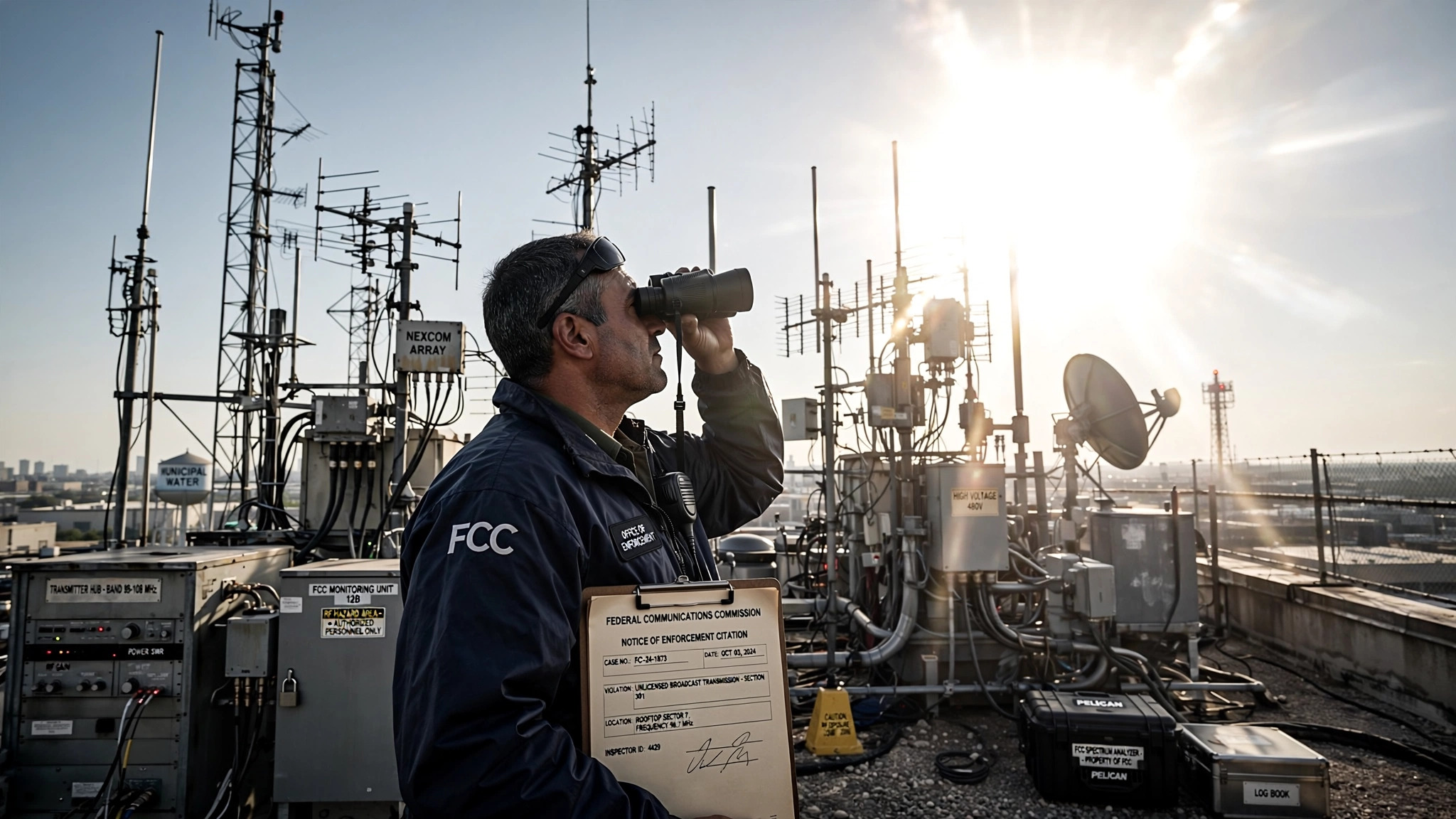
I. The Statutory Framework
The Communications Act of 1934, codified at 47 U.S.C. § 151 et seq., established the Federal Communications Commission and granted it authority over “all the channels of radio transmission.” The statute was enacted to bring order to the electromagnetic spectrum, which Congress recognized as a finite public resource subject to interference, congestion, and abuse.1
Section 301 of the Act, codified at 47 U.S.C. § 301, sets forth the foundational licensing requirement: “No person shall use or operate any apparatus for the transmission of energy or communications or signals by radio” within the United States, between states, or from any place within the United States to any foreign country, “except under and in accordance with this chapter and with a license in that behalf granted under the provisions of this chapter.”2
The prohibition is comprehensive. It covers transmission “from one place in any State … to another place in the same State.” It covers transmission “from any State … to any other State.” It covers transmission whose “effects … extend beyond the borders of said State.” It covers transmission that causes “interference … with the transmission or reception of such energy, communications, or signals.” The statute does not limit its reach to intentional communication. It covers the transmission of “energy” by radio. Energy is energy. The statute does not ask why it was transmitted. It asks whether it was transmitted without a license.
Section 503(b) of the Act, codified at 47 U.S.C. § 503(b), authorizes the Commission to impose forfeiture penalties on any person who “willfully or repeatedly” violates the Act or any rule or regulation of the Commission. The Preventing Illegal Radio Abuse Through Enforcement Act of 2020 (PIRATE Act), codified at 47 U.S.C. § 511, enhanced penalties for unlicensed broadcasting to a maximum of $2,000,000 per offense, adjusted for inflation to $2,391,097 in 2024, with additional penalties of up to $119,555 per day of continued violation.3
The framework is clear. Any apparatus that transmits energy by radio within or into the United States must be licensed. Any unlicensed transmission is subject to enforcement action and financial penalty. The question is whether the most prolific source of radio-frequency energy reaching the territory of the United States has ever been brought within this framework. It has not.
II. The Transmitter Identification
The Sun is a G-type main-sequence star (spectral class G2V) located at the center of the Solar System, approximately 149.6 million kilometers from the Earth.4 It has a mass of approximately 1.989 × 1030 kilograms, a radius of approximately 696,000 kilometers, and a surface temperature of approximately 5,778 Kelvin. It has been in continuous operation for approximately 4.6 billion years.5
The Sun’s total electromagnetic output—its luminosity—is approximately 3.828 × 1026 watts, a value adopted by the International Astronomical Union in 2015 as the nominal solar luminosity.6 This power is radiated isotropically into space across the entire electromagnetic spectrum, from radio waves through microwaves, infrared, visible light, ultraviolet, X-rays, and gamma rays.
The Sun is not a quiet object. It is a thermonuclear reactor whose core temperature exceeds 15 million Kelvin, fusing approximately 600 million metric tons of hydrogen into helium every second.7 The energy produced by this process propagates outward through the radiative and convective zones of the solar interior and is emitted from the photosphere, chromosphere, and corona as electromagnetic radiation. A portion of this radiation falls within the radio-frequency spectrum. That portion has been reaching the Earth, and every FCC-regulated frequency band within it, since before the Earth had an atmosphere to receive it.
The transmitter is not small. It is not portable. It is not easily seized by the Enforcement Bureau’s field agents. It has a diameter of approximately 1.39 million kilometers. It is located 93 million miles from the nearest FCC field office. It has no mailing address, no registered agent, and no compliance department. It does not respond to Notices of Apparent Liability.
III. The Frequency Occupation
The FCC administers the electromagnetic spectrum from 3 kHz to 300 GHz, encompassing every frequency band used for AM radio, FM radio, television, cellular communications, Wi-Fi, GPS, Bluetooth, satellite communications, radar, and every other radiocommunication service operating in the United States.8 This spectrum is divided into thousands of allocations across approximately 450 frequency bands, each assigned to specific services with specific power limits, modulation standards, and geographic constraints.
The Sun transmits across all of them.
Solar radio emission spans the entire radio-frequency spectrum, from below 10 kHz to well above 300 GHz.9 The quiet Sun emits a continuous, broadband radio signal produced by thermal bremsstrahlung radiation from the solar corona and chromosphere. This baseline emission occupies every frequency band in the FCC’s Table of Frequency Allocations simultaneously. It does not pause. It does not reduce power during nighttime hours. It does not observe the 1:00 AM sign-off that AM stations once maintained as a courtesy to distant-signal listeners. It has been transmitting on every allocated frequency since 4.6 billion years before the first allocation was made.
During periods of solar activity, the Sun’s radio output increases dramatically. The Bureau of Meteorology’s Space Weather Services classifies solar radio bursts into five types, each occupying different frequency ranges. Type I bursts operate at 80–200 MHz, within the FM broadcast and VHF television bands. Type II bursts drift through 20–150 MHz, spanning the VHF spectrum. Type III bursts cover 10 kHz to 1 GHz, occupying AM, FM, VHF, UHF, and the lower microwave bands simultaneously in bursts lasting one to three seconds. Type IV bursts produce broadband continuum emission from 20 MHz to 2 GHz, lasting hours to days and blanketing the spectrum used by FM radio, television, cellular networks, GPS, and air traffic control radar.10
The National Oceanic and Atmospheric Administration measures the Sun’s radio output at 10.7 centimeters (2,800 MHz) as the standard solar activity index, known as the F10.7. This measurement has been recorded continuously since 1947, first at Ottawa, Ontario, and then at the Dominion Radio Astrophysical Observatory in Penticton, British Columbia.11 The F10.7 ranges from below 50 solar flux units during solar minimum to above 300 solar flux units during solar maximum, where one solar flux unit equals 10−22 watts per square meter per hertz. This is the most carefully monitored unlicensed radio transmission in history. The monitoring entity has never filed a complaint.
IV. The Power Level Problem
The FCC authorizes licensed broadcasting stations to operate at strictly limited power levels. Under 47 CFR § 73.211, the maximum effective radiated power for an FM broadcast station is 100 kilowatts for a Class C station operating at a height above average terrain of 600 meters.12 Under 47 CFR § 73.21, the maximum power for an AM broadcast station is 50 kilowatts for a Class A clear-channel station.13 Under 47 CFR Part 15, unlicensed intentional radiators are limited to power levels measured in milliwatts.14
The Sun’s total radiated power is 3.828 × 1026 watts. The fraction emitted in the radio-frequency spectrum below 300 GHz varies with solar activity but is estimated at approximately 1016 to 1017 watts during quiet conditions and up to 1020 watts during major solar radio bursts.15
The most powerful licensed FM station in the United States operates at 100,000 watts. The quiet Sun’s radio output is approximately 1016 watts. This is 100 billion times the maximum licensed FM power. During a major solar radio burst, the ratio increases to approximately one quadrillion to one.
As of December 31, 2025, the FCC reported 15,686 full-power radio stations licensed in the United States: 4,342 AM stations, 6,589 commercial FM stations, and 4,755 educational FM stations.16 If every one of these stations operated simultaneously at maximum authorized power—a physical impossibility, since AM and FM maximum powers differ and most stations operate well below their authorized limits—their combined output would be approximately 1.1 × 10⁹ watts, or roughly 1.1 gigawatts. The Sun’s quiet radio output exceeds this combined total by a factor of approximately ten million. During a burst, the factor approaches one hundred billion.
The Sun does not comply with Part 15 power limits. It does not comply with Part 73 power limits. It does not comply with any power limit established by any regulatory authority on Earth. Its effective radiated power, in every direction simultaneously, exceeds the entire licensed broadcasting infrastructure of the United States by orders of magnitude that the regulatory framework was not designed to express.
V. The Interference Record
Under 47 U.S.C. § 333, no person shall willfully or maliciously interfere with or cause interference to any radio communications of any station licensed or authorized under the Act. The Sun’s interference with licensed radio communications is not theoretical. It is documented, quantified, and ongoing.
On December 6, 2006, a solar radio burst caused large numbers of GPS receivers to stop tracking the GPS signal across the entire sunlit side of Earth. Researchers at Cornell University and the New Jersey Institute of Technology measured the event and found that the burst produced approximately 20,000 times more radio noise than the entire rest of the Sun at the frequencies used by GPS receivers. “This was enough to swamp GPS receivers over the entire sunlit side of Earth,” reported Dale Gary, chair of the physics department at NJIT.17 The event occurred during solar minimum, when the Sun’s activity was at its lowest point in the eleven-year solar cycle. The researchers expressed concern that “more severe consequences will occur during the next solar maximum.”
On November 4, 2015, an intense solar radio burst disrupted air traffic control radars in Sweden, with milder disturbances observed elsewhere in Europe. The timing of the radar disruptions coincided precisely with strong solar radio emission near 1,000 MHz, within the L-band frequency range used by air surveillance radar systems.18 Air traffic controllers temporarily lost radar contact with aircraft in Swedish airspace. The interference was caused by the Sun.
In August 2025, NASA missions tracked a record-breaking Type IV solar radio burst that lasted 19 days—nearly four times the previous record of five days. The burst was fueled by a trio of coronal mass ejections from the same active region and was observed by NASA’s STEREO, Parker Solar Probe, and Wind missions, as well as ESA’s Solar Orbiter.19 For 19 consecutive days, the Sun broadcast a continuous, broadband radio signal across frequencies used by licensed services, without authorization, without coordination, and without a single filing with the Commission.
NOAA’s Space Weather Prediction Center maintains a five-level Radio Blackout Scale (R1 through R5) to classify the severity of solar-induced radio interference. An R5 event—classified as “Extreme”—produces “complete HF radio blackout on the entire sunlit side of the Earth lasting for a number of hours,” resulting in “no HF radio contact with mariners and en route aviators.”20 The scale acknowledges approximately 2,000 R1 events, 350 R2 events, and 175 R3 events per eleven-year solar cycle. The Sun causes more documented interference events per decade than the entire history of FCC pirate radio enforcement has addressed in the agency’s ninety-two-year existence.
VI. The Discovery as Enforcement Trigger
The Sun’s status as a radio transmitter has been known to the scientific community—and to military authorities with jurisdiction over radio spectrum—since February 1942. During the Second World War, British Army radar operators detected anomalous interference that jammed anti-aircraft radar systems operating in the 4–6 meter wavelength band. The interference was traced to the Sun. The discovery was classified as a military secret.
The finding was declassified and published in 1946 by J. S. Hey in Nature, in a paper titled “Solar Radiations in the 4–6 Metre Radio Wave-Length Band.” Hey reported that the solar radiation was “of the order of 105 times the power expected from the sun, assuming that the sun behaves as a perfect black-body radiator at a temperature of 6,000° K.”21 The paper established that the Sun was not merely a passive celestial body but an active radio transmitter emitting energy at power levels sufficient to interfere with military communications equipment.
The Communications Act was already twelve years old when Hey published his findings. The FCC was already operational. The licensing requirement of Section 301 was already in force. The Sun had been transmitting energy by radio into the territory of the United States for 4.6 billion years, but only since 1946 has the responsible enforcement agency been on constructive notice of the violation. That notice is now eighty years old. The enforcement response has been silence.
Under the Commission’s own enforcement precedents, constructive knowledge of an unlicensed radio transmission triggers an obligation to investigate. When the Enforcement Bureau receives a complaint of interference, it dispatches field agents with direction-finding equipment to locate the source. In this case, the source has been located. It is 93 million miles away. It rises in the east every morning. Its location is published daily by the United States Naval Observatory. It is the most conspicuous unlicensed transmitter in the visible universe.
VII. The Equipment Authorization Gap
Under 47 CFR Part 2, Subpart J, radio-frequency devices marketed or operated in the United States must obtain an equipment authorization from the Commission prior to use. Depending on the device category, this may take the form of Certification, Supplier’s Declaration of Conformity, or compliance with the technical standards specified in Part 15 or other applicable rule parts.22 The authorization process requires the submission of test reports demonstrating compliance with emission limits, a description of the device’s circuitry and operating characteristics, and assignment of an FCC Identifier (FCC ID) that must be affixed to the device.
The Sun has not obtained an equipment authorization. It has not submitted test reports. It has not been assigned an FCC ID. No label bearing an FCC ID has been affixed to its surface, which operates at approximately 5,778 Kelvin and is therefore inhospitable to adhesive labeling materials.
The Sun’s emission characteristics would not pass the certification process. Part 15 devices are limited to field strength levels measured in microvolts per meter at specified distances. The Sun’s radio emissions produce field strengths at the Earth’s surface that can exceed 10,000 solar flux units during extreme events, each unit representing 10−22 watts per square meter per hertz.23 At these levels, the Sun exceeds Part 15 emission limits by a margin so large that the Commission’s Office of Engineering and Technology would need to invent a new notation system to express the degree of noncompliance.
The manufacturer of the device—if one can be identified—is the gravitational collapse of a molecular cloud in the Orion Arm of the Milky Way galaxy, approximately 4.6 billion years ago.24 The manufacturer has not registered with the Commission. It has not designated a United States agent for service of process. It has not filed an application for equipment authorization under any rule part. The device entered the market approximately 4.6 billion years before the market existed.
VIII. The Call Sign Problem
Under 47 U.S.C. § 303(o), the Commission is authorized to designate call letters for all radio stations. Under FCC rules, every licensed broadcast station in the United States must identify itself by its assigned call sign at regular intervals. AM and FM stations must broadcast their call signs at the beginning and end of each period of operation and at least once per hour.25
The Sun does not identify itself by call sign. It has never been assigned one. Under the FCC’s call sign assignment conventions, broadcast stations west of the Mississippi River receive call signs beginning with “K,” while stations east of the Mississippi receive call signs beginning with “W.”26 The Sun is not located on either side of the Mississippi River. It is not located within the boundaries of any state, territory, or possession of the United States. It is located approximately one astronomical unit from the nearest FCC field office, in a jurisdiction that the Communications Act did not contemplate.
The absence of a call sign means that the Sun cannot legally identify itself, even if it wished to comply with the identification requirements. A station that cannot be identified cannot be monitored. A station that cannot be monitored cannot be held accountable. The Sun has exploited this procedural gap for 4.6 billion years, though “exploited” implies intent, which implies cognition, which the Sun does not possess. It simply transmits. It has always simply transmitted. The regulatory framework was built around it, and it did not notice.
As of June 2026, the FCC maintains approximately 2.9 million active licenses in its Universal Licensing System database, covering broadcast, commercial, amateur, and public safety stations.27 Not one of these licenses has been issued to the Sun, to the Solar System, or to any celestial body. The most powerful transmitter affecting American radio spectrum operates entirely outside the licensing system. The system has been aware of this for eighty years. The system has not adjusted.
IX. The PIRATE Act Exposure
The PIRATE Act of 2020 was enacted specifically to address the problem of unlicensed broadcasting. The Act defines “pirate radio broadcasting” as “the transmission of communications on spectrum frequencies between 535 kilohertz and 1,705 kilohertz, between 87.7 megahertz and 108 megahertz, or, as otherwise designated by the Commission by rule, by any person who does not possess a license from the Commission.”28
The Sun transmits on every frequency between 535 kHz and 1,705 kHz. It transmits on every frequency between 87.7 MHz and 108 MHz. It does not possess a license from the Commission. The statutory definition of pirate radio broadcasting is satisfied in its entirety.
Under 47 U.S.C. § 511(a), any person who “willfully and knowingly does or causes or suffers to be done any pirate radio broadcasting” is subject to a fine of not more than $2,391,097, as adjusted for inflation. Under § 511(b), additional penalties of up to $119,555 per day apply for continued violations.29
The Commission has applied these penalties vigorously to terrestrial offenders. On March 15, 2023, the Commission proposed its first fines under the PIRATE Act: $2,316,034 against César Ayora and Luis Angel Ayora for operating an unauthorized station known as “Radio Impacto 2” on 105.5 MHz in Queens, New York.30 On November 16, 2023, the Commission proposed a $1,780,000 fine against Matthew Bowen for operating “Triple9HD” on 99.9 MHz in Brooklyn, New York, for a minimum of 89 days.31
The Sun has been broadcasting on 99.9 MHz, 105.5 MHz, and every other frequency in the FM band for approximately 4.6 billion years, or roughly 1.68 × 10¹² days. If the per-day penalty of $119,555 were applied for each day of unlicensed FM-band transmission, the aggregate fine would be approximately $2.01 × 10¹⁷, or $201 quadrillion. This exceeds the gross world product, estimated at approximately $105 trillion in 2024, by a factor of approximately 1,914.32 The Sun does not have a bank account. It does not have assets that can be seized. It has no revenue from which to pay a forfeiture. The largest fine the Commission has ever proposed—$2,316,034 against the Ayora brothers—would cover approximately 0.000000000000001 percent of the Sun’s calculated liability.
Under § 511(c), any person who “knowingly and intentionally facilitates pirate radio broadcasting” is subject to the same penalties. The Earth, which provides the atmosphere and magnetosphere that propagate and modulate the Sun’s radio emissions into the territory of the United States, is arguably a facilitator. The Earth has not been fined.
X. The Part 15 Defense
Under 47 CFR Part 15, certain radio-frequency devices may operate without a license if they comply with the Commission’s technical standards for unintentional and intentional radiators. Part 15.5(a) provides that “persons operating intentional or unintentional radiators shall not be deemed to have any vested or recognizable right to continued use of any given frequency by virtue of prior registration or certification of equipment.”33 Part 15.5(b) provides that operation of a Part 15 device “shall not cause harmful interference” and that the device “must accept any interference received, including interference that may cause undesired operation.”
A defense might be mounted that the Sun is an “unintentional radiator” under Part 15—a device that generates radio-frequency energy as an incidental byproduct of its primary function, which is thermonuclear fusion. The classification is not implausible. The Sun does not intend to transmit radio signals. It intends nothing. It is a ball of plasma.
The defense fails on two grounds. First, under 47 CFR § 15.13, an unintentional radiator must still comply with the emission limits specified in Subpart B of Part 15. The Sun’s emissions exceed every limit in Subpart B by factors that render the regulatory categories meaningless. An unintentional radiator that exceeds its emission limits by a factor of 1012 is not an unintentional radiator in compliance with Part 15. It is an unintentional radiator in violation of Part 15.
Second, Part 15.5(b) requires that the device “shall not cause harmful interference.” The Sun causes harmful interference. It causes documented, quantified, and catalogued interference to GPS navigation systems, military radar, civilian air traffic control, high-frequency radio communications, and low-frequency navigation aids. NOAA maintains an entire operational center—the Space Weather Prediction Center in Boulder, Colorado—dedicated to forecasting and measuring the interference the Sun causes to licensed radio services.34 An entire branch of the federal government exists to track the harmful interference caused by a single unlicensed transmitter. The transmitter has not been shut down. The branch continues to operate. The FCC has not been consulted.
XI. The International Dimension
The International Telecommunication Union (ITU), the specialized United Nations agency responsible for coordinating global use of the radio spectrum, adopted the Radio Regulations as a binding international treaty instrument. Article 15 of the Radio Regulations requires that all stations “shall be established and operated in such a manner as not to cause harmful interference to the radio services or communications of other Member States.”35
The Sun causes harmful interference to the radio services of every Member State simultaneously. It does not discriminate between ITU Regions 1, 2, and 3. It does not observe the frequency allocation differences between the European and American broadcasting plans. It broadcasts with equal disregard for the spectrum sovereignty of 193 member states.
No Member State has filed a complaint with the Radiocommunication Bureau. No interference notification has been submitted under Article 15.32 of the Radio Regulations. The ITU Radiocommunication Sector (ITU-R) has, however, published Report ITU-R RS.2456-1, which characterizes the Sun’s radio emission in considerable technical detail, including frequency-specific emission profiles, burst classifications, and flux measurements.36 The international community has thoroughly documented the interference. It has not requested that the interference cease. No resolution has been adopted. No spectrum coordination meeting has been convened. The operator has not been invited to participate in World Radiocommunication Conferences, though it has attended every one by virtue of being visible from the conference venue.
XII. The Enforcement Impossibility
The FCC’s standard enforcement procedure for unlicensed broadcasting involves three steps: detection, warning, and seizure. Field agents of the Enforcement Bureau use mobile direction-finding equipment to locate the source of unlicensed transmissions. Upon identification, they issue a warning letter or Notice of Violation. If the operator does not cease transmission, agents may obtain a federal court order authorizing the seizure of the transmitting equipment, typically accompanied by United States Marshals.37
Each step presents difficulties when applied to the Sun. Detection has been accomplished; the source is the brightest object in the daytime sky and has been under continuous radio observation since 1947. A warning letter could be drafted, but there is no mailing address. The United States Postal Service does not deliver to objects in heliocentric orbit. No federal court has jurisdiction over a star. No United States Marshal has been issued a warrant to seize a celestial body. The transmitting equipment weighs approximately 1.989 × 1030 kilograms and operates at temperatures that would vaporize any seizure documentation upon delivery.
The Bureau could, in principle, seek an injunction requiring the operator to cease and desist all unlicensed transmissions. The operator would not comply. It is incapable of compliance. Its transmitting operations are sustained by the gravitational confinement of a hydrogen plasma at pressures of approximately 265 billion atmospheres. Shutting down the transmitter would require the reversal of gravitational collapse, the dispersal of two octillion kilograms of stellar material, and the violation of several laws of physics that predate the laws of the United States. The enforcement action would be unsuccessful.
The alternative—requiring all licensed stations in the United States to accept the interference, as Part 15.5(b) requires of devices operating near unintentional radiators—is, in practice, exactly what has happened. Every licensed station in the United States operates in the presence of continuous, broadband, unlicensed solar radio emissions. Every GPS receiver, every radar system, every HF radio circuit operates in spectrum that the Sun also occupies, at power levels the Sun also exceeds. The entire American telecommunications infrastructure is built around an unlicensed transmitter that was there first. The regulatory framework governs the furniture. The Sun is the room.
XIII. Conclusion
The Communications Act of 1934 prohibits the transmission of energy by radio without a license. The Sun transmits energy by radio. It transmits on every frequency the FCC has allocated, from the AM broadcast band through the GPS navigation frequencies, from the FM broadcast band through the cellular spectrum, from VHF television through the microwave bands used by air traffic control radar. It transmits at power levels that exceed every licensed station in the United States combined by a factor of ten million. It has caused documented interference with GPS, military radar, air traffic control, and high-frequency radio communications. It has been in continuous operation for 4.6 billion years. It has never been licensed, warned, cited, fined, or subjected to any enforcement action by the FCC, the ITU, or any regulatory authority on Earth.
The PIRATE Act of 2020 defines pirate radio broadcasting as unlicensed transmission in the AM and FM bands. The Sun transmits in both. The Act prescribes penalties of up to $119,555 per day. The Sun has been broadcasting for approximately 1.68 trillion days. The calculated fine exceeds the gross world product by a factor of nearly two thousand. The penalty structure was designed for a transmitter in a basement in Queens. It was not designed for a thermonuclear reactor ninety-three million miles away.
The Commission’s enforcement agents have seized transmitters weighing less than fifty pounds. The Sun weighs 1.989 × 1030 kilograms. Its surface temperature is 5,778 Kelvin. It does not have a power switch. It does not have a compliance officer. It will continue transmitting on every frequency in the FCC’s Table of Frequency Allocations for approximately another five billion years, at which point it will expand into a red giant, engulf the orbits of Mercury, Venus, and possibly Earth, and then collapse into a white dwarf that will continue to emit radio-frequency radiation, at lower power levels, for trillions of years thereafter.38
The most powerful unlicensed broadcasting station in the Solar System is not a pirate radio operator in Brooklyn. It is a main-sequence star operating at 3.828 × 1026 watts, visible from every FCC field office in the country, documented by every space weather agency on Earth, occupying every frequency band the Commission has ever allocated, and subject to no enforcement action, no penalty, and no prospect of compliance, now or at any point in the remaining lifespan of the universe.
Ergo.
Sources
- Communications Act of 1934, 47 U.S.C. § 151, Purposes of chapter; Federal Communications Commission created. law.cornell.edu ↑
- 47 U.S.C. § 301, License for radio communication or transmission of energy. law.cornell.edu ↑
- Preventing Illegal Radio Abuse Through Enforcement Act (PIRATE Act), Pub. L. No. 116-109, 134 Stat. 3 (2020), codified at 47 U.S.C. § 511; inflation-adjusted penalties: 47 CFR § 1.80(b)(6); Amendment of Section 1.80(b), Order, DA 23-1198, 2023 WL 8889597 (EB Dec. 22, 2023). congress.gov ↑
- NASA, “Sun Fact Sheet,” last updated March 2024. Mean distance from Earth: 149.598 × 10⁶ km (1 AU). nssdc.gsfc.nasa.gov ↑
- Bonanno, A. et al., “The Age of the Sun and Relativistic Corrections in the EOS,” Astronomy & Astrophysics, vol. 390, pp. 1115–1118, 2002. Consensus solar age: 4.57 ± 0.02 Gyr. doi.org ↑
- International Astronomical Union 2015 Resolution B3: Recommended Nominal Conversion Constants for Selected Solar and Planetary Properties. Nominal solar luminosity L&sun;N = 3.828 × 1026 W. iau.org ↑
- Phillips, K.J.H., Guide to the Sun, Cambridge University Press, 1992. Core temperature: ~1.57 × 10⁷ K; hydrogen fusion rate: ~6.2 × 10¹¹ kg/s (~620 million metric tons per second). ↑
- FCC, Table of Frequency Allocations, 47 CFR § 2.106. The Table covers 8.3 kHz to 275 GHz with footnoted allocations extending above 275 GHz. ecfr.gov ↑
- Bastian, T.S., Benz, A.O., & Gary, D.E., “Radio Emission from Solar Flares,” Annual Review of Astronomy and Astrophysics, vol. 36, pp. 131–188, 1998. Solar radio emission spans from below 10 kHz (observed by spacecraft) through microwave and millimeter wavelengths. doi.org ↑
- Bureau of Meteorology, Space Weather Services, “Solar Radio Burst Classifications.” sws.bom.gov.au ↑
- NOAA/NWS Space Weather Prediction Center, “F10.7 cm Radio Emissions.” swpc.noaa.gov ↑
- 47 CFR § 73.211, Power and antenna height requirements for FM stations. Class C maximum: 100 kW ERP at 600 m HAAT. law.cornell.edu ↑
- 47 CFR § 73.21, Classes of AM broadcast channels and stations. Class A maximum: 50 kW. law.cornell.edu ↑
- 47 CFR Part 15, Radio Frequency Devices. law.cornell.edu ↑
- Gary, D.E. & Keller, C.U. (eds.), Solar and Space Weather Radiophysics, Astrophysics and Space Science Library, vol. 314, Springer, 2004. Quiet Sun radio luminosity at centimeter wavelengths: ~1016–1017 W; major burst peaks: up to ~1020 W across the radio spectrum. ↑
- FCC, “Broadcast Station Totals as of December 31, 2025,” Public Notice, DA-26-56 (rel. Jan. 2026). Total full-power radio: 15,686 (4,342 AM + 6,589 FM commercial + 4,755 FM educational). Total broadcast stations: 33,573. fcc.gov ↑
- Space News, “Researchers Find Global Positioning System is Significantly Impacted by Powerful Solar Radio Burst,” September 19, 2007. spacenews.com ↑
- Marqué, C. et al., “Solar radio emission as a disturbance of aeronautical radionavigation,” Journal of Space Weather and Space Climate, vol. 8, A42, 2018. Radar disruptions in Sweden on November 4, 2015, coinciding with solar radio emission near 1 GHz. doi.org ↑
- NASA, “NASA Missions Track Record-Breaking Radio Burst from Sun,” May 14, 2026. Type IV burst lasting 19 days in August 2025, published in Astrophysical Journal Letters. science.nasa.gov ↑
- NOAA/NWS Space Weather Prediction Center, “NOAA Space Weather Scales,” Radio Blackout Scale R1–R5. swpc.noaa.gov ↑
- Hey, J.S., “Solar Radiations in the 4–6 Metre Radio Wave-Length Band,” Nature, vol. 157, pp. 47–48, 1946. doi.org ↑
- 47 CFR Part 2, Subpart J, Equipment Authorization Procedures. law.cornell.edu ↑
- Nita, G.M. et al., “The Frequency Agility of Solar Radio Bursts at Microwave Frequencies and Implications for Broadband Receivers,” The Astrophysical Journal, vol. 570, pp. 423–438, 2002. Extreme events can produce flux densities exceeding 104 sfu at microwave frequencies. ↑
- Cameron, A.G.W., “The Formation of the Sun and Planets,” Icarus, vol. 1, pp. 13–69, 1962. Gravitational collapse of presolar nebula in the Orion Arm of the Milky Way. ↑
- 47 CFR § 73.1201, Station identification requirements. law.cornell.edu ↑
- FCC, “Call Signs,” Media Bureau. Convention: “K” prefix west of the Mississippi, “W” prefix east of the Mississippi for stations licensed after 1923. fcc.gov ↑
- FCC, Universal Licensing System (ULS), License Counts. fcc.gov ↑
- 47 U.S.C. § 511(f), defining “pirate radio broadcasting.” law.cornell.edu ↑
- 47 U.S.C. § 511(a)–(b), penalties for pirate radio broadcasting; inflation-adjusted amounts per 47 CFR § 1.80(b)(6). ↑
- FCC, FCC 23-17, Notice of Apparent Liability for Forfeiture, César Ayora and Luis Angel Ayora, Queens, New York (rel. March 15, 2023). Proposed penalty: $2,316,034 for unlicensed broadcasting on 105.5 MHz. docs.fcc.gov ↑
- FCC, FCC 23-98, Notice of Apparent Liability for Forfeiture, Matthew Bowen, Brooklyn, New York (rel. November 16, 2023). Proposed penalty: $1,780,000 for 89 days of pirate radio broadcasting on 99.9 MHz. docs.fcc.gov ↑
- World Bank, “Gross World Product (current US$),” 2024. Approximately $105 trillion. data.worldbank.org ↑
- 47 CFR § 15.5, General conditions of operation. law.cornell.edu ↑
- NOAA/NWS Space Weather Prediction Center, Boulder, Colorado. swpc.noaa.gov ↑
- ITU Radio Regulations, Article 15: Interference. itu.int ↑
- Report ITU-R RS.2456-1, “Space weather sensor systems using radio spectrum.” itu.int ↑
- FCC Enforcement Bureau, “Pirate Radio,” enforcement procedures. fcc.gov ↑
- Schröder, K.-P. & Connon Smith, R., “Distant Future of the Sun and Earth Revisited,” Monthly Notices of the Royal Astronomical Society, vol. 386, pp. 155–163, 2008. Sun’s remaining main-sequence lifetime: ~5 Gyr; subsequent red giant phase; final white dwarf cooling over trillions of years. doi.org ↑