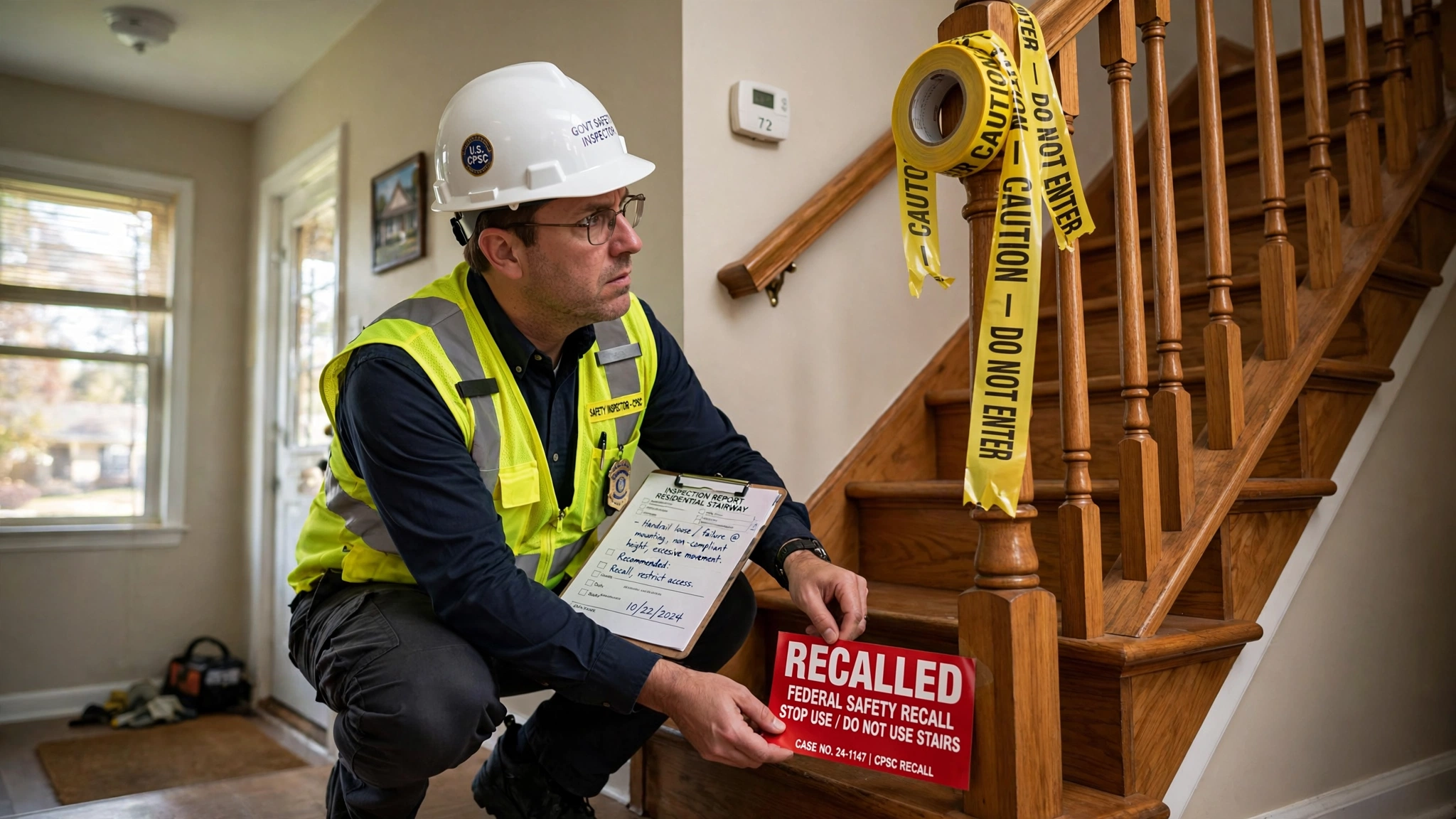
I. The Statutory Framework
The Consumer Product Safety Act was enacted on October 27, 1972, as Public Law 92–573. Congress found, at Section 2(a), that “an unacceptable number of consumer products which present unreasonable risks of injury are distributed in commerce” and that “the public should be protected against unreasonable risks of injury associated with consumer products.”1
The Act created the Consumer Product Safety Commission, an independent federal regulatory agency, and gave it jurisdiction over “consumer products” as defined at 15 U.S.C. § 2052(a)(5). The definition is broad. It encompasses “any article, or component part thereof, produced or distributed (i) for sale to a consumer for use in or around a permanent or temporary household or residence, a school, in recreation, or otherwise, or (ii) for the personal use, consumption or enjoyment of a consumer in or around a permanent or temporary household or residence, a school, in recreation, or otherwise.”2
The statute carves out specific exclusions. It does not cover tobacco products, motor vehicles, pesticides, firearms and ammunition, aircraft, boats, food, drugs, cosmetics, or medical devices. These are regulated by other agencies—the NHTSA, the ATF, the FAA, the FDA.3
The statute does not exclude stairs. It does not exclude steps. It does not exclude ramps, landings, handrails, balusters, treads, risers, stringers, or newel posts. No provision of the Consumer Product Safety Act, the Consumer Product Safety Improvement Act of 2008, or any amendment enacted in the fifty-four years since the statute’s creation has ever exempted any component of a staircase from the Commission’s jurisdiction.
A staircase is an article. It is manufactured, typically from wood, steel, concrete, or a combination thereof. It is distributed for sale—either as a pre-fabricated unit sold through building supply retailers or as a custom installation delivered through a construction contract. It is used in or around a permanent or temporary household or residence. It is used in schools. It is used in recreation. The statutory definition captures it completely.
We are aware that no CPSC commissioner has ever stated, in any public proceeding, that stairs fall within the agency’s jurisdiction. We are also aware that the statute does not require a commissioner to state this. It requires only that the article be a consumer product. Stairs are consumer products. The question is not whether the Commission has exercised jurisdiction. The question is why it has not.
II. The National Electronic Injury Surveillance System
In 1972, concurrent with the passage of the Consumer Product Safety Act, the CPSC established the National Electronic Injury Surveillance System, universally known as NEISS. The system collects injury data from a nationally representative probability sample of approximately 100 hospital emergency departments across the United States and its territories. From this sample, the Commission extrapolates national estimates of consumer product-related injuries.4
NEISS assigns every consumer product a numerical code. Product code 1842 is “stairs or steps.” Product codes 1807 and 1843 cover “ramps or landings” and related architectural surfaces. These product codes exist because the CPSC itself classified stairs as a consumer product when it designed its own surveillance system. The agency invented the tracking mechanism. It assigned the code. It has collected the data for fifty-three consecutive years.
In every one of those fifty-three years, stairs and steps have ranked at or near the top of the NEISS hazard priority ranking—a system the CPSC uses to prioritize which products pose the greatest risk to the American public. A 1985 study commissioned by the CPSC and conducted by researchers at the Georgia Institute of Technology noted that “stairs have consistently ranked at or near the top of the NEISS hazard priority ranking” and that this had been the case since the system’s inception.5
The Commission built a system to identify the most dangerous consumer products in America. The system identified one. The Commission then spent the next five decades regulating everything else.
III. The Injury Toll
The CPSC’s own annual report, Consumer Product-Related Injuries and Deaths in the United States, published in 2022 using 2020 data, provides the following finding: “Injuries related to stairs, ramps, landings, and floors, resulting in large part from slips and falls, accounted for more than 2.6 million emergency department-treated injuries and more than 6.6 million medically attended injuries per year.”6
These figures are not contested. They are not estimated by outside parties. They are produced by the Commission itself, using the Commission’s own surveillance system, and published in the Commission’s own annual report.
The 2.6 million emergency department figure represents 24 percent of all consumer product-related emergency department visits in the United States. One in four Americans who goes to an emergency room because of a consumer product goes because of stairs, ramps, landings, or floors. The next-largest category—beds, pillows, and mattresses—accounts for approximately 2.08 million medically attended injuries per year. Chairs account for approximately 1.5 million. Exercise equipment accounts for approximately 1.4 million. Bicycles account for approximately 1.3 million.7
The CPSC has issued mandatory safety standards for bicycles (16 CFR Part 1512). It has issued mandatory safety standards for cribs (16 CFR Part 1219). It has issued mandatory safety standards for play yards, toddler beds, bath seats, strollers, walkers, high chairs, swings, bouncers, bassinets, and infant sleep products. It has issued a mandatory safety standard for adult portable bed rails, finalized in January 2023, in response to 18 reported deaths.8
It has not issued a mandatory safety standard for stairs. The product that injures more Americans than any other consumer product in the Commission’s own database has never been subjected to a single federal safety requirement under the Consumer Product Safety Act.
IV. The Death Toll
The Commission’s own annual report estimates that approximately 50,900 deaths related to consumer products occurred in the United States in 2019. The 2018 estimate was 48,500. The three-year moving average for 2017 through 2019 was approximately 48,900.9
Falls are the leading mechanism of consumer product-related death. Among Americans aged 65 and older—who constitute 71 percent of all consumer product-related fatalities despite comprising only 16 percent of the population—falls account for the majority of deaths. The age-adjusted fall death rate among older adults increased 21 percent between 2018 and 2024, from 64.7 to 78.4 per 100,000.10
In 2021, the National Vital Statistics System recorded 38,742 fall-related deaths among adults aged 65 and older. Total unintentional fall deaths across all age groups have risen from approximately 20,000 in 2000 to over 44,000 by 2021, making falls the third-leading cause of unintentional injury death in the United States, behind only poisoning and motor vehicle crashes.11
The Department of Housing and Urban Development estimated in 1972 that approximately 3,800 deaths per year were directly attributable to stair accidents.12 The American population in 1972 was approximately 210 million. It is now approximately 335 million. The population aged 65 and older has more than doubled, from approximately 21 million to approximately 58 million. The age-adjusted fall death rate has approximately doubled. A conservative extrapolation places the current annual death toll from stair-related falls at well above the 1972 estimate.
The CPSC does not publish a separate annual death count for stairs. This is itself a finding. The Commission tracks the product category that generates more injuries than any other in its surveillance system and does not publish a specific mortality figure for it. It publishes mortality figures for infant sleep products, carbon monoxide detectors, fireworks, and amusement rides. It does not publish one for the product its own system identifies as the most dangerous in America.
V. The Recall Asymmetry
Under 15 U.S.C. § 2064, the CPSC may order a recall when a consumer product presents a “substantial product hazard,” defined as a product defect that creates a substantial risk of injury to the public, or a product that creates an unreasonable risk of serious injury or death.13
In 2025, the Commission issued 420 recall announcements covering more than 40 million product units—a new annual record and the largest total since 2007. In 2024, it issued 305 recall announcements covering approximately 83 million product units.14
The recalled products and the harms that triggered their recalls are instructive.
Between 2021 and 2024, the CPSC issued nine separate recalls of adult portable bed rails—a product associated with 18 reported deaths over the recall period. The recalls covered approximately 3 million units. The Commission subsequently promulgated a mandatory safety standard for the entire product category.15
In May 2021, the CPSC recalled the Peloton Tread+ treadmill after one child death and approximately 70 reported injuries. The recall covered approximately 125,000 units. The company initially resisted; the Commission publicly characterized the product as posing a “serious risk to children for abrasion, fractures, and death.”16
In 2012, the CPSC filed an administrative complaint to compel the recall of Buckyballs, a set of high-powered magnetic desk toys. The product had been associated with approximately two dozen ingestion injuries, predominantly in children. No deaths had been reported. The Commission characterized the magnets as presenting a “substantial product hazard” and ultimately obtained a federal court order requiring the company to fund a recall, contributing to the company’s dissolution.17
The pattern is consistent. The CPSC has recalled novelty decorative string lights associated with three reported injuries. It has recalled scented candles associated with zero deaths. It has recalled toddler sandals because the decorative flower could detach and present a choking hazard—no injuries reported.18
Stairs are associated with more injuries than all of these products combined by a factor of approximately one thousand. The product that the Commission’s own data rank as the number one hazard in the country has not been the subject of a single recall notice, a single mandatory standard, a single corrective action plan, or a single public warning in the fifty-four-year history of the agency.
The Commission destroyed a company that sold magnetic desk toys to adults. It has not sent a letter to the staircase industry.
VI. The Product Design
The engineering literature on stair safety is extensive, peer-reviewed, and damning. It has been available to the Commission since the agency’s founding.
A 1985 study funded by the CPSC itself, conducted by John Templer and John Archea of the Georgia Institute of Technology and H. Harvey Cohen of Safety Sciences, Inc., identified specific design features that systematically increase the risk of stair falls. These include inconsistent riser heights (a variation of as little as 0.375 inches between risers measurably increases fall risk), inadequate handrail graspability, insufficient tread depth, poor lighting at the top and bottom of flights, and visual illusions created by repetitive carpet patterns on treads.19
The research was not ambiguous. Templer, who spent decades studying stair safety, concluded that the single most important factor in stair fall prevention was dimensional consistency—every riser the same height, every tread the same depth. His research demonstrated that the human locomotor system establishes a stepping rhythm within the first two or three steps of a flight and that any deviation from that rhythm produces a misstep. The data showed that building codes then in effect permitted riser height tolerances that his own research had documented as dangerous.20
The Commission received this research. It funded this research. It published this research. It did not act on this research.
The International Residential Code, maintained by the International Code Council, does impose dimensional requirements for residential stairs: a maximum riser height of 7.75 inches, a minimum tread depth of 10 inches, a minimum width of 36 inches, and a minimum headroom of 6 feet 8 inches.21 But the IRC is not a federal standard. It is a model code, adopted—often with local modifications—by state and local jurisdictions. Compliance is enforced by local building inspectors at the time of construction. There is no ongoing inspection regime. There is no federal enforcement mechanism. There is no recall authority.
The CPSC’s own statutory authority exists independently of, and concurrently with, state and local building codes. Section 26 of the Consumer Product Safety Act, 15 U.S.C. § 2075, addresses preemption and explicitly provides that the Act does not preempt state standards unless they are “identical to” the federal standard. The existence of building codes does not diminish the Commission’s authority to issue its own safety standards for stairs. It does not diminish the Commission’s authority to order recalls of defective staircases. It does not diminish the Commission’s authority to issue public warnings.22
The CPSC has demonstrated, in other contexts, that building-integrated products are within its jurisdiction. The Virginia Graeme Baker Pool and Spa Safety Act of 2007, administered by the CPSC, imposes federal safety requirements on pool and spa drain covers—a product permanently installed in a building structure.23 In 2012, the CPSC investigated Chinese-manufactured drywall that was emitting hydrogen sulfide and corroding copper wiring in approximately 4,000 homes. The Commission did not disclaim jurisdiction over drywall because drywall is a building component. It investigated the drywall because drywall is a consumer product.24
The jurisdictional argument does not hold. The Commission regulates pool drains. It investigated drywall. It has issued mandatory standards for windows, electrical outlets, and smoke detectors installed in homes. It has not issued a standard for the product its own data identify as more dangerous than all of them.
VII. The Biomechanical Case
A staircase is, in mechanical terms, a series of controlled falls. The act of descending a staircase requires the user to shift their center of gravity forward of their base of support, commit to a ballistic leg swing over a drop of approximately 7 to 8 inches, and arrest the resulting downward momentum by striking a horizontal surface with one foot while the opposite leg is still in the air.25
This is not a metaphor. Biomechanical analysis of stair descent has consistently documented that the body is in a state of controlled instability throughout the movement. The margin between a successful step and a fall is measured in millimeters of foot placement and milliseconds of timing. Research by Startzell, Owens, Mulfinger, and Cavanagh, published in the Journal of the American Geriatrics Society in 2000, documented that even healthy young adults demonstrate measurable gait instability on stairs, with step-to-step variability increasing with fatigue, distraction, and reduced lighting.26
If a consumer electronics manufacturer designed a product that required its user to execute a series of controlled falls fourteen times in sequence, in dim lighting, carrying objects that obscure their view of the operating surface, while wearing socks on a polished hardwood interface, the CPSC would not issue a safety standard. The CPSC would issue a ban.
The staircase requires exactly this. It has required exactly this since approximately the twenty-seventh century BCE, when the first documented stairway was constructed at the Temple of Ur in Mesopotamia. In roughly 4,700 years of continuous production, the fundamental design has not been modified. The riser-and-tread architecture is unchanged. The bilateral handrail was not universally required until the twentieth century. The product has been in consumer use for nearly five millennia, and its safety features consist of a graspable rail and the assumption that the user will pay attention.27
Every other consumer product in the CPSC’s jurisdiction that relies on the assumption that the user will pay attention has been recalled, redesigned, or banned.
VIII. The Installed Base
The American Housing Survey, conducted by the U.S. Census Bureau for the Department of Housing and Urban Development, reports that approximately 128 million occupied housing units exist in the United States as of 2023. Of these, approximately 80 million are single-family detached homes, of which approximately 60 percent have two or more stories—each containing at least one staircase. Multi-unit residential buildings add millions of interior and exterior staircases. Commercial buildings, schools, houses of worship, and public facilities add millions more.28
A conservative estimate places the total number of staircases in the United States in excess of 120 million. Each one is a consumer product under the statutory definition. Each one is subject to the Commission’s jurisdiction. Each one has been in continuous use without a single federal safety inspection.
The adult portable bed rail recall covered 3 million units and was prompted by 18 deaths. If the Commission were to apply the same deaths-per-unit recall threshold to stairs—a ratio of approximately 1 death per 167,000 units—the stair recall would have been triggered several thousand times over.
But the Commission does not apply the same threshold. It does not apply any threshold. The most dangerous consumer product in its own surveillance system exists in a regulatory category of one: products the Commission knows are killing people, has known for fifty-four years, and has decided to count rather than address.
IX. The Economic Cost
The economic toll of stair-related injuries is quantifiable. The CPSC’s Injury Cost Model assigns a comprehensive cost to consumer product injuries based on medical expenses, work losses, pain and suffering, and other societal costs. The total cost of consumer product-related injuries in the United States, as estimated by the Commission, was approximately $1.4 trillion annually as of its most recent published analysis.29
If the stair, ramp, landing, and floor category accounts for 24 percent of emergency department injuries—as the Commission’s own data confirm—and a roughly proportional share of total injury costs, the annual economic burden of this single product category exceeds $300 billion. This figure exceeds the annual revenue of any single manufacturer of any consumer product in the CPSC’s jurisdiction. It exceeds the combined revenue of the bicycle, exercise equipment, and playground equipment industries. It exceeds the gross domestic product of Finland.30
The CPSC’s annual budget for fiscal year 2025 is approximately $176 million. The agency that has been assigned to protect the public from dangerous consumer products operates on a budget that is approximately 0.06 percent of the economic damage caused by the single most dangerous product category in its own database.
X. Conclusion
The facts are not in dispute. The Consumer Product Safety Act defines a “consumer product” as any article produced or distributed for use in or around a household, residence, or school. Stairs are articles. They are produced. They are distributed. They are used in 128 million American households, 130,000 schools, and millions of commercial and public buildings.
The Commission’s own surveillance system has identified stairs as the number one consumer product hazard in the United States for fifty-three consecutive years. Its own data attribute more than 2.6 million emergency department visits and more than 6.6 million medically attended injuries per year to this product category. Its own annual report confirms that the product category generates more injuries than any other in the entire NEISS database.
The Commission has recalled magnetic desk toys that killed nobody. It recalled a treadmill after one death. It recalled bed rails after 18 deaths. It recalled toddler sandals because a decorative flower could theoretically detach. It recalled scented candles. It issued 420 recall notices in a single year, covering 40 million units of products that collectively cause a fraction of the injuries caused by stairs.
Stairs kill more Americans per year than all recalled consumer products combined.
The Commission has not issued a single recall notice. It has not promulgated a single mandatory safety standard. It has not published a single public warning. It has not convened a single public hearing. It has not formed a single advisory committee. It has not opened a single investigation. It has not written a single letter.
One hundred and twenty million staircases are operating in American homes at this moment. Each one requires its user to execute a series of controlled falls, typically without protective equipment, in lighting conditions that would violate OSHA standards if the staircase were in a workplace, on surfaces that would trigger a recall if they were treadmill belts. The product was designed in Mesopotamia. The design has not been materially updated. The safety features consist of one rail and the hope that the user will look where they are going.
In 1972, Congress created an agency to protect the public from dangerous consumer products. The agency built a surveillance system. The surveillance system identified the most dangerous consumer product. The agency then spent fifty-four years protecting the public from Buckyballs.
The stairs are still there. They go up. They go down. Nobody is watching.
Ergo.
Sources
- Consumer Product Safety Act, § 2(a), 15 U.S.C. § 2051(a) (Congressional findings and purpose). law.cornell.edu ↑
- 15 U.S.C. § 2052(a)(5), Consumer Product Safety Act, § 3(a)(5) (definition of “consumer product”). law.cornell.edu ↑
- 15 U.S.C. § 2052(a)(5)(A)–(I) (exclusions from the definition of consumer product). law.cornell.edu ↑
- U.S. Consumer Product Safety Commission, “NEISS: National Electronic Injury Surveillance System,” description of sampling methodology and product coding. cpsc.gov ↑
- J. Templer, J. Archea, and H.H. Cohen, “Study of Factors Associated with Risk of Work-Related Stairway Falls,” prepared for the U.S. Consumer Product Safety Commission and National Institute for Occupational Safety and Health, Georgia Institute of Technology, 1985. stacks.cdc.gov ↑
- U.S. Consumer Product Safety Commission, Consumer Product-Related Injuries and Deaths in the United States: Estimated Injuries Occurring in 2020 and Estimated Deaths Occurring in 2019, 2022. cpsc.gov ↑
- Ibid., Table 1 (estimated medically attended injuries by product category, three-year moving average). ↑
- 16 CFR Part 1234, Safety Standard for Adult Portable Bed Rails, effective January 2024. federalregister.gov ↑
- CPSC, Consumer Product-Related Injuries and Deaths in the United States, 2022, Executive Summary (total deaths estimate). cpsc.gov ↑
- U.S. Consumer Product Safety Commission, Consumer Product-Related Injuries and Deaths Among Adults 65 Years of Age and Older, 2024; Centers for Disease Control and Prevention, Older Adult Falls Data, 2024. cdc.gov ↑
- Centers for Disease Control and Prevention, National Vital Statistics System, Mortality Data, 2021; R. Kakara et al., “Nonfatal and Fatal Falls Among Adults Aged ≥65 Years—United States, 2020–2021,” MMWR, vol. 72, no. 35, 2023, pp. 938–943. cdc.gov ↑
- U.S. Department of Housing and Urban Development, Stair Safety Study, 1972, cited in Templer, Archea, and Cohen (1985), note 5 above. ↑
- 15 U.S.C. § 2064 (substantial product hazards; notification and recall authority). law.cornell.edu ↑
- U.S. PIRG Education Fund, “New Report: Nearly 900 Injuries Linked to Unsafe Consumer Products in 2025 as Recalls Hit 18-Year High,” March 2026; CPSC Annual Recall Statistics, 2024–2025. pirg.org ↑
- U.S. Consumer Product Safety Commission, “CPSC Issues Urgent Warning on Portable Adult Bed Rails; Nine Recalls in Three Years; 18 Reported Deaths Since 2021,” November 14, 2024. cpsc.gov ↑
- U.S. Consumer Product Safety Commission, “CPSC Warns Consumers: Stop Using the Peloton Tread+,” April 17, 2021; Peloton Tread+ recall, May 5, 2021 (Recall No. 21-121). cpsc.gov ↑
- U.S. Consumer Product Safety Commission, In the Matter of Maxfield & Oberton Holdings, LLC (Buckyballs), CPSC Docket No. 12-2, Administrative Complaint, July 25, 2012. cpsc.gov ↑
- CPSC recall database search, 2020–2025, filtered by product category (candles, decorative lighting, children’s footwear). cpsc.gov ↑
- Templer, Archea, and Cohen (1985), cited at note 5 above, pp. 12–47 (analysis of dimensional, environmental, and behavioral risk factors in stair falls). ↑
- J. Templer, The Staircase: Studies of Hazards, Falls, and Safer Design, MIT Press, 1992. ↑
- International Code Council, International Residential Code for One- and Two-Family Dwellings, 2024 ed., Section R311.7 (Stairways). iccsafe.org ↑
- 15 U.S.C. § 2075 (effect of CPSA on state standards; preemption provisions). law.cornell.edu ↑
- Virginia Graeme Baker Pool and Spa Safety Act, 15 U.S.C. §§ 8001–8008 (2007); administered by the CPSC; establishes federal safety requirements for pool drain covers. cpsc.gov ↑
- U.S. Consumer Product Safety Commission, “CPSC Staff Report on Drywall-Associated Corrosion and Health Effects” and related investigation documents, 2010–2013. cpsc.gov ↑
- S. Reeves et al., “Biomechanics of Stair Negotiation: A Review,” Gait & Posture, vol. 29, no. 4, 2009, pp. 535–548. pubmed.ncbi.nlm.nih.gov ↑
- J.K. Startzell et al., “Stair Negotiation in Older People: A Review,” Journal of the American Geriatrics Society, vol. 48, no. 5, 2000, pp. 567–580. pubmed.ncbi.nlm.nih.gov ↑
- L. Woolley, Ur Excavations, vol. V: The Ziggurat and Its Surroundings, Publications of the Joint Expedition of the British Museum and of the Museum of the University of Pennsylvania to Mesopotamia, 1939 (documentation of monumental staircases at the Third Dynasty of Ur, c. 2112–2004 BCE). ↑
- U.S. Census Bureau, American Housing Survey, 2023; U.S. Department of Education, National Center for Education Statistics, “Digest of Education Statistics,” 2023 (approximately 130,000 K–12 schools in the United States). census.gov ↑
- U.S. Consumer Product Safety Commission, The CPSC Injury Cost Model, methodology and summary estimates. cpsc.gov ↑
- World Bank, GDP (current US$), Finland, 2023 (approximately $300 billion). data.worldbank.org ↑