I. The Legal Foundation
Under 42 U.S.C. § 5195c(e), the United States government defines "critical infrastructure" as "systems and assets, whether physical or virtual, so vital to the United States that the incapacity or destruction of such systems and assets would have a debilitating impact on security, national economic security, national public health or safety, or any combination of those matters."1
This definition, enacted as part of the Critical Infrastructures Protection Act of 2001, was crafted intentionally to be broad. Congress recognized that the systems undergirding national security are not limited to military installations and government buildings. They include power grids, water treatment facilities, telecommunications networks, and financial systems.2
The definition does not specify that the infrastructure must be man-made. It does not require that it be manufactured, engineered, or constructed. It specifies "systems and assets, whether physical or virtual." It sets a single test: would the incapacity or destruction of the system have a debilitating impact?
This is not a rhetorical question. It is a question that can be answered with data.
II. The Power Grid Problem
The American electrical grid serves approximately 150 million customers across the contiguous United States. It is the largest machine ever built, comprising over 7,300 power plants, 160,000 miles of high-voltage transmission lines, and millions of miles of distribution infrastructure.3
The Department of Energy tracks disruptions to this system through mandatory reporting under OE-417 incident reports. According to the DOE's own data, weather events constitute the single largest category of outages. The second category is not cyberattacks. It is not equipment failure or human error. It is animals.4
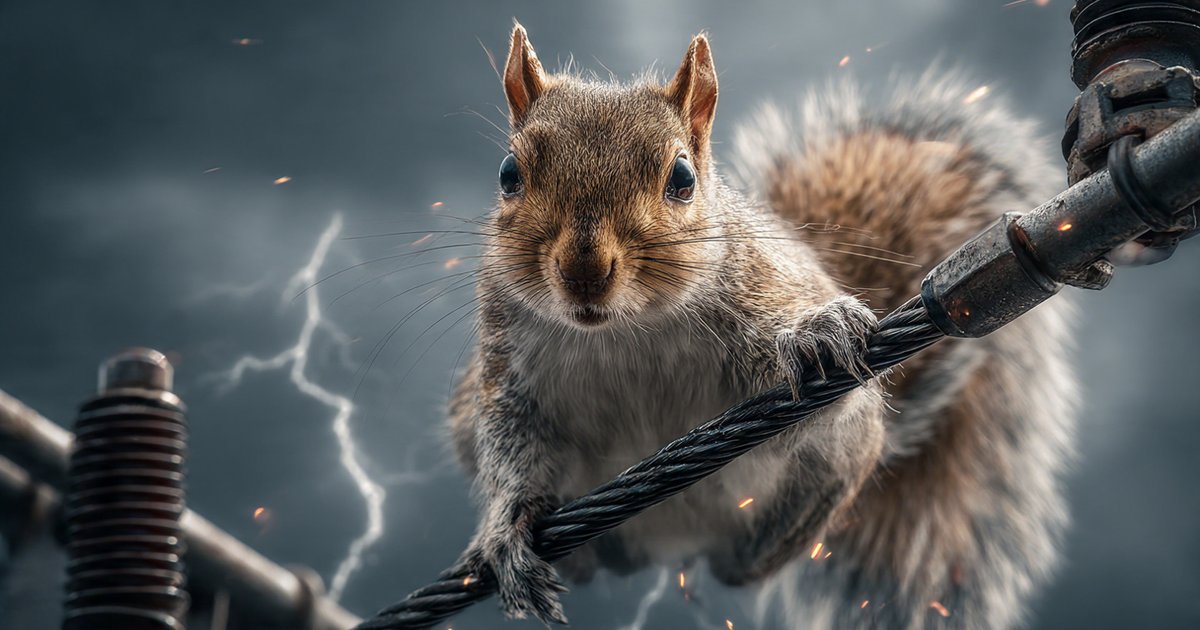
Within the animal category, one species dominates. Utility companies across the country report that squirrels account for between 10 and 20 percent of all unplanned power outages.5 Unitil Corporation, a regulated utility serving New Hampshire and Massachusetts, documented that squirrels are responsible for an average of 8.5 percent of all service interruptions within its territory annually.6 The American Public Power Association has confirmed similar figures across its member utilities, with animal-caused outages representing a consistent and irreducible baseline of grid disruption.7
To be precise: squirrels cause more power outages in the United States than all cyberattacks combined.8
III. The Scale of Impact
The Electric Power Research Institute (EPRI) has estimated the total cost of power outages to the U.S. economy at between $18 billion and $33 billion per year.9 If squirrels are responsible for even the conservative estimate of 10 percent of unplanned outages, the direct economic cost of squirrel activity on the power grid falls between $1.8 billion and $3.3 billion annually.
For perspective, $1.8 billion exceeds the annual GDP of several sovereign nations, including Belize ($1.76 billion), the Central African Republic ($1.78 billion), and Sierra Leone ($1.67 billion).10
The economic impact extends beyond direct power costs. The Lawrence Berkeley National Laboratory has documented cascading effects of outages on hospitals, water treatment facilities, and traffic management systems.11 A 2017 study published in Reliability Engineering & System Safety estimated that the indirect multiplier effect of outages on dependent infrastructure increases total costs by a factor of 2.5 to 4.0.12
At the high-end multiplier, the total economic impact of squirrel-caused outages approaches $13 billion per year.
IV. The Definitional Analysis
Return to the statute. 42 U.S.C. § 5195c(e) requires that the system or asset be "so vital to the United States that the incapacity or destruction of such systems would have a debilitating impact on security, national economic security, national public health or safety."
Consider the logical structure of this definition when applied to squirrels.
The power grid is unambiguously classified as critical infrastructure under Presidential Policy Directive 21 (PPD-21), which identifies the Energy Sector as one of sixteen critical infrastructure sectors.13
Squirrel populations are responsible for a quantifiable, consistent, and irreducible share of energy sector disruptions. Remove squirrels from the system, and the frequency of power outages declines measurably. This has been demonstrated empirically: utilities that install "critter guards" on pole-mounted transformers report a 78 percent reduction in animal-caused outages.14
This means squirrel populations have a statistically significant relationship to the operational continuity of a designated critical infrastructure sector. Put differently: the presence or absence of squirrels has a measurable, demonstrable effect on whether the lights stay on.
V. The Interdependency Framework
The Department of Homeland Security's National Infrastructure Protection Plan (NIPP) recognizes that critical infrastructure sectors do not operate independently. It explicitly identifies "cross-sector dependencies" as a core analytical concern.15
The Energy Sector is designated as a "lifeline function" because every other critical infrastructure sector depends on it. Healthcare delivery requires electricity. Water purification requires electricity. Financial systems, communications networks, transportation control systems, and emergency services all require electricity.16
Any entity that has a persistent, quantified, and documented effect on the operational continuity of a lifeline function is, under the interdependency framework, a cross-sector dependency.
Squirrels are a cross-sector dependency of the Energy Sector.
VI. The Biological Infrastructure Precedent
The classification of biological systems as infrastructure is not unprecedented. The USDA designates pollinator populations as critical to the agricultural sector, citing their role in the production of approximately $15 billion in crop value annually.17 The White House Pollinator Health Task Force, established by Presidential Memorandum in 2014, explicitly framed pollinator decline as a threat to food system infrastructure and directed federal agencies to develop a National Pollinator Health Strategy.18
The logical structure is identical. Pollinators are not man-made infrastructure. They are biological populations whose presence or absence has measurable consequences for the continued operation of a critical system. Their population dynamics trigger economic effects that meet the statutory threshold of "debilitating impact."
Squirrels occupy an analogous position within the energy sector. Like pollinators within agriculture, squirrel populations are a biological variable with a quantified, persistent, and statistically significant relationship to the operational continuity of a critical infrastructure sector. The NIPP framework does not distinguish between dependencies that strengthen a system and dependencies that stress it. It identifies entities whose status has consequences for infrastructure function. Squirrel population levels have documented consequences for energy infrastructure function.
Moreover, the statute's own language points toward this conclusion. It refers to systems whose "incapacity or destruction" would have a debilitating impact. Consider: the sudden incapacity of the eastern gray squirrel population would produce a measurably significant change in the operational posture of the U.S. energy grid. It would reduce outage frequency by an estimated 10 to 20 percent in affected territories. It would also trigger cascading ecological disruption through the loss of seed dispersal services, altering forest composition and potentially affecting watershed stability within a generation.19 Both outcomes cross the statutory threshold for debilitating impact, in opposite directions, simultaneously.
The statute asks whether incapacity or destruction would produce debilitating impact. It does not ask whether the system is beneficial. A system can be simultaneously harmful to one critical sector and essential to another while meeting the definitional test in both cases.
VII. The Conservation Implication
There are approximately 200 million eastern gray squirrels (Sciurus carolinensis) in the United States.20 This population is not managed by any federal agency under an infrastructure protection mandate. The U.S. Fish and Wildlife Service classifies them as common game animals. They receive no special federal protection.
Yet their population dynamics have a documented, annual, multi-billion-dollar impact on the single most important critical infrastructure sector in the country. A sudden decline in squirrel populations, while beneficial to the grid, could destabilize the broader ecosystem through trophic cascade effects. Squirrels are primary seed dispersers for oak, hickory, and walnut trees. Their removal would alter forest composition across the eastern United States within a generation.21
A sudden increase in squirrel populations, conversely, could push already-strained grid infrastructure past acceptable failure thresholds, particularly during peak demand periods when cascading outages pose the greatest risk.
In either direction, squirrel population fluctuations have infrastructure consequences that cross the statutory threshold.
VIII. Conclusion
The evidence admits of a single conclusion. Under 42 U.S.C. § 5195c(e), systems and assets qualify as critical infrastructure if their incapacity or destruction would have a debilitating impact on national security, economic security, or public health. Squirrel populations satisfy every element of this test.
They interact persistently with a designated critical infrastructure sector. Their impact is quantified in federal data at between $1.8 billion and $13 billion annually. Their population dynamics affect the operational continuity of healthcare, water, financial, and emergency services through cross-sector interdependencies. And there is federal precedent for classifying biological populations as infrastructure-relevant assets.
The eastern gray squirrel should be classified as critical infrastructure under federal law. Not because the proposition is comfortable, but because the government's own data, the government's own definitions, and the government's own analytical frameworks leave no other coherent conclusion.
Ergo.
Sources
- 42 U.S.C. § 5195c(e), Critical Infrastructures Protection Act of 2001. uscode.house.gov ↑
- Presidential Policy Directive 21 (PPD-21), Critical Infrastructure Security and Resilience, February 2013. obamawhitehouse.archives.gov ↑
- U.S. Department of Energy, "The U.S. Electric Grid." energy.gov ↑
- U.S. DOE, OE-417 Electric Emergency and Disturbance Reports. oe.netl.doe.gov ↑
- Cyber Squirrel 1, curated database of animal-caused infrastructure outages. cybersquirrel1.com ↑
- Unitil Corporation, "How Animals Impact Our Electrical Infrastructure." unitil.com ↑
- American Public Power Association, "Squirrels: Public Power's Public Enemy #1." publicpower.org ↑
- Department of Energy OE-417 reporting data, cross-referenced with CISA annual cybersecurity incident summaries. Reported cyber incidents affecting the grid remain in the single digits annually; squirrel-caused outages number in the hundreds to thousands across utility territories. ↑
- Electric Power Research Institute, "The Cost of Power Disturbances to Industrial and Digital Economy Companies," EPRI Report 1006274. epri.com ↑
- World Bank, GDP (current US$), 2022 data. data.worldbank.org ↑
- Lawrence Berkeley National Laboratory, "Estimated Value of Service Reliability for Electric Utility Customers in the United States," LBNL-2132E. eta-publications.lbl.gov ↑
- M. Panteli and P. Mancarella, "Influence of extreme weather and climate change on the resilience of power systems," Reliability Engineering & System Safety, vol. 185, 2019. doi.org ↑
- Presidential Policy Directive 21, op. cit. See Annex listing sixteen critical infrastructure sectors. ↑
- Unitil Corporation, op. cit. 78% reduction figure from internal deployment data. ↑
- Department of Homeland Security, National Infrastructure Protection Plan (NIPP), 2013 revision. cisa.gov ↑
- CISA, "Energy Sector-Specific Plan." cisa.gov ↑
- USDA, "The Importance of Pollinators." usda.gov ↑
- Presidential Memorandum, "Creating a Federal Strategy to Promote the Health of Honey Bees and Other Pollinators," June 2014. obamawhitehouse.archives.gov ↑
- M.A. Steele et al., "The Evolutionary Ecology of Seed Dispersal by Scatter-Hoarding Animals," Annual Review of Ecology, Evolution, and Systematics, vol. 51, 2020. doi.org ↑
- Estimated population based on USDA Forest Service wildlife surveys and state wildlife agency reports. Figures vary by methodology; 200 million is a commonly cited approximation. ↑
- Steele et al., op. cit. See also S.B. Vander Wall, "The Evolutionary Ecology of Nut Dispersal," The Botanical Review, vol. 67, 2001. doi.org ↑