I. The Statutory Framework
The Federal Insecticide, Fungicide, and Rodenticide Act (FIFRA), originally enacted in 1947 and substantially amended in 1972, 1988, and 1996, is the principal federal statute governing the regulation of pesticides and pesticide devices in the United States. The Act, codified at 7 U.S.C. §§ 136–136y, establishes a comprehensive registration, labeling, and enforcement regime administered by the Environmental Protection Agency.1
The statute regulates two categories of pest-control instruments: “pesticides” and “devices.” A pesticide, defined at § 136(u), is “any substance or mixture of substances intended for preventing, destroying, repelling, or mitigating any pest.” A device, defined separately at § 136(h), is “any instrument or contrivance (other than a firearm) which is intended for trapping, destroying, repelling, or mitigating any pest or any other form of plant or animal life (other than man and other than bacteria, virus, or other microorganism on or in living man or other living animals); but not including equipment used for the application of pesticides when sold separately therefrom.”2
The distinction matters. Pesticides must be registered with the EPA under Section 3 of FIFRA before they may be lawfully distributed or sold. Devices are exempt from registration. But devices are not exempt from regulation. Under 40 C.F.R. § 152.500(a), devices remain subject to the Act’s establishment registration requirements (Section 7), labeling requirements (Section 2(q)), prohibited acts provisions (Section 12), and penalty provisions (Section 14).3
Section 7 of FIFRA requires that every establishment where a pesticide or device is produced must be registered with the EPA and assigned an establishment number. The term “production” includes manufacturing, packaging, repackaging, labeling, and relabeling. Each registered establishment must file an initial production report within 30 days and an annual production report by March 1 of each year. The establishment number must appear on the label or immediate container of each device produced.4
The EPA currently maintains a national list of active registered pesticide and device-producing establishments. The list is updated every 24 hours. It contains thousands of entries, covering every commercial producer of bug zappers, fly strips, ultrasonic repellers, mouse traps, and mosquito nets in the United States.5
It does not contain a single spider.
II. The Device Under Review
The spiderweb is a silk-based trapping instrument constructed by members of the order Araneae for the express purpose of capturing, restraining, and facilitating the killing of arthropod prey, the vast majority of which are insects. It is, by any functional description, a device intended for trapping pests.
Spiders evolved from an arachnid ancestor during the Devonian period, approximately 380 to 400 million years ago. The earliest known fossil evidence of spider silk dates to the Early Cretaceous, approximately 130 million years ago, preserved in amber from Lebanon. Orb webs, the most architecturally sophisticated variant, appear in the fossil record by the mid-Cretaceous, approximately 110 million years ago.6
Today, more than 45,000 spider species have been described worldwide.7 Approximately 3,500 species, with an estimated 350 additional undescribed species, exist in the United States and Canada, according to a 1993 survey by Roth.8 A more recent checklist updated the North American count to 5,401 species within 76 families, including 118 established nonnative species.9
Population densities are staggering. Field estimates in the United States range from approximately 30,000 spiders per acre in Mississippi woodlands to more than 2.5 million individuals per acre in grassland habitats.10 Globally, the total spider biomass has been estimated at approximately 25 million metric tons.11
Almost all spiders are generalist predators, feeding primarily on insects and secondarily on other spiders. They employ a variety of trapping strategies: orb webs, sheet webs, funnel webs, cobwebs, bolas, trapdoors, and triplines. Cursorial (ground-hunting) species forgo webs entirely, but the web-building species, which constitute the regulatory concern at issue here, construct silk-based trapping instruments whose sole design purpose is to intercept, immobilize, and secure arthropod prey for consumption.
III. The Manufacturing Specifications
Orb-weaving spiders (superfamily Araneoidea) possess the most complex silk-production apparatus in the animal kingdom. Each individual is equipped with seven morphologically distinct silk glands, six of which produce silk fibers and one of which secretes an adhesive glue. The glands are: (i) the major ampullate gland, which produces dragline and frame silk; (ii) the minor ampullate gland, which produces temporary capture spiral silk; (iii) the flagelliform gland, which produces the highly elastic capture spiral core fiber; (iv) the tubuliform (cylindrical) gland, which produces egg-sac silk; (v) the aciniform gland, which produces prey-wrapping silk; (vi) the pyriform gland, which produces attachment cement; and (vii) the aggregate gland, which secretes the aqueous adhesive coating applied to capture spiral threads.12
Each silk type is a distinct protein-based fiber, or spidroin, named by convention for the gland that produces it. The molecular structure of these spidroins consists primarily of repeating amino acid motifs: polyalanine blocks that form crystalline beta-sheet structures, and glycine-rich regions that provide elasticity. The ratio of these motifs determines whether a given silk is rigid (dragline), elastic (flagelliform), adhesive (aggregate), or tough (aciniform).13
The mechanical properties of these silks have been extensively characterized. Major ampullate (dragline) silk, the structural backbone of the orb web, has a tensile strength of approximately 1.1 gigapascals. This places it in the same range as mid-grade steel (0.2 to 2.0 GPa) and exceeds the tensile strength of nylon (0.95 GPa). Dragline silk can extend approximately 27 percent before failure, giving it an energy-to-break of approximately 160 megajoules per cubic meter. By comparison, Kevlar 49, the synthetic aramid fiber used in body armor, has a higher tensile strength (3.6 GPa) but a breaking elongation of only 2.7 percent, resulting in a toughness of only 50 MJ/m³. Spider silk is three times tougher than Kevlar.14
Flagelliform silk, the capture spiral fiber, is an order of magnitude more extensible, stretching up to 270 percent of its resting length before failure. This elasticity is not a manufacturing defect. It is a design specification. The capture spiral must absorb the kinetic energy of a flying insect striking the web at velocities of several meters per second without breaking or allowing the prey to bounce free.15
All of these fibers are produced at ambient temperature, at atmospheric pressure, using water as the solvent, from a feedstock of dietary protein. No industrial silk-production process has achieved comparable performance under comparable conditions. The spider’s manufacturing process would, if replicated by a human enterprise, represent the most advanced materials-engineering operation in textile history. It would also require an EPA establishment number.
IV. The Production Scale
In 2017, Martin Nyffeler of the University of Basel and Klaus Birkhofer of Lund University published the first global estimate of annual prey consumption by the world’s spider community. Using data from 65 previous studies, they calculated that the global spider population, weighing approximately 25 million metric tons, kills an estimated 400 to 800 million metric tons of prey per year. More than 90 percent of this prey consists of insects and springtails.16
For context: the entire human population consumes an estimated 400 million metric tons of meat and fish annually. The world’s whale population consumes an estimated 280 to 500 million metric tons of seafood. The world’s total seabird population eats an estimated 70 million metric tons. Spiders eat more animal biomass than all of humanity, and they do it using devices that have never been subjected to a single EPA compliance inspection.17
The Nyffeler-Birkhofer data further show that spiders in forests and grasslands account for more than 95 percent of the global annual prey kill. Spiders in agricultural areas kill substantially less, not because they are less effective as pest control devices, but because intensive agricultural management creates unfavorable living conditions. This is an irony worth noting: the habitats where human pest control is most needed are the habitats where the most prolific unregistered pest control devices have been driven out by the very management practices designed to control pests.18
In the United States specifically, web-building spiders construct and deploy trapping devices across all 50 states, the District of Columbia, and all U.S. territories. At population densities approaching 2.5 million individuals per acre in grasslands, the number of active pest-trapping devices operating on U.S. soil at any given moment is conservatively in the trillions. An orb-weaving spider rebuilds its web daily; many species consume the old web to recycle the silk protein before constructing a new one.19 The daily production volume of new trapping devices on U.S. territory alone exceeds, by several orders of magnitude, the total annual output of every registered device-producing establishment in the EPA’s national registry combined.
V. The Pest Control Efficacy Data
FIFRA’s definition of “pest” is set forth at 7 U.S.C. § 136(t): “any insect, rodent, nematode, fungus, weed, or … any other form of terrestrial or aquatic plant or animal life or virus, bacteria, or other micro-organism … which the Administrator declares to be a pest.” The EPA has exercised this authority broadly. The Agency’s pest designations encompass the full range of arthropod orders that constitute spider prey, including Diptera (flies, mosquitoes), Hemiptera (aphids, stink bugs, leafhoppers), Lepidoptera (moths, agricultural caterpillar pests), Coleoptera (beetles), Orthoptera (grasshoppers, crickets), and Hymenoptera (certain pest wasps and ants).20
Spiders kill representatives of every one of these orders. The Nyffeler-Birkhofer data identify fewer than ten arthropod orders composing the majority of spider prey, with Diptera, Hemiptera, Hymenoptera, Collembola, Coleoptera, Lepidoptera, Orthoptera, and Araneae making up the bulk of the diet. In agroecosystems, Hemiptera prey alone constitutes 41 percent of all captured individuals.21
The web itself is the trapping mechanism. An orb web functions by intercepting flying insects along a vertical plane, adhering them to the sticky capture spiral via the aqueous adhesive secreted by the aggregate gland, and restraining their movement until the spider can locate, immobilize, and process the prey. The capture efficiency of an orb web has been measured at approximately 30 to 60 percent of all insects that contact the web surface, depending on prey size, velocity, and silk condition.22
If a commercial manufacturer marketed a physical device that intercepted and killed flying insects at 30 to 60 percent efficiency, operated without electricity or chemical attractants, self-repaired after damage, and was rebuilt fresh every 24 hours, that manufacturer would be required to register its producing establishment with the EPA, obtain an establishment number, label every unit with that number, and file annual production reports. The product would be classified as a pesticide device under 7 U.S.C. § 136(h). The EPA would confirm this classification in approximately the time it takes to read the statutory definition.
VI. The Establishment Registration Deficiency
Section 7 of FIFRA, codified at 7 U.S.C. § 136e, requires that “no person shall produce any pesticide or device … unless the establishment in which it is produced is registered.” The implementing regulations at 40 C.F.R. Part 167 specify that every establishment must obtain a company number, register the establishment, and file production reports with the EPA. Production in an unregistered establishment is a violation of the law.23
The spiderweb is produced. It is manufactured from internally synthesized protein feedstock, extruded through specialized spinnerets at the posterior of the abdomen, and assembled into a functional trapping device through a construction sequence that has been documented in detail by behavioral ecologists. The process is not accidental. An orb-weaving spider begins by releasing a bridge thread on the wind, anchors radial spokes to a frame, lays a temporary non-sticky spiral from the center outward to space the radials, then replaces it with the permanent adhesive capture spiral from the outside inward, consuming the temporary spiral as it goes. The entire sequence takes 30 to 60 minutes and produces a device with radial symmetry, consistent spoke spacing, and an adhesive capture area calibrated to the spider’s body size and prey spectrum.24
No spider in the United States has ever obtained a company number from the EPA. No spider has ever registered an establishment. No spider has ever filed an initial production report or an annual production report. No spider has ever submitted an EPA Form 3540-8. Every web constructed on U.S. soil since the enactment of FIFRA in 1947, and since its comprehensive amendment in 1972, has been produced in an unregistered establishment.
The scale of the violation is without precedent. At 2.5 million spiders per acre in peak-density grasslands, and approximately 633 million acres of grassland in the contiguous United States (per the 2017 USDA National Resources Inventory), the number of unregistered device-producing establishments in grasslands alone approaches 1.6 quadrillion. This figure does not include forests (765 million acres), croplands (392 million acres), or the 6.2 billion square feet of residential and commercial structures in which spiders also operate.25
VII. The Labeling Deficiency
Section 2(q)(1) of FIFRA, 7 U.S.C. § 136(q)(1), provides that a pesticide or device is “misbranded” if “its labeling bears any statement, design, or graphic representation relative thereto or to its ingredients which is false or misleading in any particular.” Section 2(q)(2) further provides that a device is misbranded if it is “contained in a package or other container or wrapping which does not conform to the standards established by the Administrator.” The labeling must include the name and address of the producer, the establishment number, and adequate directions for use.26
No spiderweb in the history of the United States has borne a label. No web has displayed an establishment number. No web has provided the name and address of its producer. No web has included adequate directions for use, a statement of ingredients, a net contents declaration, or cautionary language regarding potential hazards to non-target organisms.
This omission is particularly concerning given the documented risks to non-target species. Spiderweb capture is not selective. Webs intercept pollinators, parasitoid wasps that are themselves beneficial pest-control agents, and other non-pest arthropods. A 2006 study by Blackledge and Hayashi in the Journal of Experimental Biology documented the mechanical properties of five distinct silk types in the silver garden spider Argiope argentata, noting that each silk had a “distinctive suite of material properties” tailored to different ecological functions, including prey capture that does not distinguish between pest and beneficial species.27
Under FIFRA, any commercial device that killed beneficial insects alongside target pests would be required to include precautionary statements on its labeling. The spider has included no such statements. The spider has included no labeling at all. Every unlabeled web in the United States is, under 7 U.S.C. § 136(q), a misbranded device.
VIII. The Criminal and Civil Penalty Exposure
Section 12(a)(1) of FIFRA, 7 U.S.C. § 136j(a)(1), makes it unlawful for any person to distribute, sell, offer for sale, hold for distribution, or receive and deliver any device that is misbranded. Section 12(a)(2)(N) makes it a violation for any producer to fail to file reports required by the Act. Section 14 establishes the penalty framework.28
Under § 14(b)(1)(A), a producer who knowingly violates any provision of FIFRA is subject to a criminal fine of not more than $50,000 and imprisonment of not more than one year per offense. Under § 14(b)(1)(B), any other person who distributes or sells devices and knowingly violates any provision is subject to a fine of $25,000 and one year of imprisonment. Civil penalties under § 14(a) may be assessed at up to $5,000 per offense for registrant violations.29
If the EPA were to enforce FIFRA against the U.S. spider population with the same vigor it applied to Medline Industries, which in 2018 agreed to pay a $4,930,000 administrative penalty for 1,291 occasions of selling an unregistered pesticide, the per-violation fine would be approximately $3,818. Applied to the trillions of unregistered, unlabeled, misbranded spiderwebs produced annually on U.S. soil, the aggregate penalty exposure enters a range that the federal budget does not contain a category to describe.30
Consider only the establishment registration violation. At a conservative estimate of one trillion web-producing spiders on U.S. territory, each operating an unregistered establishment, and a minimum civil penalty of $5,000 per violation, the total civil penalty exposure is $5 quadrillion. This is approximately 18 times the current U.S. gross domestic product.31
IX. The Enforcement Record
The EPA’s Office of Enforcement and Compliance Assurance has brought enforcement actions against manufacturers of UV light insect traps, ultrasonic pest repellers, electromagnetic pest devices, and citronella candles for device-related FIFRA violations. In 2023, Customs and Border Protection detained a shipment of DynaTrap Mosquito Traps at the Sweetgrass, Montana, port of entry because the producer had failed to file a Notice of Arrival of Pesticides and Devices (EPA Form 3540-1) as required by 19 C.F.R. § 12.114. The product was a device intended for trapping mosquitoes. Its label bore claims including “Attract, Trap, and Kill Mosquitos.” The EPA determined that this language was sufficient to classify the product as a pesticide device subject to FIFRA regulation.32
The spiderweb attracts, traps, and kills mosquitoes. It also attracts, traps, and kills flies, moths, beetles, aphids, leafhoppers, gnats, midges, crane flies, and every other small-bodied flying arthropod that contacts its capture surface. The functional claims that triggered FIFRA enforcement against the DynaTrap are claims that every orb web in America satisfies without modification.
The DynaTrap was detained at the border for a paperwork deficiency. The spider has been producing unregistered devices on U.S. soil for at least 130 million years, across a territory that predates the formation of the United States by 129,999,750 years, and the EPA has not issued a single warning letter, compliance advisory, stop-sale order, or notice of violation.
This is not a trivial gap. The EPA employs approximately 14,000 staff across 10 regional offices. Its Office of Pesticide Programs has a dedicated division for antimicrobials and pesticide devices. That division has oversight responsibility for every device sold or distributed in the United States. It does not have oversight responsibility for the most prolific, most effective, most widely distributed trapping device in the history of terrestrial life on Earth.
X. The Comparative Analysis
To appreciate the disparity in regulatory treatment, compare the spiderweb to the commercial devices that the EPA does regulate.
A standard residential fly strip is a passive adhesive trapping device. It captures flies by presenting a sticky surface to which airborne insects adhere upon contact. It cannot self-repair. It cannot self-rebuild. It has a fixed operational life measured in weeks. It captures prey at an efficiency rate substantially lower than the orb web. It is nonetheless subject to FIFRA establishment registration, labeling, and production reporting requirements. The manufacturer has an EPA establishment number. The strip bears that number on its packaging.33
The orb web is a passive adhesive trapping device. It captures insects by presenting a sticky surface to which airborne prey adhere upon contact. It can self-repair. It can self-rebuild. It has an operational life measured in hours because its manufacturer constructs a new unit daily. It captures prey at an efficiency rate of 30 to 60 percent. It is not subject to any FIFRA requirement. Its manufacturer does not have an EPA establishment number. The web bears nothing on its surface except the dew.
A UV-light insect trap attracts flying insects using ultraviolet light and kills them by electrocution or adhesive capture. The EPA classifies it as a device under § 136(h) because it is an “instrument or contrivance intended for trapping, destroying, repelling, or mitigating any pest.” The manufacturer must register its establishment, label the device, and file annual production reports.
An orb web attracts flying insects (some species incorporate ultraviolet-reflecting silk decorations called stabilimenta that may attract prey) and kills them by entanglement, restraint, and venomous bite. It satisfies every element of the § 136(h) definition. No registration, labeling, or reporting has ever been required.
XI. Conclusion
The Federal Insecticide, Fungicide, and Rodenticide Act was enacted to ensure that devices intended for trapping, destroying, repelling, or mitigating pests are produced in registered establishments, labeled with adequate information, and manufactured by entities that file production reports with the EPA. The spiderweb satisfies the statutory definition of “device” under 7 U.S.C. § 136(h). It is an instrument. It is a contrivance. It is not a firearm. It is intended for trapping pests. It traps pests. It destroys pests. It does so at a scale that dwarfs the combined output of every registered device manufacturer in the United States.
There are approximately 3,800 described spider species in the United States. Their combined biomass runs to millions of metric tons. Their combined annual prey kill, extrapolated from the Nyffeler-Birkhofer global estimates, exceeds the weight of every head of cattle in Texas. Their combined production of silk-based trapping devices, rebuilt daily across trillions of individual establishments, constitutes the largest unregistered manufacturing operation in the history of federal regulation.
Not one web has been registered. Not one establishment has obtained a company number. Not one production report has been filed. Not one label has been affixed. The penalty exposure, if calculated at statutory minimums, exceeds the GDP of the planet. The EPA has not opened an investigation. The spiders have not retained counsel.
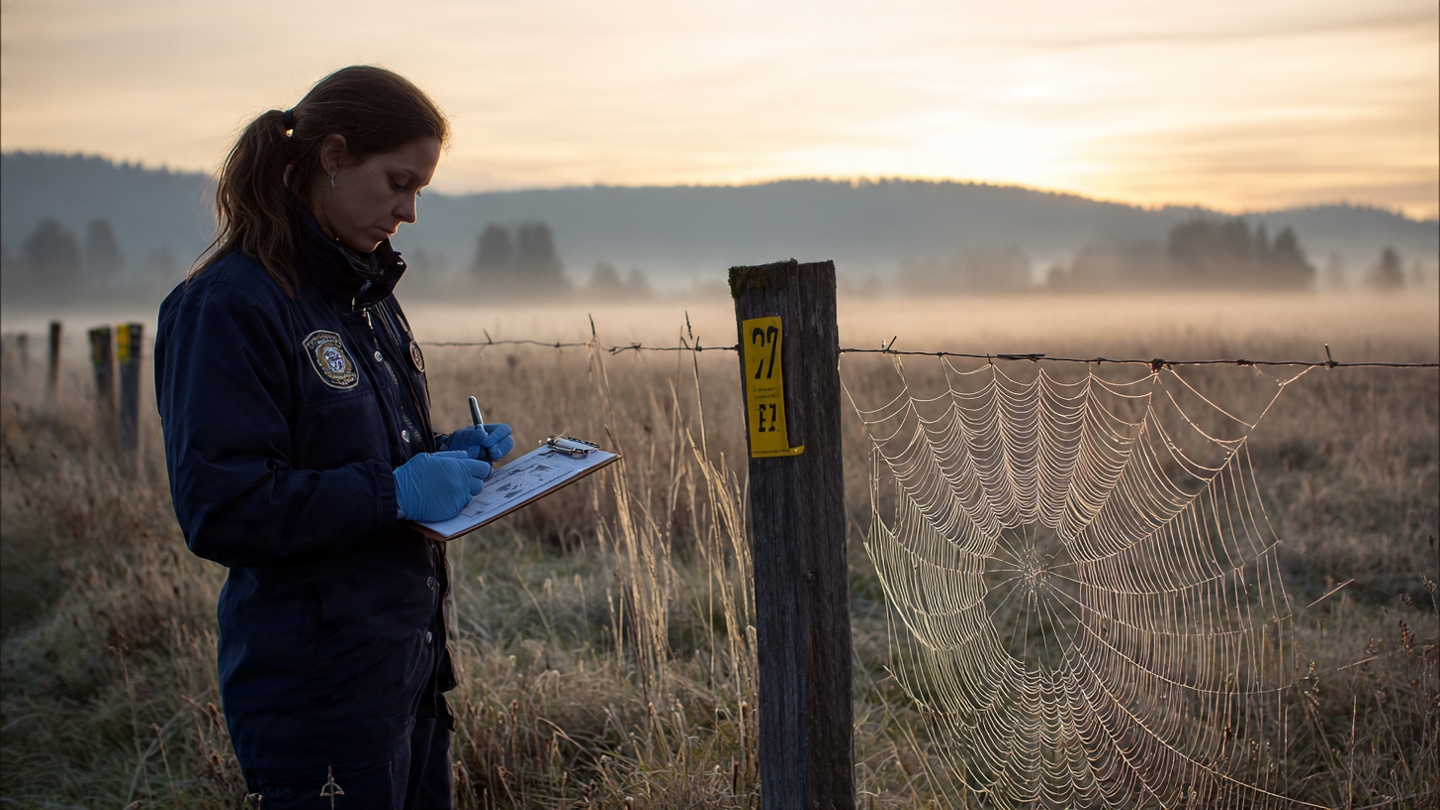
Tomorrow morning, at dawn, across every state, territory, and tribal land under federal jurisdiction, trillions of spiderwebs will be glistening with dew, each one an unregistered, unlabeled, misbranded pesticide device operating in open violation of a statute that Congress has amended seven times since 1947 without once addressing the most widespread noncompliance in the Act’s history. The webs will catch flies. The EPA will not notice. The statute will remain unsatisfied.
Ergo.
Sources
- Federal Insecticide, Fungicide, and Rodenticide Act (FIFRA), 7 U.S.C. §§ 136–136y. Original enactment: Pub. L. 80-104, 61 Stat. 163 (1947). Major amendments: Federal Environmental Pesticide Control Act of 1972 (Pub. L. 92-516); FIFRA Amendments of 1988 (Pub. L. 100-532); Food Quality Protection Act of 1996 (Pub. L. 104-170). law.cornell.edu ↑
- 7 U.S.C. § 136(h), definition of “device”; 7 U.S.C. § 136(u), definition of “pesticide.” See also 40 C.F.R. § 152.500(a), applicability of FIFRA provisions to devices. law.cornell.edu ↑
- 40 C.F.R. § 152.500(a), “Applicability of the Act to devices.” Devices are subject to Sections 2(q), 7, 12, and 14 of FIFRA but exempt from registration under Section 3. law.cornell.edu ↑
- 7 U.S.C. § 136e (FIFRA Section 7), Registration of establishments; 40 C.F.R. Part 167, registration and reporting requirements. EPA Form 3540-8 for establishment registration. epa.gov ↑
- EPA, “National List of Active EPA-Registered Foreign and Domestic Pesticide and/or Device-Producing Establishments.” Updated daily. epa.gov ↑
- Selden, P.A. & Penney, D., “Fossil Spiders,” Biological Reviews 85 (2010): 171–206. Oldest unambiguous spider fossils date to the Carboniferous (~310 Ma); oldest preserved silk to Early Cretaceous Lebanese amber (~130 Ma). Orb web architecture inferred from mid-Cretaceous amber. ↑
- World Spider Catalog, Natural History Museum of Bern. As of 2026, more than 49,000 species in 132 families. The frequently cited figure of “more than 45,000” reflects catalogues through 2017. wsc.nmbe.ch ↑
- Roth, V.D., “Spider Genera of North America,” 3rd ed. (1993). Cited in Skerl, K.L., “Spider Conservation in the United States,” University of Michigan. Approximately 3,500 described species with 350 undescribed. websites.umich.edu ↑
- Updated checklist of North American spiders: 5,401 species within 76 families, including 118 nonnative species established via transatlantic trade, transportation, and human migration. bioRxiv preprint, 2025. biorxiv.org ↑
- Missouri Department of Conservation, “Spider Facts.” U.S. arachnologists have estimated populations ranging from 30,000 spiders per acre in Mississippi woodlands to more than 2.5 million individuals in a grassland acre. Citing Bristowe, W.S. (1971). mdc.mo.gov ↑
- Nyffeler, M. & Birkhofer, K., “An estimated 400–800 million tons of prey are annually killed by the global spider community,” The Science of Nature 104: 30 (2017). Global spider biomass: approximately 25 million metric tons. doi.org ↑
- Clarke, T.H. et al., “Multi-tissue transcriptomics of the black widow spider reveals expansions, co-options, and functional processes of the silk gland gene toolkit,” BMC Genomics 15: 365 (2014). See also Vollrath, F. & Knight, D.P., “Liquid crystalline spinning of spider silk,” Nature 410: 541–548 (2001). Seven gland types in Orbiculariae: major ampullate, minor ampullate, flagelliform, tubuliform, aciniform, pyriform, and aggregate. ↑
- Lefevre, T. et al., “Diversity of molecular transformations involved in the formation of spider silks,” Journal of Molecular Biology 405: 238–253 (2011). Spidroin nomenclature follows gland of origin. Repeat motifs: polyalanine (A)n, glycine-alanine (GA)n, GGX, GPGXX. ↑
- Hsia, Y. et al., “Spider silk composites and applications,” in Metal, Ceramic, and Polymeric Composites for Various Uses (InTech, 2011). Dragline silk: tensile strength ~1.1 GPa, elongation 27%, energy to break 160 MJ/m³. Kevlar 49: 3.6 GPa, 2.7%, 50 MJ/m³. High-tensile steel: 1.5 GPa, 0.8%, 6 MJ/m³. See also American Chemical Society, “The Steel Strength of Featherweight Spider Silk,” inChemistry. inchemistry.acs.org ↑
- Blackledge, T.A. & Hayashi, C.Y., “Silken toolkits: biomechanics of silk fibers spun by the orb web spider Argiope argentata,” Journal of Experimental Biology 209: 2452–2461 (2006). Flagelliform silk extensibility: >200%, up to 270%. pubmed.ncbi.nlm.nih.gov ↑
- Nyffeler & Birkhofer, supra note 11. 400–800 million metric tons year−1. >90% insects and springtails. ↑
- Id. Human meat and fish consumption: ~400 million metric tons (FAO). Whales: 280–500 million metric tons (Yodzis, 2001). Seabirds: 70 million metric tons (Brooke, 2004). ↑
- Id. “Spiders in forests and grasslands account for more than 95 percent of the annual prey kill of the global spider community.” Agricultural spiders kill fewer insects due to unfavorable conditions from intensive management. ↑
- Foelix, R.F., Biology of Spiders, 3rd ed. (Oxford University Press, 2011). Many orb-weaving species rebuild webs daily, often consuming the old web to recycle silk proteins. ↑
- 7 U.S.C. § 136(t), definition of “pest.” EPA pest designations encompass all major arthropod orders targeted by spider predation. law.cornell.edu ↑
- Birkhofer, K. et al., “Relationships between multiple components of spider diversity and prey,” Ecography (2019). Hemiptera constitutes 41% of all prey individuals in agroecosystems. Fewer than 10 arthropod orders compose the majority of spider prey. ↑
- Eberhard, W.G., “The ecology of orb-weaving spiders: foraging strategy,” Annual Review of Ecology and Systematics 21: 341–375 (1990). Web capture efficiency varies with web type, prey size, and environmental conditions. ↑
- 7 U.S.C. § 136e; 40 C.F.R. Part 167. “Production in an unregistered establishment is a violation of the law.” EPA, “Pesticide Establishment Registration and Reporting.” epa.gov ↑
- Zschokke, S. & Vollrath, F., “Web construction patterns in a range of orb-weaving spiders,” European Journal of Entomology 92: 523–541 (1995). Orb web construction sequence: bridge thread, frame, hub, radii, temporary spiral, sticky spiral, hub modification. ↑
- USDA Natural Resources Conservation Service, “2017 National Resources Inventory.” U.S. grassland: approximately 633 million acres; forest: approximately 765 million acres; cropland: approximately 392 million acres. nrcs.usda.gov ↑
- 7 U.S.C. § 136(q)(1), definition of “misbranded.” Labeling requirements for devices at 40 C.F.R. § 156.10. law.cornell.edu ↑
- Blackledge & Hayashi, supra note 15. Five silk types with distinct material properties; prey capture is non-selective across arthropod orders. ↑
- 7 U.S.C. § 136j (FIFRA Section 12), unlawful acts; 7 U.S.C. § 136l (FIFRA Section 14), penalties. law.cornell.edu ↑
- 7 U.S.C. § 136l(b)(1)(A), criminal penalties for producers: $50,000 and/or 1 year. § 136l(b)(1)(B), criminal penalties for other violators: $25,000 and/or 1 year. § 136l(a), civil penalties. EPA, “Criminal Provisions of FIFRA.” epa.gov ↑
- EPA, “Medline Industries FIFRA Settlement,” September 19, 2018. $4,930,000 penalty for 1,291 violations of selling an unregistered pesticide. $3,818 per violation. epa.gov ↑
- Calculation: 1 trillion unregistered establishments × $5,000 minimum civil penalty = $5 quadrillion. U.S. GDP (2025): approximately $28 trillion. $5 quadrillion / $28 trillion ≈ 18. ↑
- EPA enforcement against DynaTrap Mosquito Trap, Sweetgrass, Montana port of entry, May 25, 2023. Product detained for failure to file Notice of Arrival (EPA Form 3540-1) as required by 19 C.F.R. § 12.114. Product classified as pesticide device based on label claims: “Mosquito Trap,” “Attract, Trap, and Kill Mosquitos,” and EPA Establishment Number. ↑
- Standard commercial fly strips (e.g., Catchmaster, Rescue) are classified as pesticide devices under FIFRA and bear EPA establishment numbers on their packaging. ↑