I. The Statutory Framework
The Atomic Energy Act of 1954, signed into law on August 30, 1954, is the foundational statute governing the civilian use of nuclear materials in the United States. It established the framework under which the Atomic Energy Commission—and, after 1974, the Nuclear Regulatory Commission—regulates the production, possession, transfer, and disposal of radioactive materials. The statute is codified at 42 U.S.C. § 2011 et seq.1
Section 81 of the Act, codified at 42 U.S.C. § 2111, provides the statutory authority for the domestic distribution of byproduct material. The provision establishes that byproduct material may only be transferred to and disposed of in facilities that are “adequate to protect public health and safety” and that are licensed by the Commission or by an Agreement State whose licensing requirements are compatible with the Commission’s own. It is the congressional grant of authority under which the NRC promulgates the licensing regulations that govern who may possess byproduct material and under what conditions.2
The Commission’s implementing regulations appear at 10 CFR Part 30, “Rules of General Applicability to Domestic Licensing of Byproduct Material.” Section 30.3 states the general requirement: “No person shall manufacture, produce, transfer, receive, acquire, own, possess, or use byproduct material except as authorized in a specific or general license issued in accordance with the regulations in this chapter.” The section qualifies this prohibition with references to exemptions provided elsewhere in Part 30 and Part 150—including the exemption at § 30.15 that is the subject of this investigation. But the qualifier proves the rule. The exemptions exist because the prohibition would otherwise apply. The default position of federal law is that the possession of byproduct material requires a license.3
The operative word is “possess.” Not “manufacture.” Not “sell.” Not “distribute.” Possess. Absent an exemption, the regulation prohibits the mere physical custody of byproduct material without a license. The prohibition, where it applies, applies to every person and in every jurisdiction. It draws no distinction between a nuclear medicine laboratory and a hallway closet.
The term “byproduct material” is defined at Section 11(e) of the Act, codified at 42 U.S.C. § 2014(e). In its original and still-operative definition, byproduct material means “any radioactive material (except special nuclear material) yielded in or made radioactive by exposure to the radiation incident to the process of producing or utilizing special nuclear material.”4 This definition is inclusive. It encompasses any radioactive substance that exists because a nuclear reactor operated or a nuclear weapon was produced. It does not require that the substance itself be dangerous. It does not require that the substance be present in any minimum quantity. It requires only that the substance be radioactive and that it owe its existence to the nuclear enterprise.
II. The Material
Americium-241 is a synthetic transuranic element. It does not exist in nature. Every atom of americium-241 on Earth was produced, directly or indirectly, by human nuclear activity. The isotope is formed through the beta decay of plutonium-241, which is itself produced in nuclear reactors when uranium-238 absorbs neutrons during the fission process. The decay chain is: uranium-238 captures a neutron to become uranium-239, which beta-decays to neptunium-239, which beta-decays to plutonium-239, which captures two additional neutrons to become plutonium-241, which beta-decays with a half-life of 14.3 years to americium-241.5
Americium-241 has a half-life of 432.2 years. It decays primarily through alpha emission, producing alpha particles with an energy of 5.4 to 5.5 million electron volts and soft gamma radiation at 59.5 keV. It has a specific activity of 3.43 curies per gram. The Centers for Disease Control and Prevention classifies it as a radionuclide that, in the form of dust or fine powder, “can cause certain cancers” and notes that it “concentrates in the bones, liver, and muscles, exposing these organs to alpha particles.”6
The CDC further notes the origin of the material in terms that leave nothing to interpretation: “Am-241 is a manmade metal that is produced from plutonium.”6 Los Alamos National Laboratory, the institution that designed the first nuclear weapons, states that americium-241 “decays primarily through alpha emission to give neptunium-237” and confirms that “this reaction is the basis of operation for smoke detectors.”7
Americium-241 is, by the plain text of the Atomic Energy Act’s definition, byproduct material. It is radioactive. It was yielded in the process of producing special nuclear material. It owes its existence to plutonium production in nuclear reactors—the same reactors that produced plutonium-239 for warheads. Los Alamos National Laboratory, the institution that designed the first nuclear weapons, states that by 2004 the remaining American inventory of americium “was depleted, leaving the US dependent on Russian supplies.”7 The chain of custody runs from the Hanford Site and Savannah River Site production reactors, through Los Alamos and Oak Ridge separation facilities, to the manufacturing plants of First Alert and Kidde, to the ceiling of a bedroom in which a child is sleeping. The NRC does not dispute this classification. The NRC regulates americium-241 as byproduct material. The NRC requires specific licenses from the Commission under 10 CFR Part 32 for any manufacturer that produces or distributes products containing it.8
The label on every ionization smoke detector sold in the United States confirms this. Under 10 CFR § 32.15(b)(2)(i)(A), every detector must bear a durable, legible, readily visible label containing the statement: “CONTAINS RADIOACTIVE MATERIAL.” Subsection (B) requires that the label identify the radionuclide—“americium-241” or “Am-241”—and the quantity of activity. Subsection (C) requires identification of the NRC licensee who manufactured it.8
The manufacturers label the product as radioactive because it is radioactive. The NRC requires the label because the NRC agrees it is radioactive. The label does not say “CONTAINS MATERIAL THAT WOULD BE RADIOACTIVE IF IT WEREN’T IN A SMOKE DETECTOR.” It says “CONTAINS RADIOACTIVE MATERIAL.” The material does not change character when it is installed on a ceiling.
III. The Exemption as Confession
The NRC’s regulations at 10 CFR § 30.15 are titled “Certain items containing byproduct material.” The section provides exemptions from licensing requirements for specific categories of consumer products that contain byproduct material. Paragraph (a)(7), added by final rule published October 16, 2007 (72 FR 58473), provides:
“Ionization chamber smoke detectors containing not more than 1 microcurie (μCi) of americium-241 per detector in the form of a foil and designed to protect life and property from fires.”9
The regulatory logic is identical to the logic of statutory exemptions in every other domain of American law. You do not exempt something from a requirement unless it falls within the requirement. If ionization smoke detectors did not contain byproduct material, no exemption would be necessary. If the possession of a smoke detector did not constitute possession of byproduct material requiring a license under 10 CFR § 30.3, the Commission would not have needed to write twelve words to ensure that it does not.
The structure of 10 CFR § 30.15 is itself revealing. The section exempts, in addition to smoke detectors: timepieces containing tritium or promethium-147 in their luminous dials (paragraph (a)(1)); static elimination devices containing up to 500 microcuries of polonium-210 (paragraph (a)(2)); balances of precision containing tritium (paragraph (a)(3)); marine compasses containing up to 750 millicuries of tritium (paragraph (a)(5)); and electron tubes containing specified quantities of tritium, cobalt-60, nickel-63, krypton-85, cesium-137, or promethium-147 (paragraph (a)(8)).9
Every item on this list is a consumer product. Every item on this list contains byproduct material. Every item on this list would, but for the exemption, require a specific or general license from the Nuclear Regulatory Commission for any person who possesses it. The Commission evaluated each one, determined that the risk to public health and safety was acceptable, and exempted it from licensing. The section is not a list of things that happen to contain radioactive material. It is a list of things that the Commission decided not to regulate even though they are, by the statute’s own definitions, within its regulatory jurisdiction.
The specificity of paragraph (a)(7) is instructive. The exemption does not cover “smoke detectors.” It covers “ionization chamber smoke detectors.” It specifies the radionuclide: americium-241. It specifies the maximum activity: 1 microcurie. It specifies the physical form: a foil. It specifies the purpose: designed to protect life and property from fires. A photoelectric smoke detector, which uses a light source and photosensor rather than a radioactive source, does not appear in § 30.15 because it does not contain byproduct material and therefore does not need an exemption. The exemption applies only to the type of detector that contains the type of material that requires a license.
The Commission has enforced the limits of this exemption. An ionization smoke detector containing more than 1 microcurie of americium-241 is not exempt. An industrial ionization detector not designed to protect life and property from fires is not exempt. A detector containing a different radionuclide, even if functionally identical, is not exempt unless separately provided for. The boundary of the exemption is the boundary of the Commission’s decision not to require a license. Everything outside that boundary requires one.
IV. The Installed Base
The Consumer Product Safety Commission has conducted multiple surveys of smoke detector prevalence in American households. A 2004–2005 CPSC survey found that ninety-six to ninety-seven percent of surveyed households reported having at least one smoke detector. Telephone surveys conducted for the National Fire Protection Association by Harris in 2008 and 2010 produced consistent results.10 The NFPA reports that “19 out of every 20 U.S. homes had at least one smoke alarm.”11
The United States Census Bureau reports approximately 131 million occupied housing units in the country. At ninety-five percent penetration, approximately 124 million households possess at least one smoke detector. NFPA 72, the National Fire Alarm and Signaling Code, requires newly constructed homes to have smoke alarms on each floor, in hallways, and inside all sleeping areas. The International Association of Fire Chiefs reports that more than 84 million homes—most built prior to 1993—have battery-operated or hardwired smoke alarms that may not meet current code but are nonetheless present and operational.12
Not all of these devices are ionization detectors. The smoke detector market has shifted significantly toward photoelectric technology in recent decades, driven by fire service recommendations, state legislation, and consumer awareness. Several states, including Vermont and Massachusetts, have enacted legislation requiring or encouraging photoelectric detectors. Nevertheless, ionization detectors dominated the consumer market for the majority of the period from the early 1970s through the 2010s, and an enormous installed base remains in American homes.
The NRC’s own environmental assessment, published as NUREG/CR-1156 in 1979, documented the scale of distribution at an early stage: fourteen million ionization smoke detectors containing a total of forty-one curies of americium-241 were distributed in 1978 alone, with an average activity of three microcuries per unit. The report projected that approximately ninety million units would be distributed by 1986.13 Distribution continued for decades after 1986. The devices have a certified useful life of approximately ten years, but many remain installed far longer. Because of the 432.2-year half-life of americium-241, the radioactive content of a smoke detector at the end of its useful life is, for all practical purposes, identical to the radioactive content at the time of manufacture.14
The cumulative result is an installed base of radioactive sources in American homes that dwarfs, by orders of magnitude, the inventory administered under the NRC’s licensed materials program.
V. The Regulatory Asymmetry
The NRC and its thirty-nine Agreement State partners administer a total of 17,698 specific radioactive material licenses across the United States. Of these, 15,610 are administered by Agreement States and 2,088 by the NRC directly. The licenses cover medical uses (hospitals, cancer treatment centers, nuclear medicine laboratories), industrial uses (radiography, well logging, gauging devices), and academic and research uses (university laboratories, federal research institutions).15
Each of these 17,698 licensees is subject to inspection by the NRC or its Agreement State regulator. Each must designate a Radiation Safety Officer. Each must maintain records of receipt, transfer, and disposal of byproduct material. Each must conduct radiation surveys. Each must monitor worker exposure. Each must file incident reports. Each must pay annual licensing fees. A hospital nuclear medicine department that possesses ten millicuries of technetium-99m for diagnostic imaging is inspected on a routine cycle. A university laboratory that possesses five microcuries of carbon-14 for tracer studies maintains a detailed inventory. A well-logging company whose sealed sources contain americium-241—the identical isotope present in smoke detectors—files annual reports with the Commission and submits to announced and unannounced inspections.
The Commission inspects these 17,698 licensees because it has determined that the possession of byproduct material creates risks that require regulatory oversight. The risk is dose-dependent. The risk is use-dependent. The risk is real. The Commission has never suggested otherwise.
The same Commission has determined that the possession of the same category of material—byproduct material, containing the same isotope, americium-241, emitting the same alpha particles and gamma radiation, with the same 432.2-year half-life—by approximately 124 million households requires no license, no Radiation Safety Officer, no inventory, no inspection, no incident reporting, and no fee. The exemption requires only that the material be in the form of a foil, sealed inside a smoke detector, in a quantity not exceeding one microcurie.
One microcurie is a small quantity. It is 37,000 radioactive disintegrations per second. It is, by radiological standards, negligible under normal conditions of use. The NRC’s own assessment concluded that the radiation exposure from an intact smoke detector is approximately three thousand times less than normal background radiation at a distance of one meter.16 The Commission’s decision to exempt these devices is, by every reasonable measure, a sound exercise of regulatory judgment.
But the exercise of regulatory judgment is not the same as the absence of regulatory jurisdiction. The Commission exempted smoke detectors because it concluded that the risk was acceptable. It did not conclude that the material was not byproduct material. It did not conclude that the possession was not possession. It concluded that the possession of this particular byproduct material, in this particular form, in this particular quantity, for this particular purpose, did not warrant the burden of individual licensing. The jurisdiction remains. The power to revoke the exemption remains. The classification of the material remains. The label on the device confirms it.
VI. The Manufacturer’s Obligation
The regulatory architecture for ionization smoke detectors distributes compliance obligations unevenly. The manufacturer bears the weight. The consumer bears none.
Under 10 CFR § 32.14, any person who wishes to manufacture, process, or produce ionization smoke detectors containing americium-241 for distribution to exempt persons must obtain a specific license from the NRC. The application must demonstrate that the product is designed so that in normal use and in the most severe accident conditions likely to occur, the byproduct material will not be released or produce radiation levels that could create an unreasonable risk.8
Under 10 CFR § 32.15, the licensee must maintain quality assurance practices in the manufacture of every detector. It must subject inspection lots to statistical sampling and testing. It must visually inspect each unit. It must reject any lot containing defective units above a specified tolerance. It must label every detector with the “CONTAINS RADIOACTIVE MATERIAL” statement, the identity and quantity of the radionuclide, and the licensee’s identification.8
Under 10 CFR § 32.27, the manufacturer is obligated to accept the return of any detector it distributed, and to arrange for the proper disposal of the americium-241 at a licensed radioactive waste disposal facility. Multiple state guidance documents and the U.S. Postal Service confirm that consumers may mail used ionization smoke detectors to manufacturers for this purpose.17
The consumer, by contrast, has no obligation under any NRC regulation. The consumer is not required to label the detector. The consumer is not required to track its location. The consumer is not required to report its disposal. The consumer is not required to return it to the manufacturer. The consumer is not prohibited from placing the detector—with its americium-241 foil intact, its half-life running through its first four centuries—in a household trash bin for collection by a municipal solid waste truck and delivery to a licensed landfill.
Multiple states have confirmed this. The Wisconsin Department of Natural Resources states that household ionization smoke detectors “may be placed in household trash bins for disposal at a licensed landfill,” but recommends that homeowners “spread out” disposal over several loads “to minimize the potential of setting off the radiation detectors located at landfills.”18
The guidance is worth reading twice. The state acknowledges that landfills have radiation detectors. The state acknowledges that multiple smoke detectors arriving simultaneously may trigger those detectors. The state’s recommendation is not that the consumer obtain a license, file an incident report, or contact the NRC. The state’s recommendation is that the consumer spread out the disposal of the radioactive material over multiple garbage pickups so that the radiation detectors at the landfill are not triggered.
VII. The Disposal Paradox
The disposal of americium-241 from ionization smoke detectors presents a regulatory paradox that illuminates the structural tension at the heart of the exemption.
Under 10 CFR § 20.2001, licensed material may only be disposed of by transfer to an authorized recipient, by decay in storage, by release in effluents within prescribed limits, or as authorized by the Commission. For licensed users of americium-241—the hospitals, laboratories, and industrial facilities that hold the 17,698 material licenses—improper disposal of even trace quantities of byproduct material constitutes a violation that may result in civil penalties, license suspension, or criminal prosecution under Section 223 of the Atomic Energy Act (42 U.S.C. § 2273), which provides for fines and imprisonment of up to two years for willful violations.19
For the exempt consumer, the regulatory landscape is different. The exemption at 10 CFR § 30.15 relieves the consumer of all licensing obligations, including the obligation to dispose of the material through licensed channels. The result is that a hospital laboratory that improperly disposes of a microcurie of americium-241 is subject to NRC enforcement action, while a homeowner who places a smoke detector containing the same isotope, in the same quantity, in a trash bag on the curb is in compliance with applicable law.
The physical reality is identical. A microcurie of americium-241 in a trash bag emits the same alpha particles and gamma radiation as a microcurie of americium-241 in a laboratory waste container. The alpha particles have the same energy. The half-life is the same 432.2 years. The material will remain radioactive in the landfill for millennia after the smoke detector’s plastic housing has decomposed. The regulatory treatment is not identical because the regulatory treatment was never designed to be identical. It was designed to exempt one population from obligations imposed on another, for the same material, on the basis of the Commission’s determination that the risk in the exempt context was acceptable.
The determination may be correct. The risk may indeed be acceptable. But the material is the same material. The atom does not consult the Code of Federal Regulations before it decays.
VIII. Conclusion
The evidence requires no creative interpretation. The Atomic Energy Act of 1954 provides the authority under which the NRC licenses the possession of byproduct material. The implementing regulations at 10 CFR § 30.3 prohibit possession except under a license or an enumerated exemption. Americium-241 is byproduct material by every definition the statute provides. Ionization smoke detectors contain americium-241. The CPSC’s own surveys confirm that ninety-six percent of American households possess at least one smoke detector. The NRC administers 17,698 material licenses for the entire country. It has issued none of them to any homeowner for any smoke detector.
The Commission resolved this in the manner that regulatory agencies typically resolve such gaps: it wrote an exemption. It specified the isotope. It specified the quantity. It specified the physical form. It specified the purpose. The exemption is narrow, precise, and conditional. It is a carve-out in the Code of Federal Regulations that stands between approximately 124 million American households and a federal licensing requirement.
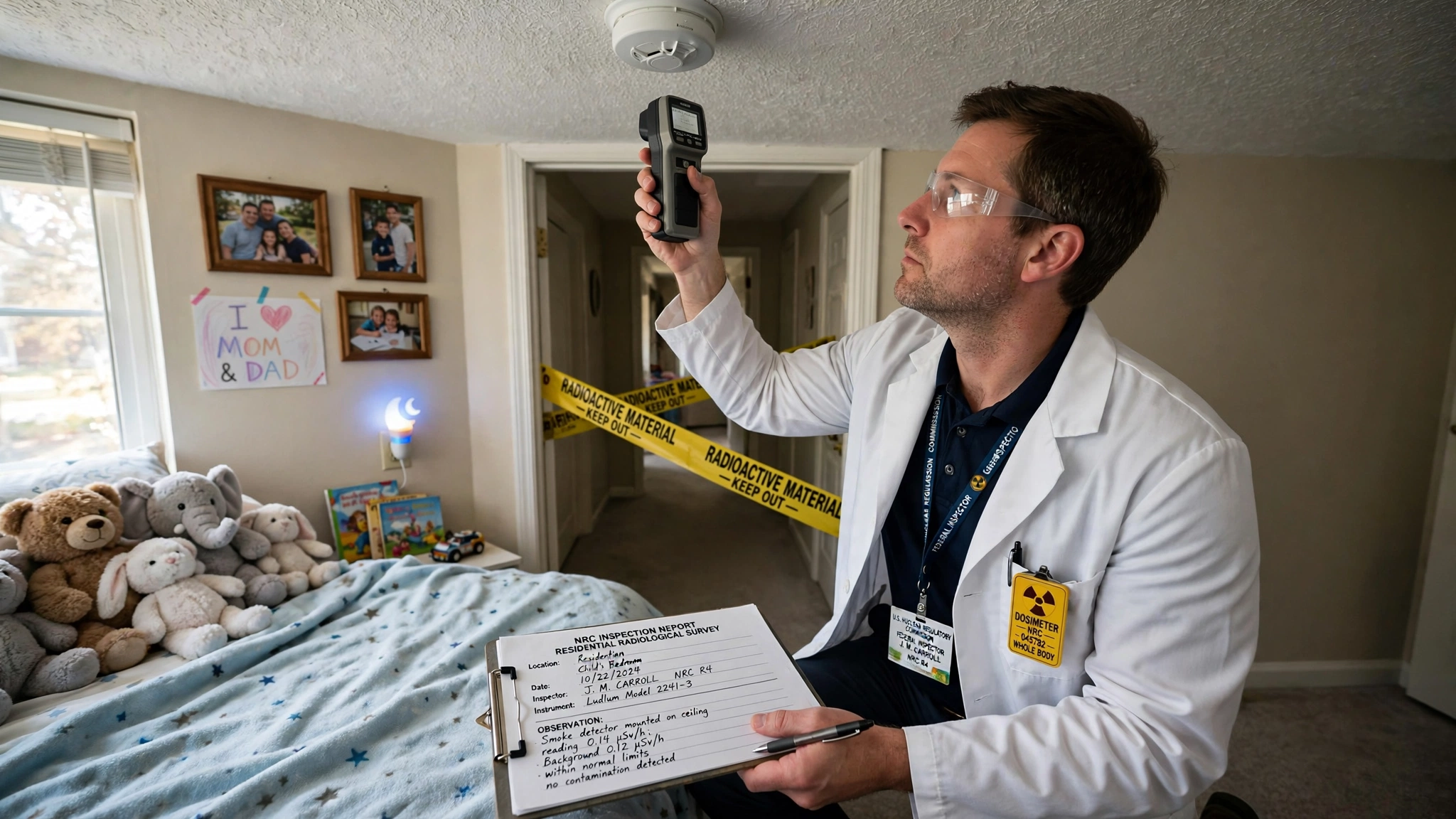
Every ionization smoke detector bears a label that reads “CONTAINS RADIOACTIVE MATERIAL”—a label the NRC requires because the statement is true. The consumer who purchased the detector at a hardware store does not read the label. The consumer does not know what americium-241 is. The consumer does not know that a transuranic element produced from plutonium in the nation’s nuclear weapons complex is mounted on the ceiling above the crib. The consumer knows that the smoke detector beeps when the battery is low.
The material has a half-life of 432.2 years. The label will remain accurate long after the smoke detector has stopped functioning, long after the house has been demolished, and long after the landfill where it was discarded—spread across several garbage pickups, as the state of Wisconsin recommends, so as not to trigger the radiation detectors—has closed.
The Nuclear Regulatory Commission has decided that this is acceptable. The risk is manageable, the quantities are small, the containment is adequate, and the benefit to public safety from widespread smoke detector adoption outweighs the radiological cost of distributing a weapons-program byproduct to every household in the country. This decision is almost certainly correct.
But the material is still byproduct material. The exemption is still an exemption. And the label still says what it says.
Ergo.
Sources
- Atomic Energy Act of 1954, Pub. L. 83-703, 68 Stat. 919, codified as amended at 42 U.S.C. § 2011 et seq. nrc.gov ↑
- 42 U.S.C. § 2111 (Atomic Energy Act of 1954, Section 81), “Domestic Distribution.” uscode.house.gov ↑
- 10 CFR § 30.3, “Activities requiring license.” nrc.gov ↑
- 42 U.S.C. § 2014(e), definition of “byproduct material.” uscode.house.gov ↑
- “Isotopes of americium,” Wikipedia, describing the production chain for americium-241 via beta decay of plutonium-241; see also “United States of Americium,” Los Alamos National Laboratory. wikipedia.org ↑
- “Americium-241,” Radiation Emergencies, Centers for Disease Control and Prevention. Properties, origin, form, and health risks of Am-241. cdc.gov ↑
- “United States of Americium,” Los Alamos National Laboratory, documenting the properties, production history, and applications of americium-241, including the statement that the Am-241 alpha decay to neptunium-237 “is the basis of operation for smoke detectors.” lanl.gov ↑
- 10 CFR Part 32, “Specific Domestic Licenses to Manufacture or Transfer Certain Items Containing Byproduct Material,” including §§ 32.14 (application requirements), 32.15 (quality assurance, labeling), and 32.27 (manufacturer acceptance of returned detectors). nrc.gov ↑
- 10 CFR § 30.15, “Certain items containing byproduct material,” paragraph (a)(7): “Ionization chamber smoke detectors containing not more than 1 microcurie (μCi) of americium-241 per detector in the form of a foil and designed to protect life and property from fires.” Added by Final Rule, 72 FR 58473, Oct. 16, 2007. law.cornell.edu ↑
- U.S. Consumer Product Safety Commission, smoke detector prevalence surveys (2004–2005); Harris telephone surveys for NFPA (2008, 2010); both reporting 96–97 percent household penetration. Cited in NFPA, “Smoke Alarms in U.S. Home Fires,” 2014. cpsc.gov ↑
- “NFPA Report: 70% Of All Home Fire Deaths Occur In Homes With No Alarms Or No Working Alarms,” Fire Engineering, citing NFPA data that “19 out of every 20 U.S. homes had at least one smoke alarm.” fireengineering.com ↑
- International Association of Fire Chiefs, “Do Not Be Left Under Protected,” reporting that “more than 84 million homes—most built prior to 1993—only have isolated battery- or electric-powered smoke alarms.” iafc.org ↑
- NUREG/CR-1156, “Environmental Assessment of Ionization Chamber Smoke Detectors Containing Am-241,” U.S. Nuclear Regulatory Commission, 1979. Reports that 14 million units containing 41 curies of Am-241 were distributed in 1978, with 26 million units distributed since 1972 and projections of 90 million by 1986. nrc.gov ↑
- EPA Office of Solid Waste, guidance on smoke detector disposal, noting that “because of the long half-life of americium-241 the amount of radioactive material in the smoke alarm at the end of its certified useful life will be about the same as when you bought it.” montclairnjusa.org ↑
- NRC Staff Technical Conference Paper STC-23-075, “Annual Count of Active Radioactive Material Licenses in the National Materials Program,” February 1, 2023: 17,698 total material licenses (15,610 Agreement State, 2,088 NRC). nrc.gov ↑
- Morris County Municipal Utilities Authority (MCMUA), Household Hazardous Waste guidance, citing NRC data that “the amount of radiation that escapes the detector is roughly 3000 times less than normal background radiation exposure rates, at 1 meter from the alarm.” mcmua.com ↑
- 10 CFR § 32.27, manufacturer obligation to accept returns; U.S. Postal Service Postal Bulletin 22343, guidance on shipping smoke detectors for disposal; multiple state and county guidance documents (Montgomery County, PA; Union County, NJ; City of Albuquerque) confirming the return-to-manufacturer process. ↑
- Wisconsin Department of Natural Resources, “Disposal of Household Smoke Detectors,” recommending that homeowners “spread out” disposal over several loads “to minimize the potential of setting off the radiation detectors located at landfills.” apps.dnr.wi.gov ↑
- 42 U.S.C. § 2273 (Atomic Energy Act of 1954, Section 223), criminal penalties for violations: imprisonment of not more than two years or a fine, or both, for willful violations of Commission regulations. ↑