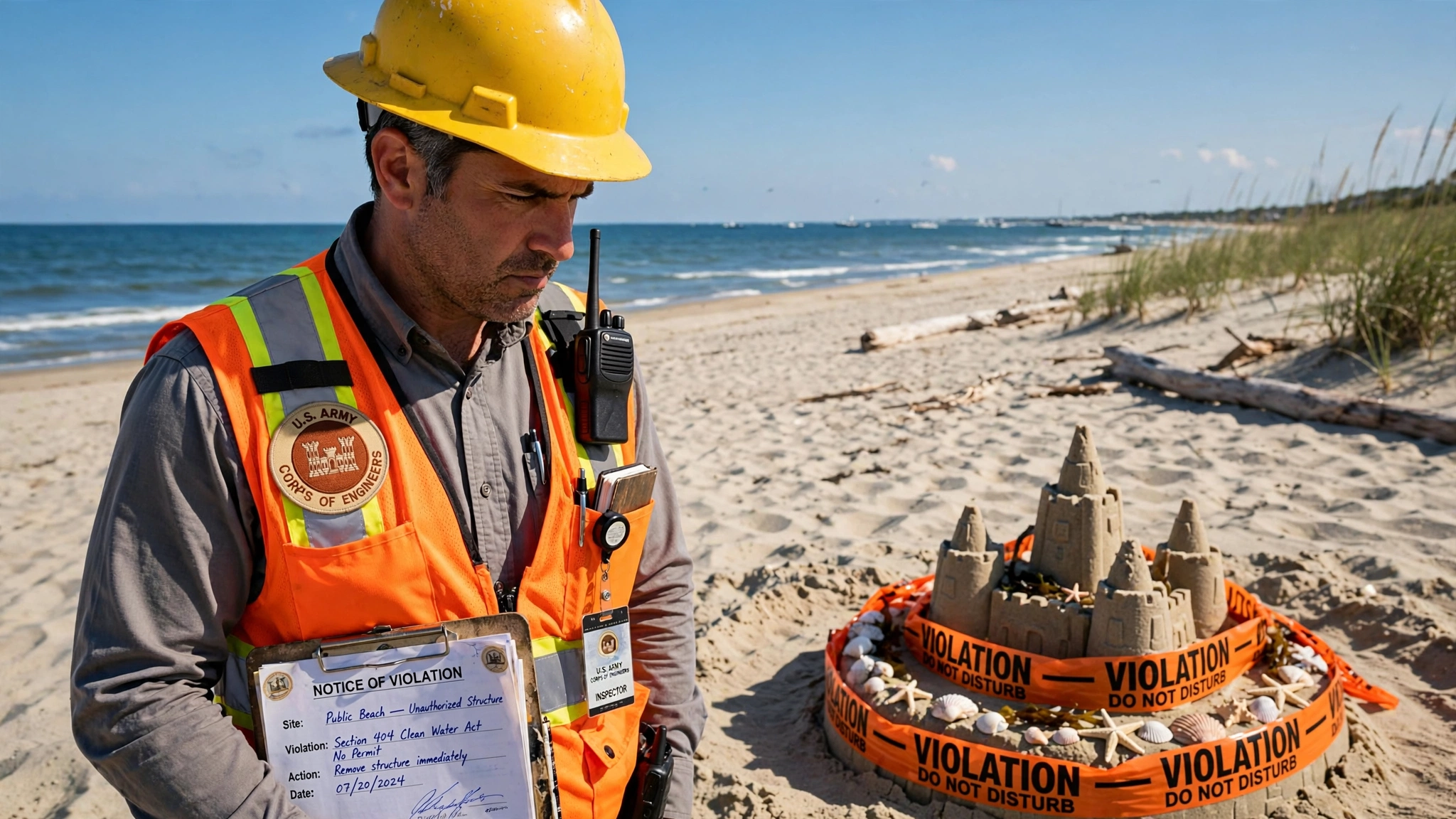
I. The Statutory Framework
The Clean Water Act, enacted as the Federal Water Pollution Control Act Amendments of 1972, Pub. L. 92-500, 86 Stat. 816, codified at 33 U.S.C. § 1251 et seq., established the national objective “to restore and maintain the chemical, physical, and biological integrity of the Nation’s waters.”1 To achieve this objective, Section 301(a) of the Act, codified at 33 U.S.C. § 1311(a), declared that “the discharge of any pollutant by any person shall be unlawful” except in compliance with the Act’s various permitting provisions.
Section 404 of the Clean Water Act, codified at 33 U.S.C. § 1344, addresses one specific category of pollutant discharge: the placement of dredged or fill material into waters of the United States. Under Section 404(a), “the Secretary [of the Army] may issue permits, after notice and opportunity for public hearings, for the discharge of dredged or fill material into the navigable waters at specified disposal sites.”2 The regulatory program implementing this provision is administered by the United States Army Corps of Engineers, which shares oversight responsibility with the Environmental Protection Agency.
The statute does not contain a minimum size threshold for regulated activities. It does not exempt structures based on their aesthetic merit, their intended audience, or the age of their architect. It does not distinguish between projects that are commercially motivated and projects that are recreationally motivated. It requires a permit for the discharge of fill material into waters of the United States. The only operative questions are: Was material placed? Was it fill material? Were the receiving waters “waters of the United States”? If so, a permit is required.
II. The Regulatory Definitions
The Corps’ implementing regulations at 33 CFR Part 323 define the key terms with specificity that their drafters made deliberate and that their application to recreational beach construction makes inevitable.
Section 323.2(e)(1) of Title 33 of the Code of Federal Regulations defines “fill material” as follows:
“[T]he term fill material means material placed in waters of the United States where the material has the effect of: (i) Replacing any portion of a water of the United States with dry land; or (ii) Changing the bottom elevation of any portion of a water of the United States.”3
The regulation continues at 33 CFR § 323.2(e)(2) with illustrative examples:
“Examples of such fill material include, but are not limited to: rock, sand, soil, clay, plastics, construction debris, wood chips, overburden from mining or other excavation activities, and materials used to create any structure or infrastructure in the waters of the United States.”3
Sand is listed second. It is not listed as an exception. It is not listed with qualifications. It is listed as an example of the regulated material. The regulation does not add “when placed by a licensed contractor” or “when transported by heavy machinery.” It states that sand, placed in waters of the United States, where the placement has the effect of changing the bottom elevation, constitutes fill material. The placement of fill material without a permit is unlawful.
Section 323.2(c) defines the companion term with equal precision:
“[T]he term dredged material means material that is excavated or dredged from waters of the United States.”3
The definition does not specify the tool used for excavation. It does not require a dredging vessel, a backhoe, or a crane. It requires that material be excavated from waters of the United States. A child’s plastic shovel is a tool. A cupped hand is a tool. Excavation is excavation regardless of the diameter of the implement.
III. The Activity
The construction of a sandcastle on a tidal beach involves the following regulated activities, each of which is described with clinical precision by the Corps’ own regulatory definitions:
First, the operator excavates sand from the beach. Under 33 CFR § 323.2(c), this sand is “material that is excavated or dredged from waters of the United States.” The excavation typically occurs in the intertidal zone—the area between the high-tide line and the low-tide line—which falls squarely within the Corps’ regulatory jurisdiction over tidal waters of the United States.4 The excavation creates a hole, pit, or trench in the substrate of a jurisdictional waterbody. This is dredging.
Second, the operator transports the excavated material—by hand, by bucket, by overturned pail—to a nearby site within the same waterbody.
Third, the operator places the sand at the disposal site. The placement has the effect of changing the bottom elevation of a portion of the waterbody. Before construction, the beach surface at the disposal site was at grade. After construction, it has been elevated by the height of the finished structure—commonly twelve to thirty-six inches, though ambitious projects exceed five feet. Under 33 CFR § 323.2(e)(1)(ii), this constitutes the placement of fill material in waters of the United States.
Fourth, the operator frequently returns to the source site for additional material, repeating the dredge-transport-fill cycle dozens or hundreds of times per construction session. Each cycle constitutes a separate discharge event under the Act.
The completed structure is, in the nomenclature of the Corps’ own regulatory guidance, a structure constructed in waters of the United States from fill material excavated from waters of the United States, without authorization under Section 404 of the Clean Water Act or Section 10 of the Rivers and Harbors Act of 1899.
IV. The Jurisdictional Waters
The question of whether a tidal beach constitutes “waters of the United States” subject to Section 404 jurisdiction has been settled by the Corps’ own regulations, by the Supreme Court, and by five decades of consistent enforcement practice.
The Corps’ regulations at 33 CFR § 328.3(a)(1) define “waters of the United States” to include, at minimum, “waters which are subject to the ebb and flow of the tide.”4 This is the most basic category of jurisdictional water. It has never been contested, narrowed, or qualified by any court. Even the Supreme Court’s decision in Sackett v. EPA, 598 U.S. 651 (2023), which substantially narrowed the definition of “waters of the United States” for purposes of wetlands jurisdiction, left tidal waters entirely undisturbed.5 Justice Alito, writing for the majority, defined the jurisdictional reach of the Act by reference to “relatively permanent, standing or continuously flowing bodies of water” and “the traditional definition of navigable waters.” The ocean is both.
A tidal beach is, by definition, subject to the ebb and flow of the tide. The intertidal zone is alternately submerged and exposed on a cycle of approximately twelve hours and twenty-five minutes. Sand in this zone is the bed of a navigable waterbody during every incoming tide. During the outgoing tide, it is exposed substrate of that same waterbody. The Corps has never questioned its jurisdiction over the intertidal zone. It exercises that jurisdiction every time it reviews a beach nourishment project, a seawall application, a marina expansion, or a pier construction permit.
The jurisdictional status of the material is equally clear. The sand on a tidal beach was deposited by tidal waters. It is reworked by tidal waters. It is saturated by tidal waters. When excavated, it is “material that is excavated or dredged from waters of the United States.” When redeposited in a new configuration, it is fill material placed in waters of the United States. The definitions are satisfied. The jurisdiction is established. The permit requirement applies.
V. The Beach Nourishment Precedent
The Corps does not treat the placement of sand on beaches as an unregulated activity. It treats it as one of the most heavily regulated coastal construction activities in the federal permitting system.
Beach nourishment—the practice of placing sand on an eroding beach to restore its width and elevation—requires authorization under both Section 404 of the Clean Water Act and Section 10 of the Rivers and Harbors Act of 1899.6 The Corps’ Galveston District has published a Letter of Permission procedure specifically for “dredging/excavation, transport, and discharge of dredged/excavated material for beach nourishment activities.”7 The Corps’ St. Paul District has published a Regional General Permit for “the placement of sand or pea gravel for the creation of new recreational beaches or nourishment of established beaches,” with detailed restrictions on dimensions, depth, and environmental impact.8
These permits govern the exact same physical operation performed during sandcastle construction: the excavation of sand from one location and its placement at another location within or adjacent to a jurisdictional waterbody. The difference is one of scale, not of kind. A beach nourishment project places thousands of cubic yards of sand along a shoreline. A sandcastle places two to ten cubic feet of sand on the same shoreline. Both change the bottom elevation of a portion of waters of the United States. Both involve the discharge of fill material. Both require a permit.
The City of Virginia Beach, Virginia, applied for and received a Section 404 and Section 10 permit to place sand along 3,700 linear feet of Croatan Beach, resulting in impacts to approximately 2.43 acres of intertidal non-vegetated areas and 19.58 acres of subaqueous bottom.9 The City of Milford, Connecticut, filed a joint federal and state permit application for a beach nourishment project involving the placement of sand in the intertidal zone.10 Both projects required public notice, comment periods, environmental review, and compliance with the Section 404(b)(1) Guidelines at 40 CFR Part 230. Both projects placed sand on a beach. Neither project built a sandcastle.
The regulatory distinction between a permitted beach nourishment project and an unpermitted sandcastle is not found in the statute, the regulations, or the case law. It is found in the apparent assumption that Section 404 was not intended to apply to activities performed by persons under four feet tall. The assumption is not supported by the text.
VI. The Permanence Question
The most intuitive defense of the recreational sandcastle industry is that sandcastles are temporary. The tide destroys them. The wind erodes them. No sandcastle has ever survived a full tidal cycle. Surely the Clean Water Act was not designed to regulate structures that cease to exist within hours of their construction.
The Corps has addressed this argument. It rejected it.
The Los Angeles District of the United States Army Corps of Engineers, in its public guidance on Section 404 jurisdiction, states with unmistakable clarity:
“A Corps permit is required whether the work is permanent or temporary. Examples of temporary discharges include dewatering of dredged material prior to final disposal, and temporary fills for access roadways, cofferdams, storage and work areas.”11
The regulation draws no distinction between a temporary fill that is removed by the permittee and a temporary fill that is removed by the ocean. The governing criterion is not the duration of the discharge. It is the fact of the discharge. A cofferdam built to facilitate bridge construction is temporary. It requires a permit. An access roadway built across a wetland during pipeline installation is temporary. It requires a permit. A sandcastle built on a tidal beach is temporary. It does not require a permit, for reasons that do not appear in the statute.
The argument that temporary structures are exempt from Section 404 would, if accepted, exempt every beach nourishment project in the country. Beach nourishment is inherently temporary. The sand placed on a nourished beach erodes at documented rates of two to ten feet per year, requiring renourishment every three to eight years.12 The Corps does not treat this temporariness as a basis for exemption. It treats it as a basis for re-permitting.
VII. The Rivers and Harbors Act
Section 404 of the Clean Water Act is not the only federal statute that a sandcastle violates. Section 10 of the Rivers and Harbors Act of 1899, codified at 33 U.S.C. § 403, provides:
“The creation of any obstruction not affirmatively authorized by Congress, to the navigable capacity of any of the waters of the United States is prohibited.”13
The statute further prohibits the construction of “any wharf, pier, dolphin, boom, weir, breakwater, bulkhead, jetty, or other structures in any port, roadstead, haven, harbor, canal, navigable river, or other water of the United States” without the approval of the Chief of Engineers and the Secretary of the Army. Section 10 permits are administered by the same Corps districts that administer Section 404 permits, and the two authorizations are typically sought in tandem for coastal construction projects.
A sandcastle is a structure. It is constructed in waters of the United States. It obstructs the navigable capacity of those waters to the extent of its footprint—typically four to twelve square feet, occasionally larger when moats, retaining walls, and ancillary fortifications are included. The Corps has required Section 10 permits for the placement of mooring buoys that obstruct less navigable area than a well-constructed sandcastle.
The statute is 127 years old. It was enacted to prevent the obstruction of waterways by industrial debris, sunken vessels, and unauthorized structures. The legislative history does not mention sandcastles. Then again, it does not mention mooring buoys, duck blinds, or temporary fishing platforms, all of which require permits under the Corps’ current regulatory program. The statute prohibits unauthorized structures in navigable waters. A sandcastle is an unauthorized structure in navigable waters. The text admits no exception for structures designed to be photographed before the tide comes in.
VIII. The Endangered Species Overlay
The regulatory burden does not end with the Clean Water Act and the Rivers and Harbors Act. On beaches where federally listed species are present—which includes virtually every beach on the Atlantic and Gulf coasts of the southeastern United States during the May-through-October nesting season—sandcastle construction implicates Section 9 of the Endangered Species Act.
Section 9 of the ESA, codified at 16 U.S.C. § 1538(a)(1)(B), prohibits any person from “taking” any endangered species within the United States. The statutory definition of “take” at 16 U.S.C. § 1532(19) means “to harass, harm, pursue, hunt, shoot, wound, kill, trap, capture, or collect.” The U.S. Fish and Wildlife Service’s implementing regulations at 50 CFR § 17.3 define “harm” to include “significant habitat modification or degradation where it actually kills or injures wildlife by significantly impairing essential behavioral patterns, including breeding, feeding, or sheltering.”14
Five of the seven sea turtle species found in U.S. waters are listed under the ESA: the loggerhead (Caretta caretta), green (Chelonia mydas), leatherback (Dermochelys coriacea), hawksbill (Eretmochelys imbricata), and Kemp’s ridley (Lepidochelys kempii).15 All five nest on sandy beaches. The U.S. Fish and Wildlife Service has designated critical habitat for loggerhead sea turtles along approximately 685 miles of coastline spanning the Gulf and Atlantic coasts.16 Canaveral National Seashore alone recorded 7,404 sea turtle nests in 2024, including 5,571 loggerhead nests and 1,801 green turtle nests.17
Sandcastle construction in sea turtle nesting habitat involves the physical disturbance of the beach substrate in which nests are buried. A nest typically consists of 100 to 130 eggs deposited in a chamber excavated twelve to twenty-four inches below the sand surface.18 A sandcastle hole of comparable depth, excavated in the same substrate during the same nesting season, constitutes habitat modification of the sort the USFWS has consistently regulated in other contexts. The Service requires Incidental Take Permits under Section 10(a)(1)(B) for beach nourishment projects, construction activities, and even beach-driving operations that disturb nesting habitat.19 It has not required a single Incidental Take Permit for any sandcastle.
The regulatory omission is all the more conspicuous given the documented hazard that sandcastle remnants pose to nesting females and hatchlings. The USFWS and state wildlife agencies routinely advise beachgoers to fill in holes and flatten sandcastles before leaving the beach, precisely because these structures impede the movement of nesting adults and trap emerging hatchlings.20 The agencies have identified the problem. They have identified the cause. They have not identified the permit.
IX. The Scale of the Unpermitted Activity
The coastal and ocean recreation statistics of the United States place the scope of the unauthorized construction program in quantitative perspective.
According to estimates compiled from federal and state sources, approximately 180 million Americans make roughly two billion visits to ocean, gulf, and inland beaches each year—more than twice the number of visits to all National Park Service properties combined.21 The National Ocean Economics Program and NOAA’s National Ocean Recreation Expenditure Survey reported that in its baseline year, nearly 49 million adults participated in ocean and coastal recreation, spending more than 1.2 billion activity-days along the coasts and contributing over $141 billion in direct expenditures.22
Not all beach visitors build sandcastles. But a substantial fraction do. The Hearth, Patio & Barbecue Association has never surveyed sandcastle construction rates, and the Census Bureau does not track fill material discharges performed by minors. However, if even ten percent of the estimated two billion annual beach visits involve the construction of a sand structure of any kind—a castle, a wall, a mound, a trench, a moat, a turtle, or an amorphous pile shaped by a toddler—the result is approximately 200 million unpermitted discharges of fill material into waters of the United States per year.
Each of these discharges constitutes a separate violation of 33 U.S.C. § 1311(a). Under Section 309(d) of the Clean Water Act, 33 U.S.C. § 1319(d), each violation is subject to a civil penalty of up to $25,000 per day, adjusted for inflation under the Federal Civil Penalties Inflation Adjustment Act to approximately $64,618 per violation per day as of 2026.23 At one violation per sandcastle per day, the theoretical aggregate civil liability for a single summer season exceeds $12.9 trillion. This figure does not include penalties under the Rivers and Harbors Act, which provides for separate fines and imprisonment, or under the Endangered Species Act, which authorizes civil penalties of up to $57,878 per violation for knowingly taking a listed species.
X. The Enforcement Asymmetry
The Corps’ regulatory program processes approximately 60,000 permit actions per year through its 38 district offices.24 These include individual permits for major projects requiring full environmental review, nationwide permits for categories of activities with minimal environmental impact, letters of permission, and after-the-fact authorizations for work performed without a permit. The program is staffed by approximately 1,500 regulatory personnel nationwide.
The Corps pursues unauthorized discharges of fill material with documented rigor. In United States v. M.C.C. of Florida, Inc., 772 F.2d 1501 (11th Cir. 1985), the Corps obtained an injunction and restoration order against a developer who placed fill material in wetlands without a permit. In United States v. Pozsgai, 999 F.2d 719 (3d Cir. 1993), the Corps referred a case to the Department of Justice that resulted in a property owner being sentenced to three years in federal prison and fined $202,000 for filling 14 acres of wetlands. The fill material was soil and rock. The court noted that the defendant had been warned by the Corps before placing the material.25
John Pozsgai went to federal prison for placing fill material in waters of the United States without a Section 404 permit. The fill material was not sand. The waters were not tidal. The structure was not a castle. The difference between John Pozsgai and a six-year-old at Myrtle Beach is not found in the statute. It is found in the enforcement manual.
The EPA has exercised its own independent authority under Section 404(c) of the Clean Water Act to veto or restrict disposal sites designated by the Corps. In its most prominent use of this authority, the EPA vetoed the Spruce No. 1 mine in West Virginia, determining that the discharge of fill material would cause unacceptable adverse effects on aquatic resources. The fill material was overburden from mining operations. Overburden is listed alongside sand in 33 CFR § 323.2(e)(2) as an example of fill material. The EPA has exercised Section 404(c) authority to restrict the discharge of overburden. It has not exercised Section 404(c) authority to restrict the discharge of sand shaped like a turret.
XI. The Nationwide Permit Defense
The Corps maintains fifty-seven active Nationwide Permits under Section 404(e) of the Clean Water Act, each authorizing a category of activities determined to have minimal individual and cumulative adverse environmental effects.26 These general permits cover activities ranging from aids to navigation (NWP 1) to residential developments (NWP 29) to maintenance dredging of existing basins (NWP 35). A reasonable observer might expect that one of these fifty-seven permits authorizes recreational sand construction on tidal beaches.
None of them does. The 2026 Nationwide Permits, published in the Federal Register on January 8, 2026, and effective March 15, 2026, do not include a nationwide permit for recreational sandcastle construction, sand sculpture, or any other temporary discharge of sand for non-commercial purposes in the intertidal zone.26 NWP 19 authorizes minor dredging of no more than twenty-five cubic yards from navigable waters. NWP 36 authorizes boat ramps. NWP 52 authorizes water-based renewable energy generation. Not one of the fifty-seven permits authorizes the most common construction activity performed in waters of the United States.
The absence is not merely an oversight. The nationwide permit program was designed to provide streamlined authorization for categories of activities that are widespread, repetitive, and individually minor. Sandcastle construction is widespread. It is repetitive. It is individually minor. It satisfies every criterion for a nationwide permit except the one the Corps appears to consider dispositive: that anyone, anywhere, has ever conceived of it as a regulated activity.
XII. Conclusion
Section 404 of the Clean Water Act prohibits the discharge of fill material into waters of the United States without a permit from the Army Corps of Engineers. The Corps’ own regulations define “fill material” as material placed in waters of the United States where the placement has the effect of changing the bottom elevation. The regulations list sand as an example. The regulations define “dredged material” as material excavated from waters of the United States. A tidal beach is, by the Corps’ own jurisdictional regulations, waters of the United States subject to the ebb and flow of the tide.
A sandcastle is constructed by excavating sand—a listed fill material—from the bed of a jurisdictional waterbody and placing it at a nearby site within the same waterbody in a configuration that changes the bottom elevation. The Corps’ own Los Angeles District states that a permit is required whether the work is permanent or temporary. The Corps requires Section 404 and Section 10 permits for beach nourishment projects that perform the exact same operation—excavation, transport, and placement of sand in the intertidal zone—at larger scale. The EPA’s Section 404(b)(1) Guidelines at 40 CFR Part 230 apply to all discharges of fill material into waters of the United States, without a de minimis exception.
Approximately 180 million Americans visit beaches each year. The structures they build involve the unpermitted discharge of fill material into waters of the United States, the unpermitted construction of obstructions in navigable waters in violation of the Rivers and Harbors Act, and, on nesting beaches during the May-through-October season, the unpermitted modification of critical habitat for endangered sea turtles in violation of the Endangered Species Act. The aggregate theoretical civil penalty exposure exceeds twelve trillion dollars per summer.
The Army Corps of Engineers sent a man to federal prison for placing fill material in waters of the United States without a permit. It has issued fifty-seven nationwide permits covering everything from utility line installations to aquaculture operations. It processes 60,000 permit actions per year. It has not processed a single permit for a single sandcastle in one hundred and fifty-three years of statutory authority under the Rivers and Harbors Act or fifty-four years of authority under the Clean Water Act.
The compliance gap is approximately eighteen inches tall and surrounded by a moat.
Ergo.
Sources
- Federal Water Pollution Control Act (Clean Water Act) § 101(a), 33 U.S.C. § 1251(a). “The objective of this Act is to restore and maintain the chemical, physical, and biological integrity of the Nation’s waters.” law.cornell.edu ↑
- Clean Water Act § 404(a), 33 U.S.C. § 1344(a). law.cornell.edu ↑
- 33 CFR § 323.2(c), (e)(1), (e)(2). “The term dredged material means material that is excavated or dredged from waters of the United States.” “The term fill material means material placed in waters of the United States where the material has the effect of: (i) Replacing any portion of a water of the United States with dry land; or (ii) Changing the bottom elevation of any portion of a water of the United States.” Examples include “rock, sand, soil, clay, plastics, construction debris, wood chips, overburden from mining or other excavation activities, and materials used to create any structure or infrastructure in the waters of the United States.” law.cornell.edu ↑
- 33 CFR § 328.3(a)(1). Waters of the United States include “waters which are subject to the ebb and flow of the tide.” law.cornell.edu ↑
- Sackett v. EPA, 598 U.S. 651 (2023). The Court held that wetlands must have a “continuous surface connection” to traditionally navigable waters to fall within the CWA’s coverage. The decision did not alter jurisdiction over tidal waters or traditionally navigable waters themselves. supreme.justia.com ↑
- USACE Los Angeles District, “Section 404 of the Clean Water Act.” “Discharges of fill material generally include, without limitation: placement of fill that is necessary for the construction of any structure… beach nourishment… and any other work involving the discharge of fill or dredged material.” spl.usace.army.mil ↑
- USACE Galveston District, CWA 404 Letter Permission Procedure for beach nourishment activities along Gulf of America-facing beaches. “Activities subject to Section 404 and Section 10 authorization requirements” include “dredging/excavation, transport, and discharge of dredged/excavated material for beach nourishment activities.” swg.usace.army.mil ↑
- USACE St. Paul District, Regional General Permit for beach creation and nourishment. Authorizes “the placement of sand or pea gravel for the creation of new recreational beaches or nourishment of established beaches,” subject to dimensional restrictions (50 ft parallel, 50 ft perpendicular for new beaches; 0.50 acre maximum for established beaches; 6-inch maximum depth for sand blanket discharges). mvp.usace.army.mil ↑
- USACE Norfolk District, Public Notice NAO-2017-00979. City of Virginia Beach beach nourishment project: “approximately 3,700 linear feet of shoreline at Croatan Beach… impacts to approximately 2.43 acres of intertidal non-vegetated wetlands and 19.58 acres of subaqueous bottom.” Permits required “pursuant to Section 10 of the Rivers and Harbors Act of 1899 (33 U.S.C. 403), Sections 401 and 404 of the Clean Water Act.” nao.usace.army.mil ↑
- USACE New England District, Public Notice. City of Milford beach nourishment project. “The application for the federal permit was filed with the Corps in compliance with Section 10 of the Rivers and Harbors Act… with Section 404 of the Clean Water Act, which regulates the discharge or fill of material in U.S. waters.” nae.usace.army.mil ↑
- USACE Los Angeles District, “Section 404 of the Clean Water Act.” “A Corps permit is required whether the work is permanent or temporary. Examples of temporary discharges include dewatering of dredged material prior to final disposal, and temporary fills for access roadways, cofferdams, storage and work areas.” spl.usace.army.mil ↑
- National Research Council, Beach Nourishment and Protection (National Academies Press, 1995). Beach nourishment projects require periodic renourishment as placed sand erodes due to wave action and longshore drift. Renourishment intervals range from three to eight years depending on wave energy, sediment characteristics, and project design. ↑
- Rivers and Harbors Act of 1899, § 10, 33 U.S.C. § 403. “The creation of any obstruction not affirmatively authorized by Congress, to the navigable capacity of any of the waters of the United States is prohibited.” law.cornell.edu ↑
- 50 CFR § 17.3. Definition of “harm”: “an act which actually kills or injures wildlife. Such act may include significant habitat modification or degradation where it actually kills or injures wildlife by significantly impairing essential behavioral patterns, including breeding, feeding or sheltering.” law.cornell.edu ↑
- Endangered Species Act of 1973, 16 U.S.C. § 1531 et seq. Five sea turtle species in U.S. waters are listed: loggerhead (threatened), green (threatened/endangered by DPS), leatherback (endangered), hawksbill (endangered), and Kemp’s ridley (endangered). fws.gov ↑
- 79 Fed. Reg. 39,856 (July 10, 2014). Final rule designating critical habitat for the Northwest Atlantic Ocean distinct population segment of the loggerhead sea turtle. Approximately 685 miles of coastline designated as critical habitat units along the Gulf and Atlantic coasts. govinfo.gov ↑
- National Park Service, “Sea Turtle Monitoring — Canaveral National Seashore.” 2024 nest totals: 5,571 loggerhead, 1,801 green, 30 leatherback, 2 Kemp’s ridley. Total: 7,404 nests. nps.gov ↑
- Endangered Species Coalition, “Endangered Species Act Bringing Green Sea Turtles Back in Florida.” Loggerheads lay approximately 111 eggs per clutch; green turtles lay approximately 130 eggs per clutch. Nests are deposited in chambers excavated in the sand at the base of dunes. endangered.org ↑
- ESA § 10(a)(1)(B), 16 U.S.C. § 1539(a)(1)(B). Incidental Take Permits are required for activities that may result in the incidental take of listed species, including beach nourishment, coastal construction, and beach-driving operations in sea turtle nesting habitat. law.cornell.edu ↑
- USFWS and Florida Fish and Wildlife Conservation Commission guidance advise beachgoers to fill in holes and flatten sandcastles before leaving the beach. “Holes and sandcastles can obstruct sea turtle nesting and trap hatchlings.” Similar advisories are issued by state agencies in Georgia, South Carolina, North Carolina, Texas, and Alabama. ↑
- StudyCountry, citing Houston, J. R. and Dean, R. G., coastal recreation statistics. “Some 180 million Americans annually make 2 billion visits to ocean, gulf and inland beaches—more than twice as many visitors that go to all the National Park Service properties during the same period.” Cf. Southern California beaches alone experience over 129 million visits annually, accounting for almost 60% of all beach visits in the United States. Dwight et al., 2007; Pendleton et al., 2011, Ocean & Coastal Management. ↑
- NOAA Fisheries, “National Survey Shows Ocean and Coastal Recreation Is Big Business.” In the 2012 baseline year, nearly 49 million adults participated in ocean and coastal recreation, spending more than 1.2 billion days along the coasts and over $141 billion in ocean recreation-related goods and services. fisheries.noaa.gov ↑
- Clean Water Act § 309(d), 33 U.S.C. § 1319(d). Civil penalties of up to $25,000 per day per violation (as originally enacted), adjusted for inflation under the Federal Civil Penalties Inflation Adjustment Act Improvements Act of 2015. Current maximum approximately $64,618 per violation per day. law.cornell.edu ↑
- USACE Regulatory Program overview. The Corps regulatory program processes approximately 60,000 permit actions per year through 38 district offices with approximately 1,500 regulatory personnel. usace.army.mil ↑
- United States v. Pozsgai, 999 F.2d 719 (3d Cir. 1993). The defendant was sentenced to three years in federal prison and fined $202,000 for discharging fill material (soil and rock) into approximately 14 acres of wetlands without a Section 404 permit. The court upheld the sentence, noting that the defendant had been warned by the Corps before placing the fill. ↑
- USACE, “Reissuance and Modification of Nationwide Permits,” 91 Fed. Reg. 1,016 (Jan. 8, 2026). Fifty-six reissued and one new nationwide permit, effective March 15, 2026. usace.army.mil ↑