I. The Constitutional Text
The Fifth Amendment to the United States Constitution, ratified on December 15, 1791, as part of the Bill of Rights, concludes with a clause of sixteen words: “nor shall private property be taken for public use, without just compensation.”1 The Supreme Court has described this provision as “a tacit recognition of a preexisting power to take private property for public use, rather than a grant of new power,” establishing both the government’s authority to seize private land and the absolute requirement that it pay for what it takes.2
Justice Joseph Story, in his Commentaries on the Constitution of the United States, grounded the Takings Clause in “natural equity,” calling it “a principle of universal law” without which “almost all other rights would become utterly worthless.”3 The Supreme Court has affirmed in Backus v. Fort Street Union Depot Co. (1898) that when the power of eminent domain is exercised, the government must provide “full and adequate compensation, not excessive or exorbitant, but just compensation.”4
The text does not qualify the word “taken.” It does not specify that the taking must be intentional. It does not require that the taker be aware it is taking. It does not exempt takings accomplished by hydraulic force rather than bulldozer. It requires only that private property not be taken for public use without just compensation. The clause is, by its own terms, agnostic as to mechanism. A seizure by eminent domain and a seizure by floodwater are, constitutionally, the same event. One produces a check. The other produces sediment.
II. The Nature of the Taking
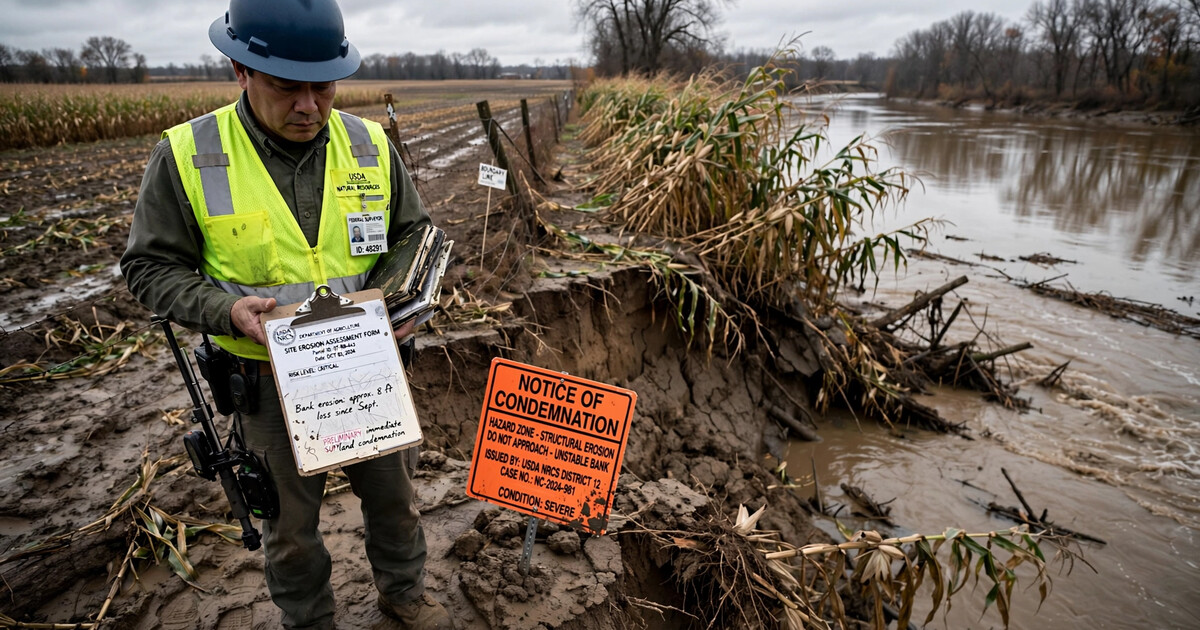
Rivers take land. This is not a metaphor. It is a geomorphological process documented across centuries of scientific observation, measured in meters per year, and quantified in peer-reviewed literature to a degree of precision that would satisfy any appraiser the Department of Justice might retain.
Bank erosion occurs when flowing water exerts shear stress on the channel boundary, detaching soil particles and transporting them downstream. The rate at which a river consumes adjacent land is a function of discharge velocity, bank composition, vegetative cover, and channel geometry. Hudson and Kesel (2000), in a comprehensive study of the lower Mississippi River published in Geomorphology, found that meander bends in the upper alluvial valley migrated at an average rate of 45.2 meters per year, increasing to 59.1 meters per year along the lower alluvial valley.5 At the higher rate, the Mississippi River consumes approximately 194 feet of private land per year at each actively migrating bend. This is not seepage. This is confiscation at a pace visible to the naked eye.
The Mississippi is not exceptional. The Missouri River, which forms the boundary between Iowa and Nebraska, has migrated so aggressively that it has been the subject of no fewer than three Supreme Court boundary disputes.6 The Red River of the South has consumed entire farms in Texas and Oklahoma. The Ohio, the Columbia, the Sacramento, the Rio Grande—every major river system in the United States takes private property as a matter of routine hydrological operation.
The U.S. Geological Survey has quantified the aggregate result. In a comprehensive analysis of coastal Louisiana from 1932 to 2010, the USGS documented a net loss of approximately 1,883 square miles of land—an area equivalent to the entire state of Delaware.7 This represents a 25 percent reduction in the 1932 land area. The rate, measured from 1985 to 2010, was 16.57 square miles per year, a pace the USGS helpfully translates as the loss of one American football field per hour.8 Louisiana currently accounts for approximately 90 percent of the total coastal wetland loss in the continental United States. The remaining 10 percent is distributed across forty-nine other states, each of which is also losing land to water, and none of which has received a condemnation notice.
III. The Federal Nexus
The Takings Clause constrains the federal government. It was extended to state governments through the Fourteenth Amendment in Chicago, Burlington & Quincy Railroad Co. v. City of Chicago (1897).9 A private actor who destroys property has committed a tort. A government actor who takes property without compensation has committed a constitutional violation. The distinction is not academic. It is jurisdictional.
Navigable rivers are federal jurisdiction. The Supreme Court established this in The Daniel Ball (1870), holding that navigable waters of the United States are “those rivers that are used, or are susceptible of being used, in their ordinary condition, as highways for commerce, over which trade and travel are or may be conducted in the customary modes of trade and travel on water.”10 The Army Corps of Engineers codifies this at 33 CFR § 329.4: “Navigable waters of the United States are those waters that are subject to the ebb and flow of the tide and/or are presently used, or have been used in the past, or may be susceptible for use to transport interstate or foreign commerce.”11
The Rivers and Harbors Appropriation Act of 1899 makes the federal interest explicit. Section 10, codified at 33 U.S.C. § 403, provides that “the creation of any obstruction not affirmatively authorized by Congress, to the navigable capacity of any of the waters of the United States is hereby prohibited.”12 Congress has asserted plenary authority over navigable waterways. It has funded their management, directed their channels, and constructed the levees, dikes, and revetments that determine where these rivers flow and, consequently, whose land they take.
The U.S. Army Corps of Engineers operates the largest water resources infrastructure program in the world. In fiscal year 2024, Congress appropriated $8.68 billion for USACE civil works, of which 64 percent funded the operation and maintenance of existing infrastructure.13 This infrastructure includes 25,000 miles of navigable channels, 702 dams, and 14,700 miles of levees. When the Army Corps builds a levee on the north bank of a river, the water that would have spread across the northern floodplain is redirected south. When that redirected water erodes the southern bank, consuming a farmer’s field, the erosion is not an act of nature. It is a consequence of a federal engineering decision, funded by federal appropriations, executed by a federal agency.
The government controls the river. The river takes the land. The government does not pay for the land the river takes. This is the structure of a constitutional violation.
IV. The Kaskaskia Precedent
If any single fact demonstrates the scale of the taking, it is this: the Mississippi River stole a state capital.
Kaskaskia, Illinois, became the capital of the Illinois Territory in 1809 and served as the first state capital when Illinois was admitted to the Union in 1818. At its peak, the town had a population of approximately 7,000, making it one of the most significant settlements in the trans-Appalachian West. Lewis and Clark stopped there in 1803 and recruited several members of their expedition from its population.14
In 1881, during a flood, the Mississippi River abandoned its existing channel west of Kaskaskia and cut through a narrow strip of land to occupy the lower ten miles of the Kaskaskia River’s bed, which sat a few feet lower than the Mississippi’s own. The entire flow of the Mississippi redirected through this new course, placing the river east of the town rather than west of it. The town, which had been situated on the east bank of the Mississippi, was suddenly on the west bank. It was now accessible only from Missouri.15
The buildings crumbled into the river over the following decade. Three thousand graves were exhumed in an emergency operation and reburied atop a bluff to the east. The state boundary, however, did not move. Under the legal doctrine of avulsion—which holds that sudden changes in a river’s course do not alter political boundaries—Kaskaskia remained part of Illinois. It remains part of Illinois today. It has an Illinois telephone area code (618) and a Missouri ZIP code (63673). Its roads are maintained by the Illinois Department of Transportation. Its few residents vote in Illinois elections.16
In the 2010 census, the population of Kaskaskia was fourteen. The Mississippi River reduced the first capital of the twenty-first state in the Union from a population of 7,000 to a population of 14, destroyed its buildings, displaced its dead, and marooned the survivors on an exclave reachable only by crossing into another state. No condemnation proceeding was filed. No just compensation was offered. The state of Illinois agreed to maintain the cemetery as a memorial. The Constitution was not consulted.
V. The Accretion-Avulsion Distinction
The legal system is not unaware that rivers take land. It has, in fact, developed an elaborate doctrinal framework to address the consequences. This framework proves the case.
In Nebraska v. Iowa (1892), the Supreme Court established the foundational distinction between accretion and avulsion as applied to interstate boundaries. Justice Brewer, writing for the Court, held that “when grants of land border on running water, and the banks are changed by the gradual process known as accretion, the riparian owner’s boundary line still remains the stream.” However, “when the boundary stream suddenly abandons its old bed and seeks a new course by the process known as avulsion, the boundary remains as it was, in the center of the old channel.”17
The case concerned Carter Lake, Iowa. In 1877, the Missouri River cut through the neck of an oxbow near Omaha, creating a new channel that left a portion of Iowa on the Nebraska side of the river. The Court classified this as avulsion—a sudden change—and held that the boundary remained in the center of the old channel. Carter Lake remained Iowa territory despite sitting west of the Missouri River, surrounded entirely by Nebraska.18
The significance of this doctrine for Takings Clause purposes is that the Supreme Court has explicitly acknowledged that rivers take land. The accretion-avulsion framework does not deny the seizure. It classifies it. Gradual erosion shifts property boundaries. Sudden avulsion does not. In both cases, the underlying fact is the same: the river has taken physical custody of land that previously belonged to a private owner. The Court has simply decided which takings move the lines on the map and which do not. The question of whether the landowner is entitled to compensation for the land itself—the soil, the topsoil, the crops, the improvements—has never been addressed.
In Missouri v. Nebraska (1904), the Court refined the doctrine further, holding that “accretion, no matter to which side it adds ground, leaves the boundary still the center of the channel. Avulsion has no effect on boundary, but leaves it in the center of the old channel.”19 The Court described the distinction between erosion and avulsion as “universally recognized as correct” and applied it to state boundaries as readily as to private property lines. The framework presupposes that rivers routinely seize land. It simply declines to compensate anyone for the loss.
VI. The Army Corps as Managing Agent
The U.S. Army Corps of Engineers does not merely observe rivers. It directs them. Since the Flood Control Act of 1936, the federal government has assumed responsibility for “the improvement of rivers and other waterways… for flood control and allied purposes.”20 The Army Corps maintains 14,700 miles of levees, 702 dams, and thousands of river training structures—wing dikes, bendway weirs, revetments, and channel-stabilization works—that collectively determine the course, velocity, and erosive behavior of the nation’s navigable waterways.
The Mississippi River and Tributaries Project, the largest flood control project in the world, has been in continuous operation since the Flood Control Act of 1928. Congress appropriated $244.8 million for the MR&T program in fiscal year 2025 alone.21 The project includes 3,787 miles of levees, 248 miles of floodwalls, and four major floodways designed to divert floodwaters across designated sacrifice zones. When the Army Corps opens the Bonnet Carré Spillway, it deliberately redirects Mississippi River floodwaters into Lake Pontchartrain and, ultimately, across private land. The decision is made by a federal officer. The water follows federal engineering. The land that disappears is private property.
In takings jurisprudence, the government is liable not only for property it physically seizes but also for property damage that is the “direct, natural, or probable result of an authorized activity.”22 The Army Corps’s management of the Mississippi River is an authorized activity. The erosion that results from channelization, levee construction, and flow redirection is a direct, natural, and probable result. The elements of a taking are satisfied by the government’s own operational documents.
VII. The Scale of the Uncompensated Seizure
Louisiana’s 1,883 square miles of documented land loss from 1932 to 2010 is the most precisely measured case, but it is not the only one. The USGS notes that Louisiana accounts for approximately 90 percent of the continental United States’ total coastal wetland loss.23 The remaining 10 percent, distributed across forty-nine states, adds conservatively another 200 square miles over the same period. Inland riverbank erosion, which the USGS has not aggregated to a single national figure, adds substantially more.
A conservative estimate of the total private land taken by rivers in the United States since the ratification of the Fifth Amendment in 1791 would require accounting for 235 years of erosion across approximately 3.5 million miles of rivers and streams. Even at modest average erosion rates, the cumulative seizure exceeds tens of thousands of square miles—an area larger than many states.
The fair market value of this land is not speculative. Agricultural land in the Mississippi River Valley currently averages between $5,000 and $12,000 per acre, depending on the state and county. Louisiana cropland averages approximately $4,500 per acre, while Iowa farmland exceeds $10,000 per acre. Taking the USGS-documented Louisiana loss alone: 1,883 square miles equals 1,205,120 acres. At $4,500 per acre, the uncompensated seizure in a single state over eighty years totals approximately $5.4 billion. Adjusted for the value of improvements, structures, and development rights that were also taken, the figure exceeds $10 billion for Louisiana alone.
Under the Supreme Court’s ruling in Tyler v. Hennepin County (2023), the government may not retain surplus value from a property seizure beyond what is owed.24 Rivers retain everything they take. They convert private real property into federal navigable waterway, extracting 100 percent of the value and returning 0 percent to the owner. The surplus is infinite. The liability is correspondingly unlimited.
VIII. The Football-Field-Per-Hour Problem
The USGS’s observation that Louisiana loses one football field of land per hour deserves independent analysis.25 A standard American football field, including end zones, measures 1.32 acres. At one field per hour, the rate of taking is 31.68 acres per day, 11,563 acres per year, or approximately 18 square miles per year.
The Department of Justice, when it exercises eminent domain, files a complaint in federal court under 40 U.S.C. § 3114, deposits estimated just compensation with the court, and serves the property owner with notice. A typical condemnation case takes twelve to thirty-six months to resolve. At the current rate of taking in Louisiana, the rivers would seize approximately 23 to 70 football fields’ worth of private property between the filing of a condemnation complaint and the entry of a final judgment. The rate of taking exceeds the capacity of the legal system to process it.
This does not excuse the failure to process it. The Sixth Amendment guarantees the right to a speedy trial. The Fifth Amendment does not guarantee the right to a speedy taking. If the government cannot condemn property fast enough to keep pace with the rate at which its managed waterways are seizing it, the constitutional remedy is to slow the seizure, not to abandon the process.
IX. Why No One Has Filed
The objection will be raised that erosion is a natural process, not a government action, and therefore falls outside the Takings Clause. This objection fails on the government’s own record.
The federal government has asserted jurisdiction over navigable waterways since 1824. It has funded their management since 1824. It has constructed the levees, dams, dikes, and revetments that determine where these rivers flow since 1879. It has spent cumulative billions on a single river system’s management. It employs approximately 37,000 civilian personnel to operate and maintain the infrastructure that channels these rivers across private land.26 It collects the economic benefits of navigation, flood control, and hydroelectric power generation that these managed waterways provide.
A taking that the government profits from is still a taking. A taking that the government has spent $8.68 billion per year managing is not a natural event. It is a managed event with a dedicated federal workforce, a line item in the federal budget, and a commanding general who reports to the Secretary of the Army. The fact that the physical mechanism of the taking is hydraulic rather than mechanical does not render it extrajurisdictional. The government did not invent erosion. But it channelized it, directed it, accelerated it in some locations, and decelerated it in others, and it did so as a matter of deliberate federal policy, funded by annual congressional appropriations, for 200 years.
The more honest explanation for why no condemnation proceeding has been filed is simpler: the liability is too large to acknowledge.
X. Conclusion
The Fifth Amendment prohibits the taking of private property for public use without just compensation. It does not prohibit the taking. It requires the compensation. The distinction is foundational. The government may take land. It must pay for it.
Rivers take land. The USGS measures how much. The Army Corps of Engineers determines where. The Supreme Court has acknowledged the taking repeatedly, developing an entire doctrinal framework—accretion, avulsion, the thalweg doctrine, the ambulatory boundary principle—to manage its legal consequences. Congress appropriates billions annually to manage the takers. The Constitution requires that the people whose land is taken be made whole.
Not one of them has been. Not the farmers along the Mississippi whose fields migrate into the channel each spring. Not the ranchers along the Missouri whose pastures ended up in another state. Not the citizens of Kaskaskia, Illinois, whose capital, whose homes, whose dead were taken by a river that the United States government had asserted jurisdiction over since the Louisiana Purchase.
Kaskaskia had a population of 7,000 when it was the capital of Illinois. Lewis and Clark recruited expedition members from its streets. The Mississippi River consumed it over the course of a decade, depositing the first state capital of the twenty-first state in the Union on the wrong side of the river, in a jurisdictional no-man’s-land with an Illinois area code and a Missouri ZIP code. Fourteen people live there now. The state maintains the cemetery. The Constitution maintains its silence.
The rivers do not dispute the evidence. They do not retain counsel. They do not file responsive pleadings or assert affirmative defenses. They continue to take, at a rate the USGS has measured to the tenth of a square mile per year, property that belongs to private citizens of the United States, under the management of a federal agency that reports to the Secretary of the Army, in continuous violation of a constitutional amendment that has been on the books for 235 years.
No one has filed a condemnation proceeding because the defendant is a river. But the Fifth Amendment does not ask who took the property. It asks whether the property was taken. It was.
Ergo.
Sources
- U.S. Const. amend. V. constitution.congress.gov ↑
- Kohl v. United States, 91 U.S. 367 (1876), affirming the preexisting power of eminent domain. supreme.justia.com ↑
- J. Story, Commentaries on the Constitution of the United States, § 1790 (1833); cited in Library of Congress, Annotated Constitution, Amdt5.10.1. constitution.congress.gov ↑
- Backus v. Fort Street Union Depot Co., 169 U.S. 557, 573 (1898). supreme.justia.com ↑
- P.F. Hudson and R.H. Kesel, “Channel Migration and Meander-Bend Curvature in the Lower Mississippi River Prior to Major Human Modification,” Geology, vol. 28, no. 6, 2000, pp. 531–534. pubs.geoscienceworld.org ↑
- Nebraska v. Iowa, 143 U.S. 359 (1892); Missouri v. Nebraska, 196 U.S. 23 (1904); Nebraska v. Iowa, 406 U.S. 117 (1972). supreme.justia.com ↑
- J.A. Barras, S. Beville, D. Britsch, et al., “Land Area Change in Coastal Louisiana from 1932 to 2010,” U.S. Geological Survey Scientific Investigations Map 3164, 2011. pubs.usgs.gov ↑
- Ibid.; see also B.R. Couvillion et al., “Land Area Change in Coastal Louisiana (1932 to 2016),” USGS Scientific Investigations Map 3381, 2017. pubs.usgs.gov ↑
- Chicago, Burlington & Quincy Railroad Co. v. City of Chicago, 166 U.S. 226 (1897). supreme.justia.com ↑
- The Daniel Ball, 77 U.S. (10 Wall.) 557 (1870). supreme.justia.com ↑
- 33 CFR § 329.4, “General definition” of navigable waters. law.cornell.edu ↑
- 33 U.S.C. § 403, Rivers and Harbors Appropriation Act of 1899, § 10. epa.gov ↑
- Congressional Research Service, “U.S. Army Corps of Engineers: FY2024 Appropriations,” updated May 28, 2024. crsreports.congress.gov ↑
- Fort Kaskaskia State Historic Site; see also “Kaskaskia: The Lost Capital of Illinois,” Southern Illinois University Press, 2019. mythicmississippi.illinois.edu ↑
- Ibid.; Kaskaskia entry, Mythic Mississippi Project, University of Illinois at Urbana-Champaign. ↑
- U.S. Census Bureau, 2010 Decennial Census, Kaskaskia village, Illinois: population 14. census.gov ↑
- Nebraska v. Iowa, 143 U.S. 359, 361 (1892) (Brewer, J.). supreme.justia.com ↑
- Ibid. at 370; see also Nebraska v. Iowa, 145 U.S. 519 (1892) (decree establishing boundary at center of old channel). ↑
- Missouri v. Nebraska, 196 U.S. 23, 35–36 (1904). supreme.justia.com ↑
- Flood Control Act of 1936, Pub. L. 74-738, 49 Stat. 1570, codified at 33 U.S.C. § 701a. law.cornell.edu ↑
- Congressional Research Service, “U.S. Army Corps of Engineers: FY2025 Appropriations.” crsreports.congress.gov ↑
- United States v. Cress, 243 U.S. 316 (1917), holding that government-induced flooding of private land constitutes a taking. supreme.justia.com ↑
- USGS, “Land Area Change in Coastal Louisiana (1932 to 2010),” cited above at note 7. ↑
- Tyler v. Hennepin County, 598 U.S. 631 (2023). supreme.justia.com ↑
- USGS, “Land Area Change in Coastal Louisiana (1932 to 2016),” cited above at note 8. The “football field per hour” figure reflects the 1985–2010 loss rate of 16.57 square miles per year. ↑
- U.S. Army Corps of Engineers, “Fact Sheet: U.S. Army Corps of Engineers at a Glance,” reporting approximately 37,000 civilian and military personnel. usace.army.mil ↑