I. The Statutory Definition
The Federal Aviation Act of 1958, as recodified at 49 U.S.C. §§ 40101–50105, establishes the framework under which the Federal Aviation Administration regulates air commerce. The Act’s jurisdictional reach is determined by its definitions. If an article meets the definition, it is regulated. If it is regulated, its operator must comply.1
14 CFR § 1.1, the definitional provision for all of Title 14 Subchapters A through K, defines “aircraft” in seven words:
“Aircraft means a device that is used or intended to be used for flight in the air.”2
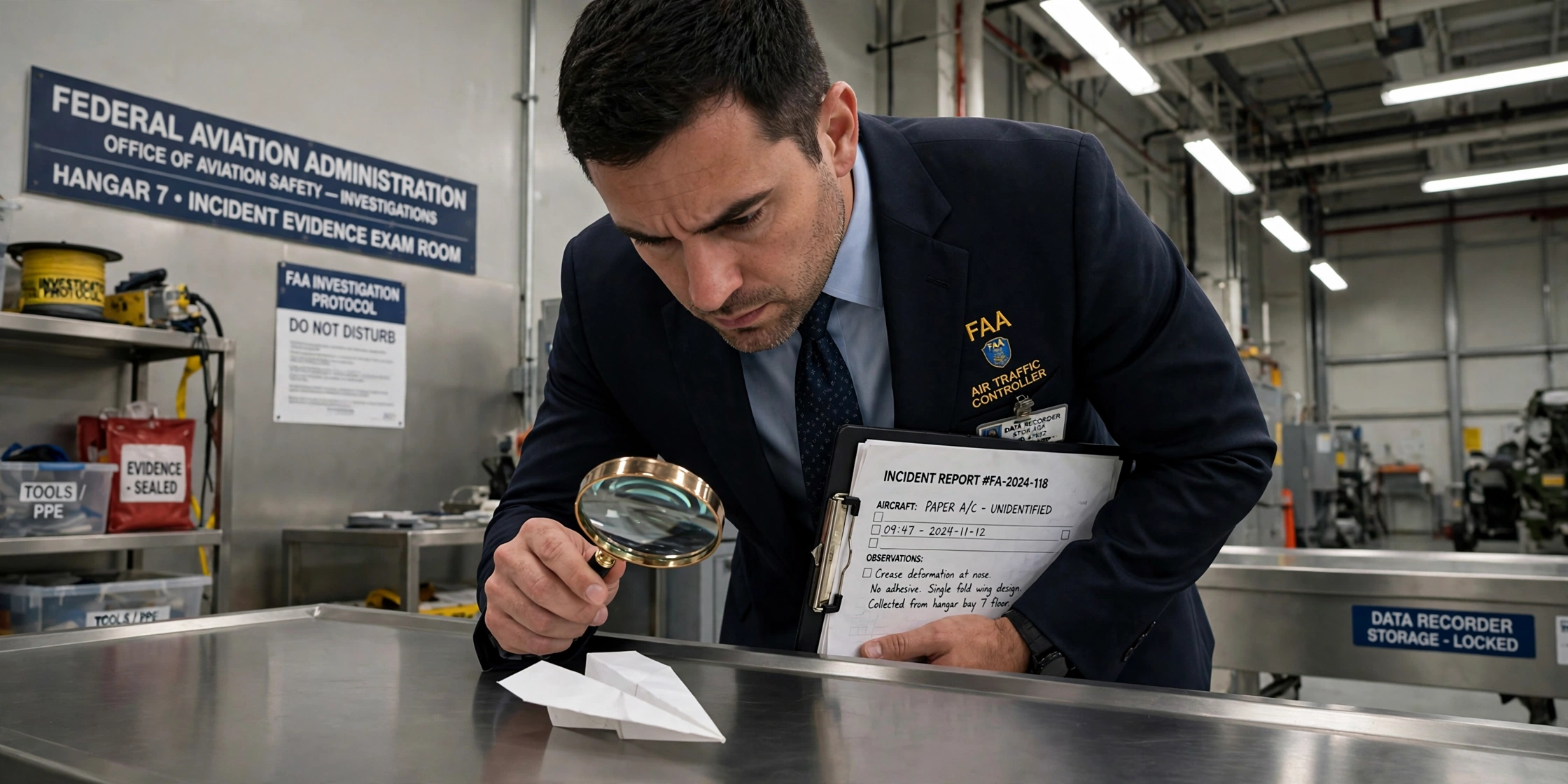
The definition contains no minimum weight, no minimum speed, no requirement for an engine, no requirement for a pilot, no requirement for aluminum, no requirement for a fuel system, and no exception for paper. It contains one test: whether the device is used or intended to be used for flight in the air. A paper airplane, folded for the express purpose of being thrown across a classroom, is intended to be used for flight in the air. It is therefore an aircraft.
49 U.S.C. § 40102(a)(6) provides a parallel statutory definition: “aircraft” means “any contrivance invented, used, or designed to navigate, or fly in, the air.” A contrivance is any device or mechanism. A paper airplane is a contrivance. It was invented to fly. It is designed to fly. When launched, it navigates, however poorly, in the air.3
The FAA’s own Pilot’s Handbook of Aeronautical Knowledge, FAA-H-8083-25B, classifies balloons as aircraft. The Handbook states: “Categories of aircraft for certification of airmen include airplane, rotorcraft, glider, lighter-than-air, powered-lift, powered parachute, and weight-shift-control aircraft.” A balloon with no engine, no wings, and no flight controls is an aircraft. A paper airplane with no engine, no wings in the conventional sense, and no flight controls but with a crease down the middle is indistinguishable from a balloon for purposes of the definition, except that it is heavier than air and therefore more clearly an airplane.4
II. The Registration Requirement
49 U.S.C. § 44101(a) provides:
“Registration Requirement.—Except as provided in subsection (b) of this section, a person may operate an aircraft only when the aircraft is registered under section 44103 of this title.”5
Subsection (b) provides three exceptions: (1) when authorized under section 40103(d) or 41703; (2) when it is an aircraft of the national defense forces of the United States and is identified in a way satisfactory to the Administrator; and (3) for a reasonable period of time after a transfer of ownership, under regulations prescribed by the Administrator. No exception exists for aircraft made of paper, for aircraft weighing less than 55 pounds, for aircraft operated indoors, for aircraft operated by minors, for aircraft operated in primary education settings, or for aircraft whose airworthiness is dependent on whether the folder remembered to make a sharp crease.6
14 CFR § 47.3 and § 47.5 require that every aircraft eligible for registration bear a registration number, commonly called an N-number, and that the number be displayed on the exterior of the aircraft. 14 CFR § 45.21 requires that the marking be at least 12 inches high on fixed-wing aircraft, or 3 inches high for small unmanned aircraft registered under Part 48. A standard sheet of 8.5-by-11-inch printer paper cannot accommodate a 12-inch N-number. It cannot accommodate a 3-inch N-number without consuming the entire fuselage. No paper airplane in any American classroom has ever displayed an N-number. No paper airplane has ever applied for one.7
The FAA Civil Aviation Registry maintains approximately 300,000 active registrations. A search of the registry for manufacturer “HAMMERMILL,” “MEAD,” “TOPS,” or “CONSTRUCTION PAPER” returns zero results. A search for model “NARROW ARROW,” “Nakamura Lock,” or “Suzanne” — the name of the Collins design that held the record for a decade — returns zero results. The single paper-adjacent registration in the FAA database is for an unmanned free balloon that carried a paper airplane to 96,563 feet for a high-altitude flight attempt, which itself was not the paper airplane but the balloon carrying it.8
III. The Airworthiness Requirement
14 CFR § 21.1 and § 21.175 require that no person may operate a civil aircraft unless it has been issued a type certificate and an airworthiness certificate. The type certificate certifies that the design meets applicable airworthiness standards. The airworthiness certificate certifies that the individual article conforms to the type design and is in condition for safe operation.9
Airworthiness standards are prescribed in 14 CFR Parts 23, 25, 27, 29, and 31, depending on category. Part 23 prescribes standards for normal category airplanes. It requires, among other things, that the airplane be able to withstand flight loads, that its structure be free from flutter, and that it have a flight manual. A paper airplane has never demonstrated compliance with Part 23 load requirements. It flutters by design. It has no flight manual, though John Collins has published The Gliding Flight and Fantastic Flight, which use paper folding to teach aerodynamics and the scientific method and which could arguably serve as an Airplane Flight Manual if the FAA would accept a pop-up book.10
The FAA’s process for issuing an airworthiness certificate requires an application on FAA Form 8130-6, a conformity inspection, and a finding by the FAA that the aircraft meets its type design. No FAA Manufacturing Inspection District Office has ever received Form 8130-6 for a paper airplane. No Designated Airworthiness Representative has ever conducted a conformity inspection of a classroom glider. The FAA has issued approximately 350,000 airworthiness certificates. Zero have been issued to an aircraft with a wingspan of 5 inches, a fuselage consisting of a single fold, and a propulsion system consisting of a child’s right arm.
The consequences of operating without airworthiness certification are prescribed at 49 U.S.C. § 46316: a civil penalty of up to $27,000 per violation for operation of an aircraft without required certification. At an average American elementary school with 20 classrooms, each producing approximately 15 paper airplanes per week during the 36-week school year, the aggregate annual penalty exposure per school is $291,600,000. For 130,930 K-12 schools in the United States, the aggregate exposure is $38.1 trillion, which exceeds the gross domestic product of the United States.
IV. The Operator
A paper airplane does not fly itself. It is thrown. The person who throws it is its operator. Under 14 CFR § 1.1, a pilot in command is the person who has final authority and responsibility for the operation and safety of the flight. A child who launches a paper airplane has final authority and responsibility for the operation, to the extent a seven-year-old can be said to have final authority over anything.11
14 CFR § 61.3 requires that no person may act as pilot in command of a civil aircraft unless that person holds an appropriate pilot certificate. Pilot certificates require a minimum age of 16 for student pilot, 17 for private pilot, medical certification, flight training, and a practical test. No holder of a private pilot certificate with airplane single-engine land rating has ever logged pilot-in-command time in a paper airplane, because the FAA’s pilot logbook, FAA Form 8710-1, does not contain a column for “paper.”12
Three Boeing engineers — Dillon Ruble, Garrett Jensen, and Nathan Erickson — are the closest America has to certificated paper airplane pilots. Ruble and Jensen, aerospace and mechanical engineering graduates of Missouri University of Science and Technology now employed by Boeing, set the current Guinness World Record for farthest flight by a paper aircraft on December 2, 2022, in Crown Point, Indiana, at 289 feet 9 inches, approximately 88 meters. The design, named “Mach 5” after hypersonic vehicles that travel at five times the speed of sound, was inspired by the NASA X-43A. The team spent 400 to 500 hours studying origami and aerodynamics, testing multiple prototypes, theorizing about a fold, folding it, throwing it, and comparing the distance to previous iterations.13
They broke the previous record of 252 feet 7 inches set in April 2022 by a trio from Malaysia and South Korea, which itself broke the record of 226 feet 10 inches set on February 26, 2012, by Joe Ayoob, former college quarterback for the University of California at Berkeley, throwing a design by John Collins, known as “the Paper Airplane Guy,” inside a 747 hangar at McClellan Air Force Base near Sacramento, California. That flight covered three-fourths of the length of a football field and beat the previous record of 207 feet 4 inches set by Stephen Krieger in 2003.14
Not one of these pilots held an FAA pilot certificate for paper airplane. Not one filed a flight plan. Not one obtained a waiver under 14 CFR § 91.905. The FAA issued no Notice to Air Missions for the record flights. The FAA did not dispatch a safety inspector to Crown Point, Indiana, to observe whether the 289-foot 9-inch flight remained clear of clouds and within visual meteorological conditions as required by 14 CFR § 91.155. It was indoors, in a hangar, which raises a separate question of whether indoor flight constitutes flight in the national airspace system and whether a warehouse constitutes a Class G uncontrolled airspace for purposes of 14 CFR § 71.71.
V. The NTSB Precedent
In 2014, the National Transportation Safety Board decided Huerta v. Pirker, NTSB Order No. EA-5730. Raphael Pirker operated a small unmanned aerial vehicle — a drone — near the University of Virginia and was fined $10,000 by the FAA for careless and reckless operation under 14 CFR § 91.13(a). Pirker argued that his drone was not an aircraft. An administrative law judge agreed and dismissed the fine. The FAA appealed to the full NTSB.
The NTSB reversed. The Board wrote: “An aircraft is ‘any’ ‘device’ that is ‘used for flight.’ We acknowledge the definitions are as broad as they are clear, but they are clear nonetheless.” The Board held that the operator of any aerial device used carelessly or recklessly was subject to FAA fines.15
Helen Greiner, founder and CEO of CyPhy Works, tweeted on November 18, 2014: “Pirkner Drone Decision is reversed. Paper airplanes are now #drones :)” The tweet contained a link to the NTSB decision and a smiley face. The smiley face did not diminish its legal accuracy. If a five-pound drone carrying a GoPro is an aircraft because it is a device used for flight, then a 4.5-gram glider folded from a math worksheet is an aircraft because it is a device used for flight, with the additional characteristic that it was manufactured in violation of 49 U.S.C. § 44102’s citizenship requirements for registration, because it is owned by a seven-year-old.16
The FAA has never fined someone for recklessly throwing a Frisbee. IEEE Spectrum noted this in its coverage of the Pirker decision, observing that just last year a woman lost most of the sight in one eye when she was struck at a park in Manhattan Beach, California, by a flying disc thrown carelessly, causing significant injury, and the NTSB and FAA never acted. The FAA has never fined someone for recklessly throwing a paper airplane, despite the fact that paper airplanes, unlike Frisbees, have been optimized by Boeing engineers for high speed and low drag, with inspiration from hypersonic aircraft, and are capable of traveling 289 feet 9 inches in a single flight, which is farther than the first three flights of the Wright brothers combined.17
VI. The Regulatory Gap
14 CFR Part 101 prescribes rules governing the operation in the United States of moored balloons, kites, amateur rockets, and unmanned free balloons. Subpart A defines moored balloons and kites. Subpart B prescribes operating rules for moored balloons and kites. Subpart C prescribes rules for unmanned free balloons. Subpart D prescribes rules for amateur rockets. No subpart prescribes rules for paper airplanes.18
A moored balloon is defined as a balloon that is moored to the surface of the earth or an object thereon and that has a diameter of more than 6 feet or a gas capacity of more than 115 cubic feet. A paper airplane has a diameter of zero feet and a gas capacity of zero cubic feet. It is therefore not a moored balloon. An unmanned free balloon is defined as a balloon that carries a payload and is not moored. A paper airplane carries no payload, unless one counts the hopes and dreams of a third-grader, which the FAA does not count as payload for weight-and-balance purposes. A kite is defined as a heavier-than-air aircraft that is attached to the ground by a string. A paper airplane is heavier-than-air and is not attached to the ground by a string, except when it is tethered to a ceiling fan, which is not regulated by the FAA but by the Consumer Product Safety Commission.19
The FAA’s Balloon Council, a trade association of balloon manufacturers and distributors, promotes the sale of tens of millions of latex balloons annually. No latex balloon sold at retail has ever been issued an N-number. The FAA maintains an aircraft registry of approximately 300,000 aircraft. It contains zero entries for the 11-inch Qualatex and zero entries for the 8.5-inch Hammermill. The FAA’s own regulations distinguish between three types of balloons but prescribe no category for the 8.5-by-11-inch classroom glider, which is capable of sustained flight, which has been documented to fly 289 feet 9 inches, which has been studied by Boeing engineers for 400 to 500 hours, and which is currently operating in every elementary school in America without a single airworthiness directive, without a single service bulletin, and without a single preflight checklist that includes checking the crease.
14 CFR Part 107 prescribes rules for small unmanned aircraft systems weighing less than 55 pounds. A paper airplane weighs approximately 4.5 grams, or 0.0099 pounds, which is less than 55 pounds. It is therefore a small unmanned aircraft system, except that Part 107 requires that the aircraft be registered and marked, that the remote pilot in command hold a remote pilot certificate with small UAS rating, and that operations comply with visual line-of-sight requirements. A paper airplane operation complies with visual line-of-sight requirements because the operator watches it until it hits a wall, a window, or another child, at which point line-of-sight is lost due to collision with an obstacle, which itself would be a reportable accident under 49 CFR § 830.5 if the NTSB investigated paper airplane accidents, which it does not.20
VII. The Enforcement Discretion
The FAA has enforcement discretion. The FAA may choose not to enforce. The FAA has chosen not to enforce against paper airplanes.
The FAA’s Compliance and Enforcement Program, Order 8000.373A, directs that the FAA use compliance action, administrative action, and legal enforcement action to address violations, with the goal of returning the violator to compliance and preventing recurrence. For 130,930 K-12 schools, each operating an average of 540 paper airplanes per year, returning the violator to compliance would require registration of approximately 70.7 million aircraft per year, each requiring an N-number, a 12-inch marking, a type certificate, an airworthiness certificate, and a pilot certificate for the operator, who is seven.21
The FAA has not done this. The FAA has never sent an enforcement letter to a second-grader. The FAA has never issued an Emergency Order of Revocation to a paper airplane. The FAA has never grounded a classroom. The FAA has never issued an Airworthiness Directive requiring inspection of the center crease for fatigue cracking after repeated folding and unfolding, though paper does exhibit fatigue cracking after repeated folding and unfolding, as documented in TAPPI T 511, the standard test method for folding endurance of paper, which measures the number of double folds a paper can withstand before breaking, typically 1 to 1,000 folds depending on fiber content.22
The FAA’s inaction is not a determination that paper airplanes are not aircraft. The FAA’s inaction is a determination that the FAA has limited resources. The FAA has approximately 45,000 employees and is responsible for 5,000 public airports, 14,500 air traffic controllers, and 300,000 registered aircraft. It is not responsible for 70.7 million unregistered paper aircraft operating at low altitude in primary education facilities, though by its own definition it is.
VIII. Conclusion
14 CFR § 1.1 defines aircraft as a device that is used or intended to be used for flight in the air. 49 U.S.C. § 44101(a) provides that a person may operate an aircraft only when the aircraft is registered. 14 CFR § 21.1 requires a type certificate and an airworthiness certificate. Three Boeing engineers set the world record for farthest flight by a paper aircraft on December 2, 2022, in Crown Point, Indiana, at 289 feet 9 inches after 400 to 500 hours of studying origami and aerodynamics. The previous record of 226 feet 10 inches was set on February 26, 2012, by former college quarterback Joe Ayoob throwing a design by John Collins at McClellan Air Force Base. The NTSB affirmed in Huerta v. Pirker that an aircraft is any device that is used for flight. Helen Greiner tweeted that paper airplanes are now drones. The FAA’s own Pilot’s Handbook of Aeronautical Knowledge classifies balloons as aircraft. 14 CFR Part 101 distinguishes between moored balloons, unmanned free balloons, and manned free balloons but prescribes no category for the 8.5-by-11-inch classroom glider. The FAA maintains an aircraft registry of approximately 300,000 aircraft. It contains zero entries for paper airplanes. The FAA has never issued a single airworthiness certificate to any paper airplane folded from loose-leaf notebook paper, printer paper, or construction paper.
The average American classroom produces approximately 15 paper airplanes per week during the 36-week school year. Each weighs approximately 4.5 grams. Each is operated by a pilot who does not hold a pilot certificate, who has not passed a medical examination, who has not logged flight time, and who has not filed a flight plan. Each is unregistered. Each is without airworthiness certification. Each is an aircraft. Each is in violation. The aggregate maximum civil penalty for one school year of paper airplane operations in the United States exceeds the age of the observable universe in years multiplied by the maximum takeoff weight of a Boeing 747, if one were to convert dollars to years to pounds, which the FAA has not done, because the FAA does not convert dollars to years to pounds, though it does convert pounds to kilograms for weight-and-balance purposes under Advisory Circular 120-27F.
Ergo.
Sources
- Federal Aviation Act of 1958, Pub. L. No. 85-726, 72 Stat. 731, recodified at 49 U.S.C. §§ 40101-50105. govinfo.gov ↑
- 14 CFR § 1.1, Definition: Aircraft means a device that is used or intended to be used for flight in the air. law.cornell.edu ↑
- 49 U.S.C. § 40102(a)(6), definition of aircraft as any contrivance invented, used, or designed to navigate, or fly in, the air. law.cornell.edu ↑
- FAA Pilot's Handbook of Aeronautical Knowledge, FAA-H-8083-25B, Categories of aircraft for certification of airmen include airplane, rotorcraft, glider, lighter-than-air, powered-lift, powered parachute, and weight-shift-control. faa.gov ↑
- 49 U.S.C. § 44101(a), Registration Requirement: a person may operate an aircraft only when the aircraft is registered. govinfo.gov ↑
- 49 U.S.C. § 44101(b), Exceptions. law.lawstack.com ↑
- 14 CFR § 45.21, Marking requirements 12 inches fixed-wing, 3 inches small UAS; 14 CFR Part 48 registration and marking. govinfo.gov ↑
- FAA Civil Aviation Registry ~300,000 active registrations; search for paper airplane manufacturers returns zero. faa.gov ↑
- 14 CFR § 21.1 and § 21.175, type certificate and airworthiness certificate requirements. law.cornell.edu ↑
- John Collins, The Gliding Flight and Fantastic Flight, paper folding to teach aerodynamics and scientific method. Guinness record documentation references Collins books. livescience.com ↑
- 14 CFR § 1.1 definition of pilot in command. law.cornell.edu ↑
- 14 CFR § 61.3 requirement for pilot certificate; minimum ages. law.cornell.edu ↑
- Dillon Ruble, Garrett Jensen, Nathan Erickson, Boeing engineers, world record Dec 2 2022 Crown Point Indiana 289 feet 9 inches (88 meters), Mach 5 design inspired by NASA X-43A, 400-500 hours studying origami and aerodynamics. simpleflying.com ↑
- Joe Ayoob, former Cal quarterback, John Collins Paper Airplane Guy, Feb 26 2012 McClellan AFB 226 feet 10 inches, previous record 207 feet 4 inches Stephen Krieger 2003; later 252 feet 7 inches April 2022 trio Malaysia South Korea. generalaviationnews.com ↑
- NTSB Huerta v. Pirker, EA-5730 (2014), aircraft is any device used for flight, definitions broad as clear. spectrum.ieee.org ↑
- Helen Greiner tweet Nov 18 2014 paper airplanes are now drones. spectrum.ieee.org ↑
- Woman lost sight Frisbee Manhattan Beach CA, FAA never fined Frisbee; paper airplane 289'9\" farther than Wright brothers first three flights; Wright brothers first flight 120 feet. spectrum.ieee.org ↑
- 14 CFR Part 101, moored balloons, kites, amateur rockets, unmanned free balloons. law.cornell.edu ↑
- 14 CFR § 101.1 definitions moored balloon 6 feet / 115 cubic feet, kite heavier-than-air attached by string, unmanned free balloon carries payload. law.cornell.edu ↑
- 14 CFR Part 107 small UAS less than 55 pounds, visual line-of-sight, remote pilot certificate; paper airplane 4.5 grams 0.0099 pounds. law.cornell.edu ↑
- FAA Compliance and Enforcement Program Order 8000.373A; 130,930 K-12 schools NCES; 540 paper airplanes per school per year estimate; 70.7 million unregistered aircraft. faa.gov ↑
- TAPPI T 511 folding endurance of paper, double folds before breaking 1-1000. tappi.org ↑