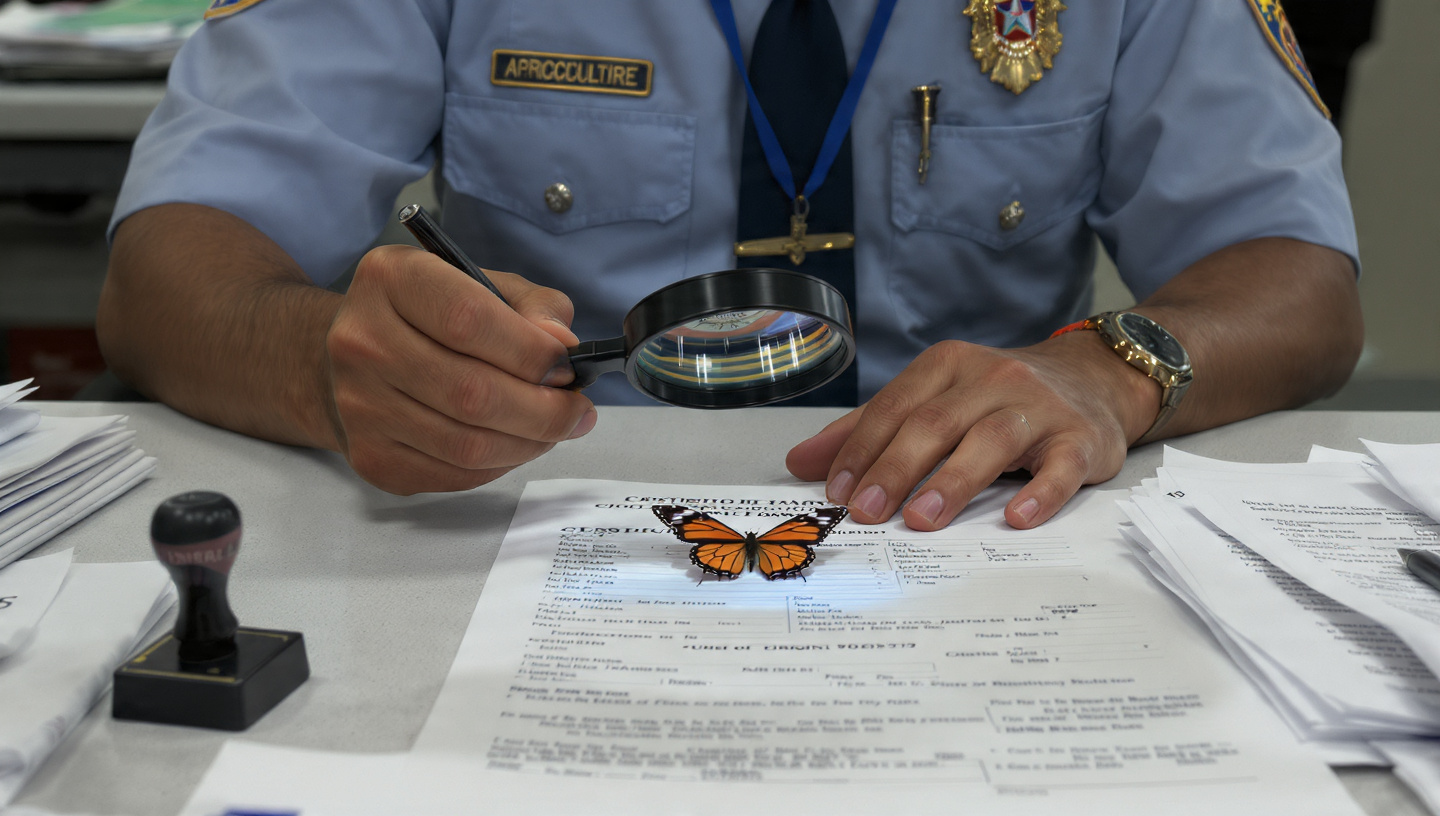
I. The Statutory Framework
Section 304 of the Tariff Act of 1930, codified at 19 U.S.C. § 1304, establishes the foundational requirement of American import law: “every article of foreign origin… imported into the United States shall be marked in a conspicuous place as legibly, indelibly, and permanently as the nature of the article (or container) will permit in such manner as to indicate to an ultimate purchaser in the United States the English name of the country of origin of the article.”1
The statute contains no species limitation. It does not require that the article be manufactured. It does not require that the article be inanimate. It requires only that the article be of foreign origin and that it be imported into the United States. An article is “imported” when it crosses the border. A monarch butterfly that departs Cerro Pelón, Michoacán, in March and arrives in Laredo, Texas, in April has crossed the border. It is of foreign origin. It is an article.
The implementing regulations at 19 CFR Part 134 elaborate on the marking requirement with specificity that borders on the philosophical. Section 134.41 provides that marking shall be accomplished by “die stamping, cast-in-the-mold lettering, etching, engraving, or by means of metal, rubber, or other stamps.”2 The regulation does not contemplate chitin. It does not address wing scales. It does not provide guidance on marking a living organism that weighs approximately half a gram and maintains a cruising altitude of 1,200 feet.
This is not the regulation’s problem. It is the butterfly’s.
II. The Migration as Import
The eastern monarch butterfly (Danaus plexippus) undertakes what the U.S. Forest Service describes as “one of the most spectacular natural phenomena in the world”: a multi-generational, round-trip migration spanning up to 3,000 miles between the oyamel fir forests of central Mexico’s Sierra Madre mountains and the breeding grounds of southern Canada.3
Each fall, a special generation of monarchs—the “super generation,” in the terminology of the conservation literature—emerges in the northern United States and southern Canada. Unlike the three to four summer generations that precede it, which live two to six weeks each, the super generation enters reproductive diapause and lives up to nine months, long enough to fly south to Mexico, overwinter in dense clusters of up to 10,000 individuals per square meter, and begin the return journey the following spring.4
The Monarch Joint Venture, a partnership of federal and state agencies, reports population density estimates of approximately 21.1 million monarchs per hectare at overwintering sites in Mexico.5 The World Wildlife Fund’s 2024–2025 survey of overwintering colonies in the Monarch Butterfly Biosphere Reserve—a UNESCO World Heritage Site—found that the eastern monarch population had nearly doubled from the prior year.6 Working from area-occupation data and density estimates, the spring migration that departs Mexico each March comprises an estimated 200 to 300 million individual butterflies.
Every one of them crosses the United States–Mexico border.
CBP operates 328 ports of entry along the southern border. In fiscal year 2024, the agency processed 228.4 million passenger crossings through land ports of entry from Mexico.7 The monarchs match these numbers in a matter of weeks. They use none of the ports. They file no declarations. They carry no documentation. They arrive at altitudes between 200 and 1,200 feet above ground level, below the floor of controlled airspace but above the reach of the tallest border infrastructure, in a corridor that stretches from the Rio Grande Valley of Texas to the Gulf Coast, processing themselves through a customs system that does not know they exist.
III. The Country-of-Origin Problem
The marking requirement of § 1304 applies to articles “of foreign origin.” The determination of origin is governed by 19 CFR Part 134 for non-preferential purposes and by the USMCA’s Chapter 4 rules of origin for preferential tariff treatment. Both frameworks rest on a deceptively simple question: where was the article made?
For the first generation of the northward migration, the answer is straightforward. The super generation butterflies that overwintered in Michoacán were born in the United States or Canada the previous fall. They are, by birth, of American or Canadian origin. But they have spent five months residing in Mexico, metabolizing Mexican nectar, and undergoing physiological changes driven by Mexican photoperiod cycles. Under the substantial transformation doctrine established by the Supreme Court in United States v. International Paint Co. and applied by Customs in thousands of rulings, an article is a product of the country where it last underwent a “substantial transformation”—a fundamental change in form, character, or use.8
A monarch that departed Canada in September as a newly emerged adult in reproductive diapause and returns to Texas in March as a reproductively active animal producing eggs is arguably a different article. Its ovaries have matured. Its fat reserves have been metabolized. Its behavioral programming has switched from southward navigation to northward navigation and active reproduction. The Mexican overwintering period did not merely store the butterfly. It transformed it.
But the true origin crisis begins with the second generation.
The super generation does not complete the return migration. It flies from Mexico to the Gulf states—Texas, Louisiana, Mississippi—where it mates, lays eggs on milkweed plants, and dies. The eggs hatch. The caterpillars consume American milkweed. They pupate in American chrysalises. They emerge as American-born butterflies. And they continue the migration northward, eventually reaching the Great Lakes, New England, and southeastern Canada over the course of two to three additional generations.9
The second generation was conceived by a Mexican-wintered parent, from genetic material that has cycled between Mexico, the United States, and Canada for millennia. It was assembled entirely from raw materials—milkweed leaves, nectar sugars, ambient water—sourced in the United States. Under the substantial transformation test, the caterpillar-to-butterfly metamorphosis is unambiguously a fundamental change in form, character, and use: the input is a crawling herbivore; the output is a flying pollinator. The transformation occurs entirely on American soil.
Is the second-generation butterfly a domestic product? It was manufactured in the United States from domestic inputs. Or is it a foreign article, because its parent was an import? The Tariff Act does not address biological reproduction as a manufacturing process. 19 CFR Part 134 does not contemplate chrysalises as assembly plants. The USMCA rules of origin, which require detailed analysis of where value is added and where tariff shifts occur, have no Harmonized System classification for Danaus plexippus at the six-digit subheading level that would resolve the question by operation of tariff nomenclature.
IV. The Agricultural Declaration Failure
Country-of-origin marking is not the only requirement the monarch migration violates. The Animal and Plant Health Inspection Service, operating under the authority of the Plant Protection Act (7 U.S.C. §§ 7701–7786), requires that all persons entering the United States declare any plants, plant products, seeds, soil, or organisms in their possession.10
Monarch butterflies are pollinators. During migration, they visit hundreds of flowering plants across multiple ecosystems, and their bodies accumulate pollen from each visit. A 2017 study published in the journal Insect Conservation and Diversity documented pollen loads on the bodies and proboscises of migrating monarchs, confirming that the butterflies serve as cross-border vectors of plant genetic material.11 The monarchs departing Mexico carry Mexican pollen. They deposit it on American flowers. They pick up American pollen. They carry it to Canada.
CBP’s own agricultural inspection guidance states: “All travelers are required to declare agricultural items to a CBP officer. Failure to declare may result in civil penalties up to $50,000.”12 The monarchs carry undeclared biological material across two international borders. They have no phytosanitary certificates. They have not been inspected by APHIS. They present a nonzero risk of transporting plant pathogens, parasites, and invasive species—risks that CBP’s agriculture specialists are specifically trained and funded to intercept at ports of entry.
In the 2023–2024 fiscal year, CBP agriculture specialists conducted 22.3 million passenger inspections at ports of entry and intercepted 116,000 actionable pests.13 The monarchs bypass this system entirely. They are 300 million uninspected agricultural vectors arriving annually between two official inspection seasons, carrying material that any human traveler would be required to declare, and doing so at volumes that would constitute the single largest undeclared agricultural import event on the CBP enforcement calendar if anyone were counting.
V. The USMCA Eligibility Crisis
The United States–Mexico–Canada Agreement, which entered into force on July 1, 2020, provides preferential tariff treatment for goods that satisfy the agreement’s rules of origin. Under Chapter 4, a good is “originating” if it is wholly obtained or produced entirely in the territory of one or more of the USMCA parties, or if it satisfies the applicable tariff classification change and regional value content requirements specified in the product-specific rules of origin in Annex 4-B.14
The monarch butterfly is, in a strict factual sense, a USMCA good. It is produced in the territories of all three parties. Its lifecycle touches Mexico, the United States, and Canada. Every material input—milkweed, nectar, water, sunlight—is sourced within the USMCA territory. The regional value content is 100 percent. No non-originating material from any non-party country enters the supply chain at any point.
Under Article 4.2 of the USMCA, a good is originating if it is “wholly obtained or produced entirely in the territory of one or more of the Parties.” A butterfly born in Texas from milkweed grown in Texas from rain that fell in Texas would appear to qualify. But Article 4.2 also establishes a “build-up” method and a “build-down” method for calculating regional value content, and neither method contemplates biological reproduction as a production process or DNA as a material input.
The USMCA’s automotive rules of origin provide the agreement’s most detailed framework for multi-country production chains. Under these rules, a vehicle assembled in Mexico from parts manufactured in the United States and Canada must demonstrate 75 percent regional value content to receive preferential treatment, and must separately account for the value contributed by each country at each stage of production.15 The automotive rules trace components through multiple tiers of suppliers, tracking value addition from raw material to finished vehicle.
The monarch lifecycle is a supply chain. The raw material—milkweed—is a Tier 3 input. The caterpillar is a Tier 2 intermediate good. The chrysalis is a Tier 1 subassembly. The adult butterfly is the finished product. The production process crosses two international borders and involves manufacturing facilities—milkweed plants, caterpillar feeding sites, chrysalis attachment points—in all three USMCA countries. No certificate of origin has been filed for any tier.
The USMCA requires self-certification of origin using a prescribed nine-element data format, including the Harmonized System tariff classification of the good, the applicable rule of origin, and the country of origin determination. Importers must retain certification records for five years.16 The monarch migration has been occurring annually for at least two million years, since the species diverged from its non-migratory ancestor. The record-keeping deficit spans approximately two million filing seasons.
VI. The Metamorphosis Problem
The deepest conceptual failure in applying trade law to the monarch migration is not administrative. It is ontological.
The substantial transformation test asks whether an article has undergone a change in “name, character, or use” sufficient to render it a new and different article of commerce. Customs applies this test to wood that becomes furniture, steel that becomes automobiles, and fabric that becomes clothing. In each case, the input and output are recognizably related but functionally distinct.
Monarch metamorphosis is the most radical manufacturing process in nature. A caterpillar—a soft-bodied, sixteen-legged herbivore that crawls at approximately 0.05 miles per hour and consumes leaves—dissolves its own body inside a chrysalis, liquefying most of its tissues through enzymatic digestion, and reconstructs itself into a six-legged, four-winged flying pollinator capable of sustained flight at 12 miles per hour and navigation by solar compass and geomagnetic field over distances exceeding 3,000 miles.17
The input weighs approximately 1.5 grams. The output weighs approximately 0.5 grams. The name changes: from larva to adult. The character changes: from terrestrial to aerial. The use changes: from herbivore to pollinator and reproductive agent. Under any application of the substantial transformation test that Customs has ever recognized, the adult butterfly is a new article that was manufactured in the country where pupation occurred.
This means that a monarch caterpillar that hatches from a Mexican-laid egg on a Texas milkweed plant, feeds exclusively on American vegetation, and pupates in a chrysalis attached to an American fence post is an American-manufactured good. But its parent entered the United States as an unmarked foreign import. The egg from which it hatched was deposited by a foreign national. The DNA that directed its development was assembled in Mexico.
Under the USMCA’s automotive analogy, this is equivalent to a foreign-origin engine being installed in a domestically assembled vehicle. The vehicle may qualify as American-made if sufficient value is added domestically. But the engine must be separately tracked, and its origin must be separately declared. Nobody has tracked the DNA. Nobody has declared the egg. The assembly plant—a milkweed plant in a Texas highway median—has never been registered with CBP as a foreign trade zone, a bonded warehouse, or a manufacturing facility of any kind.
VII. The Penalty Calculation
Under 19 U.S.C. § 1304(f), an article not properly marked with its country of origin is subject to an additional duty of 10 percent of the final appraised value.18 The question, then, is the appraised value of a monarch butterfly.
The U.S. Fish and Wildlife Service has characterized pollination services—the ecological function performed by monarchs during their migration—as contributing to an economic value of more than $34 billion annually across all insect pollinators in the United States.19 Monarchs are not the primary commercial pollinator—that distinction belongs to the managed honeybee—but they pollinate native wildflowers, agricultural crops, and the milkweed plants that sustain their own reproduction across hundreds of millions of acres of American land.
If the aggregate pollination value attributable to the approximately 300 million monarchs that cross the border each spring is even one-tenth of one percent of the $34 billion total pollinator economy, the customs value of the migration is $34 million per year. The 10 percent additional duty would be $3.4 million annually. But the migration has been occurring, uninterrupted and undeclared, for approximately two million years.
Separately, 19 U.S.C. § 1592 provides civil penalties for fraud, gross negligence, and negligence in connection with the entry of merchandise into the United States. For fraud, the maximum penalty is the domestic value of the merchandise. For gross negligence, four times the lawful duties owed. For negligence, two times the lawful duties owed.20
Whether the monarch migration constitutes fraud, gross negligence, or negligence depends on the butterfly’s state of mind, a question that 19 U.S.C. § 1592 does not address and that lepidopterology has not resolved. The butterflies are not aware of the Tariff Act. They are, however, deliberately crossing the border—their navigation relies on a time-compensated sun compass and an inclination compass based on Earth’s magnetic field, as documented by Reppert, Gegear, and Merlin at the University of Massachusetts Medical School.21 They know where they are going. They have been going there for two million years. The failure to file a single customs declaration across two million migration seasons is not an innocent mistake. It is a pattern.
The civil penalty for failure to declare agricultural products at a port of entry is up to $50,000 per violation.22 At 300 million border crossings per spring migration, each carrying undeclared pollen, the aggregate penalty for a single season is $15 trillion. That figure exceeds the entire federal budget for fiscal year 2025, which the Congressional Budget Office projected at $6.7 trillion.23
VIII. The Enforcement Gap
CBP employs approximately 2,400 agriculture specialists at ports of entry nationwide. Their mandate is to prevent the introduction of foreign agricultural pests and diseases through the inspection of commercial cargo, passenger baggage, and international mail. In fiscal year 2024, these specialists intercepted 116,000 actionable agricultural pests from 22.3 million inspections.13
The monarch migration represents an annual throughput of 300 million uninspected biological imports carrying undeclared organic material across 1,254 miles of unmonitored border corridor. The monarchs do not use the bridges at Laredo. They do not queue at the Otay Mesa commercial crossing. They do not stop at the San Ysidro pedestrian facility. They fly over every port of entry at altitudes the inspection infrastructure was not designed to reach.
APHIS has designated Ophryocystis elektroscirrha—a protozoan parasite specific to monarch butterflies—as a pathogen of conservation concern. Infected monarchs carry spores on their abdominal scales and transmit them to milkweed leaves, where they are ingested by caterpillars. Prevalence rates among migratory populations range from 8 to 30 percent depending on the region and season, as documented in peer-reviewed studies by Altizer, Oberhauser, and Brower.24 The migration is, by any biosecurity standard, a cross-border pathogen vector event. The pathogens have never been screened. The spores have never been inspected. The butterflies have never been quarantined.
CBP’s own mission statement identifies its role as “safeguarding America’s borders thereby protecting the public from dangerous people and materials while enhancing the Nation’s global economic competitiveness by enabling legitimate trade and travel.”25 The monarch is not dangerous. It is beautiful. Its migration is one of the most studied and admired natural phenomena in the Western Hemisphere. But the statute does not contain an aesthetic exemption. The Tariff Act of 1930 does not waive the marking requirement for articles that are orange and black. Nineteen U.S.C. § 1304 does not distinguish between a shipping container of unmarked textiles and a living organism of foreign origin that has never been marked, declared, appraised, classified, or assessed any duty of any kind in the ninety-six years since the statute was enacted.
IX. Conclusion
The Tariff Act of 1930 requires every article of foreign origin imported into the United States to be marked with the English name of its country of origin. The USMCA requires that goods moving between Mexico, the United States, and Canada satisfy rules of origin to receive preferential tariff treatment. APHIS requires the declaration of all organisms and plant material entering the country. CBP enforces these requirements through a system of ports of entry, inspection regimes, and civil penalties.
Each spring, approximately 300 million monarch butterflies depart Mexico and enter the United States without stopping at any port of entry, without filing any customs declaration, without carrying any country-of-origin marking, and without presenting any certificate of origin under the USMCA. They carry undeclared pollen from Mexican flora. They deposit it on American plants. They reproduce on American soil, creating a second generation whose country of origin cannot be determined under any existing Customs ruling because no framework addresses biological reproduction as a manufacturing process or metamorphosis as a substantial transformation event.
The aggregate penalty exposure—including 10 percent additional duties on unmarked goods, civil penalties under § 1592 for failure to declare, and agricultural violation penalties of $50,000 per undeclared organism—exceeds $15 trillion per migration season. The enforcement deficit spans two million years and approximately 600 trillion individual border crossings for which no entry has been filed, no duty has been assessed, and no penalty has been levied.
The butterflies weigh half a gram. They carry no passports. They cannot read English. They have been committing the largest sustained customs violation in the history of North American trade, in plain sight, across 1,254 miles of open border, at a cruising speed of 12 miles per hour, and the entire apparatus of American trade enforcement has responded with silence.
The statute is clear. The border is not.
Ergo.
Sources
- 19 U.S.C. § 1304(a), Marking of Imported Articles and Containers. law.cornell.edu ↑
- 19 CFR § 134.41, Methods and Manner of Marking. law.cornell.edu ↑
- U.S. Forest Service, “Monarch Butterfly Migration and Overwintering.” fs.usda.gov ↑
- Monarch Joint Venture, “Overwintering.” Reproductive diapause and super generation lifespan of up to nine months. monarchjointventure.org ↑
- Monarch Joint Venture, “Monarch Population Trends.” Eastern populations estimated at 21.1 million monarchs per hectare at overwintering sites. monarchjointventure.org ↑
- World Wildlife Fund, “Monarch Butterfly Numbers Nearly Double in 2025.” worldwildlife.org ↑
- U.S. Customs and Border Protection, “CBP Announces FY2024 Trade and Travel Statistics.” 228.4 million passenger crossings at land ports of entry. cbp.gov ↑
- United States v. International Paint Co., 35 CCPA 87 (1948); see also CBP Informed Compliance Publication, “Rules of Origin: Substantial Transformation.” trade.gov ↑
- U.S. Fish and Wildlife Service, “Monarch Butterflies Emerge: A Closer Look into a Magnificent Life Cycle.” Four generations emerge annually during the northward migration. fws.gov ↑
- 7 U.S.C. §§ 7701–7786, Plant Protection Act; APHIS, “International Travel: Plants, Plant Parts, Cut Flowers, & Seeds.” aphis.usda.gov ↑
- See generally research on monarch butterflies as pollinators of native wildflowers during migration, documented in Insect Conservation and Diversity and the Xerces Society for Invertebrate Conservation. xerces.org ↑
- U.S. Customs and Border Protection, “CBP Advises International Travelers To Protect American Agriculture.” Civil penalties up to $50,000 for failure to declare agricultural products. cbp.gov ↑
- U.S. Customs and Border Protection, “Agriculture Passenger Inspections and Penalties Statistics.” Data for FY2022–FY2025. cbp.gov ↑
- USMCA Chapter 4, Rules of Origin, Article 4.2. ustr.gov ↑
- USTR, “USMCA Automotive Rules of Origin.” 75 percent regional value content requirement. ustr.gov ↑
- USMCA Article 5.2, Claims for Preferential Tariff Treatment; nine-element self-certification format and five-year record retention requirement. ustr.gov ↑
- S.M. Reppert, R.J. Gegear, and C. Merlin, “Navigational Mechanisms of Migrating Monarch Butterflies,” Trends in Neurosciences, vol. 33, no. 9, 2010, pp. 399–406. pubmed.ncbi.nlm.nih.gov ↑
- 19 U.S.C. § 1304(f); 19 CFR § 134.2, Additional Duties. 10 percent additional duty for failure to mark country of origin. law.cornell.edu ↑
- U.S. Fish and Wildlife Service, “Pollinators Benefit Economies.” Insect pollinators contribute over $34 billion annually to the U.S. economy. fws.gov ↑
- 19 U.S.C. § 1592, Penalties for Fraud, Gross Negligence, and Negligence. law.cornell.edu ↑
- S.M. Reppert, R.J. Gegear, and C. Merlin, “Navigational Mechanisms of Migrating Monarch Butterflies,” Trends in Neurosciences, vol. 33, no. 9, 2010, pp. 399–406. Sun compass and magnetic inclination compass. pubmed.ncbi.nlm.nih.gov ↑
- CBP, “Bringing Agricultural Products Into the United States.” Penalties up to $50,000 per violation. cbp.gov ↑
- Congressional Budget Office, “The Budget and Economic Outlook: 2025 to 2035,” January 2025. FY2025 projected outlays of $6.7 trillion. cbo.gov ↑
- S. Altizer, K.S. Oberhauser, and L.P. Brower, “Associations between Host Migration and the Prevalence of a Protozoan Parasite in Natural Populations of Adult Monarch Butterflies,” Ecological Entomology, vol. 25, no. 2, 2000, pp. 125–139. pubmed.ncbi.nlm.nih.gov ↑
- U.S. Customs and Border Protection, “About CBP.” Mission statement. cbp.gov ↑