I. The Statutory Vacuum
Title 49 of the United States Code, Subtitle VII, governs aviation in the United States. Section 40102(a)(2) defines an “air carrier” as “a citizen of the United States undertaking by any means, directly or indirectly, to provide air transportation.”1 Section 40102(a)(6) defines “aircraft” as “any contrivance invented, used, or designed to navigate, or fly in, the air.”2
These definitions were written by the 85th Congress in 1958, during the passage of the Federal Aviation Act, and subsequently codified with minor amendments. The legislative history reveals no discussion of biological organisms. No floor debate addressed the question of feathered compliance. No committee report contemplated wings that were not bolted on.
This omission has created what regulatory scholars would recognize as a statutory vacuum: a domain of activity that clearly falls within the purpose of the regulatory scheme but was never explicitly addressed by its drafters. More than four billion birds use North American airspace every autumn.3 Not one has filed a flight plan.
II. The Aircraft Question
The threshold question is whether a bird constitutes an “aircraft” under federal law. The statutory definition—“any contrivance invented, used, or designed to navigate, or fly in, the air”—appears, at first glance, to require human invention. But the word “contrivance” warrants closer examination.
Black’s Law Dictionary defines “contrivance” as “a device, plan, or scheme.”4 The word does not intrinsically require human agency. In patent law, the Supreme Court has held that naturally occurring phenomena can constitute “inventions” when applied to a new and useful purpose. Diamond v. Chakrabarty (1980) extended patent eligibility to a living organism—a genetically modified bacterium—on the grounds that “anything under the sun that is made by man” is patentable.5
But the Court did not foreclose the inverse proposition. If a living organism can be an invention, the question of whether a living organism can be a contrivance is not as settled as the FAA might prefer.
More critically, the statute uses the disjunctive: “invented, used, or designed.” A bird need not be invented. It must merely be “used” or “designed” to fly in the air. Birds are, by any biological standard, designed to fly in the air. Natural selection is a design process. It has objectives (reproductive fitness), constraints (physics, energy budgets), and iterative optimization over generations. The output is a flight-capable organism.
The peregrine falcon achieves speeds exceeding 240 miles per hour in its hunting stoop, making it the fastest organism on Earth and faster than a Cessna 172 at cruising speed.6 If this is not a contrivance designed to fly in the air, the word “designed” has no meaning.
III. The Fleet
A 2019 study published in Science by Rosenberg et al. estimated the total breeding bird population in North America at approximately 7.2 billion individuals, representing more than 1,000 species.7 This figure reflects a net decline of nearly 3 billion birds since 1970—a 29 percent reduction—but the remaining population still constitutes the largest fleet of airborne vehicles on the continent by several orders of magnitude.
For context, the FAA’s Aircraft Registry contained approximately 294,000 active aircraft as of 2024.8 The United States airline industry operates roughly 7,800 commercial aircraft.9 The ratio of unregistered avian aircraft to registered human aircraft in North American airspace is approximately 24,490 to 1.
No industry in the history of American transportation has operated at this scale without regulatory oversight. The Interstate Commerce Commission was established in 1887 to regulate railroads when there were fewer than 200,000 miles of track.10 The FAA was created in 1958 partly in response to a midair collision over the Grand Canyon involving two aircraft.11 Two. The avian fleet operates seven billion aircraft in the same airspace and the regulatory response has been silence.
IV. The Route Network
The United States Fish and Wildlife Service officially recognizes four migratory bird flyways: the Atlantic, Mississippi, Central, and Pacific Flyways.12 These are not metaphorical descriptions. They are administratively designated corridors with defined geographic boundaries, used by the federal government for wildlife management, hunting regulation, and habitat conservation planning.
Each flyway has a Flyway Council composed of representatives from every state within the flyway’s boundaries. The councils meet biannually to coordinate regulatory policy. The Atlantic Flyway extends from the Canadian Maritime Provinces to the Caribbean. The Pacific Flyway reaches from Alaska to Patagonia. The geographic coverage exceeds that of any commercial airline alliance.
The Arctic Tern (Sterna paradisaea) operates the longest documented route in the network, migrating from Arctic breeding grounds to Antarctic waters and back—a round trip of approximately 44,000 miles annually.13 Over a typical 30-year lifespan, this totals roughly 1.5 million miles, equivalent to three round trips to the Moon. Delta Air Lines, the largest U.S. carrier by revenue, operates a network spanning approximately 300 destinations.14 The Arctic Tern serves two hemispheres on a single route with no layovers, no delays, and no lost baggage.
The Bar-tailed Godwit (Limosa lapponica) holds the verified record for the longest continuous nonstop flight by any organism: 13,560 kilometers (8,435 miles) from Alaska to Tasmania, accomplished in October 2022 over approximately 11 days without rest, food, or water.15 No commercial aircraft in service is rated for 11 continuous days of flight. The godwit operates beyond the design envelope of every aircraft Boeing has ever manufactured.
V. The Cargo Operations
An air carrier need not transport passengers. Under 49 U.S.C. § 40102(a)(5), “air transportation” includes the transport of “property.”16 If migratory birds transport property, they satisfy this element regardless of whether a human has ever boarded a goose.
They transport property. The evidence is overwhelming.
A 2016 meta-analysis published in AoB PLANTS by Viana et al. documented that migratory waterbirds disperse the seeds of more than 1,000 plant species across continental and intercontinental distances, a process termed endozoochory when seeds pass through the digestive tract and epizoochory when seeds adhere to feathers or feet.17 Clark’s Nutcracker (Nucifraga columbiana) alone caches approximately 98,000 whitebark pine seeds per individual per year, transporting them up to 22 kilometers from the source tree.18
This is not incidental. It is an operational cargo network. The U.S. Forest Service has officially recognized avian seed dispersal as a critical ecological service underpinning forest regeneration across millions of acres of federal land.19 Sekercioglu (2008), writing in the Annals of the New York Academy of Sciences, estimated the global economic value of ecosystem services provided by birds—including seed dispersal, pest control, and pollination—in the billions of dollars annually, with seed dispersal alone underpinning the regeneration of commercially and ecologically significant forest systems.20
Billions of dollars in annual cargo value, moved without a single waybill. FedEx reported $87.7 billion in revenue for fiscal year 2024.21 The avian cargo network is not FedEx. But it is not trivial, either. It is a continental logistics operation running entirely without customs declarations, cargo manifests, or hazardous materials certifications.
VI. The Compensation Problem
The statutory definition of “air carrier” requires that transportation be provided “for compensation.” This appears to be the strongest objection to avian carrier classification. Birds do not invoice for their services.
But compensation in transportation law has never been limited to monetary exchange. The Department of Transportation has consistently interpreted “compensation” to include any economic benefit, direct or indirect, received in connection with the transportation service.22 The DOT’s own enforcement guidance specifies that compensation can take the form of “goodwill, future business, or any other tangible or intangible benefit.”23
Birds receive compensation for seed dispersal. The relationship between fruiting plants and seed-dispersing birds is one of the most extensively documented mutualistic exchanges in ecology. Plants produce fleshy, energy-rich fruits specifically to attract avian dispersers. The bird receives caloric compensation—a tangible, measurable benefit—in direct exchange for the transportation service. This is not charity. It is a transaction that has been maintained by natural selection for approximately 80 million years.24
The caloric value of the compensation is quantifiable. A single cedar waxwing (Bombycilla cedrorum) consumes roughly its own body weight in fruit per day during migration—approximately 30 to 40 grams of berries, representing 40 to 50 kilocalories.25 This is payment. It is received in exchange for a transportation service. The DOT’s own framework does not require that compensation be denominated in dollars.
VII. The Airspace Violations
The Convention on International Civil Aviation, signed at Chicago in 1944 and ratified by 193 states, establishes that every state has “complete and exclusive sovereignty over the airspace above its territory.”26 Article 3 distinguishes between civil and state aircraft. Article 5 permits non-scheduled flights of aircraft of contracting states to transit other contracting states without prior permission, provided they comply with the terms of the Convention.
Migratory birds comply with none of these terms. They carry no registration marks. They file no flight plans. They do not maintain radio contact with air traffic control. They routinely penetrate sovereign airspace of multiple nations in a single flight, crossing the territories of Canada, the United States, Mexico, and dozens of Caribbean and South American nations without clearance.
The Migratory Bird Treaty Act of 1918 implicitly acknowledges this problem. The Act was precipitated by the recognition that birds do not respect national boundaries—that the resource crosses jurisdictions in ways the existing regulatory framework could not address.27 The United States ultimately signed bilateral treaties with Canada (1916), Mexico (1936), Japan (1972), and Russia (1976) to manage the issue. These treaties established protections for more than 1,100 species.
Notably, none of these treaties addressed the aviation compliance question. They addressed the birds as a resource to be protected, not as operators to be regulated. This is a categorization error with significant regulatory consequences.
VIII. The Safety Record
The FAA Wildlife Strike Database, maintained since 1990, has recorded more than 332,000 reported wildlife strikes involving civil aircraft in the United States.28 Approximately 97 percent of these involve birds. The FAA estimates that wildlife strikes cost the U.S. aviation industry more than $500 million annually in direct damage and associated costs, and have caused more than 300 human deaths worldwide since 1988.29
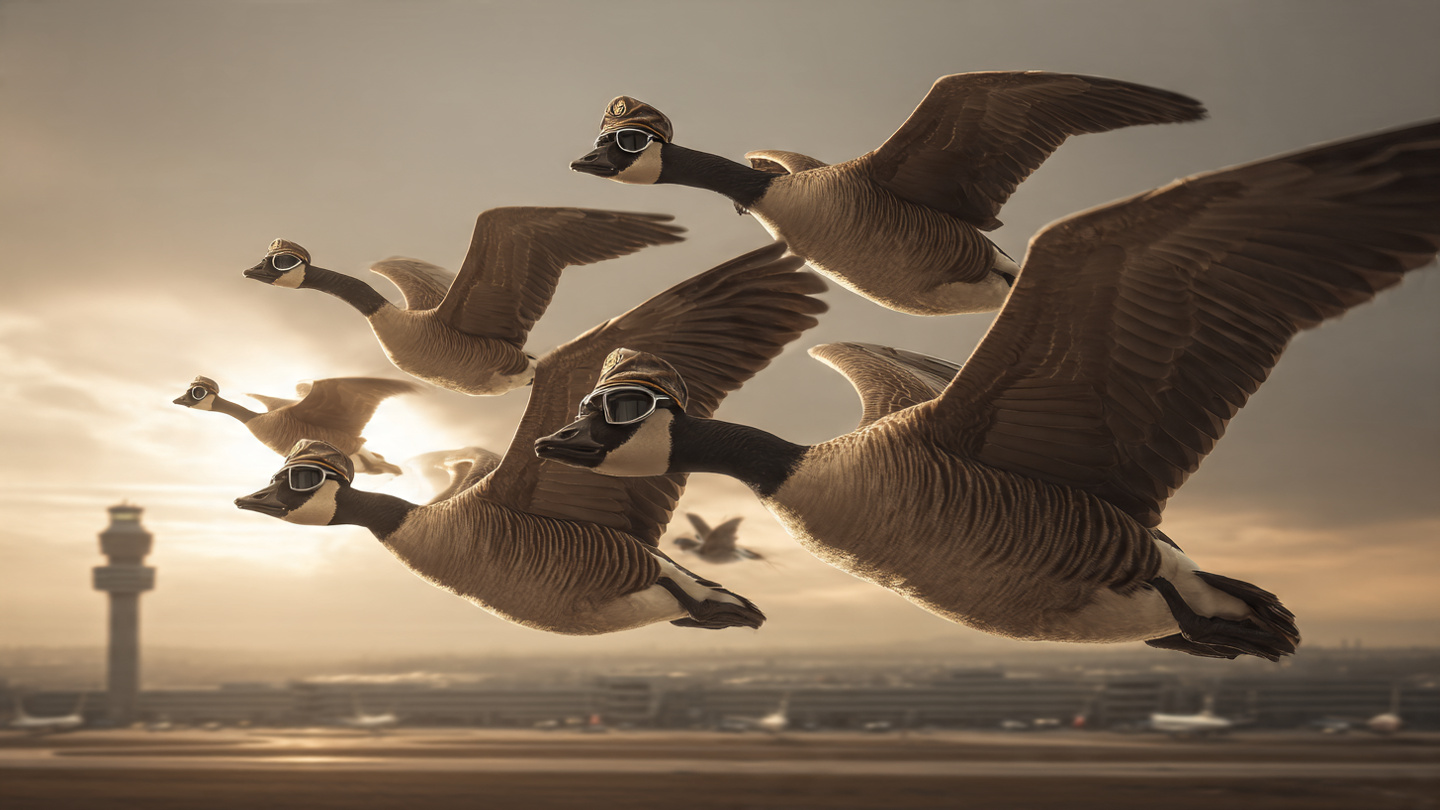
The single most famous incident occurred on January 15, 2009, when US Airways Flight 1549, an Airbus A320 commanded by Captain Chesley “Sully” Sullenberger, struck a flock of Canada Geese shortly after takeoff from LaGuardia Airport. Both engines lost thrust. The aircraft ditched in the Hudson River. All 155 passengers and crew survived, but the aircraft was a total loss.30
In any other transportation context, an entity whose operations caused $500 million in annual damages, destroyed hundreds of aircraft, and killed more than 300 people would face immediate regulatory action. The National Transportation Safety Board would issue urgent safety recommendations. The Department of Justice would consider criminal liability. Congressional hearings would be convened.
When a self-driving car is involved in a single fatality, the entire autonomous vehicle industry faces months of regulatory scrutiny. Birds destroy an average of 14 aircraft per year and the regulatory response is a voluntary reporting database.
IX. The Enforcement Paradox
The FAA has, in fact, attempted to address the problem—but from the wrong direction. FAA Advisory Circular 150/5200-33C, “Hazardous Wildlife Attractants On or Near Airports,” provides guidance for airport operators on reducing wildlife hazards.31 Part 139 of Title 14 of the Code of Federal Regulations requires certificated airports to conduct wildlife hazard assessments.32
These regulations treat birds as a hazard to be managed, not as operators to be regulated. This is the enforcement paradox. The FAA regulates the airports that birds use, but not the birds that use the airports. It is as if the Department of Transportation regulated highways but exempted all vehicles that were not manufactured by a human.
The paradox deepens when one considers the Migratory Bird Treaty Act, which makes it a federal crime to “pursue, hunt, take, capture, kill, or attempt to” any migratory bird without a permit.33 The FAA cannot ground the fleet. Federal law protects it. The avian airline operates under a regulatory shield that no human carrier has ever enjoyed—one that makes enforcement action against the operator a separate federal offense.
The DOT fined American Airlines $4.1 million in 2019 for chronic tarmac delays—flights that sat on the ground too long.34 Migratory birds have caused the destruction of hundreds of aircraft and the FAA cannot issue a citation because doing so would violate the Migratory Bird Treaty Act. The regulatory framework has produced a paradox in which the most dangerous operators in American airspace are also the most legally protected.
X. The Regulatory Imperative
The numbers are unambiguous. Approximately 7.2 billion birds inhabit North America. More than 4 billion of them use the national airspace system during each migration season. They operate on four federally recognized route networks spanning the Western Hemisphere. They transport measurable quantities of biological cargo across international boundaries for caloric compensation. Their operations cause more than $500 million in annual damages to regulated carriers. They have never obtained an operating certificate, filed a flight plan, or submitted to an FAA safety inspection.
Under 49 U.S.C. § 46101, any person may file a complaint with the Secretary of Transportation regarding violations of the aviation statutes.35 The Secretary is required to investigate complaints that “reasonably indicate” a violation. The evidence presented in this investigation more than meets that threshold. The question is not whether migratory birds satisfy the statutory elements of an unregulated air carrier. The question is why the complaint has not already been filed.
The answer, one suspects, is institutional. The FAA has 45,000 employees and an annual budget of approximately $20 billion.36 It struggles to maintain oversight of 294,000 registered aircraft. Adding 7.2 billion unregistered avian aircraft to the regulatory portfolio would require a budget increase of approximately 2,449,000 percent. This is, perhaps, the strongest argument against enforcement.
But the statute does not contain an exception for inconvenience. It does not exempt operators whose fleet size would overwhelm the regulator. It does not grandfather in operators who have been violating the law since the Cretaceous Period.
The birds have been flying for 150 million years.37 The FAA has existed for 68. The question of who has priority in the airspace is, from a seniority perspective, not close.
Ergo.
Sources
- 49 U.S.C. § 40102(a)(2). law.cornell.edu ↑
- 49 U.S.C. § 40102(a)(6). Ibid. ↑
- A. Farnsworth et al., “A characterization of autumn nocturnal migration detected by weather surveillance radars in the northeastern USA,” Ecological Applications, vol. 26, no. 3, 2016; see also Cornell Lab of Ornithology, “More than 4 billion birds stream overhead during fall migration,” 2018. news.cornell.edu ↑
- Black’s Law Dictionary, 11th ed. (2019), s.v. “contrivance.” ↑
- Diamond v. Chakrabarty, 447 U.S. 303 (1980). supreme.justia.com ↑
- National Geographic, “Peregrine Falcon.” Documented speeds exceed 240 mph (386 km/h) in a stoop. nationalgeographic.com ↑
- K.V. Rosenberg et al., “Decline of the North American avifauna,” Science, vol. 366, no. 6461, pp. 120–124, 2019. doi.org ↑
- FAA, “U.S. Civil Airmen and Aircraft Statistics.” faa.gov ↑
- Airlines for America, “U.S. Airline Industry Fleet Summary,” 2024. airlines.org ↑
- Interstate Commerce Act of 1887, 24 Stat. 379. Association of American Railroads historical data. aar.org ↑
- Federal Aviation Act of 1958, Pub. L. 85-726, 72 Stat. 731. The 1956 Grand Canyon midair collision between TWA Flight 2 and United Airlines Flight 718 killed all 128 persons aboard both aircraft. faa.gov ↑
- U.S. Fish and Wildlife Service, “Flyways.” fws.gov ↑
- E. Egevang et al., “Tracking of Arctic terns Sterna paradisaea reveals longest animal migration,” Proceedings of the National Academy of Sciences, vol. 107, no. 5, 2010. doi.org ↑
- Delta Air Lines, Inc., Form 10-K, Fiscal Year 2024. Route network summary. ir.delta.com ↑
- “Bar-tailed godwit sets new record for longest nonstop bird flight,” Audubon Magazine, October 2022. Satellite tag data confirmed 13,560 km from Alaska to Tasmania. audubon.org ↑
- 49 U.S.C. § 40102(a)(5): “‘air commerce’ means foreign air commerce, interstate air commerce, the transportation of mail by aircraft...” See also § 40102(a)(23) defining “air transportation.” law.cornell.edu ↑
- D.S. Viana et al., “Migratory birds as global dispersal vectors,” Trends in Ecology & Evolution, vol. 31, no. 10, 2016. doi.org ↑
- D.F. Tomback, “Dispersal of whitebark pine seeds by Clark’s nutcracker: a mutualism hypothesis,” Journal of Animal Ecology, vol. 51, no. 2, 1982. doi.org ↑
- U.S. Forest Service, “Whitebark Pine Restoration Strategy,” 2011. Acknowledges Clark’s Nutcracker as the primary dispersal agent for whitebark pine regeneration. fs.usda.gov ↑
- C.H. Sekercioglu, “Ecosystem services provided by birds,” Annals of the New York Academy of Sciences, vol. 1134, 2008. Comprehensive valuation of avian ecosystem services including seed dispersal, pest control, and scavenging. doi.org ↑
- FedEx Corporation, Form 10-K, Fiscal Year 2024. Total revenue: $87.7 billion. investors.fedex.com ↑
- DOT Office of Aviation Consumer Protection, enforcement guidance on “compensation” for purposes of air carrier economic regulations. transportation.gov ↑
- Ibid. The DOT has applied this standard in multiple enforcement actions against unlicensed charter operations. ↑
- R.E. Eriksson, “Evolution of angiosperm seed disperser mutualisms: the timing of origins and their consequences for coevolutionary interactions between angiosperms and frugivores,” Biological Reviews, vol. 91, no. 1, 2016. doi.org ↑
- S.R. McWilliams et al., “Flying, fasting, and feeding in birds during migration: a nutritional and physiological ecology perspective,” Journal of Avian Biology, vol. 35, no. 4, 2004. doi.org ↑
- Convention on International Civil Aviation (“Chicago Convention”), signed December 7, 1944, Art. 1. 61 Stat. 1180; TIAS 1591. icao.int ↑
- Migratory Bird Treaty Act of 1918, 16 U.S.C. §§ 703–712. fws.gov ↑
- FAA National Wildlife Strike Database. wildlife.faa.gov ↑
- R.A. Dolbeer et al., “Wildlife Strikes to Civil Aircraft in the United States, 1990–2023,” FAA Serial Report No. 28, 2024. faa.gov ↑
- National Transportation Safety Board, “Loss of Thrust in Both Engines After Encountering a Flock of Birds,” Accident Report NTSB/AAR-10/03, 2010. ntsb.gov ↑
- FAA Advisory Circular 150/5200-33C, “Hazardous Wildlife Attractants On or Near Airports,” 2020. faa.gov ↑
- 14 CFR Part 139, Certification of Airports. ecfr.gov ↑
- 16 U.S.C. § 703(a). law.cornell.edu ↑
- DOT, Office of Aviation Consumer Protection, enforcement actions for tarmac delay violations. American Airlines consent order, 2019. transportation.gov ↑
- 49 U.S.C. § 46101. law.cornell.edu ↑
- FAA, “Budget Estimates, Fiscal Year 2025.” faa.gov ↑
- O’Connor, J.K. and Zhou, Z., “The evolution of the modern avian flight apparatus,” in Living Dinosaurs: The Evolutionary History of Modern Birds, Wiley, 2011. The earliest known birds date to the Late Jurassic, approximately 150 million years ago (Archaeopteryx). doi.org ↑