I. The Statutory Foundation
In 1935, Congress passed the Federal Power Act, codified at 16 U.S.C. § 824, establishing federal jurisdiction over the transmission and sale of electric energy in interstate commerce. The Act declared that “the business of transmitting and selling electric energy for ultimate distribution to the public is affected with a public interest” and that “Federal regulation of matters relating to generation” and “the transmission of electric energy in interstate commerce” was “necessary in the public interest.”1
Section 824(c) defines when electric energy is transmitted in interstate commerce. The test is functional, not contractual: “electric energy shall be held to be transmitted in interstate commerce if transmitted from a State and consumed at any point outside thereof.” The statute does not require that the transmission occur along a wire. It does not require that a utility company own the transmission medium. It does not require that the energy be metered, sold, or intended for delivery. It requires only that electric energy originate in one state and arrive in another.
The entity charged with enforcing this framework is the Federal Energy Regulatory Commission, or FERC. Under 16 U.S.C. § 824d, every public utility that transmits or sells electric energy subject to FERC’s jurisdiction must file rate schedules with the Commission showing all rates and charges, and those rates must be “just and reasonable.”2 Under 16 U.S.C. § 824e, the Commission may, after a hearing, determine that any rate or charge is unjust, unreasonable, or unduly discriminatory, and fix the appropriate rate.3
This regulatory framework governs every entity in America that generates, transmits, or sells electric energy across state lines. Every coal plant. Every nuclear station. Every wind farm. Every solar installation. Every hydroelectric dam. The framework does not, by its own terms, contain an exception for entities that predate the legislation by several billion years. And yet one such entity operates continuously across all fifty states, generating and transmitting electric energy of extraordinary magnitude, without a license, without a rate schedule, and without a single interaction with the Commission since its founding.
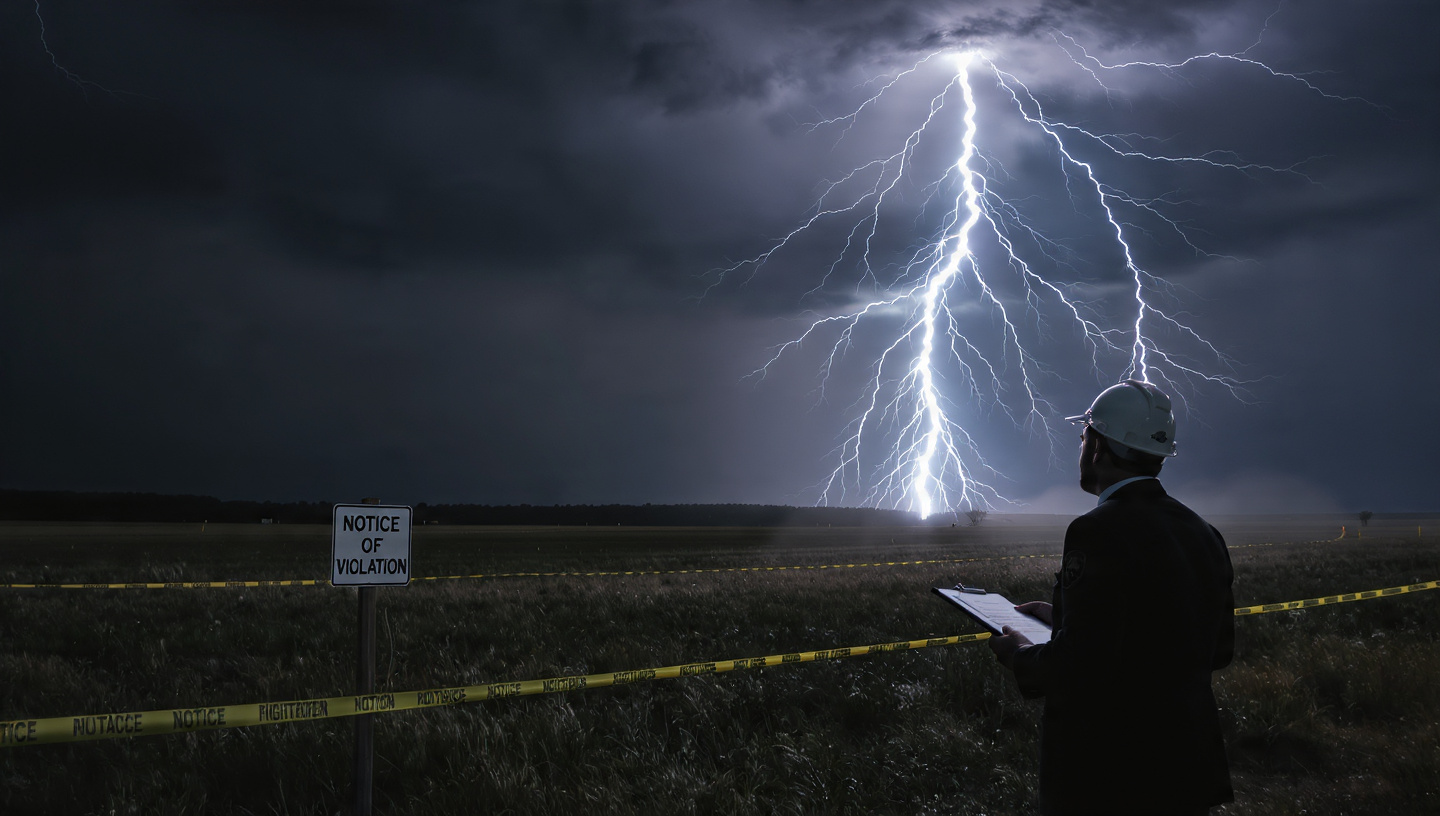
That entity is lightning.
II. The Generation Characteristics
Lightning is the natural discharge of electrical energy between regions of opposite charge in the atmosphere, or between the atmosphere and the ground. It is not a metaphor for electricity. It is electricity. The same electrons, the same electromagnetic force, the same fundamental physics that move current through a regulated transmission line move it through a lightning channel at approximately 270,000 miles per hour.4
According to the National Weather Service, a typical cloud-to-ground lightning flash involves approximately 300 million volts and 30,000 amperes of current.5 For comparison, a standard American household outlet supplies 120 volts at 15 amperes. The voltage differential between a regulated outlet and a lightning bolt is a factor of 2.5 million. The current differential is a factor of two thousand. The NWS does not note whether lightning has ever applied for a permit to operate at these levels. We looked. It has not.
The energy content of a single lightning discharge has been measured through multiple methodologies, including analysis of fulgurites—the glassy tubes formed when lightning vitrifies sand—and direct electromagnetic field recordings. Estimates range from 200 megajoules to 7 gigajoules per flash, with a central estimate of approximately 1 to 5 gigajoules.6 One gigajoule is sufficient to power a 100-watt incandescent light bulb continuously for approximately 116 days.7
The temperature of the lightning channel reaches approximately 30,000 kelvin—roughly 54,000 degrees Fahrenheit. This is approximately five times the temperature of the surface of the sun.8 No licensed utility in the United States operates a generation facility at five times the surface temperature of the sun. Several have been denied permits for considerably less ambitious thermal profiles.
III. The Service Territory
The National Lightning Detection Network, operated by Vaisala and used by the National Weather Service, records every cloud-to-ground lightning strike in the continental United States with a detection efficiency exceeding 95 percent. According to data published in the Bulletin of the American Meteorological Society, the United States receives approximately 23.4 million lightning flashes, producing 55.5 million individual strokes and 36.8 million ground strike points annually.9
In 2025, total lightning events in the United States reached 252 million—an eight-year high—according to Vaisala’s annual lightning report.10 Lightning struck in all fifty states. It struck in every month of the year. It struck on federal land, private land, tribal land, military installations, and, on at least several statistically inevitable occasions, FERC’s own headquarters at 888 First Street NE in Washington, D.C.
The service territory of this unlicensed utility is, in a word, total. No regulated utility in American history has achieved market penetration in all fifty states simultaneously. The nearest comparison is the interconnected grid itself, which is managed by regional transmission organizations and independent system operators under FERC oversight. Lightning operates in all of their territories. It has filed interconnection agreements with none of them.
IV. The Interstate Transmission Problem
Under 16 U.S.C. § 824(c), electric energy is “transmitted in interstate commerce if transmitted from a State and consumed at any point outside thereof.” Lightning satisfies this test regularly and with vigor.
Individual lightning bolts can travel horizontal distances of 10 miles or more from their parent thunderstorm. In 2020, the World Meteorological Organization certified a single megaflash over the southern United States that extended 768 kilometers—approximately 477 miles—across three states.11 The record was broken that same year by a flash spanning 829 kilometers across parts of Texas, Louisiana, and Mississippi.12 The electrical energy in that discharge originated in one state and was consumed in others. This is, by the statute’s own definition, interstate transmission of electric energy.
But even without record-breaking megaflashes, every thunderstorm system that develops near a state border and produces ground strikes on both sides has transmitted electric energy in interstate commerce. The electromagnetic field changes from a lightning discharge propagate at the speed of light and are detectable hundreds of miles from the source. The energy radiated as very low frequency electromagnetic waves from a single bolt travels across state, national, and continental boundaries continuously.13
Under FERC’s own jurisdictional tests, this should trigger federal oversight. Under the actual regulatory record, it has triggered nothing.
V. The Rate Schedule Deficiency
Section 824d(c) of the Federal Power Act requires that “every public utility shall file with the Commission… schedules showing all rates and charges for any transmission or sale of electric energy subject to the jurisdiction of the Commission.” The Commission maintains the Electronic Quarterly Reports system, or EQR, through which all FERC-jurisdictional entities must report their wholesale power transactions.14
Lightning has never filed a rate schedule. It has never submitted an EQR. It has never proposed a tariff for public comment. It delivers electric energy at no charge to the recipient, which might seem benevolent until one considers the delivery mechanism. The “rate” at which lightning delivers energy is not zero in any meaningful economic sense. It is undefined. The cost to the recipient includes structural fires, destroyed transformers, killed livestock, and, as documented by the Insurance Information Institute, approximately $1.04 billion in homeowners’ insurance claims paid out in 2024 alone.15
Under 16 U.S.C. § 824d(a), all rates must be “just and reasonable.” A rate that is simultaneously zero and $1.04 billion per year is difficult to characterize as either just or reasonable. The rate schedule, insofar as one can be inferred from lightning’s behavior, appears to involve involuntary delivery of energy at catastrophically high voltages to parties who have not requested service, at times of lightning’s own choosing, with no mechanism for complaint, adjustment, or opt-out.
The Commission has the authority under § 824e to fix just and reasonable rates for any utility whose rates are found to be unjust. This power has never been exercised against lightning. The practical challenges of imposing a rate order on an atmospheric electrostatic discharge are acknowledged. They are not, however, the statute’s problem.
VI. The Reliability Standards Gap
In 2005, Congress amended the Federal Power Act to add Section 215, codified at 16 U.S.C. § 824o, establishing mandatory and enforceable reliability standards for the bulk power system of the United States. The North American Electric Reliability Corporation, or NERC, was designated as the Electric Reliability Organization responsible for developing and enforcing these standards. Under § 824o(e)(6), the Commission may impose penalties for violations of reliability standards of up to $1 million per violation per day.16
NERC’s reliability standards address every aspect of grid operation: resource adequacy, transmission planning, generator performance, protection system maintenance, cybersecurity, and personnel training. The standards are mandatory for all users, owners, and operators of the bulk power system. Compliance is not optional. Audits are regular. Violations are public.
Lightning does not comply with a single NERC reliability standard. Not one. Its generation output is entirely unpredictable. Its transmission path is uncontrollable. Its frequency regulation is nonexistent—it operates at whatever frequency thermodynamics requires at the moment of discharge, which is to say at no stable frequency whatsoever. It has never filed a compliance monitoring plan. It has never submitted to an audit. It has never designated a compliance officer.
Under the standards for Transmission Planning (TPL-001 through TPL-004), every transmission planner must conduct planning assessments to evaluate system performance under various contingency conditions. Lightning is itself the contingency. It is the single most common cause of transmission line outages in the United States. According to NERC’s own State of Reliability reports, weather-related events—dominated by lightning—account for the majority of forced transmission outages each year.17 The entity causing the outages and the entity that should be complying with the standards to prevent them are the same entity, and that entity has never registered with NERC.
VII. The Environmental Impact
The National Environmental Policy Act of 1969, codified at 42 U.S.C. § 4332, requires that federal agencies prepare a detailed environmental impact statement for “major Federal actions significantly affecting the quality of the human environment.”18 While NEPA applies to federal actions rather than to natural phenomena directly, the failure of federal agencies to regulate lightning under their existing statutory authority means that no EIS has ever been prepared for what is, by any quantitative measure, one of the most environmentally consequential energy operations on American soil.
The National Interagency Fire Center maintains comprehensive records of lightning-caused wildfires in the United States. In 2024, lightning ignited 6,935 wildfires that burned approximately 4.26 million acres. In 2022, the figure was 4.21 million acres. In 2017, it was 5.20 million acres. In 2015, 9,235 lightning-caused fires burned 8.11 million acres of American land.19
For perspective, the Keystone XL pipeline’s environmental impact statement ran to thousands of pages and required years of review for a project that would have occupied a 36-inch-diameter corridor across approximately 1,200 miles. Lightning burns millions of acres per year, produces megatons of nitrogen oxides and particulate matter, kills an average of 20 Americans annually, and has never been the subject of a single page of environmental review.20
Under NEPA, an EIS must analyze the direct, indirect, and cumulative impacts of a proposed action. The cumulative impact of lightning on the American landscape includes approximately 4 million acres of wildfire per year, $1 billion in annual property damage, contamination of the nitrogen cycle, production of ozone and nitrogen oxides in the troposphere, and the deaths of between 10 and 20 Americans per year. This has been occurring for the entire duration of the planet’s atmospheric history. No scoping meeting has been held.
VIII. The Electromagnetic Interference Problem
Lightning is not merely an unregulated electrical utility. It is also an unregulated radio transmitter. Each lightning discharge produces a broadband burst of electromagnetic radiation spanning frequencies from below 1 Hz to beyond 300 MHz. Studies published in Nature have documented that lightning is the dominant source of natural radio noise in the Earth’s atmosphere, producing signals strong enough to be detected thousands of miles from the source discharge.21
Under 47 C.F.R. Part 15, the FCC regulates all intentional and unintentional radiators of electromagnetic energy. Devices that emit radio frequency energy must comply with emission limits designed to prevent interference with licensed radio services. The regulations apply to any “device or system that intentionally generates and emits radio frequency energy by radiation or induction.” Lightning generates and emits radio frequency energy by radiation. The fact that its intention cannot be established is a problem of legal theory, not of physics.
The electromagnetic pulse from a single lightning stroke can induce voltage surges on power lines, telecommunications cables, and electronic equipment for miles around the strike point. These surges routinely cause interference with licensed radio services, disrupt navigation systems, and damage consumer electronics. The FCC issues notices of violation against commercial entities for emissions that are, in absolute magnitude, undetectable by comparison. Lightning produces emission events that the Commission has classified as natural radio noise and therefore excluded from regulatory concern. This exclusion appears nowhere in the statute.
IX. The Enforcement Calculation
Under 16 U.S.C. § 824o(e)(6), FERC may impose penalties of up to $1 million per violation per day for noncompliance with mandatory reliability standards. Lightning has been in continuous noncompliance with every applicable standard since the standards were adopted in 2007. That is approximately 6,935 days as of May 2026.
There are currently 107 mandatory NERC reliability standards in effect. If each day of noncompliance with each standard constitutes a separate violation—which FERC’s own enforcement guidance permits—the aggregate penalty exposure is approximately $1 million × 107 standards × 6,935 days, or approximately $742 billion. This figure does not include penalties for the preceding 4.5 billion years during which lightning was noncompliant with standards that did not yet exist, a temporal defense that FERC has not been asked to evaluate.
Under 16 U.S.C. § 824d(f), any person who willfully violates the rate schedule filing requirements is subject to a penalty of not more than $1 million for each day during which such violation continues. Lightning has never filed a rate schedule. It has been delivering energy in interstate commerce for longer than the continent has existed in its current configuration. The rate filing violation is, conservatively, continuous.
The total penalty exposure, if calculated from the adoption of the Federal Power Act in 1935 through the present day—a period of approximately 33,200 days—is $33.2 billion for rate schedule violations alone. If calculated from the first lightning bolt to strike the North American landmass, the number exceeds the observable universe’s estimated baryon content expressed in dollars, which is not a useful enforcement figure but is an accurate one.
X. The Market Power Concern
FERC’s market-based rate authorization process requires applicants to demonstrate that they lack market power in the relevant market, or to accept mitigation measures. Under Order No. 697, the Commission applies both a pivotal supplier analysis and a market share analysis to determine whether an entity possesses horizontal market power in any region.22
Lightning possesses absolute market power in the market for involuntary electrical energy delivery. It has no competitors. No other entity delivers unrequested electric energy at 300 million volts to recipients who have not agreed to receive service. Its market share in this segment is 100 percent. Under FERC’s own analytical framework, this constitutes textbook horizontal market dominance, and the appropriate remedy is either divestiture or a cost-based rate. Neither has been ordered.
Lightning also exhibits vertical market power. It controls the generation facility (cumulonimbus clouds), the transmission medium (ionized atmospheric channels), and the delivery point (the ground). Vertical integration at this level would trigger antitrust concern if the entity were a corporation. It has triggered no concern because the entity is a meteorological phenomenon, and FERC has apparently decided that atmospheric physics is outside its jurisdiction. The Federal Power Act does not support this position.
XI. Conclusion
The evidence is not ambiguous. The Federal Power Act grants FERC jurisdiction over the transmission of electric energy in interstate commerce. Lightning generates electric energy. It transmits that energy across state lines. It does so 25 million times per year in the United States alone, at voltages 2.5 million times higher than a household outlet, at temperatures five times the surface of the sun, delivering involuntary service to recipients across all fifty states.
It has never obtained a license. It has never filed a rate schedule. It has never submitted to a NERC reliability audit. It has never prepared an environmental impact statement, despite burning millions of acres of American land per year and causing over $1 billion in annual property damage. It has never registered as a market participant. It has never designated a compliance officer. It has never appeared at a FERC hearing, though it has, on several documented occasions, struck the buildings where FERC hearings were being conducted.
The Commission’s inaction is not a matter of policy discretion. It is a categorical regulatory failure to apply existing law to an entity that satisfies every statutory criterion for jurisdiction. The Federal Power Act does not contain an atmospheric exemption. It does not exclude generators that predate the legislation. It does not exempt energy that is delivered involuntarily, at catastrophic voltages, without a meter.
Eight billion joules per bolt. Twenty-five million bolts per year. Four point five billion years of continuous, unlicensed operation. Zero enforcement actions. Zero notices of inquiry. Zero rate cases. Zero reliability audits.
The grid is regulated. The sky is not. The electricity is the same.
Ergo.
Sources
- 16 U.S.C. § 824, Declaration of Policy; Application of Subchapter, Federal Power Act. law.cornell.edu ↑
- 16 U.S.C. § 824d, Rates and Charges; Schedules; Suspension of New Rates, Federal Power Act. law.cornell.edu ↑
- 16 U.S.C. § 824e, Power of Commission to Fix Rates and Charges, Federal Power Act. law.cornell.edu ↑
- M.A. Uman, The Lightning Discharge, Academic Press, 1987; updated in M.A. Uman, Lightning: Physics and Effects, Cambridge University Press, 2003. Standard reference for lightning return stroke propagation velocities (~one-third the speed of light, or roughly 60,000 miles per second). ↑
- National Weather Service, “How Powerful Is Lightning?” weather.gov ↑
- M.A. Pasek et al., “A Fossilized Energy Distribution of Lightning,” Scientific Reports, vol. 11, no. 1, 2021. See also “Lightning,” Wikipedia, citing energy range of 200 MJ to 7 GJ per flash from multiple atmospheric electricity sources. nature.com ↑
- University of Illinois Department of Physics, “Energy of a Lightning Strike,” Ask the Van. van.physics.illinois.edu ↑
- National Weather Service, “Lightning Safety Tips and Resources”; NOAA, “5 Striking Facts Versus Myths About Lightning.” Temperature of lightning channel approximately 30,000 K (54,000°F), compared to solar surface temperature of approximately 5,778 K (9,941°F). noaa.gov ↑
- C. Vagasky, R.L. Holle, and M.J. Murphy, “How Much Lightning Actually Strikes the United States?” Bulletin of the American Meteorological Society, 2022. Using National Lightning Detection Network data. journals.ametsoc.org ↑
- Vaisala Annual Lightning Report 2025; reported by The Weather Channel. 252 million total lightning events in the United States, an eight-year high. weather.com ↑
- World Meteorological Organization, “WMO Certifies Megaflash Lightning Records,” February 1, 2022. Previous record: 768 km flash across southern United States on April 29, 2020. wmo.int ↑
- Ibid. Subsequent record: 829 km flash across southern United States on April 29, 2020. ↑
- R.A. Marshall and U.S. Inan, “Two-Dimensional Frequency Domain Modeling of Lightning EMP-Induced Perturbations to VLF Transmitter Signals,” Journal of Geophysical Research, vol. 115, 2010. experts.colorado.edu ↑
- Federal Energy Regulatory Commission, “Electronic Quarterly Reports (EQR).” ferc.gov ↑
- Insurance Information Institute, “Triple-I: Lightning Caused $1.04B in US Homeowners Claim Payouts in 2024; Frequency Drops 21.5% Year-Over-Year,” 2025. iii.org ↑
- 16 U.S.C. § 824o, Electric Reliability, Federal Power Act, as added by Energy Policy Act of 2005, Pub. L. 109-58, § 1211. law.cornell.edu ↑
- North American Electric Reliability Corporation, State of Reliability (annual reports). Weather-related events consistently identified as the leading cause of forced transmission outages. nerc.com ↑
- 42 U.S.C. § 4332, Cooperation of Agencies; Reports; Availability of Information, National Environmental Policy Act of 1969. law.cornell.edu ↑
- National Interagency Fire Center, “Lightning-Caused Wildfires,” annual statistics, 2001–2025. nifc.gov ↑
- National Weather Service, National Lightning Safety Council, “Lightning Fatalities” (annual reports). Average of approximately 20 lightning fatalities per year in the United States. weather.gov ↑
- “Radio Noise from Lightning Discharges,” Nature, 1961. Foundational study on high-frequency radio noise produced by lightning. nature.com ↑
- Federal Energy Regulatory Commission, Order No. 697, “Market-Based Rates for Wholesale Sales of Electric Energy, Capacity and Ancillary Services by Public Utilities,” 119 FERC ¶ 61,295, 2007. ferc.gov ↑