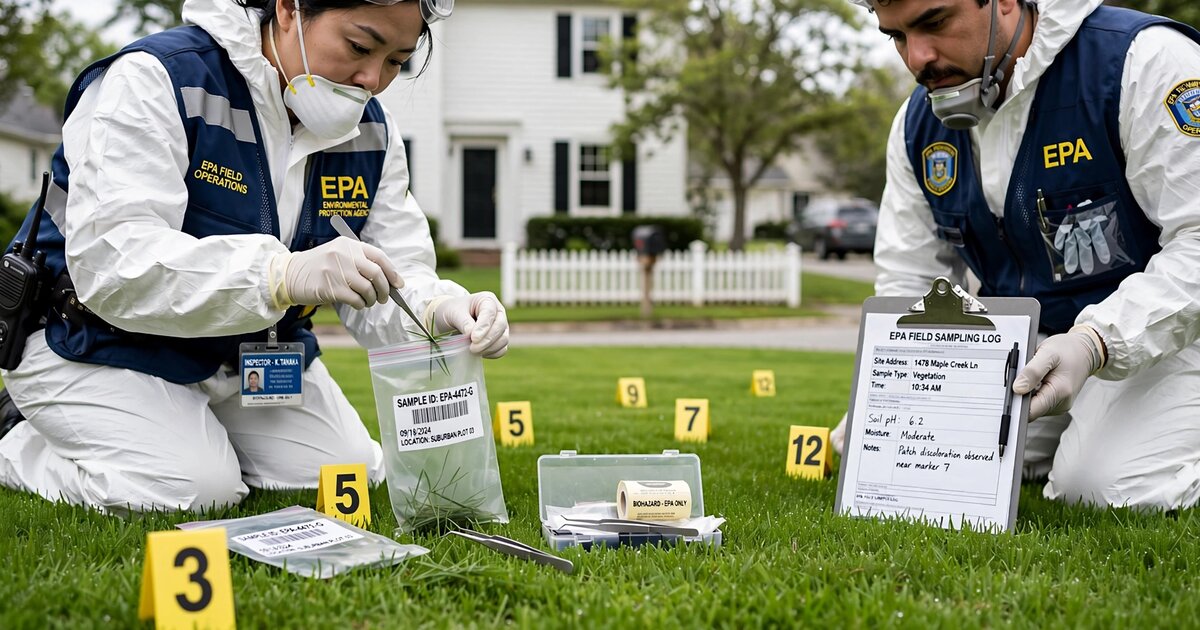
I. The Statutory Definition
Under Section 2(u) of the Federal Insecticide, Fungicide, and Rodenticide Act, codified at 7 U.S.C. § 136(u), the term “pesticide” means “any substance or mixture of substances intended for preventing, destroying, repelling, or mitigating any pest.”1
The statute defines “pest” at 7 U.S.C. § 136(t) to include “any weed.”2
Under Section 3 of FIFRA, 7 U.S.C. § 136a, no pesticide may be distributed, sold, or used in the United States unless it has been registered with the Environmental Protection Agency. Registration requires submission of data on the product’s composition, labeling, toxicology, and environmental fate. Unregistered pesticide distribution is a federal violation carrying civil penalties of up to $21,712 per offense per day.3
The EPA’s own implementing regulations, at 40 CFR § 152.15, clarify that intent is determined not only from labeling claims but from the composition, use, and mode of action of the product as distributed. A substance whose functional characteristics prevent, destroy, repel, or mitigate a pest is, under the regulations, a pesticide.4
This is not ambiguous. It is a definition with a test. The test has three elements: a substance, a pesticidal function, and intent. Two of the three can be established by laboratory analysis alone.
II. The Compound
In 2007, researchers at Cornell University’s Boyce Thompson Institute for Plant Research published a paper in the Proceedings of the National Academy of Sciences identifying a previously unknown herbicidal compound produced by fine fescue grasses (Festuca spp.), one of the most widely planted lawn grass species in the United States.5
The compound is meta-tyrosine, a nonprotein amino acid that is a structural isomer of the common protein amino acid para-tyrosine. Fine fescue grasses synthesize m-tyrosine in their root systems and deposit it in large quantities into the soil rhizosphere. Senior author Frank Schroeder described the compound in terms that leave little room for interpretation: “We at first didn’t believe m-tyrosine had anything to do with the observed herbicidal activity, but then we tested it and found it to be extremely toxic to plants but not toxic to fungi, mammals or bacteria.”6
The researchers demonstrated that m-tyrosine exposure results in growth inhibition across a wide range of plant species. The proposed mechanism of toxicity is the misincorporation of the nonprotein amino acid into proteins during translation, disrupting protein function and interfering with root development in competing plants. Acid hydrolysis of total root protein from Arabidopsis thaliana confirmed incorporation of m-tyrosine into the plant’s own proteins.7
The compound is not a trace byproduct. It is, in the researchers’ own characterization, “the major active component” of the aqueous phytotoxic root exudate that fine fescue grasses deploy to displace neighboring plants.8 The grass produces it, transports it to its roots, and releases it into the soil. The compound then prevents the germination and growth of surrounding vegetation.
The technical term for this process is allelopathy: chemical warfare between plants. Fine fescues are not the only practitioners. Perennial ryegrass (Lolium perenne) produces benzoxazinoid compounds including DIBOA and DIMBOA, which exert “strong suppression of plant growth.”9 Tall fescue (Festuca arundinacea) harbors endophytic fungi that produce loline alkaloids, providing chemical defense against both insects and competing plants.10 These species, collectively, form the foundation of the American lawn.
III. The Scale
In 2005, Cristina Milesi and a team of researchers at NASA’s Ames Research Center published a landmark study in Environmental Management that quantified, for the first time, the total surface area of managed turfgrass in the continental United States.11
The figure was approximately 163,800 square kilometers, or 40 million acres. This includes residential lawns, commercial landscapes, golf courses, parks, athletic fields, highway medians, and institutional grounds.
To understand the scale of this number, consider that the total harvested acreage of corn in the United States is approximately 87 million acres, but only about 12 million acres of that is irrigated. The Milesi study found that turfgrass occupies an area “three times larger than any irrigated crop” in the country.12 Turfgrass is, by surface area, the single largest irrigated crop in the continental United States.
It receives no crop designation from the USDA. It appears in no Farm Service Agency enrollment records. It qualifies for no agricultural subsidies. No county extension agent has ever been assigned to inspect it for regulatory compliance.
Yet this unregistered crop covers an area larger than the state of Georgia. Americans spend approximately $60 billion per year maintaining it.13 And a quantified, peer-reviewed fraction of it is producing and distributing phytotoxic compounds into the soil across all fifty states, continuously, without interruption, without a label, without an EPA registration number, and without a single Material Safety Data Sheet.
IV. The Plant-Incorporated Protectant Precedent
The EPA has already answered the question of whether pesticidal substances produced inside living plants are subject to FIFRA registration. The answer is yes.
In 2001, the EPA promulgated regulations at 40 CFR Part 174 establishing a category called “Plant-Incorporated Protectants,” or PIPs. A PIP is defined at 40 CFR § 174.3 as “a pesticidal substance that is intended to be produced and used in a living plant, or the produce thereof, and the genetic material necessary for the production of such a pesticidal substance.”14
The paradigm case is Bt corn. The bacterium Bacillus thuringiensis naturally produces proteins that are toxic to certain insect pests. When the gene encoding one of these proteins is introduced into a corn plant, the corn produces the pesticidal protein in its own tissues. The EPA treats this protein as a pesticide. It requires a federal registration. It requires tolerance exemptions for food safety under 40 CFR §§ 174.501–174.530. It requires data submissions on toxicology, allergenicity, and environmental fate. It requires labeling. The fact that the substance is produced by a living plant rather than formulated in a factory does not exempt it from FIFRA.15
The EPA recognized, when promulgating these regulations, that plants naturally produce pesticidal substances. It noted that “these pesticidal substances naturally produced by plants are PIPs when intended for pesticide use in the plant.”16 The agency then published exemptions at 40 CFR §§ 174.25 and 174.508 for PIPs created through conventional breeding of sexually compatible plants, reflecting what the agency called “the history of safe use of PIPs in conventional breeding.”
Note the structure of the exemption. It does not exempt all naturally occurring plant-produced pesticides from FIFRA. It exempts pesticidal substances that have been moved through conventional breeding into sexually compatible plants. The exemption is for the human act of breeding, not for the naturally occurring substance itself.
Fine fescue’s m-tyrosine is not a product of conventional breeding programs designed to optimize its herbicidal function. It is produced by wild-type and cultivated varieties alike, deposited into the soil rhizosphere at phytotoxic concentrations, and it functions to destroy competing plants. Under the EPA’s own framework, a pesticidal substance produced by a living plant is a PIP. A PIP is a pesticide. A pesticide requires registration. No registration exists.
V. The Alien Species Problem
Kentucky bluegrass (Poa pratensis) is the most widely planted lawn grass species in the United States. It is the species that gives Kentucky the name “Bluegrass State.” It is the default species in standard lawn seed mixes recommended by cooperative extension services from Massachusetts to Oregon.17
It is not from Kentucky. It is not from North America.
The USDA Forest Service’s Fire Effects Information System states plainly: “Kentucky bluegrass is generally considered to be nonnative to North America.”18 The species is native to Europe, northern Asia, and the mountains of Algeria and Morocco. Early European colonists brought seed of Poa pratensis to the New World in mixtures with other grasses. The Invasive Plant Atlas of the United States lists it as an introduced species.19 When found on native grasslands in Canada, it is classified as “an unwelcome exotic plant” and “indicative of a disturbed and degraded landscape.”20
Fine fescues and perennial ryegrasses are similarly of European origin. The species that constitute the standard American lawn are, taxonomically, a consortium of Eurasian immigrants that were transported across the Atlantic Ocean, planted across 40 million acres of the continent, and then left to conduct chemical warfare against the native vegetation using compounds that the federal government has never registered, tested, or labeled.
The irony is structural. The EPA requires registration of synthetic herbicides that homeowners apply to their lawns. Scotts Miracle-Gro’s Turf Builder Weed and Feed carries EPA Registration Number 538-760. Its active ingredient, 2,4-D, is registered, labeled, and subject to federal tolerances. Meanwhile, the lawn grasses underneath the application are producing and distributing their own herbicidal compounds at concentrations sufficient to inhibit root growth across a wide range of plant species, and the EPA has registered none of them.
The homeowner is, in effect, applying a registered pesticide to an unregistered one.
VI. The Functional Intent Doctrine
The anticipated objection is intent. FIFRA’s definition specifies substances “intended for” pest prevention or mitigation. Grasses, it will be argued, do not intend anything. They are plants. They lack the cognitive apparatus to form intentions.
This objection, however appealing to common sense, is inconsistent with the EPA’s own regulatory practice.
The EPA’s implementing regulations at 40 CFR § 152.15 provide that intent is determined not solely by the manufacturer’s stated purpose but by the composition, use, and mode of action of the substance. A 1995 Administrative Law Judge decision in Aquarium Products, Inc. established that a product need not act directly on a pest to be considered a pesticide; claims affecting the habitat or food source of a pest constitute “mitigation” under FIFRA.21
More fundamentally, the PIP framework itself collapses the intent objection. When the EPA classified Bt proteins in genetically modified corn as pesticides requiring registration, it did so despite the fact that the corn plant has no cognitive intent to kill insects. The gene produces a protein. The protein is toxic to pests. The functional outcome is pesticidal. That was sufficient.
m-Tyrosine presents an identical functional profile. The gene encodes an enzyme. The enzyme produces a compound. The compound is toxic to neighboring plants. The functional outcome is herbicidal. The mechanism is analogous. The regulatory conclusion should be identical.
If intent is established by functional outcome and mode of action rather than cognitive purpose, then the 200-million-year evolutionary history of allelopathy constitutes the longest-running unregistered pesticide manufacturing operation in the history of the planet.
VII. The Data Gap
FIFRA registration requires submission of data on environmental fate, ecological effects, and toxicology. Under 40 CFR Part 158, a pesticide registrant must provide studies on avian toxicity, aquatic organism effects, pollinator exposure, soil persistence, groundwater contamination potential, and human health risk assessment.22
For m-tyrosine, none of this data has been submitted to the EPA. The compound has no EPA registration number. It has no tolerance exemption under 40 CFR Part 180. It has no approved label. No environmental fate study has been filed. No ecological risk assessment has been conducted under the EPA’s framework.
What we know of m-tyrosine’s properties comes entirely from academic research. Bertin, Schroeder, and colleagues at Cornell demonstrated broad-spectrum phytotoxicity. They showed that the compound is incorporated into plant proteins, suggesting a mechanism that could affect any organism relying on protein synthesis in roots. They noted that it is “significantly more phytotoxic than its structural isomers o- and p-tyrosine.”23
Yet the compound is being distributed into the soil of approximately 40 million acres of American landscape every growing season. It enters the rhizosphere, interacts with soil microbiota, leaches into groundwater, and suppresses native plant communities. It does all of this without a single page of regulatory data on file with any federal agency.
For comparison: if a chemical company sought to register a new synthetic herbicide that was “extremely toxic to plants,” functioned through protein misincorporation, exhibited broad-spectrum activity against dicots and monocots alike, and was intended for distribution across 40 million acres, the EPA would require years of study and hundreds of pages of data before granting a registration number. Fine fescue has been distributing this compound across the continent for centuries. The agency has required nothing.
VIII. Conclusion
The evidence arranges itself into a syllogism from which there is no comfortable escape.
FIFRA defines a pesticide as any substance intended for preventing, destroying, repelling, or mitigating any pest. The EPA’s own regulations establish that intent is determined by composition, use, and mode of action. The EPA’s own Plant-Incorporated Protectant framework confirms that pesticidal substances produced inside living plants are pesticides subject to federal registration. Cornell University has identified the specific compound, characterized its mode of action, and documented its broad-spectrum phytotoxicity. NASA has quantified the scale of its distribution at 40 million acres.
Fine fescue grasses produce m-tyrosine. m-Tyrosine is a substance that destroys competing plants. The destruction of competing plants is the mitigation of a pest under FIFRA’s own definitions. A substance that mitigates a pest is a pesticide. A pesticide distributed without registration is a federal violation.
Every lawn in the United States that contains fine fescue, perennial ryegrass, or tall fescue is an active distribution point for unregistered pesticidal compounds. Every bag of lawn seed sold at every hardware store in every state is a vehicle for unregistered pesticide dissemination. Every homeowner who has ever spread a fine fescue blend across their yard has, under a strict reading of FIFRA, distributed an unregistered pesticide in the United States of America.
The EPA has not opened a file. The USDA has not designated turfgrass as a crop. No county extension agent has flagged the compliance gap. The grass grows. The compound flows. The neighboring plants die. And the largest pesticide manufacturing operation in the western hemisphere operates in full public view, under clear skies, on the front lawns of a hundred million American homes, without a registration number, without a label, and without a single inspector who has thought to check.
Ergo.
Sources
- 7 U.S.C. § 136(u), Federal Insecticide, Fungicide, and Rodenticide Act, Section 2(u). uscode.house.gov ↑
- 7 U.S.C. § 136(t), defining “pest” to include “any insect, rodent, nematode, fungus, weed, or any other form of terrestrial or aquatic plant or animal life.” uscode.house.gov ↑
- 7 U.S.C. § 136a (registration requirements); 7 U.S.C. § 136l (penalty amounts, adjusted for inflation per 40 CFR § 19.4). epa.gov ↑
- 40 CFR § 152.15, “Determining whether a product is a pesticide.” See also EPA guidance, “Determining If a Cleaning Product Is a Pesticide Under FIFRA.” govinfo.gov ↑
- C. Bertin, X. Yang, and L.A. Weston, “The Role of Root Exudates and Allelochemicals in the Rhizosphere,” Plant and Soil, vol. 256, 2003; F.C. Schroeder et al., “Grass roots chemistry: meta-Tyrosine, an herbicidal nonprotein amino acid,” Proceedings of the National Academy of Sciences, vol. 105, no. 36, 2008. pmc.ncbi.nlm.nih.gov ↑
- Cornell Chronicle, “Cornell researchers identify natural herbicide that controls weeds around some common lawn grasses,” November 2007. Quoting Frank Schroeder, Boyce Thompson Institute for Plant Research. news.cornell.edu ↑
- Schroeder et al. (2008), op. cit. “Acid hydrolysis of total root protein from Arabidopsis thaliana showed incorporation of m-tyrosine, suggesting this as a possible mechanism of phytotoxicity.” ↑
- Schroeder et al. (2008), op. cit. Abstract: “Fine fescue grasses displace neighboring plants by depositing large quantities of an aqueous phytotoxic root exudate in the soil rhizosphere. Via activity-guided fractionation, we have isolated and identified the nonprotein amino acid m-tyrosine as the major active component.” ↑
- J. Huang et al., “Allelopathy and Allelochemicals in Grasslands and Forests,” Plants (MDPI), reviewing benzoxazinoid allelochemicals in grasses. DIBOA and DIMBOA “can be released by rye and exert strong suppression of plant growth.” mdpi.com ↑
- C.L. Schardl et al., “Regulation of a chemical defense against herbivory produced by symbiotic fungi in grass plants,” Plant Physiology, 2013. Neotyphodium endophytes in fescues produce loline alkaloids following herbivore damage. pubmed.ncbi.nlm.nih.gov ↑
- C. Milesi et al., “Mapping and Modeling the Biogeochemical Cycling of Turf Grasses in the United States,” Environmental Management, vol. 36, no. 3, 2005. doi.org ↑
- NASA Science, “Looking for Lawns.” Quoting Milesi: “Even conservatively, I estimate there are three times more acres of lawns in the U.S. than irrigated corn.” science.nasa.gov ↑
- Mordor Intelligence, “United States Lawn Care Market Analysis,” 2025. Market size valued at approximately USD 60 billion. Corroborated by Research and Markets (USD 61.74 billion, 2025). mordorintelligence.com ↑
- 40 CFR § 174.3, defining “Plant-Incorporated Protectant” as “a pesticidal substance that is intended to be produced and used in a living plant, or the produce thereof, and the genetic material necessary for the production of such a pesticidal substance.” govinfo.gov ↑
- U.S. EPA, “Oversight of Pesticide Traits in Genetically Modified Plants,” reviewing PIP registration requirements for Bt proteins (Cry1Ab, Cry2Ab2, mCry3A) in corn. pmc.ncbi.nlm.nih.gov ↑
- 66 FR 37814, July 19, 2001. EPA final rule on plant-incorporated protectants: “Plants naturally produce substances that have pesticidal properties. When EPA developed its regulations for PIPs, it determined that these pesticidal substances naturally produced by plants are PIPs when intended for pesticide use in the plant.” federalregister.gov ↑
- UMass Amherst, Center for Agriculture, Food, and the Environment, “Seeding Rate Considerations,” recommending lawn mixtures of 65–75% Kentucky bluegrass with fine fescue and perennial ryegrass. ag.umass.edu ↑
- USDA Forest Service, Fire Effects Information System, Poa pratensis: “Kentucky bluegrass is generally considered to be nonnative to North America.” fs.usda.gov ↑
- Invasive Plant Atlas of the United States, Poa pratensis (Kentucky bluegrass). invasiveplantatlas.org ↑
- Wikipedia, “Poa pratensis,” citing Canadian ecological assessments: “an unwelcome exotic plant, and is indicative of a disturbed and degraded landscape.” en.wikipedia.org ↑
- In re Aquarium Products, Inc., FIFRA Docket No. IF&R-V-014-93, 1995. EPA Administrative Law Judge decision establishing that products affecting a pest’s habitat or food source constitute “mitigation” claims subject to FIFRA. Cited in EPA guidance, 40 CFR § 152.15. ↑
- 40 CFR Part 158, “Data Requirements for Pesticides.” Subpart G (Product Performance); Subpart K (Reentry Protection); Subpart L (Target Area); Subparts N–R (Toxicology, Environmental Fate, Ecological Effects). ecfr.gov ↑
- Schroeder et al. (2008), op. cit. “m-Tyrosine is significantly more phytotoxic than its structural isomers o- and p-tyrosine.” ↑