I. The Regulatory Framework
The Textile Fiber Products Identification Act was enacted as Public Law 85-897 on September 2, 1958. Its stated purpose was “to protect producers and consumers against misbranding and false advertising of the fiber content of textile fiber products.” The Act directed the Federal Trade Commission to promulgate rules and regulations to carry out its provisions, which the Commission did at 16 CFR Part 303.1
The Act applies to “textile fiber products.” Section 2(h) of the Act, codified at 15 U.S.C. § 70(h), defines that term to include: “(1) any fiber, whether in the finished or unfinished state, used or intended for use in household textile articles; (2) any yarn or fabric, whether in the finished or unfinished state, used or intended for use in household textile articles; and (3) any household textile article made in whole or in part of yarn or fabric.”2
“Household textile articles,” in turn, are defined at § 70(g) as “articles of wearing apparel, costumes and accessories, draperies, floor coverings, furnishings, beddings, and other textile goods of a type customarily used in a household regardless of where used in fact.”3
A scarf is an article of wearing apparel. A blanket is bedding. A hat is an accessory. A pair of mittens is wearing apparel. A baby garment is wearing apparel. Each of these is a textile fiber product under the Act’s own definitions, regardless of whether it was manufactured by a multinational corporation in a factory in Shenzhen or by a retired schoolteacher in a recliner in Des Moines.
II. The Labeling Requirements
Section 4(b) of the Act, codified at 15 U.S.C. § 70b(b), provides that a textile fiber product shall be misbranded if a stamp, tag, label, or other means of identification is not on or affixed to the product showing, in words and figures plainly legible:4
(1) the constituent fiber or combination of fibers in the textile fiber product, designating each fiber present by its generic name, in order of predominance by the weight thereof, and showing the percentage of each such fiber present, “by weight, in such textile fiber product, exclusive of ornamentation not exceeding 5 per centum by weight of the total fiber weight of the product;”
(2) the name of the manufacturer of the product, “or in lieu thereof the name of one or more persons subject to section 70a of this title with respect to such product”; and
(3) the name of the country where the product was “processed or manufactured.”
The FTC’s implementing regulation at 16 CFR § 303.15 specifies that required labels must be “securely affixed or attached” to the textile fiber product and “must remain attached and legible throughout any distribution, sale, resale, and until sold and delivered to the ultimate consumer.”5
In lieu of the manufacturer’s name, the Act permits the use of a registered identification number issued by the Commission. These numbers are available through an online application portal at rn.ftc.gov. As of the date of this publication, the Commission has issued registered identification numbers to thousands of entities ranging from Nike to the maker of a synthetic fleece sold exclusively in airport gift shops. It has issued zero to any person who knits.
III. The Care Labeling Rule
In addition to the Textile Fiber Products Identification Act, the FTC’s Care Labeling Rule at 16 CFR § 423 imposes a separate and independent labeling obligation. The rule requires that manufacturers and importers of textile wearing apparel products furnish care instructions that are “permanently attached to, or permanently printed on” the product and “remain legible and attached during the useful life of the product.”6
Care instructions must include at least one safe method of washing and drying, or a statement that the product must be dry-cleaned. If regular use or care will harm the product, a warning must be provided. The rule specifically requires that instructions be “reliable” and that any reasonable interpretation of the instructions will not substantially damage the product.7
The FTC’s own compliance guide for the Care Labeling Rule states that violations are “subject to enforcement actions and penalties of up to $16,000 for each offense.” It further states: “In enforcement actions, the FTC contends that each mislabeled garment is a violation.” Since 1990, the FTC has brought 16 enforcement actions under the rule; 15 were resolved by settlements and one was litigated. Penalties have ranged as high as $300,000.8
Consider the regulatory obligation. A manufacturer who produces a polyester blouse in a temperature-controlled factory with industrial quality control equipment must permanently affix a label providing reliable laundering instructions tested to ensure they will not damage the fabric. A grandmother who produces an alpaca-merino blend scarf with mismatched gauge and a dropped stitch in the third row must do the same thing. The blouse manufacturer has a compliance department. The grandmother has a pattern she found on Ravelry. Neither obligation is smaller than the other.
IV. The Enforcement Precedent
The FTC does not treat textile labeling as a minor administrative technicality. It treats textile labeling as a matter warranting the full deployment of its enforcement apparatus.
In 2022, the Department of Justice, acting on behalf of the FTC, filed complaints against Walmart, Inc. and Kohl’s, Inc. for labeling and marketing textile fiber products made of rayon as “bamboo.” The complaints alleged that since at least 2015, both retailers had “made false or unsubstantiated representations in violation of the FTC Act by improperly labeling and marketing textile fiber products as ‘made of bamboo’ in both product titles and descriptions.” Walmart agreed to pay a $3 million civil penalty. Kohl’s agreed to pay $2.5 million. Total: $5.5 million.9
These were not the first textile enforcement actions. In 2013, the FTC reached consent decrees with Amazon.com, Inc.; Macy’s, Inc.; Sears, Roebuck and Co.; and Leon Max, Inc. (d/b/a Max Studio) for the same bamboo-rayon labeling violations. In 2015, consent decrees followed against Nordstrom, Inc.; J.C. Penney Company, Inc.; Backcountry.com LLC; and Bed Bath & Beyond, Inc.10
The FTC has also used its Penalty Offense Authority to put the entire textile industry on notice. In 2022, the Commission issued a formal Notice of Penalty Offenses Concerning Textile Fiber Products, compiling administrative decisions from Verrazzano Trading Corp. (1978), H. Myerson Sons (1971), Delco Carpet Mills, Inc. (1966), Taylor-Friedsam Co., Inc. (1966), and Transair, Inc. (1962) to establish that certain textile labeling violations are per se unfair or deceptive. Companies that have received a copy of this notice and subsequently violate its terms face civil penalties of up to $50,120 per violation.11
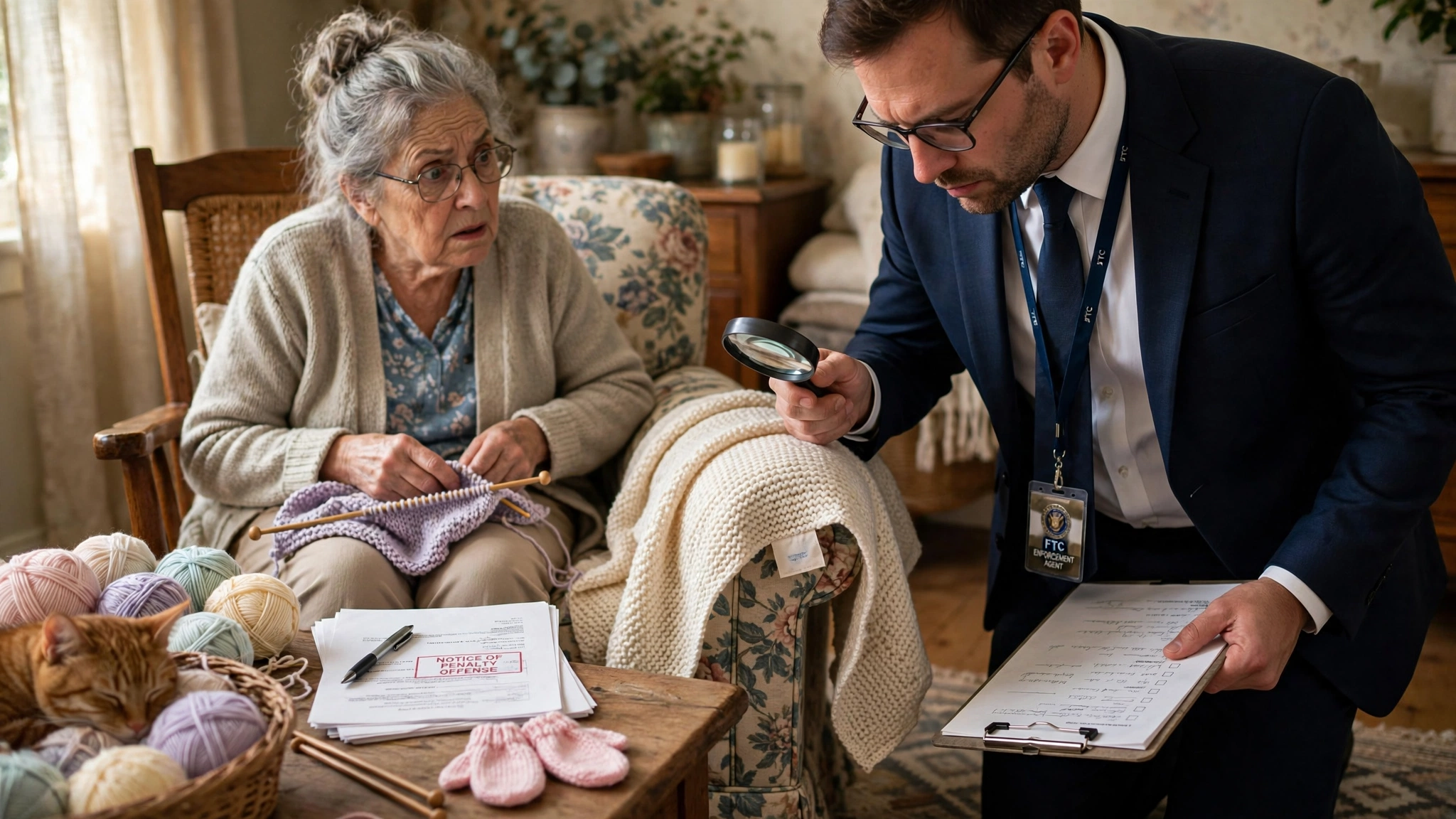
The Notice of Penalty Offenses was sent to companies. It was not sent to knitting circles.
V. The Domestic Textile Manufacturing Sector
According to data cited by the Craft Yarn Council and reported by Forbes, approximately 45 million Americans know how to knit or crochet.12 The Association for Creative Industries found that the knitting and crochet market had a value of $2.79 billion in 2016, with an average knitting expenditure of $20.57 per household.13 An earlier study by the same organization identified 28.8 million active American knitters and crocheters.14
These 45 million people are not idle. They produce objects. Specifically, they produce textile fiber products as defined by 15 U.S.C. § 70(h): scarves, hats, mittens, socks, sweaters, cardigans, shawls, cowls, baby blankets, baby booties, baby hats, afghans, throws, dishcloths, washcloths, tote bags, headbands, leg warmers, and items that the Ravelry pattern database classifies under 1,532 distinct subcategories of “clothing” and “home.”15
Ravelry, the largest online community for knitters, crocheters, spinners, and weavers, reports more than 9 million registered users and a database of nearly 1.2 million patterns.16 The community has logged more than 1.3 million completed projects. Each completed project is a textile fiber product. Each textile fiber product is subject to the labeling requirements of 15 U.S.C. § 70b. The number of those projects that bear a fiber content label, a manufacturer name or RN number, a country of origin disclosure, and permanent care instructions is not reported by Ravelry, but it can be estimated with high confidence at zero.
VI. The Fiber Content Problem
The labeling requirements of the Act are not suggestions. They are specific. Section 70b(b)(1) requires disclosure of the generic name and percentage by weight of each constituent fiber. The FTC’s Textile Fiber Rule at 16 CFR § 303.6 establishes the generic names that must be used—“acrylic,” “nylon,” “polyester,” “rayon,” and so on—and specifically prohibits the use of trade names or brand names in lieu of the generic name without accompanying generic identification.17
Consider a hand-knitted hat made from one skein of Malabrigo Rios in the colorway “Sunset.” The yarn is 100% superwash merino wool. The hat is an article of wearing apparel. It is a textile fiber product. It is subject to the Act. Its label must state: “100% Wool.” It does not state this because the hat does not have a label. The knitter knows the fiber content because she read the ball band. She did not transfer that information to a stamp, tag, or other means of identification permanently affixed to the product. The hat is misbranded.
Now consider a hat knitted from two yarns held together—a strand of mohair-silk blend (72% kid mohair, 28% silk) and a strand of merino-cashmere (80% extra fine merino, 20% cashmere). The resulting fabric is a composite whose fiber content, by weight, must be calculated according to the proportional yardage and weight per yard of each yarn, then expressed in order of predominance. The label must show something like: “46% Kid Mohair, 31% Wool, 18% Silk, 5% Cashmere.” The knitter would need a scale accurate to the gram to comply. The knitter does not own a scale accurate to the gram. The knitter owns a kitchen scale that she also uses for banana bread. The hat is misbranded.
VII. The Wool Complication
The regulatory architecture becomes more intricate for wool. The Textile Fiber Products Identification Act at 15 U.S.C. § 70(h) explicitly excludes from its scope “a product required to be labeled under the Wool Products Labeling Act of 1939.” The Wool Products Labeling Act, codified at 15 U.S.C. §§ 68–68j, imposes its own labeling requirements on “wool products”—defined as any product or portion thereof that contains, purports to contain, or in any way is represented as containing wool, reprocessed wool, or reused wool.18
The WPLA requires its own disclosure regime: the percentage of wool, reprocessed wool, reused wool, and each other fiber by weight, the maximum percentage of nonfibrous loading or filling, and the name or registered number of the manufacturer. The implementing rules are at 16 CFR Part 300.19
The practical result is a regulatory fork. When a knitter produces a scarf from 100% acrylic yarn, the product falls under the Textile Fiber Products Identification Act. When the same knitter, using the same needles in the same recliner, produces a scarf from 100% merino wool, the product falls under the Wool Products Labeling Act. When the knitter produces a scarf from a 50/50 wool-acrylic blend, both statutes have potential jurisdiction, and the knitter must determine which regime governs the labeling obligation. The knitter is not a textile regulatory attorney. The knitter is watching television.
VIII. The Etsy Problem
If there remained any ambiguity about whether handmade textile products enter commerce, the existence of Etsy, Inc. resolves it.
As of December 31, 2024, Etsy reported 5.6 million active marketplace sellers, 89.6 million active buyers, and gross merchandise sales of $13.2 billion. Approximately 97 percent of Etsy sellers operate their shops from their homes.20 The platform lists more than 140 million items for sale across 234 countries.21
Etsy’s founding category is handmade goods. A substantial portion of its listings consist of hand-knitted, crocheted, and hand-sewn textile fiber products: sweaters, scarves, hats, blankets, baby clothing, bags, and home furnishings. These products are advertised for sale. They are sold. They are transported in commerce—by the United States Postal Service, United Parcel Service, and FedEx—across state lines and international borders. They satisfy every element of 15 U.S.C. § 70a(a): introduction for sale in commerce, delivery for introduction in commerce, and transportation in commerce.
Navigate to any Etsy listing for a hand-knitted baby sweater. Examine the product photographs. Note the sweater’s construction, its colorwork, its carefully blocked dimensions. Note the absence of a label. The product description may state “Made from 100% organic cotton,” but the product itself does not bear a stamp, tag, label, or other means of identification showing the fiber content, the manufacturer’s name or RN number, or the country of origin. The product description is not a label affixed to the product. The product is misbranded. It is offered for sale in commerce. The offering is unlawful under 15 U.S.C. § 70a(a).
Etsy’s own seller handbook does not mention the Textile Fiber Products Identification Act. It does not mention the Wool Products Labeling Act. It does not mention the Care Labeling Rule. It does not mention 16 CFR Part 303. Etsy requires sellers to provide a “detailed description” of their products. It does not require sellers to affix a fiber content label to a physical product before shipping it to a buyer in another state. Etsy has processed billions of dollars in handmade textile transactions. The number of those transactions in which the shipped product carried a compliant label is not publicly reported.
IX. The Christmas Morning Compliance Gap
The Act’s labeling requirements apply at the point of sale and delivery to the ultimate consumer. The Act defines “ultimate consumer” at § 70(m) as “a person who obtains a textile fiber product by purchase or exchange with no intent to sell or exchange such textile fiber product in any form.”22
A gift is an exchange. The recipient obtains a textile fiber product. The recipient has no intent to sell or exchange it. The recipient is, by the Act’s own definition, an ultimate consumer.
According to the Craft Yarn Council, the most commonly cited reason for learning to knit is making gifts. One-third of knitters and crocheters purchase supplies at least once per month.23 The most popular hand-knitted gift items are scarves, hats, and baby blankets. These are produced in quantities that peak sharply between October and December each year, a production schedule that the textile industry would describe as a “seasonal ramp” and that knitters describe as “panicking.”
On the morning of December 25, approximately 330 million Americans open gifts. Some unknown but nontrivial fraction of those gifts consist of hand-knitted or crocheted textile fiber products. Each of those products was manufactured without a fiber content label. Each was manufactured without a manufacturer identification. Each was manufactured without a country of origin disclosure. Each was manufactured without permanent care instructions. Each was delivered to an ultimate consumer. Each is, by the plain text of the statute, misbranded.
The handwritten gift tag that reads “To: Emily, From: Grandma, Merry Christmas” does not constitute a compliant label under 16 CFR § 303.15. It does not identify the generic names and percentages of the constituent fibers. It does not provide the manufacturer’s registered identification number. The gift tag identifies the manufacturer as “Grandma.” “Grandma” is not a name under which business is conducted, nor is it a registered identification number issued by the Federal Trade Commission pursuant to 16 CFR § 303.20.
X. The Criminal Penalty
Section 11 of the Act, codified at 15 U.S.C. § 70i, provides the criminal penalty for willful violations: “Any person who willfully does an act which by section 70a of this title is declared to be unlawful shall be guilty of a misdemeanor and upon conviction shall be fined not more than $5,000, or be imprisoned not more than one year, or both, in the discretion of the court.”24
The Act does not define “willful.” The FTC has not published guidance on whether a person who knows they are manufacturing a textile fiber product without a label, and who continues to manufacture that product without a label, and who delivers that product to an ultimate consumer without a label, has acted willfully. The question has not arisen because the FTC has never charged a knitter.
But the statute is clear on its face. A person who willfully introduces into commerce a misbranded textile fiber product faces a fine of up to $5,000 or imprisonment of up to one year. An Etsy seller who has listed 200 hand-knitted scarves, each without a fiber content label, has potentially committed 200 separate offenses. At the statutory maximum, this represents $1 million in fines and 200 years of imprisonment. For scarves.
XI. The Scale of the Violation
The arithmetic is straightforward but its implications are not.
Forty-five million Americans knit or crochet. If each produces an average of four textile fiber products per year—a conservative estimate for an active crafter—the domestic handcraft sector manufactures approximately 180 million textile fiber products annually. Each product is subject to the labeling requirements of 15 U.S.C. § 70b. Each product that does not carry a compliant label is misbranded. The compliance rate across 180 million products is zero percent.
For comparison, the FTC’s Penalty Offense Notice concerning textile products was sent to 90 companies. The Commission has brought enforcement actions against eight major retailers for bamboo labeling violations. It has obtained $5.5 million in penalties. The textile compliance apparatus of the federal government has been directed at the commercial textile industry with meaningful force.
That industry operates within a regulatory framework in which every garment on every rack in every store in the United States bears a label disclosing its fiber content, its manufacturer, its country of origin, and its care instructions. The label is sewn into the garment. It is legible. It is accurate. It persists for the useful life of the product. This is not an accident. It is the product of a 68-year-old federal statute enforced by an agency with a $450 million annual budget.
And then there is the parallel textile manufacturing sector. It employs 45 million workers. It has no compliance department. It has no registered identification numbers. It has no country of origin disclosures, because the country of origin is the couch, and the couch is in Ohio, and Ohio is in the United States, but no one has sewn a label reading “Made in USA” into the inside of a hand-knitted sock since the statute was enacted in 1958.
XII. Conclusion
The evidence requires no interpretation. It requires a sewing needle and a compliance label.
The Textile Fiber Products Identification Act requires every textile fiber product to bear a label disclosing its fiber content, manufacturer identity, and country of origin. The Care Labeling Rule requires permanent care instructions. The FTC has fined Walmart $3 million and Kohl’s $2.5 million for getting the fiber content label wrong—for writing “bamboo” when they should have written “rayon.” It has obtained consent decrees against Amazon, Macy’s, Nordstrom, Sears, and J.C. Penney for the same offense. The Commission considers textile labeling compliance serious enough to invoke its Penalty Offense Authority, carrying fines of up to $50,120 per violation.
Meanwhile, 45 million Americans produce textile fiber products with no label at all. Not a wrong label. Not a misleading label. No label. Zero fiber content disclosure. Zero manufacturer identification. Zero country of origin. Zero care instructions. The products enter households through gift exchanges, church bazaars, craft fairs, baby showers, and an e-commerce platform with $13.2 billion in gross merchandise sales.
Walmart wrote “bamboo” on a sheet set. The FTC fined them $3 million. Your grandmother wrote nothing on a scarf. She handed it to you on Christmas morning with a note that said “Hand wash only, I think.” The note is not a permanent care label. The scarf is misbranded. The grandmother is an unregistered textile manufacturer operating without an RN number, without a compliance program, and without apparent concern.
The knitting needles click. The yarn unspools. The scarf grows. No label is attached. No label will be attached. The grandmother has been manufacturing misbranded textile fiber products in plain view of the federal government for forty years, and the FTC has not opened a file.
Ergo.
Sources
- Textile Fiber Products Identification Act, Pub. L. 85-897, 72 Stat. 1717 (1958), codified at 15 U.S.C. §§ 70–70k. Implementing regulations at 16 CFR Part 303. ftc.gov ↑
- 15 U.S.C. § 70(h), defining “textile fiber product.” uscode.house.gov ↑
- 15 U.S.C. § 70(g), defining “household textile articles.” uscode.house.gov ↑
- 15 U.S.C. § 70b(b), labeling requirements for textile fiber products. govinfo.gov ↑
- 16 CFR § 303.15, required label and method of affixing. law.cornell.edu ↑
- 16 CFR § 423.6, Care Labeling Rule, care label requirements for textile wearing apparel. ftc.gov ↑
- FTC, “Clothes Captioning: Complying with the Care Labeling Rule,” business guidance. ftc.gov ↑
- FTC Care Labeling Rule compliance guide: “Violators are subject to enforcement actions and penalties of up to $16,000 for each offense. In enforcement actions, the FTC contends that each mislabeled garment is a violation. Since 1990, the FTC has brought 16 enforcement actions; 15 were resolved by settlements and one was litigated. Penalties have ranged as high as $300,000.” ftc.gov ↑
- DOJ/FTC complaints and settlements against Walmart, Inc. ($3M) and Kohl’s, Inc. ($2.5M) for bamboo/rayon textile labeling violations, May 2022. lexology.com ↑
- FTC, Penalty Offenses Concerning Textiles, listing enforcement actions against Amazon.com (2013), Macy’s (2013), Sears/Kmart (2013), Leon Max/Max Studio (2013), Nordstrom (2015), J.C. Penney (2015), Backcountry.com (2015), Bed Bath & Beyond (2015). ftc.gov ↑
- FTC Notice of Penalty Offenses Concerning Textile Fiber Products (2022), citing Verrazzano Trading Corp., 91 F.T.C. 888 (1978); H. Myerson Sons, 78 F.T.C. 464 (1971); Delco Carpet Mills, Inc., 70 F.T.C. 1706 (1966); Taylor-Friedsam Co., Inc., 69 F.T.C. 483 (1966); Transair, Inc., 60 F.T.C. 694 (1962). ftc.gov ↑
- Forbes, citing Craft Yarn Council data: “More than 45 million Americans knit or crochet.” Separately cited by Lantern Moon (2026), Edinburgh Yarn Fest, and Crochet Penguin compilations of Craft Yarn Council tracking study data. ↑
- Association for Creative Industries (AFCI), cited in Anthony Thomas Creative Arts compilation: knitting market worth $2.79 billion in 2016, average knitting spending of $20.57 per household. ↑
- AFCI study, ibid.: 28.8 million American knitters and crocheters; 71% female, 29% male; 37% full-time employees. ↑
- Ravelry pattern database, categorization system. ravelry.com ↑
- Ravelry: “more than 9 million users” (The Guardian, 2024); nearly 1.2 million patterns and 1.3 million completed projects (Ravelry Blog, 2022). ↑
- 16 CFR § 303.6, generic names of manufactured fibers. ftc.gov ↑
- Wool Products Labeling Act of 1939, codified at 15 U.S.C. §§ 68–68j. ftc.gov ↑
- 16 CFR Part 300, Rules and Regulations Under the Wool Products Labeling Act. ftc.gov ↑
- Etsy, Inc. annual report data as of December 31, 2024: 5.6 million active marketplace sellers, 89.6 million active buyers; 97% of sellers operate from home. linkmybooks.com (citing Etsy SEC filings) ↑
- Etsy, Inc.: $13.2 billion gross merchandise sales (2024), 140 million+ items listed, 234 countries. skillademia.com (citing Etsy SEC filings) ↑
- 15 U.S.C. § 70(m), defining “ultimate consumer.” uscode.house.gov ↑
- Forbes, citing Craft Yarn Council: “One-third of [knitters and crocheters] buy knitting supplies at least once each month.” ↑
- 15 U.S.C. § 70i, criminal penalty for willful violations. uscode.house.gov ↑