I. The Statutory Framework
Section 201(h) of the Federal Food, Drug, and Cosmetic Act, codified at 21 U.S.C. § 321(h), defines the term “device” with an enumeration that has not been substantively amended since the Medical Device Amendments of 1976. The statute provides, in relevant part, that a device is:
“an instrument, apparatus, implement, machine, contrivance, implant, in vitro reagent, or other similar or related article, including a component part, or accessory which is—(1) recognized in the official National Formulary, or the United States Pharmacopoeia, or any supplement to them, (2) intended for use in the diagnosis of disease or other conditions, or in the cure, mitigation, treatment, or prevention of disease, in man or other animals, or (3) intended to affect the structure or any function of the body of man or other animals, and which does not achieve its primary intended purposes through chemical action within or on the body of man or other animals and which is not dependent upon being metabolized for the achievement of its primary intended purposes.”1
The critical regulatory distinction between a “device” and a “drug” under the Act is the mechanism by which the article achieves its purpose. Drugs work through chemical action or metabolism. Devices work through physical means. A titanium hip stem is classified as a device because it achieves structural support of the proximal femur through mechanical load transfer, not through biochemistry. A cortisone injection is classified as a drug because it achieves inflammation reduction through glucocorticoid receptor binding and subsequent metabolic pathways.2
The human femur achieves structural support through mechanical load transfer. It is not metabolized in the process of bearing weight. It does not achieve its load-bearing function through chemical action within or on the body. Its Young’s modulus, its cortical thickness, its trabecular architecture—these are mechanical parameters, not pharmacological ones. By the statute’s own definitional framework, the femur is not a drug. It is a device.
The statute does not require that the device be manufactured by a corporation. It does not require that the device be sold in interstate commerce. It does not require that anyone intended the article to be a device. It requires only that the article be an implant intended to affect the structure or any function of the body through non-chemical means. The skeleton satisfies every element. The statute does not appear to care that the implant arrived before the statute did.
II. The Device Under Review
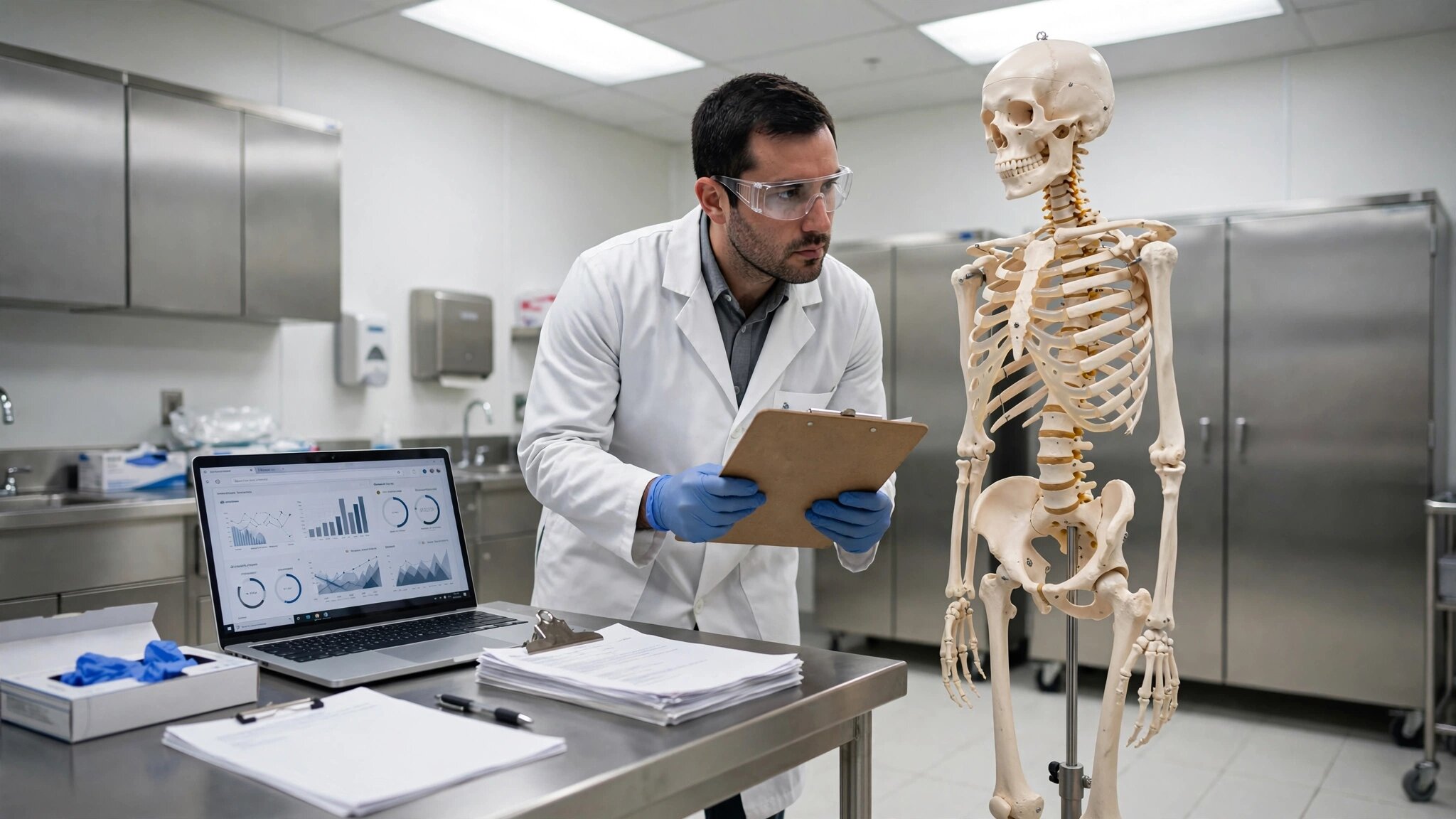
The human skeleton is a load-bearing composite material structure comprising 206 discrete components in the standard adult configuration, reduced from approximately 270 in the neonatal version through a process of post-delivery consolidation that the manufacturer has never documented in a design history file. The primary structural material is a two-phase composite of hydroxyapatite mineral crystals—a calcium phosphate ceramic with the chemical formula Ca10(PO4)6(OH)2—embedded in a type I collagen matrix, at an approximate ratio of 65 percent mineral to 35 percent organic material by weight.3
Cortical bone, the dense outer shell of the long bones, exhibits a compressive strength of approximately 170 megapascals and a tensile strength of approximately 130 megapascals, as measured by standardized mechanical testing.4 For comparison, the ASTM F136 specification for the Ti-6Al-4V titanium alloy used in FDA-cleared orthopedic implants requires a minimum ultimate tensile strength of 860 megapascals.5 The synthetic devices that the FDA has cleared to replace skeletal components are, by objective engineering metrics, approximately five to six times stronger than the biological components they are designed to replicate. The agency has approved the superior product. It has not reviewed the inferior one.
The device is installed automatically beginning at approximately the eighth week of embryonic development, when mesenchymal stem cells begin differentiating into osteoblasts through a process known as intramembranous and endochondral ossification. The process is not supervised by a quality control engineer. No dimensional tolerances are specified in the manufacturing instructions, which do not exist. No incoming material inspection is performed on the calcium, phosphorus, and amino acid precursors used in production. The device reaches peak structural density at approximately age 30, at which point it begins a gradual, uncontrolled material degradation that the clinical literature calls “age-related bone loss” and the manufacturer calls nothing, because the manufacturer is a cell and does not issue technical bulletins.
III. Classification
The FDA classifies medical devices into three regulatory categories based on the level of control necessary to provide reasonable assurance of safety and effectiveness. Class I devices, such as elastic bandages and tongue depressors, pose minimal risk and are subject only to general controls. Class II devices, such as powered wheelchairs and surgical drapes, require special controls, typically including the 510(k) premarket notification. Class III devices, which include replacement heart valves, implantable defibrillators, and total joint replacement systems, pose the highest risk and require Premarket Approval.6
The criteria for Class III classification are codified at 21 U.S.C. § 360c(a)(1)(C). A device is classified as Class III if “insufficient information exists to determine that the application of general controls” and special controls “would provide reasonable assurance of its safety and effectiveness” and the device “is purported or represented to be for a use in supporting or sustaining human life or for a use which is of substantial importance in preventing impairment of human health.”7
The human skeleton sustains human life. Without it, the lungs would lack the thoracic cage necessary for ventilation. The brain would have no cranial vault. The heart would lack the rigid framework of the sternum and ribs that maintains the geometry of the thoracic cavity. The spinal cord would be unprotected. The skeleton is, by any defensible reading of the statutory language, a life-sustaining implanted device. Under the FDA’s own classification criteria, it is Class III.
The agency has applied precisely this reasoning to every synthetic skeletal replica it has reviewed. Total hip replacement systems are classified under 21 CFR § 888.3300 as Class III devices requiring Premarket Approval.8 Total knee replacement systems are classified under 21 CFR § 888.3590 as Class III.9 Even bone void fillers—materials that merely occupy the space where bone should be—are classified as Class II or III depending on their composition and intended use. The agency has imposed its most rigorous regulatory requirements on every device that mimics a skeletal component. It has imposed no requirements on the skeleton itself.
IV. The Predicate Problem
The 510(k) premarket notification pathway, codified at 21 U.S.C. § 360(k), permits a manufacturer to market a new medical device by demonstrating that it is “substantially equivalent” to a legally marketed predicate device. Substantial equivalence requires that the new device have the same intended use and the same or similar technological characteristics as the predicate, or, if different technological characteristics exist, that these differences do not raise new questions of safety and effectiveness.10
The FDA’s 510(k) database contains more than six thousand cleared orthopedic device submissions. These include bone plates, bone screws, intramedullary nails, spinal fusion cages, artificial ligaments, total and partial joint replacement components, bone cements, bone graft substitutes, and external fixation systems. Each of these devices was cleared on the basis that it is substantially equivalent to a prior legally marketed device that performs a function performed by the human skeleton.11
The chain of predicates, if traced backward through the clearance history of any orthopedic device family, terminates at a pre-amendment device that entered the market before the Medical Device Amendments of 1976. These pre-amendment devices were grandfathered into legal marketing status without being required to demonstrate safety or effectiveness. But the ultimate predicate—the device that every orthopedic implant is designed to replicate—is the skeletal component itself. Every hip stem is modeled on the proximal femur. Every tibial baseplate mimics the articular geometry of the tibial plateau. Every spinal cage replicates the load-bearing function of the vertebral body. The FDA has cleared thousands of copies. It has never reviewed the original.
The regulatory implications of this oversight are, on reflection, vertiginous. If the skeleton has never received marketing authorization, it is not a legally marketed device. If it is not a legally marketed device, it cannot serve as a predicate. If it cannot serve as a predicate, the chain of substantial equivalence that supports every orthopedic 510(k) clearance in the database terminates at an unreviewed article. The entire edifice of orthopedic device regulation rests on a predicate that has never been through the front door of the Center for Devices and Radiological Health.
V. The Manufacturing Facility
Medical device manufacturers in the United States are required to register their establishments with the FDA under 21 U.S.C. § 360 and to operate under the quality system regulation codified at 21 CFR Part 820. The quality system regulation requires, among other things, design controls (Subpart C), document controls (§ 820.40), production and process controls (Subpart G), corrective and preventive action procedures (§ 820.90), and complaint handling (§ 820.198).12
The manufacturing facility for the human skeleton is the osteoblast, a specialized bone-forming cell approximately 20 to 30 micrometers in diameter that synthesizes bone matrix by secreting type I collagen and facilitating the nucleation of hydroxyapatite crystals onto the collagen scaffold. The typical adult skeleton contains approximately one to two million active osteoblasts at any given time, operating across multiple production sites simultaneously. These cells replace approximately 10 percent of the total skeletal mass per year in a continuous remodeling process coordinated with osteoclasts, the cells responsible for bone resorption.13
No osteoblast has ever registered with the FDA. No establishment registration number has been assigned to any site of skeletal production. No facility inspection has been conducted. The manufacturing process is not documented in a device master record. There are no standard operating procedures for ossification. The incoming material specifications for calcium, phosphorus, and collagen precursors are not controlled by any written procedure. The process validation records do not exist, because no process validation has been performed.
The FDA’s Office of Regulatory Affairs conducts approximately 1,900 domestic medical device facility inspections per year.14 Its inspectors have examined the manufacturing operations of every major orthopedic company in the country, including Stryker, Zimmer Biomet, DePuy Synthes, Smith+Nephew, and Medtronic. They have issued Form 483 observations for deviations ranging from inadequate complaint files to insufficient sterilization validation to missing design review documentation. They have never issued a Form 483 to an osteoblast. The osteoblast’s compliance record is technically perfect, though only in the sense that a facility which has never been inspected has never been found in violation.
VI. The Failure Rate
A medical device failure occurs when the device ceases to perform its intended function. The intended function of the skeleton is structural support of the human body. A fracture is, by any engineering definition, a structural failure of the device. The installed base in the United States is approximately 330 million skeletal units.
The Bone Health and Osteoporosis Foundation, formerly the National Osteoporosis Foundation, estimates that osteoporosis is responsible for more than two million fractures per year in the United States, including approximately 300,000 hip fractures, 547,000 vertebral fractures, 135,000 pelvic fractures, and 250,000 wrist fractures.15 These figures represent only the osteoporosis-attributable subset. Fractures caused by trauma, overuse, pathological processes, and congenital structural deficiencies add substantially to the total. The National Institutes of Health estimates that approximately one in two women and one in four men over age 50 will sustain an osteoporotic fracture in their remaining lifetime.16
For context, the most consequential orthopedic device recall in recent history involved the DePuy Articular Surface Replacement (ASR) hip system, which was recalled by the manufacturer in August 2010 after approximately 93,000 devices had been implanted worldwide. The failure rate that precipitated the recall was approximately 13 percent at five years, as reported in data submitted to the National Joint Registry of England, Wales, Northern Ireland and the Isle of Man.17 The recall was classified by the FDA as Class I, its most serious category, defined as a situation in which “there is a reasonable probability that the use of, or exposure to, a violative product will cause serious adverse health consequences or death.”18
The human skeleton’s failure rate exceeds the DePuy ASR’s by every available metric. Fifty percent of women over 50 will experience a structural failure of the device. Twenty-five percent of men over 50 will experience the same. Hip fractures, the single most serious mode of skeletal failure, carry a one-year mortality rate of approximately 20 to 30 percent in patients aged 65 and older, a figure documented across multiple large cohort studies and confirmed in a 2010 meta-analysis by Haentjens et al. published in the Annals of Internal Medicine.19 A device that is associated with the death of one in five users who experience a specific failure mode, at a cumulative failure rate affecting one in two female users, would not pass premarket review. It would trigger an import alert.
VII. Adverse Event Reporting
The Medical Device Reporting regulation, codified at 21 CFR Part 803, requires manufacturers, importers, and device user facilities to submit reports to the FDA when they become aware that a device may have caused or contributed to a death or serious injury. User facilities must report device-related deaths to the FDA and the manufacturer within ten work days. Manufacturers must report deaths, serious injuries, and certain malfunctions within thirty calendar days of becoming aware of the event.20
These reports are entered into the Manufacturer and User Facility Device Experience database, known as MAUDE, which is publicly searchable through the FDA’s website. MAUDE contains millions of individual adverse event reports spanning decades of device surveillance. The database includes reports for total hip replacements that fractured, total knee replacements that loosened, spinal fixation systems that migrated, bone screws that backed out, and bone plates that fatigued. It contains reports for devices that failed once. It contains reports for device families that failed thousands of times.21
MAUDE does not contain a single adverse event report for the human skeleton.
The reporting obligation under 21 CFR § 803.50 applies to the manufacturer of the device. The manufacturer of the human skeleton, in any meaningful biological sense, is the osteoblast population operating under genetic instructions encoded in the host organism’s DNA. These manufacturers have not registered with the FDA. They have not designated a United States agent, as required of foreign manufacturers under 21 CFR § 807.40. They have not appointed an MDR contact person. They have not established a complaint handling procedure. They have filed zero reports despite overseeing a device with a documented multi-million-unit annual failure rate.
The asymmetry is precise. When a Stryker LFIT V40 femoral head taper junction fails, Stryker is required to submit an MDR report within thirty calendar days and to evaluate whether the failure represents a reportable trend.22 When the biological femoral head that the LFIT V40 was designed to replicate fails—an event that occurs approximately 300,000 times per year in the United States—no report is required, no investigation is initiated, and no corrective action is contemplated. The copy is regulated. The original is not.
VIII. The Warranty Gap
The human skeleton is delivered with no warranty of any kind. There is no express warranty. There is no limited warranty. The Magnuson-Moss Warranty Act, codified at 15 U.S.C. § 2301 et seq., requires that any written warranty on a consumer product costing more than fifteen dollars be made available to the consumer prior to sale and be designated as either a “full” or “limited” warranty.23 The skeleton is accompanied by neither designation, because no commercial transaction has occurred, no written warranty has been offered, and no point-of-sale disclosure has been made.
The absence of warranty coverage would be unremarkable for a product with a negligible failure rate and an indefinite service life. The skeleton has neither. Over one million Americans per year receive synthetic joint replacements because the original equipment failed, as documented by the American Joint Replacement Registry, which captured its four millionth procedure in 2024.24 These replacement devices arrive with regulatory clearance, unique device identifiers, sterilization validation certificates, biocompatibility testing reports, and complaint-handling procedures. The device they are replacing arrived with none of these things. It arrived in amniotic fluid, without packaging, without labeling, and without an instructions-for-use document.
Approximately seven million Americans are currently living with at least one artificial hip or knee joint, according to a prevalence study by Maradit Kremers et al. published in the Journal of Bone and Joint Surgery.25 Each of these individuals underwent major surgery to remove a failed biological device and install a synthetic replacement that had been reviewed, cleared, manufactured under quality system regulations, and tracked through post-market surveillance. Each of them is, in regulatory terms, living with the remediation of an unreported adverse event involving an uncleared device.
IX. Conclusion
The evidence is structural, which is appropriate given the device under review. The Federal Food, Drug, and Cosmetic Act defines a device. The human skeleton meets every element of that definition. It is an implant. It affects the structure of the body. It achieves its primary purpose through mechanical means rather than chemical action. It is not metabolized in the performance of its intended function.
The FDA has classified every synthetic replica of a skeletal component under its risk-based framework, subjected each to premarket review, required adverse event reporting for each, and inspected the manufacturing facilities of each. The biological original has been exempted from all of these requirements—not by statutory exclusion, not by regulatory guidance, not by enforcement discretion, and not by rulemaking. It has been exempted by the simple fact that no one at the Center for Devices and Radiological Health has filed the paperwork.
The skeleton does not dispute the characterization. It does not submit a citizen petition. It does not request a pre-submission meeting with the Office of Orthopedic Devices. It does not retain regulatory counsel or engage a contract research organization to prepare a 510(k) submission. It simply continues to operate as a Class III implantable device inside approximately 330 million Americans, bearing loads, sustaining fractures, and generating adverse events at a rate that would produce a congressional hearing if the device bore a brand name and traded on the New York Stock Exchange.
Over one million joint replacements are performed in the United States every year because the original equipment failed. These replacement devices have 510(k) clearance numbers, Premarket Approval orders, unique device identifiers, sterilization validation records, and biocompatibility data conforming to ISO 10993. The device they are replacing has none of these things. It has never had any of these things. It has been in continuous operation for approximately 300,000 years in anatomically modern humans, sustaining structural failures at an industrial scale, secure in the knowledge that the regulator responsible for ensuring the safety and effectiveness of every device that touches the human body has not yet noticed that the most important device in the body was never submitted for review.
It was not.
Ergo.
Sources
- 21 U.S.C. § 321(h), Federal Food, Drug, and Cosmetic Act, Section 201(h), as amended by the Medical Device Amendments of 1976, Pub. L. 94-295. law.cornell.edu ↑
- FDA, “Is The Product A Medical Device?” Guidance for Industry and FDA Staff, distinguishing devices from drugs based on primary mode of action. fda.gov ↑
- J.-Y. Rho, L. Kuhn-Spearing, and P. Zioupos, “Mechanical Properties and the Hierarchical Structure of Bone,” Medical Engineering & Physics, vol. 20, no. 2, 1998, pp. 92–102. pubmed.ncbi.nlm.nih.gov ↑
- D.T. Reilly and A.H. Burstein, “The Elastic and Ultimate Properties of Compact Bone Tissue,” Journal of Biomechanics, vol. 8, no. 6, 1975, pp. 393–405. pubmed.ncbi.nlm.nih.gov ↑
- ASTM F136-13, “Standard Specification for Wrought Titanium-6Aluminum-4Vanadium ELI (Extra Low Interstitial) Alloy for Surgical Implant Applications.” astm.org ↑
- 21 U.S.C. § 360c, Classification of Devices Intended for Human Use, establishing the three-tier classification framework. law.cornell.edu ↑
- 21 U.S.C. § 360c(a)(1)(C), criteria for Class III device classification. law.cornell.edu ↑
- 21 CFR § 888.3300, Hip Joint Metal/Polymer/Metal Semi-Constrained Cemented Prosthesis, Class III. accessdata.fda.gov ↑
- 21 CFR § 888.3590, Knee Joint Femorotibial Metallic Constrained Cemented Prosthesis, Class III. accessdata.fda.gov ↑
- 21 U.S.C. § 360(k), Premarket Notification (510(k)) requirements. law.cornell.edu ↑
- FDA 510(k) Premarket Notification database, publicly searchable. accessdata.fda.gov ↑
- 21 CFR Part 820, Quality System Regulation for Medical Devices. law.cornell.edu ↑
- L.F. Bonewald, “The Amazing Osteocyte,” Journal of Bone and Mineral Research, vol. 26, no. 2, 2011, pp. 229–238. pubmed.ncbi.nlm.nih.gov ↑
- FDA Office of Regulatory Affairs, Annual Inspection Statistics. fda.gov ↑
- Bone Health and Osteoporosis Foundation (formerly National Osteoporosis Foundation), “What Is Osteoporosis and What Causes It?” bonehealthandosteoporosis.org ↑
- NIH Osteoporosis and Related Bone Diseases National Resource Center, “Osteoporosis Overview.” bones.nih.gov ↑
- National Joint Registry, 7th Annual Report (2010), reporting on ASR hip system revision rates. See also DePuy Orthopaedics, Inc., Voluntary Recall of the ASR™ Hip System, August 24, 2010. njrcentre.org.uk ↑
- FDA, “Class I Recall: DePuy ASR™ XL Acetabular System and DePuy ASR™ Hip Resurfacing System,” MedWatch Safety Alert, August 26, 2010. fda.gov ↑
- P. Haentjens et al., “Meta-analysis: Excess Mortality After Hip Fracture Among Older Women and Men,” Annals of Internal Medicine, vol. 152, no. 6, 2010, pp. 380–390. pubmed.ncbi.nlm.nih.gov ↑
- 21 CFR Part 803, Medical Device Reporting. law.cornell.edu ↑
- FDA MAUDE (Manufacturer and User Facility Device Experience) database. accessdata.fda.gov ↑
- Stryker, Urgent Field Safety Notice: LFIT™ Anatomic CoCr V40 Femoral Heads, 2016. See FDA recall database entry. fda.gov ↑
- 15 U.S.C. § 2301 et seq., Magnuson-Moss Warranty—Federal Trade Commission Improvements Act. law.cornell.edu ↑
- American Academy of Orthopaedic Surgeons, “2024 American Joint Replacement Registry Annual Report.” aaos.org ↑
- H. Maradit Kremers et al., “Prevalence of Total Hip and Knee Replacement in the United States,” Journal of Bone and Joint Surgery, vol. 97, no. 17, 2015, pp. 1386–1397. pubmed.ncbi.nlm.nih.gov ↑