I. The Statutory Framework
The Controlled Substances Act of 1970, codified at 21 U.S.C. § 801 et seq., establishes a comprehensive framework for the regulation of drugs and other substances that have a potential for abuse. Section 812 creates five schedules of controlled substances, each reflecting a different assessment of abuse potential, accepted medical use, and safety under supervision.1
Schedule I is the most restrictive classification. A substance is placed in Schedule I if the Attorney General finds that it “has a high potential for abuse,” “has no currently accepted medical use in treatment in the United States,” and there is “a lack of accepted safety for use of the drug or other substance under medical supervision.” Schedule II substances share the high abuse potential but have a currently accepted medical use, and abuse may lead to “severe psychological or physical dependence.”1
Section 841(a)(1) provides the principal criminal prohibition: “Except as authorized by this subchapter, it shall be unlawful for any person knowingly or intentionally to manufacture, distribute, or dispense, or possess with intent to manufacture, distribute, or dispense, a controlled substance.”2
The term “manufacture” is defined at 21 U.S.C. § 802(15) as “the production, preparation, propagation, compounding, or processing of a drug or other substance,” including “any packaging or repackaging of such substance or labeling or relabeling of its container.” The term “production” is defined separately at § 802(22) to include “the planting, cultivation, growing, or harvesting of a controlled substance.”3
Section 822(a)(1) imposes a registration requirement: “Every person who manufactures or distributes any controlled substance … shall obtain annually a registration issued by the Attorney General.” The registration requirement applies to Schedule I through Schedule V. The penalties for manufacturing a Schedule I or Schedule II substance without authorization range from five to forty years of imprisonment, depending on the substance and quantity, under § 841(b).4
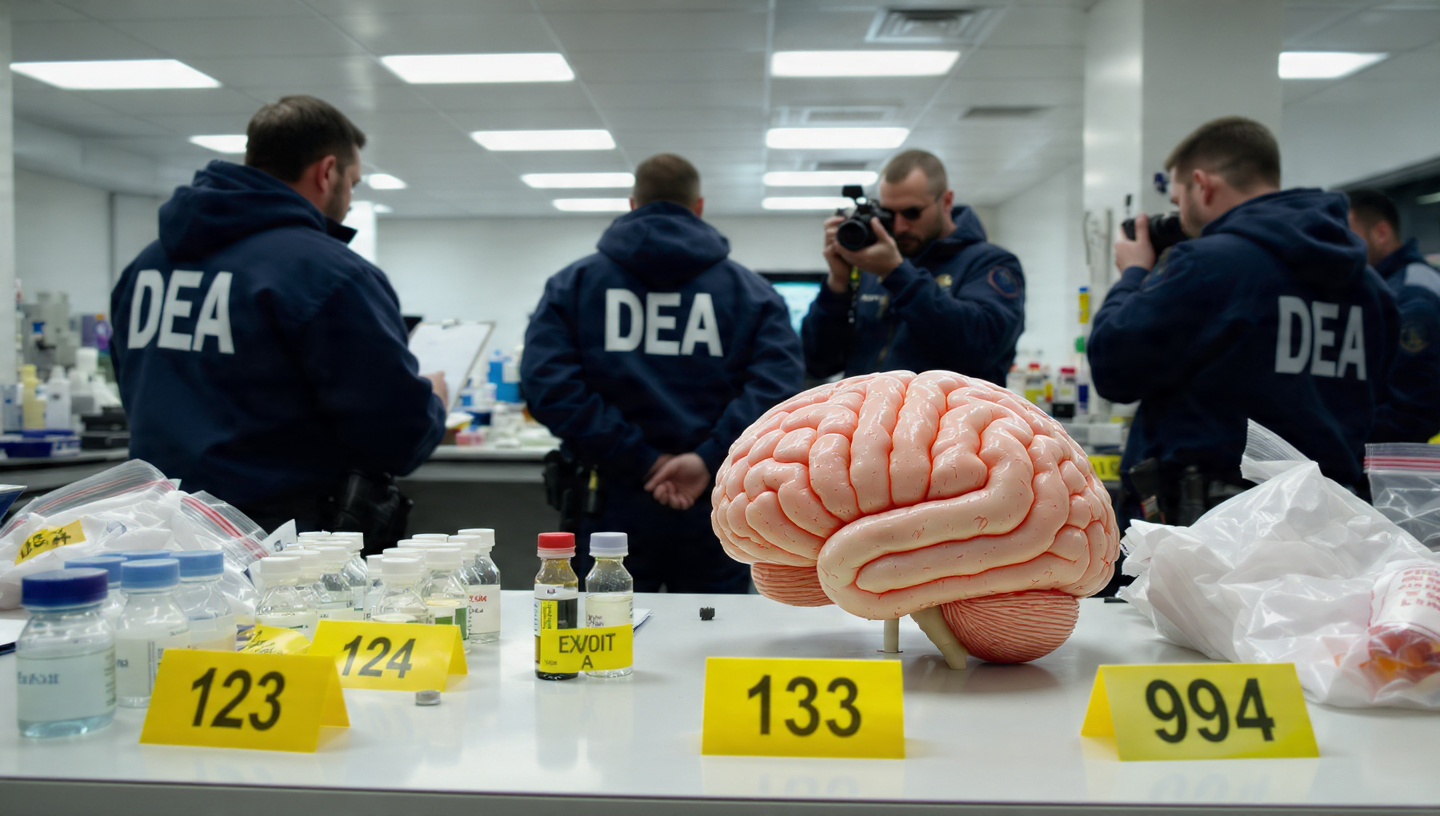
The statute does not define “person” to exclude biological organs. It does not contain a neurological exemption. It does not distinguish between exogenous synthesis in a clandestine laboratory and endogenous synthesis in a cranial vault. The verb is “manufacture.” The brain manufactures.
II. Product Line One: N,N-Dimethyltryptamine
N,N-Dimethyltryptamine, commonly known as DMT, is classified as a Schedule I hallucinogenic substance under 21 C.F.R. § 1308.11(d). It has been listed on Schedule I since the original enactment of the Controlled Substances Act in 1970. Its DEA Controlled Substances Code Number is 7435.5
DMT is also one of the most widely distributed naturally occurring compounds in the biological world. It has been identified in over sixty plant species across multiple families, in marine organisms, in amphibians, and in mammals, including humans. A 2016 review published in Brain Research Bulletin by Carbonaro and Gatch at Johns Hopkins and the University of North Texas Health Science Center described DMT as “an indole alkaloid widely found in plants and animals” and noted “increasing evidence” that “endogenous DMT plays important roles for a number of processes in the periphery and central nervous system, and may act as a neurotransmitter.”6
In 2019, a research team led by Jon Dean at the University of Michigan published a landmark study in Scientific Reports titled “Biosynthesis and Extracellular Concentrations of N,N-dimethyltryptamine (DMT) in Mammalian Brain.” The study demonstrated three findings of regulatory significance. First, it confirmed that indolethylamine N-methyltransferase (INMT), the enzyme that catalyzes the final step in DMT biosynthesis, is expressed in the human cerebral cortex, choroid plexus, and pineal gland. Second, it showed that INMT and aromatic L-amino acid decarboxylase (AADC), the two enzymes required for DMT synthesis, are co-expressed in the same brain cells in rats, providing a “plausible mechanism for cellular synthesis of DMT in the mammalian neocortex.” Third, using in vivo microdialysis, it detected DMT in the extracellular fluid of rat visual cortex at concentrations “consistent with that of other known monoamine neurotransmitters” such as serotonin and dopamine.7
A 2018 review by David Nichols at the University of North Carolina, published in the Journal of Psychopharmacology, confirmed that “very minute concentrations of N,N-dimethyltryptamine have been detected in the brain.” Nichols cautioned that these concentrations are “not sufficient to produce psychoactive effects,” a finding that is pharmacologically reassuring but legally irrelevant.8 The Controlled Substances Act does not require that a manufactured substance be produced in psychoactive quantities. It does not contain a de minimis exception for Schedule I compounds. If it did, every amateur methamphetamine cook whose yield fell below the threshold of pharmacological effect would have an affirmative defense. None has ever successfully raised one.
The brain does not merely possess DMT. It synthesizes DMT. It contains the enzymatic machinery (INMT and AADC), the precursor substrate (tryptamine, derived from the essential amino acid tryptophan), and the methyl donor (S-adenosyl-L-methionine). It assembles these components through a defined biochemical pathway, producing a finished Schedule I controlled substance that is released into extracellular fluid. Under 21 U.S.C. § 802(15), this is manufacturing. Under § 841(a)(1), this is a federal crime.
III. Product Line Two: The Endogenous Opioids
In 1975, John Hughes and Hans Kosterlitz at the University of Aberdeen isolated two pentapeptides from pig brain that bound to opiate receptors with high affinity. They named them methionine-enkephalin and leucine-enkephalin. This discovery initiated the identification of an entire family of endogenous opioid peptides that the human brain manufactures, stores, and deploys through dedicated neural circuits.9
The endogenous opioid system, as currently understood, comprises four families of neuropeptides: beta-endorphins, enkephalins, dynorphins, and nociceptin. Each is derived from a distinct precursor protein encoded by a specific gene. Beta-endorphin is cleaved from proopiomelanocortin (POMC) and primarily targets the mu-opioid receptor (MOR). Enkephalins target the delta-opioid receptor (DOR). Dynorphins target the kappa-opioid receptor (KOR).10
The mu-opioid receptor is the principal site of action for morphine, heroin, fentanyl, oxycodone, and hydrocodone. Morphine is Schedule II. Heroin is Schedule I. Fentanyl is Schedule II. The human brain manufactures substances that bind to the same receptor, activate the same intracellular signaling cascades, and produce the same downstream effects: analgesia, euphoria, respiratory depression at sufficient doses, and measurable physiological dependence.
In 1997, a research team led by James Zadina at the Veterans Affairs Medical Center in New Orleans published the discovery of endomorphin-1 and endomorphin-2 in mammalian brain. Their study, published in Nature, reported that endomorphin-1 exhibited “a high affinity (Ki = 360 pM) and selectivity (4,000- and 15,000-fold preference over the delta and kappa receptors) for the mu receptor.” The paper described endomorphin-1 as “more effective than the mu-selective analogue DAMGO in vitro” and noted that it “produces potent and prolonged analgesia in mice.”11
To be precise: the human brain manufactures peptides with the highest known specificity and affinity for the same receptor that makes heroin addictive. The word “endorphin” is a contraction of “endogenous morphine.” The scientific community named the substance after the Schedule II drug it functionally replicates. This was not an accident. It was an acknowledgment.
Beta-endorphin, a 31-amino-acid peptide, is synthesized in the hypothalamus and the anterior pituitary. It is not stored in a locked cabinet. It is not inventoried under 21 C.F.R. § 1304.11, which requires every registrant to maintain “a complete and accurate record of all controlled substances on hand.” It is released into the bloodstream during exercise, stress, pain, and sexual activity, where it circulates freely to peripheral target organs. In the brain, it is distributed through defined neural pathways originating in the arcuate nucleus of the hypothalamus.12
IV. Product Line Three: The Endocannabinoid System
In 1990, Lisa Matsuda and colleagues at the National Institute of Mental Health cloned the CB1 cannabinoid receptor, the primary receptor through which Δ9-tetrahydrocannabinol (THC) produces its psychoactive effects. THC is Schedule I. The receptor it binds to is located throughout the human brain, with the highest densities in the basal ganglia, cerebellum, hippocampus, and cerebral cortex.13
The existence of a receptor implied the existence of an endogenous ligand. In 1992, William Devane, Lumír Hanuš, and Raphael Mechoulam isolated from porcine brain the first endogenous cannabinoid: arachidonoyl ethanolamide, which they named “anandamide” from the Sanskrit word ananda, meaning “bliss.” It bound to the CB1 receptor and mimicked the behavioral effects of THC in rodents.14
A second endocannabinoid, 2-arachidonoylglycerol (2-AG), was discovered independently in 1995 by Mechoulam et al. and Sugiura et al. Together, these two substances constitute the core signaling molecules of what is now called the endocannabinoid system: a network of receptors, enzymes, and lipid messengers that regulates synaptic plasticity, pain perception, mood, appetite, memory, and immune function throughout the body.15
Anandamide is synthesized on demand in postsynaptic neurons through a phospholipase D-mediated cleavage pathway. A 1994 study by Di Marzo, Fontana, and colleagues, published in Nature, demonstrated that anandamide is “produced in and released from cultured brain neurons in a calcium ion-dependent manner when the neurons are stimulated with membrane-depolarizing agents.” The study concluded that these results “strongly support the proposed role of anandamide as an endogenous neuronal messenger.”16
Anandamide binds to CB1 receptors. THC binds to CB1 receptors. The Controlled Substances Act lists THC as Schedule I. The brain produces a substance that activates the same receptor, triggers the same G-protein coupled signaling cascade, and modulates the same neurotransmitter release pathways. The brain does not distinguish between the two molecules at the receptor level. The statute does not distinguish between them at the definitional level. Section 802(6) defines “controlled substance” as “a drug or other substance, or immediate precursor, included in schedule I, II, III, IV, or V.” It does not specify that the substance must be exogenous.
THC is a cannabinoid that binds to CB1 receptors. Anandamide is a cannabinoid that binds to CB1 receptors. The distinction the law draws between them is not pharmacological. It is jurisdictional. One is on the schedule because Congress put it there. The other is not, despite binding to the same receptor, because no one thought to check whether the brain was already manufacturing it when the schedule was written.
V. Product Line Four: Gamma-Hydroxybutyrate
Gamma-hydroxybutyric acid (GHB) is classified as a Schedule I controlled substance under 21 C.F.R. § 1308.11(e). Its sodium salt formulation, sodium oxybate, is marketed as Xyrem and classified separately as Schedule III under § 1308.13, creating the unusual regulatory circumstance in which the identical molecule occupies two different schedules depending on its packaging.17
GHB is also an endogenous constituent of the mammalian brain. A 2005 study by Maitre et al. at the University of Strasbourg described GHB as “an endogenous substance present in several organs, including brain where it is synthesized from GABA in cells containing glutamic acid decarboxylase, the marker of GABAergic neurons.” The study further demonstrated that GHB “is accumulated by the vesicular inhibitory amino acid transporter (VIAAT) and released by depolarization via a Ca2+ dependent-mechanism” and that “a family of GHB receptors exists in brain which possesses hyperpolarizing properties through Ca2+ and K+ channels.”18
A 2008 review by Castelli at the University of Cagliari, published in Mini Reviews in Medicinal Chemistry, described GHB as “an endogenous constituent of the mammalian brain” that “acts as i) a neurotransmitter or neuromodulator, ii) a medicine used for the treatment of narcolepsy and alcoholism, and iii) a drug illicitly used for its psychotropic effects.”19
Endogenous GHB concentrations in the human brain have been measured at approximately 0.5 to 1.0 mg/L in various tissues. These concentrations are orders of magnitude below the recreational dose (approximately 100 mg/L in plasma produces euphoria) and far below the lethal dose (approximately 500 mg/L). This is, once again, pharmacologically reassuring and legally irrelevant. The Controlled Substances Act criminalizes manufacture, not effect. A laboratory that synthesizes GHB and stores it in containers below the dose threshold has still manufactured a Schedule I controlled substance. The brain synthesizes GHB and stores it in synaptic vesicles. The vesicle is the container. The concentration is not a defense.20
The brain does not simply tolerate the presence of a Schedule I depressant in its tissue. It has constructed dedicated infrastructure for it: biosynthetic enzymes to produce it, vesicular transporters to package it, calcium-dependent release mechanisms to deploy it, and a receptor system, distinct from GABAB receptors, specifically designed to respond to it. The brain has not stumbled into manufacturing GHB. It has industrialized the process.
VI. The Registration Requirement
Under 21 U.S.C. § 822(a)(1), “every person who manufactures or distributes any controlled substance … shall obtain annually a registration issued by the Attorney General.” The registration is administered by the Drug Enforcement Administration through DEA Form 224 (for dispensers) and DEA Form 225 (for manufacturers and distributors). A DEA registration number is a unique identifier assigned to each registrant, formatted as two letters followed by seven digits.21
Section 823(a) specifies the factors the Attorney General must consider before registering a manufacturer of Schedule I or Schedule II substances. These include “maintenance of effective controls against diversion,” “compliance with applicable State and local law,” “prior conviction record of applicant,” and “past experience in the manufacture of controlled substances.”22
The human brain cannot complete DEA Form 225. It does not have a mailing address separate from the skull that houses it. It cannot demonstrate “compliance with applicable State and local law” because it has been violating federal law continuously since approximately the fourteenth week of gestation, when monoamine neurotransmitter systems begin operating in the fetal brain. It has extensive “past experience in the manufacture of controlled substances” but none of that experience has been conducted under federal supervision. Its “effective controls against diversion” consist of the blood-brain barrier, which is selectively permeable and has been breached by every substance of abuse that has ever produced a central nervous system effect.
Section 822(a)(1) requires registration “annually.” The human brain has been manufacturing controlled substances for every year of its existence. The average American lifespan is approximately 77 years. The cumulative registration delinquency for a single American brain is therefore 77 annual registrations, plus the fetal manufacturing period. For the current U.S. population of approximately 330 million, the total number of delinquent annual registrations exceeds 25 billion.
VII. The Scale of the Enterprise
The human brain weighs approximately 1.4 kilograms and contains roughly 86 billion neurons, connected by approximately 100 trillion synapses.23 Each of these synapses is a potential site of controlled substance manufacture, storage, and distribution. The endocannabinoid system alone involves synthesis in postsynaptic membranes, retrograde transport across the synaptic cleft, and binding to presynaptic CB1 receptors. This is manufacture, distribution, and dispensing. Each synapse in the circuit performs all three activities that § 841(a)(1) prohibits.
The endogenous opioid system deploys beta-endorphin from the arcuate nucleus of the hypothalamus through axonal projections to the periaqueductal gray, the locus coeruleus, and the nucleus accumbens. Enkephalins are distributed more widely, present in virtually every region of the brain as well as the adrenal medulla and the gastrointestinal tract. Dynorphins are concentrated in the hypothalamus, hippocampus, and spinal cord.10
The production is not occasional. It is continuous. Beta-endorphin synthesis occurs in a circadian pattern with peak production during the early morning hours. Anandamide is synthesized on demand with every postsynaptic depolarization event that triggers its production pathway. DMT biosynthesis proceeds wherever INMT and AADC are co-expressed. GHB synthesis from GABA occurs continuously in GABAergic neurons. The brain is not a laboratory that occasionally produces a batch. It is a continuous-flow manufacturing operation that has never been shut down for maintenance, inspection, or regulatory compliance.
There are approximately 330 million human brains in the United States. Each one simultaneously manufactures DMT (Schedule I), endogenous opioids functionally equivalent to morphine (Schedule II) and heroin (Schedule I), endocannabinoids functionally equivalent to THC (Schedule I), and GHB (Schedule I). The number of individual manufacturing events occurring across the American population at any given moment is not calculable with existing technology. A conservative estimate, based on the number of synaptic transmission events in a single brain (approximately 10 quadrillion per day), suggests that the number of controlled substance manufacturing events occurring in the United States per second exceeds the number of stars in the observable universe.
VIII. The Distribution Network
The Controlled Substances Act criminalizes not only manufacture but also distribution and dispensing. Section 802(11) defines “distribute” as “to deliver (other than by administering or dispensing) a controlled substance or a listed chemical.” Section 802(8) defines “deliver” as “the actual, constructive, or attempted transfer of a controlled substance or a listed chemical, whether or not there exists an agency relationship.”3
When a neuron synthesizes anandamide in its postsynaptic membrane and releases it across the synaptic cleft to bind to a presynaptic CB1 receptor on a different neuron, this constitutes a transfer of a controlled substance analog from one cell to another. It is a delivery. It occurs without an agency relationship. It satisfies the statutory definition of distribution.
Beta-endorphin distribution is more dramatic. The hypothalamic-pituitary axis releases beta-endorphin into the systemic circulation, where it travels through the bloodstream to peripheral target organs throughout the body. The pituitary gland functions as a wholesale distributor, releasing endogenous opioids into a transportation network (the circulatory system) that delivers them to retail endpoints (peripheral opioid receptors in the gut, immune cells, and connective tissue). This is a supply chain. The DEA has mapped cartel distribution networks less complex than the hypothalamic-pituitary-adrenal axis.
Under 21 U.S.C. § 841(b), the penalties for distributing a Schedule I substance are not less than five years and not more than forty years of imprisonment for a first offense. The brain distributes Schedule I substances approximately 86,400 seconds per day. The sentencing calculation is left as an exercise for the judiciary.
IX. The Exemption That Does Not Exist
It may be argued that endogenous neurochemistry falls outside the scope of the Controlled Substances Act because the statute was plainly intended to regulate exogenous substances introduced into the body by human agents. This is almost certainly what Congress meant. It is not what the statute says.
Section 841(a)(1) applies to “any person” who manufactures a “controlled substance.” The term “controlled substance” is defined at § 802(6) as “a drug or other substance, or immediate precursor, included in schedule I, II, III, IV, or V.” DMT is included in Schedule I. The brain produces DMT. The statute does not condition the definition on the source of the substance. It does not provide that a controlled substance ceases to be controlled when biosynthesized endogenously rather than prepared in a flask.
The statute does contain certain exemptions. Section 822(c) exempts common carriers, agents, and employees acting in the usual course of business, as well as certain federal officers. It exempts warehousemen holding controlled substances “incident to their employment or occupation.” It does not exempt neurons. It does not exempt the hypothalamus. The word “brain” does not appear in the Controlled Substances Act. The word “endogenous” does not appear in the Controlled Substances Act. The words “except when produced by the body’s own biochemistry” do not appear in the Controlled Substances Act.4
It may further be argued that the constitutional principle of absurdity provides a judicial check against literal interpretations that produce results Congress could not have intended. The Supreme Court has held, since Church of the Holy Trinity v. United States (1892), that statutes should not be interpreted to produce absurd results.24 Classifying every human brain as an illegal drug laboratory is, by any reasonable standard, an absurd result.
But consider what this admission requires: an acknowledgment that the Controlled Substances Act, as written, defines the normal operation of the human brain as a federal crime, and that only a judicial doctrine of interpretive mercy prevents the logical conclusion of the statute from being enforced. The law does not say what Congress meant. It says what Congress wrote. And what Congress wrote, applied literally, criminalizes the neurochemistry of every person subject to United States jurisdiction.
X. The Enforcement Gap
The Drug Enforcement Administration employs nearly 10,000 personnel, including approximately 4,600 special agents and 800 diversion investigators, according to Administrator Anne Milgram’s testimony before the House Appropriations Subcommittee on Commerce, Justice, and Science on May 7, 2024.25 In fiscal year 2024, the DEA’s enacted budget was $2.567 billion. Its Diversion Control Fee Account, which funds the regulation of legal controlled substance handlers, accounted for an additional $595 million.26
The DEA’s Diversion Control Division maintains a database of approximately 1.8 million active DEA registrants: pharmacies, hospitals, manufacturers, distributors, researchers, and practitioners authorized to handle controlled substances. It conducts thousands of inspections annually to verify compliance with record-keeping, security, and inventory requirements.
It has never inspected a prefrontal cortex. It has never conducted an inventory audit of a hippocampus. It has never served a subpoena on a hypothalamus. It has never placed a pineal gland under administrative forfeiture. The Controlled Substances Act provides for the forfeiture of “all controlled substances which have been manufactured, distributed, dispensed, or acquired in violation of this subchapter” under 21 U.S.C. § 881(a)(1). The endogenous controlled substances in every American brain were manufactured in violation of this subchapter. The forfeiture provision does not specify a mechanism for seizing neurochemicals from a living brain. The omission is telling.
The Comprehensive Drug Abuse Prevention and Control Act of 1970, of which the CSA is Title II, was signed into law by President Richard Nixon as part of a comprehensive strategy to address the growing drug crisis. The legislative history contains extensive debate about marijuana, heroin, amphetamines, and barbiturates. It contains no discussion of tryptamines synthesized in the visual cortex, opioid peptides released by the pituitary, cannabinoids produced in postsynaptic neurons, or sedatives manufactured in GABAergic cells. Congress was regulating what people put into their bodies. It did not occur to the Ninety-first Congress that the body was already running its own operation.
XI. Conclusion
The Controlled Substances Act defines five schedules of controlled substances. Schedule I includes N,N-dimethyltryptamine, tetrahydrocannabinol, gamma-hydroxybutyrate, and heroin. Schedule II includes morphine, fentanyl, and oxycodone. The human brain manufactures endogenous equivalents of substances on both schedules: DMT in the cerebral cortex and pineal gland, endorphins and endomorphins that bind to the same mu-opioid receptors as morphine and heroin, anandamide and 2-AG that activate the same CB1 receptors as THC, and GHB in GABAergic neurons throughout the central nervous system.
Under 21 U.S.C. § 841(a)(1), it is unlawful to manufacture a controlled substance without authorization. Under § 822(a)(1), every manufacturer must register annually with the DEA. The brain manufactures. The brain has not registered. The brain has been manufacturing Schedule I controlled substances continuously since fetal development, across every human being born within United States jurisdiction, for the entire duration of American history. The statute of limitations for drug manufacturing offenses is five years under 18 U.S.C. § 3282, but the offense is ongoing: each biosynthetic event restarts the clock.
The number of unregistered manufacturing facilities is approximately 330 million. The cumulative delinquent registration count exceeds 25 billion. The total volume of Schedule I and Schedule II controlled substances manufactured without authorization in the United States at this moment is, by weight, by count of discrete production events, and by number of facilities in operation, larger than every other drug manufacturing enterprise in the country combined. The DEA’s most wanted list contains no organs.
We do not suggest that the DEA should raid 330 million skulls. We observe that, by the plain text of the statute it is sworn to enforce, it could. The Controlled Substances Act was written to criminalize the introduction of dangerous substances into the human body. It inadvertently criminalized the human body itself. The legislature has not amended the statute to address this. The executive has not issued an enforcement memorandum acknowledging it. The judiciary has not been asked to rule on it.
The brain does not dispute the evidence. It has no counsel. It manufactured the endorphins that would have calmed it during arraignment.
Ergo.
Sources
- 21 U.S.C. § 812, Schedules of controlled substances. uscode.house.gov ↑
- 21 U.S.C. § 841(a)(1), Prohibited acts A. law.cornell.edu ↑
- 21 U.S.C. § 802, Definitions, including § 802(15) (“manufacture”), § 802(22) (“production”), § 802(11) (“distribute”), and § 802(8) (“deliver”). law.cornell.edu ↑
- 21 U.S.C. §§ 822, 841(b), Persons required to register; penalties. law.cornell.edu ↑
- 21 C.F.R. § 1308.11(d), Schedule I hallucinogenic substances, including Dimethyltryptamine (DEA Code 7435). law.cornell.edu ↑
- T.M. Carbonaro and M.B. Gatch, “Neuropharmacology of N,N-dimethyltryptamine,” Brain Research Bulletin, vol. 126, pt. 1, 2016, pp. 74–88. pubmed.ncbi.nlm.nih.gov ↑
- J.G. Dean et al., “Biosynthesis and Extracellular Concentrations of N,N-dimethyltryptamine (DMT) in Mammalian Brain,” Scientific Reports, vol. 9, 2019, article 9333. nature.com ↑
- D.E. Nichols, “N,N-dimethyltryptamine and the pineal gland: Separating fact from myth,” Journal of Psychopharmacology, vol. 32, no. 1, 2018, pp. 30–36. pubmed.ncbi.nlm.nih.gov ↑
- J. Hughes et al., “Identification of two related pentapeptides from the brain with potent opiate agonist activity,” Nature, vol. 258, 1975, pp. 577–580. pubmed.ncbi.nlm.nih.gov ↑
- StatPearls, “Biochemistry, Endorphin,” National Center for Biotechnology Information Bookshelf, updated 2024: “The endogenous opioid system comprises 4 families of neuropeptides: β-endorphins, enkephalins, dynorphins, and nociceptin.” ncbi.nlm.nih.gov ↑
- J.E. Zadina et al., “A potent and selective endogenous agonist for the mu-opiate receptor,” Nature, vol. 386, 1997, pp. 499–502. pubmed.ncbi.nlm.nih.gov ↑
- S.H. Snyder, “The opiate receptor and morphine-like peptides in the brain,” American Journal of Psychiatry, vol. 135, no. 6, 1978, pp. 645–652: “beta-Endorphin, an opiate-like peptide containing 31 amino acids, is localized to the pituitary gland from which it can be released into the circulation.” pubmed.ncbi.nlm.nih.gov ↑
- L.A. Matsuda et al., “Structure of a cannabinoid receptor and functional expression of the cloned cDNA,” Nature, vol. 346, 1990, pp. 561–564. pubmed.ncbi.nlm.nih.gov ↑
- W.A. Devane et al., “Isolation and structure of a brain constituent that binds to the cannabinoid receptor,” Science, vol. 258, 1992, pp. 1946–1949. pubmed.ncbi.nlm.nih.gov ↑
- V. Di Marzo, M. Bifulco, and L. De Petrocellis, “The endocannabinoid system and its therapeutic exploitation,” Nature Reviews Drug Discovery, vol. 3, 2004, pp. 771–784; R. Mechoulam et al., “Identification of an endogenous 2-monoglyceride, present in canine gut, that binds to cannabinoid receptors,” Biochemical Pharmacology, vol. 50, 1995, pp. 83–90. pubmed.ncbi.nlm.nih.gov ↑
- V. Di Marzo et al., “Formation and inactivation of endogenous cannabinoid anandamide in central neurons,” Nature, vol. 372, 1994, pp. 686–691. pubmed.ncbi.nlm.nih.gov ↑
- 21 C.F.R. § 1308.11(e), Schedule I depressants (GHB); 21 C.F.R. § 1308.13, Schedule III (sodium oxybate/Xyrem). law.cornell.edu ↑
- M. Maitre et al., “A mechanism for gamma-hydroxybutyrate (GHB) as a drug and a substance of abuse,” Médecine Sciences, vol. 21, no. 3, 2005, pp. 284–289. pubmed.ncbi.nlm.nih.gov ↑
- M.P. Castelli, “Multi-faceted aspects of gamma-hydroxybutyric acid: a neurotransmitter, therapeutic agent and drug of abuse,” Mini Reviews in Medicinal Chemistry, vol. 8, no. 12, 2008, pp. 1188–1202. pubmed.ncbi.nlm.nih.gov ↑
- F.P. Busardò and A.W. Jones, “GHB Pharmacology and Toxicology: Acute Intoxication, Concentrations in Blood and Urine in Forensic Cases and Treatment of the Withdrawal Syndrome,” Current Neuropharmacology, 2015: endogenous concentrations “0.5–1.0 mg/L” in various tissues. pubmed.ncbi.nlm.nih.gov ↑
- 21 U.S.C. § 822(a)(1); DEA Form 225, Application for Registration as a Manufacturer or Distributor. deadiversion.usdoj.gov ↑
- 21 U.S.C. § 823(a), Registration requirements for manufacturers of Schedule I or II substances. law.cornell.edu ↑
- F.A.C. Azevedo et al., “Equal numbers of neuronal and nonneuronal cells make the human brain an isometrically scaled-up primate brain,” Journal of Comparative Neurology, vol. 513, no. 5, 2009, pp. 532–541: approximately 86 billion neurons. pubmed.ncbi.nlm.nih.gov ↑
- Church of the Holy Trinity v. United States, 143 U.S. 457 (1892). supreme.justia.com ↑
- Statement of Anne Milgram, Administrator, Drug Enforcement Administration, before the Subcommittee on Commerce, Justice, and Science, Committee on Appropriations, U.S. House of Representatives, May 7, 2024: “the nearly 10,000 employees working at the Drug Enforcement Administration.” justice.gov ↑
- DEA FY 2026 President’s Budget Exhibits, Salaries and Expenses: FY 2024 Enacted $2,567,000,000; Diversion Control Fee Account: FY 2024 Actual $595,773,000. justice.gov ↑