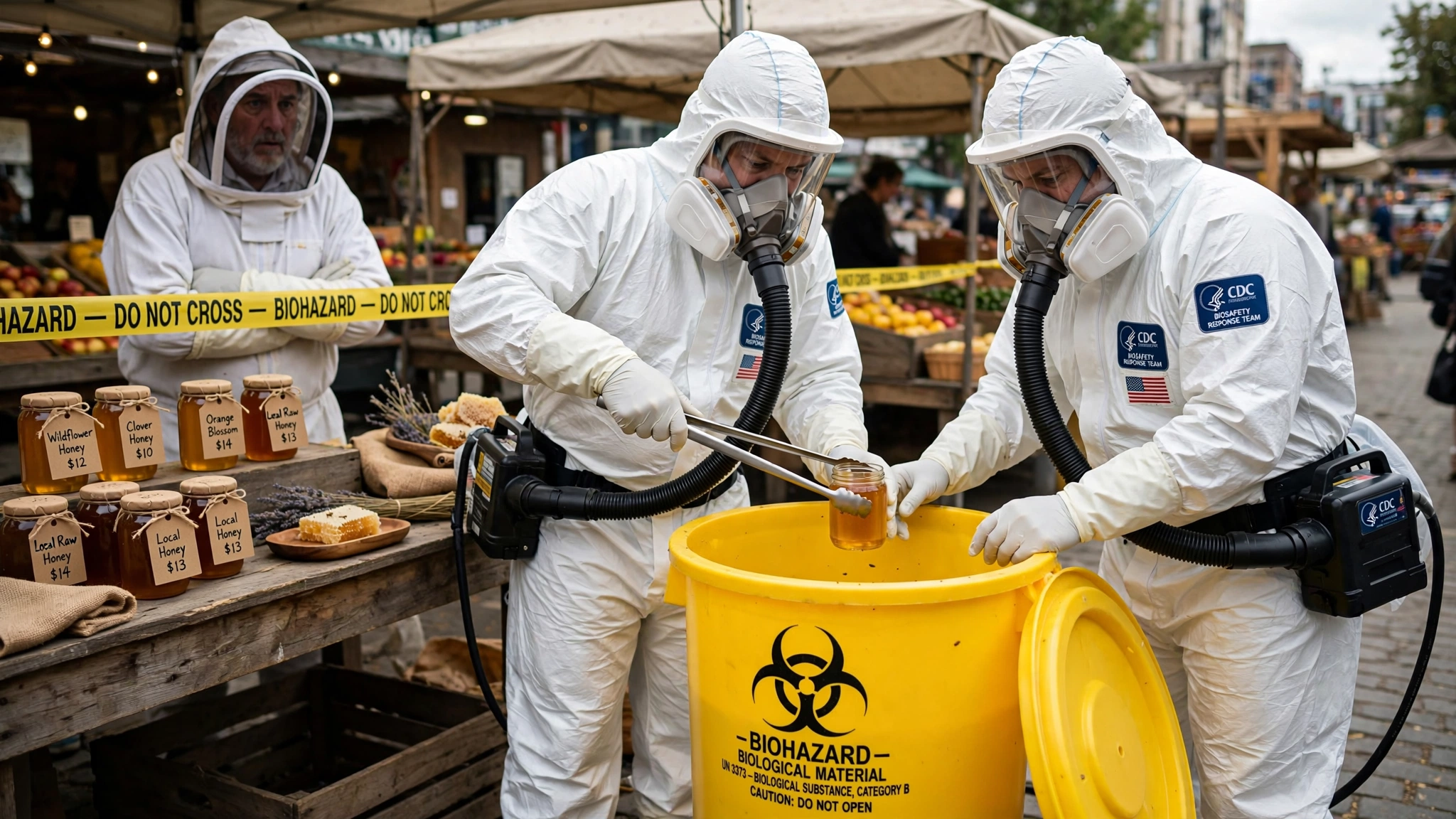
I. The Regulatory Framework
The Public Health Security and Bioterrorism Preparedness and Response Act of 2002, codified at 42 U.S.C. § 262a, directed the Secretary of Health and Human Services to establish and maintain a list of biological agents and toxins that “have the potential to pose a severe threat to public health and safety.”1 The resulting Select Agent Program, administered jointly by the CDC’s Division of Select Agents and Toxins and the USDA’s Animal and Plant Health Inspection Service, maintains the most restrictive biological regulatory regime in the United States.
Under 42 CFR § 73.3(a), the HHS Secretary has determined that certain biological agents and toxins “have the potential to pose a severe threat to public health and safety.” Agents marked with an asterisk are designated as Tier 1 Select Agents and Toxins. Tier 1 designation, per Executive Order 13546, is reserved for agents that “present the greatest risk of deliberate misuse with the most significant potential for mass casualties or devastating effects to the economy, critical infrastructure, or public confidence.”2
The list at 42 CFR § 73.3(b) includes two entries relevant to this investigation. The first: “Botulinum neurotoxins*.” The second: “Botulinum neurotoxin producing species of Clostridium*.” Both carry the asterisk. Both are Tier 1. The organism and its toxin occupy the same regulatory tier as Variola major—smallpox—and Ebola virus.3
Under 42 CFR § 73.7, any individual or entity that possesses, uses, or transfers a select agent or toxin must register with the HHS Secretary. Registration requires a biosafety plan, a security plan, and the names and qualifications of all individuals who will have access to the agents. Under § 73.8, the Responsible Official at each registered entity must undergo a security risk assessment conducted by the Attorney General. Under § 73.15, all individuals with access must complete select-agent-specific biosafety training.4
Violations carry criminal penalties under 18 U.S.C. § 175. Subsection (a) provides that whoever knowingly develops, produces, stockpiles, transfers, acquires, retains, or possesses any biological agent or toxin for use as a weapon “shall be fined under this title or imprisoned for life or any term of years, or both.” Subsection (b) provides that whoever knowingly possesses a biological agent in a type or quantity not reasonably justified by a peaceful purpose shall be imprisoned not more than 10 years.5
II. The Organism
Clostridium botulinum is an anaerobic, spore-forming, gram-positive bacillus found in soil, water, and sediment worldwide. It is not a rare organism. It is not an exotic organism. It is, in the words of multiple federal agency publications, “ubiquitous in nature.”6 The Virginia Department of Health’s clinical guidance notes that C. botulinum spores are “ubiquitous in the environment” and “can be found in soil, dust, marine sediments, and the intestinal tracts of animals, including fish.”7
The organism produces seven serologically distinct neurotoxins, designated types A through G. Types A, B, E, and rarely F cause disease in humans. Type A predominates west of the Mississippi River. Type B predominates east of it. This geographic distribution has been stable for decades.8
The organism’s endospores resist temperatures up to 121°C, survive high acidity, and persist in hostile environments for extended periods in a dormant state. When conditions become favorable—anaerobic, neutral pH, temperatures between 4°C and 48°C—they germinate. When they germinate, they produce botulinum neurotoxin.9
III. The Toxin
Botulinum neurotoxin is the most acutely lethal substance known to science. This is not a colloquialism. It is a quantitative statement derived from measured lethality data.
The median lethal dose for botulinum neurotoxin type A in humans is estimated at 1 nanogram per kilogram of body weight by injection and 1 to 3 nanograms per kilogram by inhalation.10 For a 75-kilogram adult, the lethal dose is approximately 75 nanograms—seventy-five billionths of a gram. Approximately 39 grams of pure botulinum neurotoxin would be sufficient to eradicate the entire human species.11
For calibration: the LD50 of sodium cyanide is 6.4 milligrams per kilogram. Botulinum neurotoxin is approximately six million times more lethal than cyanide on a weight-for-weight basis. It occupies the highest position on the linearized toxicity scale, eleven orders of magnitude more toxic than water.12
The CDC classifies botulinum toxin as a Category A bioterrorism agent—the highest priority category. Iraq, the Soviet Union, and the Japanese cult Aum Shinrikyo have all attempted to weaponize it.13
This is the substance whose producing organism has been detected in the condiment aisle.
IV. The Contamination Data
Published studies spanning four decades have documented Clostridium botulinum spores in honey at rates that vary by source but converge on a consistent finding: the organism is there. Arnon et al. (1979), in the foundational epidemiological study of infant botulism, detected C. botulinum in 10 percent of 90 retail honey specimens and confirmed that “of all food items tested, only honey contained C. botulinum organisms.”14 Nakano et al. (1990) found 8.5 percent of 270 honey samples positive, with apiary-sourced samples reaching 23 percent.15 A 2022 meta-review of international literature reported contamination rates ranging from 0.5 percent in processed retail honey to 68 percent in raw apiary samples.16
The spore counts in contaminated honey are low—typically 1 to 80 spores per gram.17 This is relevant because the Select Agent regulations do not establish a minimum threshold below which possession becomes lawful. The quantity exemption at 42 CFR § 73.3(d)(3) provides that 0.5 milligrams of purified botulinum neurotoxin under the control of a principal investigator is excluded from regulation. The living organism that produces the toxin has no such threshold. One viable spore of a botulinum neurotoxin producing species of Clostridium is a Tier 1 Select Agent.18
V. The Viability Question
The Select Agent regulations at 42 CFR § 73.3(d)(2) exclude “non-viable HHS select agents or nontoxic HHS toxins” from the requirements of the regulation. If the spores in honey were dead, they would not be select agents.
The spores in honey are not dead.
We know this because they kill people. Specifically, they kill infants. Approximately 100 cases of infant botulism are reported annually in the United States, making it the most common form of botulism in the country.19 The mechanism is precise: an infant under twelve months ingests C. botulinum spores; the spores germinate in the infant’s intestinal tract; the germinated bacteria produce botulinum neurotoxin in vivo; the toxin causes descending flaccid paralysis, respiratory failure, and, without treatment, death.20
Approximately 20 percent of infant botulism cases have been linked to honey consumption. Arnon et al. (1979) found that 29.2 percent of hospitalized California patients had been fed honey prior to symptom onset, and worldwide, honey exposure was documented in 34.7 percent of hospitalized cases.21
The CDC, the FDA, the American Academy of Pediatrics, and the Mayo Clinic all advise against giving honey to infants under twelve months of age. The advisory exists because the spores are alive. If the spores were not alive, there would be no advisory. The Select Agent regulations exempt non-viable agents. Honey contains viable agents. The exemption does not apply.
VI. The Naturally Occurring Environment Defense
Under 42 CFR § 73.3(d)(1), select agents are excluded from regulation if they are “in [their] naturally occurring environment provided the select agent or toxin has not been intentionally introduced, cultivated, collected, or otherwise extracted from its natural source.”22 An identical exclusion appears in the criminal statute at 18 U.S.C. § 175(b).23
The naturally occurring environment of Clostridium botulinum is soil. A jar of honey is not soil. A jar of honey is a processed agricultural product packaged in glass and sold at Whole Foods for $12.99.
The exclusion requires that the agent has not been “collected, or otherwise extracted from its natural source.” Consider the mechanism by which C. botulinum spores arrive in honey. A foraging honeybee visits flowers and environmental surfaces. The bee’s body contacts soil particles and dust containing C. botulinum spores. The bee returns to the hive. The spores are transferred to the honey during processing in the comb. The beekeeper harvests the honey. The honey is filtered, bottled, labeled, and shipped to a retail distribution point.
The spores are no longer in soil. They are in honey. They arrived there through a multi-step agricultural process involving collection, transport, processing, extraction, filtration, packaging, and commercial distribution. The naturally occurring environment exclusion was written for a soil sample left in the ground, not for a consumer product on a grocery shelf.24
VII. The Bee as Biological Collection Apparatus
The honeybee, Apis mellifera, is the largest unregistered select agent collection and concentration system in the agricultural economy.
There are approximately 2.60 million honey-producing colonies in the United States, according to the USDA National Agricultural Statistics Service’s 2024 Honey Report.25 Each colony contains 20,000 to 60,000 individual bees. Each bee makes approximately ten foraging trips per day, visiting 50 to 100 flowers per trip. Each trip involves physical contact with environmental surfaces—including the soil and dust in which C. botulinum spores reside.
At a conservative estimate of 30,000 bees per colony, 10 trips per day, and 2.60 million colonies, the American honeybee population makes approximately 780 billion environmental contact events per day during the foraging season. Each contact event is an opportunity for spore collection. No foraging bee has undergone a security risk assessment. No foraging bee has completed biosafety training. No foraging bee has been issued a CDC/USDA select agent registration number.
VIII. The Distribution Network
United States honey production in 2024 totaled 134 million pounds, produced by 2.60 million colonies managed by an estimated 115,000 to 125,000 beekeeping operations.26 Total honey consumption, including imports, exceeds 500 million pounds annually. At a retail contamination rate of 5 to 10 percent, between 25 and 50 million pounds of honey sold annually in the United States contain viable Tier 1 Select Agent spores.
Under 42 CFR § 73.16, the transfer of select agents requires prior authorization from the CDC or APHIS. Each transfer must include documentation of the receiving entity’s registration. Each transfer must be reported to the Federal Select Agent Program within two business days.27
In 2024, approximately 134 million pounds of honey were transferred from beekeeping operations to processing facilities to distribution centers to retail outlets to private residences across every state in the union. None of these transfers were reported to the Federal Select Agent Program. None of the receiving entities were registered. The compliance rate with 42 CFR § 73.16 was zero.
IX. The Botox Paradox
Allergan, a subsidiary of AbbVie, manufactures onabotulinumtoxinA under the brand name Botox at a facility in Irvine, California. The facility is registered with the Federal Select Agent Program. Its employees have undergone FBI security risk assessments. Its biosafety protocols are inspected regularly by the CDC.28
The regulatory apparatus treats Allergan’s Irvine facility with appropriate gravity. Biosafety Level 2 containment. Personnel reliability programs. Inventory controls accurate to the microgram. The most lethal substance known to science, handled with the seriousness it warrants.
The regulatory apparatus treats the beekeeper in North Dakota with nothing. No containment requirements. No personnel reliability program. No inventory controls. The same organism that Allergan handles under BSL-2 containment protocols is managed in open wooden boxes in agricultural fields by individuals wearing, at most, a mesh veil and cotton gloves.
The federal government requires a security risk assessment for a laboratory technician who handles a purified, diluted form of botulinum toxin in a controlled clinical setting. It does not require a security risk assessment for a beekeeper who manages 2,000 colonies of organisms that produce the toxin autonomously, continuously, and in unpurified form. Both entities possess botulinum neurotoxin producing species of Clostridium. One is registered. One is not. One is inspected. One is not. The regulations apply to both. They are enforced against one.
X. The Enforcement Gap
The Federal Select Agent Program maintains approximately 300 registered entities in the United States.29 There are approximately 125,000 beekeeping operations. Zero are registered. Zero have undergone inspection. Zero maintain a biosafety plan. Zero have a designated Responsible Official who has undergone an FBI security risk assessment.
And the beekeepers are not the end of the distribution chain. They are the beginning. The honey they produce places viable Tier 1 Select Agent spores on approximately 130 million kitchen shelves across the country. The number of private residences inspected by the Federal Select Agent Program for unauthorized possession of botulinum neurotoxin producing species of Clostridium is zero.
XI. Conclusion
The evidence does not require interpretation. It requires arithmetic.
The Federal Select Agent Program designates botulinum neurotoxin producing species of Clostridium as Tier 1 Select Agents—the highest threat classification available, shared with smallpox and Ebola. Clostridium botulinum spores have been detected in 5 to 10 percent of retail honey samples. The spores are viable. The toxin they produce has a median lethal dose of 1 nanogram per kilogram—six million times more lethal than cyanide.
One hundred and thirty-four million pounds of honey were produced in the United States in 2024. The honey was transferred through interstate commerce without Select Agent transfer authorization. It was stored in uncontained facilities. It was consumed by approximately 330 million Americans, including approximately 4 million infants—the only population in which the spores reliably germinate and produce the toxin in vivo.
The bear-shaped squeeze bottle does not carry a biohazard trefoil. It does not list a CDC registration number. It does not identify a Responsible Official. It does not warn the consumer that the contents may include viable spores of an organism that the federal government has classified, under the same regulatory framework it uses to secure the nation’s smallpox stockpile, as a Tier 1 Select Agent.
It says “PURE” and “NATURAL” and “RAW” and “UNFILTERED.” The last adjective is, from a biosecurity perspective, the most alarming word on the label.
Ergo.
Sources
- 42 U.S.C. § 262a, Public Health Service Act, as amended by the Public Health Security and Bioterrorism Preparedness and Response Act of 2002 (Pub. L. 107-188). uscode.house.gov ↑
- Executive Order 13546, “Optimizing the Security of Biological Select Agents and Toxins in the United States,” July 2, 2010. 75 Fed. Reg. 39439. ↑
- 42 CFR § 73.3(b), listing “Botulinum neurotoxins*” and “Botulinum neurotoxin producing species of Clostridium*” with Tier 1 designation (asterisk). ecfr.io ↑
- 42 CFR §§ 73.7 (registration), 73.8 (security risk assessments), 73.15 (training). ecfr.io ↑
- 18 U.S.C. § 175, Biological Weapons Anti-Terrorism Act of 1989, as amended by USA PATRIOT Act § 817 and the Bioterrorism Act of 2002 § 231. Subsection (a): imprisonment for life for weapons use. Subsection (b): up to 10 years for unjustified possession. govinfo.gov ↑
- USDA National Institute of Food and Agriculture, “Preventing Foodborne Illness: Clostridium botulinum,” Food Safety fact sheet. nifa.usda.gov ↑
- Virginia Department of Health, “Botulism: Overview for Healthcare Providers,” 2019. vdh.virginia.gov ↑
- StatPearls, “Infantile Botulism,” NCBI Bookshelf. ncbi.nlm.nih.gov ↑
- Thermo Fisher Scientific, “Fact sheet on Clostridium botulinum.” thermofisher.com ↑
- B.Z. Horowitz, “Botulinum Toxin,” Critical Care Clinics, vol. 21, no. 4, pp. 825–839, 2005: “the human LD50 for inhalation botulism is 1 to 3 nanograms of toxin/kilogram body mass.” pubmed.ncbi.nlm.nih.gov ↑
- M. Dhaked et al., “Botulinum toxin: Bioweapon & magic drug,” Indian Journal of Medical Research, vol. 132, pp. 489–503, 2010. pmc.ncbi.nlm.nih.gov ↑
- Wikipedia, “Median lethal dose.” LD50 of botulinum toxin = 1 ng/kg; sodium cyanide = 6.4 mg/kg. en.wikipedia.org ↑
- S.S. Arnon et al., “Botulinum Toxin as a Biological Weapon,” JAMA, vol. 285, no. 8, pp. 1059–1070, 2001. ↑
- S.S. Arnon et al., “Honey and other environmental risk factors for infant botulism,” The Journal of Pediatrics, vol. 94, no. 2, pp. 331–336, 1979. pubmed.ncbi.nlm.nih.gov ↑
- H. Nakano et al., “Incidence of Clostridium botulinum in honey of various origins,” Japanese Journal of Medical Science and Biology, vol. 43, no. 5, pp. 183–195, 1990. pubmed.ncbi.nlm.nih.gov ↑
- Contamination of honey products by Clostridium botulinum spores, Caspian Journal of Environmental Sciences, vol. 20, no. 5, pp. 1143–1148, 2022. doaj.org ↑
- Grabowski and Klein, cited in Processes (MDPI), vol. 10, no. 11, article 2232, 2022: spore counts 1–80 per gram. mdpi.com ↑
- 42 CFR § 73.3(d)(3): quantity exemption of 0.5 mg for purified botulinum neurotoxins. No quantity exemption for the living organism. ecfr.io ↑
- StatPearls, op. cit.: “Approximately 100 cases of infantile botulism are reported annually in the United States.” ncbi.nlm.nih.gov ↑
- StatPearls, op. cit., and USDA NIFA fact sheet, op. cit. ↑
- Arnon et al. (1979), op. cit.: “29.2% (12/41) of hospitalized patients had been fed honey prior to onset of constipation; worldwide, honey exposure occurred in 34.7% (28/75) of hospitalized cases.” pubmed.ncbi.nlm.nih.gov ↑
- 42 CFR § 73.3(d)(1). ecfr.io ↑
- 18 U.S.C. § 175(b). govinfo.gov ↑
- Regulatory interpretation is the authors’, derived from the plain text of the statute and regulation. ↑
- USDA NASS, “Honey,” March 2025: 134 million pounds, 2.60 million colonies, 51.7 lbs/colony. nass.usda.gov ↑
- Agricultural Marketing Resource Center, “Bees,” rev. May 2024: 115,000–125,000 beekeepers. agmrc.org ↑
- 42 CFR § 73.16, transfer requirements. ecfr.io ↑
- Allergan/AbbVie Botox manufacturing under Select Agent Program registration. ↑
- Federal Select Agent Program, CDC/APHIS. Approximately 300 registered entities. ↑