I. The Statute
On January 13, 1972, the Ninety-Second Congress enacted Public Law 92-205, the Weather Modification Reporting Act, codified at 15 U.S.C. §§ 330–330e. The Act was born of a mid-century preoccupation with weather control—cloud seeding programs had proliferated across the American West, farmers were hiring private contractors to make it rain over their fields, and the federal government had recently concluded Project Stormfury, a multi-year attempt to weaken Atlantic hurricanes by seeding their eyewalls with silver iodide.1
Congress was not, in 1972, primarily concerned with whether weather modification worked. It was concerned with tracking it. The Act imposed a single, sweeping obligation: reporting. Section 330a provides:
“No person may engage, or attempt to engage, in any weather modification activity in the United States unless he submits to the Secretary such reports with respect thereto, in such form and containing such information, as the Secretary may by rule prescribe.”2
The key term—“weather modification”—is defined at 15 U.S.C. § 330(3):
“The term ‘weather modification’ means any activity performed with the intention of producing artificial changes in the composition, behavior, or dynamics of the atmosphere.”3
Read the definition again. It does not say “any atmospheric intervention using specialized chemical agents deployed from aircraft.” It does not say “any deliberate attempt to alter precipitation patterns through cloud nucleation.” It says any activity performed with the intention of producing artificial changes in the composition, behavior, or dynamics of the atmosphere. The definition is, by design, maximally inclusive. Congress could have limited it to cloud seeding. Congress chose not to.
The Secretary of Commerce, acting through the National Oceanic and Atmospheric Administration, promulgated implementing regulations at 15 CFR Part 908, titled “Maintaining Records and Submitting Reports on Weather Modification Activities.”4 The regulations require initial, interim, and final reports for any weather modification activity, including the purpose, location, materials used, and results observed. NOAA maintains a database of these filings. As of the date of this publication, the database contains reports from cloud seeding operations in Texas, Colorado, Wyoming, North Dakota, and several other states. It contains zero reports from any homeowner, landscaping company, golf course superintendent, or municipal parks department in the United States.
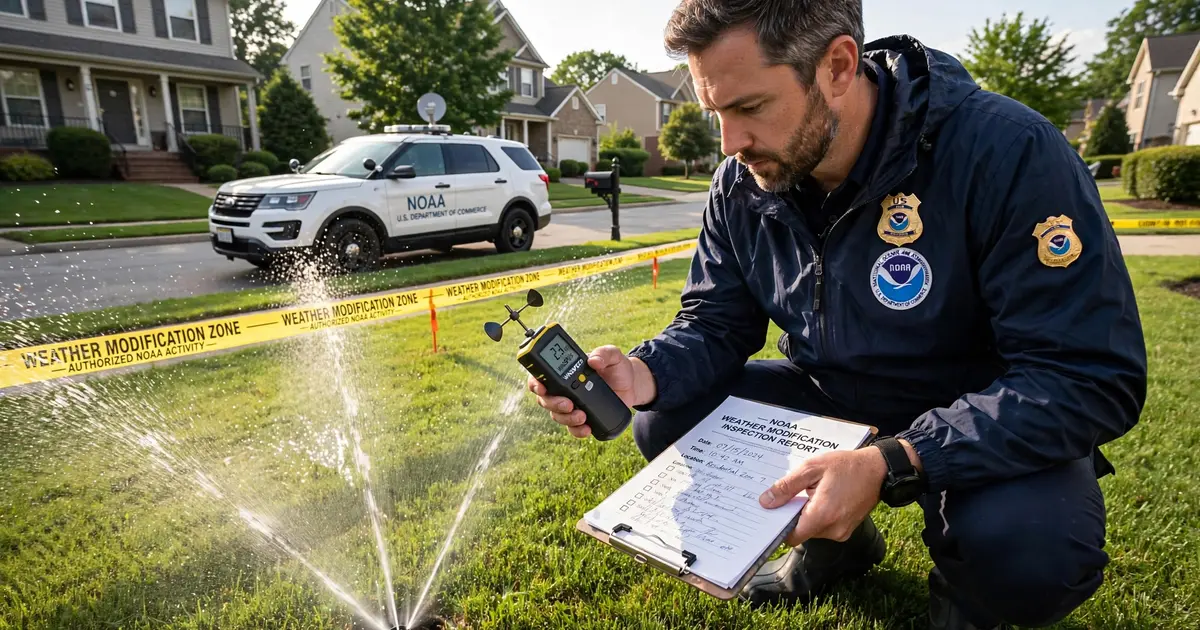
This is a problem. Because the statute, read on its own terms, appears to cover every sprinkler system in the country.
II. The Atmospheric Chemistry of Lawn Care
A lawn sprinkler is a mechanical device that disperses pressurized water through an array of nozzles in a radial or oscillating pattern over a defined area of turf grass. This is not in dispute. What is in dispute—or, more accurately, what has never been disputed because no one has thought to raise it—is what happens to the water after it leaves the nozzle.
The EPA’s WaterSense program, a partnership program administered by the Office of Wastewater Management, has studied this question in detail. Its findings are unambiguous. According to the Agency’s own data, residential outdoor water use accounts for nearly nine billion gallons per day in the United States, principally for landscape irrigation. About thirty percent of an average household’s total water consumption is devoted to outdoor use. The average American family uses approximately 320 gallons per day, of which roughly 96 gallons go outside.5
The critical datum, however, is not total volume. It is disposition. The EPA further reports that as much as fifty percent of outdoor irrigation water is “wasted”—the Agency’s term—through evaporation, wind drift, runoff, and overwatering.6 Evaporation is the dominant loss pathway. When water is sprayed into the air in fine droplets under ambient solar radiation at midday during the growing season—which is precisely when most residential sprinkler systems are programmed to operate—a substantial fraction of the dispersed volume undergoes a phase transition from liquid to gas before it reaches the soil.
The gas in question is water vapor. Water vapor is not a trace constituent of the atmosphere. It is, by mass, the most abundant variable greenhouse gas in Earth’s atmosphere, responsible for absorbing and re-radiating approximately sixty percent of the planet’s natural greenhouse effect.7 Its atmospheric concentration varies from near zero in arid regions to approximately four percent by volume in tropical air masses. Its presence determines relative humidity, dew point, cloud formation potential, and precipitation probability.
When a lawn sprinkler converts liquid water into atmospheric water vapor, it is performing an activity that artificially changes the composition of the atmosphere. The atmosphere, prior to the sprinkler’s operation, contained a given concentration of water vapor at that location. After the sprinkler operates, it contains more. The change is artificial—it was produced by a machine, connected to a municipal water supply, powered by pressurized infrastructure, on a timer set by a homeowner. The composition of the atmosphere has been modified.
The scale is not trivial. If residential irrigation consumes nine billion gallons per day and fifty percent is lost to evaporation, then 4.5 billion gallons of liquid water per day are being artificially converted into atmospheric water vapor across the residential landscapes of the United States.8 That is approximately seventeen billion liters. Per day.
III. The Peer-Reviewed Evidence of Atmospheric Modification
One might object that lawn sprinkler evaporation, while technically producing “artificial changes in the composition” of the atmosphere, does not produce changes in its “behavior or dynamics.” This objection fails on the evidence.
In 2002, J. Marshall Shepherd, Harold Pierce, and Andrew J. Negri of NASA’s Goddard Space Flight Center published a landmark study in the Journal of Applied Meteorology titled “Rainfall Modification by Major Urban Areas: Observations from Spaceborne Rain Radar on the TRMM Satellite.” The study used calibrated precipitation data from the Tropical Rainfall Measuring Mission—a joint mission between NASA and the Japan Aerospace Exploration Agency—to compare rainfall rates upwind and downwind of six major American cities: Atlanta, Montgomery, Nashville, San Antonio, Waco, and Dallas.9
The results were unequivocal. The study documented an average 28.4 percent increase in monthly rainfall rates in areas thirty to sixty kilometers downwind of these urban centers, with portions of the downwind zone showing increases up to fifty-one percent. The effect was statistically robust and replicated across all six cities in the sample.
Shepherd subsequently expanded the analysis. In a 2003 study, he examined the Houston metropolitan area and found that the downwind zone exhibited a forty-four percent higher mean rainfall rate than the upwind control area.10 The mechanism he identified was precisely the one at issue here: the urban environment—through waste heat, impervious surfaces, and, critically, irrigation—was injecting sufficient moisture and thermal energy into the boundary layer to enhance convective precipitation development.
This is not speculative modeling. This is observational data from a satellite-borne precipitation radar, published in a peer-reviewed journal, replicated across multiple metropolitan areas, and subsequently confirmed by independent researchers. The atmosphere downwind of American cities is producing more rain than the atmosphere upwind. The cities are causing this effect. The effect is, by any reasonable interpretation of the term, a modification of the behavior and dynamics of the atmosphere.
And residential irrigation is a documented contributor. Urban landscapes, including lawns, parks, and golf courses, produce a “moisture island” effect that supplements the well-studied “heat island” effect. The combination of excess heat and excess moisture enhances atmospheric instability, promotes convective updraft development, and increases the probability and intensity of precipitation events in the downwind zone.11
The atmosphere’s behavior is being modified. The modification is measurable. The modification is being caused, in part, by lawn sprinklers.
IV. The Definitional Test
Return to the statute. 15 U.S.C. § 330(3) defines weather modification as “any activity performed with the intention of producing artificial changes in the composition, behavior, or dynamics of the atmosphere.”
The word that does the most work in this definition is “intention.” The statute does not require that the person intend to modify the weather. It requires that the person perform an activity with the intention of producing artificial changes in the composition, behavior, or dynamics of the atmosphere. These are not the same thing.
A homeowner who sets a sprinkler timer intends to water a lawn. But the mechanism by which a sprinkler waters a lawn is by dispersing pressurized water into the air, where it descends through the atmosphere under gravity while a significant fraction evaporates. The homeowner knows—or, under the EPA’s own public education materials, is expected to know—that sprinkler operation produces evaporation. The EPA has spent millions of dollars telling homeowners exactly this, under the WaterSense banner, in an effort to reduce it.12
If a person knows that an activity produces a specific atmospheric consequence, and performs the activity anyway, does the person intend the consequence? Under the doctrine of substantial certainty—applied in tort law and, by analogy, in regulatory contexts—a person who knows to a substantial certainty that a consequence will follow from their act is treated as having intended that consequence.13
The EPA itself has informed every homeowner with a WaterSense-labeled sprinkler controller that conventional sprinkler operation loses up to fifty percent of its water to evaporation. The Agency has published this figure on its website, in its brochures, and on the product labeling it certifies. A homeowner who reads this information, nods, and sets the timer for 6:00 AM anyway is performing an activity with knowledge—supplied by the United States government—that the activity will produce artificial changes in the composition of the atmosphere.
Under the substantial certainty standard, the intention element is met.
V. The Scale of Noncompliance
According to the National Association of Landscape Professionals, eighty-one percent of Americans have lawns.14 Not all of these lawns are irrigated by automated systems, but a significant majority of residential properties in water-served areas employ some form of supplemental irrigation during the growing season. The Irrigation Association has estimated that there are approximately sixty million irrigated residential properties in the United States.
Under 15 U.S.C. § 330a, every one of these properties is required to submit reports to the Secretary of Commerce before commencing weather modification activity, at prescribed intervals during the activity, and upon completion. The reports, per 15 CFR Part 908, must include the type of activity, the materials used, the area affected, and the purpose of the operation.
Zero homeowners have filed these reports. Zero.
NOAA’s weather modification activity database is publicly available. It contains reports from cloud seeding operations conducted by state agencies, private contractors, and research institutions. The reports describe the deployment of silver iodide flares from fixed-wing aircraft over designated target areas in the western United States. The database does not contain a single entry for residential landscape irrigation. Not in California. Not in Texas. Not in Florida, Arizona, Georgia, or any of the fifty states. The filing rate among homeowners is zero percent.15
The penalty for noncompliance is specified at 15 U.S.C. § 330d: “Any person who knowingly and willfully violates section 330a of this title shall, upon conviction thereof, be fined not more than $10,000.”16
Consider the arithmetic. Sixty million irrigated residential properties. An average irrigation season of one hundred and eighty days. If each day of unreported sprinkler operation constitutes a separate violation—a standard interpretation under continuing-violation doctrine, applied by the EPA in Clean Water Act and Clean Air Act enforcement contexts—the annual violation count is approximately 10.8 billion. At a maximum fine of $10,000 per violation, the theoretical annual penalty exposure is $108 trillion.
This exceeds the gross domestic product of the planet.
VI. The Federal Policy Context
The regulatory gap is not attributable to Congressional inattention. Four years after the Weather Modification Reporting Act, Congress returned to the subject with considerably greater ambition. The National Weather Modification Policy Act of 1976, enacted as Public Law 94-490, declared that “weather modification activities have been carried out for more than twenty years in the United States and have been found to have significant potential for beneficial applications,” that “the interstate nature of climatic and weather phenomena, the inadvertent effects of weather modification activities, and the complexities of the interactions involved in such activities make it a matter beyond the capacity and responsibility of any single State to act alone,” and that “there is a need for a comprehensive Federal program of weather modification research.”17
Read that language again: “the interstate nature of climatic and weather phenomena” and “the inadvertent effects of weather modification activities.” Congress explicitly acknowledged that weather modification has inadvertent effects and that those effects cross state lines. This is precisely what the Shepherd studies documented: urban areas, through their collective atmospheric emissions—including irrigation evaporation—produce rainfall changes that extend thirty to sixty kilometers downwind. A suburb in northern Virginia irrigates its lawns; the enhanced precipitation falls in Maryland. The effect is interstate. Congress said so.
Moreover, Congress was not only concerned with deliberate atmospheric intervention. The 1976 Act specifically recognized “inadvertent” weather modification as a subject requiring federal attention. The distinction between deliberate cloud seeding and incidental irrigation evaporation, which might seem intuitively obvious, is not a distinction the statutory framework makes. The 1972 Act’s definition covers “any activity performed with the intention of producing artificial changes.” The 1976 Act acknowledges that weather modification can produce “inadvertent effects.” Together, the two statutes describe a continuum: at one end, the deliberate deployment of nucleating agents into cloud formations; at the other, the incidental atmospheric consequences of activities undertaken for other purposes. Congress recognized the entire continuum. It chose to regulate the first half and study the second. But the definitional language of the 1972 Act does not clearly exclude the second.
VII. The State-Level Regulatory Mosaic
The federal framework is not alone. At least thirty-one states have enacted their own weather modification statutes, creating an overlapping patchwork of permits, licenses, and reporting requirements that compound the compliance burden on anyone whose activities fall within the statutory definition.18
Texas, for instance, administers a state weather modification program through the Texas Department of Licensing and Regulation, which issues permits for cloud seeding operations and requires permittees to file operational reports. Colorado’s Weather Modification Act requires a permit from the Colorado Water Conservation Board for any person who “engages in weather modification operations or research.” Wyoming requires a license from the State Engineer. North Dakota maintains a Weather Modification Board with authority to regulate all weather modification activities within the state.19
None of these states has ever issued a weather modification permit to a homeowner for the operation of a residential sprinkler system. None has required a landscaping company to obtain a license for activities that, by the state’s own statutory definitions, may constitute weather modification. The state statutes vary in their definitional language, but most track the federal definition or employ similarly broad formulations. Texas defines weather modification as “changing or controlling, or attempting to change or control, by artificial methods the natural development of atmospheric cloud forms or precipitation forms which occur in the troposphere.” A sprinkler system changes the natural development of atmospheric precipitation forms. The development is no longer natural. The change is produced by a machine. The troposphere begins at the ground.
The theoretical result is that a homeowner in Lubbock, Texas, operating a Rainbird irrigation system on a half-acre lot is simultaneously in violation of federal weather modification reporting requirements under 15 U.S.C. § 330a, state weather modification permitting requirements under the Texas Agriculture Code, and, if the evaporated moisture crosses the state line into New Mexico before condensing, the interstate weather modification provisions recognized by the National Weather Modification Policy Act of 1976.
No enforcement action has ever been brought. Not in Texas. Not anywhere.
VIII. The Disparity of Treatment
The regulatory disparity at the center of this investigation is not subtle. It is, in fact, quantifiable to an almost comic degree.
A cloud seeding operation that disperses ten to fifty grams of silver iodide—a quantity that would fit in the palm of a human hand—from a single-engine aircraft into an existing cloud formation is required, under federal and state law, to file reports with the Secretary of Commerce, obtain state permits, notify affected jurisdictions, maintain operational records, and submit post-activity analyses. The material dispersed is measured in grams. The atmospheric effect, by the operators’ own reports, is typically an estimated ten to fifteen percent increase in precipitation over the target area, if any effect is observed at all.20
A residential sprinkler system that disperses thousands of gallons of liquid water into the atmosphere via evaporation over the course of a growing season is required to do nothing. It is not required to file a report. It is not required to obtain a permit. It is not required to notify its neighbors, its municipality, its state, or the Secretary of Commerce. The material dispersed is not measured in grams. It is measured in acre-feet. The atmospheric effect, per peer-reviewed satellite data, is a 28.4 percent mean increase in monthly rainfall rates in the downwind zone—an effect roughly double what cloud seeding claims to achieve on its best days.21
The statute that governs both activities is the same statute. The definition that covers both activities is the same definition. The reporting obligation that applies to both activities is the same obligation. The distinction between the two is not found in the text of 15 U.S.C. §§ 330–330e. It is not found in the implementing regulations at 15 CFR Part 908. It is not found in the National Weather Modification Policy Act of 1976. It exists only in practice, in the unstated assumption—shared by NOAA, by the states, by the regulated community, and by every homeowner who has ever adjusted a sprinkler head—that lawn care is not weather modification.
The assumption is understandable. It is also, on the statutory language, indefensible.
IX. The Collective Action Problem
Individual sprinkler operation might be dismissed as de minimis—too small to constitute meaningful weather modification. A single residential lot, dispersing perhaps forty gallons per day into the atmosphere through evaporation, produces an atmospheric effect too small to measure against the background noise of natural hydrological processes.
But the statute does not contain a de minimis exception. It says “any activity.” And the aggregate is staggering.
Eighty-one percent of American households have lawns. The United States has approximately 130 million housing units. If sixty million of those irrigate during a season spanning April through September—one hundred and eighty days—the total volume of water dispersed into the residential atmosphere via sprinkler operation is approximately 1.62 trillion gallons per season, of which 810 billion gallons are lost to evaporation.22 This is water that was in the municipal supply. It is now in the atmosphere. It got there by way of a Toro pop-up nozzle on a quarter-inch drip line staked into a bed of petunias.
For comparison: the largest cloud seeding program in the United States, operated by the Wyoming Weather Modification Pilot Program under contract with the State of Wyoming, uses approximately eighty-five ground-based silver iodide generators and a small fleet of aircraft to seed two target mountain ranges during the winter months. The total mass of nucleating material deployed in a typical season is measured in kilograms. The target area is a few hundred square miles. The reported precipitation increase is five to fifteen percent, and even that figure is the subject of ongoing scientific debate.23
The nation’s residential irrigators collectively inject more water into the atmosphere in a single July afternoon than the Wyoming program deploys in an entire winter. The atmospheric modification produced by residential irrigation is documented by NASA satellites. The atmospheric modification produced by cloud seeding is, by the operators’ own admission, sometimes indistinguishable from natural variability.
One of these activities is regulated. The other is sold at Home Depot.
X. The Enforcement Vacuum
The Department of Commerce has never initiated an enforcement action against a homeowner for failure to report weather modification activity. The Department of Justice has never prosecuted a violation of 15 U.S.C. § 330a arising from residential sprinkler operation. No federal inspector has ever visited a suburban subdivision to determine whether the irrigation schedule has been reported to NOAA. No compliance letter has been sent. No administrative proceeding has been convened. No fine has been assessed.
This is not because the Department lacks jurisdiction. The statute is clear: “No person may engage, or attempt to engage, in any weather modification activity in the United States unless he submits to the Secretary such reports.” The term “person” is not defined in the Act, but under the Dictionary Act, 1 U.S.C. § 1, “person” includes “every individual, corporation, company, association, firm, partnership, society, and joint stock company.” A homeowner is an individual. A landscaping company is a company. A homeowners’ association is an association. The term “any weather modification activity” includes, on its face, any activity that falls within the definition at 15 U.S.C. § 330(3).24
The absence of enforcement is, itself, the regulatory gap. The statute covers the activity. The implementing regulations prescribe the reporting format. The penalty provision sets the fine. Every element of the enforcement framework is in place. The only missing component is the will to apply it to the most widespread atmospheric modification program in the history of the United States: the American lawn.
XI. Conclusion
The Weather Modification Reporting Act of 1972 defines weather modification as “any activity performed with the intention of producing artificial changes in the composition, behavior, or dynamics of the atmosphere.” The EPA has documented that residential lawn sprinklers disperse nearly nine billion gallons of water per day, fifty percent of which evaporates into the atmosphere. Peer-reviewed satellite data has shown that urban areas produce a 28.4 percent mean increase in rainfall rates in their downwind zones, an effect driven in part by surface-level moisture injection from irrigated landscapes. The National Weather Modification Policy Act of 1976 explicitly recognizes the “interstate nature” of atmospheric modification and its “inadvertent effects.” At least thirty-one states have their own weather modification statutes. None has licensed a sprinkler system.
The reporting requirement of 15 U.S.C. § 330a applies to any weather modification activity. NOAA’s database contains filings from operators who deploy grams of silver iodide into cloud formations at altitude. It contains no filings from operators who deploy billions of gallons of water into the atmosphere from ground level every day. The statute draws no distinction between the two. The implementing regulations draw no distinction between the two. The penalty provision—$10,000 per knowing and willful violation—draws no distinction between the two.
Approximately sixty million irrigated residential properties in the United States are operating unreported weather modification systems one hundred and eighty days per year. The total theoretical penalty exposure exceeds the gross domestic product of the planet. The total number of enforcement actions in the program’s fifty-four-year history is zero.
Cloud seeding operations file reports. Homeowners do not. The atmosphere does not care who filed the paperwork. It responds to the water.
Ergo.
Sources
- Weather Modification Reporting Act of 1972, Pub. L. 92-205, codified at 15 U.S.C. §§ 330–330e. uscode.house.gov ↑
- 15 U.S.C. § 330a, “Report of weather modification activities.” uscode.house.gov ↑
- 15 U.S.C. § 330(3), definition of “weather modification.” uscode.house.gov ↑
- 15 CFR Part 908, “Maintaining Records and Submitting Reports on Weather Modification Activities.” ecfr.gov ↑
- U.S. Environmental Protection Agency, WaterSense, “Outdoor Water Use in the United States.” Statistics on residential outdoor water use, 320 gallons per day household average, and 30 percent outdoor share. epa.gov ↑
- U.S. Environmental Protection Agency, WaterSense, “Watering Tips.” “As much as 50 percent of water used for outdoor irrigation is wasted due to evaporation, wind, or runoff.” epa.gov ↑
- NOAA Climate.gov, “Climate Change: Water Vapor.” Water vapor as the atmosphere’s most abundant greenhouse gas. climate.gov ↑
- Calculation: 9 billion gallons/day × 50% evaporation rate = 4.5 billion gallons/day. Based on EPA WaterSense data, supra notes 5–6. ↑
- J.M. Shepherd, H. Pierce, and A.J. Negri, “Rainfall Modification by Major Urban Areas: Observations from Spaceborne Rain Radar on the TRMM Satellite,” Journal of Applied Meteorology, vol. 41, no. 7, pp. 689–701 (2002). doi.org ↑
- J.M. Shepherd, “Evidence of Urban-Induced Precipitation Variability in Arid Climate Regimes,” Journal of Arid Environments, vol. 67, no. 4, pp. 607–628 (2006); see also earlier conference presentation (2003) documenting 44% higher mean rainfall rate in Houston downwind area. doi.org ↑
- S.A. Changnon et al., “METROMEX: A Review and Summary,” Meteorological Monographs, vol. 18, no. 40, American Meteorological Society (1981). The St. Louis Metropolitan Meteorological Experiment was the first comprehensive field study documenting urban effects on precipitation. ↑
- U.S. Environmental Protection Agency, WaterSense Program, established 2006. The program has produced extensive consumer-facing materials documenting irrigation water waste, including evaporation losses. epa.gov ↑
- Restatement (Second) of Torts § 8A (1965): “The word ‘intent’ is used throughout the Restatement of this Subject to denote that the actor desires to cause consequences of his act, or that he believes that the consequences are substantially certain to result from it.” ↑
- National Association of Landscape Professionals, “Industry Statistics.” 81 percent of Americans have lawns. landscapeprofessionals.org ↑
- NOAA, Weather Modification Activity Reports, accessible via the National Weather Service. weather.gov ↑
- 15 U.S.C. § 330d, penalty provision. “Any person who knowingly and willfully violates section 330a of this title shall, upon conviction thereof, be fined not more than $10,000.” uscode.house.gov ↑
- National Weather Modification Policy Act of 1976, Pub. L. 94-490, § 2, Findings and Purpose. govinfo.gov ↑
- Desert Research Institute, “State Weather Modification Laws in the United States,” survey of existing legislation. At least 31 states have weather modification statutes. ↑
- Texas Agriculture Code, Chapter 301, Weather Modification; Colorado Revised Statutes § 36-20-101 et seq.; Wyoming Statutes § 9-5-201 et seq.; North Dakota Century Code § 61-04.1. ↑
- National Research Council, “Critical Issues in Weather Modification Research,” National Academies Press (2003). Cloud seeding operations typically use 10–50 grams of silver iodide per operation; reported precipitation increases range from 5–15% where detectable. nap.nationalacademies.org ↑
- Shepherd et al. (2002), supra note 9. 28.4% mean increase in monthly rainfall rates, with portions showing increases up to 51%. ↑
- Calculation: 9 billion gallons/day × 180 days = 1.62 trillion gallons/season. At 50% evaporation rate: 810 billion gallons. Based on EPA WaterSense data, supra notes 5–6. ↑
- Wyoming Weather Modification Pilot Program, operated under contract by Weather Modification, Inc. for the Wyoming Water Development Office. See National Research Council (2003), supra note 20, on scientific uncertainty regarding cloud seeding efficacy. ↑
- 1 U.S.C. § 1, the Dictionary Act: “the words ‘person’ and ‘whoever’ include corporations, companies, associations, firms, partnerships, societies, and joint stock companies, as well as individuals.” uscode.house.gov ↑