I. The Statutory Framework
The Consumer Product Safety Act of 1972, signed by President Nixon on October 27 of that year and codified at 15 U.S.C. §§ 2051–2089, created the Consumer Product Safety Commission and established a comprehensive federal regulatory framework for the safety of consumer products sold in the United States.1 The Act’s jurisdictional reach is vast. It covers virtually every product sold to consumers, with narrow enumerated exceptions for tobacco, motor vehicles, pesticides, aircraft, boats, drugs, medical devices, cosmetics, and food—categories already regulated by other federal agencies.2
Everything else is a consumer product. A toaster is a consumer product. A crib is a consumer product. A lamp, a blender, a stuffed animal, a hair dryer, a power tool, a space heater, and a child’s bicycle are all consumer products. So is the fondue set you received as a wedding gift in 1987 and have not used since. So is the exercise equipment in your garage that you have been meaning to put on your driveway with a price tag of fifteen dollars.
Section 19(a) of the Act, codified at 15 U.S.C. § 2068(a), establishes the prohibited acts. Subsection (a)(1) makes it unlawful for “any person” to “sell, offer for sale, distribute in commerce, or import into the United States any consumer product, or other product or substance that is regulated under this chapter, which is not in conformity with an applicable consumer product safety rule under this chapter.”3 Subsection (a)(2) makes it equally unlawful to sell any product “which has been declared a banned hazardous product by a rule under this chapter.”
The phrase “any person” does not mean “any manufacturer.” It does not mean “any retailer holding a valid business license.” It does not mean “any person who has incorporated a limited liability company and retained compliance counsel.” It means any person. A person standing in a driveway behind a folding table is a person. The statute makes no distinction between a person operating a nationwide retail chain and a person operating a card table in a cul-de-sac.
II. The CPSC’s Own Position
The Consumer Product Safety Commission has not left the application of this statute to garage sales as a matter of academic inference. The agency has published an official document titled “Reseller’s Guide to Selling Safer Products,” available for download at cpsc.gov, that addresses the question directly.4
The Guide opens with the following declaration, printed in bold: “It is illegal to sell any recalled product.” It continues: “If you are in the business of reselling products, you are expected to know the laws, rules, and regulations that apply to your business, including whether a product you are selling has been recalled for a safety issue.” It further states: “It is unlawful to offer recalled products for sale under Section 19 of the Consumer Product Safety Act (15 U.S.C. § 2068), so having the recalled product in inventory is a violation of federal law.”
The Guide specifies its intended audience. It states that it was “created specifically for resale stores and product resellers.” It enumerates those resellers: “This includes thrift stores, consignment stores, charities, and individuals holding yard sales and flea markets.”
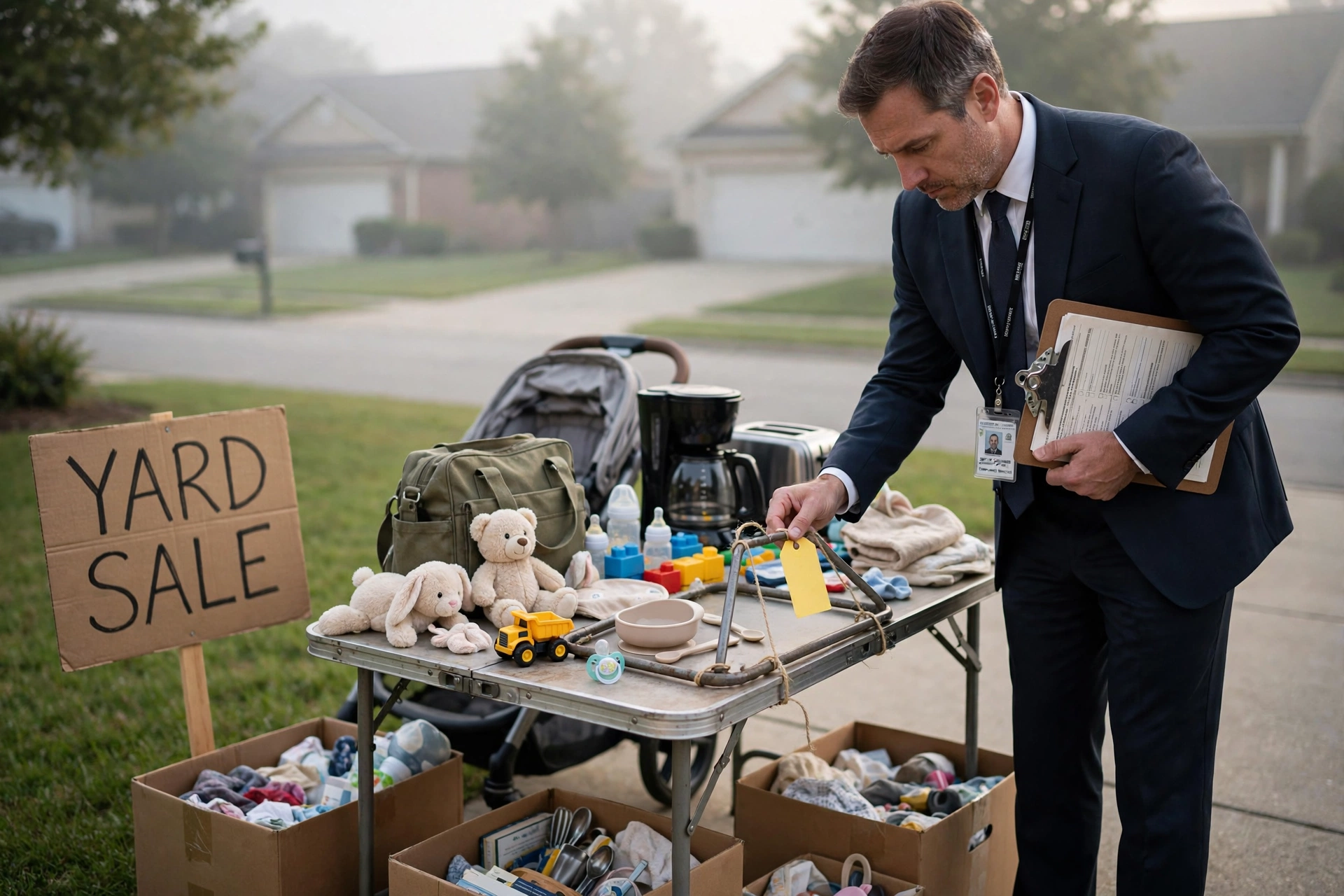
Individuals holding yard sales. The CPSC did not create a separate enforcement regime for yard sales. It did not carve out a de minimis exception. It did not suggest that the law applies only to commercial resellers operating at scale. It said that the law applies to individuals holding yard sales, and that ignorance of the law is not an excuse, and that having a recalled product in your inventory is itself a violation, and then it provided a helpful link to the recall database that it expected every individual holding a yard sale to check before placing a 1997 Graco stroller on a card table with a piece of masking tape reading “$5.”
Consumer Reports, in its coverage of the agency’s position, provided the summary that the CPSC itself had declined to state so bluntly: “The same law—the Consumer Product Safety Improvement Act—that bars manufacturers from peddling a million lead-tainted toys applies to the tag-sale host selling just one.”5
III. The Children’s Product Regulatory Catastrophe
The Consumer Product Safety Improvement Act of 2008, enacted in response to a series of mass recalls of children’s products containing lead paint—most notably millions of Mattel toys manufactured in China—imposed a regulatory framework on children’s products that is, by any measure, the most stringent consumer product safety regime in American federal law.6
Under the CPSIA, a “children’s product” is any consumer product designed or intended primarily for children 12 years of age or younger. Every children’s product sold in the United States must comply with the following requirements:
First, the total lead content in any accessible component of the product must not exceed 100 parts per million. Lead in surface coatings must not exceed 90 parts per million.7
Second, children’s toys and child care articles must not contain more than 0.1 percent—1,000 parts per million—of any of eight specified phthalates: DEHP, DBP, BBP, DINP, DIBP, DPENP, DHEXP, and DCHP.8
Third, compliance with these limits must be verified through testing performed by a CPSC-accepted third-party laboratory, and each children’s product must be accompanied by a Children’s Product Certificate issued by the manufacturer or importer. These testing and certification obligations fall on manufacturers and importers, not on individual resellers.9
Fourth, every children’s product must bear permanent tracking labels on both the product itself and its packaging, enabling the consumer to identify the manufacturer, production date, and other information necessary to ascertain the product’s provenance.10
Here is the problem. Individual resellers are not required to retest used children’s products or to issue new certificates. They are, however, still prohibited under 15 U.S.C. § 2068(a)(1) from selling any consumer product that does not conform with an applicable safety standard. The lead and phthalate limits are applicable safety standards. The prohibition applies to “any person.” And the individual standing in a driveway behind a card table has absolutely no way to determine whether the vintage Fisher-Price Little People set in the box marked “TOYS — MAKE OFFER” conforms with the 100 parts per million lead limit without sending it to a laboratory. The individual has never heard of DINP. The individual is selling a Tupperware bin full of Legos, a stroller from 2009, three partially deflated soccer balls, and a baby swing that may or may not have been the subject of a recall announced on a Tuesday afternoon in 2014 when the individual was at work.
IV. The Recall Database Problem
The CPSC maintains a searchable database of all consumer product recalls at cpsc.gov/recalls. The database spans the period from 1973 to the present and encompasses thousands of recall campaigns covering hundreds of millions of individual product units.11 In the first half of 2026, U.S. recall volume exceeded one billion units across all regulated product categories, according to Sedgwick’s Product Safety and Recall Index.12 The CPSC itself conducted 142 consumer product recalls in the first quarter of 2026—the highest quarterly count since the fourth quarter of 2007—affecting 20.17 million units.
The CPSC’s Reseller’s Guide instructs every reseller, including every individual holding a yard sale, to “search Recalls” at SaferProducts.gov and to “review the list of recalled products before taking a product into inventory or selling it.” The Guide further instructs resellers to “subscribe to the CPSC’s email list for resale stores and product resellers” and to “keep current on information developed specifically for resale stores.”4
The agency recalls between 300 and 500 products annually. To comply with the law as the CPSC has stated it, an individual planning a Saturday morning yard sale would need to cross-reference every item on every table against a database of thousands of recall campaigns spanning five decades, using each product’s brand, model number, serial number, and date of manufacture—information that, for a used product that has been sitting in a garage for eight years, is frequently unavailable because the original packaging was discarded, the serial number plate has worn off, and the instruction manual is in a landfill somewhere in central New Jersey.
The alternative, as the CPSC’s own Guide helpfully suggests, is: “When in doubt, throw it out!”
V. The 70 Percent Finding
In 1999, the CPSC conducted a study of resale and thrift stores across the United States. The study found that nearly 70 percent of the stores surveyed were selling at least one product that had been recalled or was otherwise hazardous.13
A follow-up study, the results of which the CPSC published in a 2000 press release titled “CPSC Finds Hazardous Products Being Sold in Thrift Stores,” examined 301 thrift stores and extrapolated the findings to the estimated 9,547 thrift stores operating nationally. The results were as follows: 51.4 percent of thrift stores were selling children’s outerwear with drawstrings around the hood or neck, posing a strangulation hazard. 19.8 percent were selling hair dryers without protection against electrocution. 12.3 percent were selling cribs that did not meet the current safety standard, posing an entrapment hazard. 10.3 percent were selling halogen torchiere floor lamps without wire guards, posing a fire hazard. 7.0 percent were selling recalled play yards with protruding rivets or rotating top rails, posing strangulation and entrapment hazards.14
These were thrift stores—organizations that, unlike the individual yard sale operator, have fixed addresses, regular operating hours, paid staff, and at least a theoretical capacity to implement compliance procedures. If 70 percent of thrift stores were selling recalled or hazardous products despite being commercial enterprises subject to routine oversight, the compliance rate among individuals operating for six hours on a Saturday morning with no staff, no training, no awareness of the CPSC’s existence, and no knowledge that a regulatory obligation attaches to the sale of a used Crock-Pot is not 70 percent noncompliance. It is something closer to the number that the CPSC has never had the resources or the inclination to measure.
VI. The Recall Completion Rate
Even when the CPSC issues a recall, the recalled products do not disappear. In its fiscal year 2021 report on annual performance measures, the CPSC reported that only 32 percent of products recalled during that period had been returned to the manufacturer or had the defective component corrected.15 The agency noted that this rate meant it had met its own performance goals.
Thirty-two percent. This means that for every recall the CPSC issues, approximately two-thirds of the affected units remain in consumer hands—in garages, in closets, in attics, in basements, and, eventually, on folding tables in driveways with prices written in Sharpie on masking tape. The recalled product that was not returned to the manufacturer does not acquire a stamp reading “RECALLED — DO NOT SELL.” It acquires dust. Then, three to fifteen years later, it acquires a price tag.
CPSC Chairman Alexander Hoehn-Saric acknowledged the problem in a 2023 interview, noting that for inexpensive products, “we may never know exactly what happens because a lot of people hear about those recalls and just throw the product away.” More dangerously, he noted, “the products may end up on secondary marketplaces and in garage sales.”15
The math is not complicated. The CPSC recalled 20.17 million consumer product units in the first quarter of 2026 alone. If the historical recall completion rate of 32 percent holds, approximately 13.7 million of those units will not be returned. They will enter the secondary market, or they will sit in storage, or they will be placed on folding tables in driveways, where they will be sold to consumers who do not know that the product has been recalled, by other consumers who do not know that the product has been recalled, in transactions that the CPSC has declared to be federal crimes carrying penalties of up to $100,000 per unit.
VII. The Penalty Structure
The penalties for violating Section 19 of the Consumer Product Safety Act are not symbolic. They are among the most severe civil and criminal penalties in federal consumer protection law.
Under 15 U.S.C. § 2069(a)(1), any person who knowingly violates Section 19 is subject to a civil penalty not to exceed $100,000 for each violation. A violation constitutes “a separate offense with respect to each consumer product involved.” The maximum civil penalty for any related series of violations is $15,000,000.16
The Ninth Circuit interpreted the per-product provision in United States v. Mirama Enterprises, 387 F.3d 983 (9th Cir. 2004), holding that “a company commits a separate offense for every potentially dangerous unit it fails to report.”17 This means that a garage sale offering twelve items for sale, three of which happen to be subject to active CPSC recalls, is not committing one violation. It is committing three. At a maximum of $100,000 per violation, the theoretical exposure is $300,000—for a Saturday morning commercial enterprise with total projected revenues of approximately $48.60.
Under 15 U.S.C. § 2070, criminal penalties include imprisonment for not more than five years for a knowing and willful violation, a fine determined under 18 U.S.C. § 3571, or both.18 Any individual director, officer, or agent of a corporation who knowingly and willfully authorizes or performs the violation is subject to the same penalties. The statute does not specify whether the “agent” includes the twelve-year-old who has been conscripted to sit in a lawn chair and make change from a cigar box.
The CPSC has not been shy about deploying these penalties against commercial entities. In January 2023, the agency assessed a $19.065 million civil penalty against Peloton Interactive for failing to timely report defects in its Tread+ treadmill that had been linked to the death of a child and dozens of injuries.19 In 2016, the CPSC obtained a then-record $15.45 million penalty against Gree Electric Appliances for defective dehumidifiers that had caused fires and property damage.
It has collected exactly zero dollars from anyone holding a garage sale.
VIII. The Scale of Noncompliance
Americans hold an estimated 165,000 garage, yard, tag, rummage, and estate sales every week.20 Annualized, this yields approximately 8.58 million sales per year. Industry estimates range from 6.5 million to 9 million, depending on the source and the methodology.21
Each week, approximately 690,000 Americans purchase at least one item at a garage sale. The average item sells for 85 cents. The average buyer spends $6.12 on seven items per sale. Total weekly revenue from garage sales across the United States is approximately $4.2 million, yielding annual revenues of approximately $220 million.20
Let us consider the compliance obligation these numbers impose. Each of the 165,000 weekly sales involves a person offering multiple consumer products for sale. Under the CPSC’s published position, each seller is legally required, prior to the sale, to determine whether any product on the table has been the subject of a CPSC recall. The recall database contains thousands of campaigns spanning over five decades. A typical garage sale might offer anywhere from several dozen to several hundred items. The seller must cross-reference each item’s manufacturer, brand, model number, and approximate year of manufacture against the database. For children’s products, the seller is additionally prohibited from selling any product that does not conform with federal lead and phthalate limits—limits that cannot be verified without laboratory testing.
The cost of CPSIA compliance testing at a CPSC-accepted laboratory is not trivial. Manufacturers routinely pay hundreds to thousands of dollars per product for the required battery of third-party tests. Resellers are not required to retest, but they remain liable if the product they sell does not conform. The only way to know whether a used children’s toy priced at 50 cents on a card table conforms with the 100 parts per million lead limit is to not sell it, or to trust the manufacturer who sold it ten years ago and whose name you cannot remember.
No one has done this. No one has ever done this. No one will ever do this.
IX. The Enforcement Paradox
The CPSC is a small agency. Its total staffing has fluctuated between approximately 500 and 560 full-time equivalents in recent years, spread across all functions including rulemaking, recall management, import surveillance, laboratory testing, and public outreach.22 The agency’s compliance and field operations staff conduct on the order of several thousand inspections per year, focused primarily on manufacturers, importers, and large retailers.
To inspect each of the 8.58 million garage sales held annually in the United States, the CPSC would need to deploy inspectors to approximately 165,000 locations per week, each operating for approximately four to eight hours on a Saturday, in residential neighborhoods across all 50 states. At the agency’s current staffing level, each CPSC employee would need to inspect approximately 16,189 garage sales per year, or approximately 311 per week, or approximately 45 per day, seven days a week, without rest, without administrative duties, and without any time allocated to the agency’s other statutory responsibilities.
The CPSC has not inspected a single garage sale. It has not sent a compliance officer to a driveway. It has not issued a warning letter to an individual holding a yard sale. It has not assessed a civil penalty against any person for the sale of a recalled product at a garage sale. No public enforcement record, legal reporter, or CPSC annual report located during the research for this article documents any enforcement action of any kind against any individual operating a garage sale anywhere in the United States at any point in the fifty-four-year history of the Consumer Product Safety Act.
The agency’s posture is, to use a legal term of art, paradoxical. It has published a guide stating that the law applies to individuals holding yard sales. It has published that guide on its official website. It has distributed that guide through its outreach programs. It has declared that “ignorance of the law is not an excuse.” It has then declined to enforce the law against any of the millions of individuals who are, by the agency’s own published position, violating it every Saturday morning between May and October.
X. The Information Asymmetry
The typical American garage sale operator has little reason to suspect that the CPSC has a regulatory opinion about their Saturday morning. When the CPSC launched its first “Resale Round-up” campaign in 2009, WAMC Northeast Public Radio reported that “most of the people we spoke with were unaware of the new rules, one operator said he had not received any notice from the government.”23 A Consumer Reports investigation found recalled Fisher-Price Rock ‘n Play Sleepers—a product linked to at least 73 infant deaths before its recall in April 2019—being sold on Facebook Marketplace and Craigslist by sellers who explicitly praised the product’s safety in their listings.24
The knowledge gap is structural. The CPSC’s Reseller’s Guide is a 16-page PDF document available for download at a government website. The typical garage sale is organized by a person who discovers a collection of unused items in their garage, places them on folding tables, writes prices on masking tape, and puts a sign at the end of the street. The temporal distance between the CPSC’s PDF and the hand-lettered sign is measured in light-years of regulatory awareness.
The CPSC’s own recall communication strategy depends on press releases, email subscriptions, and social media posts. It reaches, reliably, a fraction of the approximately 131 million households in the United States. A product recalled in 2017 through a press release that appeared on a Tuesday afternoon’s news cycle has, by 2026, achieved approximately the same level of public salience as the identity of the 2017 winner of the Westminster Dog Show. It is information that exists. It is not information that the person pricing a used baby monitor at $8 has any reason to know, any practical mechanism to discover, or any emotional capacity to care about at 6:45 a.m. on a Saturday while arranging old board games on a tarp.
XI. The Theoretical Liability Calculation
The CPSC’s own study found that 70 percent of resale stores were selling at least one recalled or hazardous product. If this rate applies even approximately to garage sales—which, unlike thrift stores, have no compliance infrastructure whatsoever—then approximately 115,500 of the 165,000 weekly garage sales in the United States are offering at least one product for sale in violation of 15 U.S.C. § 2068(a).
At a conservative estimate of one recalled or noncompliant product per noncompliant sale, 115,500 violations occur every week. Each violation is a separate offense carrying a maximum civil penalty of $100,000. The theoretical weekly civil liability of the American garage sale industry is therefore approximately $11.55 billion. Annualized, this yields a theoretical civil liability of approximately $600 billion—roughly two-thirds of the federal government’s annual defense budget, arising from the sale of used lamps, outgrown children’s clothing, and fondue sets that have not been touched since the Carter administration.
If three recalled products per noncompliant sale is the estimate—a number easily achievable given the thousands of recall campaigns spanning five decades, the 68 percent recall non-completion rate, and the typical garage sale’s inventory of assorted children’s products, small appliances, and household items accumulated over the past two decades—the weekly liability rises to $34.65 billion and the annual liability exceeds $1.8 trillion.
The criminal exposure is no less remarkable. If one percent of the operators of the 8.58 million annual garage sales have sold a recalled product “knowingly and willfully”—a standard that requires actual knowledge, but which the CPSC’s own guide attempts to constructively establish by publishing the recall database and declaring that ignorance is not an excuse—then approximately 85,800 Americans per year are theoretically eligible for imprisonment of up to five years under 15 U.S.C. § 2070. The federal Bureau of Prisons currently holds approximately 158,000 inmates. Enforcing the Consumer Product Safety Act against garage sale operators at a one percent prosecution rate would increase the federal prison population by 54 percent.
XII. The Saturday Morning Criminal Enterprise
The evidence admits no ambiguity. Section 19(a) of the Consumer Product Safety Act makes it unlawful for any person to sell a consumer product that does not conform with applicable safety standards or that has been recalled. The CPSC’s own Reseller’s Guide states that this law applies to individuals holding yard sales. The Ninth Circuit has held that each product constitutes a separate offense. The civil penalties reach $100,000 per product and $15,000,000 per related series. The criminal penalties reach five years’ imprisonment. The CPSC’s own study found that 70 percent of resale operations were selling at least one recalled or hazardous product. Only 32 percent of recalled products are ever returned or corrected, leaving two-thirds in permanent secondary circulation.
Americans hold 165,000 of these sales every week. They sell approximately 4.97 million items per week at an average price of 85 cents. They do so without consulting the recall database, without any way to verify whether their children’s products conform with federal lead or phthalate limits, without tracking labels, and without the slightest awareness that the transaction occurring between the seller of a used blender and the buyer who has just handed over three quarters and a dime is a transaction that the federal government of the United States has declared, in writing, to be a violation of federal law subject to six-figure civil penalties and potential incarceration.
The CPSC has published the guide. It has posted the database. It has declared that ignorance is not an excuse. It has then stationed itself at a comfortable regulatory distance from every residential driveway in the country, content in the knowledge that the law applies, that compliance is zero, and that enforcement would require a deployment of federal resources roughly equivalent to the Allied invasion of Normandy, conducted fifty-two weekends per year, in cul-de-sacs.
The largest unregulated consumer product distribution network in the United States operates every Saturday morning between April and October, in an estimated 8.58 million annual installments, staffed by untrained volunteers armed with Sharpies and masking tape, offering for sale a rotating inventory of products from the past three decades, a statistically significant percentage of which have been declared by the federal government to be too dangerous for any person to sell, offer for sale, or distribute in commerce.
The going rate for a federal crime is 85 cents.
Ergo.
Sources
- Consumer Product Safety Act, Pub. L. No. 92-573, 86 Stat. 1207 (1972), codified at 15 U.S.C. §§ 2051–2089. law.cornell.edu ↑
- 15 U.S.C. § 2052(a)(5), defining “consumer product” and enumerating exclusions for products regulated by other federal agencies. law.cornell.edu ↑
- 15 U.S.C. § 2068(a), “Prohibited acts” under the Consumer Product Safety Act. See also USCODE-2024-title15, Chapter 47, Sec. 2068. govinfo.gov ↑
- U.S. Consumer Product Safety Commission, “Reseller’s Guide to Selling Safer Products,” updated February 2025. Available at cpsc.gov. Quotes: “It is illegal to sell any recalled product,” “This includes thrift stores, consignment stores, charities, and individuals holding yard sales and flea markets,” “Ignorance of the law is not an excuse.” cpsc.gov ↑
- Consumer Reports, “Recalled Products Sold on Craigslist & Facebook Marketplace.” Quote: “The same law—the Consumer Product Safety Improvement Act—that bars manufacturers from peddling a million lead-tainted toys applies to the tag-sale host selling just one.” consumerreports.org ↑
- Consumer Product Safety Improvement Act of 2008, Pub. L. No. 110-314, 122 Stat. 3016 (2008). Enacted following mass recalls of children’s products containing lead paint. congress.gov ↑
- CPSIA Section 101(a), lead content limits: 100 ppm total lead in accessible components; 16 CFR Part 1303, lead in paint: 90 ppm. See also CPSC, “Common E-Commerce Safety Violations.” cpsc.gov ↑
- CPSIA Section 108, phthalate restrictions: 0.1% (1,000 ppm) of eight specified phthalates (DEHP, DBP, BBP, DINP, DIBP, DPENP, DHEXP, DCHP) in children’s toys and child care articles. Final phthalates rule, 2017. law.cornell.edu ↑
- CPSIA Section 14(a)(2), requiring third-party testing of children’s products by a CPSC-accepted laboratory; Children’s Product Certificate requirements. See CPSC, “FAQs — Certification and Third Party Testing.” cpsc.gov ↑
- 15 U.S.C. § 2063(a)(5), tracking label requirements for children’s products. law.cornell.edu ↑
- CPSC Recalls Database, searchable at cpsc.gov/recalls, containing all consumer product recall campaigns from 1973 to the present. See also CPSC, “Search CPSC Recalls.” cpsc.gov ↑
- Sedgwick, “U.S. Recall Volume Exceeds One Billion Units in 2026,” H1 2026 Product Safety and Recall Index. Q1 2026: 142 CPSC recall events (highest since Q4 2007), 20.17 million consumer product units recalled. prnewswire.com ↑
- CPSC, “CPSC Finds Hazardous Products Being Sold in Thrift Stores” (2000): A CPSC study found that nearly 70 percent of resale stores sold at least one recalled or otherwise hazardous product. The agency cited this study in launching its 2009 “Resale Round-up” campaign. cpsc.gov ↑
- CPSC, “CPSC Finds Hazardous Products Being Sold in Thrift Stores” (2000): study of 301 thrift stores, extrapolated to 9,547 nationally. Findings: 51.4% had drawstring children’s outerwear, 19.8% had hair dryers without electrocution protection, 12.3% had noncompliant cribs, 10.3% had halogen torchiere lamps without wire guards. cpsc.gov ↑
- InvestigateTV/Gray Television, “Defective: After recalls, Americans continue to die and get injured as products remain in homes and for sale online” (2023). CPSC FY2021 recall completion rate: 32%. CPSC Chairman Hoehn-Saric: “the products may end up on secondary marketplaces and in garage sales.” gray-ksnb-prod.cdn.arcpublishing.com ↑
- 15 U.S.C. § 2069(a)(1), civil penalties: up to $100,000 per violation, $15,000,000 for any related series of violations. Amounts adjusted for inflation per CPSIA amendment. law.cornell.edu ↑
- United States v. Mirama Enterprises, 387 F.3d 983, 987 (9th Cir. 2004): “a company commits a separate offense for every potentially dangerous unit it fails to report.” casetext.com ↑
- 15 U.S.C. § 2070, criminal penalties: imprisonment for not more than 5 years for knowing and willful violation, fine under 18 U.S.C. § 3571, or both. govinfo.gov ↑
- CPSC, “CPSC Secures $19.065 Million Penalty Against Peloton for Corporate Misconduct Surrounding Lethal Defect” (January 5, 2023). Peloton Tread+ treadmill: $19.065M civil penalty, largest in CPSC history. Gree dehumidifiers (2016): $15.45M, then the largest CPSC civil penalty. cpsc.gov ↑
- Signs.com, “Yard Sale Infographic — Facts & Statistics”: 165,000 yard sales per week, 690,000 weekly buyers, average item price 85¢, $4,222,375 total weekly revenue. See also Greenovate Boston, “Five Things You Never Knew About Yard Sales.” signs.com ↑
- CNHI, “Secondhand sales: Use your garage or yard to cash in on billion-dollar industry” (2024): “It’s estimated Americans host 6.5 to 9 million garage or yard sales every year.” Market size: $2.78 billion (2023, Arizton). National Today, “Garage Sale Day”: same 6.5–9 million estimate. cnhi.com ↑
- CPSC, fiscal year budget justifications and performance reports. The agency’s total full-time equivalent staffing has fluctuated between approximately 500 and 560 FTEs in recent years. See also CPSC Strategic Plan 2023–2026. cpsc.gov ↑
- WAMC Northeast Public Radio, “New law says selling recalled toys at Garage sales illegal” (2009): “most of the people we spoke with were unaware of the new rules, one operator said he had not received any notice from the government.” wamc.org ↑
- Consumer Reports, “Recalled Products Sold on Craigslist & Facebook Marketplace”: Fisher-Price Rock ‘n Play Sleeper recalled April 2019 after 73 infant deaths; sellers on Craigslist and Facebook Marketplace praised the product’s safety in listings. consumerreports.org ↑