I. The Statutory Framework
The Consumer Product Safety Act of 1972, signed into law by President Nixon on October 27 of that year, established the Consumer Product Safety Commission as an independent federal regulatory agency with jurisdiction over approximately 15,000 categories of consumer products.1 The Act’s stated purpose, codified at 15 U.S.C. § 2051(b), is “to protect the public against unreasonable risks of injury associated with consumer products.”
Section 19 of the Act, codified at 15 U.S.C. § 2068, enumerates the conduct the statute prohibits. Subsection (a)(1) makes it unlawful for “any person to sell, offer for sale, manufacture, distribute in commerce, or import into the United States any consumer product” that is subject to a recall or corrective action. Subsection (a)(2) prohibits the sale of any consumer product that has been “declared a banned hazardous product by a rule of the Commission.”2
The phrase “any person” does not contain a revenue threshold. It does not specify a minimum transaction volume. It does not require a business license, a taxpayer identification number, a commercial lease, or a storefront. The CPSC itself has confirmed this interpretation in published guidance. In its 2009 clarification of the Consumer Product Safety Improvement Act, the Commission stated explicitly that “when the CPSIA was signed into law on August 14, 2008, it became unlawful to sell recalled products” and that “all resellers should check the CPSC Web site for information on recalled products before taking into inventory or selling a product.”3
The word “resellers,” as used by the Commission in this context, includes thrift stores, consignment shops, online auction sellers, and — the Commission does not omit them — garage sales. The CPSC’s own resale safety webpage states, without qualification, that “it is illegal to sell any recalled product” and that “when reselling a product, such as your old bassinet or leaf blower, it is your responsibility to know whether that product has been recalled for a safety issue.”4
The obligation is not to check if you feel like it. The obligation is not conditional on your awareness that a recall exists. The statute does not provide an ignorance defense. It provides a prohibition.
II. The Penalty Structure
Section 20 of the Consumer Product Safety Act, codified at 15 U.S.C. § 2069, establishes the civil penalty framework for violations of Section 19. As amended by the Consumer Product Safety Improvement Act of 2008, the statute sets the maximum civil penalty at $100,000 per violation, with a cap of $15,000,000 for any related series of violations.5
These amounts are adjusted for inflation. The CPSIA itself required periodic adjustments under the Federal Civil Penalties Inflation Adjustment Act of 1990, as further amended in 2015. As of the most recent adjustment, the per-violation maximum has risen to approximately $120,000.6
A violation of Section 19(a)(1) “shall constitute a separate offense with respect to each consumer product involved.” This is not ambiguous. If a garage sale offers twelve products for sale and three of them are subject to active recalls, the host has committed three separate violations. At the inflation-adjusted maximum of $120,000 per violation, the theoretical civil penalty exposure for three recalled items on a folding table in a suburban driveway is $360,000.
The statute further provides, at 15 U.S.C. § 2070, that “any person who knowingly and willfully violates section 19 of this Act” shall be subject to criminal penalties of up to $50,000, imprisonment for not more than one year, or both.7 A garage sale host who has been informed by a neighbor that the crib is recalled and proceeds to sell it anyway has “knowingly” violated the statute. The host who sells it because they never checked cpsc.gov has merely committed a civil violation. Both are violations.
III. The Scale of Noncompliance
The United States hosts an estimated 6.5 to 9 million garage sales per year, according to figures cited by Encyclopedia.com and subsequently referenced by the Arizton Advisory & Intelligence research firm, the Lawnstarter Research Institute, and numerous consumer publications.8 The Statistic Brain Research Institute has estimated approximately 165,000 garage sales per week during peak season, with buyers purchasing close to 5 million individual items per week at these sales.9
The CPSC issued 420 recall announcements in 2025 alone, covering more than 40 million individual product units.10 This was the highest annual recall total since 2007. These 40 million units did not vanish from the consumer ecosystem upon recall. The CPSC’s own recall effectiveness data consistently shows that most recalled products are never returned. The Commission does not publish a comprehensive aggregate return rate, but individual recall return rates commonly fall below 30 percent, and for many recalls the figure is in the single digits.11 This means that tens of millions of recalled products remain in American households at any given time, awaiting precisely the disposition pathway that a garage sale provides.
The math is not complex. If approximately 8 million garage sales occur each year, and each sale offers an average of 50 to 200 items drawn from years or decades of accumulated household goods, the total inventory passing through American garage sales each year runs to hundreds of millions of individual consumer products. These products were manufactured across every era of product safety regulation, including eras before many current safety standards existed. They are inspected by no one. They are screened against no recall database. They are sold by hosts who, in the overwhelming majority of cases, have never visited cpsc.gov.
IV. The Agency’s Own Evidence
The CPSC does not speculate about the presence of hazardous products in resale channels. It has studied the question directly. From May through September 1999, the Commission conducted a national study of 301 randomly selected thrift, consignment, and resale stores across the country. Local and independent stores accounted for 72 percent of the sample. National organizations, including the Salvation Army and Goodwill, accounted for 28 percent.12
The study’s central finding: 69 percent of the thrift shops visited had at least one product that was banned, recalled, or did not meet current voluntary safety standards. The three most commonly found hazardous products were children’s outerwear with drawstrings that could cause strangulation, hair dryers lacking immersion-protection devices to prevent electrocution, and cribs that failed to meet contemporary safety standards.13
These were not fringe establishments. These were the Salvation Army. These were Goodwill Industries. These were the professional resale operations with staff, inventory management systems, and, in many cases, explicit corporate safety policies. Sixty-nine percent of them failed.
A garage sale has no staff. It has no inventory management system. It has no corporate safety policy. It has a homeowner, a driveway, and a Saturday morning. If 69 percent of the professional resellers failed the CPSC’s own inspection, the compliance rate of the nonprofessional resale channel is not an open question. It is a statistical certainty that the rate is lower. The CPSC has not studied it. Nobody has studied it. The agency whose jurisdiction explicitly includes garage sales has never inspected one.
What the Commission has done, beginning in 2004 and recurring annually through at least 2010, is launch a public education campaign called “Resale Round-up.” In announcing the 2009 iteration, then-Chairman Inez Tenenbaum stated: “Those who re-sell recalled children’s products are not only breaking the law, they are putting children’s lives at risk. Resale stores should make safety their business and check for recalled products and hazards to children.”14
The Chairman did not say that resellers who sell recalled products are engaging in a gray area. The Chairman said they are “breaking the law.” The campaign then distributed booklets and held seminars. No penalties were assessed. No enforcement actions were filed. The law was acknowledged. The violation was named. The remedy was a pamphlet.
V. The Enforcement Asymmetry
The CPSC does enforce Section 19 against commercial resellers. It enforces it vigorously. In 2022, the parent company of a well-known national clothing chain agreed to pay $13 million in civil penalties for selling approximately 1,200 recalled products across its retail locations.15 In September 2023, the Commission assessed a $9 million civil penalty against a wholesale retailer for failing to report a fire hazard in certain air conditioners sold in its stores.16 Under Chairman Alexander Hoehn-Saric’s tenure through 2024, the Commission assessed more than $109 million in total civil penalties for violations of product safety laws.17
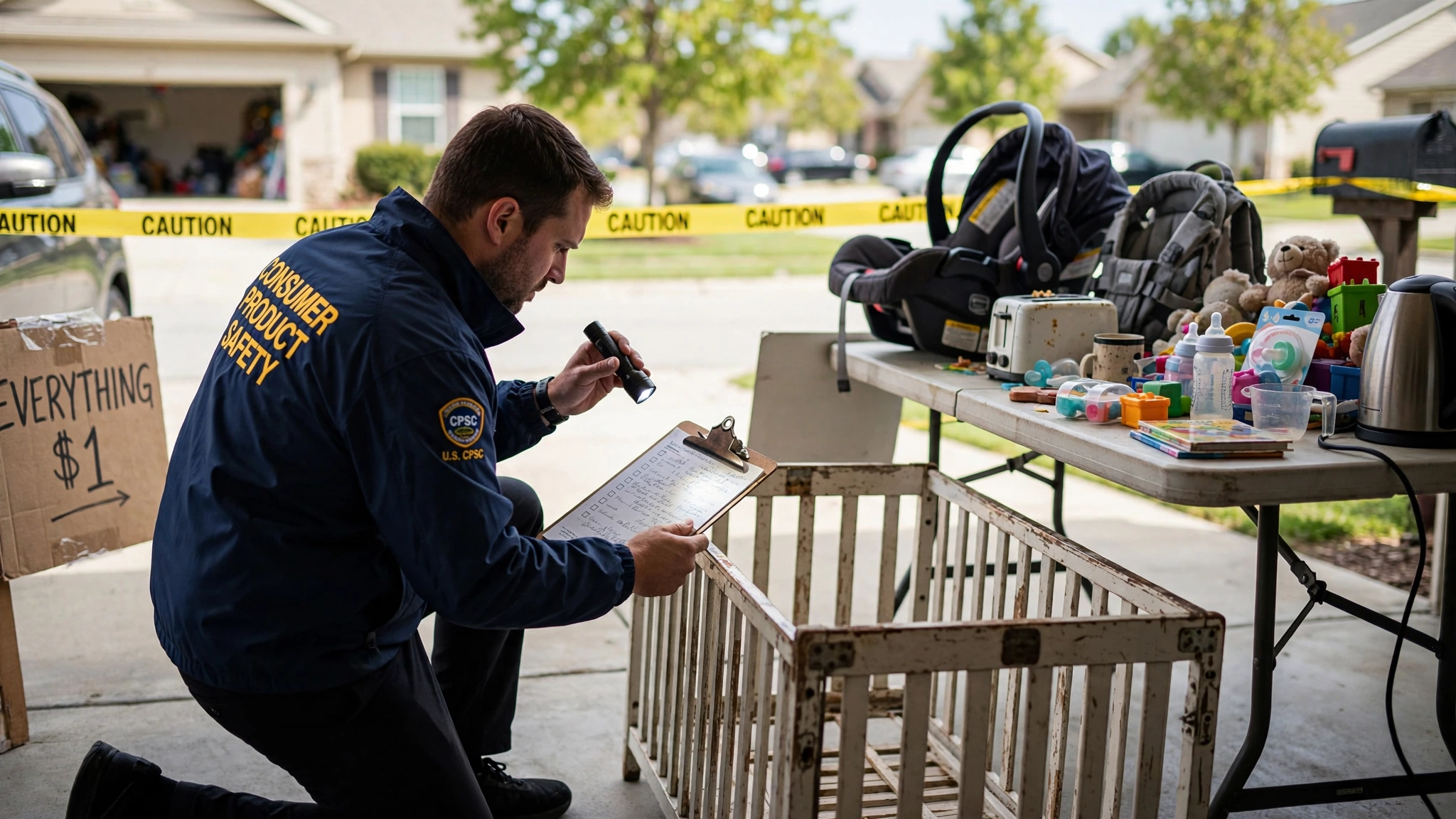
Each of these penalties was assessed under the same statutory provision that applies to a garage sale. Section 19 does not contain a carve-out for residential commerce. Section 20 does not reduce the per-violation penalty for transactions conducted on card tables. The statute that makes it a violation for a national retailer to sell a recalled portable crib makes it an identical violation for a retired schoolteacher in Topeka to sell the same crib for six dollars at a Saturday morning yard sale.
The per-item penalty calculus is instructive. The national clothing chain paid $13 million for approximately 1,200 violations, yielding an average assessed penalty of approximately $10,833 per recalled product sold. The statutory maximum for a single violation is $120,000. The retailer’s penalty represented approximately 9 percent of the available maximum per item. If the same 9-percent rate were applied to a garage sale host who sold three recalled products at two dollars each, the assessed penalty would be $32,499 for a transaction that generated six dollars in revenue. If the maximum were applied, the penalty would be $360,000.
The Commission has assessed zero dollars against any garage sale host. It has not assessed a reduced penalty. It has not assessed a nominal penalty. It has not sent a warning letter. It has not opened an investigation. It has acknowledged in public statements and published guidance that these sales fall within its jurisdiction, deployed an annual public education campaign premised on the fact that they are subject to the law, and then enforced the law exclusively against entities with revenues large enough to make a penalty notice worth printing.
The Consumer Reports investigation of recalled products on Facebook Marketplace and Craigslist documented the same asymmetry in the online resale context. One observer quoted in the report suggested that sellers’ listings of recalled products “should bounce back to them with an alert saying it is unlawful to sell this product.”18 No such system exists for the driveway.
VI. The Impracticability Defense
It is at this point in the analysis that the word “impractical” traditionally appears. The enforcement of consumer product safety laws against millions of individual garage sale hosts would require inspection resources that the Commission does not possess and could never reasonably acquire. The CPSC’s entire workforce comprises approximately 600 employees, of whom roughly 100 are field investigators.19 Dispatching even one inspector to each of the nation’s estimated 165,000 weekly garage sales would require the Commission to hire more field staff than the FBI.
This is true. It is also irrelevant to the legal analysis. The word “impractical” does not appear in 15 U.S.C. § 2068. The statute does not provide that its prohibitions apply only when enforcement is convenient. It does not suspend itself on Saturday mornings between 8 a.m. and 2 p.m. It does not differentiate between a violation that occurs in a warehouse monitored by an inventory management database and a violation that occurs on a plastic tarp in a front yard monitored by a golden retriever.
The Supreme Court has addressed the relationship between a statute’s scope and the practicability of its enforcement in numerous contexts. In Gonzales v. Raich, 545 U.S. 1 (2005), the Court held that Congress’s power under the Commerce Clause extends to the regulation of activities that are “purely local in character” if the regulated class of activities, taken in the aggregate, has a substantial effect on interstate commerce.20 Garage sales are not merely local. The products they sell were manufactured in interstate and international commerce. The buyers who purchase them frequently transport them across state lines. The aggregate value of the secondhand market in the United States exceeds $61 billion per year.21
The jurisdictional question is not close. The enforcement question is logistically impossible. These are different questions. The first is legal. The second is budgetary. The statute answers the first. Congress has not appropriated the answer to the second.
VII. The Recalled Item as Evidentiary Problem
Even if a garage sale host wished to comply with the statute, the compliance burden would be, by any reasonable measure, staggering. The CPSC’s recall database at cpsc.gov/recalls contains thousands of entries spanning decades of consumer products. As of the most recent available data, the database includes recalls dating to the 1970s, covering product categories from infant sleep positioners to space heaters to extension cords to children’s jewelry.22
A typical garage sale offers products spanning the full chronological range of a household’s accumulation. A family that has lived in its home for twenty years may offer children’s toys from three different decades, small appliances purchased under product standards that have since been revised, sporting equipment manufactured before current impact-resistance requirements, and furniture designed before current tip-over prevention standards. Each of these products may or may not be subject to an active recall. Determining the recall status of each item requires identifying the manufacturer, the model number, and the date of manufacture, then searching the database for a matching recall notice.
For a sale offering 150 items, this represents 150 individual searches. The CPSC’s recall database does not support batch queries. It does not accept photographs. It does not have a barcode scanner. It requires the user to know what they are looking for before they search for it, which is precisely the knowledge gap the statute was designed to close.
The Commission’s own solution to this compliance challenge is a one-page guide titled “Reseller’s Guide to Selling Safer Products.” The guide advises resellers to “look out” for products with certain characteristics, check the recall database, and sign up for email alerts. It does not provide a method for checking 150 products in the two hours between setting up a sale and the first customer’s arrival. The gap between the statutory obligation and the practical means of compliance is not a technical limitation. It is a chasm.
VIII. The International Comparison
The United States is not alone in recognizing the resale channel as a product safety risk, but it is unusual in the breadth of its statutory prohibition relative to its enforcement activity. The European Union’s General Product Safety Regulation (EU) 2023/988, which took effect on December 13, 2024, applies to products “made available on the market,” a term that the regulation defines to include second-hand products unless they are “antique products or products in need of repair or reconditioning prior to use, provided that the supplier clearly informs the person to whom it makes the product available thereof.”23
The EU regulation at least acknowledges the category of “products in need of repair” and provides an exemption for goods that are clearly identified as non-functional. The CPSA provides no such exemption. A recalled product is a recalled product whether it is being sold as a functional item, a parts donor, a decorative object, or a doorstop. The prohibition follows the product, not the use.
IX. Conclusion
The evidence does not require interpretive creativity. Section 19 of the Consumer Product Safety Act prohibits the sale of recalled consumer products. The Consumer Product Safety Improvement Act of 2008 strengthened this prohibition and the CPSC has explicitly confirmed that it extends to all resellers, including garage sales. The per-violation civil penalty, adjusted for inflation, is up to $120,000. Each recalled product sold constitutes a separate violation.
The CPSC’s own national study found that 69 percent of professional resale establishments offered at least one hazardous product for sale. The agency has never conducted a comparable study of garage sales, but the compliance infrastructure of a garage sale — which consists of nothing — offers no basis for expecting better results. If seven out of ten Goodwill stores failed the agency’s inspection, the folding table in a retired couple’s garage is not outperforming them.
In 2025, the Commission issued 420 recalls covering more than 40 million individual units. Most recalled products are never returned. They migrate from kitchen drawers to basement shelves to the “free” pile at the edge of the driveway. They enter the secondary market through precisely the channel the statute purports to regulate and the Commission declines to inspect.
An estimated 6.5 to 9 million garage sales occur in the United States each year. At each one, products change hands under a legal framework that imposes the same penalties that cost a national retailer $13 million. The host does not check the recall database. The host does not issue a Consumer Product Safety Act disclosure. The host makes change from a fanny pack.
The Commission’s field operations division, charged with enforcing the laws under CPSC jurisdiction, maintains a dedicated e-commerce team that monitors websites, requests takedowns of recalled product listings, and purchases suspect products for testing.24 It devotes zero comparable resources to the largest unmonitored consumer product distribution channel in the American economy. It monitors eBay. It does not monitor Elm Street.
The statute is clear. The violation is pervasive. The enforcement is absent. Six to nine million times a year, on driveways and lawns and church parking lots across fifty states, Americans conduct transactions that the Consumer Product Safety Act classifies as federal violations, under the supervision of a Commission that has published guides, launched campaigns, held seminars, and issued press releases acknowledging its own jurisdiction over these transactions, and then turned its entire enforcement apparatus in the other direction.
The sign says “EVERYTHING MUST GO.” The statute says it must not.
Ergo.
Sources
- Consumer Product Safety Act, Pub. L. 92-573, 86 Stat. 1207 (1972), codified at 15 U.S.C. §§ 2051–2089. law.cornell.edu ↑
- 15 U.S.C. § 2068, “Prohibited acts.” law.cornell.edu ↑
- U.S. Consumer Product Safety Commission, “CPSC Clarifies Requirements of New Children’s Product Safety Laws Taking Effect in February; Guidance Intended for Resellers of Children’s Products, Thrift and Consignment Stores,” February 2009. cpsc.gov ↑
- U.S. Consumer Product Safety Commission, “Stopping the Online Sale of Recalled Products.” cpsc.gov ↑
- 15 U.S.C. § 2069, “Civil penalties,” as amended by the Consumer Product Safety Improvement Act of 2008, Pub. L. 110-314, § 217. law.cornell.edu ↑
- U.S. Consumer Product Safety Commission, “Notice of Adjusted Civil Penalty Maximum Amounts,” pursuant to the Federal Civil Penalties Inflation Adjustment Act Improvements Act of 2015. cpsc.gov ↑
- 15 U.S.C. § 2070, “Criminal penalties.” law.cornell.edu ↑
- Encyclopedia.com, “Garage and Yard Sales.” encyclopedia.com ↑
- LawnStarter, “The 16 Best Metro Areas for Yard Sales,” citing Statistic Brain Research Institute data on weekly garage sale frequency and item volume. lawnstarter.com ↑
- U.S. PIRG Education Fund, “New Report: Nearly 900 Injuries Linked to Unsafe Consumer Products in 2025 as Recalls Hit 18-Year High,” March 2026. pirg.org ↑
- The CPSC does not publish aggregate recall return rates. Individual recall effectiveness reports, where available, are posted to the CPSC’s recall database. Consumer safety organizations and academic studies have documented single-digit return rates for many consumer product recalls. ↑
- U.S. Consumer Product Safety Commission, “CPSC Study of Hazardous Products in Thrift Stores,” 1999. cpsc.gov ↑
- Ibid. ↑
- U.S. Consumer Product Safety Commission, “CPSC Launches Resale Round-up Campaign to Keep Dangerous Recalled Products Out of Resale Stores and Off the Internet,” Press Release, 2009. cpsc.gov ↑
- Foley & Lardner LLP, “2024 CPSC and FDA Enforcement Trends,” August 2024, reporting that “in 2022, the parent of a well-known clothing chain agreed to pay $13,000,000 for selling approximately 1,200 recalled products.” foley.com ↑
- Ibid., reporting a $9,000,000 civil penalty in September 2023 against a wholesale retailer for failure to report a fire hazard. ↑
- Testimony of Alexander D. Hoehn-Saric, Chairman, U.S. Consumer Product Safety Commission, before the House Committee on Energy and Commerce, FY 2025 Budget Hearing. cpsc.gov ↑
- Consumer Reports, “Recalled Products Are Being Sold on Craigslist & Facebook Marketplace.” consumerreports.org ↑
- The CPSC’s workforce and organizational structure are described in its annual congressional budget justifications. Field investigator count is approximate based on the Division of Field Operations staffing disclosed in recent budget cycles. ↑
- Gonzales v. Raich, 545 U.S. 1 (2005). supreme.justia.com ↑
- Capital One Shopping Research, U.S. secondhand market valuation. Cited in multiple consumer industry publications including CNHI, “Secondhand Sales: Use Your Garage or Yard to Cash In on Billion-Dollar Industry,” August 2024. cnhi.com ↑
- U.S. Consumer Product Safety Commission, Recalls Database. cpsc.gov ↑
- Regulation (EU) 2023/988 of the European Parliament and of the Council of 10 May 2023 on general product safety (General Product Safety Regulation), Article 3(9). eur-lex.europa.eu ↑
- U.S. Consumer Product Safety Commission, “For Buying and Selling Products Online,” Division of Field Operations FAQs. cpsc.gov ↑