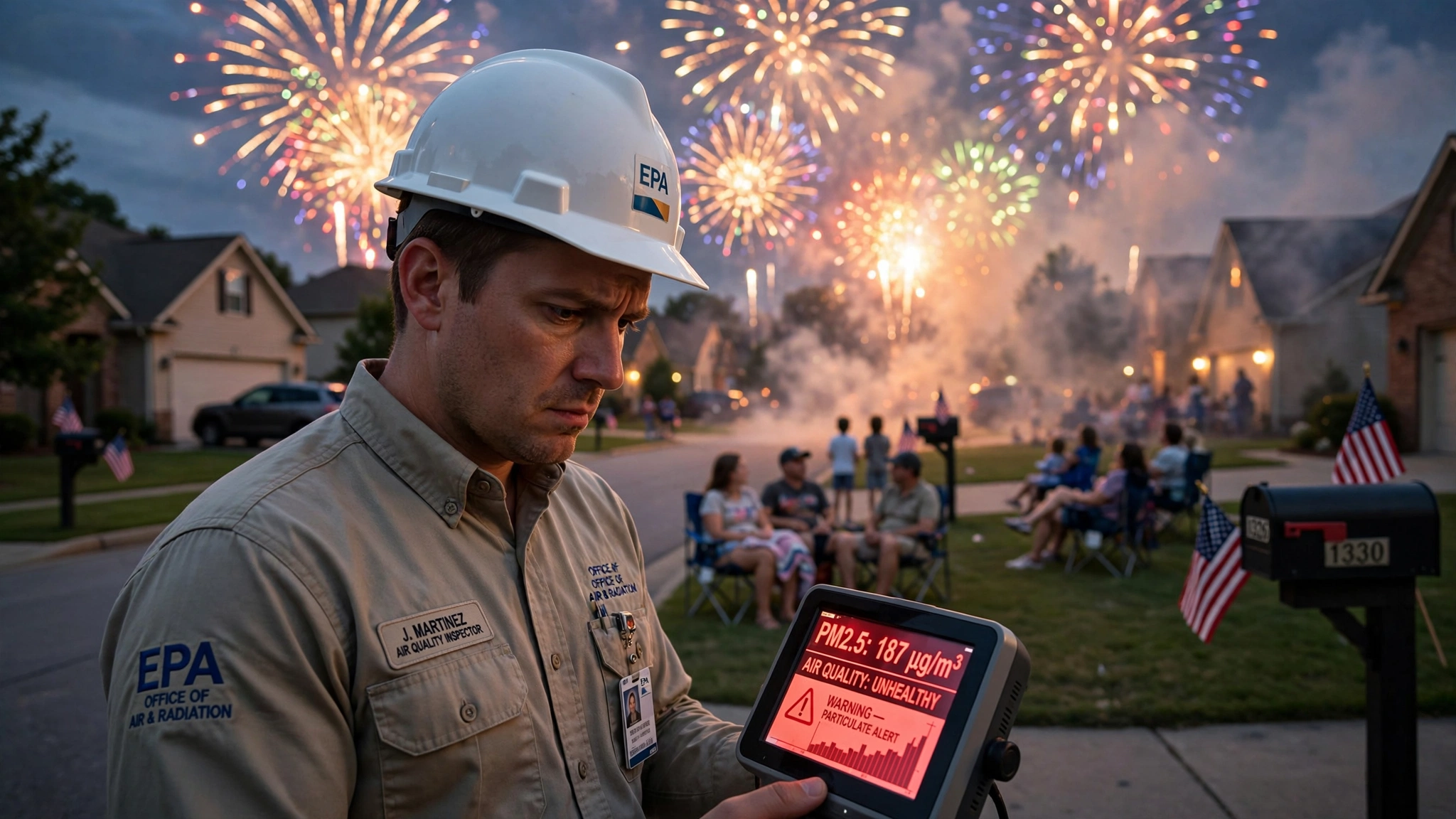
I. The Standard
Section 109 of the Clean Air Act, 42 U.S.C. § 7409, directs the Administrator of the Environmental Protection Agency to promulgate National Ambient Air Quality Standards (NAAQS) for criteria pollutants at levels “requisite to protect the public health” with “an adequate margin of safety.”1 The Act identifies six criteria pollutants. Fine particulate matter, designated PM2.5, is one of them.
The current 24-hour NAAQS for PM2.5 is 35 micrograms per cubic meter (µg/m³), not to be exceeded on more than one percent of days per year, averaged over three years.2 The annual standard is 9.0 µg/m³.3 These standards were last revised in 2024, when the EPA tightened the annual standard from 12.0 to 9.0 µg/m³ based on updated epidemiological evidence linking PM2.5 exposure to cardiovascular mortality, respiratory disease, and premature death.4
The health basis for these standards is not in dispute. The EPA’s 2019 Integrated Science Assessment for Particulate Matter found a “causal relationship” between short-term PM2.5 exposure and cardiovascular effects, respiratory effects, and mortality.5 The World Health Organization’s 2021 Global Air Quality Guidelines recommend an even stricter 24-hour PM2.5 limit of 15 µg/m³.6
The standard is clear. The science is settled. The enforcement apparatus is operational 364 days per year.
II. The Violation
In 2015, Seidel and Birnbaum published a peer-reviewed study in the journal Atmospheric Environment analyzing PM2.5 data from 315 air quality monitors across the contiguous United States on July 4th over the period 1999 to 2013.7 Their findings were unambiguous.
On July 4th, the mean PM2.5 concentration across all monitors increased by 42 percent relative to the surrounding days. At individual monitors near fireworks displays, hourly PM2.5 concentrations exceeded 500 µg/m³, approximately fourteen times the 24-hour NAAQS of 35 µg/m³. Peak concentrations were recorded between 9:00 p.m. and midnight local time, coinciding precisely with the discharge window of municipal fireworks displays.8
For context: the EPA classifies air quality as “Hazardous” at PM2.5 concentrations above 250.4 µg/m³. This is the highest category on the Air Quality Index, colored maroon, defined as “health alert: everyone may experience more serious health effects.”9 The 500 µg/m³ readings documented by Seidel and Birnbaum are not merely in violation of the NAAQS. They are off the top of the scale the EPA built to measure violations.
A 2020 study published in Atmospheric Chemistry and Physics confirmed these findings and extended them, demonstrating that July 4th PM2.5 spikes affect air quality monitors up to 40 kilometers downwind of major displays and that the elevated particulate concentrations persist for six to twelve hours after the final detonation.10 The plume does not know when the holiday ends.
III. The Chemical Inventory
A firework shell is, from a regulatory perspective, an open-air chemical incinerator with a fuse. The combustion products include a catalogue of substances that the Clean Air Act and its implementing regulations were specifically designed to control.
The principal oxidizer in commercial fireworks is potassium nitrate (KNO3), commonly known as saltpeter, which provides the oxygen necessary for rapid combustion of the fuel mixture.11 Additional oxidizers include potassium perchlorate (KClO4) and barium nitrate (Ba(NO3)2). The metallic fuel is typically aluminum or magnesium powder. The color-producing agents are metal salts: strontium carbonate for red, barium chlorate for green, copper compounds for blue, and sodium compounds for yellow.12
Upon detonation, this mixture produces a well-characterized emission profile: fine and ultrafine particulate matter (PM2.5 and PM0.1), sulfur dioxide (SO2), nitrogen oxides (NOx), carbon monoxide (CO), ozone precursors, and a suite of heavy metals including barium, strontium, copper, lead, antimony, and potassium in respirable form.13 A 2007 study published in the Journal of Atmospheric Chemistry measured barium concentrations in ambient air near fireworks displays at levels 1,000 times above background.14
Barium is regulated as a hazardous air pollutant under Section 112 of the Clean Air Act. Lead is a criteria pollutant with its own NAAQS. Sulfur dioxide has a 1-hour NAAQS of 75 parts per billion. A single fireworks shell violates or contributes to violations of standards for multiple criteria and hazardous air pollutants simultaneously. The shell does not file a pre-detonation emissions report.
IV. The Nitrate Connection
The chemistry of the Fourth of July contains a molecular coincidence so precise that it appears designed by an irony committee with tenure.
Potassium nitrate, the primary oxidizer in fireworks, is a salt of nitric acid. Its cousin, sodium nitrate (NaNO3), is the primary curing agent used in the production of hot dogs.15 The two compounds share a nitrate anion (NO3−) and differ only in their cation: potassium in the firework, sodium in the frankfurter. Both undergo thermal decomposition when heated. Both release nitrogen oxides as combustion byproducts. Both are deployed in extraordinary quantities on July 4th.
The National Hot Dog and Sausage Council reports that Americans consume approximately 150 million hot dogs on the Fourth of July alone, out of roughly 20 billion consumed annually.16 The American Pyrotechnics Association estimates that approximately 16,000 fireworks displays are held on or around July 4th each year, consuming an estimated 285.3 million pounds of fireworks product sold annually, with the majority concentrated in the July window.17
On the same evening, the American public detonates one form of nitrate salt into the troposphere while ingesting another form of nitrate salt at a rate of approximately 17,360 hot dogs per second. The nitrate goes up. The nitrate goes down. The nitrogen cycle has never been more festive.
V. The Stationary Source Question
Section 111 of the Clean Air Act defines a “stationary source” as “any building, structure, facility, or installation which emits or may emit any air pollutant.”18 Section 302(z) further defines “stationary source” for Title V permitting purposes with similar breadth.19
A municipal fireworks display is conducted from a fixed launch site, typically a barge, a cleared field, or a stadium. The launch site is a facility. The facility emits air pollutants. A major stationary source under Title V requires a permit if it emits or has the potential to emit 100 tons per year of any criteria pollutant, or 10 tons per year of any single hazardous air pollutant, or 25 tons per year of any combination of hazardous air pollutants.20
A large municipal fireworks display may discharge 10,000 to 60,000 aerial shells in a single evening.21 The total particulate and gaseous emissions from a display of this scale have not been comprehensively measured in a regulatory context, because no regulatory body has attempted to measure them. This is not because the emissions are small. It is because no one has pointed the instrument at the explosion and filed the paperwork.
The EPA has issued Title V operating permits to power plants, refineries, cement kilns, and animal feeding operations. It has not issued a Title V operating permit to a Fourth of July fireworks display. The question is whether the Act distinguishes between a facility that emits barium, lead, sulfur dioxide, and fine particulate matter on 365 days per year and a facility that emits the same substances on one day per year at fourteen times the concentration. The Act does not draw this distinction. The Act says “any.”
VI. The Consumer Product Safety Overlay
While the EPA declines to regulate the atmospheric consequences of fireworks, the Consumer Product Safety Commission (CPSC) diligently tracks the human ones. The CPSC’s 2024 Fireworks Annual Report documented approximately 9,500 emergency department-treated injuries associated with fireworks during the calendar year, with 7,500 of those occurring in the 30-day window around July 4th.22 Eight deaths were reported.23
The most common injuries were burns (44 percent), contusions and lacerations (21 percent), and fractures (4 percent). The body parts most frequently injured were hands and fingers (29 percent), head, face, and ears (21 percent), and legs (17 percent).24 The age group with the highest injury rate was children aged 5 to 9.
For comparison, the EPA’s own health impact assessments estimate that PM2.5 exposure causes approximately 100,000 to 200,000 premature deaths per year in the United States.25 The CPSC counts the people whose fingers the fireworks removed. The EPA counts the people whose lungs the fireworks impaired. The CPSC publishes its report. The EPA publishes its Air Quality Index forecast for July 4th with the caveat that “fireworks may temporarily affect local air quality”26 and moves on.
The word “temporarily” is doing more structural work in that sentence than any load-bearing element of the Clean Air Act was designed to support.
VII. The Flag Burning Regulation
Title 4 of the United States Code, Section 8(k), prescribes the proper method for disposing of an American flag that is “in such condition that it is no longer a fitting emblem for display.” The prescribed method is burning: “it should be destroyed in a dignified way, preferably by burning.”27
The American Legion, Veterans of Foreign Wars, Boy Scouts of America, and Girl Scouts of the USA all conduct annual flag retirement ceremonies, many of which are held on or around Flag Day (June 14) and the Fourth of July.28 The United States Flag Foundation estimates that approximately 30 million flags are retired annually, though the number that are properly burned versus discarded in landfills is not tracked by any federal agency.29
The standard American flag is manufactured from nylon or polyester. The combustion of nylon releases hydrogen cyanide (HCN), nitric oxide (NO), and caprolactam.30 The combustion of polyester releases terephthalic acid, acetaldehyde, carbon monoxide, and fine particulate matter.31 Hydrogen cyanide is listed as a hazardous air pollutant under Section 112 of the Clean Air Act.32
Federal law mandates the burning of a textile that, when burned, releases a substance that federal law classifies as a hazardous air pollutant. The mandate and the prohibition were enacted by the same legislature, signed by the same executive, and enforced by agencies within the same executive branch. The flag code creates the emission source. The Clean Air Act prohibits the emission. The flag is caught in a regulatory superposition: it must be burned and must not produce the chemical byproducts of burning. The flag code does not specify fire-retardant nylon.
VIII. The Exceptional Event Rule
The EPA is aware of the July 4th particulate problem. It has solved the problem by deciding it is not a problem.
The Exceptional Events Rule, promulgated under 40 CFR Parts 50 and 51, allows states to exclude air quality monitoring data from NAAQS compliance determinations if the data are attributable to “exceptional events,” defined as events that are “not reasonably controllable or preventable” and are “caused by human activity that is unlikely to recur at a particular location or a natural event.”33
The rule was designed for wildfires, volcanic eruptions, and dust storms. The EPA has acknowledged in guidance documents that fireworks-related air quality exceedances may qualify for exceptional event treatment under certain circumstances.34
This deserves scrutiny. The rule requires that the event be “unlikely to recur at a particular location.” The Macy’s Fourth of July Fireworks display has been held in New York City every year since 1976.35 The Boston Pops Fireworks Spectacular has been held on the Esplanade since 1974. The National Mall display in Washington, D.C., has occurred annually since 1777. An event that has recurred at the same location for 249 consecutive years is, by any definitional standard, likely to recur.
The Exceptional Events Rule was designed to exclude genuinely unforeseeable perturbations from the compliance record. The Fourth of July is not unforeseeable. It is printed on the calendar. It is a federal holiday. The fireworks are permitted months in advance by local fire marshals. The supply chain is pre-staged by the American Pyrotechnics Association. The violation is not exceptional. It is annual, planned, funded, and celebrated. The rule is being used not to exclude anomalies but to ratify them.
IX. The Comparative Enforcement
In fiscal year 2024, the EPA’s Office of Enforcement and Compliance Assurance initiated 1,489 civil enforcement cases and 126 criminal enforcement cases under the Clean Air Act and related statutes.36 The penalties assessed included $3.8 billion in injunctive relief and $171 million in civil penalties. These cases targeted power plants, industrial facilities, and vehicle manufacturers for emissions violations, many involving particulate matter and criteria pollutants.
For comparison, consider the following enforcement asymmetry.
A coal-fired power plant that exceeds its PM2.5 emissions limit by 42 percent on a single day faces a potential civil penalty of up to $109,024 per day of violation under Section 113 of the Clean Air Act, as adjusted for inflation.37 If the exceedance is 42 percent sustained across multiple days, the penalty exposure escalates and may trigger mandatory permit revision, installation of additional controls, and potential criminal referral.
On July 4th, 2026, the entire national PM2.5 average will increase by approximately 42 percent. Hundreds of individual monitoring stations will record readings five, ten, or fourteen times the NAAQS. The emission sources are known. The operators are identifiable. The permits are on file with local fire departments. The emissions timing is predictable to the minute.
The EPA will not initiate a single enforcement action. It will post an Air Quality Index advisory. It will recommend that sensitive groups limit outdoor exposure. Then the Administrator will watch the fireworks.
X. The Population Exposure
The American Pyrotechnics Association estimates that approximately 16,000 professional fireworks displays are conducted annually in the United States, the vast majority on or within three days of July 4th.38 Consumer fireworks sales in 2023 totaled approximately $2.3 billion, representing 418.5 million pounds of product sold to the general public for private use.39
The distinction between “display fireworks” (1.3G, professional) and “consumer fireworks” (1.4G, retail) is a Bureau of Alcohol, Tobacco, Firearms and Explosives classification that determines who may purchase and discharge the product.40 It is not an atmospheric classification. A 1.4G Roman candle and a 1.3G aerial shell produce the same categories of criteria pollutants and hazardous air pollutants upon combustion. The ATF classification determines who lights the fuse. It does not determine what happens to the barium.
In 2024, the National Fire Protection Association estimated that 64 percent of the U.S. population lives in a jurisdiction where some or all consumer fireworks are legal.41 On July 4th evening, the simultaneous discharge of consumer fireworks across these jurisdictions, combined with 16,000 professional displays, creates a coordinated emissions event with no parallel in the EPA’s regulatory history.
Wildfires, the principal natural source of PM2.5 exceedances, are episodic, spatially concentrated, and treated as emergencies. The July 4th particulate event is national in scope, geographically distributed across every populated area, and treated as a celebration. The particulate concentration per event may be lower than a wildfire. The exposed population is larger. The intent is recreational. The particulate does not know.
XI. The Ozone Precursor Problem
The combustion of fireworks pyrotechnic compositions produces nitrogen oxides (NOx) and volatile organic compounds (VOCs), both of which are precursors to ground-level ozone formation.42 The 8-hour NAAQS for ozone is 0.070 parts per million, last revised in 2015.43 Ozone formation requires sunlight, which means the NOx and VOCs emitted on the evening of July 4th contribute to ozone formation the following morning, July 5th, when photochemistry resumes.
The Clean Air Act requires states to develop State Implementation Plans (SIPs) demonstrating how they will achieve and maintain compliance with the ozone NAAQS.44 Many metropolitan areas, including Los Angeles, Houston, Phoenix, and the New York tristate region, are classified as “nonattainment” for ozone, meaning they have failed to meet the standard and are subject to additional planning and emission reduction requirements.
In these nonattainment areas, state regulators impose increasingly stringent controls on industrial sources, commercial facilities, and motor vehicles to reduce NOx and VOC emissions by fractions of a percent. New Source Review permits require industrial facilities to install Best Available Control Technology. Automobile manufacturers spend billions to meet tailpipe emission standards. Paint and solvent formulations are regulated to minimize VOC content.
Then, on the evening of July 4th, 16,000 points of uncontrolled combustion simultaneously release NOx and VOCs directly into the urban boundary layer, and every SIP model that does not account for this annual bolus injection is, to that extent, incomplete.
XII. The Waterway Dimension
A substantial fraction of professional fireworks displays are conducted over water: from barges on rivers, harbors, and lakes. The Macy’s display is launched from barges in the East River. The National Mall display is visible from the Potomac. Boston’s is on the Charles. San Diego’s is in the harbor.
The post-detonation fallout from fireworks includes unburned pyrotechnic composition, spent cardboard and paper casings, and particulate residue containing perchlorate, barium, strontium, copper, and other metallic compounds.45 Perchlorate is a known thyroid disruptor and a contaminant of concern under the Safe Drinking Water Act.46 Barium is regulated under the SDWA with a maximum contaminant level of 2 mg/L.47
Section 301 of the Clean Water Act prohibits the discharge of any pollutant from a point source into navigable waters of the United States without a National Pollutant Discharge Elimination System (NPDES) permit.48 A barge is a point source. The East River is a navigable water. Metallic particulate falling from a detonated shell into the river is a discharge of a pollutant. No fireworks operator in the United States holds an NPDES permit for pyrotechnic fallout.
The Clean Air Act violation and the Clean Water Act violation occur simultaneously from the same detonation event. The shell goes up and violates one statute. The debris comes down and violates another. The round trip takes approximately eight seconds.
XIII. The Regulatory Superposition
To summarize the regulatory position of a single aerial fireworks shell detonated on July 4th, 2026, over a navigable waterway:
The shell is classified as a 1.3G explosive by the ATF, requiring a Federal Explosives License for manufacture, distribution, and storage.49 The detonation releases PM2.5 in concentrations exceeding the NAAQS by a factor of up to 14, constituting a violation of the Clean Air Act. The combustion produces barium, a hazardous air pollutant under Section 112, and lead, a criteria pollutant with its own NAAQS. The NOx emissions contribute to ozone formation in nonattainment areas, implicating State Implementation Plans under Title I. The perchlorate and metallic fallout entering the waterway constitute an unpermitted discharge under Section 301 of the Clean Water Act. The disposal of the spent casing constitutes disposal of a solid waste containing hazardous constituents under RCRA Subtitle C if the residue exhibits the characteristic of toxicity for barium or lead under 40 CFR Part 261.50
A single shell. Seven seconds of flight time. Five federal environmental statutes violated. Three separate federal agencies with jurisdiction. Zero enforcement actions in 249 years of American pyrotechnic celebration.
The regulatory system has not failed to notice this. The regulatory system has decided that some violations are patriotic.
XIV. The Comparative Combustion
In 2015, Volkswagen agreed to pay approximately $14.7 billion to settle charges that it had installed defeat device software in 11 million diesel vehicles, causing them to emit NOx at levels up to 40 times the applicable standard during normal driving conditions.51 The EPA described the violation as “one of the most significant cases of corporate fraud in American history.”
On July 4th, 2026, approximately 16,000 fireworks displays will emit PM2.5 at levels up to 14 times the applicable standard and NOx at levels that have never been measured because no regulatory body has attempted to quantify them. The displays are not fraudulent. They are permitted. They are funded by municipal governments, corporate sponsors, and private citizens. They are attended by the regulators themselves.
Volkswagen exceeded its emissions standard by 40x and paid $14.7 billion. Fireworks exceed the NAAQS by 14x and receive applause. The distinction is that Volkswagen lied about exceeding the standard, while fireworks displays exceed it openly, spectacularly, and with a soundtrack. The Clean Air Act does not contain an exemption for honesty, spectacle, or musical accompaniment.
XV. Conclusion
The Clean Air Act was enacted in 1970 and substantially amended in 1977 and 1990. Its stated purpose is “to protect and enhance the quality of the Nation’s air resources so as to promote the public health and welfare and the productive capacity of its population.”52 It has been used to shut down coal plants, redesign automobile engines, reformulate gasoline, and impose emission controls on cement kilns, oil refineries, and dry cleaners. The EPA has assessed billions in penalties against violators.
On July 4th, 2026, approximately 330 million Americans will be exposed to a coordinated, scheduled, permitted, and celebrated violation of the Act’s most fundamental air quality standard. The violation will be visible from space. The monitoring data will show it. The health studies have documented it. The regulatory agency charged with enforcement will post a polite advisory, then watch.
There are two possible interpretations of this situation. The first is that the Fourth of July represents a one-night regulatory holiday in which the Clean Air Act, the Clean Water Act, and RCRA are suspended by informal consensus in the name of national celebration. If so, the EPA should formally codify this suspension in the Federal Register, specify its duration, and explain to the 37 million Americans with asthma why their respiratory systems are expected to observe it.53
The second interpretation is that the Clean Air Act was never intended to regulate celebratory combustion, that its framers understood the difference between a coal plant and a bottle rocket, and that the regulatory apparatus is applying reasonable prosecutorial discretion by declining to enforce the statute against an activity that is culturally foundational, economically trivial, and temporally limited.
This interpretation is plausible. It is also, by the text of the statute, legally indefensible. The Act says “any.” The NAAQS says 35 µg/m³. The monitors say 500. The gap between what the law says and what the law does is 465 micrograms wide and filled with barium, strontium, potassium nitrate, and the lingering smell of gunpowder.
Happy Independence Day. The particulate is complimentary.