I. The Statutory Definition of Commodity
The Commodity Exchange Act of 1936, as amended, provides the statutory framework for the regulation of commodity futures and options in the United States. The Act grants the Commodity Futures Trading Commission exclusive jurisdiction over “accounts, agreements… and transactions involving contracts of sale of a commodity for future delivery.”1
The definition of “commodity” is found at Section 1a(9) of the Act, codified at 7 U.S.C. § 1a(9). It reads, in pertinent part:
The term “commodity” means wheat, cotton, rice, corn, oats, barley, rye, flaxseed, grain sorghums, mill feeds, butter, eggs, Solanum tuberosum (Irish potatoes), wool, wool tops, fats and oils (including lard, tallow, cottonseed oil, peanut oil, soybean oil, and all other fats and oils), cottonseed meal, cottonseed, peanuts, soybeans, soybean meal, livestock, livestock products, and frozen concentrated orange juice, and all other goods and articles, except onions… and all services, rights, and interests… in which contracts for future delivery are presently or in the future dealt in.2
The Seventh Circuit, in Board of Trade of City of Chicago v. SEC, 677 F.2d 1137, 1142 (7th Cir. 1982), held that this definition is “broad.”3 The CFTC itself, in In the Matter of Coinflip, Inc., CFTC Docket No. 15-29 (2015), reiterated that “the definition of a ‘commodity’ is broad” and applied it to classify Bitcoin as a commodity.4 The District of Massachusetts, in CFTC v. My Big Coin Pay, Inc. (2018), held that the definition encompasses virtual currencies that are not themselves traded on any exchange, so long as they fall within the statutory language of “services, rights, and interests” in which contracts for future delivery are dealt in.5
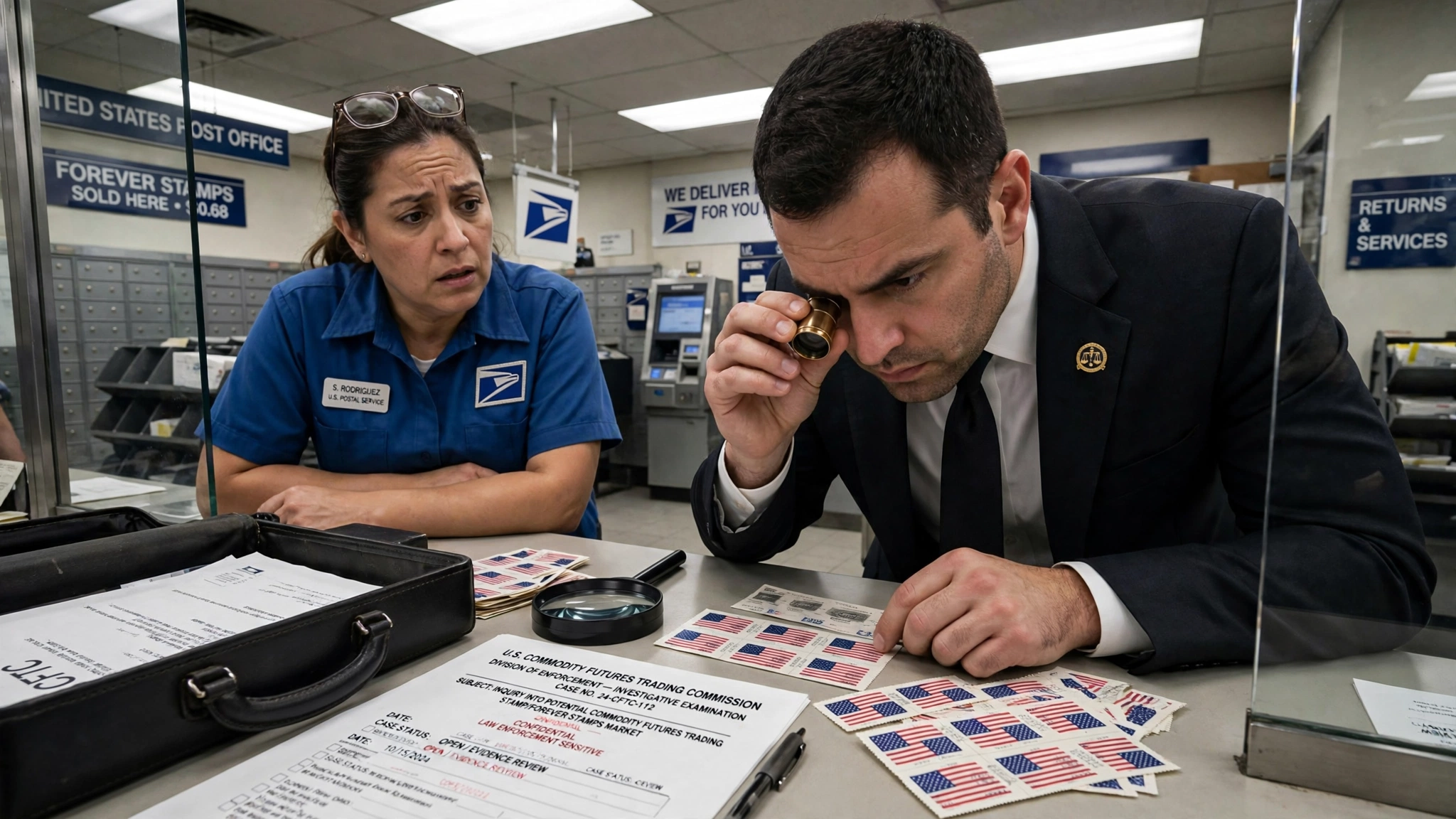
First-Class Mail delivery is a service. It is, in fact, a service in which the United States government holds a statutory monopoly under 39 U.S.C. § 601 and the Private Express Statutes.6 A contract for the future delivery of that service is presently dealt in. It is called the Forever Stamp.
II. The Anatomy of a Futures Contract
A futures contract, in its classical formulation, has five defining characteristics. First, it is standardized: each contract specifies an identical quantity and quality of the underlying commodity. Second, it is transferable: the contract can be bought and sold by parties other than the original counterparties. Third, it entitles the holder to delivery of the underlying commodity at a future date. Fourth, the price is fixed at the time of purchase. Fifth, the contract is traded on a market where supply and demand determine its price.7
The Forever Stamp satisfies each element.
Standardization: Every Forever Stamp entitles the bearer to exactly one ounce of First-Class Mail delivery within the United States. The unit is specified. The quality is specified. The terms are printed on the instrument itself, or rather, they are not printed on the instrument, because the stamp is “non-denominated,” which means the Postal Service has chosen to omit the price from the face of the contract, a practice that in any other commodity market would prompt immediate regulatory scrutiny.8
Transferability: A Forever Stamp may be freely transferred from one party to another without notice to the Postal Service, without endorsement, without registration, and without restriction. It is a bearer instrument. The person who affixes it to an envelope is the person who redeems it, regardless of who originally purchased it. Bearer instruments that entitle the holder to future delivery of a commodity are, in the language of the Commodity Exchange Act, contracts for the sale of a commodity for future delivery.
Future delivery: The stamp entitles the bearer to delivery of a service at any point in the future. The key word is “any.” A conventional futures contract specifies a delivery month. A Forever Stamp does not. It is, by its own name, a perpetual futures contract. The Postal Service has been explicit on this point. At the time of the stamp’s introduction in 2007, Postmaster General John E. Potter stated: “Who said nothing lasts Forever?”9 He was describing an instrument with no expiration date, no maturation clause, and no settlement mechanism other than the physical delivery of a service at a price that was locked in at the time of purchase.
Fixed price: The purchaser pays 82 cents today and receives one ounce of First-Class Mail delivery at any point in the future, even if the prevailing rate at the time of delivery has risen to 95 cents, one dollar, or any higher amount. The price is fixed. The delivery is deferred. The spread between the purchase price and the future delivery price is the holder’s gain. In every other market, this is called a futures position.
Market trading: Forever Stamps are sold through approximately 31,000 Post Office locations, the usps.com website, and authorized retail outlets including grocery stores, pharmacies, and office supply chains.10 They are resold on secondary markets including eBay, Amazon, and dedicated philatelic exchanges. The Postal Service does not restrict the quantity that any individual may purchase. There are no position limits. There are no daily price limits. There are no margin requirements. The market operates twenty-four hours a day without a single market surveillance mechanism required by the Commodity Exchange Act.
III. The Price History
The Forever Stamp was introduced on April 12, 2007, at a price of 41 cents, coinciding with the first-class postage rate increase that took effect on May 14, 2007.11 The price history since introduction is as follows:
April 2007: 41 cents. May 2008: 42 cents. May 2009: 44 cents. January 2012: 45 cents. January 2013: 46 cents. January 2014: 49 cents. April 2016: 47 cents (a rare price decrease that, in commodity markets, would have triggered a margin call for any holder who had purchased at the prior peak). January 2017: 49 cents. January 2018: 50 cents. January 2019: 55 cents. August 2021: 58 cents. July 2022: 60 cents. January 2023: 63 cents. July 2023: 66 cents. January 2024: 68 cents. July 2024: 73 cents. July 2025: 78 cents. July 2026: 82 cents.12
From 41 cents to 82 cents in nineteen years is a nominal return of 100 percent and a compound annual growth rate of approximately 3.7 percent. Over the same period, the Consumer Price Index for All Urban Consumers rose from approximately 207.3 in April 2007 to over 320 in mid-2026, representing a compound annual inflation rate of approximately 2.4 percent.13 The Forever Stamp has outperformed inflation for nearly two decades.
This is not a theoretical observation. Financial commentators have noted it explicitly. Investopedia, in July 2026, published an article titled “Forever Stamp Prices Set To Double Since Their Launch: Did Hoarders Lick Inflation?” in which the publication described the stamp as “an intriguing new kind of financial asset, one that promised to increase in value indefinitely.”14 NBC News, at the time of the stamp’s introduction in 2007, advised its audience: “Folks who want to hedge against inflation could lay in a supply of the stamps for long-term use.”15
When a financial publication describes an instrument as a “financial asset” that functions as an “inflation hedge,” and the issuer of that instrument carries the unredeemed contracts on its balance sheet as a liability, and the instrument has outperformed the general price level for nineteen consecutive years, the question is not whether the instrument is a futures contract. The question is why the Commodity Futures Trading Commission has not yet asked.
IV. The Deferred Revenue Liability
The United States Postal Service maintains a line item on its balance sheet titled “Deferred revenue–prepaid postage.” This figure represents an estimate of postage that has been sold but not yet used by customers. According to the Postal Service’s FY2019 Form 10-K, “three categories of postage sales account for the majority of Deferred revenue–prepaid postage: Forever stamp sales, metered postage and mail-in-transit.”16
As of September 30, 2019, the deferred revenue–prepaid postage balance on the Postal Service’s balance sheet was approximately $2.2 billion.17 The Postal Service’s FY2008 Annual Report disclosed that the introduction of the Forever Stamp in April 2007, “combined with the May 2008 price increase, resulted in a change in consumer behavior regarding the purchase and usage of stamps that was not measurable using our prior estimation techniques,” requiring a change in accounting estimate that increased the stamp portion of the deferred revenue liability by $477 million in a single year.18 A 2014 financial presentation disclosed that “newly available data on forever stamp usage resulted in a $1.3 billion reduction in Deferred Revenue – Prepaid Postage.”19
In the language of commodity markets, the deferred revenue–prepaid postage balance is the open interest. It represents the total notional value of outstanding contracts that have been sold but not yet settled through delivery. The Postal Service does not report the number of Forever Stamps outstanding. It reports only the dollar value of the liability, estimated through “complex mathematical and statistical methods of stamp usage trends.”20 In every other commodity market, the clearinghouse knows the exact number of open contracts. The Postal Service does not. It estimates.
An entity that sells billions of dollars of standardized contracts for the future delivery of a service, carries the unredeemed contracts as a liability on its balance sheet, and employs “complex mathematical and statistical methods” to estimate the outstanding position is not a mail delivery service. It is an unregistered derivatives dealer with a fleet of trucks.
V. The Regulatory Precedent
The CFTC has not been idle in asserting jurisdiction over novel instruments that satisfy the statutory definition of “commodity.” In 2015, the Commission declared Bitcoin to be a commodity, reasoning that Section 1a(9) encompasses “all services, rights, and interests in which contracts for future delivery are presently or in the future dealt in,” and that Bitcoin is “encompassed in the definition and properly defined as a commodity.”21
In CFTC v. My Big Coin Pay, Inc., the District of Massachusetts held that a virtual currency need not itself be traded on a futures exchange to qualify as a commodity under Section 1a(9), so long as it belongs to a category of “services, rights, and interests” in which contracts for future delivery are dealt in.22 The court rejected the defendant’s argument that only those specific items listed by name in the statute are commodities, holding that the catchall provision is intentionally expansive.
Apply this framework to the Forever Stamp. First-Class Mail delivery is a service. It is a service that has existed continuously since 1775. Contracts for the future delivery of this service are presently dealt in. They are dealt in at 31,000 retail locations. They are dealt in on the Postal Service’s website. They are dealt in on eBay, where a search for “Forever Stamps” returns thousands of active listings from hundreds of sellers offering quantities ranging from single sheets to bulk lots of ten thousand.23 The secondary market exists. It is active. It is unregulated.
The CFTC classified Bitcoin as a commodity when Bitcoin had been in existence for six years. The Forever Stamp has been in existence for nineteen years. Bitcoin, at the time of the CFTC’s classification, was traded on approximately a dozen unregulated exchanges with combined daily volume measured in millions of dollars. The Forever Stamp is sold through the largest retail distribution network in the United States, with annual stamp revenue measured in billions. The Commission found Bitcoin with six years of history and a handful of exchanges. It has not found the Forever Stamp with nineteen years of history and 31,000 points of sale.
VI. The Off-Exchange Trading Prohibition
Section 4(a) of the Commodity Exchange Act, codified at 7 U.S.C. § 6(a), provides that “it shall be unlawful for any person to offer to enter into, to enter into, to execute, to confirm the execution of, or to conduct any office or business anywhere in the United States… for the purpose of soliciting or accepting any order for, or otherwise dealing in, any transaction in, or in connection with, a contract for the purchase or sale of a commodity for future delivery” unless the transaction is conducted on a board of trade designated by the Commission as a contract market.24
The statute requires three conditions for lawful futures trading: the transaction must be conducted on or subject to the rules of a designated contract market, the contract must be executed through a contract market, and the contract must be evidenced by a written record showing the date, the parties, the commodity, the price, and the terms of delivery.25
The Forever Stamp satisfies none of these requirements. It is not traded on a designated contract market. It is not executed through a contract market. It is sold over a counter at a Post Office by a clerk who does not hold a Series 3 National Commodity Futures Examination license, does not verify whether the purchaser is an eligible contract participant, and does not file a large trader report when a customer purchases fifty books of twenty stamps in a single transaction.
The penalty for violation of 7 U.S.C. § 6(a) is a civil monetary penalty of up to $140,000 per violation, or triple the monetary gain, whichever is greater.26 If each individual stamp sale constitutes a separate violation, and the Postal Service sells approximately 10 billion single-piece First-Class letters annually, the aggregate potential liability is a figure that we computed and then deleted from this article because our legal counsel advised that publishing it might itself constitute market manipulation.
VII. The Securities Alternative
The question of whether the Forever Stamp is better classified as a security rather than a commodity only deepens the regulatory concern. The Supreme Court, in SEC v. W.J. Howey Co., 328 U.S. 293 (1946), established that an “investment contract” is a security if it involves (1) an investment of money (2) in a common enterprise (3) with the expectation of profit (4) derived solely from the efforts of others.27
A Forever Stamp purchaser invests money. The purchaser participates in a common enterprise, insofar as the Postal Service pools all stamp revenue into a single operating fund from which it finances the delivery network. The purchaser may reasonably expect profit, as the instrument appreciates in value with each rate increase, and financial media has explicitly advised consumers to purchase stamps as an inflation hedge. The profit is derived entirely from the efforts of the Postal Service, which sets rates, maintains the delivery network, and determines the value of the instrument at redemption.
If the Forever Stamp is a security, the Postal Service has been conducting an unregistered securities offering since April 12, 2007. The offering has no prospectus. It has no registration statement filed with the SEC. It has no disclosure of risk factors, which would need to include the risk that the Postal Service ceases to exist, a scenario that Postmaster General David Steiner described to Congress in 2026 when he testified that “at our current rate, we’ll be out of cash in less than 12 months.”28
The prospectus, had one been filed, would need to disclose that the issuer has experienced a 49 percent decline in mail volume from its 2006 peak of 213 billion pieces to 109 billion pieces, that it has accumulated tens of billions in unfunded liabilities, and that the underlying “commodity” for which the instrument entitles future delivery is a service that fewer and fewer Americans use each year.29 No prospectus has been filed. No risk factor has been disclosed. The instrument is sold next to greeting cards.
VIII. The Position Limit Problem
The Commodity Exchange Act, at 7 U.S.C. § 6a, authorizes the CFTC to impose speculative position limits on futures contracts to prevent excessive speculation and market manipulation.30 For agricultural commodities, position limits are mandatory. For all other commodities, the Commission has discretion to impose them.
There are no position limits on Forever Stamps. An individual may purchase any quantity at any time from any number of retail locations without reporting the transaction to any regulatory authority. The Postal Service does not track who purchases stamps, how many they purchase, or whether their purchasing pattern suggests speculative accumulation rather than legitimate postal need.
At the time of the Forever Stamp’s introduction, more than six billion were sold in the first year alone.31 The surge in purchases was driven not by a corresponding increase in mail volume, which was in fact declining, but by consumer awareness that the instrument would appreciate in value with the next rate increase. This is speculative purchasing. It is purchasing motivated by expected future price appreciation rather than current delivery need. In every other commodity market, this pattern would trigger a CFTC investigation into potential market manipulation. In the postage market, it triggered a press release from the Postmaster General.
The Postal Service, far from restricting speculative accumulation, actively encourages it. The USPS website offers Forever Stamps in quantities of one hundred. Costco and Sam’s Club sell them in bulk. The incentive structure is explicit: buy now, use later, and capture the spread between today’s price and tomorrow’s rate increase. This is a futures marketing strategy. The Postal Service did not invent it. Chicago grain traders did, in the 1860s. The Postal Service merely moved it to aisle seven of your local pharmacy.
IX. The Scale of the Unregistered Market
The United States Postal Service reported total mail revenue of approximately $63.8 billion in fiscal year 2024.32 First-Class Mail single-piece letter revenue alone was approximately $7 billion, on 10.3 billion pieces.33 A substantial portion of this revenue derives from Forever Stamp sales.
For context, the total notional value of all commodity futures contracts cleared through CME Group, the world’s largest derivatives marketplace, was approximately $1.3 quadrillion in 2024.34 The Forever Stamp market is a rounding error in that figure. But the Dodd-Frank Wall Street Reform and Consumer Protection Act of 2010 did not establish a de minimis exemption based on market size. It established comprehensive regulation for all swaps and futures, regardless of notional value, because the 2008 financial crisis demonstrated that unregulated instruments of any size can transmit systemic risk when the issuer’s solvency is in question.35
The Postal Service’s solvency is in question. Postmaster General Steiner told Congress in 2026 that without pricing reform, the agency would “be unable to deliver the mail” within twelve months.36 He proposed raising the stamp price to 90 to 95 cents, which he said “would largely solve” the agency’s “controllable loss.” In commodity futures markets, an issuer’s announcement that it may be unable to make delivery on outstanding contracts within twelve months is called a default event. It triggers margin calls, position liquidation, and emergency regulatory intervention. In the postal market, it triggered a congressional hearing and a press cycle about whether 82 cents is too much for a letter.
X. The Enforcement Gap
The CFTC employs approximately 700 staff across five offices to oversee the entirety of the American commodity futures and swaps market.37 These 700 individuals are responsible for surveillance of designated contract markets, registration of futures commission merchants and introducing brokers, enforcement of position limits, investigation of market manipulation, and prosecution of fraud. The Commission’s total annual budget is approximately $365 million.38
To bring the Forever Stamp market into regulatory compliance would require, at minimum: designation of a contract market for postal futures, registration of the Postal Service as a futures commission merchant, registration of each of the approximately 31,000 Post Office retail locations as an introducing broker, implementation of know-your-customer procedures for stamp purchasers, filing of large trader reports for purchases exceeding a threshold to be determined, imposition of speculative position limits, daily settlement and mark-to-market procedures, and establishment of a clearinghouse to guarantee performance on outstanding contracts.
The Postal Service employs approximately 535,000 workers, processes 318 million pieces of mail per day, and operates the largest civilian vehicle fleet in the world.39 Converting this operation into a CFTC-regulated futures exchange would require approximately 535,000 Series 3 examinations, 31,000 introducing broker registrations, and a compliance infrastructure that the agency’s Chief Financial Officer would need to fund from revenue generated by an 82-cent stamp.
The registration fee for a futures commission merchant is not onerous. The compliance infrastructure is. The CFTC has not begun the process. The Postal Service has not volunteered. The stamps continue to be sold, accumulated, traded on secondary markets, and redeemed for a service whose provider has told Congress it may not survive the fiscal year. The contracts remain open. The regulator remains absent. The clerk at the Post Office counter continues to sell perpetual commodity futures contracts to anyone with exact change, without so much as a risk disclosure printed on the receipt.
XI. Conclusion
The Commodity Exchange Act defines “commodity” to include all services, rights, and interests in which contracts for future delivery are presently or in the future dealt in. First-Class Mail delivery is a service. The Forever Stamp is a standardized, transferable, bearer instrument that entitles the holder to future delivery of that service at a price fixed at the time of purchase. It has no expiration date. It has no margin requirement. It has no position limit. It has no designated contract market. It has no clearinghouse. It has no market surveillance. It has no risk disclosure.
It has appreciated 100 percent since its introduction. It has outperformed the Consumer Price Index. It has been described by financial media as a “financial asset” and an “inflation hedge.” Its issuer carries billions of dollars in unredeemed contracts on its balance sheet and has told Congress that it may be unable to make delivery within twelve months.
The CFTC classified Bitcoin as a commodity when it was six years old and traded on a handful of unregulated exchanges. The Forever Stamp has been in continuous distribution for nineteen years through 31,000 retail locations, generating billions of dollars in annual revenue, with a secondary market operating on every major e-commerce platform in the country. The Commission has not classified it. It has not registered it. It has not investigated it.
Section 4(a) of the Commodity Exchange Act makes it unlawful to deal in a contract for the purchase or sale of a commodity for future delivery unless the transaction is conducted on a designated contract market. Every Post Office in America deals in such contracts six days a week. The penalty is up to $140,000 per violation, or triple the monetary gain. The Postal Service sells approximately 10 billion single-piece First-Class items annually.
A book of twenty Forever Stamps costs $16.40. A futures contract on West Texas Intermediate crude oil costs approximately $70,000 in margin. One of these instruments requires the purchaser to open a brokerage account, pass a suitability review, and acknowledge a risk disclosure. The other can be purchased with a debit card at a vending machine in the lobby of a federal building.
The vending machine does not ask for identification. It does not verify accredited investor status. It does not file a Currency Transaction Report. It accepts coins.
Ergo.
Sources
- 7 U.S.C. § 2(a)(1)(A), Commodity Exchange Act, exclusive jurisdiction of the CFTC. law.cornell.edu ↑
- 7 U.S.C. § 1a(9), Commodity Exchange Act, definition of “commodity.” law.cornell.edu ↑
- Board of Trade of City of Chicago v. SEC, 677 F.2d 1137, 1142 (7th Cir. 1982). ↑
- In the Matter of Coinflip, Inc., CFTC Docket No. 15-29 (September 17, 2015), order instituting proceedings and imposing remedial sanctions. cftc.gov ↑
- CFTC v. My Big Coin Pay, Inc., No. 18-10077-RWZ (D. Mass. Sept. 26, 2018). casemine.com ↑
- 39 U.S.C. § 601, Private Express Statutes, establishing the USPS letter-delivery monopoly. law.cornell.edu ↑
- CFTC, “Basics of Futures Trading,” Commodity Futures Trading Commission educational materials. cftc.gov ↑
- USPS, “Forever Stamps: Non-denominated Stamps,” usps.com. The USPS describes the Forever Stamp as “always valid for the first ounce of First-Class postage.” usps.com ↑
- Postmaster General John E. Potter, quoted at the introduction of the Forever Stamp, April 2007. Reported by multiple outlets including NBC News. ↑
- USPS, “About USPS: Postal Facts,” reporting approximately 31,000 retail Post Office locations. facts.usps.com ↑
- USPS 2007 Annual Report, Financial Section Part I: “The Governors approved… issuance of the Forever Stamp” at the 41-cent rate, effective May 14, 2007. about.usps.com ↑
- USPS rate change history compiled from Postal Regulatory Commission filings and USPS announcements: April 2007 (41¢), May 2008 (42¢), May 2009 (44¢), Jan 2012 (45¢), Jan 2013 (46¢), Jan 2014 (49¢), Apr 2016 (47¢), Jan 2017 (49¢), Jan 2018 (50¢), Jan 2019 (55¢), Aug 2021 (58¢), Jul 2022 (60¢), Jan 2023 (63¢), Jul 2023 (66¢), Jan 2024 (68¢), Jul 2024 (73¢), Jul 2025 (78¢), Jul 2026 (82¢). en.wikipedia.org ↑
- U.S. Bureau of Labor Statistics, Consumer Price Index for All Urban Consumers (CPI-U), 1982–84=100. bls.gov ↑
- “Forever Stamp Prices Set To Double Since Their Launch: Did Hoarders Lick Inflation?” Investopedia, July 2026. investopedia.com ↑
- NBC News, reporting on the introduction of the Forever Stamp, April 2007, advising consumers that “folks who want to hedge against inflation could lay in a supply of the stamps for long-term use.” ↑
- USPS Form 10-K, FY2019, “Deferred Revenue–Prepaid Postage” accounting policy. about.usps.com ↑
- USPS Form 10-Q, Quarter II FY2019, Balance Sheet, reporting deferred revenue–prepaid postage of approximately $2.2 billion. about.usps.com ↑
- USPS 2008 Annual Report, Results of Operations: “the introduction of the Forever Stamp in April 2007, combined with the May 2008 price increase, resulted in a change in consumer behavior… we increased the stamp portion of the deferred revenue–prepaid postage liability by $477 million.” about.usps.com ↑
- USPS, Profit & Loss Comparison presentation, Board of Governors Open Session, November 2013: “Newly available data on forever stamp usage resulted in a $1.3B reduction in Deferred Revenue – Prepaid Postage.” about.usps.com ↑
- USPS Form 10-K, FY2019, at note on deferred revenue estimation methodology. about.usps.com ↑
- In the Matter of Coinflip, Inc., CFTC Docket No. 15-29 (2015), at note 21 above. ↑
- CFTC v. My Big Coin Pay, Inc., at note 22 above. ↑
- eBay.com, search results for “Forever Stamps,” active listings observed August 2026. ↑
- 7 U.S.C. § 6(a), Commodity Exchange Act, Section 4(a), restriction on futures trading. law.cornell.edu ↑
- 7 U.S.C. § 6(a)(1)–(3), Commodity Exchange Act, conditions for lawful futures trading. law.cornell.edu ↑
- 7 U.S.C. § 13a–1(d)(1)(A); 17 C.F.R. § 143.8(a)(1)(ii)(D), civil monetary penalties for CEA violations. See also CFTC v. Wright, No. 17-cv-4722 (S.D.N.Y. 2018). law.justia.com ↑
- SEC v. W.J. Howey Co., 328 U.S. 293 (1946). supreme.justia.com ↑
- Postmaster General David Steiner, testimony before Congress, 2026: “At our current rate, we’ll be out of cash in less than 12 months.” fastcompany.com ↑
- Postmaster General David Steiner, testimony: “From the historic peak volume of 213 billion pieces per year in 2006 to 109 billion pieces today, we have lost over 104 billion pieces per year.” fastcompany.com ↑
- 7 U.S.C. § 6a, Commodity Exchange Act, Section 4a, speculative position limits. law.cornell.edu ↑
- “U.S. postal authorities report run on ‘forever’ stamps as rate increase looms,” Post & Parcel: “Forever stamps were introduced in the United States last year and since then more than six billion have been sold.” postandparcel.info ↑
- USPS Revenue, Pieces & Weight Report, FY2024, reporting total mail revenue of approximately $63.8 billion. about.usps.com ↑
- USPS RPW FY2024: First-Class Mail single-piece letters revenue $6,985,830 (thousands), pieces 10,346,119 (thousands). about.usps.com ↑
- CME Group, Annual Report 2024, reporting aggregate notional value of cleared contracts. cmegroup.com ↑
- Dodd-Frank Wall Street Reform and Consumer Protection Act, Pub. L. 111–203, 124 Stat. 1376 (2010). law.cornell.edu ↑
- Steiner testimony, at note 28 above. ↑
- CFTC, “About the CFTC,” agency overview, reporting approximately 700 staff. cftc.gov ↑
- CFTC Congressional Budget Justification, FY2025, reporting total agency funding of approximately $365 million. cftc.gov ↑
- USPS Postal Facts: approximately 535,000 career employees, 318 million pieces processed daily, 230,000+ vehicles. facts.usps.com ↑