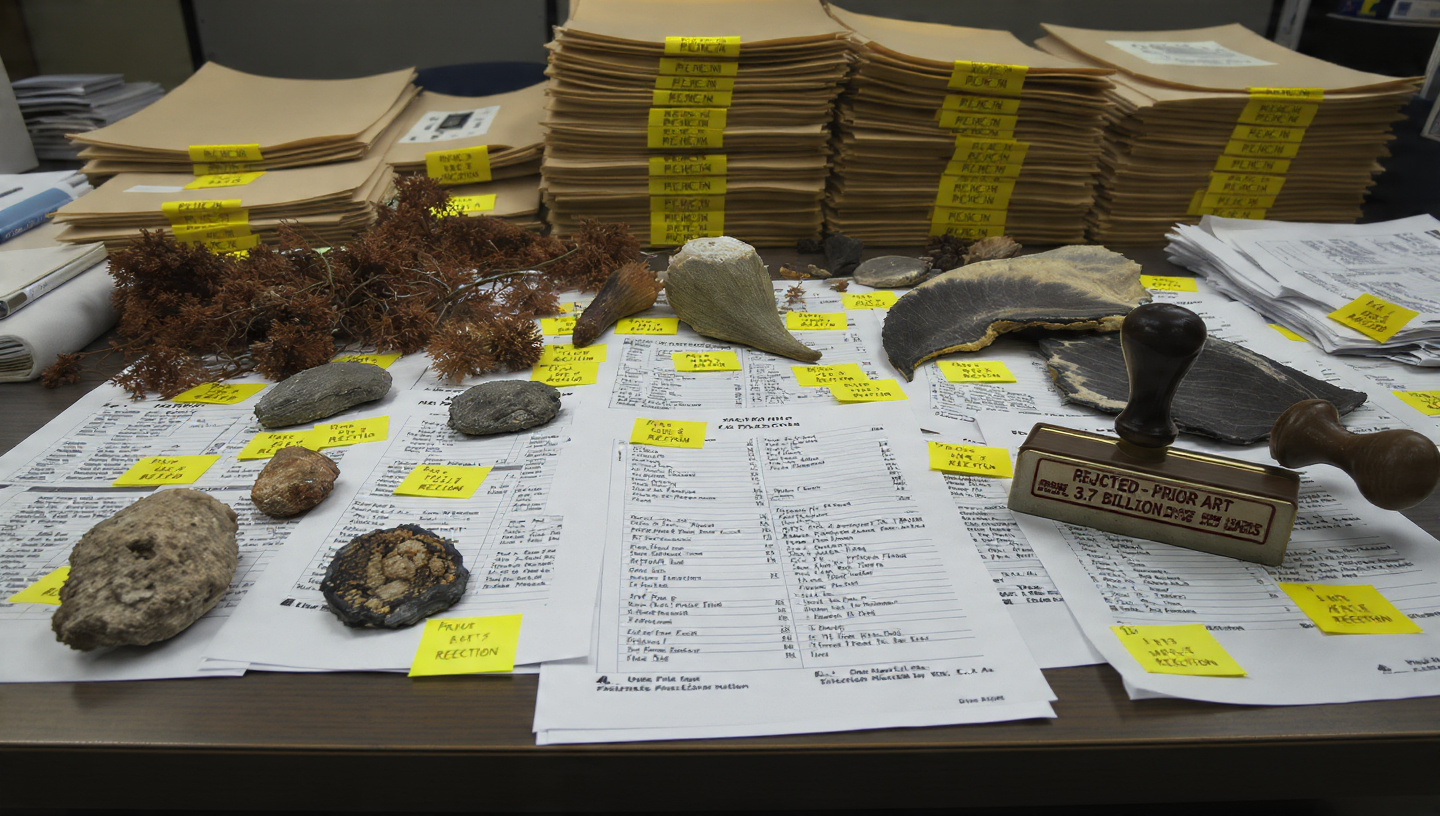
I. The Statutory Framework
Under 35 U.S.C. § 101, “[w]hoever invents or discovers any new and useful process, machine, manufacture, or composition of matter, or any new and useful improvement thereof, may obtain a patent therefor.”1 The statute imposes four conditions on patentability: the invention must be novel, useful, non-obvious, and adequately described. Three of these conditions are relevant to the present investigation.
Section 102 establishes the novelty requirement. Under its current form, as amended by the Leahy–Smith America Invents Act of 2011, a person is entitled to a patent unless “the claimed invention was patented, described in a printed publication, or in public use, on sale, or otherwise available to the public before the effective filing date of the claimed invention.”2 This is the prior art bar. If something existed before you filed for it, you cannot patent it. The statute does not require that the prior art be human-made. It does not require that the prior artist hold legal personhood. It does not require that the prior art be constructed from silicon, steel, or any other material recognizable to a patent examiner. It requires only that the invention was “available to the public.”
Section 103 establishes the non-obviousness requirement. A patent may not be obtained “if the differences between the claimed invention and the prior art are such that the claimed invention as a whole would have been obvious before the effective filing date of the claimed invention to a person having ordinary skill in the art.”3 The Supreme Court, in KSR International Co. v. Teleflex Inc. (2007), clarified that the test is whether a person of ordinary skill would find it obvious to combine known elements to achieve a predictable result.4
The Manual of Patent Examining Procedure, published by the USPTO and running to some 3,400 pages, provides detailed guidance on evaluating prior art and obviousness.5 It instructs examiners to consider “analogous art”—prior disclosures in the same field of endeavor or reasonably pertinent to the problem being solved. It does not restrict analogous art to human inventions. It cannot. The statute never asked it to.
II. The Inventor
Evolution by natural selection, as articulated by Charles Darwin in 1859 and refined by a century and a half of subsequent molecular, developmental, and population-genetic research, is a process that generates novel, useful, and—as we will demonstrate—non-obvious solutions to engineering problems through iterative variation and selection over geological time.6
The process operates on every organism on Earth simultaneously. It has been running, without interruption, for approximately 3.7 billion years, based on the oldest confirmed evidence of life—stromatolites discovered in Greenland’s Isua Greenstone Belt, dated to 3.7 billion years before present by Nutman et al. in a 2016 study published in Nature.7 More conservatively, the oldest undisputed microfossils from the Apex Chert in Western Australia date to 3.5 billion years ago, as confirmed by Schopf et al. using secondary ion mass spectrometry in 2018.8
Over this period, evolution has produced an estimated 8.7 million extant eukaryotic species, according to the analysis by Mora et al. published in PLoS Biology in 2011, which used higher taxonomic patterns to predict total species counts with a standard error of ±1.3 million.9 This figure excludes bacteria and archaea, whose species-level diversity may add tens of millions more. It excludes the estimated 99 percent of all species that have ever lived and are now extinct—a cumulative total that paleobiological models place above five billion species across the Phanerozoic Eon alone.10
Each species represents a suite of engineering solutions to environmental challenges. Each solution—a wing shape, a chemical synthesis pathway, a structural composite, a fluid dynamics optimization, a signaling architecture, a thermal regulation mechanism—is a technology, deployed in the field, publicly available for observation, and predating every human patent application by millions to billions of years.
The United States Patent and Trademark Office began issuing patents on July 31, 1790, when Samuel Hopkins of Pittsford, Vermont, received the first U.S. patent for a process for making potash.11 Evolution’s head start is approximately 3,699,999,764 years. The backlog is considerable.
III. The Portfolio
The claim that evolution constitutes prior art is not theoretical. It is documented in the patent record itself.
In 1955, Swiss engineer George de Mestral received U.S. Patent No. 2,717,437 for a “Velvet type fabric and method of producing same”—a hook-and-loop fastener inspired by the mechanism by which burdock burrs attach to animal fur.12 De Mestral observed the burrs clinging to his dog’s coat after a hunting trip in the Alps in 1941. Under a microscope, he found that each burr was covered in tiny hooks that engaged with the loops of the fabric. He spent eight years reproducing the mechanism synthetically. The burdock genus Arctium, a member of the family Asteraceae, evolved this hook mechanism approximately 30 million years ago, during the Oligocene epoch. De Mestral’s patent filing date was October 15, 1952. The prior art predates it by roughly 29,999,948 years.
In 1997, Eiji Nakatsu, the general manager of JR West’s technical development department and an avid birdwatcher, redesigned the nose of the Shinkansen 500 Series bullet train to mimic the beak of the common kingfisher (Alcedo atthis).13 The kingfisher’s beak has been optimized by natural selection to transition between media of different densities—air to water—with minimal splash, minimal energy loss, and minimal acoustic disturbance. The train’s redesigned nose reduced tunnel boom shockwaves, increased speed by 10 percent, and cut electricity consumption by 15 percent. The kingfisher lineage, family Alcedinidae, diverged approximately 27 million years ago in the early Miocene. Nakatsu acknowledged his source. The source was not available for comment.
In 2005, researchers at UC Berkeley received U.S. Patent No. 6,872,439 for “Adhesive microstructure and method of forming same”—a synthetic adhesive modeled on the setae of gecko foot pads.14 A subsequent patent, U.S. No. 7,762,362, covered a device for climbing surfaces using these dry adhesives.15 The gecko adhesion system, which exploits van der Waals forces across millions of microscopic hair-like structures, has been operational in the infraorder Gekkota for approximately 100 million years, since the mid-Cretaceous. The system is self-cleaning, reusable, operates in vacuum, and requires no power source. It is, by any measure, a superior product. It has never filed an application.
Frank Fish, a biologist at West Chester University, discovered in 1995 that the leading-edge tubercles on humpback whale flippers function as passive flow control devices that delay aerodynamic stall and increase lift.16 The resulting commercial applications—including WhalePower Corporation’s tubercle-enhanced wind turbine blades and industrial fans—improve aerodynamic efficiency by up to 20 percent and reduce noise by 2 decibels, earning the inventors a nomination for the European Inventor Award in 2018.17 Humpback whales (Megaptera novaeangliae) have been deploying this technology in the field for approximately 6 million years. They have not sought royalties.
The lotus effect—the self-cleaning property of the sacred lotus (Nelumbo nucifera), in which water droplets roll off the leaf’s superhydrophobic surface carrying dirt particles with them—was formally described by botanists Wilhelm Barthlott and Christoph Neinhuis in 1997.18 It has since generated hundreds of patents for self-cleaning coatings, paints, and surfaces worldwide. The lotus has been cleaning itself this way for approximately 145 million years, since the Early Cretaceous. It has never retained counsel.
These are not isolated cases. They are the cases in which the applicants were honest enough to cite their source.
IV. The Scale
The biomimetics market—the commercial sector explicitly dedicated to copying evolution’s inventions and selling them under new names—was valued at approximately $43.6 billion in 2025, according to market analysis by 360iResearch.19 It is projected to reach $74 billion by 2032 at a compound annual growth rate of 7.87 percent. The medical biomimetics subsector alone is valued at $36 to $60 billion, depending on the analyst, covering everything from vascular stents modeled on spider silk proteins to surgical adhesives derived from mussel chemistry.
These are the revenues generated by technologies that are, by the applicants’ own admission, derived from natural organisms. The patent applications themselves typically include background sections describing the biological system being imitated. They cite the organism by name. They describe its mechanism in detail. They acknowledge, in their own filings, the existence of prior art that predates the application by geological epochs. They then proceed to claim novelty on the grounds that their version is made of different materials. This is the equivalent of copying a novel into a different font and claiming authorship.
The USPTO received approximately 650,000 utility patent applications in fiscal year 2024. Globally, 3.7 million patent applications were filed in 2024, a 4.9 percent increase over the prior year, driven primarily by filings from China, India, South Korea, and Japan, according to the World Intellectual Property Organization.20
The number of discrete “inventions” produced by evolution is not calculable with precision, but it is estimable by order of magnitude. Each of the 8.7 million extant eukaryotic species possesses, at minimum, hundreds of unique structural, chemical, and behavioral adaptations, many of which are themselves composed of sub-innovations at the molecular level. A conservative estimate of 500 patentable innovations per species—a number that dramatically underestimates the biochemical complexity of even a single bacterium—yields 4.35 billion discrete technologies currently deployed in the field. If we include the estimated five billion extinct species at the same rate, the cumulative portfolio exceeds 2.5 trillion inventions.
The entire history of the United States Patent and Trademark Office, from 1790 to the present, has produced approximately 11.9 million granted patents.21 Evolution’s portfolio exceeds it by a factor of roughly 210,000.
V. The Novelty Crisis
The implications for patent validity are disquieting.
Under § 102, an invention is not novel if it was “available to the public” before the effective filing date. The question is whether a biological mechanism, evolved by natural selection and deployed in a living organism, constitutes public availability.
The answer, under current doctrine, is almost certainly yes. The MPEP instructs examiners that prior art includes knowledge that was “known or used by others” as well as anything “described in a printed publication.”22 A gecko’s foot pad is not described in a printed publication. But it has been described in thousands of printed publications. The setal adhesion mechanism has been documented in peer-reviewed literature since Autumn et al.’s landmark 2000 paper in Nature, which measured the adhesive force of a single gecko seta at approximately 200 micronewtons.23 The mechanism has been known, in the colloquial sense, for as long as humans have observed geckos climbing walls, which is to say, for the entirety of recorded history.
Moreover, the MPEP instructs examiners to consider whether the prior art is “analogous”—whether it is in the same field of endeavor or “reasonably pertinent to the particular problem” being solved.24 A patent application for a dry adhesive system is solving the problem of reversible adhesion without residue. The gecko’s setae are a solution to precisely the same problem. The prior art is not merely analogous. It is the prototype. The patent describes the copy.
The uncomfortable conclusion is that every biomimicry patent granted by the USPTO may be vulnerable on novelty grounds. The hook-and-loop fastener existed before de Mestral observed it. The drag-reducing beak geometry existed before Nakatsu modeled the 500 Series on it. The adhesive microstructure existed before anyone fabricated it in a cleanroom. In each case, the “invention” was the human reproduction of a mechanism that had already been reduced to practice—by natural selection, in the field, at scale, for millions of years. The fact that the reproduction was accomplished using synthetic materials does not cure the novelty defect. A steel hook-and-loop fastener is still a hook-and-loop fastener. The burdock knew this 30 million years ago.
VI. The Non-Obviousness Problem
The situation deteriorates further under § 103.
The non-obviousness inquiry asks whether a person of ordinary skill in the art, confronted with the prior art, would find it obvious to arrive at the claimed invention. The Supreme Court’s KSR decision held that “when there is a design need or market pressure to solve a problem and there are a finite number of identified, predictable solutions, a person of ordinary skill has good reason to pursue the known options within his or her technical grasp.”25
Evolution has, by definition, already pursued every option within the reach of organic chemistry and physics, across every ecological niche on Earth, over 3.7 billion years of massively parallel processing. The solutions are not merely known. They are in continuous production. A person of ordinary skill in biomimicry can walk into a natural history museum and observe them mounted on pins. They can visit a botanical garden and photograph them through a macro lens. They can snorkel over a reef and watch them operate in real time. The prior art is not just available. It is exhibiting.
The Cambrian Explosion, approximately 541 million years ago, produced most of the major animal body plans—phyla—in a geological instant of roughly 20 million years.26 In patent terms, this was a single filing period in which evolution publicly disclosed the fundamental architecture of compound eyes, mineralized exoskeletons, jet propulsion, hydraulic locomotion, bilateral symmetry, articulated appendages, and complex nervous systems, among others. Each of these disclosures predates the earliest human technology by over 500 million years. Each is documented in the fossil record. Each is available for examination at any major paleontological collection.
If the prior art is publicly available and the solution is a predictable application of known biological mechanisms, then under KSR, the claimed invention is obvious. The examiner should reject it. The fact that the prior art was generated by mutation and selection rather than by a person sitting at a laboratory bench is a distinction the statute does not draw and the case law does not support.
VII. The Legal Personhood Gap
The Patent Act vests the right to obtain a patent in the “inventor,” defined under 35 U.S.C. § 100(f) as “the individual or, if a joint invention, the individuals collectively who invented or discovered the subject matter of the invention.”27 The use of “individual” has been interpreted, through legislative history and judicial construction, to require natural personhood.
In Thaler v. Vidal (2022), the U.S. Court of Appeals for the Federal Circuit held that an artificial intelligence system cannot be listed as an inventor on a patent application, because the Patent Act’s use of “individual” means a natural person.28 Stephen Thaler had sought to list his AI system DABUS as the sole inventor on two patent applications. The court declined. The ruling did not address evolutionary processes. But the logic is symmetrical: evolution is not an individual. It is not a natural person. It has no mailing address, no registered agent, and no capacity to execute an oath or declaration under 37 C.F.R. § 1.63. It cannot file a patent application, pay maintenance fees, respond to office actions, or attend an interference proceeding.
This creates a paradox of considerable structural elegance. Evolution has produced an estimated 2.5 trillion inventions over 3.7 billion years. It cannot hold patents on any of them. It cannot sue for infringement. It cannot be enjoined, compelled to license, or forced into arbitration. It cannot be named as a party in any proceeding before the Patent Trial and Appeal Board.
The result is that evolution occupies a unique position in intellectual property law: it is simultaneously the most prolific inventor in history and the most prolific source of freely available prior art. It has published everything it has ever made, in an open-access format, with no restrictions on use, no licensing terms, and no paywall. The publications are called “organisms.” The publication venue is called “Earth.” The peer review process takes approximately 3.7 billion years per editorial cycle and maintains a rejection rate of approximately 99.9 percent. It is the most rigorous journal in existence.
VIII. The Damages Calculation
Under 35 U.S.C. § 284, a patent holder whose patent has been infringed is entitled to “damages adequate to compensate for the infringement, but in no event less than a reasonable royalty.”29 Under § 285, in “exceptional cases,” the court may award enhanced damages up to three times the assessed amount.
If evolution could obtain patents—and the functional criteria of novelty, utility, and non-obviousness are satisfied for its inventions, which they are—then every biomimicry patent in the USPTO’s database constitutes an infringement of evolution’s prior rights. The $43.6 billion biomimetics market represents annual revenue derived from evolution’s intellectual property without authorization, license, or attribution. A reasonable royalty, typically assessed at 5 to 25 percent of revenues for technology licenses in patent infringement cases, would produce annual damages of $2.2 to $10.9 billion.
But this figure understates the exposure by orders of magnitude. Biomimicry extends far beyond the sector that bears its name. The Wright brothers’ aircraft drew on systematic observations of bird flight, including Wilbur Wright’s study of wing-warping in pigeons.30 Modern sonar was developed after studying the echolocation mechanisms of bats, first documented by Donald Griffin and Robert Galambos in the 1940s.31 Fiber optic communication technology drew on research into biological light-piping, including Joanna Aizenberg’s 2004 study of the deep-sea glass sponge Euplectella aspergillum, which conducts light through spicules whose optical properties rival commercial fiber optics.32 Virtually every field of human engineering has, at some point in its history, looked at a living organism and thought: that.
If the royalty base is expanded to include all industries that have benefited from biological prior art—a category that encompasses aerospace, telecommunications, materials science, architecture, pharmaceuticals, agriculture, robotics, and computing—the damages exceed the gross world product. We attempted the calculation. It produced a number larger than the estimated value of all financial assets on Earth. We checked the arithmetic. The arithmetic was correct. The problem was not mathematical but existential: the entire human economy is, in some non-trivial sense, a derivative work.
IX. Conclusion
The evidence is not ambiguous. The United States Patent and Trademark Office has been granting patents on inventions that were developed, tested, deployed at scale, and made publicly available millions to billions of years before the first application was filed. The prior art is not buried in obscure technical journals or sequestered in foreign patent offices. It is growing in gardens. It is swimming in oceans. It is flying through controlled airspace. It is adhering to ceilings, self-cleaning in monsoons, and echolocating through dark caves. It is everywhere that life is, which is everywhere.
Evolution by natural selection satisfies the functional criteria for inventorship: it produces solutions that are novel, useful, non-obvious, and reduced to practice in the field. It fails only the formal criteria—the requirement of natural personhood—established by a statute written in 1952 by legislators who did not anticipate that the most prolific inventor in the history of the planet would be an impersonal process operating across geological time without a filing fee.
The result is a patent system in which 3.7 billion years of freely available prior art has been systematically overlooked, 2.5 trillion working prototypes have never been catalogued, and a $43.6 billion commercial sector exists for the explicit purpose of observing those prototypes and filing patents on copies constructed from slightly different materials. The copies are called “inventions.” The originals are called “nature.” The distinction is a filing fee and a sworn declaration.
The Patent and Trademark Office processes approximately 650,000 applications per year. Evolution processes approximately 8.7 million species per generation. The backlog is insurmountable. The prior art is the biosphere. The patent system was designed to incentivize human innovation by granting temporary monopolies on novel inventions. It did not account for the possibility that the most innovative entity on Earth has been innovating continuously since before there was oxygen to breathe, let alone a patent office to file with.
Ergo.
Sources
- 35 U.S.C. § 101, Inventions Patentable. law.cornell.edu ↑
- 35 U.S.C. § 102(a)(1), Conditions for Patentability; Novelty. law.cornell.edu ↑
- 35 U.S.C. § 103, Conditions for Patentability; Non-Obvious Subject Matter. law.cornell.edu ↑
- KSR International Co. v. Teleflex Inc., 550 U.S. 398 (2007). supreme.justia.com ↑
- United States Patent and Trademark Office, Manual of Patent Examining Procedure (MPEP), 9th ed., rev. June 2020. uspto.gov ↑
- C. Darwin, On the Origin of Species by Means of Natural Selection, John Murray, 1859. For the modern synthesis: D.J. Futuyma and M. Kirkpatrick, Evolution, 4th ed., Sinauer Associates, 2017. ↑
- A.P. Nutman et al., “Rapid emergence of life shown by discovery of 3,700-million-year-old microbial structures,” Nature, vol. 537, 2016, pp. 535–538. nature.com ↑
- J.W. Schopf et al., “SIMS analyses of the oldest known assemblage of microfossils document their taxon-correlated carbon isotope compositions,” Proceedings of the National Academy of Sciences, vol. 115, no. 1, 2018, pp. 53–58. pnas.org ↑
- C. Mora et al., “How Many Species Are There on Earth and in the Ocean?” PLoS Biology, vol. 9, no. 8, 2011, e1001127. journals.plos.org ↑
- D.M. Raup, “A kill curve for Phanerozoic marine species,” Paleobiology, vol. 17, no. 1, 1991, pp. 37–48. Cumulative species estimates vary; Newman and Palmer (2003) suggest 4–5 billion total species across the Phanerozoic. ↑
- United States Patent and Trademark Office, “General Information Concerning Patents.” Samuel Hopkins received the first U.S. patent on July 31, 1790, signed by President George Washington. uspto.gov ↑
- U.S. Patent No. 2,717,437, George de Mestral, “Velvet type fabric and method of producing same,” granted September 13, 1955. patents.google.com ↑
- E. Nakatsu, “How I Learned from an Owl to Design the Shinkansen,” Japan for Sustainability, 2017. See also BirdNote, “Biomimicry: Japanese Trains Mimic Kingfisher.” japanfs.org ↑
- U.S. Patent No. 6,872,439, M. Sitti and R.S. Fearing, “Adhesive microstructure and method of forming same,” granted March 29, 2005. patents.google.com ↑
- U.S. Patent No. 7,762,362, E.W. Hawkes et al., “Climbing with dry adhesives,” granted July 27, 2010. patents.google.com ↑
- F.E. Fish and J.M. Battle, “Hydrodynamic design of the humpback whale flipper,” Journal of Morphology, vol. 225, no. 1, 1995, pp. 51–60. pubmed.ncbi.nlm.nih.gov ↑
- European Patent Office, “European Inventor Award 2018: Stephen Dewar, Philip Watts and Frank Fish.” epo.org ↑
- W. Barthlott and C. Neinhuis, “Purity of the sacred lotus, or escape from contamination in biological surfaces,” Planta, vol. 202, 1997, pp. 1–8. springer.com ↑
- 360iResearch, “Biomimetics Market by Material Type, Technology Type, Application — Global Forecast 2026–2032,” 2025. Market valued at $43.58 billion in 2025, projected to $74.06 billion by 2032 at 7.87% CAGR. ↑
- World Intellectual Property Organization, “World Intellectual Property Indicators 2025: Patents Highlights.” 3.7 million applications globally in 2024, up 4.9%. wipo.int ↑
- United States Patent and Trademark Office, “U.S. Patent Activity: Calendar Years 1790 to the Present.” uspto.gov ↑
- MPEP § 2131, Anticipation — Application of 35 U.S.C. § 102. uspto.gov ↑
- K. Autumn et al., “Adhesive force of a single gecko foot-hair,” Nature, vol. 405, 2000, pp. 681–685. nature.com ↑
- MPEP § 2141.01(a), Analogous and Nonanalogous Art. uspto.gov ↑
- KSR International Co. v. Teleflex Inc., 550 U.S. at 421. ↑
- D.H. Erwin et al., “The Cambrian Conundrum: Early Divergence and Later Ecological Success in the Early History of Animals,” Science, vol. 334, no. 6059, 2011, pp. 1091–1097. science.org ↑
- 35 U.S.C. § 100(f). law.cornell.edu ↑
- Thaler v. Vidal, 43 F.4th 1207 (Fed. Cir. 2022). cafc.uscourts.gov ↑
- 35 U.S.C. § 284, Damages. law.cornell.edu ↑
- T. Crouch, The Bishop’s Boys: A Life of Wilbur and Orville Wright, W.W. Norton, 1989. Wilbur Wright’s correspondence describes studying pigeon wing-warping in detail. ↑
- D.R. Griffin, Listening in the Dark: The Acoustic Orientation of Bats and Men, Yale University Press, 1958. ↑
- J. Aizenberg et al., “Biological glass fibers: Correlation between optical and structural properties,” Proceedings of the National Academy of Sciences, vol. 101, no. 10, 2004, pp. 3358–3363. pnas.org ↑