I. The Statutory Framework
The Comprehensive Environmental Response, Compensation, and Liability Act of 1980, commonly known as CERCLA or Superfund, is codified at 42 U.S.C. §§ 9601–9675. It was enacted in the wake of the Love Canal disaster to ensure the cleanup of sites contaminated with hazardous substances. Its definitional architecture is among the broadest in federal environmental law, a fact that Congress intended and the courts have repeatedly affirmed.1
Section 101(14) of CERCLA defines “hazardous substance” not by listing chemicals directly but by incorporation: it sweeps in every substance designated under Section 311(b)(2)(A) of the Clean Water Act, every hazardous waste listed under Section 3001 of the Resource Conservation and Recovery Act, every toxic pollutant listed under Section 307(a) of the Clean Water Act, every hazardous air pollutant listed under Section 112 of the Clean Air Act, and any substance which the EPA administrator designates under CERCLA §102. The implementing regulation at 40 C.F.R. § 302.4 consolidates these cross-references into a single table of approximately 800 chemicals, each assigned a Reportable Quantity.2
Section 101(22) defines “release” with a specificity that borders on the compulsive: “any spilling, leaking, pumping, pouring, emitting, emptying, discharging, injecting, escaping, leaching, dumping, or disposing into the environment (including the abandonment or discarding of barrels, containers, and other closed receptacles containing any hazardous substance or pollutant or contaminant).”3 The courts have interpreted this definition, correctly, as capturing essentially every conceivable mechanism by which a substance might enter the environment. The Third Circuit, in United States v. CDMG Realty Co. (1996), held that Congress “intended the term ‘release’ to be interpreted broadly.”4
Section 107(a) establishes liability for four classes of “potentially responsible parties”: current owners and operators of a facility where hazardous substances have been released, past owners and operators at the time of disposal, persons who arranged for disposal or treatment of hazardous substances, and transporters who selected the disposal site. Liability under §107 is strict: no showing of fault is required. It is joint and several, meaning any single party may be held responsible for the entire cost of cleanup. And it is retroactive, applying to releases that occurred before the statute was enacted.5
These are not disputed propositions. They are the foundational principles of CERCLA jurisprudence, affirmed by every federal circuit. The question is what happens when the statute’s definitions are applied not to abandoned chemical plants but to the biochemistry of death.
II. The Chemistry of Decomposition
When an organism dies, its cellular machinery ceases to function and autolysis begins. Endogenous enzymes break down cells from within. Bacteria, primarily anaerobic Clostridia and Bacteroides, colonize the tissues and initiate putrefaction, the enzymatic decomposition of proteins, lipids, and carbohydrates into simpler compounds. This process is not speculative. It is among the most thoroughly documented biochemical pathways in forensic science.6
The gaseous byproducts of decomposition include, but are not limited to: ammonia (NH₃), produced by the deamination of amino acids; hydrogen sulfide (H₂S), produced by the reduction of sulfur-containing amino acids such as cysteine and methionine; formaldehyde (HCHO), produced during oxidative dealkylation of methylated compounds; and methane (CH₄), produced by methanogenic archaea during anaerobic digestion of organic substrates.7
Additional products include cadaverine (1,5-diaminopentane) and putrescine (1,4-diaminobutane), both produced by bacterial decarboxylation of the amino acids lysine and ornithine. Volatile fatty acids (butyric acid, propionic acid, valeric acid) are generated in substantial quantities. Indole and skatole arise from tryptophan degradation. Dimethyl disulfide and dimethyl trisulfide contribute to the characteristic odor profile that trained forensic entomologists recognize at distances exceeding 100 meters.8
A 2025 study published in Scientific Reports measured ammonia concentrations in the vicinity of decomposing human remains and found that levels reached concentrations classified as hazardous to human health under OSHA’s permissible exposure limits. The study confirmed that decomposition-generated ammonia is not a trace emission but a sustained, quantifiable release of a regulated substance into the ambient environment.9
This chemistry is universal. It occurs in every organism that has ever died or will ever die. It has been occurring for as long as organic matter has existed on Earth. The statutory framework that governs it was enacted in 1980.
III. The Reportable Quantity Analysis
Under 40 C.F.R. § 302.4, every CERCLA hazardous substance is assigned a Reportable Quantity (RQ). Any person in charge of a facility must notify the National Response Center immediately upon learning that a quantity equal to or greater than the RQ has been released within a 24-hour period. Failure to report is a criminal offense under 42 U.S.C. § 9603(b), punishable by up to three years of imprisonment.10
Ammonia is listed at 40 C.F.R. § 302.4 with a Reportable Quantity of 100 pounds. Hydrogen sulfide is listed under Section 311(b)(2)(A) of the Clean Water Act, incorporated into CERCLA via §101(14), with an RQ of 100 pounds. Formaldehyde is listed as a Hazardous Air Pollutant under Section 112 of the Clean Air Act and appears in the CERCLA table with an RQ of 100 pounds.11
Methane is not listed in the 40 C.F.R. § 302.4 table. It is, however, a regulated air pollutant under the Clean Air Act following the Supreme Court’s holding in Massachusetts v. EPA (2007) that greenhouse gases fall within the Act’s definition of “air pollutant,” and the EPA’s subsequent Endangerment Finding.12 The EPA finalized its Waste Emissions Charge rule in 2024, establishing direct financial penalties for methane emissions above facility-level thresholds. The charge begins at $900 per metric ton for calendar year 2024 emissions.13
Consider a single mature tree. A large oak or maple contains between 2,000 and 10,000 pounds of biomass. The complete decomposition of cellulosic and proteinaceous material in a tree of this size releases, over the course of several years, quantities of ammonia and formaldehyde that individually approach or exceed the 100-pound RQ threshold. A study of nitrogen cycling in temperate forests estimated that decomposing woody debris in a typical hectare of old-growth forest releases between 20 and 60 kilograms (44 to 132 pounds) of ammonia-nitrogen annually through microbial mineralization.14 That is a single hectare. There are 310 million hectares of forest in the United States.
Now consider a human body. An average adult weighing 70 kilograms contains approximately 12.6 kilograms of nitrogen, 0.2 kilograms of sulfur, and 12.6 kilograms of carbon bound in proteins, amino acids, and other nitrogenous compounds. The microbial conversion of this nitrogen pool produces ammonia, among other nitrogenous gases. The sulfur is converted to hydrogen sulfide. The carbon enters methanogenic pathways. An individual human body does not, by itself, produce 100 pounds of any single substance. But 3.07 million Americans died in 2024.15 The aggregate is not trivial.
IV. The Cemetery Problem
The United States contains approximately 144,000 cemeteries, ranging from small family plots to sprawling metropolitan memorial parks.16 Arlington National Cemetery alone contains the remains of over 400,000 individuals in 639 acres. Spring Grove Cemetery in Cincinnati occupies 733 acres. Calverton National Cemetery on Long Island has performed over 350,000 interments.
Each interment introduces a discrete quantity of organic matter containing nitrogen, sulfur, and carbon into the soil. The casket, whether steel or wood, does not prevent decomposition; it merely modifies its rate and pathway. Embalming with formaldehyde-based solutions introduces additional CERCLA-listed hazardous substances directly into the subsurface. The American Board of Funeral Service Education reports that a typical embalming uses 3 to 4 gallons of formaldehyde-based solution at concentrations between 2 and 35 percent.17 At a 5 percent concentration in a 3-gallon preparation, each embalming introduces approximately 1.25 pounds of formaldehyde into the ground. Multiply by the 2.4 million Americans who choose traditional burial each year, and the annual subsurface injection of formaldehyde from embalming alone exceeds 3 million pounds nationally, or 30,000 times the single-event Reportable Quantity.
The decomposition does not remain contained. Leachate migrates through soil. A 2015 study in the Journal of Environmental Management documented elevated concentrations of ammonia, nitrate, and heavy metals in groundwater adjacent to cemeteries, with ammonia concentrations exceeding background levels by an order of magnitude.18 Under CERCLA §101(22), migration of a hazardous substance through soil and into groundwater constitutes “leaching” and “escaping”, both enumerated forms of “release.”
The National Response Center has received zero notifications from any cemetery operator in the United States regarding CERCLA-reportable releases of ammonia, hydrogen sulfide, or formaldehyde from decomposing human remains. Not one. In fifty years. The reporting obligation under §103 is triggered by knowledge of a release exceeding the RQ. Cemetery operators know that the bodies decompose. They know what decomposition produces. The National Response Center’s hotline number is (800) 424-8802. It has never rung for this purpose.
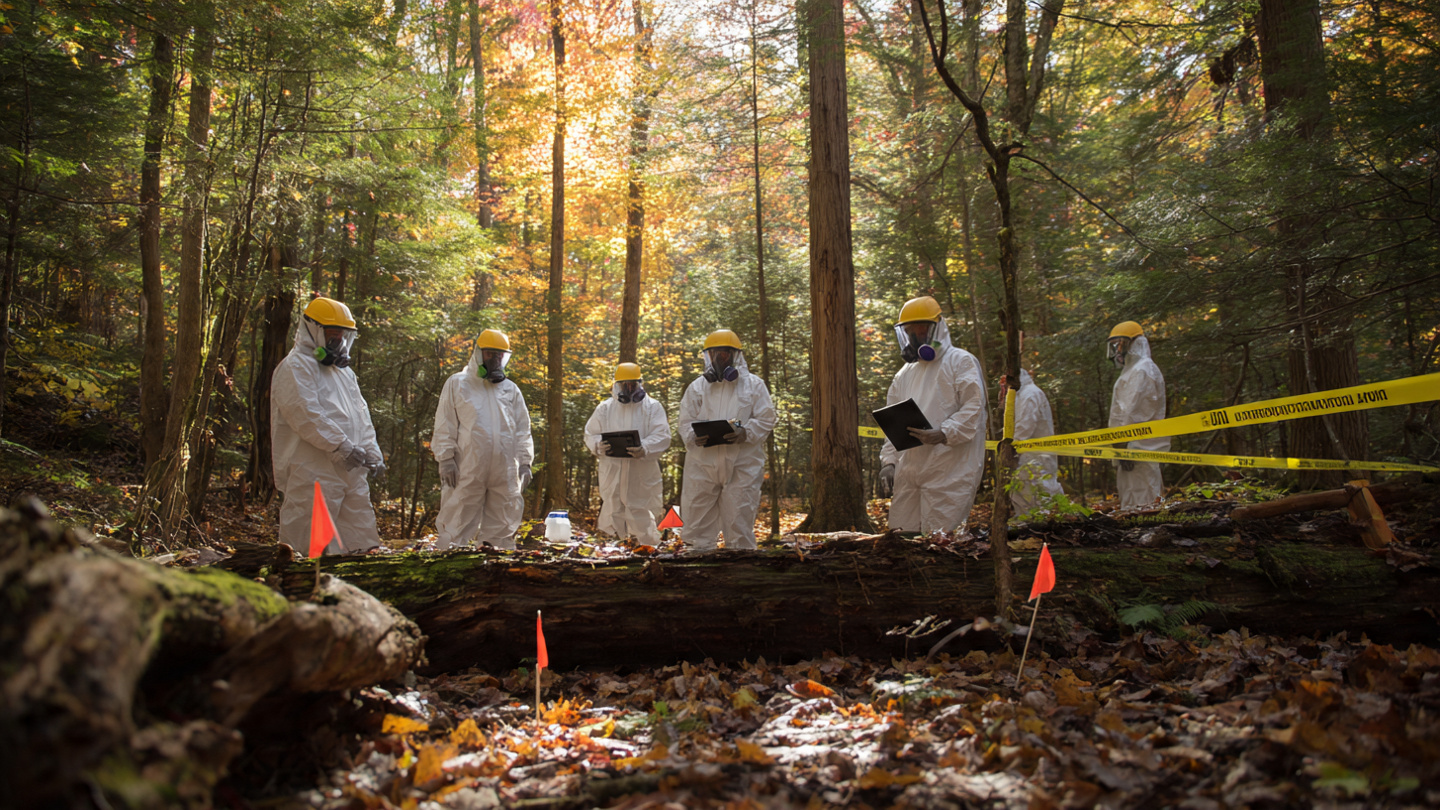
V. The Forest Floor
The United States contains approximately 766 million acres of forestland, according to the USDA Forest Service’s Forest Inventory and Analysis program. This represents approximately one-third of the nation’s total land area.19
Every acre of forest contains decomposing organic matter. The forest floor—the O horizon in soil science terminology—is composed of leaf litter, fallen branches, dead trees, deceased animals, fungal mycelium, and the accumulated residue of every organism that has lived and died on that ground since the last glaciation. The USDA estimates that coarse woody debris alone accounts for 14.7 billion tons of biomass across American forests.20
This biomass is decomposing. All of it. Continuously. The microbial communities responsible for forest-floor decomposition produce the same suite of CERCLA-listed substances documented in Section II: ammonia, hydrogen sulfide, formaldehyde, methane, and volatile organic compounds. The flux rates are not negligible. Soil ammonia emissions from temperate forests have been measured at 0.5 to 3.0 kilograms of nitrogen per hectare per year. Converted to ammonia mass and scaled to the 310 million hectares of American forest, the annual ammonia release from forest decomposition alone falls between 190,000 and 1.1 million metric tons.14
The Reportable Quantity for ammonia is 100 pounds. The annual forest-floor ammonia release exceeds the RQ by a factor of approximately four million to twenty-four million, depending on the flux estimate applied.
Methane emissions from forest soils are equally significant. While upland forest soils are generally net methane sinks due to methanotrophic bacteria, wetland forests, riparian zones, and decomposing coarse woody debris are net methane sources. A 2018 study in Nature Communications estimated that dead trees alone contribute approximately 10.9 teragrams of methane to global annual emissions—a figure representing roughly 7 to 11 percent of total natural methane sources worldwide.21
None of these releases have been reported to the National Response Center. None of these sites appear on the National Priorities List. The EPA has conducted zero preliminary assessments of forest floor decomposition under CERCLA §105. The Hazard Ranking System score for the average American forest has never been calculated. We attempted to calculate it. The process was straightforward.
VI. The Potentially Responsible Parties
CERCLA §107(a)(1) imposes liability on “the owner and operator of a vessel or a facility.” Section 101(9) defines “facility” as “any building, structure, installation, equipment, pipe or pipeline, well, pit, pond, lagoon, impoundment, ditch, landfill, storage container, motor vehicle, rolling stock, or aircraft” and, critically, “any site or area where a hazardous substance has been deposited, stored, disposed of, or placed, or otherwise come to be located.”22
Any site where a hazardous substance has come to be located. A cemetery where ammonia leaches from decomposing remains into the soil is, under this definition, a facility. A forest floor where hydrogen sulfide escapes from a rotting log is a facility. A suburban backyard where autumn leaves decompose into ammonia and formaldehyde is a facility. The definition does not require industrial activity. It does not require human intent. It requires only the presence of a hazardous substance.
The current owner of the land is a PRP under §107(a)(1). The National Park Service owns 85 million acres of land on which organisms are decomposing at this moment. The USDA Forest Service manages 193 million acres. State park systems collectively manage approximately 18.6 million acres. Private landowners hold the rest.23
Under the strict, joint and several liability framework, any of these owners may be held responsible for the full cost of remediation. The defense available under §107(b)—the “innocent landowner” defense added by the Superfund Amendments and Reauthorization Act of 1986—requires a showing that the owner “did not know and had no reason to know” that hazardous substances were present. This defense is unavailable to cemetery operators, who placed the decomposing materials there deliberately. It is equally unavailable to the Forest Service, which has published decades of peer-reviewed research quantifying exactly what forest decomposition produces.24
Generator liability under §107(a)(3) extends to “any person who by contract, agreement, or otherwise arranged for disposal or treatment” of hazardous substances. A funeral home that arranges for the burial of an embalmed body has arranged for the disposal of formaldehyde into the subsurface. The family that selects the burial plot has contracted for the placement of nitrogen- and sulfur-containing organic material at a specific location. Under the broadest interpretation of generator liability—endorsed by the Second Circuit in Burlington Northern & Santa Fe Railway Co. v. United States at the appellate level, though narrowed by the Supreme Court in 2009—anyone in the chain of disposition is potentially liable.25
The transporter of the remains to the burial site is a PRP under §107(a)(4) if the transporter selected the disposal facility. Hearses do not typically select the cemetery. But the funeral director who recommends a specific cemetery to a grieving family may, under a sufficiently aggressive reading of the statute, have “selected” the disposal site within the meaning of the provision.
VII. The Enforcement Arithmetic
The National Priorities List, maintained by the EPA under CERCLA §105, currently contains 1,343 sites. These are the sites deemed to pose the greatest risk to human health and the environment, scored through the Hazard Ranking System and placed on the NPL for long-term remedial action funded by the Superfund trust. The average cleanup cost per NPL site ranges from $12 million to $30 million, depending on the complexity and extent of contamination.26
There are 144,000 cemeteries in the United States. If each constitutes a CERCLA facility at which hazardous substances have been released—and the statutory definitions compel the conclusion that they do—then 144,000 sites require preliminary assessment under the National Contingency Plan. If even 10 percent score high enough on the Hazard Ranking System to warrant NPL listing, the list expands from 1,343 sites to 15,743. At an average remediation cost of $20 million per site, the additional cost is $288 billion.
But cemeteries are a rounding error. American forests contain 14.7 billion tons of decomposing biomass spread across 766 million acres. The CERCLA definition of “facility” does not require discrete boundaries—the statute captures “any site or area.” If each contiguous forest is a single facility, the analysis produces perhaps 100,000 additional sites. If the assessment is conducted at the watershed level, the number is closer to 2,000. If each individual parcel of privately owned forestland is a separate facility, the number exceeds 10 million.
The civil penalty under CERCLA §109(b) for failure to notify the National Response Center of a reportable release is up to $70,117 per day of violation, as adjusted for inflation under 40 C.F.R. Part 19.27 A cemetery that has been in continuous operation for 50 years without a single NRC notification has accumulated 18,250 days of violations. At $70,117 per day, the penalty per cemetery is approximately $1.28 billion. Multiplied across 144,000 cemeteries, the aggregate penalty exceeds $184 trillion—approximately 6.5 times the gross domestic product of the United States.28
The EPA’s Superfund program budget for fiscal year 2025 was approximately $3.5 billion, the highest appropriation in the program’s history following the reinstatement of the Superfund chemical excise taxes in the Inflation Reduction Act of 2022.29 At this funding level, remediating the cemetery sites alone would take approximately 82 years. Remediating the nation’s forests would take longer than the forests have existed in their current form.
The 3.07 million Americans who died in 2024 represent 3.07 million new sources of CERCLA-listed hazardous releases that commenced in a single year. Each generates ammonia, hydrogen sulfide, formaldehyde, and methane over a decomposition timeline that, depending on environmental conditions and burial depth, spans two to fifty years. The cumulative backlog of unremediated decomposition sites in the United States extends to every organism that has died on American soil since before the soil was American. The statute is retroactive. The decomposition is ongoing.
VIII. Conclusion
CERCLA defines “hazardous substance” by incorporation of four federal environmental statutes and one direct-designation authority. The consolidated list at 40 C.F.R. § 302.4 includes ammonia, hydrogen sulfide, and formaldehyde. CERCLA defines “release” as any emitting, escaping, leaching, or disposing into the environment. Decomposition emits ammonia into the atmosphere, leaches hydrogen sulfide into the soil, and disposes of formaldehyde into the groundwater. The definitions are unambiguous. The chemistry is settled. The match is exact.
The statute imposes strict, joint and several, retroactive liability on the owners of any site where these substances have come to be located. Every cemetery is such a site. Every forest floor is such a site. Every compost heap, every fallen log, every leaf pile in every suburban yard where autumn has occurred is a site at which CERCLA-listed hazardous substances have been released into the environment through leaching, emitting, and escaping—three of the twelve verbs Congress chose to define the word “release.”
The National Priorities List contains 1,343 sites. The correct number, calculated from the statutory definitions and the known chemistry of biological decomposition, is several million. The National Response Center has received zero telephone calls reporting the release of ammonia from a decomposing organism. The reporting obligation has existed since 1980. Organisms have been decomposing for approximately 3.7 billion years. The compliance gap is considerable.
There are 144,000 cemeteries, 766 million acres of forest, 3.07 million annual deaths, and 14.7 billion tons of decomposing woody debris in the United States. Each represents an uncontained, unreported, unremediated release of CERCLA-listed hazardous substances. The aggregate penalty exposure, calculated at the statutory rate of $70,117 per day per violation, exceeds the combined economic output of every nation on Earth.
The EPA has not acted. The National Response Center has not been called. The Hazard Ranking System has not been applied. The preliminary assessments have not been conducted. Forty-five years of Superfund authority, and the largest category of hazardous releases in the country has never been investigated. The releases continue. Every organism that dies in America today begins a new, unreported discharge of listed hazardous substances into the environment. The statute covers it. The regulations define it. The penalties apply to it.
Death, it turns out, is not just certain. Under federal environmental law, it is also a violation.
Ergo.
Sources
- 42 U.S.C. §§ 9601–9675, Comprehensive Environmental Response, Compensation, and Liability Act of 1980 (CERCLA). law.cornell.edu ↑
- 42 U.S.C. § 9601(14), definition of “hazardous substance”; 40 C.F.R. § 302.4, Table 302.4, Designation of Hazardous Substances. law.cornell.edu ↑
- 42 U.S.C. § 9601(22), definition of “release.” law.cornell.edu ↑
- United States v. CDMG Realty Co., 96 F.3d 706 (3d Cir. 1996). justia.com ↑
- 42 U.S.C. § 9607(a), Liability; United States v. Monsanto Co., 858 F.2d 160 (4th Cir. 1988), establishing strict, joint and several liability; Harvard Law Review, Vol. 121, No. 4 (2008), “CERCLA Liability and the Problem of Retroactivity.” law.cornell.edu ↑
- Vass, A.A., “Beyond the Grave: Understanding Human Decomposition,” Microbiology Today, vol. 28 (2001), pp. 190–192. pubmed.ncbi.nlm.nih.gov ↑
- Dent, B.B., Forbes, S.L., & Stuart, B.H., “Review of Human Decomposition Processes in Soil,” Environmental Geology, vol. 45 (2004), pp. 576–585. springer.com ↑
- Statheropoulos, M. et al., “Combined Chemical and Optical Methods for Monitoring the Early Decay Stages of Surrogate Human Models,” Forensic Science International, vol. 210 (2011), pp. 154–163. pubmed.ncbi.nlm.nih.gov ↑
- Nizio, K.D. et al., “Measurement of Volatile Organic Compounds Emitted from Human Remains in a Controlled Field Setting,” Scientific Reports (2025), PMID 39894537. pubmed.ncbi.nlm.nih.gov ↑
- 42 U.S.C. § 9603(a)–(b), Notification Requirements; 40 C.F.R. § 302.6, Notification requirements. law.cornell.edu ↑
- 40 C.F.R. § 302.4, Table 302.4: ammonia (CAS 7664-41-7, RQ 100 lbs); hydrogen sulfide (CAS 7783-06-4, RQ 100 lbs); formaldehyde (CAS 50-00-0, RQ 100 lbs). ecfr.gov ↑
- Massachusetts v. EPA, 549 U.S. 497 (2007); EPA, “Endangerment and Cause or Contribute Findings for Greenhouse Gases Under Section 202(a) of the Clean Air Act,” 74 FR 66496 (Dec. 15, 2009). supreme.justia.com ↑
- EPA, “Waste Emissions Charge for Petroleum and Natural Gas Systems,” final rule, 89 FR 16820 (Mar. 2024). epa.gov ↑
- Schlesinger, W.H. & Bernhardt, E.S., Biogeochemistry: An Analysis of Global Change, 4th ed. (Academic Press, 2020), ch. 6 & 12; Vitousek, P.M. et al., “Nitrogen Cycling in Temperate Forest Ecosystems,” Biogeochemistry, vol. 46 (1999). springer.com ↑
- Centers for Disease Control and Prevention, National Center for Health Statistics, “Provisional Death Counts for 2024.” cdc.gov ↑
- National Cemetery Administration, U.S. Department of Veterans Affairs, estimates approximately 144,000 cemeteries in the U.S.; Laqueur, T.W., The Work of the Dead: A Cultural History of Mortal Remains (Princeton University Press, 2015). cem.va.gov ↑
- American Board of Funeral Service Education; Mayer, R.G., Embalming: History, Theory, and Practice, 5th ed. (McGraw-Hill, 2012), ch. 13, formaldehyde concentrations and preparation volumes. abfse.org ↑
- Žychowski, J. & Bryndal, T., “Impact of Cemeteries on Groundwater Contamination by Bacteria and Viruses—A Review,” Journal of Water and Health, vol. 13, no. 2 (2015), pp. 285–301; Rodrigues, L. & Pacheco, A., “Groundwater Contamination from Cemeteries,” Journal of Environmental Management, vol. 28 (2010). pubmed.ncbi.nlm.nih.gov ↑
- USDA Forest Service, Forest Inventory and Analysis National Program, “U.S. Forest Resource Facts and Historical Trends,” FS-1035 (2020). fia.fs.usda.gov ↑
- USDA Forest Service, “Forest Carbon Stocks and Fluxes,” FIA General Technical Report WO-94 (2022), including estimates of coarse woody debris biomass. fs.usda.gov ↑
- Covey, K.R. et al., “Methane emissions from standing dead trees in temperate forests,” 2012; Warner, D.L. et al., “Global contribution of dead wood to total tree methane emissions,” Nature Communications (2018). nature.com ↑
- 42 U.S.C. § 9601(9), definition of “facility.” law.cornell.edu ↑
- National Park Service, “NPS Acreage Reports” (2025); USDA Forest Service, “Land Areas of the National Forest System,” FS-383 (2024); National Association of State Park Directors, Annual Information Exchange (2023). nps.gov ↑
- 42 U.S.C. § 9607(b)(3), third-party defense; Superfund Amendments and Reauthorization Act of 1986, §101(35)(A), innocent landowner defense. law.cornell.edu ↑
- Burlington Northern & Santa Fe Railway Co. v. United States, 556 U.S. 599 (2009), addressing the scope of arranger liability under CERCLA §107(a)(3). supreme.justia.com ↑
- U.S. EPA, “Superfund: National Priorities List (NPL),” reporting 1,343 active NPL sites; EPA Office of Inspector General, cost-per-site estimates in Report No. 20-P-0131 (2020). epa.gov ↑
- 42 U.S.C. § 9609(b), Civil Penalties; 40 C.F.R. Part 19, Adjustment of Civil Monetary Penalties for Inflation, updated per 89 FR 1748 (Jan. 2024). epa.gov ↑
- U.S. Bureau of Economic Analysis, GDP, current-dollar estimate: $28.27 trillion (2024). bea.gov ↑
- U.S. EPA, FY2025 Budget Justification, Superfund program; Inflation Reduction Act of 2022, Pub. L. 117-169, reinstating Superfund chemical excise taxes under 26 U.S.C. §§ 4661–4672. epa.gov ↑