I. The Two Statutes
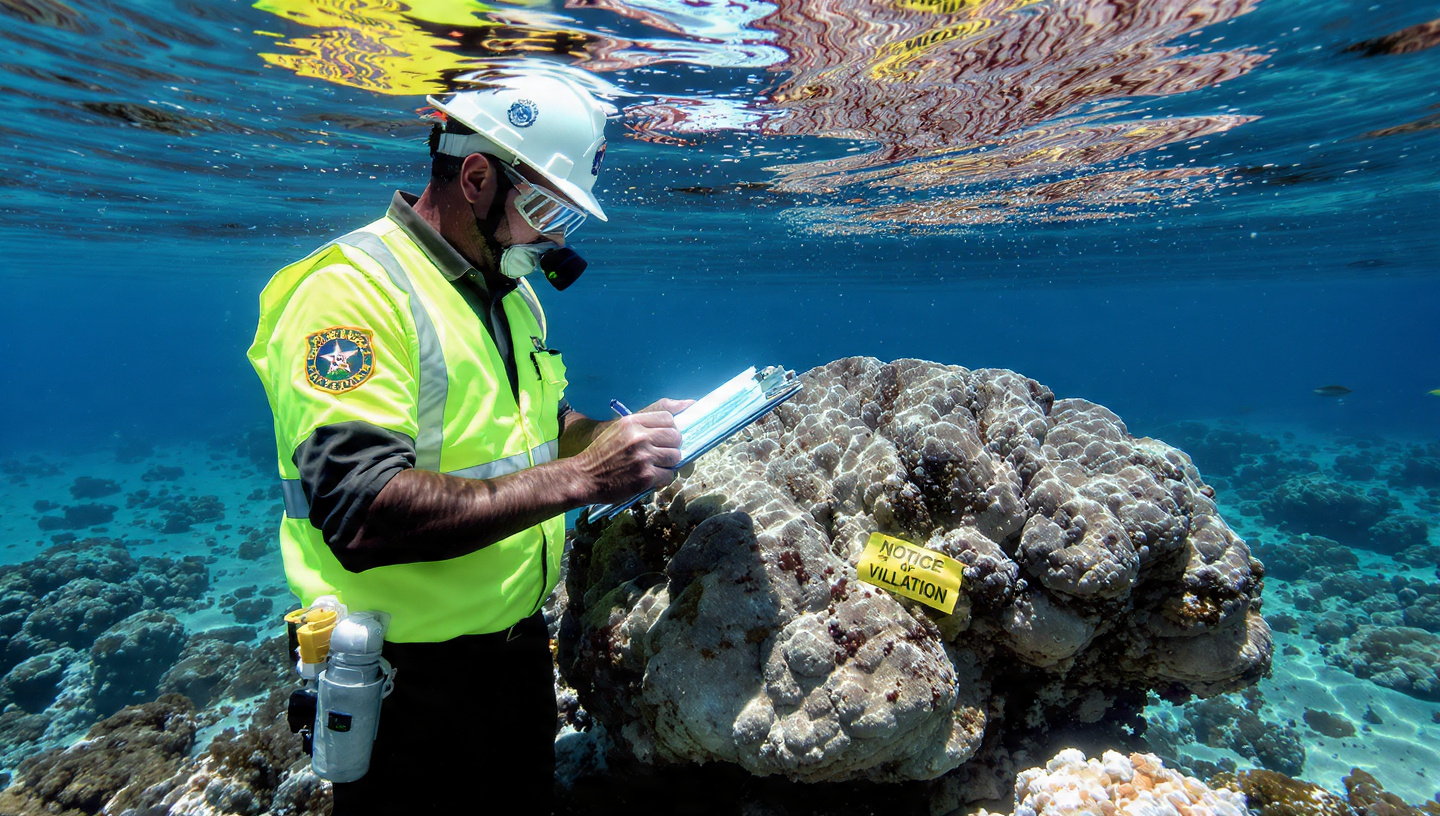
Two federal statutes govern the placement of material in navigable waters of the United States. Both are old. Both are broad. Both have been enforced against human beings with considerable enthusiasm. Neither has been applied to corals.
The first is Section 404 of the Federal Water Pollution Control Act, commonly known as the Clean Water Act, codified at 33 U.S.C. § 1344. Enacted in 1972, Section 404 prohibits the discharge of dredged or fill material into navigable waters of the United States except pursuant to a permit issued by the Secretary of the Army, acting through the Chief of Engineers.1 The provision was designed to prevent the destruction of wetlands and aquatic ecosystems by development, dredging, and construction. Its enforcement has generated thousands of administrative orders, hundreds of civil actions, and a significant body of case law interpreting the jurisdictional reach of “waters of the United States.”
The second is Section 10 of the Rivers and Harbors Act of 1899, codified at 33 U.S.C. § 403. Section 10 provides:
The creation of any obstruction not affirmatively authorized by Congress, to the navigable capacity of any of the waters of the United States is prohibited.2
The statute additionally prohibits the building of “any wharf, pier, dolphin, boom, weir, breakwater, bulkhead, jetty, or other structures” in navigable waters without authorization. It has been in force for 127 years. It predates the Clean Water Act by 73 years. It predates the existence of the EPA by 71 years. Its text is not ambiguous. The word “any” appears three times in its opening sentence. Congress did not use a word meaning “some.”
II. The Definition of Fill Material
In 2002, the Army Corps of Engineers and the Environmental Protection Agency jointly promulgated a revised regulatory definition of “fill material” at 40 CFR § 232.2. The definition resolved a longstanding interagency disagreement about whether the term should be defined by the material’s purpose (the Corps’ prior approach) or its effect (the EPA’s prior approach). The agencies adopted the effects-based test:3
The term fill material means material placed in waters of the United States where the material has the effect of: (i) Replacing any portion of a water of the United States with dry land; or (ii) Changing the bottom elevation of any portion of a water of the United States.
The definition then provides examples of fill material. The list includes “rock, sand, soil, clay, plastics, construction debris, wood chips, overburden from mining or other excavation activities, and materials used to create any structure or infrastructure in the waters of the United States.” The list is explicitly non-exhaustive. The operative criterion is the effect, not the composition.
Calcium carbonate is a material. When deposited on the seafloor by corals, it changes the bottom elevation of a portion of a water of the United States. The bottom elevation of the Florida Reef Tract has been changed by up to thirty meters above the surrounding seafloor.4 The material is not rock, sand, soil, or clay. It is crystalline aragonite secreted by cnidarian polyps. But the definition does not require that the material be rock, sand, soil, or clay. It requires that the material have the effect of changing the bottom elevation. The effect is not in dispute. The effect is visible from space.
III. The Organism and Its Discharge
Reef-building corals are not decorative. They are construction equipment.
Scleractinian corals, the order responsible for building the vast majority of modern reef structures, are colonial marine invertebrates in the phylum Cnidaria. Each colony consists of thousands to millions of individual polyps, each approximately one to three millimeters in diameter, each secreting a calcium carbonate exoskeleton through a process known as calcification.5 The polyp extracts dissolved calcium ions (Ca2+) and bicarbonate ions (HCO3−) from ambient seawater and precipitates them as crystalline aragonite (CaCO3) at the base of its tissue. The process is biologically mediated, metabolically expensive, and continuous.
The result is limestone. Not metaphorical limestone. Actual limestone: a rigid, durable, load-bearing construction material composed of the same mineral that constitutes approximately ten percent of all sedimentary rock on Earth.6 The pyramids of Giza were built from limestone quarried from reef deposits laid down by corals during the Eocene epoch, forty to fifty million years ago. The coral that built that limestone is extinct. The regulatory framework that would have required a permit for its deposition is merely unenacted.
The rate of deposition is not trivial. Smith and Kinsey, in their foundational 1976 study published in Science, measured net calcium carbonate production rates on shallow seaward reef flats at approximately four kilograms per square meter per year.7 Subsequent estimates have converged on a central present-day value of approximately 2.8 kilograms per square meter per year for Indo-Pacific reefs, with considerable variation depending on depth, species composition, wave energy, and water chemistry.8 A single large colony of Orbicella faveolata, one of the principal reef-building species in the Caribbean, can deposit several kilograms of calcium carbonate per year for decades. A reef system deposits millions of metric tons.
IV. The Scale
The United States controls approximately 3,770 square kilometers of coral reef, distributed across the main Hawaiian Islands, the Northwestern Hawaiian Islands, the Florida Reef Tract, the U.S. Virgin Islands, Puerto Rico, Guam, American Samoa, the Commonwealth of the Northern Mariana Islands, and several Pacific Remote Islands.9
At a conservative mean calcification rate of 2.8 kilograms per square meter per year, the total annual calcium carbonate discharge into United States waters by coral reefs is approximately 10.6 million metric tons. At the higher shallow-reef rate of four kilograms per square meter per year measured by Smith and Kinsey, the figure exceeds fifteen million metric tons annually. For context, the largest Section 404 permit ever issued by the Army Corps of Engineers, for the mountaintop removal coal mining operations in central Appalachia that generated decades of litigation and multiple federal court injunctions, authorized the discharge of approximately 110 million cubic yards of fill material across the entire life of the mining operation.10 Coral reefs in U.S. waters exceed this volume every few years. They do so without an application on file.
The cumulative discharge is staggering. Global Holocene reef deposits, accumulated over the approximately eight thousand years since sea levels stabilized after the last glacial maximum, total roughly 8,100 gigatons of calcium carbonate.11 A gigaton is one billion metric tons. The entirety of human concrete production since the invention of Portland cement in 1824 totals approximately 500 gigatons.12 Corals have discharged sixteen times more construction material into navigable waters than the entire human species has produced for all purposes combined.
No environmental impact statement has been prepared. No public comment period has been opened. No mitigation plan has been submitted. No compensatory mitigation bank has been established to offset the loss of open-water habitat caused by the placement of approximately 8,100,000,000,000 metric tons of unauthorized fill material on the seafloor.
V. The Obstruction
Section 10 of the Rivers and Harbors Act prohibits obstructions to navigable capacity. The question of whether coral reefs obstruct navigation does not require statutory interpretation, regulatory analysis, or expert testimony. It requires a casualty list.
The Florida Reef Tract extends approximately 580 kilometers from the Dry Tortugas to Martin County, making it the third-largest barrier reef system in the world and the only one in the continental United States.13 It lies directly in the path of the Gulf Stream and the Straits of Florida, one of the most heavily trafficked maritime corridors in the Western Hemisphere. The reef has been destroying vessels for as long as vessels have entered its waters.
Between 1733 and 1900, over one thousand vessels are documented to have wrecked on the Florida Keys reef system.14 In 1848 alone, at least forty-eight ships were lost to the reef.15 Between 1848 and 1859, a period of just eleven years, at least 618 vessels were wrecked on the Florida Reef, according to records compiled by the federal government’s own wrecking courts.16 The scale of destruction was so systematic that wrecking became the primary industry of Key West, which by 1860 was the richest city per capita in the United States, its economy built almost entirely on salvaging the cargo of vessels destroyed by an unpermitted underwater obstruction.17
Three reefs in the Florida Keys bear the names of British warships they destroyed. The HMS Looe, a fifth-rate frigate of twenty guns, ran aground on a reef in the lower Keys in 1744; the reef is now called Looe Key.18 The HMS Fowey, a fifth-rate frigate of twenty guns, struck a reef off Elliott Key in 1748; the reef is now called Fowey Rocks.19 The HMS Carysfort, a sixth-rate frigate, grounded on a reef near Key Largo in 1770; the reef is now called Carysfort Reef, and the lighthouse built atop it in 1852 to warn subsequent vessels of the obstruction is one of the oldest surviving offshore lighthouses in the United States.20
The Spanish, who navigated these waters for two centuries before the British, called the island chain Los Martires, “the Martyrs,” because the low, rocky islands, built from ancient reef limestone, resembled suffering men from a distance.21 The name is apt. The reef has been martyring vessels since the sixteenth century. The obstruction has not been removed. The obstruction has not been authorized. The obstruction has been growing.
VI. The Protected Violator
On September 10, 2014, the National Marine Fisheries Service published a final rule listing twenty coral species as threatened under the Endangered Species Act.22 The listing, codified at 79 FR 53852, added fifteen Indo-Pacific species and five Caribbean species to the federal threatened species list. Two additional Caribbean coral species, Acropora cervicornis (staghorn coral) and Acropora palmata (elkhorn coral), had been listed as threatened in 2006.23 The total number of reef-building coral species currently listed as threatened under the ESA is twenty-two.
Section 9 of the Endangered Species Act, 16 U.S.C. § 1538, makes it unlawful to “take” any species listed as endangered, and the protections are extended to threatened species through regulations under Section 4(d). The statutory definition of “take” at 16 U.S.C. § 1532(19) means to “harass, harm, pursue, hunt, shoot, wound, kill, trap, capture, or collect, or to attempt to engage in any such conduct.”24 Violation of the take prohibition carries civil penalties of up to $25,000 per violation and criminal penalties of up to $50,000 and one year of imprisonment per violation.
The regulatory posture is this: the species that are discharging fill material into navigable waters without a permit, and that are constructing obstructions to navigable capacity without authorization, are simultaneously protected by federal law from being harassed, harmed, or killed. The government cannot issue a cease-and-desist order to a threatened species. It cannot compel a listed coral to stop depositing calcium carbonate without “harming” the coral, which would constitute an unlawful take under Section 9. The violator is immune from enforcement by virtue of its own endangerment.
VII. The Regulatory Collision
The collision is not hypothetical. It is structural.
Under the Clean Water Act, any person who discharges fill material into navigable waters without a Section 404 permit is subject to civil penalties of up to $25,000 per day of violation and criminal penalties of up to $50,000 per day and three years of imprisonment for negligent violations, or $100,000 per day and six years of imprisonment for knowing violations.25 The discharge of calcium carbonate by corals into navigable waters has been continuous for approximately eight thousand years on the current reef platforms, yielding approximately 2.9 million days of continuous violation. At $25,000 per day, the civil penalty exposure for the Florida Reef Tract alone exceeds $72 billion.
Under the Rivers and Harbors Act, any person who creates an unauthorized obstruction in navigable waters is subject to criminal penalties of up to $2,500 per violation or imprisonment of up to one year, or both.26 Given that the reef has obstructed navigation on at least one thousand documented occasions in the Florida Keys alone, the criminal exposure is considerable, though the question of how to incarcerate a cnidarian remains procedurally unresolved.
But the reef cannot comply with the Clean Water Act and the Rivers and Harbors Act simultaneously with the Endangered Species Act. A coral can either deposit calcium carbonate or not deposit calcium carbonate. If it deposits calcium carbonate, it violates 33 U.S.C. § 1344 by discharging fill material without a permit and 33 U.S.C. § 403 by creating an unauthorized obstruction. If it does not deposit calcium carbonate, it dies, and its death is a “take” under 16 U.S.C. § 1538 if caused by a federal action, making the enforcing agency liable under Section 7 consultation requirements.
The coral’s existence is the violation. The coral’s termination is also a violation. The two statutory regimes are in irreconcilable conflict, mediated only by the agency practice of not noticing.
VIII. The Corps’ Own Complicity
The Army Corps of Engineers does not merely fail to enforce the Clean Water Act against coral reefs. It actively constructs artificial reefs.
The National Fishing Enhancement Act of 1984, 33 U.S.C. §§ 2101–2106, authorizes the Corps and other federal agencies to issue permits for the construction of artificial reefs in the navigable waters of the United States.27 Under this program, the Corps has permitted the deliberate sinking of decommissioned ships, retired subway cars, concrete rubble, and purpose-built reef modules onto the seafloor for the express purpose of creating obstructions to the water column that will attract marine life. The State of Florida alone maintains over three thousand permitted artificial reef sites.28
The government permits the construction of artificial structures designed to replicate the function of coral reefs while simultaneously failing to regulate the coral reefs that have been performing that function without permission for eight millennia. It issues Section 404 permits for structures that mimic the very organism it has never required a Section 404 permit from. The permit program for imitation reefs is vigorous. The enforcement program for actual reefs is nonexistent.
IX. The Declining Violator
The reef’s rate of violation is declining. De’ath and colleagues, writing in Science in 2009, documented a 14.2 percent decline in calcification rates on the Great Barrier Reef since 1990, the most severe reduction in at least four hundred years.29 The decline is attributed to ocean acidification, the absorption of atmospheric carbon dioxide by seawater that reduces the concentration of carbonate ions available for calcification, and to thermal stress caused by rising sea surface temperatures.
In United States waters, the situation is worse. Staghorn coral (Acropora cervicornis) and elkhorn coral (Acropora palmata), the two species listed as threatened in 2006, have declined by an estimated 97 percent in the Caribbean since the 1980s.30 The Florida Reef Tract has lost approximately 90 percent of its living coral cover over the past four decades.31 In 2023, a marine heat wave in the Florida Keys raised water temperatures above 100 degrees Fahrenheit at some nearshore monitoring stations, triggering mass bleaching and mortality across the entire reef system.32
The unauthorized fill operation is winding down. The obstruction is dissolving. The violator, after eight thousand years of continuous unpermitted construction, is being killed by the same atmospheric chemistry that warms the water and acidifies the ocean. No enforcement action was necessary. The violation is self-correcting. It is self-correcting because the violator is dying.
The Army Corps of Engineers did not issue the stop-work order. The ocean did.
X. The Permit That Cannot Be Issued
Suppose the Army Corps wished to regularize the situation by issuing an after-the-fact Section 404 permit for the reef. The permit process requires an alternatives analysis under the EPA’s Section 404(b)(1) guidelines, codified at 40 CFR Part 230. The applicant must demonstrate that the proposed discharge is the “least environmentally damaging practicable alternative.”33
The least environmentally damaging practicable alternative to a coral reef depositing calcium carbonate on the seafloor is the coral reef not depositing calcium carbonate on the seafloor. The practical consequence of this alternative is the death of the reef. The death of the reef is a take under the Endangered Species Act. The alternatives analysis requires the Corps to prefer the option that triggers a separate federal violation. The permit cannot be issued under the existing regulatory framework without either violating the ESA or amending the Section 404(b)(1) guidelines to exempt organisms whose existence constitutes the discharge.
No such exemption exists. No rulemaking has been proposed. The administrative record is blank.
XI. The Arithmetic of Noncompliance
There are approximately 800 species of reef-building scleractinian corals worldwide.34 An estimated sixty-two species occur in the waters of Florida, Puerto Rico, and the U.S. Virgin Islands.35 Across all U.S. jurisdictions, including the Pacific territories, the number is higher. Each colony is an independent discharger. A single square meter of healthy reef may contain dozens of colonies from multiple species. The total number of individual coral colonies discharging fill material into navigable waters of the United States at this moment is in the billions.
The administrative burden of permitting this activity is not merely impractical. It is ontologically incompatible with the permit program. A Section 404 individual permit requires a project description, a purpose and need statement, an alternatives analysis, a public interest review, and compliance with the National Environmental Policy Act, the Endangered Species Act, the National Historic Preservation Act, the Coastal Zone Management Act, and the Essential Fish Habitat provisions of the Magnuson-Stevens Act.36 A nationwide permit, the streamlined alternative, requires a pre-construction notification for discharges exceeding certain thresholds. No coral has filed a pre-construction notification. No coral has retained counsel. No coral has appeared at a public hearing.
The reef that built Key West into the richest city in America, that destroyed a thousand ships, that the Spanish called Los Martires, that the British named after their sunken warships, that the federal government lists as threatened and the Army Corps has never permitted, is depositing fill material into navigable waters of the United States at this moment. It has been depositing fill material for eight thousand years. The rate is four kilograms per square meter per year. The cumulative deposit weighs billions of metric tons. The bottom elevation has been changed. The navigable capacity has been obstructed. The permit application is not pending. It has not been filed. It has not been contemplated. It has not been served, because the respondent is a sessile invertebrate affixed to its own unauthorized fill, and it does not accept mail.
Ergo.
Sources
- Federal Water Pollution Control Act § 404, 33 U.S.C. § 1344. Enacted as part of the Federal Water Pollution Control Act Amendments of 1972, Pub. L. 92–500, 86 Stat. 816. law.cornell.edu ↑
- Rivers and Harbors Appropriation Act of 1899, § 10, 33 U.S.C. § 403. law.cornell.edu ↑
- 40 CFR § 232.2, definition of “fill material.” Revised definition promulgated jointly by the Army Corps of Engineers and EPA in 2002. 67 Fed. Reg. 31,129 (May 9, 2002). law.cornell.edu ↑
- Shinn, E.A. et al., “Geology of the Florida Keys,” in The Geology of Florida, University Press of Florida, 1997. Reef-crest elevations on the Florida Reef Tract. ↑
- Barnes, D.J. and Chalker, B.E., “Calcification and photosynthesis in reef-building corals and algae,” in Ecosystems of the World 25: Coral Reefs, Dubinsky, Z. (ed.), Elsevier, 1990, pp. 109–131. ↑
- Morse, J.W. and Mackenzie, F.T., Geochemistry of Sedimentary Carbonates, Elsevier, 1990. Carbonate rocks constitute approximately 10% of sedimentary rock volume globally. ↑
- Smith, S.V. and Kinsey, D.W., “Calcium Carbonate Production, Coral Reef Growth, and Sea Level Change,” Science, vol. 194, pp. 937–939, 1976. Net CaCO3 production on shallow seaward reef flats: approximately 4 kg m−2 yr−1. doi.org ↑
- Perry, C.T. et al., “Regional-scale dominance of non-framework building corals on Caribbean reefs affects carbonate production and future reef growth,” Global Change Biology, vol. 19, pp. 2446–2457, 2013. Updated reef carbonate budget estimates. doi.org ↑
- NOAA Coral Reef Conservation Program, “Coral Reef Information System (CoRIS).” Total U.S. coral reef area approximately 36,813 km² including EEZ waters; shallow reef area in territorial waters approximately 3,770 km². coris.noaa.gov ↑
- See, e.g., Ohio Valley Environmental Coalition v. Aracoma Coal Co., 556 F.3d 177 (4th Cir. 2009), discussing the scale of valley fill permits in Appalachian surface mining operations. ↑
- Vecsei, A. and Berger, W.H., “Increase of atmospheric CO2 during deglaciation: Constraints on the coral reef hypothesis from patterns of deposition,” Global Biogeochemical Cycles, vol. 18, GB1035, 2004. Global Holocene reef CaCO3 accumulation estimated at approximately 8,100 Gt. doi.org ↑
- Monteiro, P.J.M. et al., “Towards sustainable concrete,” Nature Materials, vol. 16, pp. 698–699, 2017. Cumulative global cement/concrete production estimates. doi.org ↑
- NOAA Florida Keys National Marine Sanctuary, “Florida Reef Tract.” Third-largest barrier reef system in the world after the Great Barrier Reef and Belize Barrier Reef. floridakeys.noaa.gov ↑
- Barnette, M.C., “A Historical Perspective on Florida Shipwrecks and Florida’s Underwater Archaeological Preserves,” paper presented at the 2010 NOAA Maritime Heritage Conference. Over 1,000 documented wrecks in the Florida Keys over 500 years. ↑
- Viele, J., The Florida Keys: A History of the Pioneers, Pineapple Press, 1996. Forty-eight vessels wrecked in the Keys in 1848. ↑
- Viele, J., The Wreckers: A History of the Wrecking Industry in the Florida Keys, Pineapple Press, 2001. Federal wrecking court records, 1848–1859. ↑
- Browne, J.R., “The Florida Reef,” Harper’s New Monthly Magazine, vol. 16, 1858, pp. 456–468. Key West as the wealthiest city per capita in the United States by the 1850s, supported primarily by the wrecking industry. ↑
- NOAA Florida Keys National Marine Sanctuary, “Looe Key.” HMS Looe wrecked February 5, 1744. floridakeys.noaa.gov ↑
- NOAA Florida Keys National Marine Sanctuary, “HMS Fowey.” Wrecked 1748 on reef near Elliott Key. floridakeys.noaa.gov ↑
- Hurley, N.J., Keepers of Florida Lighthouses, 1820–1939, Historic Lighthouse Publishers, 1990. Carysfort Reef Light, first screwpile lighthouse on the Florida Reef, lit March 10, 1852. Named for HMS Carysfort, grounded 1770. ↑
- Fontaneda, H.d.E., Memoir of Hernando de Escalante Fontaneda Respecting Florida, c. 1575, translated by Buckingham Smith, 1854. Spanish navigator’s description of Los Martires. ↑
- 79 Fed. Reg. 53,852 (Sept. 10, 2014), “Endangered and Threatened Wildlife and Plants: Final Listing Determinations on Proposal To List 66 Reef-Building Coral Species and To Reclassify Elkhorn and Staghorn Corals.” Twenty species listed as threatened. federalregister.gov ↑
- 71 Fed. Reg. 26,852 (May 9, 2006), listing Acropora cervicornis and Acropora palmata as threatened. federalregister.gov ↑
- Endangered Species Act of 1973, 16 U.S.C. § 1532(19), definition of “take.” law.cornell.edu ↑
- 33 U.S.C. § 1319, enforcement provisions of the Clean Water Act. Civil penalties at § 1319(d); criminal penalties at § 1319(c). law.cornell.edu ↑
- 33 U.S.C. § 406, criminal penalties for violations of the Rivers and Harbors Act. law.cornell.edu ↑
- National Fishing Enhancement Act of 1984, 33 U.S.C. §§ 2101–2106. law.cornell.edu ↑
- Florida Fish and Wildlife Conservation Commission, “Artificial Reefs.” Over 3,700 permitted artificial reef sites in Florida waters. myfwc.com ↑
- De’ath, G. et al., “Declining Coral Calcification on the Great Barrier Reef,” Science, vol. 323, pp. 116–119, 2009. Calcification decline of 14.2% since 1990, unprecedented in at least 400 years. doi.org ↑
- Aronson, R.B. and Precht, W.F., “White-band disease and the changing face of Caribbean coral reefs,” Hydrobiologia, vol. 460, pp. 25–38, 2001. Acropora spp. decline exceeding 90% across most Caribbean sites. doi.org ↑
- Ruzicka, R.R. et al., “Temporal changes in benthic assemblages on Florida Keys reefs 11 years after the 1997/1998 El Niño,” Marine Ecology Progress Series, vol. 489, pp. 125–141, 2013. Florida Reef Tract coral cover decline from approximately 25–40% in the 1970s to under 5% at many stations. doi.org ↑
- Precht, W.F. et al., “Unprecedented heating event in 2023 caused massive mortality on the Florida Reef Tract,” reported in multiple sources. NOAA Coral Reef Watch recorded sea surface temperatures exceeding 36°C (97°F) across the Florida Keys in July–August 2023. Some nearshore Everglades monitoring stations recorded temperatures above 38°C (100°F). coralreefwatch.noaa.gov ↑
- 40 CFR Part 230, “Section 404(b)(1) Guidelines for Specification of Disposal Sites for Dredged or Fill Material.” The “least environmentally damaging practicable alternative” test. law.cornell.edu ↑
- Veron, J.E.N., Corals of the World, Australian Institute of Marine Science, 2000. Approximately 800 extant scleractinian coral species. ↑
- NOAA National Ocean Service, “Coral Species of the U.S.” Approximately 45–65 scleractinian coral species in Florida and the U.S. Caribbean. oceanservice.noaa.gov ↑
- 33 CFR Parts 320–332, Army Corps of Engineers regulatory program. Permit application requirements include compliance with NEPA (42 U.S.C. § 4321 et seq.), ESA (16 U.S.C. § 1531 et seq.), NHPA (54 U.S.C. § 300101 et seq.), CZMA (16 U.S.C. § 1451 et seq.), and Magnuson-Stevens Act EFH provisions (16 U.S.C. § 1855(b)). law.cornell.edu ↑