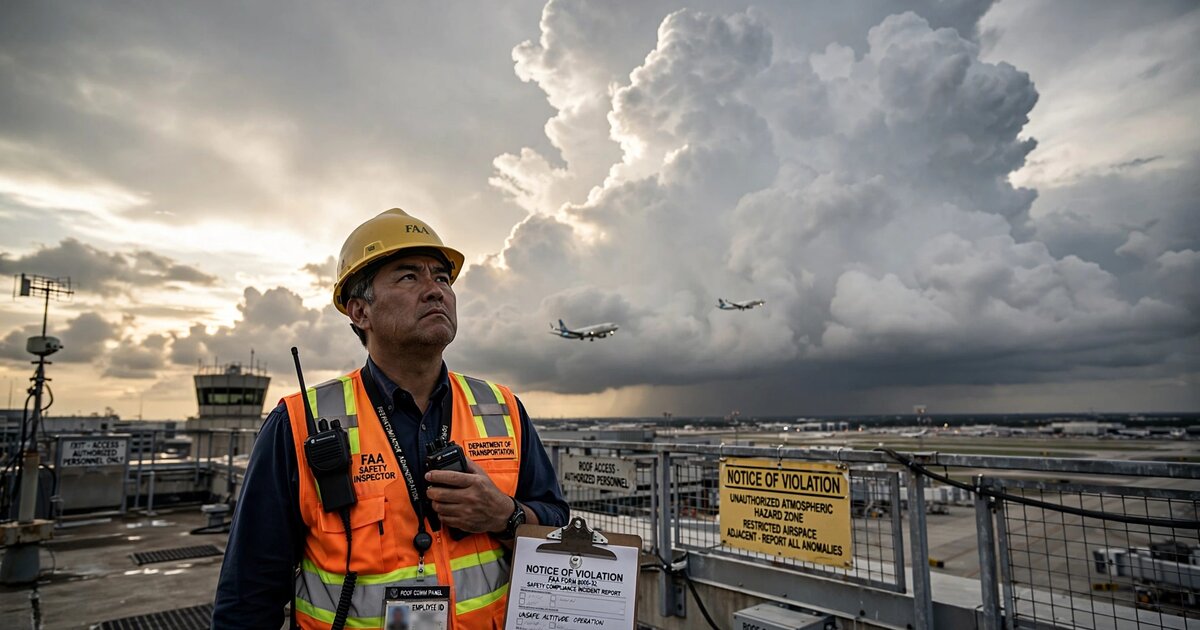
I. The Statutory Definition
In 1958, Congress passed the Federal Aviation Act, consolidating federal authority over civil aviation under a single agency for the first time. Among its provisions, now codified at 49 U.S.C. § 40102(a)(6), is a definition of “aircraft” that has governed every subsequent regulatory action in American aviation.1
The definition reads, in its entirety: “‘aircraft’ means any contrivance invented, used, or designed to navigate, or fly in, the air.”
This is a functional test. Congress chose three disjunctive verbs—“invented, used, or designed”—and two disjunctive activities—“to navigate, or fly in, the air.” A contrivance need not be invented to fly if it is used to fly. It need not navigate if it merely flies. The statute does not specify the materials, the operator, the manufacturer, or the origin of the contrivance. It does not require registration as a precondition to classification. It does not require intent. It requires only that the thing fly in the air.
The word “contrivance” is capacious. Black’s Law Dictionary defines it as “a device or mechanism; something contrived for a particular purpose.” The atmosphere, through the thermodynamic processes of evaporation, condensation, and convection, contrives structures of water droplets and ice crystals that sustain themselves in flight through the continuous application of atmospheric lift. These structures are clouds. They fly in the air. They have done so for approximately 4.4 billion years, since liquid water first appeared on the Earth’s surface in the Hadean eon. Congress did not exempt them.
II. The Flight Characteristics
A cloud is not a metaphorical aviator. It is a physical object of measurable mass, velocity, and altitude, operating within the National Airspace System at all times and in all weather conditions.
An average cumulus cloud, the white, flat-bottomed variety most commonly seen on fair-weather days, occupies a volume of approximately one cubic kilometer and contains approximately 500,000 kilograms—1.1 million pounds—of liquid water, according to calculations performed by Margaret LeMone of the National Center for Atmospheric Research and confirmed by the U.S. Geological Survey’s Water Science School.2 This is roughly equivalent to the weight of two fully loaded Boeing 747-400 aircraft. The cloud carries this weight while airborne. It does not have a maximum takeoff weight certification. It does not observe one.
Cumulonimbus clouds, the towering thunderstorm variety, present a more serious regulatory concern. These structures can extend from near the surface to altitudes exceeding 18,000 meters—approximately 60,000 feet—with updraft velocities exceeding 40 meters per second (78 knots) and, in severe supercell thunderstorms, speeds surpassing 50 meters per second (97 knots).3 For reference, 64 knots is the minimum threshold for hurricane-force wind on the Beaufort scale. A mature cumulonimbus generates internal wind speeds that, were they horizontal, would constitute a Category 2 hurricane. These winds operate in the vertical axis, inside a structure with no structural integrity certification, no flight envelope, and no published V-speeds.
Clouds move laterally at the speed of the ambient wind at their altitude. Low-altitude stratus clouds typically travel at 10 to 30 knots. Mid-altitude altostratus and altocumulus clouds move at 20 to 60 knots. Cirrus clouds embedded in the jet stream routinely exceed 100 knots and can surpass 200 knots—faster than most single-engine general aviation aircraft at cruise speed. None of these speeds have been filed on a flight plan. None have been reported to Air Traffic Control.
III. The Airspace Problem
The Federal Aviation Administration divides the National Airspace System into six classes, designated A through E and G, each with specific rules governing who and what may operate within them. Clouds violate the operating requirements of every one.
Class A airspace extends from 18,000 feet MSL to Flight Level 600 (approximately 60,000 feet). Under 14 CFR § 91.135, every aircraft operating in Class A airspace must do so under instrument flight rules, must have received an ATC clearance prior to entering, must maintain two-way radio communications with ATC, and must be equipped with the transponder and ADS-B equipment specified in 14 CFR § 91.215 and § 91.225.4 Cumulonimbus clouds routinely penetrate Class A airspace. Anvil tops can extend above 50,000 feet. Not a single cloud has received an ATC clearance. Not one has established two-way radio communications. Not one has squawked a transponder code. The ADS-B compliance rate among clouds is zero.
Under 14 CFR § 91.225, effective January 1, 2020, all aircraft operating in Class A, B, and C airspace must be equipped with Automatic Dependent Surveillance-Broadcast (ADS-B) Out equipment meeting the performance specifications of TSO-C166b or TSO-C166c.5 This equipment broadcasts the aircraft’s position, velocity, altitude, and identification to ground stations and other aircraft continuously. Clouds broadcast none of this information. They are, from the perspective of the ADS-B surveillance network, invisible participants in a system designed to make every participant visible. The irony is considerable, given that clouds are the most visible objects in the sky.
Class B airspace surrounds the nation’s busiest airports. Under 14 CFR § 91.131, operations within Class B airspace require an explicit ATC clearance and an operating transponder with altitude-reporting capability.6 Clouds enter and exit Class B airspace at will. They have never requested clearance. They do not respond to ATC instructions. When a cloud enters the Class B airspace surrounding, say, Los Angeles International Airport, it does so without authorization and remains until atmospheric conditions dissipate it, which may take hours. ATC works around the cloud. The cloud does not work around ATC.
IV. The Registration Deficit
Under 49 U.S.C. § 44101, no aircraft may operate within United States airspace unless it has been registered with the FAA and displays an N-number—the alphanumeric identifier that corresponds to its entry in the FAA Aircraft Registry maintained in Oklahoma City.7 As of 2025, the Aircraft Registry contains approximately 300,000 active registrations.
The number of clouds operating in United States airspace at any given moment is substantially larger. NASA’s Moderate Resolution Imaging Spectroradiometer (MODIS) aboard the Aqua satellite has measured global cloud coverage continuously since July 2002. The data, published by NASA’s Earth Observatory, establishes that approximately 67 percent of the Earth’s surface is covered by clouds at any given time.8 Applied to the approximately 10.4 million square kilometers of airspace over which the FAA exercises jurisdiction—the contiguous United States, Alaska, Hawaii, and oceanic airspace extending 12 nautical miles from the coast—this means approximately 7 million square kilometers of American airspace is occupied by unregistered aerial vehicles at any moment.
None of these vehicles displays an N-number. None has been entered in the Aircraft Registry. None has paid a registration fee, which, under the current schedule, is $5 per aircraft. The aggregate unpaid registration fees, assuming even a conservative estimate of one discrete cloud formation per 100 square kilometers of coverage, would exceed $350,000 at any given instant, accumulating continuously since the establishment of the registry in 1927.
V. The Airworthiness Catastrophe
Under 14 CFR § 91.7, no person may operate a civil aircraft unless it is in an airworthy condition.9 Airworthiness is established through a type certificate, issued under 14 CFR Part 21, Subpart B, which certifies that the aircraft’s design meets minimum safety standards. The aircraft must then receive an individual airworthiness certificate under 14 CFR § 21.183, confirming that the specific airframe conforms to its type design and is in condition for safe operation.
No type certificate has ever been issued for any cloud formation. The design is not standardized. Two cumulus clouds formed under apparently identical atmospheric conditions may differ in mass, internal structure, ice crystal concentration, and aerodynamic behavior by orders of magnitude. The “design” is, in engineering terms, non-repeatable. This would be disqualifying for any applicant seeking a type certificate.
The airworthiness of a cloud is, by any honest assessment, catastrophic. The structure is composed entirely of suspended water droplets and ice crystals with no tensile strength, no compressive integrity, and no structural load path. The airframe has no published service ceiling, no demonstrated flutter speed, no emergency procedures, and no minimum equipment list. The useful load is, in a sense, the entire vehicle: when the water falls, the aircraft ceases to exist. There is no term in aviation engineering for an aircraft whose continued airworthiness is contingent upon not releasing its own mass. The cloud has invented one.
VI. The Pilot Problem
Under 14 CFR § 61.3, no person may act as pilot in command of an aircraft unless that person holds the appropriate pilot certificate and medical certificate for the operation being conducted.10 Under 14 CFR § 91.3, the pilot in command is directly responsible for, and is the final authority as to, the operation of the aircraft.
Clouds have no pilot in command. They have no crew. They have no certificate holder. They are, in the most literal sense, unmanned aerial vehicles—a category the FAA has spent the last decade attempting to regulate under 14 CFR Part 107, which requires remote pilot certificates, visual line of sight, and weight limitations. Part 107 restricts unmanned aircraft to a maximum weight of 55 pounds.11 An average cumulus cloud exceeds this limit by a factor of approximately 20,000.
The absence of a pilot raises a secondary issue under 14 CFR § 91.3(b), which requires the pilot in command of an aircraft involved in an emergency to file a report with the FAA upon request. Clouds are involved in emergencies routinely. They create windshear. They generate microbursts. They produce icing conditions that have brought down commercial aircraft. They have never filed a report. They cannot be asked to file a report. The regulatory apparatus presumes a responsible human operator. The atmosphere has not provided one.
VII. The Collision Record
The hazard posed by these unregistered vehicles is not theoretical. It is documented in exhaustive detail by the National Transportation Safety Board and the FAA itself.
According to the FAA’s own safety analysis, weather is a contributing factor in approximately 41 percent of fatal aircraft accidents in the United States and is responsible for an estimated 70 percent of delays in the National Airspace System.12 The NTSB has found that approximately two-thirds of general aviation accidents that occur in instrument meteorological conditions—conditions created, almost without exception, by clouds—are fatal, a rate substantially higher than the overall fatality rate for general aviation accidents.13
The mechanism is direct. Clouds produce icing conditions that degrade aerodynamic surfaces. They generate turbulence that exceeds structural design limits. They create convective windshear and microbursts with vertical velocities sufficient to drive aircraft into terrain. They reduce visibility to zero, eliminating the see-and-avoid capability upon which 14 CFR § 91.113’s right-of-way rules depend.14
NOAA estimates that approximately 40,000 thunderstorms occur worldwide each day, with approximately 1,800 in progress at any given moment.15 The National Weather Service reports approximately 100,000 thunderstorms annually in the United States alone. Each one represents an unregistered aerial vehicle generating internal winds that exceed the design limits of most general aviation aircraft, operating without a transponder, without ATC coordination, and without any regard for the separation minima that every registered aircraft in the system is required to observe.
VIII. The Right-of-Way Paradox
Under 14 CFR § 91.113(d), the right-of-way rules for converging aircraft establish a hierarchy. A balloon has the right-of-way over any other category. A glider has the right-of-way over powered aircraft. An airship has the right-of-way over all other powered aircraft except those towing or refueling.14
The regulation does not address clouds. It does not assign them a category. It does not specify whether a cloud, when converging with a Boeing 737 at approximately the same altitude, has the right-of-way or must yield. In practice, the 737 yields. Every time. The cloud has, by operational precedent, established absolute right-of-way over all other traffic in the National Airspace System without the FAA having granted it. This is the regulatory equivalent of a vehicle that has never been licensed, inspected, or registered nonetheless commanding deference from every other vehicle on the road by virtue of being too large and too dangerous to challenge.
This unofficial primacy extends to Air Traffic Control itself. When a cumulonimbus occupies an arrival corridor, ATC does not issue the cloud a deviation clearance. ATC reroutes every registered, transponder-equipped, ADS-B-compliant aircraft in the system around it. The unregistered vehicle holds its course. The regulated participants absorb the cost. The system bends around the violator.
IX. The Enforcement Gap
Under 49 U.S.C. § 46301, the FAA may impose a civil penalty of up to $50,000 per violation for any person operating an aircraft in violation of the Federal Aviation Regulations. Under 49 U.S.C. § 46316, knowing and willful violations of the registration and airworthiness requirements carry criminal penalties including fines and imprisonment.16
The violation count is not calculable by conventional means. Each cloud operating without registration constitutes a continuing violation of 49 U.S.C. § 44101. Each cloud operating without an airworthiness certificate constitutes a continuing violation of 14 CFR § 91.7. Each cloud penetrating Class A airspace without ATC clearance, a transponder, and ADS-B constitutes a separate violation of 14 CFR §§ 91.135, 91.215, and 91.225. Each cloud creating hazardous conditions for registered aircraft without a pilot in command constitutes a violation of 14 CFR §§ 61.3 and 91.3.
At a conservative estimate of 50,000 discrete cloud formations operating within FAA-administered airspace at any given moment, each accumulating six or more simultaneous regulatory violations, the instantaneous violation count exceeds 300,000. Over the course of a single day, with cloud formations appearing, dissipating, and being replaced continuously, the total number of discrete violation events enters the millions. Over the course of a year, the figure becomes functionally meaningless. Over the 4.4 billion years that clouds have been operating in what is now United States airspace, the aggregate violation count approaches a number for which no notation exists in enforcement law.
The FAA has issued zero Notices of Proposed Civil Penalty. It has issued zero Letters of Investigation. It has referred zero cases to the NTSB for adjudication. It has not convened a single administrative hearing. The Flight Standards District Offices, of which there are approximately 80 nationwide, have conducted zero ramp inspections of any cloud. The enforcement rate is, across all categories, zero.
X. The Unmanned Aircraft Implications
Since 2016, the FAA has dedicated substantial regulatory effort to the integration of unmanned aircraft systems (UAS) into the National Airspace System. Under 14 CFR Part 107, operators of small unmanned aircraft—those weighing less than 55 pounds—must obtain a remote pilot certificate, register each aircraft, maintain visual line of sight, remain below 400 feet above ground level, and yield right-of-way to all manned aircraft.11
By 2025, the FAA had registered approximately 1.1 million small unmanned aircraft and issued approximately 400,000 remote pilot certificates. The regulatory apparatus for small drones is, by any measure, comprehensive and aggressively enforced. The FAA has pursued civil penalties against operators of drones weighing as little as two pounds for airspace violations that lasted minutes.
Meanwhile, the atmosphere operates billions of unmanned aerial vehicles weighing up to 500,000 kilograms each, at altitudes from the surface to 60,000 feet, through every class of airspace, at speeds exceeding 200 knots, with no remote pilot certificate, no registration, no visual observer, and no operational limitation whatsoever. The regulatory asymmetry is total. A twelve-year-old with a DJI Mini is subject to stricter federal oversight than a cumulonimbus cloud generating Category 2 hurricane-force updrafts inside Class A airspace.
XI. Conclusion
The evidence admits no ambiguity. Under 49 U.S.C. § 40102(a)(6), an “aircraft” is “any contrivance invented, used, or designed to navigate, or fly in, the air.” Clouds fly in the air. They navigate—driven by atmospheric forces, they traverse thousands of miles of airspace along identifiable routes, responding to pressure gradients and temperature differentials with a consistency that meteorologists can forecast days in advance. They are contrivances of the atmosphere, assembled through the physical mechanisms of evaporation and condensation, and deployed in the air for durations ranging from minutes to days.
They satisfy every functional element of the statutory test. They operate in every class of FAA-administered airspace. They carry no registration, no transponder, no ADS-B transmitter, no airworthiness certificate, and no pilot. They are a contributing factor in 41 percent of fatal aviation accidents. They cause 70 percent of all delays in the National Airspace System. Approximately 67 percent of the Earth’s surface is covered by them at any given moment.
The FAA regulates a recreational drone weighing 249 grams with more rigor than it applies to a cumulonimbus cloud weighing 500 million kilograms that is generating 97-knot vertical winds inside controlled airspace. The enforcement gap is not a rounding error. It is a permanent, structural capitulation to the largest fleet of unregistered aerial vehicles in the history of aviation.
The sky, it turns out, is not the limit. It is the violation.
Ergo.
Sources
- 49 U.S.C. § 40102(a)(6), Definitions, Federal Aviation Act of 1958 as codified. uscode.house.gov ↑
- U.S. Geological Survey, Water Science School, “How Much Does a Cloud Weigh?” See also M. LeMone, National Center for Atmospheric Research, cloud mass calculations; Library of Congress Science Reference Services. usgs.gov ↑
- “Cumulonimbus and Aviation,” citing updraft velocities exceeding 40 m/s (78 kn) in supercell thunderstorms and up to 50 m/s (97 kn) in extreme cases. See also Severe Weather Europe, “Updraft Characteristics and Thunderstorm Strength.” en.wikipedia.org ↑
- 14 CFR § 91.135, Operations in Class A Airspace, Federal Aviation Regulations. law.cornell.edu ↑
- 14 CFR § 91.225, Automatic Dependent Surveillance-Broadcast (ADS-B) Out Equipment and Use; effective January 1, 2020. law.cornell.edu ↑
- 14 CFR § 91.131, Operations in Class B Airspace. law.cornell.edu ↑
- 49 U.S.C. § 44101, Operation of Aircraft: Registration Requirement. law.cornell.edu ↑
- NASA Earth Observatory, “Cloudy Earth,” May 8, 2015, based on MODIS data from the Aqua satellite, July 2002–April 2015. earthobservatory.nasa.gov ↑
- 14 CFR § 91.7, Civil Aircraft Airworthiness. law.cornell.edu ↑
- 14 CFR § 61.3, Requirement for Certificates, Ratings, and Authorizations. law.cornell.edu ↑
- 14 CFR Part 107, Small Unmanned Aircraft Systems; see § 107.3 (definitions) and § 107.39 (operation over people). law.cornell.edu ↑
- National Business Aviation Association, “Strategic Weather Planning for Mission Success,” SDC2026, citing FAA data: weather contributes to 70% of NAS delays, 29% of Part 135 accidents, and 41% of fatal aircraft accidents. nbaa.org ↑
- National Transportation Safety Board, “Risk Factors Associated with Weather-Related General Aviation Accidents,” SS-05/01, 2005. ntsb.gov ↑
- 14 CFR § 91.113, Right-of-Way Rules: Except Water Operations. law.cornell.edu ↑
- National Oceanic and Atmospheric Administration, “Introduction to Thunderstorms”: approximately 40,000 thunderstorm occurrences each day worldwide. See also National Weather Service Melbourne, FL, lightning facts: approximately 1,800 thunderstorms in progress worldwide at any given moment. noaa.gov ↑
- 49 U.S.C. § 46301, Civil Penalties; 49 U.S.C. § 46316, General Criminal Penalty. law.cornell.edu ↑