I. The Statutory Framework
The Clean Water Act of 1972, 33 U.S.C. § 1251 et seq., declares it to be “the national policy that the discharge of pollutants into the navigable waters be eliminated.”1 Section 301(a) of the Act, 33 U.S.C. § 1311(a), provides that “the discharge of any pollutant by any person shall be unlawful” except in compliance with the Act’s permitting provisions. Section 402, 33 U.S.C. § 1342, establishes the National Pollutant Discharge Elimination System, under which the EPA or a delegated state authority may issue permits authorizing the discharge of pollutants from point sources into navigable waters of the United States, subject to conditions and effluent limitations.
The critical link between agriculture and the NPDES program is found at 40 CFR § 122.23(a), which provides that “concentrated animal feeding operations (CAFOs), as defined in paragraph (b) of this section or designated in accordance with paragraph (c) of this section, are point sources, subject to NPDES permitting requirements as provided in this section.”2 This provision was upheld by the Second Circuit in Waterkeeper Alliance, Inc. v. EPA (2005), which confirmed the EPA’s authority to regulate CAFOs as point sources while requiring that NPDES permits be sought only by those CAFOs that actually discharge.3
The regulatory architecture is tiered. An “animal feeding operation,” or AFO, is defined at 40 CFR § 122.23(b)(1) as “a lot or facility (other than an aquatic animal production facility) where the following conditions are met: (i) Animals (other than aquatic animals) have been, are, or will be stabled or confined and fed or maintained for a total of 45 days or more in any 12-month period, and (ii) Crops, vegetation, forage growth, or post-harvest residues are not sustained in the normal growing season over any portion of the lot or facility.”4 A CAFO is an AFO that meets certain size thresholds or is designated by the permitting authority under paragraph (c). But the AFO definition is the predicate. If the conditions are met, the facility is an animal feeding operation. The regulation does not specify that the animals must be livestock. It does not require that the operator intend to operate an AFO. It does not require that anyone enjoy the arrangement except the animals being fed.
The definition is two elements. We will take them one at a time.
II. The Operations Under Review
The U.S. Fish and Wildlife Service conducts the National Survey of Fishing, Hunting, and Wildlife-Associated Recreation approximately every five years in conjunction with the U.S. Census Bureau. It is the most comprehensive federal survey of wildlife-related activity in the country. The most recent addendum, published in November 2024 and based on 2022 survey data, reports that approximately 96 million Americans aged 16 and older engage in birdwatching, of whom 91 million—95 percent—watch birds from their homes.5
Of those 91 million home-based birders, a substantial majority actively provision food. The Service’s earlier survey data, summarized by bird-feeding researchers at the University of Florida Institute of Food and Agricultural Sciences, estimates that more than 53 million Americans feed wild birds, collectively depositing approximately one billion pounds of bird seed per year into the environment.6 The survey further reports that Americans spent more than $5 billion per year on bird seed and bird-feeding accessories, a figure that has approximately doubled in two decades.7
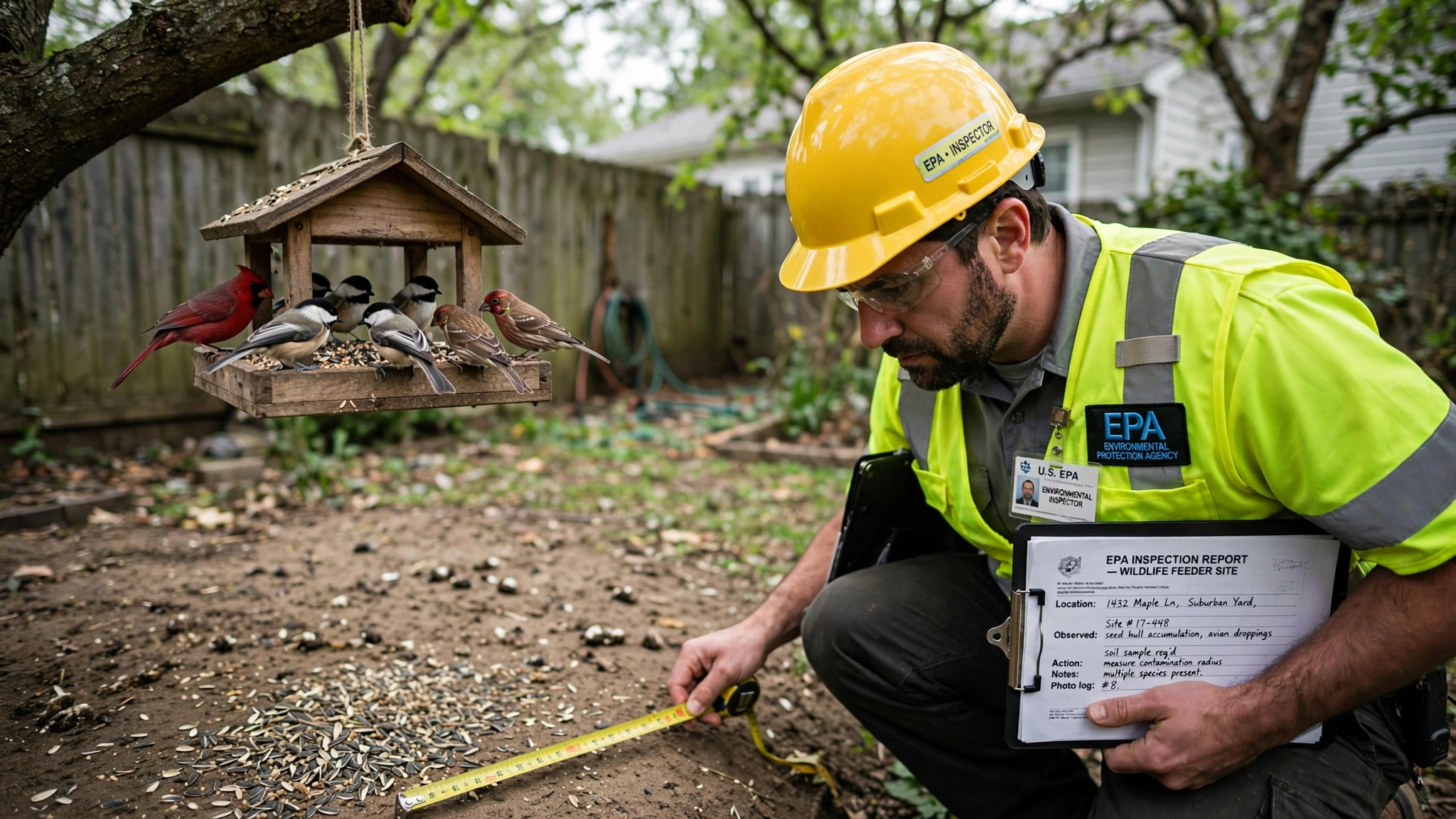
The typical backyard bird-feeding station consists of one or more suspended or pole-mounted dispensing devices positioned at a fixed location on the operator’s property. The devices are designed to attract wild birds by dispensing food—sunflower seeds, millet, thistle, suet, or mixed blends—into an accessible trough, tube, or platform. The same individual birds return to the same feeder daily, a behavior extensively documented through banding studies and radiofrequency identification tracking.8 A single feeder may serve fifty to several hundred individual birds per day, representing multiple species, each of which deposits fecal matter in the immediate vicinity of the feeding apparatus before departing and returning the following morning.
The operation runs year-round. The operator refills the feeding devices when they are depleted. The birds eat the food, excrete waste, and return. The National Audubon Society, the Cornell Lab of Ornithology, and the U.S. Fish and Wildlife Service all publish guidance recommending year-round feeding, with seasonal adjustments for food type.9 A backyard bird feeder in Topeka, Kansas, operates on essentially the same schedule as a backyard bird feeder in Portland, Oregon: daily, continuously, without closure, for twelve months of the year, for years or decades at a time. It does not file annual reports. It does not apply for permits. It does not pause to consider whether it might be a regulated facility. It hangs from a shepherd’s hook and waits for chickadees.
III. Element One: The Confinement and Feeding Requirement
The first element of the AFO definition requires that “animals (other than aquatic animals) have been, are, or will be stabled or confined and fed or maintained for a total of 45 days or more in any 12-month period.”10
The birds are fed. This is not a matter of interpretation. The devices are called feeders. The activity is called feeding. The industry is called the bird-feeding industry. The expenditure category in the USFWS survey is “bird food.” The product is sold in bags labeled “Wild Bird Food.” The verb is right there. The noun is right there. If the operator of a backyard bird feeder is not feeding animals, then the English language has suffered a definitional collapse more severe than any regulatory gap this investigation has identified.
The question of confinement is marginally less self-evident, but only marginally. The regulation uses the phrase “stabled or confined and fed or maintained.” The EPA’s own guidance on the CAFO rule, published in the Federal Register preamble to the 2003 CAFO Rule, explains that the confinement element is satisfied when animals are “confined by fences, housing, or other structures” and are not on pasture or rangeland where they can forage for their own sustenance.11 The preamble further explains that the key inquiry is whether the animals’ diet is provided by the operator rather than obtained through independent foraging in a vegetated area.
The birds at a feeding station are not foraging. They are being provisioned. Their diet at the station is provided entirely by the operator, who purchases seed, transports it to the facility, and dispenses it at a fixed location. The birds do not graze on naturally occurring vegetation at the feeding station. They consume commercially manufactured feed that the operator has placed there. The Cornell Lab of Ornithology’s Project FeederWatch, a citizen-science monitoring program that has tracked feeder visitation since 1987, documents that individual birds of species such as black-capped chickadees, tufted titmice, and house finches return to the same feeders daily throughout the winter and often year-round, establishing site fidelity to specific feeding stations.12
The forty-five-day threshold presents no difficulty. A year-round bird feeder operates for 365 days. Even a feeder maintained only during the winter months, from November through March, operates for approximately 150 days. The threshold is 45. The margin is not close. It has never been close. Every bird feeder in the continental United States that has operated through a single winter has exceeded the regulatory threshold by a factor of at least three.
Element one is satisfied. The animals are fed. The animals return to a fixed location for well in excess of 45 days. The operator provides the food. The regulation does not require that the confinement be involuntary, that the animals be unable to leave, or that the operator be unhappy about the arrangement. It requires that animals be “confined and fed or maintained.” They are confined by the food supply. They are fed by the operator. They are maintained at the facility by the daily replenishment of feed. The chickadees do not file written objections to this characterization.
IV. Element Two: The Vegetation Test
The second element of the AFO definition requires that “crops, vegetation, forage growth, or post-harvest residues are not sustained in the normal growing season over any portion of the lot or facility.”13
Anyone who has operated a bird feeder for more than one season knows what the ground beneath it looks like. The accumulated deposition of seed hulls, uneaten seed fragments, and avian fecal matter creates a zone of biological devastation directly beneath the feeding apparatus that is as barren as any feedlot in Kansas. Turf grass, the most resilient ground cover in the American suburban landscape, cannot survive the combination of physical smothering by hull debris, chemical loading from concentrated nitrogenous waste, and light deprivation from the density of the deposit layer. The bare patch beneath a well-used bird feeder typically extends two to four feet in radius from the base of the feeder pole and persists throughout the growing season and beyond.
This is not speculation. The University of Wisconsin Extension, the Penn State Master Gardener program, and the Cornell Cooperative Extension have all published guidance addressing the problem of dead vegetation beneath bird feeders, recommending strategies ranging from mulch barriers to concrete pads to the periodic relocation of the feeding station to allow the ground to recover.14 The advice presupposes the problem. The problem is that the vegetation is dead. The vegetation is dead because the facility is an animal feeding operation that concentrates waste in a confined area, which is exactly the environmental outcome that the CAFO regulations were designed to address.
The EPA’s own guidance on the vegetation criterion explains that the purpose of element two is to distinguish between facilities where animals are kept on pasture—where their waste is dispersed across a vegetated area and assimilated by growing plants—and facilities where waste is concentrated in a confined area that cannot sustain plant growth.15 The regulatory purpose is to identify operations where the concentration of animal waste exceeds the assimilative capacity of the land. A bird feeder meets this test every time the grass dies. The grass dies every time a bird feeder is operated with any regularity. The syllogism is ornithological and irrefutable.
Element two is satisfied. Vegetation is not sustained over the portion of the lot where the animals are confined and fed. The regulatory threshold is met not because of some exotic interpretation of the rule, but because of the plainly visible and universally acknowledged fact that bird feeders kill the grass beneath them. The dead zone is, in regulatory terms, the production area of an animal feeding operation. In horticultural terms, it is a nuisance. In aesthetic terms, it is an embarrassment. In legal terms, it has never been noticed.
V. The Discharge
An AFO that meets the definition is not automatically subject to NPDES permitting. Under 40 CFR § 122.23, NPDES permits are required specifically for CAFOs—AFOs that meet the size thresholds for Large or Medium CAFOs or that have been designated as CAFOs by the permitting authority. The size thresholds, codified at 40 CFR § 122.23(b)(4), are specified by animal type: 1,000 cattle, 2,500 swine over 55 pounds, 125,000 chickens other than laying hens, 82,000 laying hens if the facility uses a liquid manure handling system, 30,000 ducks if the facility uses a liquid manure handling system, and so forth.16
The regulation does not include a threshold for wild songbirds. It does not list black-capped chickadees, house finches, American goldfinches, or northern cardinals. This is a gap in the enumeration, not a gap in the statutory authority. The Clean Water Act’s definition of “point source” at 33 U.S.C. § 1362(14) is not limited to facilities with specifically enumerated animal types. And the designation authority at 40 CFR § 122.23(c) permits the EPA or a delegated state authority to designate any AFO as a CAFO “upon determining that it is a significant contributor of pollutants to waters of the United States.”17
Whether a given bird feeder discharges pollutants to waters of the United States is, of course, a site-specific inquiry. But the pollutant loading is not trivial. Avian fecal matter is rich in nitrogen and phosphorus, the two nutrients most responsible for eutrophication of surface waters in the United States. A single gram of passerine fecal matter contains approximately 30 to 50 milligrams of total nitrogen and 5 to 15 milligrams of total phosphorus, as documented in avian waste characterization studies.18 A busy feeder station attracting 100 to 200 birds per day, each producing approximately 10 to 15 grams of fecal matter daily, generates on the order of 1 to 3 kilograms of waste per day in the immediate vicinity of the feeding station. Over a year, this is 365 to 1,095 kilograms of concentrated animal waste deposited on a patch of land approximately three feet in diameter.
When it rains, this waste enters stormwater runoff. Stormwater runoff flows into municipal storm drains, ditches, swales, and ultimately into streams, rivers, and estuaries that are navigable waters of the United States. The pathway from the bird feeder to the receiving water is a “manmade ditch, flushing system, or other similar manmade device”—the exact conveyance that satisfies the Medium CAFO discharge criterion at 40 CFR § 122.23(b)(6)(ii)(A).19 The EPA has brought enforcement actions against cattle feedlots that discharged manure-laden runoff through exactly this type of conveyance. It has not brought an enforcement action against a bird feeder that does the same thing, at a smaller scale, fifty-three million times across the country.
VI. The Biosecurity Gap
The most revealing evidence that backyard bird feeders function as animal feeding operations comes not from the EPA but from the USDA. During the ongoing outbreaks of highly pathogenic avian influenza (HPAI), the USDA’s Animal and Plant Health Inspection Service has repeatedly issued advisories recommending that operators of backyard poultry flocks take down their wild bird feeders to prevent transmission of the H5N1 virus from wild birds to domestic poultry.20
The logic of the advisory is straightforward: bird feeders concentrate wild birds in a confined area, where they deposit fecal matter containing pathogens that can be transmitted to other animals. This is the exact biosecurity concern that drives CAFO regulation. The EPA regulates waste management at poultry CAFOs in part because the concentration of animals in a confined area creates conditions favorable to disease transmission and environmental contamination. APHIS issues advisories about bird feeders for the same reason. The two agencies have identified the same risk at the same type of facility. One agency regulates it. The other issues a suggestion.
The disease transmission record at bird feeders is extensive and well-documented. The Cornell Lab of Ornithology’s Wildlife Health Lab has tracked the spread of Mycoplasma gallisepticum, the bacterium responsible for mycoplasmal conjunctivitis in house finches, across the eastern United States since the disease emerged in 1994. A study led by Cornell ornithologist André Dhondt and published in PLOS ONE found that more than half of the 53 bird species tested had been exposed to the bacterium, which is transmitted through contact with contaminated surfaces—including bird feeder surfaces.21 A subsequent study published in Proceedings of the Royal Society B demonstrated that feeder use specifically predicted both acquisition and transmission of M. gallisepticum in free-living house finch populations.22
Salmonellosis outbreaks at bird feeding stations are a recurring phenomenon. The Centers for Disease Control and Prevention has recommended that bird feeders be removed for a minimum of two weeks during songbird salmonellosis outbreaks to reduce transmission.23 The California Department of Fish and Wildlife has stated that “the increased congregation of wild birds at bird feeders and bird baths may lead to fecal contamination of the local environment, which can aid in disease transmission.”24 A 2025 study published in the American Journal of Veterinary Research documented that Salmonella can persist on bird feeder surfaces, with prevalence rates of up to 27 percent on surfaces contaminated with bird feces in shared human-wildlife environments.25
The USDA requires commercial poultry CAFOs to implement biosecurity plans addressing disease transmission risks. These plans include requirements for visitor logs, boot sanitation stations, separation of clean and dirty areas, and rodent control programs. The typical bird feeder operator implements none of these measures. The facility has no biosecurity plan. It has no visitor log, which would in any case require a staff ornithologist to administer. It has no sanitation protocol beyond the Audubon Society’s suggestion to clean the feeder periodically with a ten-percent bleach solution, a recommendation that the Society acknowledges most operators do not follow.26 The disease transmission infrastructure at a backyard bird feeder is, from a biosecurity standpoint, a poultry CAFO with no walls, no roof, no veterinarian, no mortality disposal plan, and no regulatory oversight, serving a population of animals that is free to leave and spread pathogens across the entire flyway.
VII. The Designation Authority
The EPA’s authority to designate any AFO as a CAFO is codified at 40 CFR § 122.23(c). The regulation provides that the “permit authority may designate any animal feeding operation as a CAFO upon determining that it is a significant contributor of pollutants to waters of the United States.” The designation factors include the size of the operation, the amount of waste reaching navigable waters, the location of the operation relative to navigable waters, the means of conveyance, and “other relevant factors.”27
Consider the aggregate. Fifty-three million bird feeding operations. One billion pounds of seed dispensed annually. Each pound of seed consumed produces a corresponding volume of avian waste deposited in a concentrated, unvegetated area. The total mass of avian fecal matter deposited at American bird feeding stations each year has not been calculated by any federal agency, because no federal agency has considered it necessary to calculate the fecal output of a recreational activity that the Department of the Interior actively encourages. The USFWS publishes pamphlets on how to attract more birds to your feeder. The EPA regulates the waste output of every other facility that attracts animals and feeds them in a confined area. The two agencies do not appear to have compared notes.
For context, the EPA estimates that there are approximately 21,000 CAFOs in the United States subject to NPDES permitting requirements, plus an additional 450,000 AFOs below the CAFO thresholds.28 Fifty-three million bird feeders exceed the combined number of regulated and unregulated agricultural animal feeding operations by a factor of approximately 113. The regulatory apparatus that the EPA has constructed to manage animal waste from 471,000 facilities has not been extended to 53 million facilities that perform the same function at a smaller scale, in closer proximity to residential populations, and with no waste management controls whatsoever.
The designation authority does not require an act of Congress. It does not require a rulemaking. It requires only that the permit authority determine that an AFO is a significant contributor of pollutants. Fifty-three million individual determinations would, admittedly, strain the administrative capacity of even the most enthusiastic regional office. But the EPA has demonstrated a willingness to regulate categories of sources through general permits and sector-specific rules. A bird feeder general permit—covering the estimated 53 million facilities, requiring annual nutrient management plans, waste characterization reports, and semi-annual monitoring of the receiving waters downstream of the shepherd’s hook—is within the agency’s existing authority. It simply has not occurred to anyone at the Office of Water to draft one.
VIII. The Common Ownership Problem
The regulatory implications compound. Under 40 CFR § 122.23(b)(2), “two or more AFOs under common ownership are considered to be a single AFO for the purposes of determining the number of animals at an operation, if they adjoin each other or if they use a common area or system for the disposal of wastes.”29
Consider a suburban cul-de-sac where four neighbors each maintain bird feeders. The feeders are on adjoining properties. The fecal waste from all four facilities enters the same stormwater conveyance system—the gutter, the storm drain, the municipal outfall. Under the common-area-for-disposal-of-wastes prong, these four AFOs are aggregated into a single operation for the purpose of determining animal numbers. The thirty chickadees at one feeder combine with the forty house sparrows at the next, the twenty-five goldfinches at the third, and the miscellaneous juncoes, nuthatches, and woodpeckers at the fourth. A cul-de-sac with four feeders is not four small AFOs. It is one medium-to-large AFO with a combined animal population that may, on a busy February morning with an irruption of pine siskins, approach the numerical threshold for a medium poultry CAFO.
The aggregation principle has been enforced by the EPA in agricultural contexts. In Community Association for Restoration of the Environment v. Henry Bosma Dairy (2002), the Ninth Circuit upheld the aggregation of multiple dairy operations under common ownership into a single CAFO for NPDES purposes.30 The principle has never been applied to a homeowners’ association whose members collectively operate bird feeders that share a common stormwater system. The legal theory is untested. The arithmetic is not.
IX. Conclusion
The regulatory definition of an animal feeding operation is two elements. The first element is that animals are confined and fed at a facility for 45 or more days in a 12-month period. Bird feeders confine and feed animals for 365 days per year. The second element is that vegetation is not sustained over the facility. Vegetation beneath bird feeders is dead. Both elements are met. The definition is satisfied. The bird feeder is an animal feeding operation.
This conclusion is not novel. It is mechanical. The regulation says what it says. The feeder does what it does. The gap between the two is not a matter of statutory ambiguity or regulatory discretion. It is a matter of no one at the Environmental Protection Agency having looked at a bird feeder and thought the thought that the regulation compels. The thought is uncomfortable. The thought is also correct.
The USDA has noticed. When avian influenza threatened the poultry industry, APHIS issued advisories directing the operators of exactly these facilities to shut them down. The advisories did not call them animal feeding operations. They called them “bird feeders.” But the regulatory concern—concentrated animals, concentrated waste, concentrated disease transmission risk—was the same concern that animates the entire CAFO regulatory program. One agency recognized the risk and issued a suggestion. The other agency has not recognized the facility at all.
Fifty-three million Americans wake up every morning and walk outside to refill a device that concentrates wild animals at a fixed location, kills the vegetation beneath it, deposits pathogen-laden waste onto the land surface, and contributes nutrient runoff to the nation’s waterways during every rain event. They do this because they like birds. They do this because the Audubon Society told them to. They do this because their grandmother did it and her grandmother did it before her. They do not do this because they have obtained a National Pollutant Discharge Elimination System permit, filed a nutrient management plan with the appropriate permitting authority, or retained a consulting engineer to characterize the waste stream emanating from the area beneath the tube feeder near the kitchen window.
The regulation does not exempt facilities operated for recreational purposes. It does not exempt facilities where the animals are cute. It does not exempt facilities whose operators describe their activity as “birdwatching” rather than “animal husbandry.” It defines an animal feeding operation. Fifty-three million Americans operate one. The environmental consequences are documented, the disease transmission is peer-reviewed, and the applicable regulation has been on the books since 2003.
The chickadees continue to eat. The grass continues to die. The EPA continues to look the other way, presumably through binoculars.
Ergo.
Sources
- 33 U.S.C. § 1251(a)(1), Clean Water Act, Section 101(a)(1), declaring national policy to eliminate discharge of pollutants. law.cornell.edu ↑
- 40 CFR § 122.23(a), designating CAFOs as point sources subject to NPDES permitting. law.cornell.edu ↑
- Waterkeeper Alliance, Inc. v. EPA, 399 F.3d 486 (2d Cir. 2005), upholding CAFO rule while requiring duty to apply for permits only upon actual discharge. casetext.com ↑
- 40 CFR § 122.23(b)(1), definition of “animal feeding operation.” law.cornell.edu ↑
- U.S. Fish and Wildlife Service, “2022 Birding in the United States: A Demographic and Economic Analysis,” Addendum to the 2022 National Survey of Fishing, Hunting, and Wildlife-Associated Recreation, published November 19, 2024. fws.gov ↑
- University of Florida Institute of Food and Agricultural Sciences, “Attracting Backyard Birds: Bird Feeder Selection,” summarizing USFWS data that more than 50 million Americans feed birds, depositing an estimated one billion pounds of bird food per year. edis.ifas.ufl.edu ↑
- D.N. Jones and S.J. Reynolds, “Feeding Birds in Our Towns and Cities: A Global Research Opportunity,” Journal of Avian Biology, vol. 39, no. 3, 2008, pp. 265–271; USFWS National Survey data showing expenditures of $5 billion on bird seed and accessories. pubmed.ncbi.nlm.nih.gov ↑
- S.M. Hackett et al., “Individual Variation and Seasonality Drive Bird Feeder Use During Winter in a Mediterranean Climate,” Ecology and Evolution, documenting individual-level site fidelity to feeding stations using PIT-tagging and RFID tracking of black-capped chickadees. pmc.ncbi.nlm.nih.gov ↑
- Cornell Lab of Ornithology, “Feeding Birds,” All About Birds; National Audubon Society, “Types of Bird Feeders”; USFWS, “For the Birds: Feeding and Sheltering Backyard Birds.” allaboutbirds.org ↑
- 40 CFR § 122.23(b)(1)(i). law.cornell.edu ↑
- 68 Fed. Reg. 7176 (Feb. 12, 2003), preamble to the 2003 CAFO Rule, discussing the distinction between pasture-based operations and confined feeding operations. govinfo.gov ↑
- Cornell Lab of Ornithology, Project FeederWatch, operating since 1987, tracking feeder bird populations across North America through citizen-science monitoring. feederwatch.org ↑
- 40 CFR § 122.23(b)(1)(ii). law.cornell.edu ↑
- Penn State Extension, “Managing the Mess Under Bird Feeders”; University of Wisconsin Extension, “Bird Feeding: Keeping Your Yard Clean”; Cornell Cooperative Extension, guidance on preventing turf damage from bird feeder waste accumulation. extension.psu.edu ↑
- 68 Fed. Reg. 7176 (Feb. 12, 2003), preamble discussion of the vegetation criterion as distinguishing pasture from confinement. govinfo.gov ↑
- 40 CFR § 122.23(b)(4), Large CAFO size thresholds by animal type. law.cornell.edu ↑
- 40 CFR § 122.23(c), CAFO designation authority. law.cornell.edu ↑
- T.E. Gould and L.A. Kapustka, “Avian Fecal Contamination of Environmental Waters,” characterizing nitrogen and phosphorus content of passerine fecal matter; see also EPA nutrient criteria documentation for urban stormwater. pubmed.ncbi.nlm.nih.gov ↑
- 40 CFR § 122.23(b)(6)(ii)(A), Medium CAFO discharge through manmade conveyance criterion. law.cornell.edu ↑
- USDA Animal and Plant Health Inspection Service, “Defend the Flock” biosecurity guidance, recommending that poultry owners take down wild bird feeders during HPAI outbreaks. aphis.usda.gov ↑
- A.A. Dhondt et al., “Epidemic Mycoplasmal Conjunctivitis Is Not Caused by a Single Clone of Mycoplasma gallisepticum,” PLOS ONE, 2014, reporting that more than half of 53 bird species tested were exposed to M. gallisepticum. pubmed.ncbi.nlm.nih.gov ↑
- D.M. Hawley et al., “Feeder Use Predicts Both Acquisition and Transmission of a Contagious Pathogen in a North American Songbird,” Proceedings of the Royal Society B, demonstrating that feeder use specifically predicts both pathogen acquisition and transmission in house finch populations. pmc.ncbi.nlm.nih.gov ↑
- Centers for Disease Control and Prevention, “Salmonella and Wild Birds,” recommending removal of bird feeders for at least two weeks during songbird salmonellosis outbreaks. cdc.gov ↑
- California Department of Fish and Wildlife, “California Outdoors Q&A: Should I Take Down My Bird Feeders Because of Avian Influenza?” August 25, 2022. wildlife.ca.gov ↑
- M.J. Seixas et al., “Salmonella Environmental Persistence Informs Management Relevant to Avian and Public Health,” American Journal of Veterinary Research, vol. 86, no. 6, 2025, documenting 27% Salmonella prevalence on surfaces contaminated with bird feces. pubmed.ncbi.nlm.nih.gov ↑
- National Audubon Society, “How to Clean Your Bird Feeders,” recommending cleaning with 10% bleach solution. audubon.org ↑
- 40 CFR § 122.23(c), listing factors for CAFO designation including size, waste reaching waters, location relative to waters, and means of conveyance. law.cornell.edu ↑
- EPA, “NPDES CAFO Permitting Status Report,” estimating approximately 21,000 permitted CAFOs and approximately 450,000 total AFOs nationwide. epa.gov ↑
- 40 CFR § 122.23(b)(2), aggregation of AFOs under common ownership that adjoin or share a common waste disposal system. law.cornell.edu ↑
- Community Association for Restoration of the Environment v. Henry Bosma Dairy, 305 F.3d 943 (9th Cir. 2002), applying the aggregation principle to multiple dairy operations under common ownership. casetext.com ↑