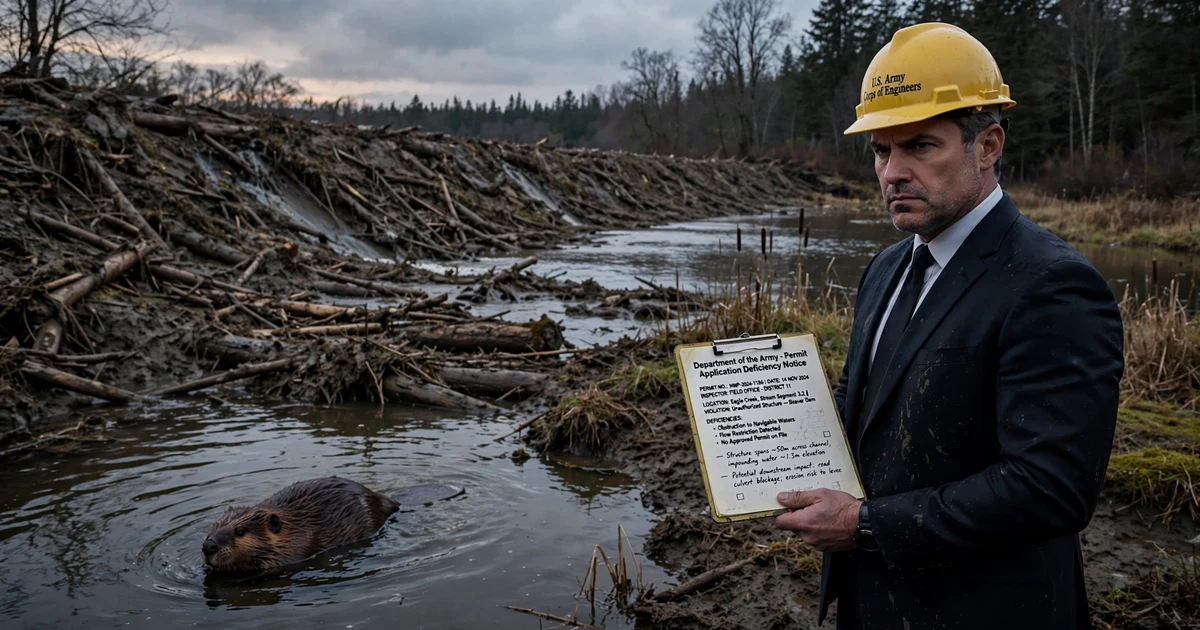
I. The Statute
The Federal Water Pollution Control Act Amendments of 1972, known as the Clean Water Act, provide at Section 301(a), codified at 33 U.S.C. § 1311(a), that the discharge of dredged or fill material into the navigable waters of the United States, defined as the waters of the United States, is unlawful except in compliance with Section 404, codified at 33 U.S.C. § 1344. Section 404 authorizes the United States Army Corps of Engineers to issue the permits that make such discharges lawful. The Environmental Protection Agency’s description of the regulated activity is plain: “A discharge of dredged or fill material involves the physical placement of soil, sand, gravel, dredged material, or other such materials.” The placement is the violation. The material is the evidence.1
The program is not a formality. The Corps processes approximately 60,000 permit actions per year under Section 404, and its nationwide permits, the general permits issued under Section 404(e), authorize approximately 25,000 reported activities per year as well as approximately 30,000 activities that do not require reporting to Corps districts, according to the Corps’ January 2026 reissuance fact sheet. Every bridge footing, every marina dredging, every utility crossing of a jurisdictional waterway passes through this system. The application requires drawings, delineations, alternatives analyses, and public notice. The beaver submits none of these.2
II. The Operator
The operator is Castor canadensis, the North American beaver. Adults may attain a weight of 70 pounds or more, making the beaver North America’s largest rodent. It is a primarily nocturnal mammal, and its nocturnal activity is earthmoving.3
The scale of the operation is a function of its manpower, and the manpower has undergone one of the great expansions in American history. The fur trade reduced the North American beaver to approximately 100,000 individuals by the turn of the twentieth century, a remnant of a population that had numbered in the tens of millions. Protection, reintroduction, and the collapse of the pelt market reversed the decline a hundredfold or more. Current estimates place the North American population at 10 to 15 million, with some assessments running higher. Every one of them engages in the regulated activity.4
The raw material of the business is timber, and the beaver harvests it without a timber plan. A beaver can cut down a willow thicker than a human leg in under five minutes. Recorded fellings include trees 45 meters tall and 115 centimeters in diameter. The felled timber is transported by water and by tooth to the job site, where it becomes structural fill.5
III. The Method
The method is dredging followed by filling, in that order, at the same location. Beavers carry mud with their forepaws and timber between their teeth. They drive branches and logs into the mud of the streambed, then build the superstructure from sticks, bark, rocks, mud, grass, and leaves. The sealing course is dredged material: beavers interlock the timber and dredge mud from the pond bottom to seal the dam. The statute prohibits the discharge of dredged material into waters of the United States. The beaver dredges material from waters of the United States and discharges it into waters of the United States, in a single continuous operation.6
The dimensions of a typical installation are modest only in comparison to the atypical ones. The majority of dams range from 0.2 to 2.2 meters tall, with a mean height around 1.0 meter, though some exceed 5 meters; lengths generally range from 0.5 to 308 meters. Colonies build in cascades, primary dams backed by secondary structures, with studies documenting series of one to eight dams stepping down a single drainage. Each dam impounds water, raises the local water table, and converts flowing water into standing water behind a wall of placed fill.7
IV. The Mega-Structure
On the southern edge of Wood Buffalo National Park in Alberta, Canada, there stands a beaver dam almost 800 meters long from end to end, the front of the dam running approximately 775 meters. It is the largest beaver dam on earth. It was discovered in October 2007 by Canadian ecologist Jean Thie, who found it while using satellite imagery and Google Earth to track melting permafrost. Absent from 1975 aerial imagery, it was constructed over the following decades by successive generations of beavers. The structure is visible from space.8
Consider the permitting posture of a fill structure almost 800 meters long, assembled across a waterway over the following decades, discovered only because a scientist happened to be looking at the ground from orbit. No application was filed. No jurisdictional determination was requested. No alternatives analysis considered whether the impoundment could have been achieved with a smaller footprint. The dam predates the satellite that found it, the software that displayed it, and several of the nationwide permits under which a human applicant would have been required to seek authorization for a structure one-thousandth its size.9
V. The Wetlands
The fill does not merely sit in the water. It remakes it. In a monitored complex of thirteen beaver ponds built by Eurasian beavers in a controlled enclosure in Devon, England, researchers measured approximately one million liters of stored water, more than one hundred tonnes of trapped sediment, nearly sixteen tonnes of trapped carbon, and nearly one tonne of nitrogen. Water leaving the complex carried lower concentrations of suspended sediment, nitrogen, and phosphate than water entering it. Studies in Glacier National Park measured sediment accumulation rates of 2 to 28 centimeters per year in one set of ponds and approximately 4 to 39 centimeters per year in another. The ponds raise water tables, create wetlands, and hold floodwater that would otherwise move downstream.10
The historical footprint has not been surveyed; it has been estimated. Environmental journalist Ben Goldfarb, in his history of the species, estimates that beavers submerged some 234,000 square miles of pre-contact North America, and other accounts hold that as much as one-tenth of the continent was beaver-created wetland. These are authorial estimates, not agency figures. The government holds no independent records of it: the largest wetland-creation program in the history of the continent was carried out by an unpermitted operator, and the government’s records of it are a journalist’s guesstimate.11
VI. The Narrowing
On May 25, 2023, the Supreme Court of the United States decided Sackett v. Environmental Protection Agency, 598 U.S. 651, holding that the Clean Water Act covers only wetlands with a “continuous surface connection” to bodies that are waters of the United States in their own right, such that the wetland is “indistinguishable” from those waters. The decision narrowed the meaning of “waters of the United States” and removed federal protection from a large class of isolated wetlands. It was the most significant contraction of Clean Water Act jurisdiction in the statute’s history.12
It did not help the beaver. A beaver pond is, by construction, a wetland with a continuous surface connection to the stream it impounds; the connection is the entire purpose of the structure. The dam exists to join the wetland to the waterway. Every beaver pond in America satisfies the Sackett test by design, because the beaver built the connection itself, out of dredged material, without a permit. Most defendants argue their way out of federal jurisdiction. This one dredges its way in, nightly.13
VII. The Penalty
The price of an unpermitted discharge is set by statute and adjusted for inflation. Under the Environmental Protection Agency’s January 2025 civil penalty rule, issued pursuant to 40 CFR Part 19, the maximum civil penalty for a Clean Water Act violation stands at $68,445 per day for each violation. The meter runs daily.14
Human dischargers learn the rate quickly. An Alaska landowner who filled wetlands and streams without authorization faced penalties of up to $32,500 per day under the schedule then in effect. The beaver’s Wood Buffalo structure, in Alberta and therefore outside Corps jurisdiction, has stood for more than three decades. Were it subject to the statute, a single continuous violation of that duration would accrue penalties at the current rate in the hundreds of millions of dollars, assessed against an operator whose total assets consist of a lodge, a food cache, and almost 800 meters of unpermitted fill.15
VIII. The Permit Gap
The Corps’ permit records are extensive. They contain authorizations for marinas, pipelines, housing developments, highway crossings, and mining operations. They contain approximately 60,000 actions per year. They do not contain a single authorization issued to Castor canadensis. No beaver has ever submitted an application. No beaver has ever received a jurisdictional determination. No beaver has ever published notice of a proposed discharge or responded to public comment, though the dams are visible: the largest one is visible from space.16
The asymmetry is the story. A human being who places fill in a jurisdictional waterway faces $68,445 per day. A rodent that places almost 800 meters of fill in a jurisdictional waterway faces nothing, because the enforcement program that processes 60,000 permit actions a year has never once treated the continent’s most prolific discharger of dredged material as a discharger. The statute prohibits the physical placement of dredged material into waters of the United States. Every structure the beaver builds is the physical placement of dredged material into waters of the United States.17
IX. Conclusion
Section 301(a) of the Clean Water Act, 33 U.S.C. § 1311(a), makes it unlawful to discharge dredged or fill material into waters of the United States except in compliance with Section 404, 33 U.S.C. § 1344, under which the Army Corps of Engineers issues permits. The North American beaver dredges mud from streambeds and pond bottoms and discharges it, with sticks, bark, rocks, grass, and leaves, into waters of the United States, impounding streams behind dams that run to almost 800 meters in length and persist for decades. A monitored thirteen-pond complex built by Eurasian beavers in a controlled Devon enclosure stored approximately one million liters of water and trapped more than one hundred tonnes of sediment. Population estimates run from approximately 100,000 individuals at the turn of the twentieth century to 10 to 15 million today, each one a potential discharger. The Supreme Court’s 2023 narrowing of federal jurisdiction in Sackett does not reach the beaver pond, which maintains its continuous surface connection by design. Civil penalties stand at $68,445 per day per violation. The Corps processes approximately 60,000 permit actions per year under Section 404.
No beaver holds a single one of them.
Ergo.
Sources
- Section 301(a) of the Clean Water Act, 33 U.S.C. § 1311(a), makes the discharge of dredged or fill material into waters of the United States unlawful except in compliance with Section 404, 33 U.S.C. § 1344, which authorizes the Army Corps of Engineers to issue permits. Under the Section 404 program, “A discharge of dredged or fill material involves the physical placement of soil, sand, gravel, dredged material, or other such materials.” law.cornell.edu epa.gov ↑
- The Corps processes approximately 60,000 permit actions per year under Section 404. Its nationwide permits authorize approximately 25,000 reported activities per year as well as approximately 30,000 activities that do not require reporting to Corps districts, per the Corps’ January 2026 reissuance fact sheet. epa.gov usace.army.mil ↑
- American beavers “may attain a weight of 70 pounds or more, making them North America’s largest rodent” (Castor canadensis). nj.gov ↑
- The fur trade reduced the North American beaver to approximately 100,000 individuals by the turn of the twentieth century; the population has rebounded a hundredfold or more, with current estimates of 10 to 15 million. kosmosjournal.org eol.org ↑
- A beaver can gnaw down “a willow tree that’s thicker than your leg in under five minutes”; recorded fellings include trees 45 meters tall and 115 centimeters in diameter. mdc.mo.gov wikipedia.org ↑
- Beavers “carry mud with their forepaws and timber between their teeth,” drive branches and logs into the mud of the streambed, and build the superstructure from “sticks, bark, rocks, mud, grass, leaves”; they interlock the timber and dredge mud from the pond bottom to seal the dam. wikipedia.org wedgetail.vc ↑
- The majority of dams range from 0.2 to 2.2 meters tall with a mean height around 1.0 meter, though some exceed 5 meters; lengths generally range from 0.5 to 308 meters; colonies build cascades of one to eight dams. beaverinstitute.org ↑
- The dam runs almost 800 meters from end to end, with the dam front approximately 775 meters; the perimeter approaches 2,000 meters and the pond covers some 70,000 square meters. Discovered in October 2007 by ecologist Jean Thie using satellite imagery and Google Earth while tracking melting permafrost; absent from 1975 aerial imagery. parks.canada.ca phys.org ↑
- On the permitting posture of long-standing unpermitted fill: the Corps’ after-the-fact authorization process applies to unauthorized discharges by human applicants; no beaver application is on record. epa.gov ↑
- A monitored complex of thirteen ponds built by two Eurasian beavers (Castor fiber) in a controlled 1.8-hectare enclosure in Devon, England: approximately 1,000 cubic meters of water stored (Puttock et al., Science of the Total Environment 576:430–443 (2017)); 101.53 tonnes of sediment, 15.90 tonnes of carbon, and 0.91 tonnes of nitrogen trapped (Puttock et al., Earth Surface Processes and Landforms (2018)); water leaving the site carried lower concentrations of suspended sediment, nitrogen, and phosphate. Sediment accumulation of 2–28 cm/yr (Butler and Malanson) and c. 4–39 cm/yr (Meentemeyer and Butler) measured in Glacier National Park ponds. martinezbeavers.org pmc.ncbi.nlm.nih.gov ↑
- Ben Goldfarb estimates beavers submerged some 234,000 square miles of pre-contact North America; other accounts hold that as much as one-tenth of the continent was beaver-created wetland. These are authorial estimates, not agency figures. scientificamerican.com baynature.org ↑
- Sackett v. Environmental Protection Agency, 598 U.S. 651 (2023), decided May 25, 2023: the Clean Water Act covers only wetlands with a “continuous surface connection” to covered waters, such that they are “indistinguishable” from those waters. law.cornell.edu waterboards.ca.gov ↑
- On the jurisdictional consequence: a beaver pond impounding a stream maintains a continuous surface connection to that stream by construction. law.cornell.edu ↑
- EPA’s January 8, 2025 civil penalty rule: maximum civil penalty of $68,445 per day for each Clean Water Act violation, per 33 U.S.C. § 1319(d) and 40 CFR Part 19. crowell.com ↑
- An Alaska landowner who filled wetlands and streams without authorization faced penalties of up to $32,500 per day under the schedule then in effect. ohsonline.com ↑
- The Corps processes approximately 60,000 permit actions per year under Section 404; no authorization issued to Castor canadensis appears in the program’s public records. epa.gov ↑
- The regulated act under 33 U.S.C. §§ 1311(a) and 1344 is the discharge of dredged or fill material into waters of the United States. epa.gov ↑