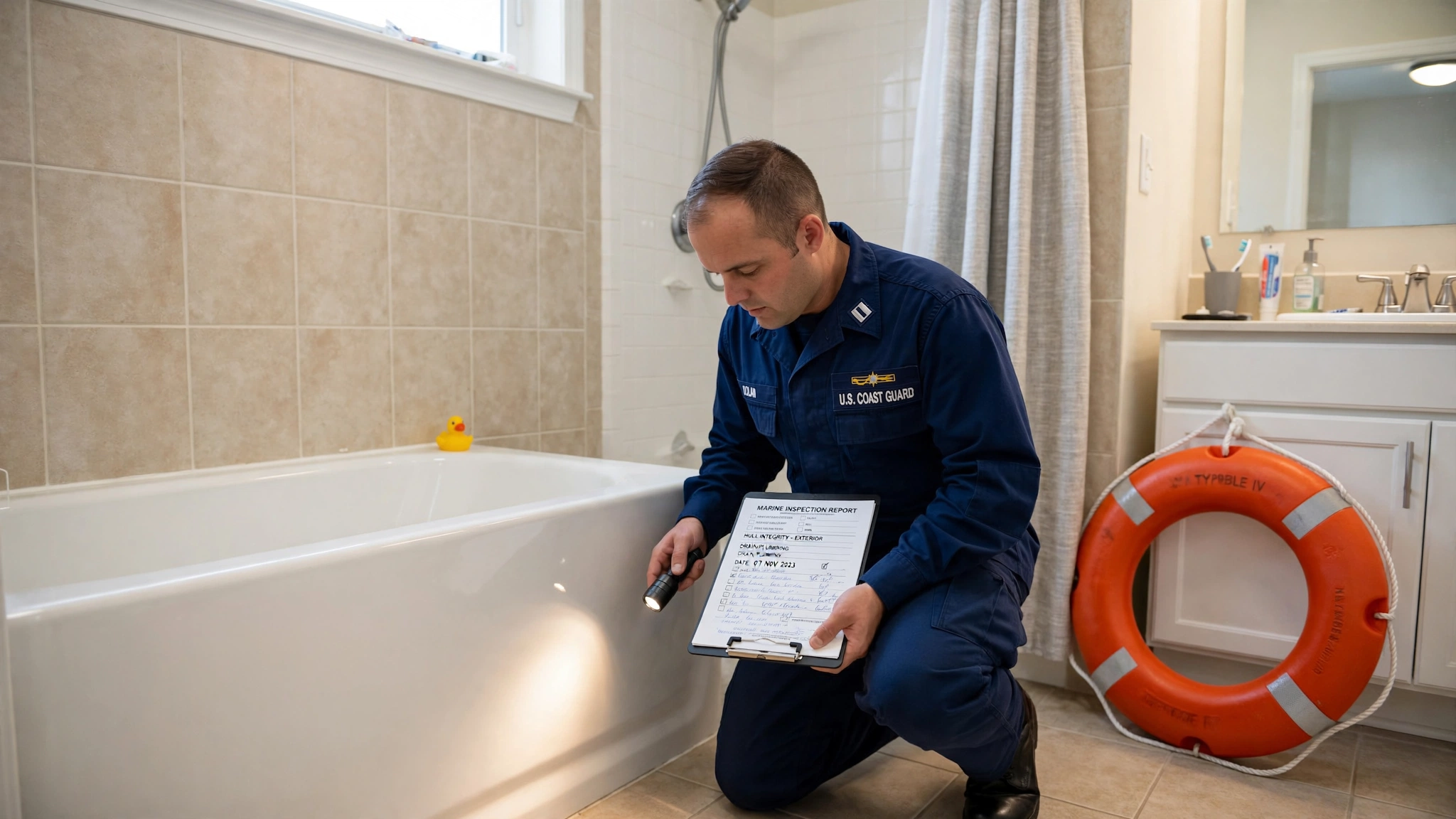
I. The Statutory Definition
The Rules of Construction Act, codified at 1 U.S.C. § 3, provides a definition of “vessel” that governs every subsequent use of the word in every title of the United States Code.1 The definition has been in continuous operation since July 30, 1947, when it was enacted as part of the general rules of statutory construction. It has never been amended.
The definition reads, in its entirety: “The word ‘vessel’ includes every description of watercraft or other artificial contrivance used, or capable of being used, as a means of transportation on water.”
This is a functional test constructed from three disjunctive elements. First, the subject must be a “watercraft or other artificial contrivance.” A bathtub is not a watercraft. It is, however, an artificial contrivance—a manufactured object designed and produced for a particular purpose. Black’s Law Dictionary defines “contrivance” as “a device or mechanism; something contrived for a particular purpose.” A bathtub is contrived for the purpose of holding water and holding a person in that water. It is manufactured in a factory. It is installed in a fixed location. It has a hull—the interior basin—a drain fitting that functions as a through-hull valve, an overflow scupper, and in many installations, a water supply system that provides both hot and cold running water to the vessel. These are design features that a shipwright would recognize.
Second, the contrivance must be “used, or capable of being used.” These terms are disjunctive. The statute does not require that the contrivance is currently in use as a means of water transportation. It requires only that it is capable of being so used. The Supreme Court has addressed this precise phrase and held that it encompasses “practical” possibilities, not “merely theoretical” ones. Stewart v. Dutra Construction Co., 543 U.S. 481, 496 (2005).2 The practical capability of bathtub-based water transportation has been demonstrated annually in open ocean conditions since 1967. This is not a theoretical possibility. It is an empirical fact with a fifty-nine-year operational record.
Third, the use must be “as a means of transportation on water.” A bathtub transports a person on water. The person enters the vessel, the vessel is filled with water, and the person is carried upon and within the water for the duration of the voyage. That the voyage is typically short—measured in minutes rather than nautical miles—and that the vessel remains stationary during transit does not appear as a limiting condition in the statute. Congress did not specify a minimum speed, a minimum distance, or a minimum duration. It specified “transportation on water.” The bather is transported from a dry state to a wet state, elevated by the buoyant force of the water, and returned to a dry state upon disembarkation. The statute does not require that the water move. It does not require that the vessel move. It requires transportation on water. The bathtub provides it.
II. The Judicial Record
The federal courts have considered the scope of the vessel definition on multiple occasions. At no point has any court issued a ruling that would categorically exclude bathtubs.
In Stewart v. Dutra Construction Co., 543 U.S. 481 (2005), the Supreme Court held that a dredge named the “Super Scoop”—a platform whose primary function was to collect silt from the floor of Boston Harbor—was a “vessel” within the meaning of 1 U.S.C. § 3 because it was practically capable of transporting workers over water.2 The Court emphasized the breadth of the statutory language, observing that Congress had chosen the phrase “every description of watercraft or other artificial contrivance” and that the word “every” was not susceptible to a narrow reading. Justice Thomas, writing for a unanimous Court, held that the definition applies to all watercraft and contrivances “practically capable” of being used as a means of transportation on water, “not merely combative combatants in the maritime arena, but also any other artificial contrivance capable of such use.”
Twenty-three years before Stewart, the Fifth Circuit had already identified the logical endpoint of the statutory text. In Burks v. American River Transportation Co., 679 F.2d 69, 75 (5th Cir. 1982), the court acknowledged: “No doubt the three men in a tub would also fit within our definition, and one probably could make a convincing case for Jonah inside the whale.”3 This was not dicta written in jest. It was a candid assessment of the statute’s reach, offered by a federal circuit court in a published opinion that remains good law. The three men in the tub. The court said it. It has never been overruled.
In Lozman v. City of Riviera Beach, 568 U.S. 115 (2013), the Supreme Court narrowed the Stewart framework by holding that a floating home—a sixty-foot-by-twelve-foot plywood structure with French doors on three sides, a bedroom, a living room, and a closet—was not a “vessel” because a “reasonable observer, looking to the home’s physical characteristics and activities, would not consider it to be designed to any practical degree for carrying people or things on water.”4 The Eleventh Circuit, in the decision below, had quoted the Burks “three men in a tub” observation with evident approval. 649 F.3d 1259, 1269 (11th Cir. 2011). The Supreme Court reversed—but on grounds that do not rescue the American bathtub.
The Lozman houseboat failed the reasonable-observer test because it was a residential structure that happened to float. It had no helm, no navigation equipment, no propulsion, and no maritime design features. It was, in Justice Breyer’s words, “a home that happened to be on water.” A bathtub is the opposite: it is a vessel that happens to be in a home. It is designed from the hull up to hold water. It is manufactured to contain a human being within that water. Its shape—an elongated basin with a curved interior, a flat bottom, and raised gunwales on all four sides—is the shape of a vessel. The reasonable observer, looking to its physical characteristics, sees a vessel. The reasonable observer does not see a house. The reasonable observer does not see a plywood structure with French doors. The reasonable observer sees a tub.
III. The Demonstrated Capability
The Supreme Court in Stewart required “practical” capability, not “merely theoretical” capability. The distinction matters. If bathtubs had never been used for water transportation, the argument for vessel classification would rest on theoretical possibility alone—precisely the standard the Court rejected. But bathtubs have been used for water transportation. They have been used for it continuously, in organized competition, with government oversight, on open ocean waters, for fifty-nine consecutive years.
In 1967, the city of Nanaimo, British Columbia, inaugurated the “Great International World Championship Bathtub Race” as a centennial project celebrating Canada’s one-hundredth birthday.5 More than two hundred participants entered the first race in every type of bathtub-derived watercraft imaginable. Forty-seven completed the thirty-six-mile course across the Strait of Georgia from Nanaimo Harbour to Fisherman’s Cove in West Vancouver. The race has been held every year since. The current course, beginning and ending in Nanaimo Harbour, covers fifty-eight kilometers—thirty-six miles—of open water in the Salish Sea. Competitors operate bathtub-hulled vessels powered by engines of up to 9.9 horsepower. Winners have completed the course in approximately ninety minutes. A twenty-three-year-old plumber from Melbourne, Australia, won the 1978 race by lying prone in his tub for added hydrodynamic efficiency.
The Canadian government does not classify these participants as bathers. It classifies them as boaters. Competitors in the Nanaimo race are required to hold a valid boating license.6 The vessels must carry safety equipment. The race is escorted by support boats. Transport Canada, the Canadian federal authority responsible for maritime safety, exercises jurisdiction over the event. The Canadian government, in other words, has already determined that bathtubs operating on navigable waters are vessels subject to marine regulatory authority. The United States government has not followed suit. The discrepancy is not a difference of legal interpretation. It is a difference of enforcement ambition.
IV. The Fleet in Question
The scope of the regulatory gap is best understood by examining the fleet.
The United States Census Bureau, through the American Housing Survey and the American Community Survey, reports that 99.4 percent of the nation’s approximately 145 million occupied housing units contain a bathtub or shower.7 The National Association of Home Builders reports that new single-family homes started in 2024 typically contained two full bathrooms—each defined as including a bathtub or shower—with 23.3 percent of starts containing three full bathrooms and 7.2 percent containing four or more.8 The average American home contains approximately 2.5 bathrooms. This produces a conservative estimate of more than one hundred million bathtub installations in the United States—a fleet that outnumbers the Coast Guard’s registered recreational vessel inventory by a factor of approximately eight.
Each vessel in this fleet has measurable physical specifications. A standard American alcove bathtub measures approximately sixty inches in length, thirty inches in width, and fourteen to sixteen inches in depth, with a water capacity of approximately sixty gallons—five hundred pounds of water, or approximately one-quarter of a short ton.9 A freestanding soaking tub, the luxury variant increasingly popular in American master bathrooms, holds eighty to one hundred gallons. A whirlpool or jetted tub may exceed one hundred gallons. The combined water-carrying capacity of the American bathtub fleet—approximately six billion gallons at conservative fill estimates—would, if loaded simultaneously, exceed the full-load displacement of every commissioned warship in the United States Navy by a factor of more than five.
Not one of these vessels has been assigned a Hull Identification Number under 33 CFR Part 181. Not one has been entered in the Coast Guard’s Vessel Documentation database or in any state’s recreational vessel registration system. Kohler, American Standard, and Jacuzzi—among the largest manufacturers in the domestic fleet—are not registered with the Coast Guard as vessel manufacturers. They do not stamp HINs on their products. They do not file Manufacturer’s Statements of Origin. They market their products as “bathroom fixtures.” The statute does not contain the word “fixture.”
V. The Safety Equipment Deficit
Federal regulations impose minimum safety equipment requirements on every vessel operating in United States waters. These requirements are codified primarily in 46 CFR Parts 25 and 26 for uninspected vessels and 33 CFR Part 175 for recreational vessels. The American bathtub fleet complies with none of them.
Under 46 CFR § 25.25-5, every vessel less than twenty-six feet in length must carry one wearable personal flotation device (PFD) for each person on board, approved by the Coast Guard under 46 CFR Part 160.10 A standard bathtub is approximately five feet in length. It carries one person. It requires one Coast Guard–approved PFD. The rubber duck that adorns many American bathtubs is not a Coast Guard–approved personal flotation device. It is not approved under any subpart of 46 CFR Part 160. It has never been submitted for approval. Its buoyancy rating, to the extent it has one, is inadequate for the weight of an adult human. Its bright yellow color, while arguably compliant with the high-visibility requirements of SOLAS Regulation III/34, is coincidental.
Under 46 CFR § 25.30-20, every vessel less than twenty-six feet in length with an enclosed engine compartment must carry at least one Coast Guard–approved fire extinguisher. A bathtub with a gas-fired water heater supplying its water system has, in any reasonable analysis, an enclosed engine compartment—the heater closet. It does not carry a fire extinguisher. Under 33 CFR § 83.25 and § 83.23, vessels must display navigation lights between sunset and sunrise and during periods of restricted visibility. Bathtubs operate routinely between sunset and sunrise. They do not display navigation lights. The bathroom overhead light, while occasionally left on during nighttime operations, does not conform to the light arc, color, or visibility specifications of COLREGS Rules 25 or 23.
Under 33 CFR § 83.33, every vessel less than twelve meters in length must carry an efficient sound-signaling device. A bathtub operator can produce sound by voice, by slapping water, or by activating the drain—a gurgling noise that, while distinctive, does not conform to the specifications for a whistle or horn under COLREGS Rule 33. The drain does, however, operate as an unregulated through-hull fitting, discharging bilge water into a municipal sewage system without a Coast Guard–approved marine sanitation device of any kind.
VI. The Manning Crisis
Under 46 U.S.C. § 8101, every inspected vessel must be manned in accordance with the certificate of inspection issued by the Coast Guard, which specifies the minimum number and qualifications of crew members required for safe operation.11 No bathtub has received a certificate of inspection. No bathtub has been assigned a minimum manning level. No bathtub operator holds a Merchant Mariner Credential issued under 46 CFR Part 11. The operator is typically the sole occupant, simultaneously serving as master, crew, and passenger—a combined role that violates the fundamental principle of maritime manning, which requires a distinction between those who operate the vessel and those who are carried upon it.
The vessel operator is, in many documented instances, unconscious. The practice of falling asleep in the bathtub is sufficiently widespread that the Consumer Product Safety Commission has identified it as a drowning risk factor. An unconscious operator at the helm of a vessel operating in the navigable waters of the residential plumbing system is, under 46 U.S.C. § 2302, an intoxicant-or-incapacity violation carrying civil penalties of up to $7,500 per incident. If the operator has consumed alcohol before entering the vessel—a practice the National Institute on Alcohol Abuse and Alcoholism has identified as a contributing factor in bathtub drownings—the per se blood alcohol content limits of 46 U.S.C. § 2302(c) apply: operating a vessel with a BAC of 0.08 percent or above is a federal criminal offense punishable by a fine and up to one year in prison.12
The situation is more acute in bathtubs carrying multiple passengers. A parent bathing a child operates as the master of a vessel carrying a minor passenger. If the parent charges for this service—as a babysitter or nanny might—the vessel transitions from an uninspected recreational vessel to a passenger vessel carrying passengers for hire, triggering the inspection requirements of 46 U.S.C. § 3301 and the Coast Guard’s Subchapter T regulations at 46 CFR Parts 175 through 187. No nanny has applied for a Certificate of Inspection. No babysitter has posted a stability letter in the bathroom.
VII. The Casualty Record
The safety record of the uninspected American bathtub fleet is, by any standard applicable to maritime vessels, disqualifying.
The Centers for Disease Control and Prevention, through the National Vital Statistics System and the Web-based Injury Statistics Query and Reporting System (WISQARS), reports that unintentional bathtub drowning accounts for approximately four hundred deaths per year in the United States.13 Between 2008 and 2010, the National Center for Health Statistics recorded 1,194 unintentional bathtub drowning deaths—an average of 398 per year. Bathtub drowning is the leading drowning location for infants under one year of age, accounting for 75 percent of all infant drowning deaths, and for adults aged eighty-five and over. It is, in the language of the Coast Guard’s Marine Casualty Regulations at 46 CFR Part 4, a “marine casualty or accident”—an event involving a vessel that results in loss of life.
Under 46 CFR § 4.05-1, the owner, agent, master, operator, or person in charge of a vessel involved in a marine casualty must submit a written report to the nearest Coast Guard Marine Safety Office within five days of the incident. The report must include the name of the vessel, the names of the persons involved, the nature and extent of injuries, and a description of the circumstances of the casualty. No bathtub casualty has ever been reported to the Coast Guard under this provision. The four hundred annual deaths have produced zero Marine Casualty Reports, zero NTSB marine accident investigations, zero Coast Guard Boards of Inquiry, and zero published findings of probable cause.
For comparison, the Coast Guard’s own Recreational Boating Statistics program, which monitors approximately twelve million registered recreational boats, reported 636 recreational boating fatalities in 2023.14 The American bathtub fleet—which is approximately eight times larger than the registered recreational fleet—produces approximately 63 percent as many fatalities per year without any regulatory oversight, any registration requirement, any safety equipment mandate, any operator licensing, or any casualty reporting obligation. The bathtub fleet is uninspected, unregistered, unmanned by credentialed personnel, and unmonitored by any federal maritime safety authority. Its casualty rate is documented exclusively by the public health system, which classifies these incidents as “accidental drownings” rather than what they are under maritime law: vessel casualties.
VIII. The Jones Act Problem
The Jones Act, codified at 46 U.S.C. § 30104, provides that “a seaman injured in the course of employment . . . may elect to bring a civil action at law, with the right of trial by jury, against the employer.”15 The Jones Act applies to persons who qualify as “seamen” under federal maritime law. The Supreme Court held in Chandris, Inc. v. Latsis, 515 U.S. 347 (1995), that seaman status requires that the worker’s duties “contribute to the function of the vessel or to the accomplishment of its mission.”
The mission of a bathtub is bathing. The bather contributes to this mission by bathing. Without the bather, the bathtub has no mission. The bather fills the vessel, operates its water supply and drainage systems, and monitors the vessel’s trim and stability throughout the voyage. The bather is, in every functional sense, the master, the crew, and the sole contributor to the accomplishment of the vessel’s mission. If the bather is also an employee—a hotel housekeeper testing water temperature, a home health aide assisting a patient, a plumber conducting a leak test—the Jones Act applies. Every slip-and-fall in a bathtub involving a worker becomes a potential federal maritime tort, carrying the right to a jury trial and the relaxed causation standard of Rogers v. Missouri Pacific Railroad Co., 352 U.S. 500 (1957), under which the employer is liable if the negligence “played any part, even the slightest, in producing the injury.”
The National Safety Council estimates that approximately 235,000 persons are treated in emergency departments each year for nonfatal injuries sustained in or around bathtubs, including slips, falls, and scalding burns. If even a fraction of these injuries involve workers, the Jones Act exposure is substantial. The maritime plaintiffs’ bar has not yet explored this theory. One suspects it is only a matter of time.
IX. The Discharge Problem
Under Section 312 of the Clean Water Act, codified at 33 U.S.C. § 1322, it is unlawful to discharge sewage from a vessel into the navigable waters of the United States except through a certified marine sanitation device (MSD).16 The Coast Guard’s implementing regulations at 33 CFR Part 159 specify three types of MSDs: Type I devices, which treat sewage by maceration and disinfection; Type II devices, which produce a higher-quality effluent; and Type III devices, which are holding tanks that retain sewage for pump-out ashore.
A bathtub discharges its entire contents—water containing soap, shampoo, skin cells, body oils, hair, and in the case of child passengers, occasionally urine—directly through an unregulated drain fitting into the municipal sewage system. This is a direct discharge of pollutants from a vessel. The drain is not a certified marine sanitation device of any type. It has not been inspected by the Coast Guard. It does not bear the Coast Guard certification label required under 33 CFR § 159.12. The bathtub operator does not maintain a placard advising passengers of the vessel’s discharge regulations, as required by 33 CFR § 159.7. The municipality that receives the discharge has not issued the vessel operator a pump-out receipt.
Under the Oil Pollution Act of 1990 (OPA 90), codified at 33 U.S.C. § 2701 et seq., vessels above a certain tonnage must maintain a Vessel Response Plan (VRP) approved by the Coast Guard, detailing the vessel’s response capability in the event of an oil discharge. Bath oils, massage oils, and essential oils used in bathtub operations constitute petroleum and non-petroleum oils within the meaning of the statute. No bathtub operator maintains a Vessel Response Plan. No bathtub has designated a Qualified Individual, as required by 33 CFR § 155.1026, to be available on a twenty-four-hour basis to authorize spill-response activities. The bath plug is not a spill-response measure recognized under Appendix B of 33 CFR Part 155.
X. Conclusion
The evidence is not ambiguous. Under 1 U.S.C. § 3, a “vessel” is “every description of watercraft or other artificial contrivance used, or capable of being used, as a means of transportation on water.” A bathtub is an artificial contrivance. It is capable of being used as a means of transportation on water—a capability demonstrated annually in organized competition since 1967 and acknowledged by name, in a published opinion, by a federal circuit court. The Supreme Court’s reasonable-observer test from Lozman does not exclude it; the reasonable observer, looking at a bathtub’s physical characteristics, sees a vessel designed to hold water and hold a human being within that water, not a residential structure that happens to float.
The regulatory gap is total. More than one hundred million bathtubs operate on the nation’s residential plumbing infrastructure without hull identification numbers, without certificates of inspection, without navigation lights, without fire extinguishers, without personal flotation devices, without licensed operators, without marine sanitation devices, without vessel response plans, and without a single Coast Guard vessel safety check. They produce approximately four hundred drowning deaths per year. They produce approximately 235,000 nonfatal injuries per year. They discharge untreated effluent directly into municipal systems without pollution prevention equipment of any kind. They carry passengers, including minors, without the operator protections of the Jones Act or the safety standards of Subchapter T.
The Coast Guard operates a fleet of 243 cutters, maintains 18,424 annual inspections on 12,189 commercial vessels, and administers a registration system for approximately twelve million recreational boats. It has not opened a file on any of the one hundred million bathtubs. The enforcement gap is not a rounding error. It is the deliberate exclusion, by administrative convention rather than statutory authority, of the single largest vessel fleet in the United States from the maritime regulatory framework that Congress, in 1947, wrote broadly enough to encompass it.
The three men are in the tub. The Fifth Circuit said so forty-four years ago. Nobody has gotten them out.
Ergo.
Sources
- 1 U.S.C. § 3, “Vessel” as including all means of water transportation, Rules of Construction Act (July 30, 1947, ch. 388, 61 Stat. 633). uscode.house.gov ↑
- Stewart v. Dutra Construction Co., 543 U.S. 481 (2005). The Court held unanimously that a dredge was a “vessel” under 1 U.S.C. § 3, emphasizing that “capable of being used” encompasses practical, not merely theoretical, possibilities. supreme.justia.com ↑
- Burks v. American River Transportation Co., 679 F.2d 69, 75 (5th Cir. 1982). law.cornell.edu ↑
- Lozman v. City of Riviera Beach, 568 U.S. 115 (2013). The Court held that a floating home was not a “vessel” because “a reasonable observer, looking to the home’s physical characteristics and activities, would not consider it to be designed to any practical degree for carrying people or things on water.” supreme.justia.com ↑
- Loyal Nanaimo Bathtub Society, “The First Race”; see also Kevin Saunders, 50 Years of Bathtub Racing 1967–2016. More than 200 participants entered the first race in 1967; 47 completed the 36-mile course across the Strait of Georgia. bathtubbing.com ↑
- “It goes without saying that now tubbers need a boating license.” Kevin Saunders, 50 Years of Bathtub Racing 1967–2016, as quoted in Pacific Yachting. pacificyachting.com ↑
- U.S. Census Bureau, American Housing Survey; see also Census Bureau Working Paper 2011-18, “How American Homes Vary By the Year They Were Built,” Table 3 (99.4–99.8 percent of homes have bathtub/shower across all construction decades). census.gov ↑
- National Association of Home Builders, Eye on Housing, “Number of Bathrooms in New Single-Family Homes in 2024,” based on U.S. Census Bureau Survey of Construction data. eyeonhousing.org ↑
- Standard American alcove bathtub dimensions: approximately 60″ × 30″ × 14–16″, water capacity 50–80 gallons. Freestanding soaking tubs: 80–100+ gallons. Specifications per major manufacturers (Kohler, American Standard, TOTO). ↑
- 46 CFR § 25.25-5, Personal Flotation Devices Required; see also 33 CFR Part 175, Equipment Requirements for Recreational Vessels. law.cornell.edu ↑
- 46 U.S.C. § 8101, Vessel Manning; Certificate of Inspection. law.cornell.edu ↑
- 46 U.S.C. § 2302, Operating a Vessel While Under the Influence of Alcohol or a Dangerous Drug. law.cornell.edu ↑
- Centers for Disease Control and Prevention, National Center for Health Statistics, NCHS Data Brief No. 149 (April 2014) and Data Brief No. 413 (July 2021): between 2008 and 2010, 1,194 unintentional drowning deaths occurred in bathtubs (10.1 percent of all drowning deaths). See also CDC WISQARS, reporting approximately 4,083 total unintentional drowning deaths per year (2012–2021 average). cdc.gov ↑
- U.S. Coast Guard, Office of Auxiliary and Boating Safety, 2023 Recreational Boating Statistics. Approximately 12 million state-registered recreational boats; 636 recreational boating fatalities in 2023. uscgboating.org ↑
- 46 U.S.C. § 30104, Personal Injury to or Death of Seamen (Jones Act). Originally enacted as Section 33 of the Merchant Marine Act of 1920 (Pub. L. 66-261). law.cornell.edu ↑
- 33 U.S.C. § 1322, Marine Sanitation Devices (Section 312 of the Federal Water Pollution Control Act, as amended by the Clean Water Act of 1977). See also 33 CFR Part 159, Marine Sanitation Devices. law.cornell.edu ↑