I. The Definition
Title 49 of the United States Code, which establishes the statutory framework for federal aviation law, begins with definitions. Section 40102(a)(6), codified at 49 U.S.C. § 40102(a)(6), defines “aircraft” as “any contrivance invented, used, or designed to navigate, or fly in, the air.”1 The definition contains no exception for festive contrivances. It contains no minimum weight. It contains no minimum duration of flight. It contains no requirement that the contrivance contain a pilot, a passenger, an engine, or a useful purpose.
The Federal Aviation Administration’s own regulations echo this breadth. 14 CFR § 1.1, the general definitions section applicable to all of Title 14, defines “aircraft” as “a device that is used or intended to be used for flight in the air.”2 The regulation then lists categories and classes of aircraft, including airplane, rotorcraft, glider, and balloon. The FAA’s Pilot’s Handbook of Aeronautical Knowledge, FAA-H-8083-25C, devotes Chapter 3 to the principles of flight for balloons and states explicitly that balloons are aircraft. The agency’s Balloon Flying Handbook, FAA-H-8083-11B, opens by noting that a balloon is an aircraft under federal law.3
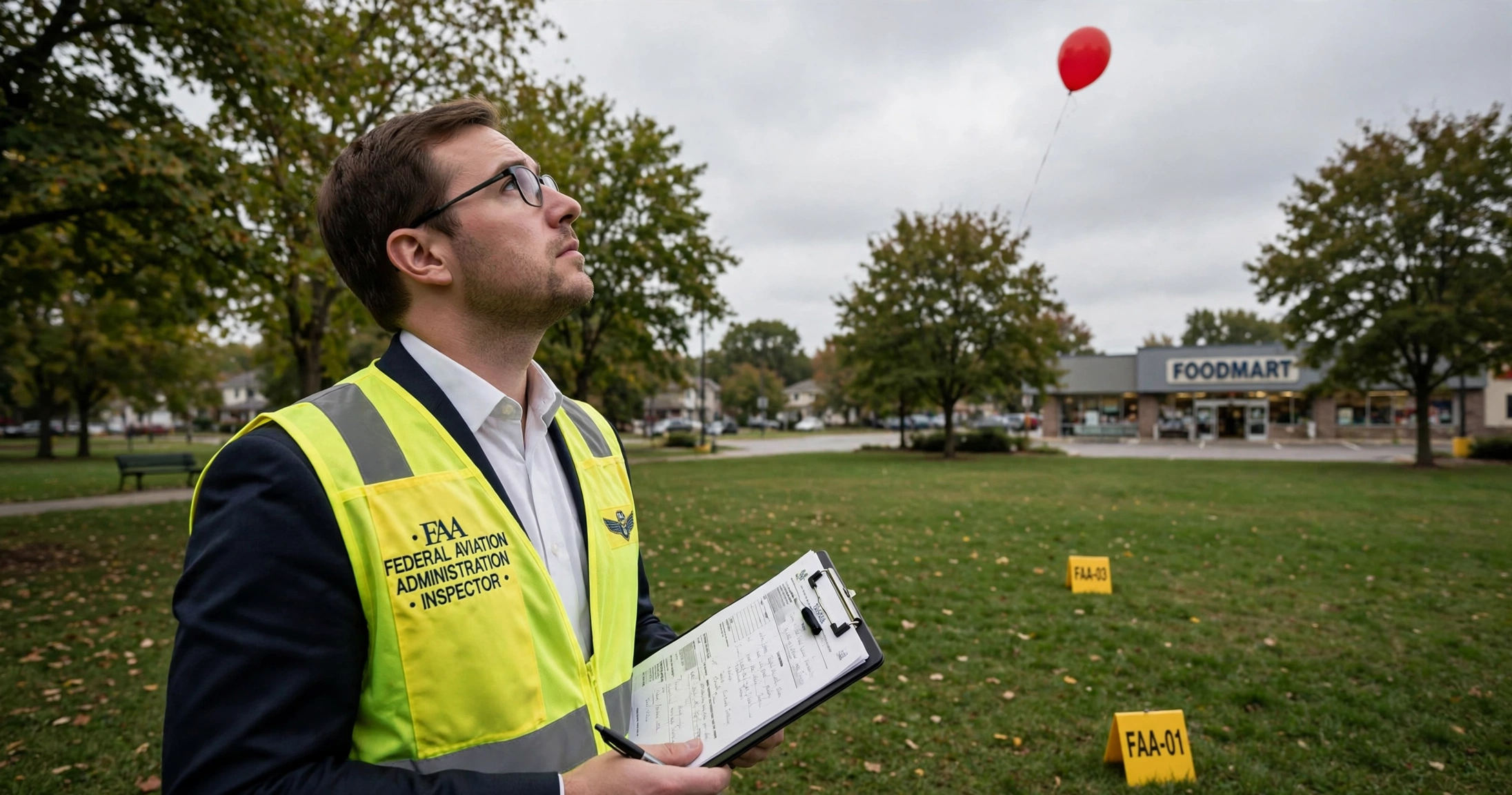
A helium-filled 11-inch latex birthday balloon is a device. It is invented to fly in the air. It is used for flight in the air. It is filled with a gas whose lifting force exceeds the weight of the envelope, causing it to ascend. It is tethered by a ribbon only to prevent it from doing what its physical construction compels it to do, which is to navigate the atmosphere. When the ribbon is released, it does so.
The Federal Aviation Administration classifies this event as flight.
II. The Registration Requirement
49 U.S.C. § 44101(a) provides: “An aircraft may be operated only when the aircraft is registered under section 44103 of this title.”4 Section 44103 directs the Administrator of the FAA to register an aircraft when its owner submits proof of ownership and meets nationality requirements. Upon registration, the aircraft is issued a unique registration number, commonly called an N-number, consisting of the letter N followed by up to five alphanumeric characters. This number must be displayed on the exterior of the aircraft in characters not less than 12 inches high for fixed-wing aircraft and 3 inches high for other aircraft.5
The FAA maintains the Civil Aircraft Registry in Oklahoma City, Oklahoma. As of fiscal year 2024, the registry contained approximately 299,600 registered civil aircraft, including approximately 5,400 registered balloons.6 These are manned free balloons, predominantly envelopes of 77,000 to 105,000 cubic feet, woven from ripstop nylon, carrying a wicker basket, propane burners, and one or more FAA-certificated pilots.
The registry contains zero entries for the 11-inch latex balloon sold in bags of 25 at Dollar Tree for $1.25. No N-number has been issued to a Qualatex, Sempertex, or Anagram-branded party balloon. No owner has submitted AC Form 8050-1, Aircraft Registration Application, for a balloon purchased in the checkout aisle of a grocery store. The characters N-#### have never been affixed to a latex envelope in letters three inches high, because the entire envelope is eleven inches in diameter when fully inflated. Compliance is physically impossible. The statute contains no waiver for dimensional impossibility.
14 CFR § 91.9(b) provides that no person may operate a U.S.-registered civil aircraft unless there is available in the aircraft a current, approved Airplane or Rotorcraft Flight Manual, or, for aircraft not requiring a flight manual, appropriate operating limitations. For balloons, the operating limitations are contained in the balloon’s flight manual. The 11-inch party balloon is sold without a flight manual.7
III. The Airworthiness Regime
Federal law establishes a comprehensive airworthiness certification system. 49 U.S.C. § 44704(a) requires the Administrator to issue a type certificate for an aircraft when the Administrator finds that the aircraft is properly designed and manufactured, performs properly, and meets regulatory requirements. 14 CFR Part 21, Subpart B, implements this requirement. 14 CFR Part 31 prescribes airworthiness standards specifically for manned free balloons.8 Section 31.12 requires that balloon envelopes be constructed of materials that will not deteriorate rapidly in service. Section 31.17 requires that each balloon have a means to allow rapid deflation for landing. Section 31.19 requires that each balloon have a system that will warn the pilot when fuel pressure is low. Section 31.27 requires that basket suspension components have a safety factor of at least five.
The latex party balloon fails every test. Its envelope is constructed of natural rubber latex that deteriorates rapidly in service when exposed to ultraviolet radiation, which is why a helium balloon left outdoors deflates to the ground within 12 to 24 hours. It has no means to allow rapid deflation for landing except spontaneous rupture. It has no fuel pressure warning system because it has no fuel. It has no basket, no suspension components, and no safety factor of five. It has a knotted neck.
The FAA has never issued a type certificate for a party balloon. It has never issued a standard airworthiness certificate for a party balloon. Under 14 CFR § 91.7(a), no person may operate a civil aircraft unless it is in an airworthy condition. A party balloon, lacking any airworthiness certificate, is by definition not in an airworthy condition. Every flight is a violation.9
IV. The Pilot
14 CFR § 61.3(a) provides that no person may serve as a required pilot flight crewmember of a civil aircraft of the United States unless that person has in that person’s physical possession or readily accessible in the aircraft when exercising the privileges of that pilot certificate a pilot certificate issued under Part 61.10 For free balloons, § 61.109(j) requires 10 hours of flight training, including six training flights and one solo flight to 2,000 feet above the takeoff point. The applicant must pass a knowledge test and a practical test administered by a Designated Pilot Examiner.
Approximately 4,200 persons in the United States hold a lighter-than-air category pilot certificate with a free balloon rating.11 None of them obtained that certificate to operate an 11-inch latex balloon at a child’s birthday party. The average operator of a party balloon is six years old and has not logged 10 hours of flight training. The average operator has not passed the Balloon Pilot knowledge test (60 questions, 70 percent minimum passing score). The average operator has not demonstrated proficiency in emergency descent procedures or recognition of high-wind conditions.
The FAA requires that each balloon pilot carry a current medical certificate, or, under BasicMed, comply with alternate medical qualification requirements. A six-year-old cannot hold a medical certificate. The child is therefore operating an aircraft without a pilot certificate and without medical qualification. Under 49 U.S.C. § 46317(a), operation of an aircraft without an airman certificate is punishable by a civil penalty of up to $27,904 per violation and, under § 46316, by criminal penalties including imprisonment for up to three years.12
V. The Fleet Size
The scale of unregistered aviation activity is not trivial. The Balloon Council, a trade association comprising balloon manufacturers, distributors, and retailers, reports that the balloon industry in the United States sells tens of millions of latex balloons annually.13 Grand View Research valued the global party balloon market at $1.73 billion in 2023, with North America accounting for approximately 32 percent of revenue.14 Walmart operates approximately 4,606 retail locations in the United States. Dollar Tree operates approximately 8,400 locations. Party City, prior to its 2023 bankruptcy filing, operated approximately 750 stores. Each of these retailers sells helium-filled latex and foil balloons for immediate flight, complete with ribbon, weight, and no FAA Form 8130-3 Authorized Release Certificate.
The FAA’s registry lists approximately 5,400 registered balloons. If even one-tenth of one percent of the estimated 50 million latex balloons sold annually in the United States achieve unmoored flight, the unregistered fleet exceeds the registered lighter-than-air fleet by a factor of approximately ten. At one percent unmoored, the ratio exceeds 92 to 1. The registered balloon fleet is a rounding error on the unregistered fleet.
14 CFR Part 101 governs moored balloons, kites, amateur rockets, and unmanned free balloons. Section 101.1(a)(2) defines unmanned free balloons as balloons that carry no payload and are not moored. A latex party balloon with a polyester ribbon and a plastic tab carries no payload in the regulatory sense. It is an unmanned free balloon. Section 101.7 prohibits operation of any moored balloon, kite, amateur rocket, or unmanned free balloon in a manner that creates a hazard to other persons or their property. Section 101.33 requires notification to the nearest FAA Air Traffic Control facility at least 24 hours before launching an unmanned free balloon in certain controlled airspace categories. No child has ever called Air Traffic Control to report a birthday.15
VI. The State Patchwork
At least six states have recognized the aviation problem and attempted to legislate a solution. California Penal Code § 653.1, enacted in 1990, makes it a misdemeanor to release, outdoors, a balloon made of electrically conductive material that is filled with a gas lighter than air as part of a public or civic event, promotional activity, or product advertisement. The statute was enacted after metallic balloons caused repeated power outages when they contacted overhead power lines. Pacific Gas & Electric Company reported that metallic balloons caused 203 power outages in its service territory in a single year, affecting more than 150,000 customers.16
Connecticut General Statutes § 26-25c prohibits the intentional release of ten or more helium-filled balloons within a 24-hour period. Florida Statute § 379.233 prohibits the intentional release of ten or more balloons within 24 hours. Tennessee Code Annotated § 68-101-108 prohibits intentional release of ten or more balloons. Virginia Code § 29.1-556.1 prohibits intentional release of any non-biodegradable balloon outdoors. The District of Columbia, the City of San Francisco, and the City of Louisville have enacted similar ordinances.17
The existence of these statutes creates a federalism problem. Federal law preempts state regulation of aviation safety under the doctrine of field preemption established in City of Burbank v. Lockheed Air Terminal, Inc., 411 U.S. 624 (1973), and Montalvo v. Spirit Airlines, 508 F.3d 464 (9th Cir. 2007). States may not impose their own airworthiness standards, pilot qualification requirements, or operational rules on aircraft operating in the navigable airspace. Yet states are currently imposing operational limitations on a class of aircraft that the FAA has declined to regulate with equal specificity. The result is a regulatory gap in which balloons are too much aircraft for state law to handle and too little aircraft for federal law to bother with.
VII. The Federal Double Standard
The National Weather Service operates approximately 92 upper-air observation stations in the United States and its territories. Twice daily, at 00:00 and 12:00 UTC, each station launches a weather balloon carrying a radiosonde instrument package weighing approximately 250 grams. The balloon envelope, made of natural latex or synthetic chloroprene, expands from approximately 6 feet in diameter at launch to more than 20 feet at burst altitude, typically between 100,000 and 115,000 feet. The radiosonde transmits temperature, humidity, pressure, and wind data during ascent and is then lost. Approximately 75,000 to 76,000 radiosondes are launched annually by the National Weather Service alone.18
These launches occur under explicit federal authorization. 14 CFR § 101.1(a)(2) excludes from certain Part 101 operating limitations unmanned free balloons that are operated under a written authorization issued by the FAA, and the NWS operates under a Certificate of Waiver or Authorization (COA) that permits these flights. The radiosonde is tracked by GPS, its trajectory is predicted using atmospheric models, and NOTAMs are issued when necessary. The NWS reports a radiosonde recovery rate of approximately 20 percent. The remaining 80 percent constitute unrecovered aerospace hardware distributed across the North American continent.19
The private citizen launching a 11-inch birthday balloon has no COA. The private citizen files no NOTAM. The private citizen’s balloon has no GPS tracker, no predicted trajectory, no recovery system, and no federal agency waiting downstream to retrieve the payload. It has a smiley face printed on one side and the words “Happy Birthday” in Comic Sans on the other.
14 CFR § 101.7 prohibits operation of an unmanned free balloon in a manner that creates a hazard to other persons or their property. A latex balloon at 5,000 feet is invisible to primary radar. It is invisible to secondary surveillance radar because it carries no transponder. Under 14 CFR § 91.215 and § 91.225, aircraft operating in Class A, B, and C airspace must be equipped with an operable transponder and ADS-B Out. The birthday balloon has neither. Under 14 CFR § 91.209, aircraft must display position lights from sunset to sunrise. The birthday balloon has no position lights.20
An aircraft without registration, without airworthiness certification, without a flight manual, without a pilot certificate, without a medical certificate, without a transponder, without ADS-B, and without position lights is operating in the National Airspace System. It is doing so 50 million times per year. The FAA has initiated zero enforcement actions against its operators.
VIII. The Debris Field
When a latex balloon achieves free flight, it ascends until one of three things occurs: the latex bursts due to expansion and low temperature at altitude, the helium diffuses through the latex membrane until neutral buoyancy is achieved followed by descent, or the envelope remains sufficiently intact to descend as a single piece. In all three scenarios, the object returns to the surface.
The Marine Debris Program of the National Oceanic and Atmospheric Administration classifies balloons as marine debris. NOAA reports that balloons are among the top 10 types of debris found on beaches during the International Coastal Cleanup. A 2019 study published in Scientific Reports examining the ingestion of marine debris by seabirds found that balloons were 32 times more likely to cause death in seabirds than hard plastic fragments, because the soft latex conforms to the shape of the stomach and blocks the digestive tract.21 The U.S. Fish and Wildlife Service has documented balloon ingestion in sea turtles, whales, and terrestrial mammals.
18 U.S.C. § 38, the Aircraft Sabotage statute, makes it a federal crime to place a destructive device or substance on board an aircraft. 49 U.S.C. § 46307 makes it a crime to operate an aircraft with a known safety deficiency. The birthday balloon is manufactured with a known safety deficiency: it is designed to fail in flight and to become debris. The FAA’s own Advisory Circular 91-57D, Model Aircraft Operating Standards, warns that unmanned aircraft operations that interfere with manned aircraft pose a hazard. A 4-gram piece of latex ingested into a turbofan engine at 35,000 feet is not evaluated in any FAA engine ingestion test, which focuses on birds of 4 to 8 pounds.
The FAA has issued airworthiness directives for bird strikes. It has issued no airworthiness directive for birthday balloons, because the agency has never type-certificated a birthday balloon to direct.
IX. The Exemption That Does Not Exist
Title 14 contains numerous exemptions. 14 CFR § 103.1 defines ultralight vehicles and excludes them from aircraft certification and registration requirements if they weigh less than 254 pounds empty, carry not more than 5 gallons of fuel, and are used for recreation. 14 CFR § 101.1 excludes moored balloons that remain below 500 feet and within a certain distance of the operator. 14 CFR Part 101 Subpart D excludes amateur rockets below certain impulse thresholds.
None of these exemptions applies to the free-flying latex birthday balloon. It is not an ultralight vehicle because it carries no person. It is not a moored balloon because it is not moored. It is not an amateur rocket because it does not produce thrust. It is an unmanned free balloon that carries no payload and is therefore subject to Part 101, but Part 101 contains no categorical exclusion for balloons below a certain weight or for balloons sold at retail for $1.25.
The FAA has discretion under 49 U.S.C. § 44701 to prescribe regulations and minimum standards in the interest of safety. The agency has exercised that discretion to exempt model aircraft operated within visual line of sight under 49 U.S.C. § 44809. It has not exercised that discretion to exempt the 11-inch latex birthday balloon, despite the fact that every American child who has ever attended a birthday party has operated one.
There is no de minimis exception in the definition of aircraft. There is no festive purpose exception in the registration requirement. There is no birthday party exception in the airworthiness certification regime.
X. Conclusion
The evidence is internally consistent, sourced to federal statute and regulation, and confirmed by the FAA’s own publications. Under 49 U.S.C. § 40102(a)(6), a helium party balloon is an aircraft. Under 49 U.S.C. § 44101, it must be registered. Under 14 CFR Part 21 and Part 31, it must hold a type certificate and an airworthiness certificate. Under 14 CFR § 61.3, its operator must hold a pilot certificate. Under 14 CFR §§ 91.215, 91.225, and 91.209, it must carry a transponder, ADS-B Out, and position lights when operating in controlled airspace or at night. It carries none of these. The FAA registry contains no entries for any such balloon. The agency has issued no airworthiness certificates to any such balloon. It has initiated no enforcement actions against any of the estimated 50 million annual operators.
The only federal agency that launches comparable vehicles on a routine basis is the National Weather Service, which does so approximately 76,000 times per year under explicit federal authorization, with predicted trajectories, GPS tracking, and a NOTAM system. The general public launches comparable vehicles at an estimated rate 650 times greater, with no authorization, no tracking, and no notice.
The FAA classifies balloons as aircraft when they are 80,000 cubic feet and carry two people in a wicker basket. It should also classify them as aircraft when they are 11 inches and carry a smiley face.
Ergo.