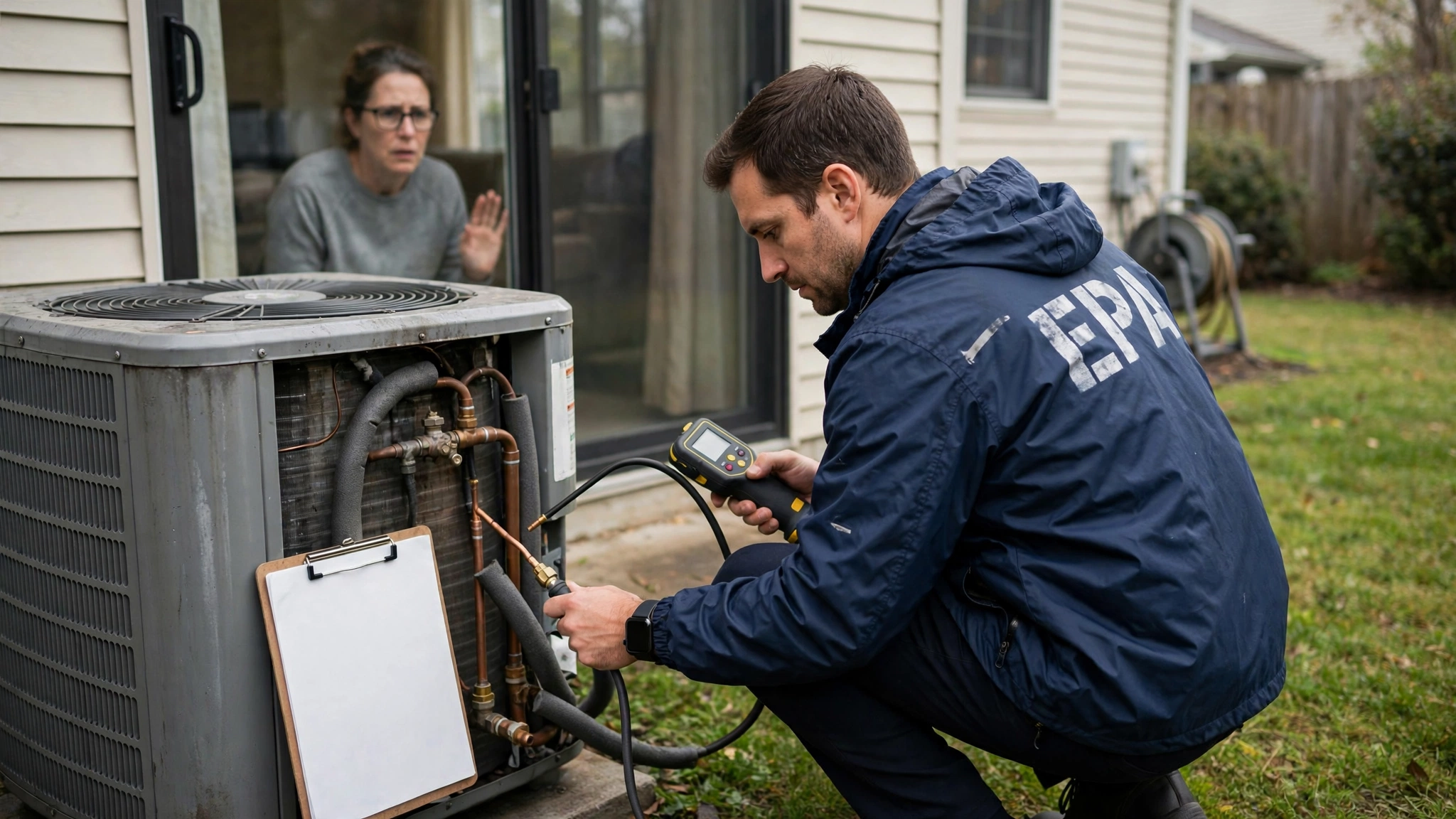
I. The Certification Regime
Section 608 of the Clean Air Act is not a suggestion. It is a federal occupational licensure program that restricts who may touch the sealed refrigerant circuit of an air-conditioning system in the United States. The statute, at 42 U.S.C. § 7671g(a), directs the EPA to promulgate regulations “to reduce the use and emission of such substances to the lowest achievable level” and to “maximize the recapture and recycling of such substances.” The implementing regulations at 40 CFR § 82.161 require that any person who maintains, services, repairs, or disposes of appliances containing regulated refrigerants hold valid EPA Section 608 technician certification at the appropriate type level.1
There are four certification types. Type I covers small appliances containing fewer than five pounds of refrigerant. Type II covers high-pressure appliances. Type III covers low-pressure appliances. Universal certification covers all three categories. The certification exam is proctored, administered by EPA-approved testing organizations including the ESCO Institute, the Refrigeration Service Engineers Society, and Ferris State University. It costs between $25 and $50. It is required one time and does not expire.2
The certification is not merely a credential. It is a prerequisite for a commercial transaction. Since January 1, 2018, EPA regulations at 40 CFR Part 82, Subpart F, have required Section 608 certification to purchase hydrofluorocarbon refrigerants in containers larger than two pounds for use in stationary refrigeration and air-conditioning systems. The sales restriction applies regardless of whether the buyer intends to service the equipment personally. The seller is legally responsible for verifying the buyer’s certification before completing the transaction.3
The statute does not contain a do-it-yourself exemption. It does not contain a hobbyist exemption. It does not contain a “just topping off” exemption. A homeowner who walks into a supply house and attempts to purchase a jug of R-410A to recharge the air conditioner humming in the backyard cannot legally complete the purchase without producing a valid EPA Section 608 certification card. The substance inside the air conditioner is, for purposes of federal law, too dangerous for an uncertified person to buy.4
II. The Substance
R-410A is a near-azeotropic blend of two hydrofluorocarbons: difluoromethane (R-32) and pentafluoroethane (R-125), combined in a 50/50 mass ratio. It was developed in the 1990s by AlliedSignal (now Honeywell) as a replacement for R-22, the hydrochlorofluorocarbon that had been the standard residential air-conditioning refrigerant since the 1950s and was phased out under the Montreal Protocol due to its ozone-depleting potential. R-410A does not deplete the ozone layer. It was adopted by the residential HVAC industry as an environmentally preferable alternative. It is environmentally preferable only with respect to ozone.5
With respect to climate, R-410A is among the most potent greenhouse gases in common commercial use. Its hundred-year global warming potential, as reported in the IPCC Fifth Assessment Report and adopted by the EPA, is 2,088. One pound released into the atmosphere traps as much heat over one hundred years as 2,088 pounds of carbon dioxide. Its twenty-year GWP is approximately 4,340—on the timescale most relevant to near-term climate targets, it is more than four thousand times more potent than the gas the entire industrialized world is attempting to reduce.7 A ten-pound leak from a single residential air conditioner produces the greenhouse gas equivalent of driving two passenger cars for a full year.6
A typical residential central air-conditioning system contains between six and twelve pounds of this substance, depending on system capacity and line-set length. A three-ton split system—the most common configuration in American homes—ships with approximately six to eight pounds. A five-ton system may contain twelve to fifteen pounds or more. The homeowner who purchased the system was not informed that the metal box in the backyard contains a quantity of greenhouse gas equivalent, pound for pound, to the annual CO₂ output of a small industrial boiler. No one told them. No regulation required it.
III. The Installed Base
The United States is the most air-conditioned nation on earth by total cooling capacity. According to data compiled by the International Energy Agency, approximately 374 million air-conditioning units are installed across the country. The Energy Information Administration reports that approximately ninety percent of American households possess an air-conditioning unit. The U.S. Census Bureau reports approximately 131.2 million occupied housing units as of 2023. Ninety percent of 131.2 million is approximately 118 million households with at least one system containing a regulated refrigerant. A 2025 study published in Scientific Data by researchers at the University of Kansas and Florida State University confirmed this at census-tract resolution using property-level data for over 103 million housing units.8
The installed base is not static. The United States consumes approximately 14.4 million new air-conditioning units per year. The older units they replace contained R-22, a hydrochlorofluorocarbon with a GWP of 1,810. The transition from R-22 to R-410A was not a transition from a dangerous refrigerant to a safe one. It was a transition from one dangerous refrigerant to a slightly more dangerous one that happens not to eat the ozone layer.9
IV. The Leak Rate
Residential air-conditioning systems leak. They leak from Schrader valve cores that are undertorqued during installation. They leak from flare connections that vibrate loose over years of compressor cycling. They leak from evaporator coils that develop pinhole corrosion from the interaction of moisture, flux residue, and the formaldehyde present in adhesives used in household furnishings. They leak from condenser coils that corrode in coastal salt air or degrade under exposure to lawn-care chemicals. They leak from the brazed joints of copper line sets that expand and contract with every cooling cycle across a fifteen-to-twenty-year service life.10
The EPA estimates that residential systems leak refrigerant at a rate of five to eleven percent of their charge per year. The IPCC’s 2006 Guidelines for National Greenhouse Gas Inventories estimate annual emissions rates of one to ten percent for residential and commercial air conditioning, with ducted residential split systems and ducted commercial split systems both reported at four to five percent per year. A lifecycle refrigerant management study verified through twenty years of field data found a baseline leakage rate of 5.3 percent per year for residential systems without leak-stop caps, driven primarily by Schrader valve failures—the single most common source of chronic refrigerant loss in split-system air conditioners.11
The consequences of leakage are not subtle. As refrigerant charge decreases, the coefficient of performance—the ratio of cooling output to electrical energy input—declines. A ten-percent loss of charge reduces system efficiency measurably. A twenty-percent loss marks what researchers describe as a “critical tipping point,” causing steep performance degradation. The system compensates by running longer compressor cycles, consuming more electricity, and delivering less cooling. The homeowner notices that the house is warmer. The homeowner calls a technician. The technician, who holds an EPA Section 608 certification, arrives with a jug of R-410A that the homeowner could not have legally purchased, connects a manifold gauge set, identifies the undercharge, adds refrigerant until the superheat and subcooling readings normalize, and leaves. The leak that caused the undercharge remains. The cycle repeats.12
No one records the leak rate. No one is required to. The system contains fewer than fifty pounds of refrigerant. It is a residential system. The EPA’s own regulations do not apply.
V. The Exemption
On September 20, 2024, EPA Administrator Michael S. Regan signed the final rule establishing the Emissions Reduction and Reclamation Program under the American Innovation and Manufacturing Act of 2020. The program, codified at 40 CFR Part 84, establishes a comprehensive regime for managing HFC refrigerant emissions from stationary equipment. Its requirements include mandatory leak-rate tracking for systems containing fifteen pounds or more of HFC refrigerant with a GWP greater than 53, mandatory repair within thirty days of discovering a leak above specified thresholds, mandatory recordkeeping for three years, and mandatory use of automatic leak detection systems for systems containing 1,500 pounds or more.13
The leak-rate thresholds are tailored by sector. Industrial process refrigeration systems trigger repair requirements at a thirty-percent annual leak rate. Commercial refrigeration systems trigger at twenty percent. Comfort cooling systems—the category that includes air conditioners—trigger at ten percent. These are the thresholds above which the system owner must take corrective action within thirty days or retire the equipment within one year.14
The rule does not apply to residential air conditioners.
The regulatory text states the exemption explicitly. The leak-rate tracking and repair requirements apply to “systems containing a full charge of 15 pounds or more of an HFC, or a substitute for an HFC, with a GWP greater than 53, excluding residential and light commercial AC and heat pump systems.” The emphasis is in the regulatory record. The exemption is not an oversight. It is not a gap. It is a deliberate carve-out written into the rule by the agency that wrote the rule.15
The exemption has two layers. Most residential systems contain fewer than fifteen pounds of refrigerant, which would place them below the rule’s weight threshold regardless of sector classification. But the exemption does not merely restate the weight threshold. It exempts residential systems categorically—which means that even a large residential system containing twenty or twenty-five pounds of R-410A, a system that would trigger monitoring requirements if it were installed in a commercial building, is exempt because it cools a living room instead of an office.
VI. The Arithmetic
The arithmetic is straightforward. Approximately 118 million American households contain at least one air-conditioning system. The majority of systems installed since the mid-2000s contain R-410A. A conservative estimate of the average refrigerant charge across central and non-central systems is five to six pounds per unit. At six pounds per unit across 100 million R-410A-charged systems—a conservative subset of the total installed base—the aggregate residential refrigerant inventory is approximately 600 million pounds of a substance with a GWP of 2,088.16
At the EPA’s own lower-bound leak-rate estimate of five percent per year, the annual residential refrigerant emission is approximately 30 million pounds. At the upper-bound estimate of eleven percent, it is 66 million pounds. The CO₂-equivalent impact of these emissions, calculated by multiplying the mass of refrigerant by its GWP, ranges from approximately 28.4 million metric tons of CO₂e at the lower bound to approximately 62.5 million metric tons at the upper bound.17
For context, the EPA’s Greenhouse Gas Reporting Program requires facilities that emit 25,000 metric tons or more of CO₂e per year to report their emissions. The combined residential air-conditioning sector, treated as a single emitter, would be one of the largest reporting entities in the United States. It does not report. It is not required to. It is residential.
The per-unit numbers are small. A single residential system leaking five percent of a six-pound charge releases 0.3 pounds of R-410A per year—approximately 626 pounds of CO₂e, roughly the emissions of driving a passenger car for 700 miles. The aggregate numbers are not small. One hundred million units releasing 0.3 pounds each produce a combined emission that exceeds the total direct CO₂ emissions of many mid-sized industrial sectors. The EPA monitors the sectors. It does not monitor the units.
VII. The Venting Prohibition
Section 608(c)(1) of the Clean Air Act provides that, effective July 1, 1992, it is “unlawful for any person, in the course of maintaining, servicing, repairing, or disposing of an appliance or industrial process refrigeration, to knowingly vent or otherwise knowingly release or dispose of any class I or class II substance used as a refrigerant in such appliance . . . in a manner which permits such substance to enter the environment.” Section 608(c)(2) extends this prohibition to substitute refrigerants, effective November 15, 1995. The statute exempts only “de minimis releases associated with good faith attempts to recapture and recycle or safely dispose” of the substance.18
The EPA’s implementing regulations carve out two additional categories of permissible release. The first is refrigerant emitted “during the normal operation of air-conditioning and refrigeration equipment (as opposed to during the maintenance, servicing, repair, or disposal of this equipment), such as from mechanical purging and leaks.” The second is releases of substitute refrigerants that the EPA has determined do not pose a threat to the environment.19
The first exemption is the one that matters. Leaks that occur during normal operation—as opposed to during servicing—are not violations of the venting prohibition. A Schrader valve that slowly weeps R-410A into the atmosphere over three years of normal compressor operation is not a violation. A corroded evaporator coil that bleeds refrigerant through a pinhole is not a violation. The only violations occur during maintenance events—when a technician opens the circuit, connects a gauge set, and either intentionally or negligently allows refrigerant to escape.
This creates a regulatory structure whose internal logic deserves careful attention. The substance is dangerous enough to require federal certification to purchase. It is dangerous enough to require federal certification to handle. It is dangerous enough to carry civil penalties of $124,426 per day for improper release during servicing. But when it leaks through a corroded fitting during the fifteen years of normal operation between installation and replacement, the release is not a violation. It is “normal operation.” The statute prohibits venting. It permits leaking. The atmosphere does not distinguish between the two.
The exemption is narrower than it appears. A homeowner whose air conditioner has gradually lost cooling capacity over three summers has, in a meaningful sense, knowledge that a regulated substance is escaping. The homeowner knows the system is underperforming. The homeowner knows—or could know, with thirty seconds of internet research—that the most common cause of gradually declining cooling capacity is refrigerant loss. The homeowner knows that the substance inside the system is federally regulated. A reasonable person in possession of these facts might be said to “know” that a regulated substance is entering the environment from equipment on the homeowner’s property. The statute prohibits “knowingly” permitting such release. Yet the EPA has never suggested that a homeowner who tolerates a slowly warming living room for three years rather than paying a certified technician to locate and repair a leak is in violation of the Clean Air Act. The agency that can fine a technician $124,426 for disconnecting a gauge set carelessly has not sent a letter to a homeowner who left a leaking condenser running in the backyard for a decade.
VIII. The Phasedown Paradox
The American Innovation and Manufacturing Act of 2020, codified at 42 U.S.C. § 7675, directed the EPA to phase down the production and consumption of hydrofluorocarbons in the United States by eighty-five percent below a baseline level by 2036. The baseline was calculated from the 2011–2013 average of U.S. HFC consumption. The phasedown schedule proceeds in steps: a forty-percent reduction by 2024, seventy percent by 2029, eighty percent by 2034, and eighty-five percent by 2036. The EPA implemented the statute through technology transition rules that, beginning January 1, 2025, prohibit the manufacture or import of new residential air-conditioning equipment using refrigerants with a GWP above 700.20
R-410A, with a GWP of 2,088, exceeds this threshold by a factor of three. New residential air conditioners manufactured after January 1, 2025, must use lower-GWP alternatives—primarily R-454B (GWP 466) and R-32 (GWP 675). The industry transition is underway. Carrier, Trane, and Lennox have adopted R-454B. Daikin, Mitsubishi, LG, and Fujitsu have adopted R-32. Both are mildly flammable (ASHRAE safety class A2L), both clear the 700-GWP threshold, and both are expected to dominate the residential market by 2027.21
The paradox is this. The EPA determined that R-410A is too dangerous to put into new equipment. It determined that the production of R-410A must be reduced by eighty-five percent within a decade. It determined that every entity in the refrigerant supply chain—from manufacturer to reclaimer to wholesaler to installing contractor—must be tracked, certified, and documented at every point of custody. And it determined that the approximately 100 million units already containing R-410A, units that will continue operating for fifteen to twenty years, units whose collective refrigerant inventory constitutes the largest stock of high-GWP HFC in any single end-use sector in the country, do not need to be monitored for leaks.
The production phasedown tightens the supply of virgin R-410A. The installed base continues to leak. The tighter the supply, the more expensive the refrigerant becomes. The more expensive the refrigerant, the longer homeowners defer service calls. The longer they defer service calls, the more refrigerant leaks into the atmosphere before anyone adds more. The phasedown creates a financial incentive to tolerate the leaks that the monitoring exemption already permits.
IX. The Regulatory Asymmetry
Consider the regulatory treatment of two air-conditioning systems operating simultaneously in the same American city on the same August afternoon.
On the east side of town, a twenty-ton rooftop packaged unit cools a two-story office building. The system contains forty-five pounds of R-410A. Under the EPA’s Emissions Reduction and Reclamation Program, the building owner must calculate the system’s leak rate each time a certified technician adds refrigerant. If the annual leak rate exceeds ten percent, the owner must repair the leak within thirty days or, if repair is not economically feasible, retrofit or retire the equipment within one year. The owner must maintain records of every refrigerant addition—including the amount added, the date, the technician’s name, and the technician’s EPA certification number—for a minimum of three years. The records must be made available to the EPA upon request. Failure to calculate, failure to repair, and failure to document are each independent violations carrying penalties of up to $124,426 per day.22
On the west side of town, in a subdivision of three hundred single-family homes, three hundred residential split systems cool three hundred living rooms. Each system contains between six and twelve pounds of R-410A. They leak at the same rate as the commercial system—four to eleven percent per year, per the EPA’s own estimate. Collectively, the three hundred systems contain between 1,800 and 3,600 pounds of R-410A—forty to eighty times the charge of the commercial rooftop unit. Their combined annual leak, at the midpoint estimate of 7.5 percent, is between 135 and 270 pounds of a substance with a GWP of 2,088. The CO₂-equivalent emission from the subdivision’s air conditioners alone—between 128 and 256 metric tons per year—exceeds the direct refrigerant emission from the commercial building by an order of magnitude.23
The commercial system is monitored. The residential systems are not. The commercial building owner maintains records. The homeowners do not. The commercial system triggers repair obligations at a ten-percent leak rate. The residential systems trigger nothing at any leak rate. The regulatory burden falls entirely on the system that contains less refrigerant and produces fewer aggregate emissions. The systems that contain more and produce more are not regulated at all.
The statute does not distinguish between a molecule of R-410A that escapes from a rooftop unit and a molecule that escapes from a condenser in a backyard. The regulation does.
X. Conclusion
The evidence assembled in these pages requires no interpretive leap. Section 608 establishes that refrigerants are substances of sufficient regulatory concern to warrant a federal certification program, a sales restriction, a venting prohibition, and civil penalties that could bankrupt a small business in a week. The AIM Act establishes that HFCs are of sufficient concern to warrant an eighty-five-percent production phasedown and a prohibition on new equipment. The EPA’s own Emissions Reduction and Reclamation Program establishes that refrigerant leaks are of sufficient concern to warrant mandatory monitoring, repair, and recordkeeping.
The same body of law and regulation establishes that none of this applies to the equipment in your backyard.
If the 100 million residential air conditioners in the United States were a single industrial facility, that facility would contain 600 million pounds of a substance that traps 2,088 times more heat than carbon dioxide. It would leak between 30 and 66 million pounds of that substance into the atmosphere every year. Its annual emissions would rank it among the largest greenhouse gas sources in the United States. The EPA would require it to report. The EPA would require it to monitor. The EPA would require it to repair. The EPA would require it to obtain a Title V operating permit. Instead, the 100 million units are distributed across 100 million backyards, and the EPA requires nothing.
The regulatory framework that governs residential refrigerants can be summarized in four propositions. The substance is regulated. The purchase is restricted. The handling is certified. The emission is unmonitored. Every homeowner who calls a technician to recharge an underperforming system has, by definition, experienced a refrigerant leak. The amount of refrigerant added is recorded on a service invoice that is filed in no database, reported to no agency, and compared to no threshold. The data exists on a carbon-copy ticket in the technician’s truck. It contributes to no inventory and activates no repair obligation.
The certification protects the point of sale. The venting prohibition protects the moment of service. The phasedown protects the point of manufacture. Nothing protects the fifteen years of slow, silent, unmonitored leakage between installation and replacement—the period during which the vast majority of residential refrigerant emissions actually occur.
The EPA built a monitoring apparatus. It pointed it at commercial buildings. It wrote an explicit exemption for the houses next door.
Ergo.
Sources
- 42 U.S.C. § 7671g(a) (Section 608 of the Clean Air Act): directing EPA to promulgate regulations to “reduce the use and emission of such substances to the lowest achievable level” and to “maximize the recapture and recycling of such substances.” 40 CFR § 82.161 (technician certification requirement). epa.gov ↑
- 40 CFR Part 82, Subpart F, §§ 82.161–82.166. Four certification types: Type I (small appliances <5 lbs), Type II (high-pressure), Type III (low-pressure), Universal (all). Certification is one-time, no renewal required. wikipedia.org ↑
- EPA Refrigerant Sales Restriction: “Only EPA-certified technicians are allowed to purchase ozone-depleting substances (ODS) or non-ozone depleting substitutes used as refrigerants.” Effective January 1, 2018, for HFCs. epa.gov ↑
- 40 CFR § 82.161: No DIY exemption, no hobbyist exemption. “There is no DIY exemption, no hobbyist exemption, no ‘just topping off’ exemption.” EPA Section 608 FAQ. epa.gov ↑
- R-410A composition: 50% R-32 (difluoromethane) / 50% R-125 (pentafluoroethane), mass-based. Developed by AlliedSignal (now Honeywell) as non-ozone-depleting replacement for R-22. ASHRAE Standard 34 designation A1 (non-toxic, non-flammable). ↑
- R-410A GWP (AR5): 2,088. EPA: “1 lb leaked → R-410A ≈ 0.95 tCO₂e; 10 lb ≈ 9.47 tCO₂e (~the annual emissions of ~2 passenger cars).” IPCC AR5 (2013), Table 8.A.1. acdirect.com ↑
- R-410A twenty-year GWP: approximately 4,340. IPCC AR5 (2013). The higher 20-year value reflects the compound’s shorter atmospheric lifetime relative to CO₂ and its concentration of radiative forcing in the near term. ↑
- IEA data compiled by World Population Review: United States has 374 million total installed air-conditioning units. EIA: approximately 90% of American households possessed an AC unit as of 2022. U.S. Census Bureau: approximately 131.2 million occupied housing units as of 2023. Y. Ahn and C.K. Uejio, “A Comprehensive Dataset of Residential Air Conditioning Prevalence in the Continental United States,” Scientific Data, vol. 12, no. 1717, 2025. worldpopulationreview.com ↑
- IndexBox market analysis: U.S. consumed 9.6 million window/wall AC units and 4.8 million non-window AC units in 2024 (14.4 million total). R-22 GWP: 1,810 (IPCC AR5). R-22 phaseout under Montreal Protocol completed January 1, 2020. indexbox.io ↑
- Lifecycle Refrigerant Management study (Verified 2024): “Most refrigerant leaks are from Schrader core valves undertightened to less than 3 inch-pounds.” Leaking Schrader valves are the primary source of annual refrigerant leakage. High-pressure liquid Schrader valves leak 40 times more than low-pressure suction valves. ↑
- EPA estimate: residential systems leak refrigerant at 5–11% per year (cited by Rocky Mountain Institute, 2025). IPCC 2006 Guidelines for National Greenhouse Gas Inventories: 1–10% annual emissions rate, ducted residential split AC at 4–5%. Lifecycle Refrigerant Management field study: 5.3% baseline leakage without leak-stop caps (Verified 2024, 20-year retention study). rmi.org ↑
- RMI analysis: “Even a 10 percent drop in refrigerant charge reduces system efficiency. . . . Losing more than 20 percent of a system’s refrigerant charge marks a critical tipping point, causing steep performance drops.” Average US household cooling bill: $719 in 2024. cleantechnica.com ↑
- EPA Final Rule, “Phasedown of Hydrofluorocarbons: Management of Certain Hydrofluorocarbons and Substitutes Under the American Innovation and Manufacturing (AIM) Act,” signed September 20, 2024. Establishes Emissions Reduction and Reclamation (ER&R) Program at 40 CFR Part 84. hvacinsider.com ↑
- ER&R leak-rate thresholds (effective January 1, 2026): Industrial Process Refrigeration 30%, Commercial Refrigeration 20%, Comfort Cooling and all other appliances 10%. Repair required within 30 days of exceeding threshold. ↑
- ER&R residential exemption: leak-rate tracking and repair requirements apply to “systems containing a full charge of 15 pounds or more of an HFC, or a substitute for an HFC, with a GWP greater than 53, excluding residential and light commercial AC and heat pump systems.” 89 FR 73010 (September 2024). ↑
- Author’s calculation. 100 million R-410A-charged residential systems (conservative subset of 118 million AC-equipped households) × 6 lbs average charge = 600 million lbs aggregate residential refrigerant inventory. ↑
- Author’s calculation. Lower bound: 600 million lbs × 5% leak rate × 2,088 GWP = 62.6 billion lbs CO₂e = 28.4 million metric tons CO₂e. Upper bound: 600 million lbs × 11% × 2,088 = 137.8 billion lbs CO₂e = 62.5 million metric tons CO₂e. ↑
- 42 U.S.C. § 7671g(c)(1)–(2). Section 608(c)(1): unlawful to “knowingly vent or otherwise knowingly release or dispose of any class I or class II substance.” Section 608(c)(2): extends prohibition to substitute refrigerants effective November 15, 1995. Exemption: “de minimis releases associated with good faith attempts to recapture and recycle or safely dispose.” govinfo.gov ↑
- EPA regulations at 40 CFR Part 82, Subpart F: permissible releases include refrigerant emitted “during the normal operation of air-conditioning and refrigeration equipment (as opposed to during the maintenance, servicing, repair, or disposal of this equipment), such as from mechanical purging and leaks.” epa.gov ↑
- American Innovation and Manufacturing Act of 2020, 42 U.S.C. § 7675. Phasedown schedule: 40% by 2024, 70% by 2029, 80% by 2034, 85% by 2036. Technology transition rule at 40 CFR § 84.54(a): prohibits manufacture or import of new residential AC equipment using refrigerants with GWP > 700 as of January 1, 2025. epa.gov ↑
- R-454B (GWP 466, ASHRAE A2L): adopted by Carrier, Trane, Lennox. R-32 (GWP 675, ASHRAE A2L): adopted by Daikin, Mitsubishi, LG, Fujitsu. Both clear the 700-GWP threshold. EPA interim final rule (88 FR 88825, December 26, 2023) extended installation compliance date to January 1, 2026, for equipment manufactured before January 1, 2025. hvacptcharts.com ↑
- Maximum civil penalty for Clean Air Act violation under Section 608: $124,426 per day per violation as of January 8, 2025 (adjusted annually for inflation). EPA can also revoke Section 608 certification. wikipedia.org ↑
- Author’s calculation. 300 homes × 9 lbs average charge = 2,700 lbs aggregate charge. At 7.5% annual leak rate: 202.5 lbs × 2,088 GWP = 422,820 lbs CO₂e = 192 metric tons CO₂e. Commercial 20-ton rooftop unit: 45 lbs charge at 7.5% = 3.375 lbs × 2,088 = 7,047 lbs CO₂e = 3.2 metric tons CO₂e. Ratio: approximately 60:1. ↑