I. The Insect
Fireflies are not flies. They are soft-bodied beetles in the family Lampyridae, related to ladybugs, and they number more than 2,000 described species worldwide, with about 170 in North America. They occur on every continent except Antarctica. The common eastern firefly, Photinus pyralis, the species most Americans know from their own backyards, is 9 to 19 millimeters long, dark brown with yellow-edged wing covers, and it is the most common firefly species in North America.120
A firefly spends almost its whole life out of sight. The female lays her eggs in moist soil. The larvae hatch into grubs, often called glowworms, that live underground or in damp leaf litter for one to two years, hunting snails, slugs, earthworms, and soft-bodied insects, and glowing the entire time. The glow is a warning. Larvae carry defensive chemicals, and the light advertises them to predators. Adults live only about three weeks. A firefly is a flying, flashing adult for roughly three weeks of a life that lasts one to two years, and it spends the rest of it in the ground, lit and flightless.2
Most adults do not eat at all, or eat only nectar and pollen. They mate, the females lay eggs, and they die. The flying stage exists for one purpose, and the light exists for one purpose, and the two purposes are the same.2
The insect is therefore a lamp with a three-week operating life, preceded by up to two years of unlit ground service, and the lamp has never been inspected, certified, or registered by any authority in the country.1
II. The Light
The light is a chemical reaction, not a flame. Inside the lantern, a light organ in the last segments of the abdomen, four ingredients meet: luciferin, a fuel the insect makes itself; luciferase, the enzyme that catalyzes the reaction; oxygen; and ATP, the cell's stored energy. Luciferase oxidizes luciferin, and the product releases its energy as visible light, yellow-green, peaking at about 560 nanometers. The firefly controls the flash by regulating the flow of oxygen to the lantern, switched by nitric oxide gas. When the oxygen stops, the light stops.34
The reaction is nearly 100 percent efficient. Almost all of the energy leaves as light, and almost none as heat, which is why the light is called cold light, and why the organ can sit in living tissue without cooking it. A standard incandescent bulb turns about 10 percent of its energy into light and wastes the rest as heat. A light-emitting diode manages about 60 percent. The firefly manages nearly all of it. By the measure the Department of Energy applies to lamps, the firefly is the most efficient lamp in the country, and it has never been tested.3
The light is also a language. Each species has a characteristic flash pattern, defined by the number and duration of the flashes and the shape of the male's flight path as he flashes. Males fly and flash their species code. Females wait on the ground or in vegetation and answer with a single flash, timed to follow the male's call after a delay specific to the species. The male reads the delay and the pattern, and flies to the female that answered correctly. A female that answers with the wrong delay is ignored. The system is a broadcast identification protocol, transmitted in light, on an open channel, with no license, no call sign, and no registration.5
One genus uses the language to kill. Females of the genus Photuris, the so-called femmes fatales, fake the flash response of females of the genus Photinus. A male Photinus, flying his courtship pattern, receives an answer timed exactly like a female of his own species. He flies to her. She catches him and eats him. She does not eat him for the calories alone. Photinus males carry defensive steroids called lucibufagins, which Photuris cannot produce. By eating the male, the female acquires his chemical defenses, and protects herself, and her eggs, from spiders and other predators. The signal is spoofed, the victim is consumed, and the spoofing party keeps the victim's armor.6
The femme fatale does not want a mate. She wants the chemicals in his blood, and the flash is how she gets them.6
III. The History
The femme fatale was documented first. In 1965, entomologist James E. Lloyd published the observation in Science that female Photuris fireflies mimic the flash patterns of female Photinus to lure and eat the males. In 1997, a team led by Thomas Eisner at Cornell established why, showing in the Proceedings of the National Academy of Sciences that the females gain lucibufagins from their prey, defensive steroids they cannot make themselves, and that spiders reject fireflies carrying them. The deception had a motive, and the motive was chemistry.6
The light itself became a laboratory instrument. In 1985, de Wet and colleagues cloned the firefly luciferase gene, the first luciferase gene ever cloned, from Photinus pyralis, and expressed the active enzyme in Escherichia coli. The reaction depends on ATP, so the enzyme became the standard test for ATP in laboratories, and the gene became one of the most widely used reporter genes in biology, inserted into plants, bacteria, and animal cells so that gene activity could be read as light. The insect's lantern now glows in laboratories on every continent, including the one continent where no wild firefly has ever lived.4
The synchronous display was denied before it was confirmed. The scientific literature held that synchronous fireflies did not occur in North America. In 1992, naturalist Lynn Faust, working in the Great Smoky Mountains, challenged that claim, and within a year scientists stood in the dark at Elkmont and confirmed it: thousands of Photinus carolinus flashing in unison, five to eight flashes, then darkness, then the whole hillside lighting again at once. The Park Service has recorded the peak dates ever since, and they have ranged from the third week of May to the third week of June.78
Demand for the display outgrew the road to it. In 2006, the Park Service closed Elkmont to private cars during the peak and began running visitors in by shuttle, and the shuttle gave way to a lottery. The fireflies had performed for millennia without an audience permit. The audience now needs one.9
The decline was measured next. In 2020, a global review in BioScience listed habitat loss, light pollution, pesticide use, and climate change among the major threats to fireflies worldwide.19 In 2021, the first formal extinction-risk assessment for North American fireflies, published in PLoS ONE, evaluated 132 species from the United States and Canada and found at least 18 of them, 14 percent, threatened with extinction, with more than half of the species impossible to evaluate at all for lack of data. In October 2024, the United States Fish and Wildlife Service proposed to list the Bethany Beach firefly as threatened under the Endangered Species Act, the first firefly ever proposed for listing. In July 2026, the Service found that a second species, the loopy five firefly, warrants consideration for the same protection.161718
Sixty years of research, and the record shows the same pattern at every step: the insect signals, the signal is read, the reader is eaten or counted or cloned, and no license is ever issued.6
IV. The Law
The jurisdictional question was settled before this investigation began. Title 49 of the United States Code defines aircraft as any contrivance invented, used, or designed to navigate, or fly in, the air, and the regulation at 14 CFR 1.1 defines it as a device that is used or intended to be used for flight in the air. In 2014, the National Transportation Safety Board held in Administrator v. Pirker that the definition is as broad as it is clear, and that it reaches any device used for flight in the air, manned or unmanned, large or small. This publication has previously established, in its investigation of birds, that the definition contains no minimum weight, no minimum speed, no requirement for an engine, no requirement for a pilot, and no exception for living things. A firefly is used, every night of its three-week adult life, for flight in the air. The statute asks nothing more.11
Once the insect is an aircraft, the lighting rules attach. Section 91.209 of Title 14 provides that no person may operate an aircraft from sunset to sunrise unless it has lighted position lights. The airworthiness standards prescribe the configuration: a red light on the left, a green light on the right, and a white light facing aft, so that any observer can tell which way the aircraft is heading. Section 91.209(b) goes further. An aircraft equipped with an anti-collision light system must operate that system whenever the aircraft is in operation, day or night. Section 91.205(c) lists the equipment required for flight at night under visual flight rules: approved position lights, an anti-collision light system, and a landing light where the flight is for hire. The firefly flies from sunset to sunrise, which is the entire period the rule covers. It displays a single yellow-green light, in the wrong color, in the wrong position, flashing in a code no pilot has been trained to read.12
The unmanned rules are no kinder. Under Part 107, a commercial operator must register every unmanned aircraft regardless of weight, and a recreational operator must register any unmanned aircraft weighing 0.55 pounds or more. Since March 2024, registered unmanned aircraft must broadcast Remote ID, their identity and location, in flight. Section 107.29 requires anti-collision lighting visible for at least three statute miles for night operations. Section 107.35 permits one remote pilot to operate one unmanned aircraft at a time, and no more. A commercial drone light show, the closest human analogue to the synchronous display, operates only under waivers to Sections 107.29 and 107.35, plus authorization to operate without standard Remote ID. The fireflies broadcast their identity in light, which is the right idea and the wrong format, and they fly thousands at a time under no pilot at all.13
The lamp rules attach separately. In 2022, the Department of Energy codified the 45 lumens per watt backstop for general service lamps, effective July 25, 2022, with full enforcement against manufacturers from January 2023 and against retailers from July 2023. The rule effectively removed the incandescent bulb, which manages about 13 lumens per watt, from American shelves. Penalties run to $560 for each noncompliant lamp sold. In April 2024, the Department finalized a further standard above 120 lumens per watt, with compliance required by July 25, 2028. The firefly's lantern converts nearly all of its energy to light, which would clear the federal floor by a wide margin, and it has never been submitted for testing, because no manufacturer exists to submit it.14
The signal rules attach as well. Section 227(e) of Title 47, the Truth in Caller ID Act of 2009, makes it unlawful for any person, in connection with any telecommunications service, to knowingly cause a caller identification service to transmit misleading or inaccurate caller identification information with the intent to defraud, cause harm, or wrongfully obtain anything of value. The Photuris female knowingly transmits a misleading identification signal, the flash pattern of a female of another species, with the intent to wrongfully obtain something of value, namely the male, and his lucibufagins. The statute speaks of caller identification services. The firefly speaks of a female identification service. The difference is one of medium.15
The conservation rules attach in the other direction. The Fish and Wildlife Service proposed in October 2024 to list the Bethany Beach firefly as threatened, with a protective rule under Section 4(d) of the Endangered Species Act, and the listing would make it unlawful to take the insect, not unlawful for the insect to fly. The Service has not completed the final determination. The loopy five firefly awaits a full status assessment. The law, having finally noticed the firefly, proposes to protect it from everyone except the lighting code.17
And the Park Service has already built the permitting system, for the wrong party. Since 2006, access to the Elkmont viewing area has been limited to the days of predicted peak activity, and visitors must win a lottery for a vehicle reservation. The government licenses the audience. It has never licensed the performers.9
V. The Display
Great Smoky Mountains National Park is home to 19 species of fireflies. One of them, the blue ghost, Phausis reticulata, does not flash at all, but holds a sustained blue-green glow for up to a minute at a time, drifting low over the forest floor like a light left on. Another, Photinus carolinus, is the synchronous firefly, one of the few species in the world that synchronizes its flashing, and the reason for the lottery.710
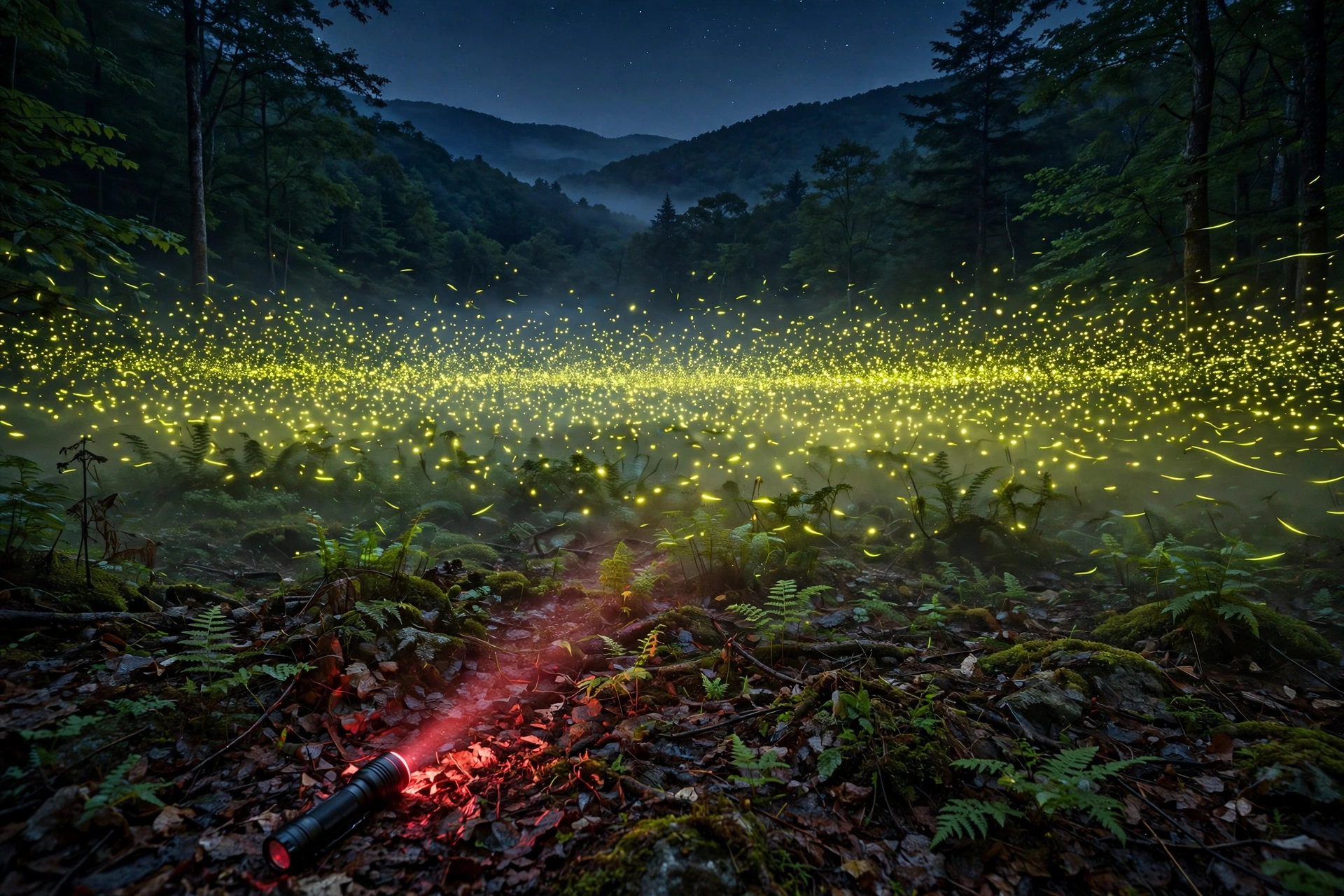
The pattern is exact. Five to eight flashes, then about eight seconds of darkness, then the cycle repeats. The mating season lasts about two to three weeks each year, with the peak predicted from soil temperatures, and since 1993 the recorded peak dates have ranged from the third week of May to the third week of June. The flashing typically begins when the forest becomes completely dark, usually around 9:30 PM, and continues for several hours into the night.7
The Park Service manages the crowd with the tools of a permitting agency. Visitors are told to arrive by 9 PM, to stay on designated trails, and to use only red-filtered flashlights, because white light and camera flashes disorient the fireflies and disrupt the mating display. Shuttle buses carry the winners in after dusk from the Sugarlands Visitor Center. The fireflies do not need the shuttle. They live there.7
The lottery is oversubscribed by an order of magnitude. In 2026, the park issued 960 vehicle reservations for the eight-day event, 120 a night, for viewing dates of May 20 to May 27. In an earlier year, 18,000 people applied for 1,800 passes. Nine of ten applicants were turned away from a light show that no one organized, no one permitted, and no one paid for.9
The display is a coordinated nighttime light show, performed by thousands of unregistered aircraft, in a national park, on a published schedule, with a federally administered lottery for admission, and the only permits in the entire operation are the ones held by the spectators.9
VI. The Scale
Do the arithmetic the record permits. The synchronous pattern is five to eight flashes, then about eight seconds of darkness. Take six flashes as the midpoint, and eleven seconds as the cycle, three seconds of flashing and eight of dark. That is about five and a half cycles a minute, or about 35 flashes a minute from a single firefly.7
The display begins around 9:30 PM and continues for several hours. Take three hours as the display. Thirty-five flashes a minute, for 180 minutes, is about 6,000 flashes a night from a single firefly, each one an unapproved light displayed in flight, after sunset, with no position lights and no filing.7
The hillside holds thousands of them. Take 2,000 flashing fireflies in the Elkmont viewing area as a conservative working figure. Two thousand fireflies at 6,000 flashes each is about 13 million flashes in a single night. Over a season of fourteen nights, that is about 180 million flashes, in a single valley, in a single national park, in a single year.7
The efficiency follows the count. The firefly converts nearly all of its energy to light. The incandescent bulb the Department of Energy removed from the shelves converted about 10 percent, and the light-emitting diode that replaced it manages about 60 percent. The federal floor is 45 lumens per watt, and the incandescent bulb failed it at about 13. The firefly would clear the floor by a wide margin on conversion efficiency alone, and it has never filed a certification, because the lamp is alive and the manufacturer is no one.314
The lottery follows the display. Nine hundred sixty vehicle reservations in 2026, 120 a night, against a demand that has reached 18,000 applications for 1,800 passes in an earlier year. The audience is rationed by randomized computer drawing. The performers are not rationed at all.9
The figures are arithmetic, not measurement, and the assumptions are stated with them. The arithmetic is correct anyway, and the flashes are real, and the permits do not exist.7
VII. The Defense
The defense is noted. It concedes every number in this investigation and disputes only the prescription.
Its first exhibit is the definition. The Federal Aviation Administration regulates civil aviation, and its rules are written for persons operating aircraft. The Board's holding in Pirker concerned a machine built by a man, a model aircraft flown for commercial photography, and no court has ever held a beetle to be an aircraft. The definition is broad, but it has always been applied to contrivances, and a firefly is not a contrivance. It is wildlife, and wildlife is the jurisdiction of the Fish and Wildlife Service and the states, not the Administration.11
Its second is the weight. The registration rule for recreational unmanned aircraft applies at 0.55 pounds, or 250 grams, and above. A firefly is an insect 9 to 19 millimeters long, and it weighs a tiny fraction of that threshold. Even under the drone framework, the firefly would be exempt from registration, and exempt from Remote ID with it. The smallest drone the rule excuses is heavier than the largest firefly it would excuse.1320
Its third is the lamp. The Department of Energy's rule governs general service lamps, defined as lamps with a standard ANSI base, operating at household voltages, producing 310 to 3,300 lumens, and sold in commerce. A firefly has no ANSI base, runs on no household voltage, is not sold, and is not a lamp within the meaning of the rule. The efficiency comparison is a category error, and the penalty of $560 per lamp has never been assessed against a living thing.14
Its fourth is the signal. Section 227(e) reaches only telecommunications services and IP-enabled voice services, and only where a caller identification service transmits the misleading information. A flash is not a telecommunications service. There is no caller identification service in the forest. The Photuris female's intent is to eat, which is not one of the three prohibited intents as the statute means them, and the male she eats is not a subscriber.15
Its fifth is the listing. The Endangered Species Act protects the Bethany Beach firefly. A listing would make it unlawful to harm the insect, not unlawful for the insect to fly unlicensed. The law, having finally noticed the firefly, proposes to shield it, and the shield runs in the wrong direction for this prosecution.17
Its sixth is the light itself. The flash is a mating signal, not a navigation aid. Position lights exist so that other aircraft can determine an aircraft's direction of flight, and no firefly has ever caused a midair collision, filed a near-miss report, or been cited in an accident investigation. The Park Service tells visitors to use red-filtered flashlights because white light disorients the fireflies, which is to say the humans are the ones whose lighting needs regulating.7
The defense rests. It is overruled.
VIII. The Prescription
The ledger is now complete, and it admits of only one reading.
Every firefly should hold a registration under Part 47 of Title 14, with an N-number marked on the outside of the aircraft, and an airworthiness certificate under Section 91.203, carried aboard or available for inspection. Every firefly should display approved position lights, red on the left, green on the right, white facing aft, from sunset to sunrise, and operate an anti-collision light system at all times. Every firefly should broadcast Remote ID, its identity and location, in flight, and the species flash code, while informative, is not a serial number and does not satisfy the rule. Every lantern should be certified by the Department of Energy at 45 lumens per watt, with the stricter 120 lumens per watt standard to follow in 2028. Every Photuris female should file a disclosure before transmitting a misleading identification signal, and the Elkmont lottery should be extended to the performers, 960 firefly permits for the season, drawn at random, with the season announced by Notice to Air Missions.11121314
The queue should be cleared in order. The Administration should process the registrations before any further firefly is flown, and the lanterns should be retrofitted to the approved configuration, and the mating signals should be re-coded to the standard pattern, and the femmes fatales should be grounded pending their disclosures, and the spectators should keep their red-filtered flashlights, since the humans are the only party in the valley holding a valid permit.9
The test case is the next June. The soil will warm, the peak will be predicted, the lottery will open, 18,000 people will apply for 960 passes, the hillside will flash five to eight times and go dark for eight seconds, about 13 million times a night, and the registrations will not exist, and the position lights will be the wrong color, and the largest unlicensed nighttime light display in the United States will operate for another season, in the open, in a national park, one flash at a time.79
Ergo.
Sources
- Fireflies are winged beetles in the family Lampyridae, not flies. There are more than 2,000 species in the world, with about 170 in North America, found on every continent except Antarctica. m.mountvernongazette.com ↑↑
- Fireflies spend most of their lives as larvae, often called glowworms, living one to two years underground or in moist leaf litter, glowing to warn predators. Adults live only about three weeks. bugs.uconn.edu ↑↑
- Firefly light comes from luciferin, luciferase, ATP, and oxygen, controlled by nitric oxide regulating oxygen flow to the lantern. The reaction is nearly 100 percent efficient, producing cold light with almost no heat, against about 10 percent for an incandescent bulb and about 60 percent for an LED. tinythat.com ↑↑↑
- Firefly luciferase emits yellow-green light at 560 nanometers. The luciferase cDNA was cloned from Photinus pyralis by de Wet and colleagues in 1985, Proceedings of the National Academy of Sciences 82:7870-7873, and the ATP-dependent reaction has long been used to measure ATP. kegg.jp ↑↑
- Male fireflies flash species-specific patterns, and females answer with a single flash after a species-specific delay. Photuris females lure Photinus males by faking the flash signal characteristics of the Photinus female. pnas.org ↑
- Female Photuris, the femmes fatales, mimic Photinus female flashes to lure and eat Photinus males, gaining defensive steroids called lucibufagins that they cannot produce themselves. Lloyd first reported the aggressive mimicry in Science in 1965; Eisner and colleagues established the lucibufagin transfer in 1997. phys.org ↑↑↑↑
- Great Smoky Mountains National Park is home to 19 firefly species. The synchronous firefly Photinus carolinus flashes five to eight times, followed by about eight seconds of darkness, in a mating season of two to three weeks each year, with recorded peak dates since 1993 ranging from the third week of May to the third week of June. Flashing typically begins around 9:30 PM. Visitors must use red-filtered flashlights, stay on designated trails, and arrive by 9 PM. home.nps.gov ↑↑↑↑↑↑↑↑↑↑
- In 1992, naturalist Lynn Faust challenged the published claim that synchronous fireflies did not occur in North America, and within a year scientists confirmed the display at Elkmont. dhp.feji.io ↑
- Since 2006, the National Park Service has limited access to the Elkmont area during the peak and run the viewing by lottery. In 2026, the park issued 960 vehicle reservations, 120 per night, for May 20 to May 27. In an earlier year, 18,000 people applied for 1,800 passes. wyshradio.com ↑↑↑↑↑↑↑
- The blue ghost firefly, Phausis reticulata, holds a sustained blue-green glow for up to a minute at a time. history.com ↑
- Title 49, United States Code, Section 40102(a)(6) defines aircraft as any contrivance invented, used, or designed to navigate, or fly in, the air. 14 CFR 1.1 defines aircraft as a device that is used or intended to be used for flight in the air. In Administrator v. Pirker, NTSB Order No. EA-5730 (2014), the Board held the definition reaches any device used for flight in the air, manned or unmanned, large or small. This publication previously applied the definition to birds. faraim.org ↑↑↑
- Section 91.209(a) of Title 14 provides that no person may operate an aircraft from sunset to sunrise unless it has lighted position lights, and Section 91.209(b) requires an equipped anti-collision light system to be lighted whenever the aircraft is operated. Position lights are red on the left, green on the right, and white facing aft. Section 91.205(c) lists the equipment required for night visual flight rules operation. gleim.com ↑↑
- Recreational unmanned aircraft weighing 0.55 pounds or more must be registered with the FAA, and commercial operators under Part 107 must register every unmanned aircraft regardless of weight. Registered unmanned aircraft must broadcast Remote ID, enforced since March 2024. Section 107.29 requires anti-collision lighting visible for at least three statute miles for night operations, and Section 107.35 limits one remote pilot to one unmanned aircraft at a time, so commercial drone light shows operate under waivers to both sections. en.wikipedia.org ↑↑↑
- The Department of Energy codified the 45 lumens per watt backstop for general service lamps in 2022, 87 FR 27439, effective July 25, 2022, with full enforcement for manufacturers from January 2023 and for retailers from July 2023. Penalties run to $560 for each noncompliant lamp sold. In April 2024, the Department finalized a standard above 120 lumens per watt, with compliance required by July 25, 2028. federalregister.gov ↑↑↑↑
- Section 227(e) of Title 47, the Truth in Caller ID Act of 2009, makes it unlawful for any person, in connection with any telecommunications service or IP-enabled voice service, to knowingly cause a caller identification service to transmit misleading or inaccurate caller identification information with the intent to defraud, cause harm, or wrongfully obtain anything of value. govinfo.gov ↑↑
- Fallon and colleagues (2021) evaluated 132 firefly species from the United States and Canada under IUCN Red List criteria and found at least 18 species, 14 percent, threatened with extinction, with more than half of the species impossible to evaluate for lack of data. Threats include habitat loss, light pollution, and climate change. PLoS ONE 16(11): e0259379. journals.plos.org ↑
- The United States Fish and Wildlife Service proposed on October 1, 2024 to list the Bethany Beach firefly (Photuris bethaniensis) as threatened under the Endangered Species Act, 89 FR 79857, the first firefly ever proposed for listing. The species lives in interdunal freshwater swales in Delaware, Maryland, and Virginia. The Service continues to work on the final determination. dnrec.delaware.gov ↑↑↑
- In July 2026, the Fish and Wildlife Service issued a positive 90-day finding on a petition to list the loopy five firefly (Photuris forresti), and will conduct a full species status assessment. xerces.org ↑
- Lewis and colleagues (2020) identified light pollution as a major threat to fireflies worldwide, because artificial light interferes with the flashing signals fireflies use to attract mates. BioScience 70:157-167. journals.plos.org ↑
- The common eastern firefly, Photinus pyralis, is 9 to 19 millimeters long and is the most common firefly species in North America. en.wikipedia.org ↑↑