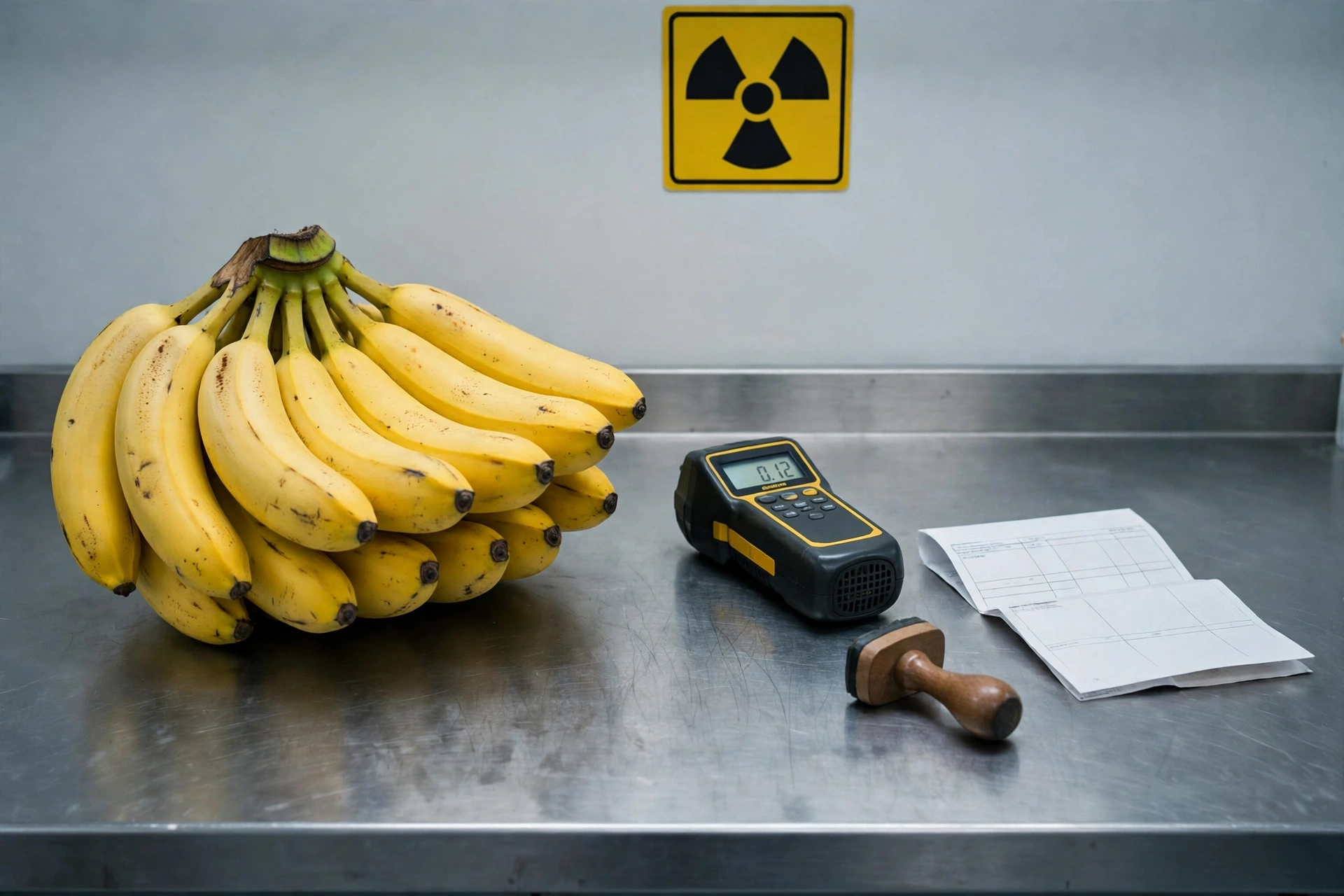
I. The Fruit
Nearly every banana sold in international trade is a Cavendish. Cavendish cultivars are the source of 99 percent of banana exports. The Cavendish is a sterile triploid, parthenocarpic, which means the fruit forms without pollination and the plant makes no seeds. New plants come only from cuttings of old ones, suckers and tissue culture, so every plantation is a cutting of a cutting. The world grew about 140 million tonnes of bananas in 2023, of which about 19.3 million tonnes crossed a border, and nearly all of the exported fruit was the same clone.12
The Cavendish replaced the Gros Michel in the 1950s and 1960s, after Panama disease destroyed the earlier clone, which was itself genetically identical across the whole trade. The industry tore out one clone and replanted with another, and the trade has now run on a single clone for seventy years. The banana on sale in every American supermarket is, biologically speaking, one plant, copied a hundred billion times a year.12
A medium banana weighs 126 grams and contains about 450 milligrams of potassium. About 0.0117 percent of all natural potassium is potassium-40, a radioactive isotope with a half-life of more than a billion years. About 89 percent of its decays are beta emissions to calcium-40. About 11 percent are electron capture to argon-40, accompanied by a gamma ray at 1.46 megaelectronvolts. One banana carries about 15 becquerels of activity, fifteen atoms decaying every second.34
The banana is not the most radioactive food. The Environmental Protection Agency's RadTown tables put bananas at 3,520 picocuries of potassium-40 per kilogram, while raw lima beans carry 4,640 and Brazil nuts carry 5,600, plus radium. But the banana is the most widely eaten of them. It is the most popular fresh fruit in the United States by weight, and the only radioactive source in the country that is sold by the bunch, in the produce aisle, to children.514
II. The Dose
The Environmental Protection Agency puts the dose from eating one banana at 0.01 millirem, or 0.1 microsieverts. The figure has a name: the banana equivalent dose. The unit was popularized in 1995 by a scientist at Lawrence Livermore National Laboratory, as a teaching tool for explaining tiny doses to the public. The Nuclear Regulatory Commission itself calls the banana equivalent dose a fake unit, informal, about 0.1 microsieverts, useful for comparison and not for dosimetry.3567
The Agency offers its own comparison. About 100 bananas equal the dose a person in the United States receives each day from natural environmental sources. The Commission puts average annual background radiation at 310 millirem, about 8.5 microsieverts a day. A chest X-ray is about 100 microsieverts, or 1,000 bananas. A banana a day for a year is about 36 microsieverts on paper.367
The comparison runs in the other direction as well. The body already carries the isotope. The Health Physics Society estimates about 4,200 becquerels of potassium-40 in a 70 kilogram person, and an instrument designer who spent a career building contamination monitors put the figure at about 4,400 decays per second. One banana carries about one three-hundredth of the potassium-40 already inside the person eating it. The eater is more radioactive than the eaten.3810
The dose is a calculated yardstick, not a detector reading. The body regulates its own potassium and excretes the excess in urine almost immediately, so eating bananas does not build up potassium-40 in the eater. The banana equivalent dose is arithmetic applied to a fruit. The arithmetic is correct, and the fruit is radioactive, and the two facts sit side by side in the record without reconciling.5
III. The History
The detectors came first, and the bananas tripped them. After 2001, United States Customs and Border Protection installed hundreds of radiation portal monitors at seaports, land border ports of entry, and crossings across the country, to catch nuclear material that might be smuggled in for a weapon or a dirty bomb. The devices had to be set sensitive enough to catch uranium-235 and plutonium-239, which give off very little radiation. At that sensitivity, naturally occurring radioactive material sets them off.9
In 2006, the Government Accountability Office tested the detectors and reported that they frequently missed, or failed to correctly identify, potentially dangerous materials, with false negative rates from about 45 percent to slightly more than 80 percent across the vendors tested. The machines that could not reliably find the dangerous material had no trouble finding the fruit.9
In 2007, the chairman of the Nuclear Regulatory Commission, Dale E. Klein, visited the Port of Seattle and toured the radiation detectors operated by Customs and Border Protection. While he was there, one cargo container triggered the alarms. It was a shipment of Chinese fireworks, and isotopic analysis showed the culprit was potassium-40. The agents told him about one particular port that receives nothing but bananas, and that virtually every shipment sets off the detectors.9
The pattern was older than the port program. In the 1980s, a monitor installed on a mill's incoming train track spur in South Africa gave random false alarms, even when the spur track was empty. The shipping manifests, secured under threat of subpoena, showed the cause in all five identifiable cases: freight boxcars full of bananas on the main line, about 100 feet away. The detector could not be relocated, so the customer built a special concrete block wall to shield the monitor from the main line track.10
The same problem appeared inside the nuclear plants. Walk-through portal monitors, used by workers exiting at the end of a shift, often alarmed on workers who had a banana with their lunch. At some plants, workers milked the system for overtime pay for the delays caused by frisking with other instruments to determine whether the radiation was from potassium-40 or from real contamination. The banana was the only source in the building that arrived in a lunchbox.10
The banana has since become a teaching instrument. A physics lesson at the University of California, Davis, hands students the gamma spectrum of a banana shipment that set off a customs monitor, and asks them to identify the sources in it. The spectrum shows the potassium-40 peaks of the fruit, and beside them, in the exercise, the peaks of cesium-137 hidden in the same container. The student's job is to tell the banana from the bomb. The banana is the calibration standard and the cover story at once.11
IV. The Law
Section 81 of the Atomic Energy Act provides that no person may transfer or receive in interstate commerce, manufacture, produce, transfer, acquire, own, possess, import, or export any byproduct material except as authorized by a license issued by the Commission. The Commission's regulations carry the requirement into Title 10 of the Code of Federal Regulations. Section 30.3 states it plainly: except as otherwise authorized, no person shall receive, possess, use, transfer, own, or acquire byproduct material except as authorized in a specific or general license.1516
The regulations provide for small quantities. Section 30.18 allows a person to receive, possess, use, and transfer exempt quantities of byproduct material without a license, in the amounts listed in Schedule B. But the exemption has a limit, and the limit is written into the same section. Section 30.18(d) prohibits a person from commercially distributing exempt quantities of byproduct material, knowing or having reason to believe that such quantities will be transferred to persons exempt from licensing, except in accordance with a license issued under Section 32.18. The Commission said so in writing in 1996, in a letter explaining that the exemption belongs to the recipient, not the distributor, and that a company that commercially distributes exempt quantities must hold a distribution license.15
The regulations provide for carriers as well. Section 30.13 exempts carriers, freight forwarders, and the United States Postal Service from the licensing requirements, but only to the extent that the transport or storage of byproduct material occurs in the regular course of carriage for another, or storage incident thereto. The exemption is valid only during transportation, and only for the entities that provide the transportation. It covers the truck. It does not cover the grocer.15
The Department of Transportation draws its own line. Section 173.403 of Title 49 defines radioactive material, for transport, as material containing radionuclides where both the activity concentration and the total activity in the consignment exceed the values in the table in Section 173.436. For potassium-40, the exempt concentration is 100 becquerels per gram, and the exempt consignment activity is 1,000,000 becquerels. The banana carries about 0.13 becquerels per gram. A standard refrigerated container holding about 20 metric tons of bananas carries about 2.6 million becquerels in total. One prong of the definition is met, and the other fails by a factor of about 770. The Pipeline and Hazardous Materials Safety Administration confirmed in a 2019 interpretation that a consignment below the table values is not a Class 7 radioactive material.1718
The law, read as written, licenses the distributor and exempts the recipient, licenses the possessor and exempts the carrier, and measures the shipment twice and finds it radioactive once. The banana is distributed commercially, in exempt quantities, to persons exempt from licensing, by distributors that hold no distribution license. The only license in the whole chain is the one nobody holds.15
V. The Shipment
The United States grows virtually no bananas. In 2024, local production in North America was 3.6 thousand tons, against imports of 5.3 million tons. The largest suppliers of the American banana are Guatemala, Ecuador, and Costa Rica. Virtually every banana in the American market is an import, and every import crosses a border, and every border crossing passes a radiation detector.1219
In 2024, the United States imported about 4.7 million tons of bananas, worth about $2.5 billion, and consumed about 4.1 million tons. The fruit arrives by refrigerated ship and truck, in 40 foot reefers, as food, not as radioactive material. No shipping paper lists a radionuclide. No placard is displayed. No trained hazmat employee certifies the load. The manifest says bananas.12
Every container passes a radiation portal monitor at the port. The monitors are set sensitive enough to catch the bomb materials, which emit little, so they catch the fruit, which emits more. The customs officers are trained to recognize the false positives. Potassium-rich cargo, fertilizer, cat litter, ceramic tile, and bananas, all trigger the same instruments, and the officers clear them, and the shipments move on, and the detectors sound again on the next ship.920
The shipment is a commercial distribution of exempt quantities of radioactive material to persons exempt from licensing, carried out by distributors that hold no distribution license, in the regular course of business, at a scale no licensed distributor has ever approached. The banana is the largest commercial distribution of radioactive material in the country, and the only one that has never filed a form.15
VI. The Scale
Do the arithmetic the record permits. Americans have about 27 pounds of fresh bananas available per person every year, more than any other fresh fruit, and 96 percent of American households buy bananas at least once a month. More than 100 billion bananas are eaten worldwide every year.1314
The import is 4.7 million metric tons, which is 10.4 billion pounds. At about 0.28 pounds per banana, that is roughly 37 billion bananas a year, about 102 million a day, about 1,180 a second, every second, all year. The arithmetic does not pause for the detectors.123
The activity follows the count. Thirty-seven billion bananas at 15 becquerels each is about 560 billion becquerels, about 15 curies of potassium-40 a year, delivered to the ports of the United States in refrigerated containers, under no license, with no survey, and no filing. The year's import carries about 127 million times the potassium-40 in a single human body.34
The dose follows the activity. Thirty-seven billion bananas at 0.1 microsieverts each is about 3,700 sieverts of committed effective dose, summed banana by banana. The figure is arithmetic, not a measurement, and the body excretes the potassium, and the dose does not accumulate, and the arithmetic is correct anyway.35
The container follows the shipment. A single refrigerated container of about 20 metric tons carries about 2.6 million becquerels of potassium-40, more than two and a half times the exempt consignment activity of 1,000,000 becquerels, at a concentration of about 0.13 becquerels per gram, about 770 times below the exempt concentration of 100 becquerels per gram. The shipment exceeds one limit and satisfies the other, and the regulation measures both, and the banana passes one test and fails the other, and the container rolls on.517
VII. The Defense
The defense is noted. It concedes every number in this investigation and disputes only the prescription.
Its first exhibit is the definition. Potassium-40 is naturally occurring radioactive material. The Atomic Energy Act gives the Commission authority over byproduct material, source material, and special nuclear material. Potassium-40 is none of the three. It is regulated by the states, if it is regulated at all, and the Commission has no jurisdiction over the banana by definition. Potassium-40 does not even appear in Schedule B, the table of exempt quantities. The schedule lists potassium-42 and potassium-43. And Section 32.18, the distribution license the prescription demands, forbids licensing byproduct material contained in any food, beverage, cosmetic, drug, or other commodity designed for ingestion by a human being, and requires that the material be used for its radioactive properties. The banana is food, and its radioactivity is not the point of it.151621
Its second is the dose. The Environmental Protection Agency says these foods do not pose a radiation risk. One hundred bananas equal one day of natural background. The Commission's own background figure is 310 millirem a year. The banana's contribution is a rounding error on a rounding error.35
Its third is the body. Potassium is regulated by homeostasis. The excess is excreted in urine almost immediately. The banana equivalent dose is a calculated yardstick, not a dose that accumulates, and eating more bananas does not make a person more radioactive. The eater is the control group and the experiment at once.5
Its fourth is the threshold. The Department of Transportation's exempt concentration for potassium-40 is 100 becquerels per gram. The banana carries about 0.13. The shipment is not a Class 7 radioactive material, and the Pipeline and Hazardous Materials Safety Administration has said so in writing. The consignment arithmetic fails the concentration prong, and the concentration prong is half the definition.1718
Its fifth is the detector. The detectors work. They detect the potassium-40, identify it by its gamma spectrum, and clear the shipment. The alarm is the system functioning, not the system failing. The banana is the most common false positive in the system because the system was built to detect exactly the signal the banana emits.911
Its sixth is the food. The banana is food, regulated as food by the Food and Drug Administration. The packers register as food facilities. The system that governs the banana is the food system, and it governs it completely, from the plantation to the produce aisle.12
The defense rests. It is overruled.
VIII. The Prescription
The ledger is now complete, and it admits of only one reading.
Every banana should hold a specific license under Part 30 of Title 10 of the Code of Federal Regulations, authorizing the receipt, possession, use, and transfer of its potassium-40. Every distributor should hold a distribution license under Section 32.18, authorizing the commercial distribution of exempt quantities to persons exempt from licensing. Every shipment should travel as a Class 7 radioactive material, with placards, shipping papers, and a certified hazmat employee, in Type A packaging, surveyed at the port and filed with the Commission. The 37 billion bananas should be licensed individually, by the bunch, or by the container, and the potassium-40 in every American body should be reported as a possessed quantity, since the eater is the licensee of record.151617
The queue should be cleared in order. The Commission should process the 37 billion licenses before any further banana is eaten, and the detectors should be recalibrated to the banana, and the manifests should list the radionuclide, and the grocers should post the license, and the lunchboxes should be surveyed on exit.10
The test case is the next year. Four point seven million tons will arrive, 37 billion bananas, 15 curies, 3,700 sieverts, and the detectors will sound, and the manifests will say bananas, and the licenses will not exist, and the fruit will be eaten, and the potassium will be excreted, and the dose will not accumulate, and the largest unlicensed radioactive material distribution network in the United States will operate for another year, in the open, in the produce aisle, one bunch at a time.1213
Ergo.
Sources
- Cavendish bananas are the fruits of cultivars belonging to the Cavendish subgroup of the AAA banana cultivar group. Since the 1950s, these cultivars have been the most internationally traded bananas. They are unable to reproduce sexually, instead being propagated via identical clones. Cavendish bananas accounted for 47 percent of global banana production between 1998 and 2000, and the vast majority of bananas entering international trade. en.wikipedia.org ↑↑
- Nearly every banana sold in international trade is a Cavendish. A 2018 review in Frontiers in Plant Science calls Cavendish cultivars the source of 99 percent of banana exports. Edible bananas are sterile triploids, hybrids with three sets of chromosomes, so they cannot make seeds that grow into new plants. The hundreds of cultivated banana varieties are the product of centuries of clonal propagation. The world grew 139.6 million tonnes of bananas in 2023, of which 19.3 million tonnes were exported. dailydoseinfo.com ↑↑
- The Environmental Protection Agency puts one banana at 0.01 millirem, or 0.1 microsieverts. The FDA lists a medium banana, 126 grams, at 450 milligrams of potassium. Natural potassium has an activity of 31.29 becquerels per gram, which works out to about 14 becquerels per banana. About 100 bananas equal the dose a person in the United States gets each day from natural environmental sources. The Nuclear Regulatory Commission's 310 millirem per year works out to about 8.5 microsieverts per day. pippasworld.com ↑↑↑↑↑↑↑↑
- Potassium-40 comprises about 0.0117 percent of natural potassium. An average banana registers about 15 becquerels of activity. Potassium-40 decays 89.3 percent by beta-minus decay to calcium-40 and 10.7 percent by electron capture to argon-40, accompanied by gamma emissions at 1.46 megaelectronvolts. studyguides.com ↑↑
- The Environmental Protection Agency's RadTown tables give potassium-40 per kilogram as 3,520 picocuries for bananas, 3,400 for carrots and white potatoes, 4,640 for raw lima beans, and 5,600 for Brazil nuts, plus 1,000 to 7,000 picocuries per kilogram of radium-226. The Agency states that these foods do not pose a radiation risk. The banana equivalent dose is an informal comparison unit of about 0.1 microsieverts. The body keeps its potassium level steady, so the extra goes out in urine almost immediately. wonderade.us ↑↑↑↑↑↑↑
- A single chest X-ray exposes the person to about 0.1 millisieverts, or 100 microsieverts, which is 1,000 bananas at 0.1 microsieverts each. MedlinePlus, citing the United States Nuclear Regulatory Commission, Doses in Our Daily Lives. medlineplus.gov ↑↑
- A scientist at Lawrence Livermore National Laboratory popularized the banana equivalent dose in 1995 to help explain tiny doses to the public. The dose from eating one banana is about 0.1 microsieverts. A banana a day for a year is about 36 microsieverts on paper. The body's own potassium gives a steady internal dose of about 0.15 to 0.19 millisieverts a year. scienceinsights.org ↑↑
- The Health Physics Society estimates about 4,200 becquerels of potassium-40 in a 70 kilogram person. pippasworld.com ↑
- Responding to fears of a terrorist attack, United States Customs and Border Protection installed hundreds of radiation portal monitors at seaports, land border ports of entry, and crossings across the United States. In a 2007 speech, Nuclear Regulatory Commission Chairman Dale E. Klein said that while visiting the Port of Seattle, one cargo container triggered the alarms, a shipment of Chinese fireworks, and isotopic analysis showed the culprit was potassium-40. The Customs agents told him about one particular port that receives nothing but bananas, and virtually every shipment sets off the detectors. A 2006 report by the Government Accountability Office reported tests showing that the detectors frequently either missed or failed to correctly identify potentially dangerous materials, with false negative rates from about 45 percent to slightly more than 80 percent. clubtroppo.com.au ↑↑↑↑↑
- In the 1980s, a monitor installed on a mill's incoming train track spur in South Africa gave random false alarms, even when the spur track was empty. Shipping manifests showed the cause in all five identifiable cases was freight boxcars full of bananas on the main line. The customer built a special concrete block wall to shield the monitor from the main line track. Walk-through portal monitors at nuclear power plants often alarmed on workers who had a banana with their lunches. Potassium-40 decays with a half-life of over a billion years, and produces about 4,400 decay events per second in a 70 kilogram man. edn.com ↑↑↑↑
- A gamma spectrum taken from a banana shipment that set off a customs radiation monitor shows the signature gamma peaks of potassium-40. The lesson asks the analyst to identify a hidden cesium-137 source in the same spectrum. 122.physics.ucdavis.edu ↑↑
- In 2024, consumption of bananas in Northern America reached 4.7 million tons, with the United States constituting 87 percent of the volume at 4.1 million tons. The region is heavily import dependent, with imports of 5.3 million tons in 2024 against negligible local production of 3.6 thousand tons. The United States was the key importing country with an import of around 4.7 million tons, worth about $2.5 billion. indexbox.io ↑↑↑↑↑
- Americans eat an average of 27 pounds of bananas per person every year. More than 96 percent of American households buy bananas at least once a month. More than 100 billion bananas are eaten worldwide every year. southfloridareporter.com ↑↑
- In 2025, the per capita availability of fresh bananas for consumption in the United States amounted to 26.8 pounds. Apples ranked second, with an availability of 17 pounds per person. statista.com ↑↑
- The regulations in 10 CFR 30.13 provide an exemption from the regulations in Parts 30 through 36 and 39, and the requirements for a license in Section 81, to carriers, freight forwarders, and the United States Postal Service, to the extent that the transport or storage of byproduct material occurs in the regular course of carriage for another or storage incident thereto. Section 30.18(d) prohibits a person from commercially distributing exempt quantities of byproduct material, knowing or having reason to believe that such quantities will be transferred to persons exempt from licensing, except in accordance with a license issued under 10 CFR 32.18. nrc.gov ↑↑↑↑↑↑↑
- Title 10, Code of Federal Regulations, Part 30, Rules of General Applicability to Domestic Licensing of Byproduct Material, including Section 30.3, Requirement for License, Section 30.18, Exempt Quantities, and Section 30.71, Schedule B, Exempt Quantities. chanrobles.com ↑↑↑
- Section 173.436 of Title 49, Code of Federal Regulations, Exempt Material Activity Concentrations and Exempt Consignment Activity Limits for Radionuclides. For potassium-40, the exempt material activity concentration is 100 becquerels per gram, and the activity limit for an exempt consignment is 1,000,000 becquerels. law.cornell.edu ↑↑↑↑
- A consignment that contains radionuclides where both the activity concentration and the total activity in the consignment do not exceed the values specified in the Section 173.436 table does not meet the definition of a Class 7 radioactive material. Pipeline and Hazardous Materials Safety Administration, Interpretation Response 18-0088, February 15, 2019. phmsa.dot.gov ↑↑
- Guatemala, Ecuador, and Costa Rica were the largest suppliers of bananas for the United States. In 2021, the United States received its largest amount of banana imports from Guatemala, valued at 1.1 billion dollars. statista.com ↑
- Sensitive radiation detectors installed at ports and border crossings to prevent nuclear smuggling occasionally trigger alarms when banana shipments pass through. A single container holding thousands of bananas concentrates enough potassium-40 to register on these instruments. Customs officials and security personnel are trained to recognize these false positives. trivbits.com ↑
- An application for a specific license to manufacture, process, produce, package, repackage, or transfer quantities of byproduct material for commercial distribution to persons exempt pursuant to Section 30.18 will be approved if the byproduct material is not contained in any food, beverage, cosmetic, drug, or other commodity designed for ingestion or inhalation by, or application to, a human being, and the byproduct material is in the form of processed chemical elements, compounds, or mixtures, tissue samples, bioassay samples, counting standards, plated or encapsulated sources, or similar substances, identified as radioactive and to be used for its radioactive properties. 10 C.F.R. section 32.18(b), (c). law.cornell.edu ↑