I. The Emission
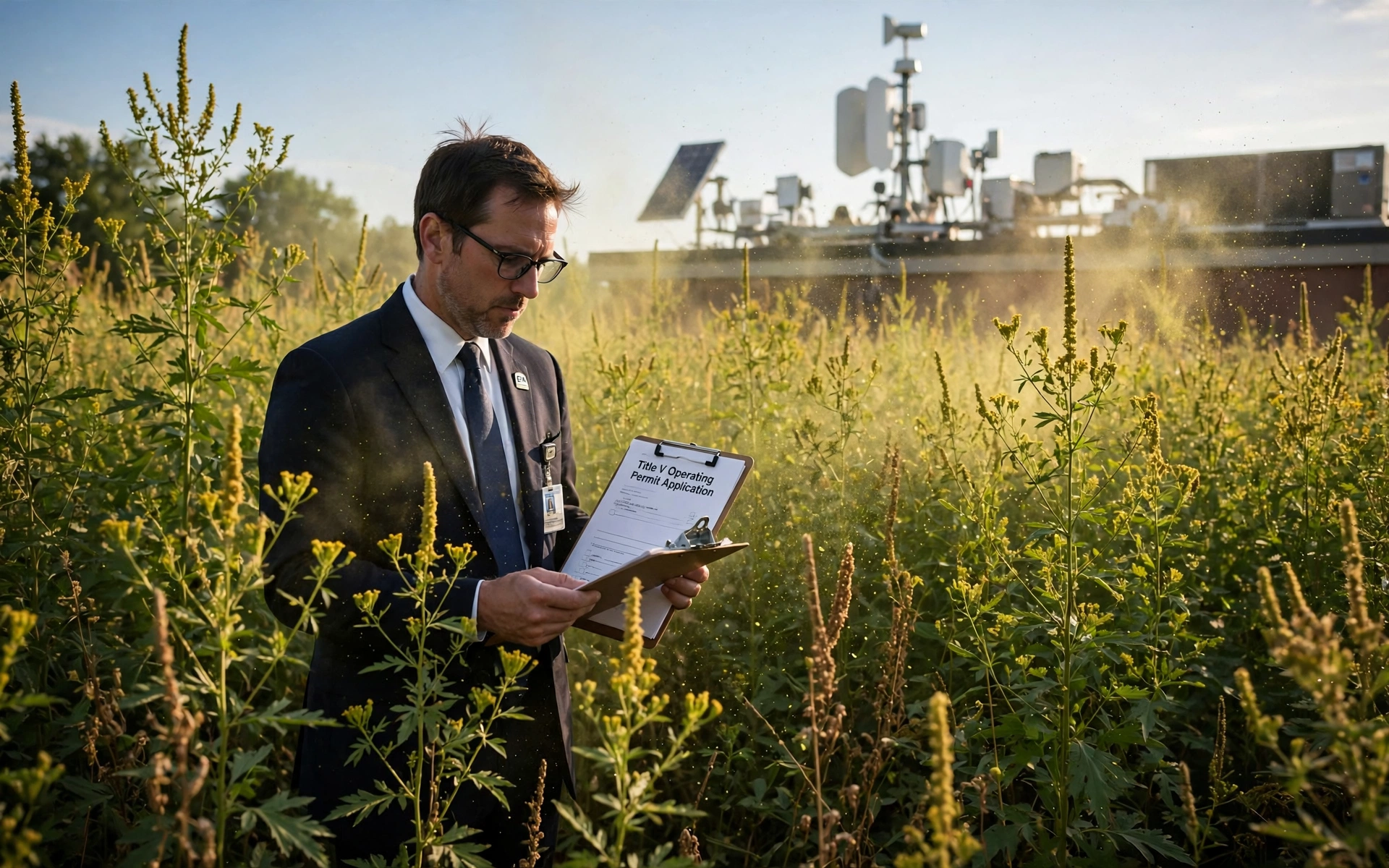
Pollen is the oldest air emission in the country and still one of the largest. It is the male fertilizing element of every seed bearing plant, released by the billions into the air by plants that do not bother with bees. Wind pollinated plants make no nectar and grow no showy flowers, because they are not trying to attract anything. They throw their pollen straight to the wind and let chance do the rest. The strategy works so well that a single common ragweed plant, a drab green weed one to four feet tall that most people could not identify if they tried, releases about a billion grains of pollen in one season. A square mile of ragweed plants produces about 16 tons of pollen. The emission is measured in tons, and the tons are measured in billions of grains, and no grain has ever carried a permit.12
The emission runs on a calendar, and the calendar is the whole of the growing season. Tree pollen opens the year in the spring. Grass pollen follows in the late spring and summer. Ragweed closes it, blooming from early August until the first hard frost, with its heaviest counts in mid-September. Ragweed alone accounts for up to half of all cases of pollen related allergic rhinitis in North America. The season is not a single event. It is a relay, one emitter handing the air to the next, from the first tree pollen of March to the last ragweed grain of October, and the air is never clear of it.23
The emission is also growing. A study published in the Proceedings of the National Academy of Sciences in 2021, drawing on 60 pollen monitoring stations across the United States and Canada from 1990 to 2018, found that pollen seasons now start about 20 days earlier than they did in 1990, last about eight days longer, and carry 21 percent more pollen. Human caused climate change accounted for about half of the lengthening of the season and about 8 percent of the increase in pollen concentrations, with the contribution accelerating in the second half of the study period. The greatest increases were recorded in Texas and the Midwest, and more among tree pollen than among any other kind. The emission is not only unpermitted. It is expanding, every year, in every direction, and the permit file is empty.4
II. The Grain
The grain is small enough to be invisible and large enough to escape the law. A ragweed pollen grain measures about 18 to 22 microns across, less than a third of the width of a human hair, and below the 40 micron limit of what the naked eye can see under ideal conditions. It is covered in spines that make it cling to whatever it touches, including the lining of a nose. It is, by the measure that matters, too small to see and too large to count.5
Too large to count is a matter of definition. The Clean Air Act regulates particulate matter in two size categories: PM10, particles up to 10 microns across, and PM2.5, particles up to 2.5 microns across. A ragweed grain at 20 microns is twice the size of the largest particle the PM10 standard counts. The monitor that measures PM10 does not see it, because the standard defines it out of existence. The grain passes through the regulatory air without ever being measured, because the measuring instrument was built for a smaller particle.56
The grain has a second form, and the second form is the one the standard cannot escape. In rain or high humidity, pollen grains burst and release fragments 0.5 to 5 microns across, squarely inside the PM2.5 range. The fragments are small enough to penetrate deep into the lung, and small enough to be measured by the PM2.5 monitor, which records them as particulate matter without knowing what they are. The monitor counts the fragment and files it under dust. The grain, whole, is too big to be pollution. The grain, broken, is pollution of unknown origin. The law measures one and ignores the other, and the plant emits both.56
The grain is counted, but not by the government. Pollen is measured in grains per cubic meter of air, tallied by a human being looking through a microscope at a glass slide and identifying each grain by its shape. The National Allergy Bureau, part of the American Academy of Allergy, Asthma and Immunology, certifies the counters, who are often board certified allergists volunteering their time, and issues the counts three times a week. Its thresholds are published: for weed pollen, 50 to 499 grains per cubic meter is high and 500 or more is very high; for tree pollen, 90 to 1,499 is high and 1,500 or more is very high; for grass pollen, 20 to 199 is high and 200 or more is very high. The counting network that supplied the national record ran on 125 certified stations between 2003 and 2024, and only 42 of them are currently active. The entire national pollen inventory is kept by volunteers with microscopes, and the volunteers are retiring faster than the stations are replaced.78
III. The Route
The route is the wind, and the wind files no flight plan. Ragweed pollen is light enough to stay aloft for hours and has been measured drifting more than 400 miles from where it started, and 400 miles out to sea, and two miles up in the atmosphere. A grain released in Ohio can be inhaled in New York. A grain released in Kansas can be counted in Missouri. The emission crosses state lines as a matter of course, which is the definition of interstate transport, and it does so without a manifest, without a carrier, and without ever stopping at a border.3
The route is unmapped because the emitter keeps no log. No agency counts the grains that cross a county line on a September afternoon. No state inspects the air at a campground entrance. The monitoring that exists is a rooftop sampler, a glass slide, and a volunteer with a microscope, reporting three days a week, a day or two late, for a network of 42 active stations covering a country of 3.8 million square miles. The Environmental Protection Agency, by contrast, compiles air quality data from a national network of more than 4,000 monitoring stations, and a 2024 study counted 4,821 active air quality monitoring stations in the country. Not one of them measures pollen as a regulated pollutant. The country watches the air with 4,821 instruments, and the largest unpermitted emission in the air is invisible to all of them.8910
The route has a second measure, and it is the one the sufferers use. The pollen count is published with the weather, and the weather report is the only permit the emission has ever held. A high count is a warning, not a violation. A very high count is a forecast, not an enforcement action. The public is told to stay indoors, close the windows, and take an antihistamine, which is the government conceding that the emission will continue, unpermitted, and that the exposed population should protect itself.7
IV. The Fellow Emitters
Ragweed is not the only emitter, and the air is not a single source problem. It is a fleet. Tree pollen opens the season, and the 2021 study found the greatest increases since 1990 among tree pollen, more than among grass or weed pollen. Birch pollen runs 20 to 22 microns, the same size as ragweed. Oak pollen fills the spring air in quantities the counters record as very high at 1,500 grains per cubic meter and above. Grass pollen is smaller and more potent by the grain: its high threshold is 20 grains per cubic meter, against 50 for weed pollen and 90 for tree pollen, because a grass grain needs fewer numbers to do the same damage.457
Mold is the fellow emitter the pollen counters count alongside the pollen, and it dwarfs the pollen by number. Mold spores are reported on the same scale, and the scale is an order of magnitude larger: 13,000 to 49,999 spores per cubic meter is high, and 50,000 or more is very high. A high day for mold means breathing tens of thousands of spores in every cubic meter of air. The mold has no permit either, and it has never applied for one.7
The fleet has a scapegoat, and the scapegoat is goldenrod. Goldenrod blooms on the same calendar as ragweed, August to first frost, with showy yellow flowers that make it visible and therefore blameworthy. But goldenrod is insect pollinated. Its pollen is heavy and sticky and cannot fly, which is why the flowers are yellow in the first place: they are built to attract bees, not wind. Ragweed is the plant with the billion grains and the 400 mile range, and goldenrod is the plant that takes the blame for it, because it is the one people can see. The invisible emitter is never charged. The visible bystander is convicted every fall.3
V. The Law
The law the plant breaks is the Clean Air Act, and the law is specific about what it covers. The Act, last amended in 1990, directs the Environmental Protection Agency to set National Ambient Air Quality Standards for six criteria pollutants: carbon monoxide, nitrogen dioxide, lead, ozone, particulate matter, and sulfur dioxide. The standards are health based, and they are the minimum outdoor air quality every region of the country must maintain. Areas that fail them are called nonattainment areas, and they face lower permitting thresholds and stricter controls. Pollen is not among the six. It has never been among the six. The list has remained essentially unchanged since 1978.1112
The Act has a second list, and pollen is not on that one either. Section 112 of the Act lists the hazardous air pollutants, chemicals known or suspected to cause cancer, neurological damage, or reproductive harm. Congress listed 189 of them in 1990. The list now holds 188, after caprolactam was removed in 1996 and 1-bromopropane was added in 2022, the first addition in 32 years. The list holds benzene, asbestos, formaldehyde, mercury compounds, and radionuclides. It does not hold pollen. A facility emitting 10 tons a year of any single listed hazardous air pollutant, or 25 tons a year of any combination of them, is a major source and must hold a Title V operating permit. A ragweed patch emitting 16 tons of pollen per square mile is not a major source of anything, because the thing it emits is not on the list.13
The permit the plant would need is Title V, and the threshold is written in tons. A major source is any stationary source that emits, or has the potential to emit, 100 tons per year or more of any air pollutant subject to regulation. The permit consolidates every applicable air quality requirement into one enforceable document, and it lasts no more than five years. At 16 tons of pollen per square mile of ragweed, a patch of ragweed covering 6.25 square miles emits 100 tons a year, which is the major source threshold, to the ton. Six and a quarter square miles of a weed nobody planted is a major source in everything but the paperwork, and the paperwork is the whole of the law.21415
The law has a third gap, and it is the one the grain falls through. Particulate matter is regulated at 150 micrograms per cubic meter over 24 hours for PM10, and 9.0 micrograms per cubic meter as an annual mean for PM2.5. Those limits are written in mass, and the grain is too large to be weighed by them. The PM10 inlet admits only particles up to 10 microns. The ragweed grain, at 18 to 22 microns, is turned away at the door. The only pollen the standard ever sees is the fragment, 0.5 to 5 microns, born when the grain bursts in the rain, and the standard weighs the fragment as dust. The emission is unregulated in its whole form and misidentified in its broken form, which is the complete record of its regulation.512
VI. The Scale
The bill is counted in people, and the people are counted in tens of millions. According to the Centers for Disease Control and Prevention, 25.7 percent of American adults had a seasonal allergy in 2021, and 18.9 percent of children did. The 2024 figures are 25.2 percent of adults and 20.6 percent of children. More than 50 million Americans experience allergies every year, making allergy the sixth most common cause of chronic illness in the country. Seasonal allergies that present as allergic rhinitis cause an estimated 4.1 million physician office visits a year.116
The bill is also counted in dollars. The Agency for Healthcare Research and Quality, in Evidence Report Number 67, puts the annual direct medical costs of allergic rhinitis in the United States at 1.16 billion to 4.5 billion dollars, rising to 7.7 billion dollars when indirect costs are included. Allergic rhinitis affects as many as 35 million people in the United States annually, of whom an estimated 19 million are employed adults. Prescription antihistamines alone account for more than 3.0 billion dollars in expenditures. The sufferers pay for the drugs, the visits, and the lost work, and the emitter pays nothing, because the emitter has never been billed.17
Do the arithmetic the record permits. One ragweed plant releases about a billion grains in a season. A square mile of ragweed produces about 16 tons of pollen. At 100 tons a year, the Title V major source threshold, the ragweed covering 6.25 square miles is a major source, and the ragweed covering a county is a fleet of them. The pollen season starts 20 days earlier than it did in 1990, lasts about eight days longer, and carries 21 percent more pollen, which means the fleet grows larger every year while the permit file stays empty. The 42 active counting stations report the grains, the 4,821 air quality stations ignore them, and the 25.7 percent of adults with a seasonal allergy breathe them, every spring, every summer, and every fall, without a single operating permit in the file.2481014
VII. The Defense
The defense is noted. It concedes every number in this investigation and disputes only the prescription.
Its first exhibit is the personhood of the defendant. A ragweed plant is not a person. It cannot hold a Title V operating permit, sign an application, or appear before a state air quality agency. The Clean Air Act regulates stationary sources, and a plant is not a stationary source. It is a plant. The permit attaches to the operator, not to the operated upon, and the ragweed has no operator.
Its second is the list. The Clean Air Act sets standards for six criteria pollutants and lists 188 hazardous air pollutants, and pollen is on neither list. The Act gives the Administrator the authority to add pollutants through rulemaking, and no Administrator in more than fifty years has added pollen. The defense submits that a pollutant the regulator has declined to list for half a century is not a pollutant the plant can be blamed for emitting.
Its third is the measurement. Pollen is counted in grains per cubic meter by volunteers looking through microscopes, three days a week, a day or two late. The Clean Air Act's standards are written in micrograms per cubic meter, measured continuously by instruments that report in real time. The defense submits that a pollutant counted by hand, in grains, on a slide, cannot be held to a standard written in mass, by machine, in the air.
Its fourth is the antiquity. Pollen predates the Clean Air Act by hundreds of millions of years. The ragweed was releasing a billion grains a season before there was a Congress to regulate it, before there was an Environmental Protection Agency to permit it, and before there was a country to file in. The Act was written for smokestacks, and the defense submits that it was not written for the spring.
Its fifth is the impossibility. A plant cannot read the National Ambient Air Quality Standards. It cannot measure 100 tons a year, cannot hire a consultant, cannot file an emissions inventory, and cannot renew a permit every five years, because it is a plant. The law does not demand the impossible, and the prescription demands exactly that.
The defense rests. It is overruled.
VIII. The Prescription
The ledger is now complete, and it admits of only one reading.
Every ragweed plant should hold a Title V operating permit, filed in advance, one permit per plant, each naming the plant, the species, the county of origin, and the expected tonnage. Every oak, birch, and grass should file an emissions inventory, with the grain count and the season length stated in grains per cubic meter. The National Ambient Air Quality Standards should add a seventh criteria pollutant, ragweed pollen, with a primary standard of 50 grains per cubic meter, the level the National Allergy Bureau calls high, and a secondary standard of 500, the level it calls very high. The 42 active counting stations should be joined by 4,821 more, one for every air quality station in the country, so that the pollen is measured with the same instruments, on the same schedule, as the six pollutants it joins. The permit should expire after five years, like every Title V permit, and the plant should reapply, in the spring, before it blooms.71014
The test case is the next spring. About a billion grains per plant, thousands of unpermitted emitters opening their flowers at dawn, each releasing a cloud it will never report, each drifting 400 miles on a wind that files no flight plan, each landing in a nose that will sneeze before the inspector arrives. The pollen will be counted, the sufferers will be treated, and the season will be measured, as it has been every year, since the first ragweed, under the first Clean Air Act, waiting for a permit that does not exist.
Ergo.
Sources
- About one quarter, 25.7 percent, of adults have a seasonal allergy, and nearly 1 in 5 children, 18.9 percent, have a seasonal allergy, according to the 2021 National Health Interview Survey. Centers for Disease Control and Prevention, National Center for Health Statistics, January 26, 2023. cdc.gov ↑↑
- A single ragweed plant may produce about a billion grains of pollen per season, and the pollen is transported on the wind. Ragweed, Wikipedia, citing Samter and Talmage, Immunological Diseases, 3rd ed., and Rees, Consumer Health USA. en.wikipedia.org ↑↑↑↑
- A single ragweed plant can produce up to one billion grains of pollen, and ragweed pollen can travel more than 400 miles by wind. Ragweed is the main cause of hay fever, and up to half of all cases of pollen related allergic rhinitis in North America are caused by ragweeds. Brooklyn Botanic Garden; Wikipedia. bbg.org ↑↑↑
- Pollen seasons in North America start about 20 days earlier than in 1990, last about eight days longer, and carry 21 percent more pollen. Human caused climate change contributed about 50 percent of the trend in pollen season length and about 8 percent of the trend in pollen concentrations. The study used long term pollen data from 60 North American stations from 1990 to 2018. Anderegg et al., Proceedings of the National Academy of Sciences, 118(7), February 8, 2021. pnas.org ↑↑↑
- Pollen grains run 10 to 100 microns, significantly larger than PM2.5 at under 2.5 microns and PM10 at under 10 microns. Ragweed pollen is 18 to 22 microns. In rain or high humidity, pollen grains burst and release fragments 0.5 to 5 microns in size, in the PM2.5 range. air-q.com ↑↑↑↑↑
- The six criteria pollutants addressed in the National Ambient Air Quality Standards are carbon monoxide, nitrogen dioxide, lead, ozone, particulate matter, and sulfur dioxide. PM10 is particles up to 10 micrometers, PM2.5 is particles up to 2.5 micrometers. United States Environmental Protection Agency. epa.gov ↑↑
- The National Allergy Bureau categorizes counts in grains per cubic meter of air: tree pollen low 0 to 14, moderate 15 to 89, high 90 to 1,499, very high 1,500 or more; grass pollen high 20 to 199, very high 200 or more; weed pollen high 50 to 499, very high 500 or more; mold high 13,000 to 49,999 spores, very high 50,000 or more. Most United States pollen counts come from stations certified by the National Allergy Bureau, about 80 active stations, staffed by trained volunteer counters. isitallergyseasonyet.com ↑↑↑↑↑
- Daily pollen concentration data were provided by 125 National Allergy Bureau certified counting stations in the continental United States, although only 42 National Allergy Bureau stations are currently active. Pollen concentrations are reported as pollen grains per cubic meter. Pollen Season Timing and Concentrations in the United States, Atmosphere, 2025, using National Allergy Bureau data 2003 to 2024. mdpi.com ↑↑↑
- The Environmental Protection Agency compiles air quality monitoring data in the Air Quality System. Ambient air concentrations are measured at a national network of more than 4,000 monitoring stations. epa.gov ↑
- The nation had 4,821 active air quality monitoring stations when the analysis was conducted, but 1,848 counties, 58 percent of all counties, have no active air quality monitoring sites. Penn State, Proceedings of the National Academy of Sciences, April 21, 2025. psu.edu ↑↑↑
- The Clean Air Act, last amended in 1990, requires the Environmental Protection Agency to set National Ambient Air Quality Standards for six principal pollutants, criteria air pollutants, which can be harmful to public health and the environment. United States Environmental Protection Agency, NAAQS Table. epa.gov ↑
- The six criteria pollutants are carbon monoxide, nitrogen dioxide, lead, ozone, particulate matter, and sulfur dioxide. The PM10 24 hour standard is 150 micrograms per cubic meter; the PM2.5 annual standard is 9.0 micrograms per cubic meter. United States Environmental Protection Agency, NAAQS Table. epa.gov ↑↑
- Under the Clean Air Act, the original list of hazardous air pollutants included 189 pollutants. Since 1990, the Environmental Protection Agency has modified the list through rulemaking to include 188 hazardous air pollutants. The list holds benzene, asbestos, formaldehyde, mercury compounds, and radionuclides, and does not hold pollen. United States Environmental Protection Agency, Initial List of Hazardous Air Pollutants with Modifications. epa.gov ↑
- A major source has actual or potential emissions at or above the major source threshold for any air pollutant. The major source threshold for any air pollutant is 100 tons per year. The major source thresholds for hazardous air pollutants are 10 tons per year for a single hazardous air pollutant or 25 tons per year for any combination of hazardous air pollutants. United States Environmental Protection Agency, Who Has to Obtain a Title V Permit? epa.gov ↑↑↑
- Major source means any stationary source that directly emits, or has the potential to emit, 100 tons per year or more of any air pollutant subject to regulation. 40 CFR 70.2. law.cornell.edu ↑
- The Centers for Disease Control and Prevention estimates that over 50 million people in America experience allergies every year, making it the sixth most common cause of chronic illness in the country. Seasonal allergies that present as allergic rhinitis cause an estimated 4.1 million physician office visits yearly. usafacts.org ↑
- Allergic rhinitis affects as many as 35 million people in the United States annually, of whom an estimated 19 million are employed adults. Estimates of the annual direct medical costs of allergic rhinitis in the United States range from 1.16 billion to 4.5 billion dollars, rising to 7.7 billion dollars when indirect costs are included. Prescription antihistamines alone account for expenditures exceeding 3.0 billion dollars. Agency for Healthcare Research and Quality, Management of Allergic Rhinitis in the Working-Age Population, Evidence Report/Technology Assessment Number 67, March 2003. ahrq.gov ↑