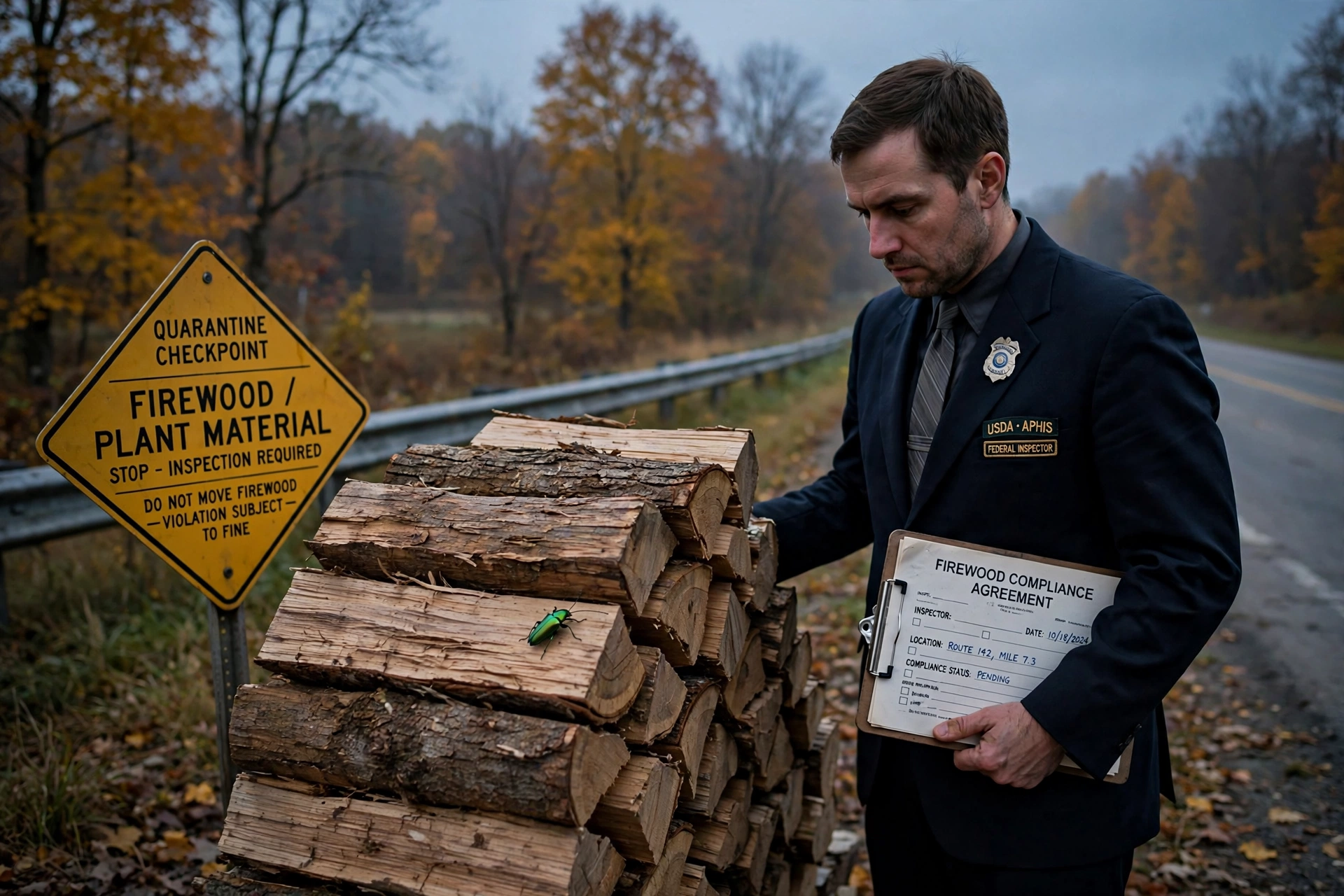
I. The Cargo
Firewood is the oldest fuel in the country and still one of the largest. The Energy Information Administration counts about 2.25 million American households that heat primarily with wood, and another 8.83 million that burn it as a secondary heat source, more than 11 million households in all. A household that heats mainly with wood burns about 4.3 cords a year. A cord is a stack four feet high, four feet deep, and eight feet long, 128 cubic feet of split wood. The residential sector burns about 500 trillion British thermal units of wood a year, which at the Administration's figure of 20 million British thermal units per cord is about 25 million cords a year, or about 3.2 billion cubic feet of wood, cut, split, stacked, and moved, every year, by hand.12
The cargo moves because the heat is needed where the trees are not. A cord of oak holds roughly 20 to 25 million British thermal units, about the heat of 150 gallons of fuel oil, and it costs a fraction of the price. The woodpile is stacked in the fall, seasoned through the winter, and burned where it is cut, or so the rulebook says. In practice the woodpile travels. Campers bring a trunkload from home. Cabin owners bring a truckload from the city. Hunters bring a bedload from the county over. The wood is cheap, the trip is short, and the load is already paid for. Nobody weighs a log at a state line. Nobody asks a log for its papers.12
The cargo is also invisible to the system built to watch it. A cord of firewood is not a shipment. It has no bill of lading, no carrier, no destination on file, and no inspection at the border. The entire American firewood trade, 25 million cords a year, moves on handshake, habit, and habit alone. The quarantine system regulates the movement of regulated articles, and firewood is a regulated article, and the system has never once seen the whole trade. It has seen the checkpoints, the roadside stops, and the six tickets handed out in Lake George in a single August week in 2012. The rest of the cargo passes in the dark.3
II. The Passenger
The passenger is Agrilus planipennis, the emerald ash borer, a beetle about half an inch long, metallic green, native to northeastern Asia. It was discovered in southeastern Michigan, near Detroit, in the summer of 2002, and it probably arrived in the United States on solid wood packing material carried in cargo ships or airplanes originating in Asia. The adult beetles nibble on ash foliage and cause little damage. The larvae do the killing. They feed on the inner bark of ash trees, cutting off the living vessels that carry water and nutrients, and the tree starves from the inside while its crown still looks green.45
The beetle attacks every species of ash native to North America, all sixteen of them, and it kills nearly all of them. In plots in southeastern Michigan and Ohio, ash mortality exceeded 85 percent. The Arkansas extension service puts it more bluntly: the larvae destroy 100 percent of the ash trees in infested areas. More than 8 billion ash trees stand in the United States, and every one of them is threatened. Since 2002 the borer has killed hundreds of millions of ash trees in North America and cost municipalities, property owners, nursery operators, and forest products industries hundreds of millions of dollars to remove, replace, or treat the dead and dying.567
The beetle is a weak traveler and a perfect passenger. An adult can fly at least half a mile from the tree where it emerges, and Canadian research puts the maximum at about 10 kilometers. Half a mile is the whole of its own range. Everything beyond that is the firewood. Humans can unknowingly transport the borer hundreds of miles in firewood, and the record shows it: by the time the federal quarantine was lifted in 2021, the beetle had spread to 35 states and the District of Columbia, from a single introduction near Detroit. The beetle did not walk there. It rode.478
The passenger is also invisible. The eggs are the size of a pin. The larvae live inside the wood, under the bark, where no eye can see them. Cutting a tree into firewood does not kill the borer developing inside it. Adult beetles can still emerge from a split log, months after the tree was cut, and infest healthy trees when they do. A log can look clean, feel solid, and smell of fresh cut oak, and still carry the insect that kills the forest it is carried into. The inspection that would catch it does not exist, because the inspector cannot see inside the wood, and the wood does not volunteer.89
III. The Route
The route is the American weekend. A camper loads the trunk on Friday, drives two hundred miles to a state park, and unloads beside the fire ring. A cabin owner fills the pickup in the city and drives it to the lake. A hunter stacks the bed before dawn and drives it to deer camp. Every one of those trips is a long distance movement of a regulated article, and every one of them is the exact movement the quarantine system was built to stop. The Arkansas Cooperative Extension Service calls firewood great mass transportation for invasive pests, and luxury mass transit for the next big invasive insect. The beetle does not buy a ticket. The ticket is bought for it, by a camper, with a trunkload of oak.89
The route is unmapped because the carrier keeps no log. No agency counts the cords that cross a county line on a Friday evening. No state inspects the trunk of a car at a campground entrance. The enforcement that exists is a roadside stop, a ticket, and a confiscation, and it is rare enough to make the news when it happens. In August 2012, New York environmental conservation officers stopped 31 vehicles carrying firewood in the Lake George region and ticketed six of them, for wood from out of state, wood from a quarantined county, and untreated wood moved beyond 50 miles. Six tickets. Thirty one vehicles. One week. One lake. The rest of the route ran on schedule.310
The rule the route breaks is simple, and it is written on the sign at the campground. Buy it where you burn it. The campaign that carries the rule, Don't Move Firewood, is run by The Nature Conservancy, and its instruction fits on a bumper sticker. The instruction is not a law. It is a request. The law is behind it, in the quarantines and the 50 mile rules and the heat treatment standards, and the law is enforced against the dealer, the shipper, and the importer. The camper with a trunkload is the largest carrier in the system and the least regulated, because the system was built for commerce and the camper is not commerce. The camper is a weekend.911
IV. The Fellow Passengers
The borer is not the only passenger, and the firewood is not a single pest carrier. It is a fleet. The Asian longhorned beetle attacks twelve types of hardwood trees, and it rides the same way, hidden inside untreated wood. Two logs, five to six inches in diameter and eighteen inches long, were found to contain more than 23,000 of the beetles, or about 11,500 beetles per log. An infested tree does not recover. It dies, becomes a safety hazard, and is removed and finely chipped. The beetle has no natural predators here, and the trees have no natural defense. The only treatment is the chipper.1213
The spotted lanternfly rides as an egg mass, laid on firewood, on vehicles, on outdoor furniture, and carried wherever the furniture goes. It was first detected in Berks County, Pennsylvania, in 2014, and by 2023 it had been found in 130 counties across 13 states, 87 of them under quarantine. It feeds on the sap of more than 70 plant species, with a preference for grapevines, and the potential economic losses in Pennsylvania alone are estimated at $554 million. Its spread, the research concludes, is driven overwhelmingly by human mediated dispersal. The insect hops or glides over short distances. The egg mass rides in a trunk.1314
The manifest continues. The spongy moth lays its egg masses on firewood. Thousand cankers disease, which threatens the black walnuts of the eastern half of the country, travels in infested wood. The United States Department of Agriculture puts the total cost of invasive pests and plant diseases at an estimated $40 billion a year in losses to trees, plants, and crops. The firewood does not carry one pest. It carries the inventory of the whole trade, and the trade runs every weekend, in every state, without a manifest, without a carrier license, and without a single inspection of the cargo hold, because the cargo hold is a pickup bed.1213
V. The Law
The law the log breaks is the Plant Protection Act, and the penalties are written for the movement, not the insect. Under 7 U.S.C. 7734, a person who knowingly violates the Act may be fined under title 18, imprisoned for up to one year, or both. A person who knowingly imports, enters, exports, or moves any plant, plant product, biological control organism, plant pest, noxious weed, or article, for distribution or sale, in violation of the Act, may be fined under title 18, imprisoned for up to five years, or both. The civil penalties run higher: up to $50,000 for an individual, except that the penalty may not exceed $1,000 for an initial violation by an individual moving regulated articles not for monetary gain, up to $250,000 for any other person for each violation, up to $500,000 for all violations adjudicated in a single proceeding without a willful violation, and up to $1,000,000 for all violations adjudicated in a single proceeding if the violations include a willful one, or twice the gross gain or gross loss, whichever is greater.15
The states run the checkpoints. New York enacted its firewood regulation in 2009. Untreated firewood grown in New York may not be transported more than 50 miles in a straight line from its source unless it has been heat treated to 71 degrees Celsius, 160 degrees Fahrenheit, for 75 minutes. Untreated firewood may not be imported into New York from any other state or country at all. A violation carries a $250 fine, a $100 civil penalty, and up to 15 days in jail, and the wood may be ordered returned to its source or confiscated and destroyed. A seven dollar bundle bought locally costs far less than the $350 penalty, and the state says so in so many words.10
Illinois draws the same line at the same distance. Firewood transported more than 50 miles from its source must be treated firewood, in its original packaging, accompanied by a label approved by the department stating that the firewood has been heat treated to reach and maintain a minimum core temperature of 140 degrees Fahrenheit, 60 degrees Celsius, for at least 60 minutes. Wisconsin certifies its firewood dealers, at $50 a year for each treatment location, with a $200 fee if the certification standards are not met on the first attempt, and the label must bear the certification number, the method of treatment, and the state and county where the wood was harvested. The paperwork follows the wood. The wood does not carry it.1617
The heat treatment itself is a specification with a number. The standard used most often in the United States is T314-a: 60 degrees Celsius for 60 minutes, measured at the core of the wood, because that is the approved heat treatment level for emerald ash borer. The highest standard in the series is T314-c: 71.1 degrees Celsius for 75 minutes, which is the level New York requires. Kiln drying is not the same thing. Seasoning is not the same thing. Air drying is not the same thing. Only firewood certified as heat treated, by a state agency or by the United States Department of Agriculture, is permitted to cross state, international, or quarantine boundaries, and it is permitted because it carries a seal. The seal is the license. The log without the seal is the violation.1118
VI. The Scale
The bill is counted in trees, and the trees are counted in billions. More than $300 million in federal USDA APHIS funds alone have been devoted to battling the borer. The cost of treating, removing, and replacing urban ash trees between 2009 and 2019 was projected to exceed $10 billion, and if the surrounding suburbs were included, the expected costs doubled. In Ohio alone, total losses were estimated at $1.8 billion to $7.6 billion. The federal government spent the money, the cities spent the money, the homeowners spent the money, and the nurseries spent the money, and the beetle kept riding, because the carrier kept carrying it.619
Do the arithmetic the record permits. The residential sector burns about 500 trillion British thermal units of wood a year, about 25 million cords. A cord is 128 cubic feet. The trade moves about 3.2 billion cubic feet of wood a year, and every cubic foot of it is a potential carrier, because the eggs are the size of a pin and the larvae live inside the wood where no eye can see them. At 11,500 beetles per log, the rate found in the two Asian longhorned beetle logs, a single cord of infested wood, roughly four hundred pieces, would carry more than 4 million beetles. The trade does not need to be infested to be dangerous. It needs only one log, and one female, and the forest on the other end.112
The scale has a second measure, and it is the one the foresters use. Ash wood is the wood of baseball bats, preferred for its resistance to splintering and its relatively light weight, and the borer is killing the supply. The tree is also the street tree of a thousand American towns, planted because it grows fast and tolerates the city, and the borer is killing the streets. The bill is not only the $10 billion. It is the shade, the canopy, the bats, and the streets, and it is still being counted, because the beetle is still spreading, and the carrier is still carrying it, every weekend, in every state, without a license.46
VII. The Defense
The defense is noted. It concedes every number in this investigation and disputes only the prescription.
Its first exhibit is the personhood of the defendant. Firewood is not a person. It cannot hold a compliance agreement, sign a certificate, or appear before a state department of agriculture. The Plant Protection Act regulates persons who move regulated articles, and a log moves nothing. It is moved. The penalty attaches to the mover, not to the moved.
Its second is the flight. The beetle flies on its own wings, half a mile at a time, and the quarantine never stopped it from flying. The federal government admitted as much when it lifted the quarantine. On December 15, 2020, the Animal and Plant Health Inspection Service published a final rule removing the federal domestic emerald ash borer quarantine regulations, effective January 14, 2021, after concluding that the domestic quarantine had not proven effective in stopping the spread of the borer.20 The quarantine ran from 2003 to 2021, and the beetle spread to 35 states and the District of Columbia anyway. The defense submits that a regulation the regulator abandons as ineffective is not a regulation the log can be blamed for evading.
Its third is the treatment. Heat treated firewood is legal to move, and it is legal because it has been heated to 60 degrees Celsius for 60 minutes at the core, or 71.1 degrees for 75 minutes under the highest standard, and the seal on the package proves it. The system the investigation demands already exists, and it works by certifying the treatment, not by licensing the log. The log that carries the seal is the lawful log, and the seal is the whole of the law.
Its fourth is the camper. The camper did not know. The eggs are the size of a pin, the larvae are invisible inside the wood, and the log looked clean. The law punishes knowing movement, and the camper moved in ignorance, with a trunkload of oak and a weekend ahead of him. The statute itself caps the civil penalty at $1,000 for an initial violation by an individual moving regulated articles not for monetary gain, which is the law conceding that the camper is not the smuggler.
Its fifth is the impossibility. A log cannot read the quarantine map. It cannot sign a compliance agreement, cannot hold a heat treatment certificate, cannot measure 50 miles in a straight line from its source, and cannot present itself at a checkpoint, because it is a log. The law does not demand the impossible, and the prescription demands exactly that.
The defense rests. It is overruled.
VIII. The Prescription
The ledger is now complete, and it admits of only one reading.
Every log that crosses a county line should carry a compliance agreement, filed in advance, one agreement per log, each naming the log, the species, the county of origin, the destination, and the hour of movement. Logs of ash, oak, maple, and hickory should hold a heat treatment certificate, with the core temperature and the duration stamped on the bark. The load should be inspected at the state line, and the inspector should count the beetles, or certify that there are none, which is the same inspection performed twice. The certificate should expire 75 minutes after issuance if no heat has been applied, which, for a log that burns in an evening, is a generous window.1518
The test case is the next weekend. About 25 million cords a year, thousands of unlicensed carriers arriving at campgrounds at dusk, each carrying a compliance agreement it will never file, each hauling a passenger it cannot see, each burning before the inspector arrives. The wood will be stacked, the fire will be lit, the beetles will emerge, and the forest will be counted, inspected, and treated, as it has been every year, since the first log, under the first quarantine, waiting for a form that does not exist.
Ergo.
Sources
- About 2.5 million households used wood as the main fuel for home heating, and an additional 9 million households used wood as a secondary heating fuel, accounting for about 500 trillion British thermal units of wood consumption per year in the residential sector. The Energy Information Administration, 2009 Residential Energy Consumption Survey, via Today in Energy, March 17, 2014. The 2020 survey counts 2.25 million households using wood for primary space heating and an additional 8.83 million as a secondary heat source. eia.gov forgreenheat.org ↑↑↑
- Homes that heat mainly with wood averaged 85 million British thermal units of wood in 2020, about 4.3 cords at the Energy Information Administration's 20 million British thermal units per cord. Homes that burn wood only as backup heat averaged about 0.9 cord. A cord is a stack four feet high, four feet deep, and eight feet long, 128 cubic feet. Energy Information Administration, 2020 Residential Energy Consumption Survey, Table CE7.2. nailthemath.com ↑↑
- Six people faced fines for illegally moving firewood in the Lake George region of the Adirondacks after roadside stops by state wildlife officials in August 2012. Of 31 vehicles found with firewood, six were ticketed, for wood from out of state, wood from a quarantined county, and untreated wood moved beyond 50 miles. Violations carried fines of up to $250, plus a $100 civil penalty and up to 15 days in jail. sleloinvasives.org ↑↑
- The emerald ash borer was detected in southern Michigan in 2002 and has since spread to 33 states. It has killed hundreds of millions of ash trees in North America since 2002, and ash wood is preferred for making baseball bats because of its resistance to splintering and its relatively light weight. By 2018 it had made its way to 35 states and 3 Canadian provinces. United States Department of Agriculture, Agricultural Research Service. tellus.ars.usda.gov ↑↑↑
- Emerald ash borer probably arrived in the United States on solid wood packing material carried in cargo ships or airplanes originating in its native Asia. The larvae feed on the inner bark of ash trees, disrupting the tree's ability to transport water and nutrients. Since its discovery, it has killed hundreds of millions of ash trees in North America, caused regulatory agencies and the USDA to enforce quarantines and fines to prevent potentially infested ash trees, logs, or hardwood firewood from moving out of areas where it occurs, and cost municipalities, property owners, nursery operators, and forest products industries hundreds of millions of dollars. marlboro-nj.gov ↑↑
- More than 8 billion ash trees in the United States are threatened by the emerald ash borer. Ash mortality rates of more than 85 percent were recorded in plots in southeast Michigan and Ohio. Economic costs of replacing or treating even half of the landscape ash trees likely to be affected in urban areas between 2009 and 2019 were projected to exceed 10 billion dollars, and if surrounding suburbs were included, expected costs doubled. Mercader et al., Forest Ecology and Management 350 (2015) 70-80. research.fs.usda.gov ↑↑↑
- The emerald ash borer is a highly destructive invasive beetle that attacks all species of ash native to North America. Since its discovery in North America in 2002, it has killed hundreds of millions of ash trees and cost municipalities, property owners, nursery operators, and forest products industries hundreds of millions of dollars to remove, replace, or treat ash trees. Iowa State University Extension and Outreach. yardandgarden.extension.iastate.edu ↑↑
- The emerald ash borer moves mostly by hitchhiking on raw wood products such as firewood and logs, and the best means to control it is to not move firewood. The insect eggs are the size of a pin, and it only takes one log to destroy a whole ecosystem. Cutting a tree into firewood does not kill the borer developing inside it, and adult beetles can still emerge, infesting healthy trees when they do. Humans can unknowingly transport the borer hundreds of miles in firewood. Arkansas Cooperative Extension Service; University of Illinois Extension. uaex.uada.edu extension.illinois.edu ↑↑↑
- The emerald ash borer is most commonly spread through the movement of firewood and other infested ash wood products, although it can also spread by flying. Research shows that adult beetles can fly up to 10 kilometers. The Don't Move Firewood campaign is run by The Nature Conservancy to reduce the rate of spread, and thus mitigate the impacts, of forest pests across North America. Canadian Food Inspection Agency; Don't Move Firewood. inspection.canada.ca dontmovefirewood.org ↑↑↑
- In 2009, a regulation was enacted to prevent the accidental and often long distance spread of invasive pests by limiting the transport of firewood. Untreated firewood grown in New York may not be transported more than 50 miles (linear distance) from its source or origin unless it has been heat treated to 71 degrees Celsius (160 degrees Fahrenheit) for 75 minutes. Violations are subject to a $250 fine, plus a $100 civil penalty and up to 15 days in jail. Untreated firewood found being moved in violation may be ordered returned to its source or confiscated and destroyed. New York State Department of Environmental Conservation. dec.ny.gov ↑↑
- Heat treated firewood is different. The makers of heat treated firewood hold a legal compliance agreement that certified the firewood was heated to a certain core temperature and for a certain amount of time. The heat treatment standard used most often in the USA is for 60 minutes to 60 degrees Celsius (140 degrees Fahrenheit) because this is the approved heat treatment level for emerald ash borer. Firewood labeled with a USDA APHIS seal is considered safe to move across jurisdictional boundaries. Don't Move Firewood. dontmovefirewood.org ↑↑
- Invasive pests and plant diseases cost the United States an estimated $40 billion in losses to trees, plants, and crops each year. The Asian longhorned beetle attacks 12 types of hardwood trees, and people can unknowingly spread the beetles by moving untreated firewood, since they can hide inside wood. United States Department of Agriculture, Animal and Plant Health Inspection Service, August 2020. broadcastnewsresource.com ↑↑↑
- Two logs, five to six inches in diameter and eighteen inches long, were found to contain over 23,000 beetles. Movement of infested raw wood for firewood or lumber can easily move large numbers of this pest. The most important vector for many tree pests is movement of infested wood. Insects and diseases moved with firewood include Asian longhorned beetle, emerald ash borer, thousand cankers disease, and spotted lanternfly. Penn State Extension, Master Gardener. extension.psu.edu ↑↑↑
- First detected in Berks County, Pennsylvania, in 2014, spotted lanternfly infestations have been detected in 130 counties (87 under quarantine) within Connecticut, Delaware, Indiana, Maryland, New Jersey, New York, Ohio, Virginia, and West Virginia, among others. Potential economic losses due to feeding damage on cultivated grapes, fruit trees, ornamentals, and timber are potentially costing $554 million in Pennsylvania alone. Human mediated dispersal is driving the observed spread dynamics and distribution throughout the eastern United States. pmc.ncbi.nlm.nih.gov ↑
- A person that knowingly imports, enters, exports, or moves any plant, plant product, biological control organism, plant pest, noxious weed, or article, for distribution or sale, in violation of the Plant Protection Act, shall be fined under title 18, imprisoned not more than five years, or both. A knowing violation in general carries a fine under title 18, imprisonment of not more than one year, or both. Civil penalties do not exceed the greater of $50,000 in the case of any individual, except that the civil penalty may not exceed $1,000 in the case of an initial violation by an individual moving regulated articles not for monetary gain, $250,000 in the case of any other person for each violation, $500,000 for all violations adjudicated in a single proceeding if the violations do not include a willful violation, and $1,000,000 for all violations adjudicated in a single proceeding if the violations include a willful violation, or twice the gross gain or gross loss. 7 U.S.C. 7734. uscode.house.gov ↑↑
- Any firewood being transported more than 50 miles from its source of origin must be treated firewood, in its original packaging, and accompanied by a label approved by the Department stating that the firewood has been heat treated to reach and maintain a minimum core temperature of 140 degrees Fahrenheit (60 degrees Celsius) for at least 60 minutes. Illinois Administrative Code, Title 8, Section 240.125. ilga.gov ↑
- Wisconsin may annually certify a firewood dealer, at a fee of $50 for each firewood treatment location, with a fee of $200 if the certification standards for heat treating are not met on the first attempt. The label shall bear the certification number of the firewood dealer who treated the firewood and shall specify the method of treatment and the state and county in which the wood was harvested. Wisconsin Administrative Code, ATCP 21.20. docs.legis.wisconsin.gov ↑
- T314-a, 60 degrees Celsius for 60 minutes, is the current emerald ash borer firewood standard, and is therefore used by many states. T314-c, 71.1 degrees Celsius for 75 minutes, is the highest treatment standard in the USDA's logs and firewood T314 series. All standards are as measured in the core of the firewood. National Plant Board, Heat Treatment Standards. firewood.nationalplantboard.org ↑↑
- More than $300 million in federal USDA APHIS funds alone have been devoted to battling the emerald ash borer, which has killed some tens of millions of ash trees, chiefly within southeastern Michigan and surrounding states, and has been found in 28 states and two Canadian provinces. A 2004 estimate by the U.S. Forest Service pegged potential costs to communities and homeowners at more than $7 billion over the next 25 years. In Ohio alone, total losses are estimated to range between $1.8 and $7.6 billion. March, The Green Menace; United States Forest Service, via Vote Smart. books.google.pl justfacts.votesmart.org ↑
- On December 15, 2020, the Animal and Plant Health Inspection Service published a final rule that removes the federal domestic emerald ash borer quarantine regulations, effective January 14, 2021. The federal program transitions to one focused on management methods such as rearing and releasing biological control agents, tiny stingless parasitoid wasps. At the time of removal, the borer had spread to 35 states and the District of Columbia, and the quarantine had not proven effective in stopping its spread. Connecticut Agricultural Experiment Station and Department of Energy and Environmental Protection, January 13, 2021. portal.ct.gov ↑