I. The Operation
The 21-gun salute is the highest military honor a nation can render. It is fired for the national flag, for the sovereign or chief of state of a foreign nation, for a member of a reigning royal family, and for the president, ex-presidents, and president-elect of the United States. Salute by cannon or artillery is a military tradition that originated in the 14th century. The custom stems from naval tradition, when a warship would signify its lack of hostile intent by firing its cannons out to sea until all ammunition was spent. The British navy developed the custom of a seven-gun salute because naval vessels typically had seven guns, and because greater quantities of gunpowder could be stored on dry land, forts could fire three rounds for every one fired at sea, hence the number 21.1
The United States adopted the practice in stages. In 1810, the War Department defined the national salute as the same number of shots as there were states in the Union. In 1818, United States Naval Regulations contained the first written instructions on the 21-gun salute, outlining the procedures for a presidential visit aboard a ship. In 1842, the 21-gun salute was designated as the presidential salute. On August 18, 1875, the United States adopted the 21-gun salute as its international salute, with salutes returned gun for gun. Naval Regulations require a 21-gun salute to be fired at noon on Presidents Day, Independence Day, and Memorial Day.12
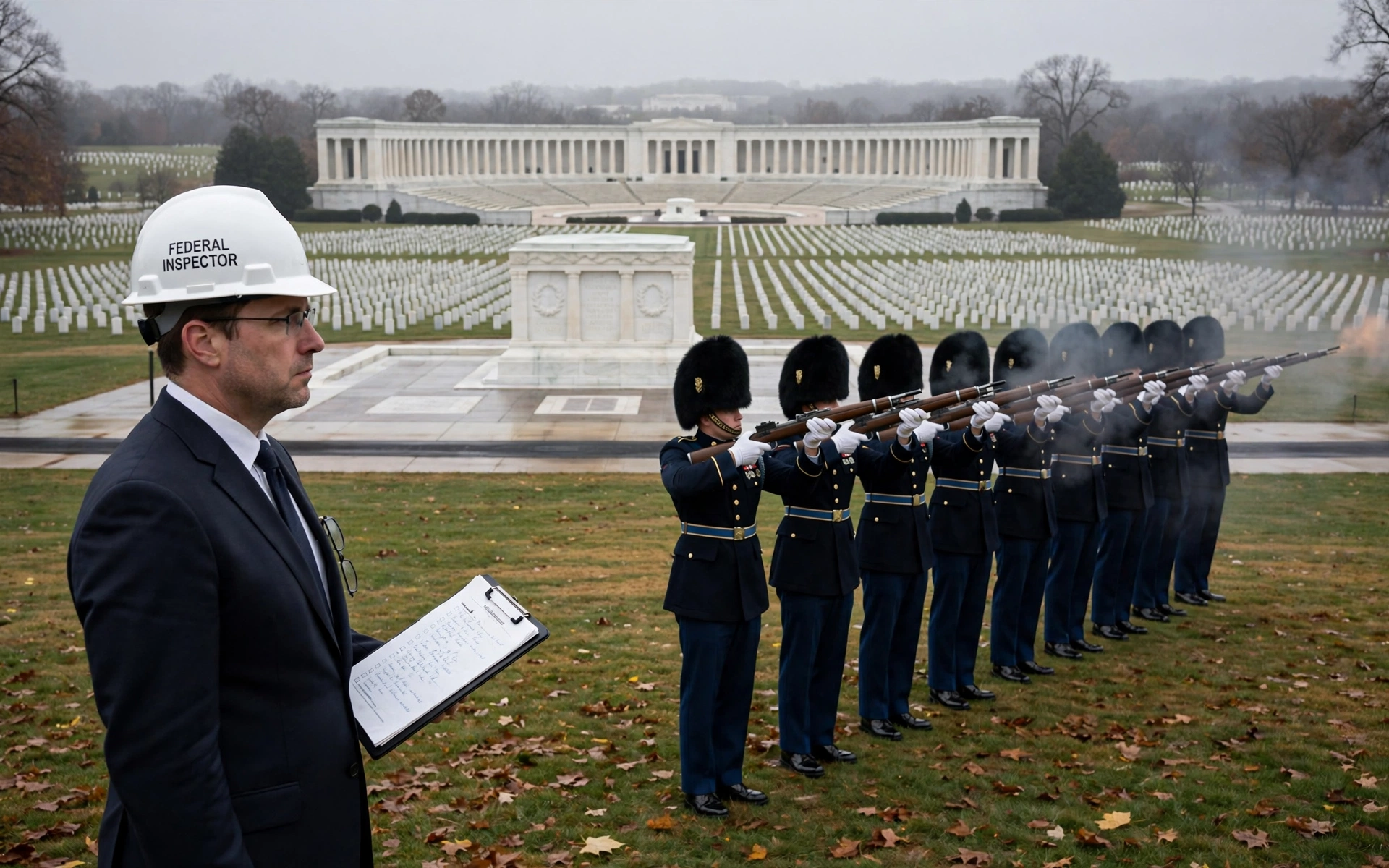
The salute most Americans actually hear is a different honor with the same arithmetic. The three-volley salute is the honor rendered at the funerals of veterans and active duty service members. A firing party of seven riflemen fires three volleys of blank cartridges into the air, in unison, on command. Seven rifles times three volleys equals 21 individual cartridge discharges. It is not a 21-gun salute, and the confusion is generations old. A numbered gun salute is rendered with cannon, artillery pieces, or naval saluting guns, and the rounds are fired separately at prescribed intervals. A firing party renders three volleys. The number 21 does not define the honor. The firing party renders three volleys regardless of whether three, five, seven, nine, ten, or twelve members fire.34
The number 21 is also marched, not only fired. At the Tomb of the Unknown Soldier, the Sentinel takes 21 steps across the mat, turns and faces the Tomb for 21 seconds, turns again, waits another 21 seconds, and steps off for another 21 step walk down the mat, repeating the pattern until the guard change. The 21 steps and the 21 second pauses symbolize the 21-gun salute, the highest military honor. A Sentinel has repeated this pattern continuously since July 2, 1937, 24 hours a day, 365 days a year, in all weather.9
II. The Scale of Production
The holiday that frames the operation is itself a legal instrument with a precise history. The fighting in World War I stopped at 11 a.m. on November 11, 1918, the eleventh hour of the eleventh day of the eleventh month. In November 1919, President Woodrow Wilson proclaimed the first Armistice Day. The Act of May 13, 1938 made November 11 a legal federal holiday, a day to be dedicated to the cause of world peace, known as Armistice Day. On June 1, 1954, President Dwight D. Eisenhower signed the law that struck the word Armistice from the 1938 act and inserted Veterans, so the day would honor veterans of all wars. A 1975 law returned the observance to November 11, beginning in 1978, after a seven year experiment with the fourth Monday in October. Today the holiday sits in federal law at 5 U.S.C. 6103 as Veterans Day, November 11. In 2026, Veterans Day falls on Wednesday, November 11.512
The war the day began by remembering was fought by 4,734,991 Americans, of whom 116,516 died, 53,402 in battle and 63,114 from disease and other non-battle causes, and 204,002 were wounded. The Department of Veterans Affairs estimates 18,267,000 living veterans as of September 30, 2023, and projects the number will decline by an average of 1.6 percent a year over the next 30 years. Every one of those living veterans, if discharged under conditions other than dishonorable, is entitled by federal law to military funeral honors.6710
The throughput of the honor is counted at a single cemetery. Arlington National Cemetery, 639 acres across the Potomac from Washington, holds more than 400,000 burials. As of 2024, it conducts approximately 27 to 30 funerals each weekday and between six and eight services on Saturday, or 141 to 158 per week, and approximately 6,900 burials each year. Arlington is one cemetery in the national cemetery system, and the same honor is rendered at veterans funerals in every state.8
Do the arithmetic the record permits. A firing party renders 21 discharges at a funeral. At 27 to 30 funerals each weekday, a five day week of firing parties at Arlington is 135 to 150 funerals and 2,835 to 3,150 discharges. At approximately 6,900 services a year, the maximum is 144,900 discharges a year at one cemetery, if a firing party rendered the honor at every service. The cemetery has been burying the dead since 1864.
III. The Process
The 21-gun salute is fired by artillery, and its rounds are fired separately at prescribed intervals, one gun at a time, until the count reaches 21. The three-volley salute is fired by rifles, and its volleys are fired in unison, seven rifles at once, three times. The volleys are always fired with blank cartridges. Traditionally the M1 Garand rifle was used, and more modern rifles such as the M14 and the M16 are now commonly employed, depending on the branch of service and availability. The key is that the rifles must be appropriate for ceremonial purposes and capable of firing blanks safely and reliably.34
Federal law prescribes the minimum elements of the funeral honor, and the firing party is not among them. Under 10 U.S.C. 1491, the Secretary of Defense shall ensure that, upon request, a funeral honors detail is provided for the funeral of any veteran. The detail consists of two or more persons, at least two of whom shall be members of the armed forces other than members in a retired status. The detail shall, at a minimum, perform a ceremony that includes the folding of a United States flag and presentation of the flag to the veteran's family and the playing of Taps. Each branch of the armed forces is free to augment these minimum components with additional elements such as firing parties, color guards, or additional participating military personnel.10
The augmentation is the discharge. The statute requires two uniformed members, a folded flag, and Taps. It does not require a rifle. The firing party is added by the branch, by custom, by availability, and by the family's expectation, and it is added with seven rifles and 21 blank cartridges, on federal property, in public, at scheduled hours, without a permit, a license, a notice, or a form of any kind. The Tomb guard's rifle, by contrast, is carried and never fired. The Sentinel walks the mat with the weapon on the outside shoulder, away from the Tomb, and the guard is changed every hour on the hour from October 1 through March 31, and every half hour from April 1 through September 30.910
The blank is the operation's most effective evasion. A blank cartridge contains powder and no projectile, so nothing is struck, wounded, or damaged, and the discharge is sound without a bullet. The statute does not punish the projectile. It punishes the possession of the firearm, and the possession is knowing, scheduled, uniformed, and public. The firing party does not hide the rifles. It presents them, raises them, and fires them three times in unison, in front of the family, the chaplain, and the folded flag.
IV. The Discharge
The discharge is governed by 18 U.S.C. 930, possession of firearms and dangerous weapons in federal facilities. Subsection (a) provides that, except as provided in subsection (d), whoever knowingly possesses or causes to be present a firearm or other dangerous weapon in a federal facility, other than a federal court facility, or attempts to do so, shall be fined under this title or imprisoned not more than one year, or both. Subsection (b) provides that whoever, with intent that a firearm or other dangerous weapon be used in the commission of a crime, knowingly possesses or causes to be present such firearm or other dangerous weapon in a federal facility, or attempts to do so, shall be fined or imprisoned not more than five years, or both.11
The statute defines its own terms. The term federal facility means a building or part thereof owned or leased by the Federal Government, where federal employees are regularly present for the purpose of performing their official duties. The term dangerous weapon means a weapon, device, instrument, material, or substance, animate or inanimate, that is used for, or is readily capable of, causing death or serious bodily injury, except that such term does not include a pocket knife with a blade of less than 2 and one half inches in length. Subsection (h) provides that notice of the provisions of subsections (a) and (b) shall be posted conspicuously at each public entrance to each federal facility, and that no person shall be convicted of an offense under subsection (a) with respect to a federal facility if such notice is not so posted at such facility, unless such person had actual notice of subsection (a).11
Apply the statute to the unit. Seven riflemen, each knowingly possessing a rifle, on federal property, at a cemetery owned by the United States and operated by the United States Army, where federal employees are regularly present for the purpose of performing their official duties, firing three volleys each, in unison, in public, at a scheduled hour. That is 21 knowing possessions and 21 discharges, per funeral, 2,835 to 3,150 per week at Arlington alone, 144,900 a year at the maximum, each punishable by a fine or up to one year in prison, and no notice is posted at the public entrance of the cemetery warning that possession of a firearm in a federal facility is a crime.
The scale is not limited to funerals. The 21-gun salute is fired at noon on Presidents Day, Independence Day, and Memorial Day, and for the president, ex-presidents, the president-elect, and visiting heads of state. The Tomb guard carries a rifle on every step of the 21 step walk, 24 hours a day, 365 days a year, since July 2, 1937. The guard has never been suspended, and the possession has never been permitted, because no one has ever asked for the permit, and no permit exists to ask for.29
V. The Standard
The standard the salute evades is written down, and the lawful version of the same act operates under it every day. A civilian who knowingly carries a firearm into a federal building faces 18 U.S.C. 930, a fine or up to one year in prison, and a state issued concealed carry permit does not authorize carry on federal property. Federal law supersedes state law in this context. The exceptions are narrow, and the statute lists them in subsection (d).11
Subsection (d) provides that subsection (a) shall not apply to the lawful performance of official duties by an officer, agent, or employee of the United States, a State, or a political subdivision thereof, who is authorized by law to engage in or supervise the prevention, detection, investigation, or prosecution of any violation of law; to the possession of a firearm or other dangerous weapon by a federal official or a member of the Armed Forces if such possession is authorized by law; or to the lawful carrying of firearms or other dangerous weapons in a federal facility incident to hunting or other lawful purposes. The lawful carrier files nothing, because the exception is written into the statute. The salute files nothing, because the salute has never been asked to.11
The standard also requires the government to do its part. Notice of the prohibition shall be posted conspicuously at each public entrance to each federal facility, and no person shall be convicted under subsection (a) if such notice is not so posted, unless the person had actual notice. A visitor entering Arlington National Cemetery passes no sign warning that possession of a firearm in a federal facility is a crime punishable by up to one year in prison. The firing party passes the same entrance, seven rifles at a time, 27 to 30 times a weekday, 52 weeks a year, and the sign is not there.
VI. The Defense
The defense is noted. It concedes every number in this investigation and disputes only the prescription.
Its first exhibit is the exception. Subsection (d)(2) provides that subsection (a) shall not apply to the possession of a firearm by a member of the Armed Forces if such possession is authorized by law, and the firing party is composed of members of the Armed Forces, in uniform, on duty, under orders, rendering an honor that 10 U.S.C. 1491 requires the Secretary of Defense to ensure. The possession is authorized by law, and the law that authorizes it is the same code that contains the prohibition.
Its second is the definition. The term federal facility means a building or part thereof owned or leased by the Federal Government, where federal employees are regularly present. The salute is fired outdoors, on open ground, under the sky, at a cemetery of 639 acres. It is not fired inside a building or part thereof. A cemetery is not a building, and a firing party standing on grass is not inside one.
Its third is the blank. The cartridges contain powder and no projectile. Nothing is struck, wounded, or damaged. The discharge is sound without a bullet, and the statute's concern is a weapon readily capable of causing death or serious bodily injury, not a ceremony that produces noise and smoke and nothing else.
Its fourth is the notice. Subsection (h) bars conviction under subsection (a) where the required notice is not posted conspicuously at each public entrance, unless the person had actual notice. No sign stands at the cemetery gate. The government has not posted the warning its own statute demands, and it cannot convict on a warning it never gave.
Its fifth is the age of the honor. The 21-gun salute was adopted as the international salute in 1875, and the federal facilities statute was written for a different century's problem, the armed intruder in a federal building, not the honor guard on a hillside. The salute predates the statute by generations, and it has been fired on schedule, in public, in front of presidents, ever since.
The defense rests. It is overruled.
VII. The Prescription
The ledger is now complete, and it admits of only one reading.
Every round fired in a salute on federal property should be covered by a permit, filed in advance, one application per discharge. The firing party at a military funeral should file 21 applications, seven rifles times three volleys, each naming the rifle, the cartridge, the hour, and the grave. The artillery battery rendering a 21-gun salute should file 21 applications, one per round, each naming the gun, the interval, and the dignitary. The Sentinel at the Tomb of the Unknown Soldier, whose rifle is carried on every step of the 21 step walk, should hold a standing possession permit, renewed at every guard change, hourly in winter and every half hour in summer. Arlington National Cemetery should post the notice required by 18 U.S.C. 930(h) conspicuously at each public entrance, so that the next conviction is not barred by the missing sign. The Veterans Day ceremony at 11 a.m. should open with the reading of the permit.11
The test case is the next funeral. Twenty-one blank cartridges, seven rifles, three volleys, on federal property, in front of a family, under a statute that punishes knowing possession by up to one year in prison, with no application filed, no notice posted, and no permit in existence, as it has been since the first volley, sounding the honor it was never licensed to sound, and waiting for a form that does not exist.
Ergo.
Sources
- Salute by cannon or artillery is a military tradition that originated in the 14th century. The 21-gun salute is the highest honor rendered. The custom stems from naval tradition, when a warship would signify its lack of hostile intent by firing its cannons out to sea until all ammunition was spent. The British navy developed the custom of a seven-gun salute because naval vessels typically had seven guns, and forts could fire three rounds for every one fired at sea, hence the number 21. In 1810, the War Department defined the national salute as the same number of shots as there were states. In 1842, the 21-gun salute was designated as the presidential salute, and in 1875 the United States adopted the 21-gun salute as its international salute. Arlington National Cemetery. arlingtoncemetery.mil ↑↑
- In 1818, United States Naval Regulations were the first written instructions on the 21-gun salute, outlining the procedures for a presidential visit aboard a ship. On August 18, 1875, the United States and Great Britain announced an agreement to return salutes gun for gun, with the 21-gun salute as the highest national honor. United States Naval Regulations require that a 21-gun salute be fired at noon on Presidents Day, Independence Day, and Memorial Day. Marine Corps History Division. usmcu.edu ↑↑
- A firing party renders the three-volley rifle salute. A cannon battery or ship renders a gun salute. They are separate honors and are not interchangeable. A seven-man firing party fires three volleys. Each member fires one blank cartridge during each volley: 7 rifles times 3 volleys equals 21 individual cartridge discharges. The number 21 does not define the honor. The firing party renders three volleys regardless of whether three, five, seven, nine, ten, or twelve members fire. A numbered gun salute is rendered with cannon, artillery pieces, or naval saluting guns, and the rounds are fired separately at prescribed intervals. thedrillmaster.org ↑↑
- The three-volley salute is the honor rendered at the funerals of veterans and active duty service members. A rifle team, often consisting of seven service members, performs the salute. They use specially prepared blank ammunition. The volleys are always fired with blank cartridges. Traditionally, the M1 Garand rifle was used, but more modern rifles like the M14 and the M16 are now commonly employed. thegunzone.com ↑↑
- The fighting in World War I stopped at 11 a.m. on Nov. 11, 1918. In November 1919, President Woodrow Wilson proclaimed the first Armistice Day. The Act of May 13, 1938 made Nov. 11 a legal federal holiday, a day to be dedicated to the cause of world peace, known as Armistice Day. On June 1, 1954, President Dwight D. Eisenhower signed H.R. 7786, Public Law 380 of the 83rd Congress, striking the word Armistice and inserting Veterans. On Sept. 18, 1975, Congress approved S. 331, signed as Public Law 94-97, returning Veterans Day to Nov. 11 starting in 1978. Today the holiday sits in federal law at 5 U.S.C. 6103 as Veterans Day, November 11. United States Army. army.mil ↑
- From 1917 to 1918, a total of 4,734,991 United States servicemembers participated, with 116,516 casualties, 53,402 battle deaths and 63,114 non-battle deaths. An additional 204,002 were wounded. Congressional Research Service. legistorm.com news.va.gov ↑
- VetPop2023 estimates 18,267,000 living Veterans at the baseline date of 9/30/2023. Over the next 30 years, the total Veteran population is projected to steadily decrease by an average annual rate of 1.6 percent. Department of Veterans Affairs, National Center for Veterans Analysis and Statistics. va.gov ↑
- Arlington National Cemetery is 639 acres, with more than 400,000 people buried. As of 2024, it conducts approximately 27 to 30 funerals each weekday and between six and eight services on Saturday, or 141 to 158 per week. Funerals, including interments and inurnments, average between 27 and 30 per day. The cemetery conducts approximately 6,900 burials each year. en.wikipedia.org ↑
- There has been a Sentinel repeating this pattern since July 2, 1937, when the cemetery first posted a 24-hour guard at the Tomb. The Sentinel takes 21 steps forward, turns to face the Tomb for exactly 21 seconds, turns again, pauses for another 21 seconds, and takes 21 steps forward. The guard is changed every hour on the hour from October 1 through March 31, and every half hour from April 1 through September 30. The 21 steps and 21 second pauses symbolize the 21-gun salute. boundarystones.weta.org mentalfloss.com ↑↑↑
- Federal law provides that each eligible veteran shall be provided, at minimum, a two person funeral honors detail, the playing of Taps, and the folding and presentation of a United States flag to the family. The current authorization is 10 U.S.C. Section 1491. A funeral honors detail shall consist of two or more persons, at least two of whom shall be members of the armed forces other than members in a retired status. The detail shall, at a minimum, perform a ceremony that includes the folding of a United States flag and presentation of the flag to the veteran's family and the playing of Taps. Each branch is free to augment these minimum components with firing parties, color guards, or additional personnel. govinfo.gov congress.gov ↑↑↑
- Except as provided in subsection (d), whoever knowingly possesses or causes to be present a firearm or other dangerous weapon in a Federal facility, other than a Federal court facility, or attempts to do so, shall be fined under this title or imprisoned not more than 1 year, or both. Whoever, with intent that a firearm or other dangerous weapon be used in the commission of a crime, knowingly possesses or causes to be present such firearm or other dangerous weapon in a Federal facility, or attempts to do so, shall be fined or imprisoned not more than 5 years, or both. Subsection (d) shall not apply to the lawful performance of official duties by an officer, agent, or employee authorized by law to engage in or supervise the prevention, detection, investigation, or prosecution of any violation of law; to the possession of a firearm by a Federal official or a member of the Armed Forces if such possession is authorized by law; or to the lawful carrying of firearms incident to hunting or other lawful purposes. The term Federal facility means a building or part thereof owned or leased by the Federal Government, where Federal employees are regularly present for the purpose of performing their official duties. Notice of the provisions shall be posted conspicuously at each public entrance to each Federal facility, and no person shall be convicted of an offense under subsection (a) with respect to a Federal facility if such notice is not so posted at such facility, unless such person had actual notice. 18 U.S.C. 930. govinfo.gov uscode.ecfr.io ↑↑↑↑↑
- Veterans Day 2026 falls on Wednesday, Nov. 11, and it will be on Nov. 11 every year no matter the day of the week. That is the law: a 1975 statute, Public Law 94-97, pulled the holiday back to Nov. 11 after a seven year experiment with a Monday in October. stuccimedia.com ↑