I. The Operation
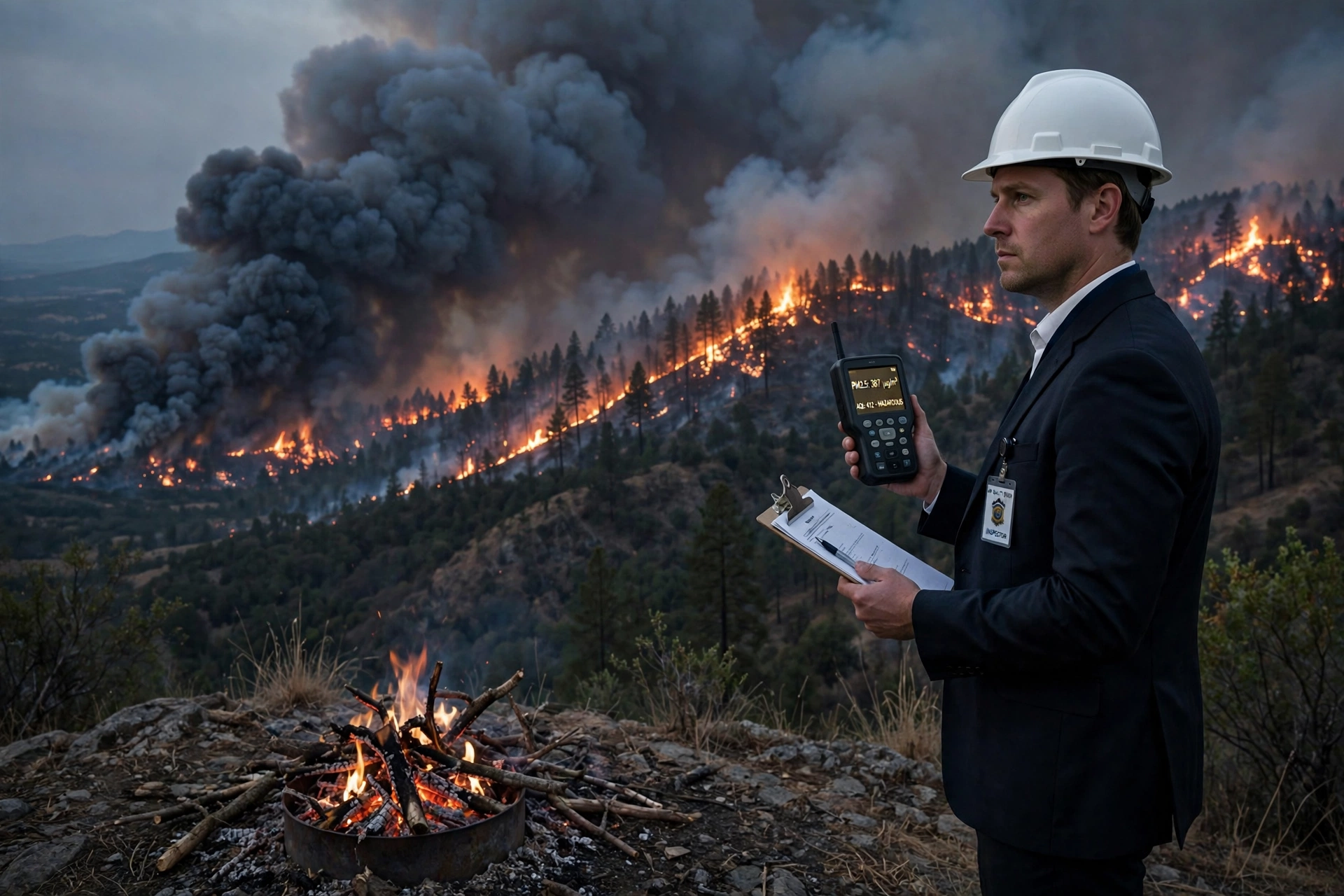
Open burning is the burning of vegetation outdoors, and in California it is regulated the way any industrial activity is regulated. Open burn permits are required by state law, issued by the local air district, and the state has thirty-five air districts to issue them.1 In the State Responsibility Area, the California Department of Forestry and Fire Protection, known as CAL FIRE, may require a separate permit after May 1, available online at no cost. In a Local Responsibility Area, the local fire department may require one as well. It is strictly prohibited to burn without a valid permit, to burn on a no-burn day, or to burn in a manner that creates excessive smoke.2 Burning without the required permit is illegal, and the air district may take enforcement action, which can include monetary penalties.3
The conditions attached to the permit are exact. A residential burn permit covers dry, natural vegetation from yard maintenance, in a pile no larger than four feet in diameter and four feet high. Before igniting the pile, the burner must clear all flammable material and vegetation within ten feet of the pile's outer edge, all the way down to bare earth. Burning is allowed only on permissive burn days, set by the air district on the basis of weather conditions that allow the smoke to rise out of the breathing zone. Large burns require a smoke management plan. Some applicants must also develop a burn plan outlining ignition procedures, fire control measures, and emergency response strategies, and CAL FIRE may require a site inspection before approval.4 California law goes further: the Health and Safety Code prohibits open burning that contributes to air pollution unless expressly permitted, and the Public Resources Code requires a burn permit from CAL FIRE during designated fire seasons and prohibits setting fires on land not owned or controlled by the burner without explicit authorization.5
Consider what a wildfire is, in regulatory terms. It is the burning of vegetation outdoors, on land the burner does not own, without a permit, without a burn plan, without a smoke management plan, and without waiting for a permissive burn day. The permitted system burns a four-foot pile on a permissive burn day. The unpermitted system burns a county on a red flag day. The difference between the two operations is not the fire. It is the paperwork.
II. The Scale of Production
The throughput of the unpermitted fleet is established by the federal government itself. Nationally, there were 64,897 wildfires reported in 2024, compared to 56,580 in 2023. Reported wildfires consumed 8,924,884 acres in 2024, compared to 2,693,910 acres in 2023, noticeably higher than the five-year and ten-year averages. The ten-year average stands at 59,513 fires and 6,950,386 acres burned. Thirteen wildfires in 2024 exceeded 40,000 acres each.6 The 2024 acreage is about 13,945 square miles, an area larger than the state of Maryland.7
The largest single unit of the year was the Smokehouse Creek Fire, which began on February 26, 2024, in the Texas Panhandle and burned approximately 1,058,482 acres before it was contained on March 16, making it the largest wildfire on record in Texas history and the largest wildfire in the United States during 2024. It killed two people, killed about 15,000 cattle, destroyed more than 500 homes and other buildings, and caused about 123 million dollars in agricultural losses. The Texas attorney general, suing the electric company in December 2025, put the total economic loss at more than one billion dollars and described the fire as entirely preventable. It was caused by downed power lines.8 In California, the Park Fire burned 429,603 acres, one of the largest fires in the state's history.9
The fleet's urban work began the following January. On January 7, 2025, the Palisades Fire erupted in the Santa Monica Mountains above Pacific Palisades at approximately 10:30 in the morning, and the Eaton Fire began that evening in Eaton Canyon near Altadena. By full containment on January 31, the two fires had burned 37,469 acres, destroyed 16,251 structures, damaged about 2,000 more, and claimed 31 lives. The Palisades Fire burned 23,448 acres, destroyed 6,837 structures, and killed 12 people. The Eaton Fire burned 14,021 acres, destroyed 9,414 structures, and killed 19 people. Early estimates from the catastrophe modeler Verisk put insured losses at 28 billion to 35 billion dollars.10
The permitted system, for comparison, burns a pile four feet across. The unpermitted system burned, in one fire, an area of 1,654 square miles, larger than the state of Rhode Island. The permitted burn requires the ground cleared to bare earth within ten feet. The Smokehouse Creek Fire cleared 1,058,482 acres to bare earth and filed nothing.
III. The Process
The fuel the unpermitted fleet burns is not the fuel the permit allows. A residential burn permit covers dry, natural vegetation from yard maintenance that is reasonably free of dirt, soil, and surface moisture. Everything else is off limits, and the state maintains a detailed list of disallowed combustibles that cannot be burned in a residential setting regardless of whether the burner holds a permit. Non-vegetative material may never be burned, and barrel burning is prohibited by law. Burn barrels were banned in California in 2002, and all residential waste burning was banned for the entire state in 2004.11
The wildfire burns all of it at once, unsorted. It burns the vegetation, and then it burns the structures standing in the vegetation, and then it burns the contents of the structures: the plastics, the paint, the solvents, the pesticides, the vehicles, the batteries, the household chemicals, and the treated lumber. The permitted burn is a pile of dry yard waste, four feet across, on a permissive burn day. The unpermitted burn in Los Angeles consumed 16,251 structures and everything inside them, on a day when the Santa Ana winds were blowing at hurricane force, and the smoke it produced was not the smoke of burning brush. It was the smoke of a city, burned outdoors, without a permit.
The ignition is not an accident of nature in the ordinary sense. Researchers have found that 84 percent of wildfires in the United States are ignited by people, through accident, negligence, or intentional act, and the share has increased steadily over the last three decades. The National Interagency Fire Center states the same finding more plainly: nearly nine out of ten wildfires are caused by people and can be prevented.12 The Smokehouse Creek Fire was ignited by a downed power line. The Palisades and Eaton fires may have been ignited by sparks from downed or idle power lines or other improperly maintained electrical utility equipment. The fleet is not struck by lightning and left to burn. It is lit, overwhelmingly, by the same civilization that wrote the permit system, and then it burns without one.
IV. The Discharge
The discharge is documented in the air quality records of cities the fire never touched. In 2023, Canada suffered the worst wildfire season in its recorded history: 6,551 fires burned 18.5 million hectares, or about 45.7 million acres, an area larger than Florida and about 5 percent of the entire forest area of Canada, more than six times the long-term average and more than twice the previous record of 7.6 million hectares set in 1989. Eight firefighters were killed, and between 185,000 and 232,000 people were displaced.13 The European Union's Copernicus program calculated that the fires emitted at least 410 million tons of carbon dioxide.14
The smoke crossed an ocean. On June 7, 2023, the smoke from the fires in Quebec reached New York City, and at 5 p.m. the air quality index hit 484, the highest level since the 1960s, in a city where anything above 300 is considered hazardous and the index tops out at 500. New York had the worst air quality of any major city on the planet that day. The smoke continued across the Atlantic and reached the European coast in the second week of June, and air quality across the Northern Hemisphere declined.15
The standard the discharge exceeds is not obscure. The Clean Air Act requires the Environmental Protection Agency to set National Ambient Air Quality Standards for six criteria pollutants, including fine particulate matter, known as PM2.5. In February 2024, the agency revised the primary annual PM2.5 standard from 12.0 micrograms per cubic meter of air to 9.0. The primary 24-hour standard remains 35 micrograms per cubic meter.16 An air quality index of 484 corresponds to 24-hour fine particulate concentrations many times that limit. The smoke from a fire in Quebec closed the schools in New York, and no state has ever issued a permit for smoke to enter it.
The discharge is also classified. Wildfire smoke is the leading reason states ask the federal government to disregard their own air quality data, under a rule discussed in Section VI. The leading cause of the nation's air quality exceedances is, by the government's own classification, the smoke of the unpermitted fleet.
V. The Standard
The standard the fleet evades is written down, and the lawful version of the same fire operates under it every year. The lawful version is the prescribed burn. It operates under a written burn plan outlining ignition procedures, fire control measures, and emergency response strategies, and for large burns it operates under a smoke management plan administered by the California Air Resources Board and the local air districts. It burns only on a permissive burn day, when the weather allows the smoke to rise out of the breathing zone, and it burns only the vegetation the permit names. The prescribed burn is the fire with a filer. The wildfire is the fire without one.4
The cost of suppressing the unpermitted fleet is also written down. In fiscal year 2024, the Forest Service's suppression costs were approximately 3.652 billion dollars, funded from 1.011 billion dollars in annual suppression appropriations and 2.63 billion dollars in transfers from the Wildfire Suppression Operations Reserve Fund. The Forest Service and the Department of the Interior combined spent more than 4 billion dollars on wildfire suppression in 2024. Over the last decade, suppression has cost the two agencies an average of 2.9 billion dollars per year.17 The public pays to fight the unpermitted burn, and it pays again to breathe the smoke, and it has never billed the operator, because the operator has never filed a form on which a bill could be addressed.
Apply the definition to the unit. Open burning is the burning of vegetation outdoors. A wildfire is vegetation burning outdoors. It burns on land the burner does not own, without explicit authorization, in a pile larger than four feet in diameter, on a day that is not a permissive burn day, without a smoke management plan, and it burns non-vegetative material that may never be burned. The definition fits the way a glove fits a hand, provided the hand is on fire.
VI. The Defense
The defense is noted. It concedes every number in this investigation and disputes only the prescription.
Its first exhibit is the weather. A wildfire is a natural event, and the law knows it. The Exceptional Events Rule, promulgated by the Environmental Protection Agency in 2007 and codified at Title 40 of the Code of Federal Regulations, Parts 50.1, 50.14, and 51.930, allows states to ask that air quality data affected by an exceptional event be excluded from attainment determinations. The Clean Air Act defines an exceptional event as one that affects air quality, is not reasonably controllable or preventable, and is a natural event or human activity unlikely to recur at a particular location. Wildfire is the paradigmatic example. The data is not removed from the record. It is removed from the determination.18
Its second is the permitted version. The system already distinguishes lawful fire from unlawful fire, and it already runs the lawful kind: the prescribed burn, under a burn plan and a smoke management plan, on a permissive burn day. The wildfire is neither lawful nor unlawful. It is fire without a filer, and the permit system was built for filers.
Its third is the statistic in Section III, which the defense notes and moves past quickly. If 84 percent of wildfires are ignited by people, the claim that the fleet is a natural event grows thin, and the claim that it is not reasonably preventable grows thinner. The defense does not answer this. It changes the subject to the form.
Its fourth is the form. No burn permit application in the history of the program has had a line for acreage in the millions, no air district issues permits for a fire that starts itself, and no smoke management plan covers smoke in two countries and an ocean. Its fifth is the operator. The largest fires in the country are fought by the government itself, through the Forest Service and the state fire agencies, which makes the state the suppressor of record for the largest unpermitted fleet in the nation, and the state does not permit itself.
The defense rests. It is overruled.
VII. The Prescription
The ledger is now complete, and it admits of only one reading.
Every wildfire in the United States should hold an open burning permit, issued to the fire as operator and the burn area as the facility, with a written burn plan, a smoke management plan, and burning confined to permissive burn days, in a pile no larger than four feet in diameter and four feet high, with all flammable material cleared to bare earth within ten feet of the pile's outer edge. The thirty-five air districts of California should be understood for what they are: the permitting authorities, already staffed, already funded, already issuing 3,000 open burn permits a year in a single district, waiting for the largest applicant in the history of the program to walk in the door.2
The Smokehouse Creek Fire is the test case. One million fifty-eight thousand four hundred eighty-two acres, zero permits, two people dead, 15,000 cattle dead, more than 500 homes destroyed, more than one billion dollars in economic loss, ignited by a downed power line belonging to a permitted electric utility, which then operated the largest unpermitted open burn in the history of Texas, in plain sight, under a name that sounds like a creek. Until compliance is achieved, the fleet will continue to operate every fire season, unpermitted, as it has since the first spark, burning the vegetation and the structures and everything inside them, filling the air of cities it never touched, and waiting for a form that does not exist.
Ergo.
Sources
- Open burn permits are required by state law in California, from the local air district, to dispose of vegetative material outdoors by open burning; California has 35 air districts. North Coast Unified Air Quality Management District, FAQs. nosocoair.ca.gov ncuaqmd.specialdistrict.org ↑
- Open burn permits are required by state law in California; after May 1, CAL FIRE may require a permit in the State Responsibility Area; it is strictly prohibited to burn without a valid permit, to burn on a no-burn day, or to burn in a manner that creates excessive smoke; the district processes over 3,000 open burn permits each year. North Sonoma County Air Pollution Control District, Open Burning. nosocoair.ca.gov ↑↑
- Except for residential pile burning at a single- or two-family residence, an air district burn permit is required; burning without the required burn permit is illegal, and the air district may take enforcement action, which can include monetary penalties. Placer County Air Pollution Control District, Burn Permit Information. placer.ca.gov ↑
- The residential burn permit covers dry, natural vegetation in piles no larger than four feet in diameter and four feet high; the burner must clear flammable material within ten feet of the pile to bare earth; large burns require a smoke management plan; some applicants must develop a burn plan outlining ignition procedures, fire control measures, and emergency response strategies, and CAL FIRE may require a site inspection. California Fire Permit guide; Mendocino County Air Quality Management District, Burn Information. legalclarity.org co.mendocino.ca.us ↑↑
- Under California Public Resources Code 4423, individuals must secure a burn permit from CAL FIRE during designated fire seasons; Public Resources Code 4421 prohibits setting fires on land not owned or controlled by the burner without explicit authorization; California Health and Safety Code 41850 prohibits open burning that contributes to air pollution unless expressly permitted; the Smoke Management Program requires burn operators to submit a smoke management plan for large-scale burns. legalclarity.org ↑
- Nationally, there were 64,897 wildfires reported in 2024, compared to 56,580 in 2023; reported wildfires consumed 8,924,884 acres, compared to 2,693,910 acres in 2023; the number of wildfires and acres burned was noticeably higher than the five- and ten-year averages; thirteen wildfires exceeded 40,000 acres. National Interagency Coordination Center, Wildland Fire Summary and Statistics Annual Report 2024. nifc.gov ↑
- Calculation: 8,924,884 acres divided by 640 acres per square mile is about 13,945 square miles; Maryland covers 12,406 square miles. This is arithmetic from the published acreage, not a separately measured area. ↑
- The Smokehouse Creek Fire burned approximately 1,058,482 acres, the largest wildfire on record in Texas history and the largest wildfire in the United States during 2024; two fatalities and about 15,000 cattle killed; over 500 residential buildings and businesses destroyed; about 123 million dollars in agricultural losses; the Texas attorney general's December 2025 suit put total economic loss at more than one billion dollars and described the fire as entirely preventable; the fire was caused by downed power lines. en.wikipedia.org environmentamerica.org texasattorneygeneral.gov ↑
- The Park Fire burned 429,603 acres in California in 2024, among the largest fires in the state's history. climatecrisis247.com ↑
- The Palisades Fire erupted on January 7, 2025, and burned 23,448 acres, destroyed 6,837 structures, and claimed 12 lives; the Eaton Fire burned 14,021 acres, destroyed 9,414 structures, and caused 19 deaths; collectively the fires burned 37,469 acres, destroyed more than 16,000 structures, and claimed 31 lives; early estimates from Verisk put insured losses at 28 billion to 35 billion dollars. britannica.com ccoa.ca.gov liveinthefuture.org ↑
- Non-vegetative material may never be burned and barrel burning is prohibited by law; burn barrels were banned in California in 2002 and all residential waste burning was banned for the entire state in 2004; the residential burn permit covers only dry, natural vegetation reasonably free of dirt, soil, and surface moisture. nosocoair.ca.gov ncuaqmd.specialdistrict.org legalclarity.org ↑
- Through accident, negligence, or intentional act, 84 percent of all wildfires are started by people, according to research, and the percentage has increased steadily over the last three decades; nearly nine out of ten wildfires are caused by people and can be prevented. Utah State University; National Interagency Fire Center. dailydispatch.com primarynewssource.org ↑
- In 2023, 6,551 fires burned 18.496 million hectares (45.70 million acres) in Canada, the most area burned in the country's recorded history, surpassing the 1989 record of 7.6 million hectares; about 5 percent of the entire forest area of Canada burned, more than six times the long-term average; eight firefighters were killed and 185,000 to 232,000 people were displaced. en.wikipedia.org science.nasa.gov ↑
- The European Union's Copernicus program calculated that the 2023 Canadian fires emitted at least 410 million tons of carbon dioxide. gfmc.online ↑
- At 5 p.m. on June 7, 2023, the air quality index in New York City hit 484, the highest level since the 1960s; anything above 300 is considered hazardous and the index tops out at 500; smoke from the Canadian fires crossed the Atlantic and reached the European coast in the second week of June. New York City Mayor's Office; Copernicus via WDNY Radio. nyc.gov wdnyradio.com ↑
- In February 2024, the Environmental Protection Agency revised the primary annual PM2.5 standard from 12.0 to 9.0 micrograms per cubic meter; the primary 24-hour PM2.5 standard remains 35 micrograms per cubic meter. sites.cnr.ncsu.edu ↑
- Fiscal year 2024 Forest Service suppression costs were approximately 3.652 billion dollars, funded from 1.011 billion dollars in annual suppression appropriations and 2.63 billion dollars in transfers from the Wildfire Suppression Operations Reserve Fund; the Forest Service and the Department of the Interior combined spent more than 4 billion dollars on wildfire suppression in 2024; over the last decade suppression has cost the two agencies an average of 2.9 billion dollars per year. U.S. Forest Service, FY 2024 Large Fire Review; Forest Service Research and Development. hsdl.org research.fs.usda.gov ↑
- The Exceptional Events Rule was promulgated in 2007 by the U.S. Environmental Protection Agency and codified at 40 CFR Parts 50.1, 50.14, and 51.930; it provides a way for states to flag pollutant exceedances that could be omitted from National Ambient Air Quality Standards attainment determinations; an exceptional event is one that affects air quality, is not reasonably controllable or preventable, and is a natural event or human activity unlikely to recur at a particular location; wildland fire is the paradigmatic example. Environmental Research Letters 16 (2021) 034029. researchgate.net ↑