I. The Source
Snoring has a mechanism, and the mechanism is not mysterious. As a person falls asleep, the tissues in the roof of the mouth, the tongue, and the throat relax. Air flowing past these relaxed tissues makes them vibrate. That vibration is the sound. The narrower the airway, the more forcefully the air must pass, and the more vigorously the tissues vibrate.1 Snoring is therefore not an accident of the night. It is the audible product of a partially obstructed airway operating under load, for hours, in the room where another person is trying to sleep.
Consider what the source is, in regulatory terms. It is a sound emitter located inside a dwelling, operating during the hours the law treats as quiet, producing a measured output in decibels, at a distance measured in centimeters from the nearest receiving person. It has no muffler. It has no enclosure. It has no off switch that the operator can reach, because the operator is asleep. It runs until morning, pauses only when the airway closes entirely or the sleeper changes position, and resumes without any action by anyone. No other residential noise source operates this way: the television can be turned down, the dog can be brought inside, the party can be told to end. The snorer cannot be told anything, because the snorer is unconscious, and the sound continues for precisely as long as the unconsciousness does.
The source is also, by the numbers in Section II, not rare. It is the normal condition of a large fraction of the adult population. A noise regime that cannot account for its most common nighttime emitter has not regulated nighttime noise. It has regulated everything except nighttime noise.
II. The Scale of Production
Population surveys summarized by Johns Hopkins Medicine put occasional snoring near 45 percent of adults and habitual snoring near 25 percent, with men snoring about twice as often as premenopausal women.2 National Sleep Foundation surveys put the American figures at 90 million adults who snore occasionally and 37 million who snore habitually.3 The federal government's own survey data point in the same direction: in the National Health and Nutrition Examination Survey for 2017 to March 2020, 28.0 percent of adults said they snored frequently, meaning five or more nights a week, and 30.2 percent of men and 21.9 percent of women said so.4
Put the threshold next to the tonnage, or in this case next to the headcount. Thirty-seven million habitual snorers in one country, operating nightly, is a larger emitter fleet than any regulated category of residential equipment. Air conditioners are permitted by code, inspected on installation, and capped by ordinance. Furnaces are permitted, vented, and inspected. The snorer is none of these things, and there are tens of millions of them. If each habitual snorer operated only on weeknights, the fleet would still produce more than 180 million emitter-nights per year in the United States alone. It operates on weekends too.
The scale extends beyond snoring itself. Snoring is the most common symptom of obstructive sleep apnea, occurring in 70 percent to 95 percent of patients with the disorder.5 Benjafield and colleagues, in a literature-based analysis published in The Lancet Respiratory Medicine in 2019, estimated that approximately 936 million adults aged 30 to 69 worldwide have mild to severe obstructive sleep apnea, including 425 million with moderate to severe disease.6 The emitter fleet is therefore not only large. Its loudest members are, in large numbers, the same people whose airways are obstructing repeatedly through the night. The noise is not only a nuisance output. It is, for a substantial share of the fleet, the audible signature of a breathing disorder.
III. The Measurement
Snoring has been metered, carefully, in sleep laboratories, and the readings leave no room for the argument that the sound is trivial. Maimon and Hanly studied 1,643 habitual snorers referred for evaluation of sleep apnea, measuring snoring intensity during overnight polysomnography. Snoring intensity increased progressively with the severity of sleep apnea, from a mean of 46.3 decibels in patients with no sleep apnea to 60.5 decibels in patients with very severe sleep apnea, with a correlation of 0.66 between intensity and the apnea-hypopnea index.5 The average across the whole cohort, for total sleep time, was 52.0 decibels. Even the quietest group in the study, people without sleep apnea at all, averaged 46.3 decibels. That figure already exceeds the nighttime limits set out in Section IV.
A second study measured the problem where it is actually received: at the bedside. Sowho and colleagues recorded 162 self-reported habitual snorers for a single night, with a sound monitor mounted 65 centimeters over the head of the bed, defining snoring as sound at or above 40 dB(A) during flow-limited inspirations. Snoring intensity exceeded 45 dB(A) in 66 percent of the participants, and 14 percent surpassed 53 dB(A). The authors chose those thresholds deliberately: 45 dB(A) is a traffic noise level associated with sleep disruption, and 53 dB(A) is a level associated with adverse cardiovascular events in exposed populations.7 Their conclusion, in their own words, was that snoring represents a source of noise pollution in the bedroom and constitutes an important target for mitigating sound and its adverse effects on bed partners.7
Reference material from the American Academy of Sleep Medicine classifies snoring intensity on a four-step scale: mild at 40 to 45 decibels, moderate at 45 to 55 decibels, severe at 55 to 60 decibels, and very heavy at 60 decibels and above.8 On that scale, the average habitual snorer in the Maimon and Hanly cohort sits in the moderate band, the severe sleep apnea patient sits at the top of the severe band, and the very severe patient sits in the very heavy band. There is no band on the scale for compliant. The scale does not go low enough for compliance, because compliance would require a bedroom reading below 30 decibels, and the quietest group measured averaged 46.3.
Decibels are logarithmic, which matters for what these numbers mean. Every increase of 10 decibels is roughly a doubling of perceived loudness. A 60 decibel snore sounds about twice as loud as a 50 decibel snore, and roughly eight times as loud as the 30 decibel bedroom level the World Health Organization recommends.9 The difference between the snorer and the standard is not a rounding error. It is, in perceived terms, most of an order of magnitude.
IV. The Standard
The standard against which the meter readings must be judged is not obscure. The World Health Organization guidelines for community noise recommend less than 30 A-weighted decibels in bedrooms during the night for sleep of good quality, and the night noise guidelines recommend less than 40 dB(A) of annual average night noise outside bedrooms to prevent adverse health effects from night noise.10 The snorer exceeds the indoor bedroom recommendation by 16 decibels at the quiet end of the measured range and by 30 decibels at the loud end. The snorer exceeds the outdoor annual average recommendation at the bedside in two-thirds of cases measured.
The federal government has endorsed numbers in the same range. The Environmental Protection Agency identified 55 dBA outdoors and 45 dBA indoors as the levels requisite to protect public health and welfare in residential areas, accounting for speech interference, sleep disruption, and general annoyance.11 Congress, in the Noise Control Act of 1972, declared that inadequately controlled noise presents a growing danger to the health and welfare of the population of the nation.12 The federal framework then left the actual limits to state and local governments, which is where the snorer's real exposure begins, because local governments wrote numbers, and the numbers are low at night.
Most residential noise ordinances set quiet hours from roughly 10:00 p.m. to 7:00 a.m. on weekdays, with slightly later windows on weekends, and set a nighttime residential cap between 45 and 50 dBA.11 Los Angeles County holds residential zones to a baseline of 45 dBA at night, from 10 p.m. to 7 a.m., and 50 dBA during the day.13 Connecticut's statewide noise regulations set the limit for a residential emitter received in a residential zone at 55 dBA by day and 45 dBA at night.14 Two jurisdictions, on opposite coasts, under different statutes, arrived at the same nighttime number: 45. The average habitual snorer, measured at the bedside, produces 52. The very severe sleep apnea patient produces 60.5. The gap between the law and the bedroom is 7 decibels for the average case and more than 15 decibels for the severe case, every night, for as long as the snorer sleeps.
V. The Receiving Property
Every noise regime has a receiving property, and this one has the most intimate receiving property in the law: the other side of the bed. The Sowho study was designed, in part, to measure sound levels produced by habitual snorers precisely because snoring is associated with sleep disturbance in bed partners, and its authors concluded that the sound degrades the quality of sleep in bed partners and may also indicate sleep apnea in the snorer.7 The receiving person does not live next door. The receiving person shares the pillow, the blanket, and the room, at a distance of 65 centimeters from the monitor that recorded the exceedance, and considerably less from the source itself.
Apply the cohort proportion to the national headcount, and the size of the receiving population becomes clear. If 66 percent of habitual snorers exceed 45 dB(A), and habitual snorers number 37 million Americans, then roughly 24 million Americans are emitting above 45 dB(A) on a habitual basis, each with a receiving person in the same bed or the same room.15 That is a conservative statement of the arithmetic, because it counts only habitual snorers and only the 45 decibel threshold, not the occasional snorers, not the 30 decibel bedroom recommendation, and not the neighbors in the next room or the next apartment, through whose walls the low-frequency component of the sound passes. The receiving population is, at minimum, in the tens of millions, and it is awake.
No other regulated noise source has a receiving person this close, this consistently, with this little recourse. The neighbor disturbed by a party can call the police. The tenant disturbed by a hallway television can complain to the landlord. The bed partner disturbed by snoring can elbow the snorer, which stops the sound until the snorer falls asleep again, or can move to another room, which is to say can vacate the receiving property. The law offers the receiving person no meter, no complaint form, and no abatement order. It offers earplugs, which the Sowho authors' own coverage noted as the practical advice, and which are, as a regulatory matter, the receiving person paying to mitigate a source the source's operator never permitted.
VI. The Defense
The defense is noted. It concedes every number in this investigation and disputes only the prescription.
Its first exhibit is the measurement point. Noise ordinances measure sound at the property line of the receiving property, or inside a neighboring dwelling unit, not at 65 centimeters over the head of the bed. Sound attenuates with distance and through walls, and a 52 decibel reading at the bedside is not a 52 decibel reading at the neighbor's fence. Its second is the source definition. Ordinances regulate devices, equipment, commercial establishments, and stationary sources, and a sleeping person is none of those things in any ordinance's definitional section. Its third is the guideline. The World Health Organization's 30 decibel bedroom recommendation is a guideline for environmental noise, not a permit limit for a person, and guidelines do not create violations.
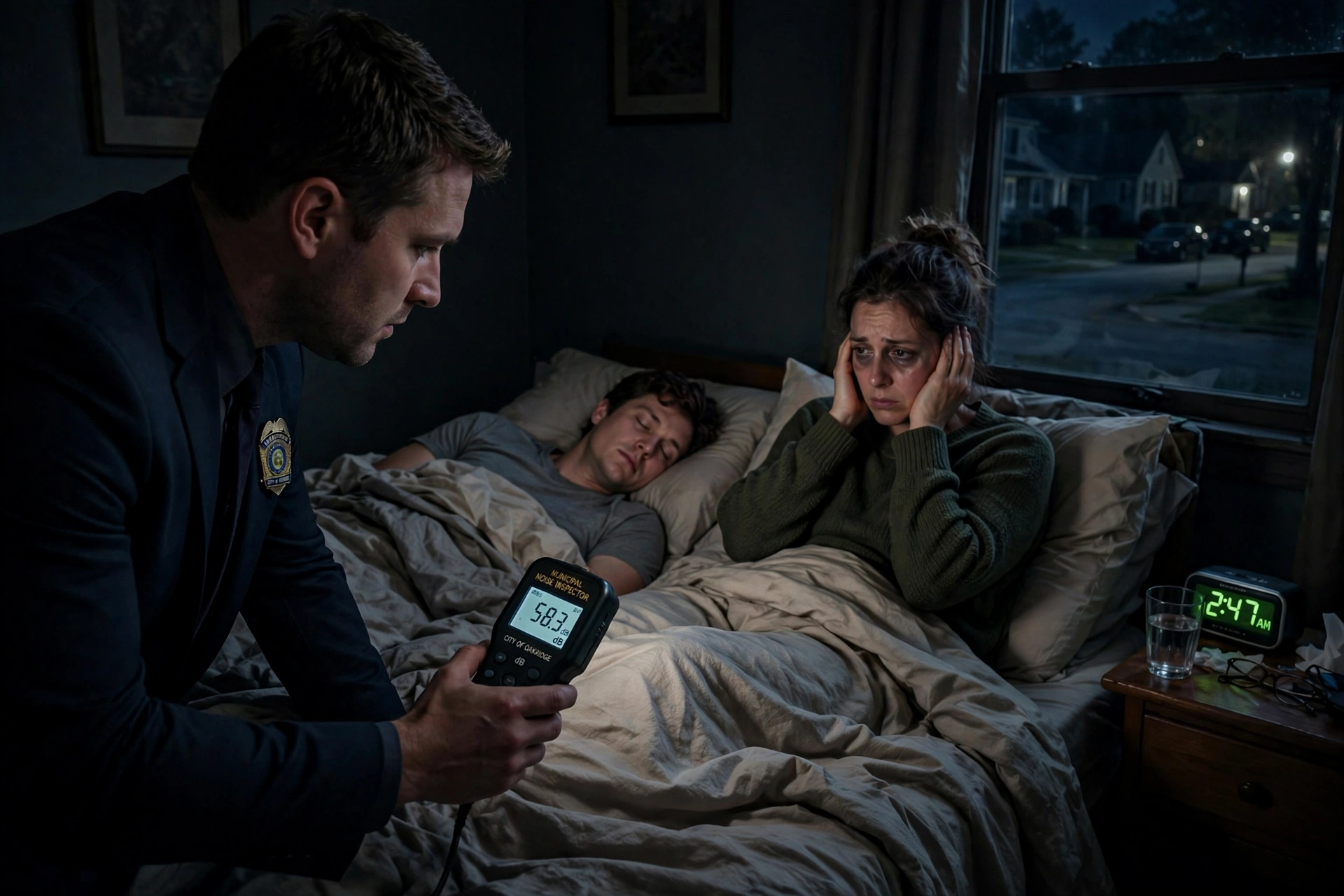
Its fourth is voluntariness. The snorer does not choose to snore, cannot stop snoring by an act of will while asleep, and in many cases does not know the snoring is happening. A regime that fines involuntary conduct during unconsciousness punishes a person for a bodily function. Its fifth is the oldest defense in the book: nobody told us. No city has ever published a snoring permit application, never held a hearing on a bedroom variance, and never sent an inspector to a bedside with a meter, except in the photograph at the top of this article.
The defense rests. It is overruled.
VII. The Prescription
The ledger is now complete, and it admits of only one reading.
Every habitual snorer in the United States should hold a nightly noise permit, issued by the municipality, naming the snorer as operator and the bedroom as the emission unit, with the bed partner named as the receiving property. Each permit should carry a measured baseline from an overnight sound study, a nighttime limit of 45 dB(A) at the bedside, and a condition that any night exceeding the limit triggers a mandatory mitigation measure: positional therapy, a mandibular device, or continuous positive airway pressure, at the operator's expense. Stack testing, in this regime, is conducted at the pillow, by the same inspectors who already enforce the ordinance everywhere except where the sound is actually produced.
Until compliance is achieved, the fleet will continue to operate all night, unpermitted, as it has since the first bedroom, emitting 46 to 60 decibels through sources that the guidelines measure, the ordinances cap, the studies document, and the permit program has never seen. The receiving population will continue to lie awake beside it, at 65 centimeters, listening to the largest unpermitted noise source in the country, waiting for a form that does not exist.
Ergo.
Sources
- As a person falls asleep, the tissues in the roof of the mouth, tongue, and throat relax; snoring happens when air flows past these relaxed tissues and the tissues vibrate when breathing. Mayo Clinic patient education, Snoring and Sleep Apnea. mcforms.mayo.edu ↑
- Population surveys summarized by Johns Hopkins Medicine put occasional snoring near 45 percent of adults and habitual snoring near 25 percent, with men snoring about twice as often as premenopausal women. sleepbrandwell.com ↑
- National Sleep Foundation surveys: snoring affects 90 million American adults occasionally and 37 million habitually. gitnux.org ↑
- National Health and Nutrition Examination Survey, 2017 to March 2020: 28.0 percent of adults snored frequently (five or more nights a week); 30.2 percent of men and 21.9 percent of women snored frequently. textapp.co ↑
- Maimon N. and Hanly P.J., Does Snoring Intensity Correlate with the Severity of Obstructive Sleep Apnea? Journal of Clinical Sleep Medicine 2010; 1,643 habitual snorers studied by overnight polysomnography; snoring intensity from 46.3 decibels with no sleep apnea to 60.5 decibels with very severe sleep apnea; correlation 0.66; mean total sleep time intensity 52.0 decibels; snoring is the most common symptom of obstructive sleep apnea, occurring in 70 percent to 95 percent of patients. pmc.ncbi.nlm.nih.gov ↑↑
- Benjafield A.V. et al., Estimation of the global prevalence and burden of obstructive sleep apnoea: a literature-based analysis, The Lancet Respiratory Medicine 2019; approximately 936 million adults aged 30 to 69 worldwide with mild to severe disease, including 425 million with moderate to severe disease, as summarized in the 2025 global burden review. mdpi.com ↑
- Sowho M. et al., Snoring: a source of noise pollution and sleep apnea predictor, Sleep 2020; 162 self-reported habitual snorers, monitor mounted 65 centimeters over the head of the bed, snoring defined as sound at or above 40 dB(A) during flow-limited inspirations; intensity exceeded 45 dB(A) in 66 percent and surpassed 53 dB(A) in 14 percent; thresholds chosen as traffic noise levels associated with sleep disruption (45) and adverse cardiovascular events (53); authors conclude snoring represents a source of noise pollution in the bedroom. pmc.ncbi.nlm.nih.gov ↑↑↑
- Reference material from the American Academy of Sleep Medicine classifies snoring intensity as mild (40 to 45 decibels), moderate (45 to 55 decibels), severe (55 to 60 decibels), and very heavy (60 decibels and above). mdf.or.jp ↑
- Decibels are logarithmic: every 10 decibel increase is roughly a doubling of perceived loudness, so a 60 decibel snore sounds about twice as loud as a 50 decibel snore and around eight times louder than the 30 decibel bedroom level the WHO recommends. snoringhub.com ↑
- WHO guidelines for community noise recommend less than 30 dB(A) in bedrooms during the night for sleep of good quality, and WHO night noise guidelines recommend less than 40 dB(A) of annual average night noise outside bedrooms to prevent adverse health effects. who.int ↑
- The EPA identified 55 dBA outdoors and 45 dBA indoors as the levels requisite to protect public health and welfare in residential areas; most residential ordinances set quiet hours from roughly 10:00 p.m. to 7:00 a.m. weekdays and a nighttime residential cap between 45 and 50 dBA. legalclarity.org ↑↑
- Noise Control Act of 1972, 42 U.S.C. 4901: inadequately controlled noise presents a growing danger to the health and welfare of the population of the nation; federal law leaves noise control to state and local governments. legalclarity.org ↑
- Los Angeles County residential zones: baseline of 45 dBA at night (10 p.m. to 7 a.m.) and 50 dBA during the day. legalclarity.org ↑
- Connecticut statewide noise regulations, Section 22a-69-3.5: residential emitter received in a residential zone limited to 55 dBA by day and 45 dBA at night. legalclarity.org ↑
- Calculation: 37,000,000 habitual snorers multiplied by 66 percent exceeding 45 dB(A) equals approximately 24,400,000 habitual emitters above that threshold; this applies the Sowho cohort proportion to the National Sleep Foundation headcount and is arithmetic, not a separately measured national count. ↑