I. The Factory
The manufacturing process begins at the flower. A forager bee extends her proboscis, draws nectar up, and stores it in her crop, an organ also called the honey stomach, which is used solely for storage: the bee does not digest the nectar at all. A stomach holds about 70 milligrams of nectar, and filling it requires visiting up to 1,500 flowers.12
The forager returns to the hive and regurgitates the nectar directly into the crop of a processor bee at the entrance. The processor bee carries it to the honeycomb, regurgitates it into a hexagonal wax cell, and the ripening begins. With every regurgitation, the bees add invertase, an enzyme secreted from glands in the worker's head. Invertase breaks the nectar's sucrose down into glucose and fructose, the two simple sugars that give finished honey its sweetness, its resistance to fermentation, and its tendency to crystallize. The enzymatic step takes about 30 minutes and continues at a measurable rate for as long as the nectar sits uncapped.12
Then comes the drying. Fresh nectar is about 70 percent water; by definition, finished honey contains less than 18.6 percent. The processor bees deposit the treated nectar into cells at roughly 20 percent moisture, then fan their wings at about 11,000 beats per minute above the open cells, generating airflow across the comb that evaporates the water out over one to three days. When the moisture drops to roughly 18 percent, the bees seal the cell with an airtight wax cap, secreted from glands on the worker's abdomen. If the cap is not airtight, the honey absorbs moisture from the air and becomes susceptible to bacterial or fungal growth.12
Consider what has occurred. A raw agricultural commodity has been extracted, enzymatically treated, evaporatively dehydrated, and wax-packaged into a distinct finished product with a shelf life measured in millennia. In the Code of Federal Regulations, the Food and Drug Administration defines manufacturing and processing as making food from one or more ingredients, or synthesizing, preparing, treating, modifying, or manipulating food, including food crops or ingredients. Its list of examples includes evaporating, extracting juice, treating to manipulate ripening, waxing, and packaging.3 The regulation reads like a description of the hive.
II. The Scale of Production
In 2024, United States honey production totaled 134 million pounds, produced by 2.60 million colonies at an average yield of 51.7 pounds per colony. The average price was $2.69 per pound, which puts the value of the crop at about $360 million: 134 million pounds multiplied by $2.69. Producer stocks stood at 43.4 million pounds on December 15, 2024.4
The labor behind the tonnage is staggering. A bee visits 50 to 100 flowers during a single collection trip. To make one pound of honey, the workers of a hive collectively visit about two million flowers and fly about 55,000 miles, more than twice around the Earth. It takes about 556 worker bees to gather a pound. The average worker, laboring five or six weeks in the active season, produces about one-twelfth of a teaspoon of honey in her entire lifetime. A colony numbers 30,000 to 60,000 bees in season, and a strong hive can put up 60 to 100 pounds of surplus honey a year above the roughly 300 pounds the colony needs for itself.567
The workforce is replenished by a single executive. Each hive has one queen, the largest bee in the colony, whose sole function is reproduction: she lays up to 2,000 eggs per day, more than her own body weight, around the clock through the laying season. The workers feed her, house her, and, if her performance disappoints, build an elongated cell and raise her replacement.8
By every operational definition, the colony is a food manufacturing facility. It has a raw material intake system, a multi-stage chemical process, a drying operation, a packaging line, a managed workforce in the tens of thousands, and an executive suite of one. It lacks only the paperwork.
III. The Registration Record
Section 415 of the Federal Food, Drug, and Cosmetic Act requires the registration of food facilities. The implementing regulation, 21 CFR 1.225, provides that the owner, operator, or agent in charge of a domestic or foreign facility must register if the facility is engaged in the manufacturing, processing, packing, or holding of food for consumption in the United States, whether or not the food enters interstate commerce. The regulation defines a facility as any establishment, structure, or structures under one ownership at one general physical location that manufactures, processes, packs, or holds food for consumption in the United States.910
The obligations are not nominal. Registrations must be renewed biennially, between October 1 and December 31 of each even-numbered year, and submitted electronically unless the agency has granted a waiver. Failure to register, to renew, or to update is a prohibited act under section 301(dd) of the Act. An expired registration is treated as a failure to register. Updates reflecting a change of operator or agent in charge are due within 60 calendar days. Registration is effected on Form FDA 3537, which must be filled out, signed, and submitted by the owner, operator, or agent in charge, with a certification statement attesting that the information is true and accurate.91112
The 2026 biennial renewal period opened on October 1, 2026, and closes on December 31, 2026. It is open now. The agency reminded the industry of the deadline this quarter.13
Against this record, the colony's compliance file is empty. No hive has ever been registered as a domestic facility. No queen, beekeeper, or worker has ever submitted Form FDA 3537. No biennial renewal has ever been filed, in 2026 or in any even-numbered year since registration began in 2003. The 2.6 million colonies operating in the United States hold zero registrations between them, and the current renewal window, now more than a month old, has produced zero filings from the sector.
The regulation anticipates the objection that no one is in charge. It defines the registrant, for purposes of the subpart, as the owner, operator, or agent in charge of the facility. The beekeeper owns the boxes but does not manufacture the honey; the manufacturing is performed by the bees, under no human direction whatever, by a process no beekeeper controls, adjusts, or even observes at the enzymatic level. The owner of the facility is not its operator. The operator of the facility is a superorganism.10
IV. The Labeling File
The agency's posture toward honey has not been one of benign neglect. It has been one of energetic confusion, directed at everyone in the supply chain except the manufacturer.
In February 2018, the Food and Drug Administration issued draft guidance proposing that jars of pure, single-ingredient honey carry an obelisk symbol, the character †, immediately after the added sugars daily value on the Nutrition Facts label, directing consumers to contextual language explaining that all the sugars are naturally occurring in honey. The agency had classified honey, even when packaged as such and with nothing added, as an added sugar. The docket received more than 3,000 comments, almost universally negative, from producers who pointed out that there are no sugars added to honey because honey is sugar. In September 2018, Commissioner Scott Gottlieb announced a revised approach, conceding that the standard added sugars declaration would mislead consumers into thinking table sugar or corn syrup had been added to a product to which nothing had been added.14
The agency has policed honey imports with considerably more success. In February 2013, the Department of Justice announced charges against the two largest domestic honey processors, Honey Holding and Groeb Farms, following an interagency honey laundering sting: Chinese honey had been transshipped through third countries and misdeclared to evade more than $180 million in antidumping duties, and some shipments were adulterated with chloramphenicol, an antibiotic the FDA does not approve for use in honey. Both companies entered deferred prosecution agreements, paying $1 million and $2 million respectively. The case was the largest food fraud prosecution in American history, breaking the previous $80 million record set by the same enforcement team. The FDA had issued an import alert for honey containing chloramphenicol back in October 2002.1516
The pattern is unmistakable. The agency will litigate the punctuation on a honey jar, prosecute the importer of adulterated honey, and alert the ports against antibiotic-laced shipments. The one party it has never asked to identify itself is the party that made the honey.
V. The Sanitation File
Under 21 USC 342(a)(4), a food is deemed adulterated if it has been prepared, packed, or held under insanitary conditions whereby it may have become contaminated with filth, or whereby it may have been rendered injurious to health. The government need not find contamination in the finished product; the conditions suffice.17
The conditions in the sector are the worst on record. Between April 2024 and April 2025, American beekeepers lost an estimated 55.6 percent of their managed colonies, the highest annual loss since national tracking began in 2010. Winter losses alone reached 40.2 percent. The survey, conducted by Auburn University with the Apiary Inspectors of America and Oregon State University, drew responses from 2,453 beekeepers managing 219,097 colonies, about 8.4 percent of the country's honey-producing colonies. The previous year had set the prior record at 55.1 percent.18
The leading suspect is a parasite. USDA scientists traced the early 2025 collapses to viruses spread by Varroa destructor, a mite that feeds on the bees' fat bodies and vectors deadly pathogens, and found the mites resistant to amitraz, the principal miticide, in nearly every sample tested. A separate survey of commercial operations found 62 percent of hives dead since June 2024, with the economic damage above $600 million. Varroa remains the top reported stressor in every quarter the Department measures.1920
A registered facility that lost 55.6 percent of its workforce in a single year to an uncontrolled parasite infestation would be operating under a consent decree. The unregistered sector has received no inspection, no warning letter, and no Form FDA 483. This is not for lack of things to observe: the colonies maintain their brood nests at 91 to 97 degrees Fahrenheit with a precision no thermostat in a registered plant could match, and they do it with no written sanitation procedures, no pest control records, and no corrective action documentation of any kind.21
VI. The Import Double Standard
The United States is the world's largest honey importer, accounting for about a third of global import volume. In 2024, imports reached 255,000 tons, up 28 percent, drawn principally from India, Argentina, and Vietnam, while domestic production declined. Every foreign facility that manufactured, processed, packed, or held that honey for consumption in the United States was required to register with the FDA and designate a United States agent, a person residing or maintaining a place of business in this country, reachable for routine and emergency communications.2210
The domestic manufacturer faces no such requirement in practice. The foreign hive's honey arrives with a registration number, a United States agent, and a paper trail. The domestic hive's honey arrives with nothing, though the bees that made it flew 55,000 miles per pound and the beekeeper merely lifted the frames. The agency has built a system in which honey manufactured abroad by registered foreign facilities is more completely documented than honey manufactured at home by nobody.
VII. The Defense
The defense is noted. It concedes every number in this investigation and disputes only the prescription.
Its first exhibit is the farm. The regulation defines a farm as an operation under one management in one general physical location devoted to the growing of crops, the harvesting of crops, the raising of animals, including seafood, or any combination thereof, and the agency exempts farms from registration. The beekeeper who harvests and packs honey is, by this definition, a farm, and the Department of Agriculture's own statisticians agree: the national honey survey draws its sample from operations with at least five colonies that meet USDA's definition of a farm.104
Its second is the queen. The regulation requires registration by the owner, operator, or agent in charge, and the defense nominates the queen: she is the only permanent executive, she directs the workforce through pheromone, and she never takes a day off. Its third is the form. Form FDA 3537 must be submitted electronically through the agency's portal, and the colony has no email address, no Unique Facility Identifier, and no authorized individual to sign the Section 13 certification statement. Its fourth is the calendar. The renewal window closes December 31, 2026. This investigation publishes November 2. The bees have 59 days.
Its fifth is the oldest defense in the book: nobody told us. The agency has never issued guidance to hives, never held a stakeholder meeting with a colony, and never published a compliance guide in waggle dance.
The defense rests. It is overruled.
VIII. The Prescription
The ledger is now complete, and it admits of only one reading.
Every honey-producing colony in the United States should be registered as a domestic food facility before December 31, 2026, on Form FDA 3537, with the beekeeper named as owner and the queen designated agent in charge. The beekeeper is disqualified from the operator field: he does not manufacture the product. The manufacturing is performed by the colony, and the registration should say so.
Each facility should come into compliance with current good manufacturing practice, including written sanitation procedures, pest control records documenting Varroa treatments, and corrective action documentation for colony losses. Updates reflecting a change of agent in charge, including supersedure and swarming events, should be filed within 60 calendar days as the regulation requires.12
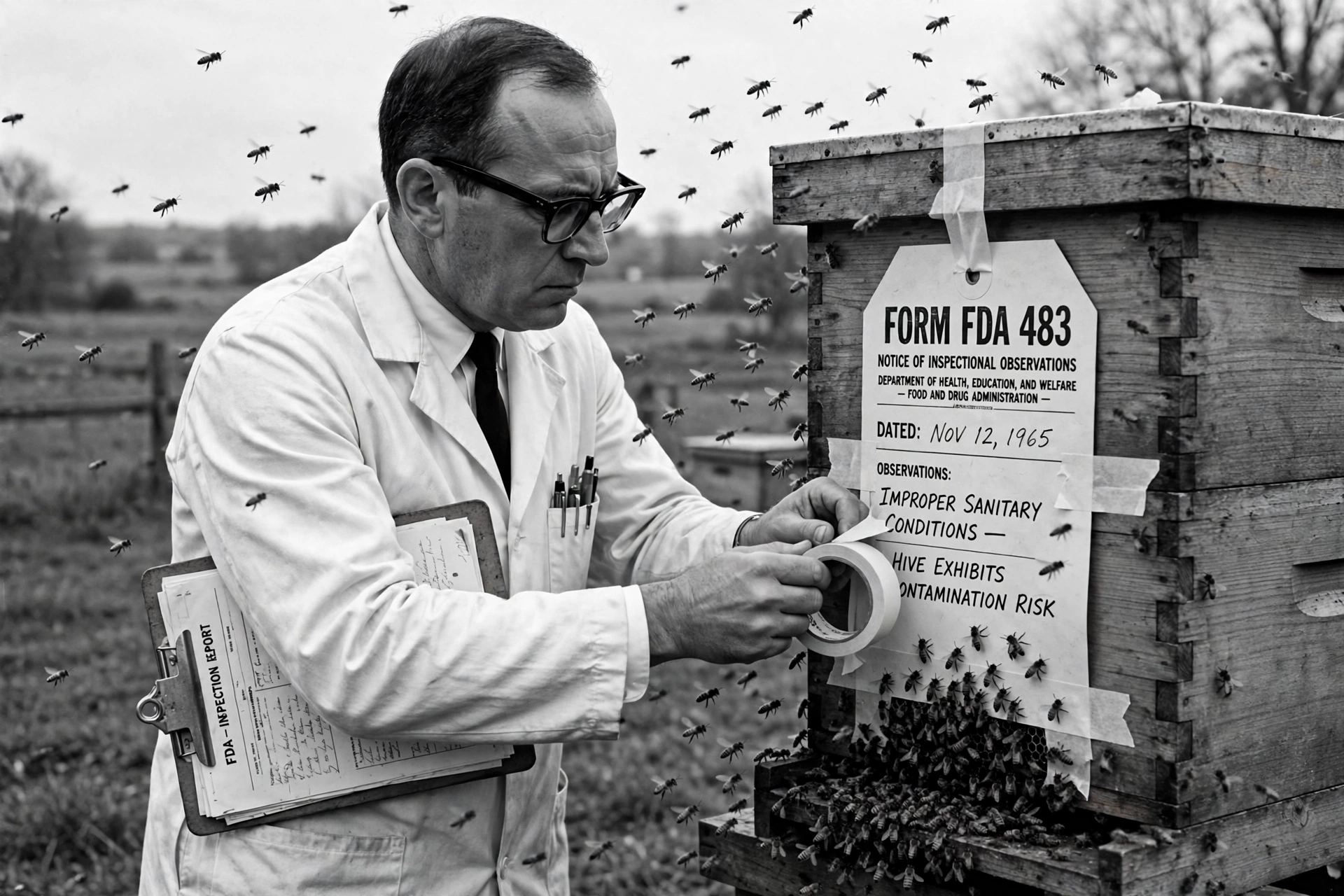
The agency should exercise the inspection authority Congress granted it in section 704 of the Act. Upon completing an inspection, the investigator must give the owner, operator, or agent in charge a written report of the conditions observed, on Form FDA 483, before leaving the premises. The premises, in this case, is a wooden box containing 60,000 venomous insects. This explains the inspection gap. It does not excuse it.23
Until compliance is achieved, the factories will continue to operate at full capacity, unregistered, as they have for millennia.
Ergo.
Sources
- Forager bees store nectar in the crop, the honey stomach, which is used solely for storage; the forager regurgitates the nectar into the crop of a processor bee, which deposits it in the comb; invertase is added with every regurgitation, breaking sucrose into glucose and fructose; nectar at about 70 percent water is fanned down to under 18.6 percent water, then capped with an airtight wax seal. news.ncsu.edu 1↑↑
- A bee's stomach holds about 70 mg of nectar; up to 1,500 flowers are visited to fill it; about two million flowers are visited per pound of honey; invertase, amylase, and diastase hydrolyze sucrose; bees fan their wings about 11,000 times per minute above the cells until the honey reaches about 18 percent moisture, then cap the cells with wax. ift.org 2↑↑
- 21 CFR 1.227: “Manufacturing/processing means making food from one or more ingredients, or synthesizing, preparing, treating, modifying or manipulating food, including food crops or ingredients. Examples of manufacturing/processing activities include: Baking, boiling, bottling, canning, cooking, cooling, cutting, distilling, drying/dehydrating raw agricultural commodities to create a distinct commodity (such as drying/dehydrating grapes to produce raisins), evaporating, eviscerating, extracting juice, formulating, freezing, grinding, homogenizing, irradiating, labeling, milling, mixing, packaging (including modified atmosphere packaging), pasteurizing, peeling, rendering, treating to manipulate ripening, trimming, washing, or waxing.” law.lawstack.com ↑
- USDA National Agricultural Statistics Service, Honey report released March 14, 2025: United States honey production in 2024 totaled 134 million pounds; 2.60 million colonies produced honey; yield per colony averaged 51.7 pounds; average price $2.69 per pound; producer stocks 43.4 million pounds on December 15, 2024. Value computed as 134 million pounds times $2.69, about $360 million. Survey procedures: data collected from a stratified sample of all known operations with at least 5 honey bee colonies that also meet USDA’s definition of a farm. release.nass.usda.gov 4↑
- A honey bee visits 50 to 100 flowers during one collection trip; about two million flowers are visited per pound of honey; a hive of bees must fly about 55,000 miles to produce a pound of honey; it requires about 556 worker bees to gather a pound of honey. honeycouncil.ca ↑
- The average worker honeybee makes only about 1/12 of a teaspoon of honey in her lifetime. apexbeecompany.com ↑
- A hive holds 30,000 to 60,000 bees; bees fly 15 to 20 mph with wings beating about 230 times per second; a healthy hive can produce 2 to 5 pounds of honey per day in season, and a beekeeper harvests 60 to 100-plus pounds per hive per year above the roughly 300 pounds the colony needs for itself. siouxhoney.com ↑
- The queen is the largest bee in the hive and the only fertile female; a well-mated queen can lay up to 2,000 eggs per day, more than her own body weight, and up to a million in her lifetime. honeybeeobsessed.com ↑
- 21 CFR 1.225: the owner, operator, or agent in charge of a domestic or foreign facility engaged in the manufacturing/processing, packing, or holding of food for consumption in the United States must register, whether or not the food enters interstate commerce; failure to register, renew, or update is a prohibited act under section 301(dd) of the Federal Food, Drug, and Cosmetic Act; renewals are due October 1 through December 31 of each even-numbered year and must be submitted electronically. customsmobile.com 9↑
- 21 CFR 1.227: “Facility means any establishment, structure, or structures under one ownership at one general physical location … that manufactures/processes, packs, or holds food for consumption in the United States”; “Farm means … an operation under one management in one general (but not necessarily contiguous) physical location devoted to the growing of crops, the harvesting of crops, the raising of animals (including seafood), or any combination of these activities”; “You or registrant means the owner, operator, or agent in charge of a facility.” law.lawstack.com 10↑↑↑
- Instructions for DHHS/FDA Form 3537, Food Facility Registration: the owner, operator, or agent in charge of the facility, or an individual authorized by the owner, operator, or agent in charge, must fill out, sign, and submit the form, including the Section 13 certification statement attesting the information is true and accurate. crowley.com ↑
- 21 CFR 1.234: the owner, operator, or agent in charge must submit an update to a facility’s registration within 60 calendar days of any change to required information, including a change of operator or agent in charge. chanrobles.com 12↑
- FDA: the 2026 Biennial Registration Renewal Period begins October 1, 2026 and concludes December 31, 2026; every facility required to register must renew every two years. fda.gov ↑
- February 2018: FDA issued draft guidance proposing an obelisk symbol (†) after the added sugars daily value on pure honey and maple syrup, directing consumers to contextual language; the agency received more than 3,000 comments, almost universally negative; on September 6, 2018, Commissioner Scott Gottlieb announced a revised approach, stating the standard added sugars declaration would mislead consumers about pure products. nyrealestatelawblog.com ↑
- February 20, 2013: the Department of Justice announced criminal charges against Honey Holding (doing business as Honey Solutions, Baytown, Texas) and Groeb Farms (Onsted, Michigan) following the “honeygate” sting; Chinese honey was transshipped and misdeclared to evade more than $180 million in antidumping duties, and some shipments were adulterated with chloramphenicol, an antibiotic not approved for honey; both companies entered deferred prosecution agreements, agreeing to pay $1 million and $2 million respectively and implement compliance programs. foodsafetynews.com ↑
- The honey laundering prosecution was the nation’s largest food fraud case, breaking the prior $80 million record; the government alleged mislabeling to avoid more than $180 million in antidumping duties plus importation of honey adulterated with unapproved antibiotics; in October 2002 the FDA issued an import alert for honey containing chloramphenicol. jdsupra.com ↑
- 21 USC 342(a)(4): a food shall be deemed adulterated “if it has been prepared, packed, or held under insanitary conditions whereby it may have become contaminated with filth, or whereby it may have been rendered injurious to health.” govinfo.gov ↑
- Auburn University, 2024-2025 U.S. Beekeeping Survey (with the Apiary Inspectors of America and Oregon State University): an estimated 55.6 percent of managed colonies were lost between April 2024 and April 2025, the highest since tracking began in 2010; winter losses were 40.2 percent; 2,453 beekeepers managing 219,097 colonies responded, about 8.4 percent of the country’s honey-producing colonies. wire.auburn.edu ↑
- USDA Agricultural Research Service, June 2025: viruses spread by the parasitic mite Varroa destructor were behind recent colony collapses, and nearly all mites tested showed resistance to amitraz, the widely used miticide. thefostoriafreepress.com ↑
- Project Apis m. survey: an estimated 62 percent of commercially managed hives died after June 2024; the economic damage was estimated above $600 million. randalolson.com ↑
- Honey bees keep the brood nest at 91 to 97 degrees Fahrenheit (33 to 36 Celsius), a phenomenon unique in the insect world. honeybeesuite.com ↑
- IndexBox, U.S. honey market 2024: imports reached 255,000 tons, up 28 percent, about 33 percent of global import volume; principal suppliers India, Argentina, and Vietnam; U.S. consumption 306,000 tons. indexbox.io ↑
- FFDCA Sec. 704 (21 USC 374), Factory Inspection: the FDA is authorized to inspect factories, warehouses, and establishments; the Form FDA 483 reverse side quotes section 704(b) requiring the investigator, before leaving the premises, to give the owner, operator, or agent in charge a written report of observed conditions indicating food prepared, packed, or held under insanitary conditions. fda.gov Recipients are expected to respond to the observations within 15 business days. wikipedia.org ↑