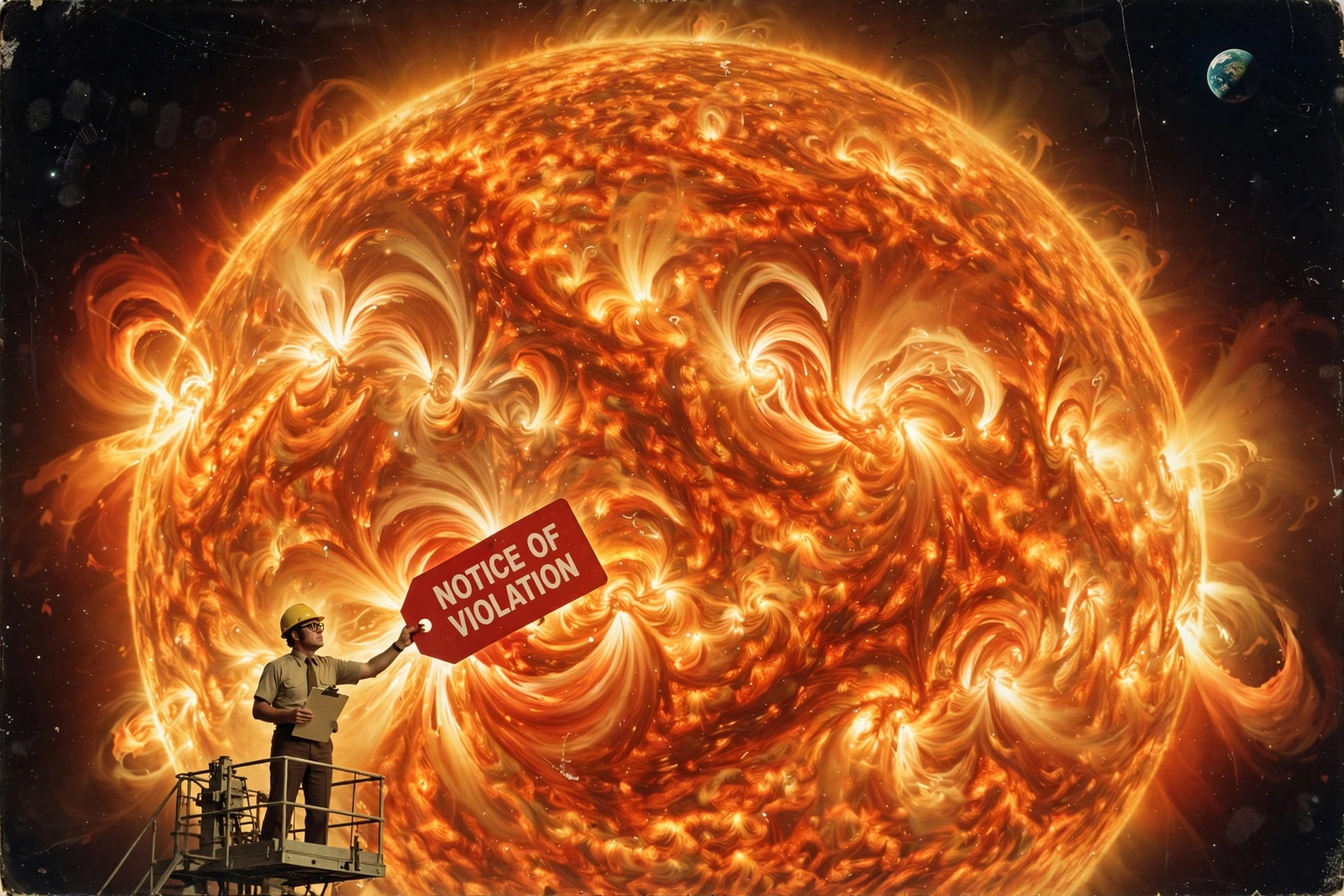
I. The Reactor
Every second, the Sun fuses roughly 600 million tons of hydrogen into helium. About four million tons of matter do not survive the transaction: the helium nucleus that emerges weighs slightly less than the four hydrogen nuclei that went in, and the missing mass, about 0.7 percent, is converted directly into energy, in accordance with Einstein’s relation. A NASA educational resource states the figure plainly: every second, a star like the Sun converts four million tons of its material into heat and light through nuclear fusion.1
The process is the proton-proton chain, worked out in detail in the 1930s after Arthur Eddington proposed in 1920 that stellar heat came from fusing hydrogen into helium. In the Sun’s core, where temperatures reach 15 million degrees Celsius and hydrogen nuclei are confined by the star’s own gravity, four protons become one helium nucleus in three steps, releasing energy at each step.2 The total output is approximately 3.8 × 1026 watts, or 380 trillion trillion watts, every second.3
The reactor has been operating for about 4.6 billion years. Scientists expect it to remain a main-sequence star for another five billion years before becoming a red giant.4 No maintenance outage has ever been recorded. No refueling has ever been required. No operator has ever been identified.
By every physical definition, the Sun is a nuclear reactor. By every legal definition the Commission enforces, it is an unlicensed one.
II. The Scale of the Operation
At Earth’s average distance from the Sun, the incoming solar power on a surface held perpendicular to the rays is about 1,361 watts per square meter, the quantity known as the solar constant, though it varies slightly with the solar cycle. Earth intercepts roughly 174,000 terawatts of incoming solar power at the top of its atmosphere.5
For comparison, the United States generated 4,703 terawatt-hours of electricity in 2025, all sources combined.6 Spread across the year, that is an average output of about half a terawatt. The Sun delivers to the top of Earth’s atmosphere more than 300,000 times the average rate at which the United States generates electricity.
Every other generator operating at this scale answers to a regulator. The balancing authorities answer to the Federal Energy Regulatory Commission. The reactor fleet answers to the Nuclear Regulatory Commission. The Sun answers to no one, and its output varies with an eleven-year sunspot cycle about which it has never filed so much as a courtesy notice.7
III. The Licensing Record
Congress established the Nuclear Regulatory Commission through the Energy Reorganization Act of 1974, splitting the old Atomic Energy Commission’s promotional and regulatory functions. The Atomic Energy Act of 1954, as amended, remains the fundamental law governing civilian uses of nuclear materials and facilities.8
Under 10 CFR 50.10, no person may begin construction of a production or utilization facility on the site where it is to be operated until that person has been issued a construction permit, a combined license, or a limited work authorization.9 The regulation is explicit about what counts as construction: the driving of piles, subsurface preparation, placement of backfill, installation of foundations, and in-place assembly, erection, fabrication, or testing.
The Sun assembled itself from a collapsing molecular cloud approximately 4.6 billion years before the regulation existed, which the Commission will presumably accept as a mitigating circumstance, but the paperwork deficit is total. No construction permit was ever applied for. No operating license was ever issued. No application of any kind appears in the agency’s records.
The licensed fleet, for reference, is thoroughly papered. As of March 2026, the United States had 94 operating commercial nuclear reactors at 54 power plants in 28 states, with a combined net summer capacity of 98,441 megawatts.10 The Commission’s own March 2026 assessment letters went out to 95 reactors in the Reactor Oversight Process, the 95th being Palisades in Michigan, returned to operational status but yet to restart.11 Every one of them holds a license. The Sun holds none.
The oversight gap extends to personnel. Since the late 1970s, the Commission has stationed resident inspectors, its own eyes and ears, at the nation’s nuclear power plants. Each plant has at least two such inspectors, and the agency maintains about 150 of them.12 No resident inspector has ever been assigned to the Sun. The duty station would be one astronomical unit from headquarters, and the travel voucher implications are acknowledged, but the regulation makes no exception for distance.
Under 10 CFR 50.73, the holder of an operating license for a nuclear power plant must submit a Licensee Event Report for reportable events within 60 days of discovery, on Form NRC 366.13 The Sun has never filed one. The docket is empty. The events that would have required filing are described below.
IV. The Fusion Precedent
On January 3, 2023, the NRC staff sent the Commission SECY-23-0001, “Options for Licensing and Regulating Fusion Energy Systems,” laying out three paths: regulate fusion as utilization facilities under 10 CFR Parts 50 through 53, regulate it under the byproduct materials framework of 10 CFR Parts 30 through 37, or a hybrid of the two. On April 14, 2023, all five Commissioners voted unanimously for the second option, directing the staff to regulate fusion energy systems under the byproduct materials framework, the same regime that covers particle accelerators.14
Congress then wrote the decision into statute. Section 205 of the ADVANCE Act of 2024 amended the Atomic Energy Act to clarify that radioactive material produced by a fusion machine falls within the statutory definition of byproduct material. In February 2026, the Commission published the proposed rule “Regulatory Framework for Fusion Machines,” which would revise the Part 30 regulations to explicitly include fusion machines that possess, use, or produce radioactive material.15
The Commission has therefore built, twice, a licensing framework for fusion machines: once by vote, once by rulemaking. The only operating fusion machine in the solar system is licensed under neither. It possesses, uses, and produces radioactive material on a scale the proposed rule’s drafters did not contemplate, and it has never submitted an application under either framework.
The Commission did leave one door open. In voting for the byproduct materials option, the Commissioners preserved the agency’s ability to revisit the decision should a future device be proposed with a different risk profile than the near-term machines under development. The Sun’s risk profile differs. The door is open. No one has walked through it.
V. The Waste Stream
On top of the four million tons per second converted to energy, the solar wind carries off another 1.3 to 1.9 million metric tons of the Sun’s mass every second.16 This is the routine effluent. The episodic releases are larger.
On September 1, 1859, the amateur astronomer Richard Carrington observed two patches of intensely bright white light erupt from a cluster of sunspots. Within hours, a coronal mass ejection reached Earth. Telegraph communications around the world began to fail. Sparks showered from telegraph machines, operators received electric shocks, papers were set ablaze, and auroras glowed so brightly that laborers began their morning chores believing the sun had risen. The Carrington Event remains the largest geomagnetic storm on record to have struck the planet.17
On March 13, 1989, the Sun did it again. At 2:44 a.m. Eastern, geomagnetically induced currents tripped equipment at the James Bay complex, and 92 seconds later the entire Hydro-Québec grid had collapsed. Six million people lost power, most for up to nine hours, in minus 15 degree weather. The same storm destroyed a transformer at the Salem nuclear plant in New Jersey.1819
No Licensee Event Report was filed for either occurrence. Under 10 CFR 50.73, any natural phenomenon posing an actual threat to a nuclear power plant is reportable within 60 days. The 1989 release posed an actual threat to at least one: it destroyed a transformer at Salem. The 60 days have elapsed. They elapsed some time ago.
VI. The Irradiator
About a tenth of the sunlight arriving at the top of Earth’s atmosphere is ultraviolet radiation. The Commission licenses irradiators, including the panoramic facilities that sterilize food and medical equipment, under a dedicated regulatory framework, and it enforces the ALARA principle of 10 CFR 20.1101: licensees must use procedures and engineering controls to keep doses as low as is reasonably achievable.24
The Sun operates the largest irradiator in the solar system without a license and without an ALARA program. To the contrary, the available evidence suggests the operator is not trying to keep exposures low at all. The American Academy of Dermatology estimates that one in five Americans will develop skin cancer in their lifetime and that approximately 9,500 people in the United States are diagnosed with skin cancer every day.20 Ultraviolet exposure is the most preventable risk factor for all skin cancers, and the source of the exposure has never submitted a dose assessment.
The Sun also irradiates every outdoor food crop on Earth, continuously. The Commission’s drafters appear to have anticipated this: the irradiator licensing rule expressly excludes “open-field (agricultural) irradiations” from its scope, the most specifically drafted loophole in the Code of Federal Regulations.25 Whether the exclusion was written for the Sun or for some terrestrial enterprise the staff declined to name, the effect is the same: the tomatoes do not consent, the wheat was not notified, and neither holds a license.
VII. The Decommissioning File
Under 10 CFR 50.75, every power reactor licensee must provide reasonable assurance that funds will be available for decommissioning, typically through a trust fund or other financial instrument, and must report the status of that funding to the Commission every two years.21 The regulation’s cost tables are denominated in January 1986 dollars, which gives some sense of the planning horizons the Commission considers reasonable.
The Sun has filed no decommissioning report, maintains no trust fund, and has submitted no biennial status update. This is not a minor omission, because the decommissioning is scheduled. In approximately five billion years, the Sun will become a red giant, engulfing Mercury and Venus and possibly Earth.4 The site release criteria for this decommissioning have not been established. The responsible party has not been identified. The cost estimate has not been prepared.
Nor is there liability coverage for the interim. The Price-Anderson Act establishes a no-fault compensation system for nuclear incidents, with the industry-funded layers currently providing roughly $16 billion per incident: $500 million in primary insurance at the site plus retrospective premiums of about $158 million from each covered reactor.22 The Sun carries none of this. Its policy limit is zero. Its deductible is the planet.
VIII. The Defense
The defense is noted. It concedes every number in this investigation and disputes only the prescription.
Its first exhibit is the statute. The Atomic Energy Act licenses “persons,” and the Sun, whatever else it may be, is not a person. Its second is the fuel cycle. The utilization-facility framework attaches to special nuclear material, source material, and byproduct material; the Sun fuses ordinary hydrogen, which is none of these, and its proton-proton chain was never submitted for materials classification. Its third is jurisdiction. The reactor sits 93 million miles from the nearest regional office, well beyond any inspection district ever drawn.
Its fourth is priority in time. The facility began operating 4.6 billion years before the Commission existed, and no grandfather clause was ever needed because no one was watching. Its fifth is the 2023 framework itself, which was written for machines that possess, use, or produce byproduct material in the course of human enterprise, a description the staff presumably did not intend to cover the sky.
Its sixth is the planning horizon. A decommissioning five billion years hence exceeds every period the regulations contemplate; the cost tables stop at January 1986 dollars, and the biennial reporting cycle would require some 2.5 billion reports. Its seventh is service of process. The Sun cannot be served, cannot retain counsel, and cannot be compelled to appear, and the Commission’s enforcement policy presumes a licensee with a mailing address.
Its eighth is the irradiator rule itself. Section 36.1(c) of Title 10 expressly excludes open-field agricultural irradiations from licensing, which the Sun’s counsel would call a complete defense to the crop-irradiation count and which this investigation has already conceded, in Section VI, to be the most specifically drafted loophole in the Code of Federal Regulations.
The defense rests. It is overruled.
IX. The Prescription
The ledger is now complete, and it admits of only one reading.
The Commission should issue a Notice of Violation to the operator of the solar fusion facility, citing the absence of a construction permit under 10 CFR 50.10, the absence of an operating license, the absence of resident inspectors, the unreported releases of September 1859 and March 1989, the unlicensed irradiator operation, and the missing decommissioning funding assurance under 10 CFR 50.75.
The operator should be required to submit a construction permit application nunc pro tunc, accounting for a facility assembled 4.6 billion years before the regulation. Two resident inspectors should be assigned to the site; the duty station is one astronomical unit from headquarters, and the travel voucher implications are acknowledged but not dispositive. A decommissioning trust fund should be established for the red giant phase, with the first biennial report due in the year 5,000,002,026. The operator should be enrolled in a fitness-for-duty program; the eleven-year sunspot cycle suggests mood variation, and the Maunder Minimum of 1645 to 1715, a seventy-year period in which astronomers observed only about 50 sunspots against a typical 40,000 to 50,000, constitutes an unreported power reduction for which no Licensee Event Report was ever filed.237
An ALARA plan should be submitted for the ultraviolet effluent. Licensee Event Reports should be filed, on Form NRC 366, for the occurrences of September 1859 and March 1989, however belatedly.
Until compliance is achieved, the reactor will continue to operate at full power, unsupervised, as it has for 4.6 billion years.
Ergo.
Sources
- A NASA educational resource: “Every second, a star like our Sun converts 4 million tons of its material into heat and light through the process of nuclear fusion.” The Sun fuses roughly 600 million tonnes of hydrogen every second; about 0.7 percent of the mass becomes energy. spacedaily.com ↑
- In the Sun’s core, where temperatures reach 15,000,000 °C, hydrogen atoms are in constant agitation; four hydrogen nuclei fuse into one helium nucleus in the three-step proton-proton chain. spacedaily.com (citing ITER and EUROfusion) ↑
- The Sun emits approximately 3.8 × 1026 joules of energy every second. The Sun converts approximately 600 million metric tons of hydrogen into helium each second; about 4 million metric tons of mass are converted into energy in the process. sciencenewstoday.org ↑
- The Sun is about 4.6 billion years old; per NASA’s science page, scientists expect it to remain a main-sequence star for another 5 billion years before becoming a red giant. spacedaily.com 4↑
- The solar constant is about 1,361 watts per square meter at the top of Earth’s atmosphere; Earth intercepts roughly 174,000 terawatts of incoming solar power. sciencenewstoday.org ↑
- Total U.S. electricity generation in 2025: 4,703 terawatt-hours. world-nuclear.org ↑
- The number of sunspots waxes and wanes with an approximate 11-year cycle (NASA Marshall Solar Physics). solarscience.msfc.nasa.gov 7↑
- The NRC was established by the Energy Reorganization Act of 1974; the Atomic Energy Act of 1954, as amended, is the fundamental U.S. law on civilian uses of nuclear materials. nrc.gov ↑
- 10 CFR 50.10(c): “No person may begin the construction of a production or utilization facility on a site on which the facility is to be operated until that person has been issued either a construction permit under this part, a combined license under part 52 of this chapter, an early site permit … or a limited work authorization.” law.cornell.edu ↑
- As of March 2026, the United States had 94 operating commercial nuclear reactors at 54 nuclear power plants in 28 states; combined net summer capacity 98,441 megawatts. eia.gov ↑
- NRC Information Notice No. 26-032 (March 13, 2026): annual assessment letters issued to the nation’s 95 operating commercial nuclear reactors in the Reactor Oversight Process, including Palisades, returned to operational status but yet to restart. nrc.gov ↑
- NRC Resident Inspectors Program backgrounder: each plant has at least two resident inspectors; the agency has about 150 resident inspectors. nrc.gov ↑
- 10 CFR 50.73(a)(1): the holder of an operating license for a nuclear power plant shall submit a Licensee Event Report within 60 days after discovery of a reportable event, on Form NRC 366. law.cornell.edu ↑
- On April 14, 2023, the five NRC Commissioners voted unanimously to regulate fusion energy systems under the byproduct materials framework (10 CFR Part 30), following SECY-23-0001. fusionindustryassociation.org ↑
- Section 205 of the ADVANCE Act of 2024 clarified that fusion-machine-produced radioactive material falls within the Atomic Energy Act’s definition of byproduct material; the NRC’s February 2026 proposed rule, “Regulatory Framework for Fusion Machines,” would revise Part 30 to explicitly include fusion machines. powermag.com ↑
- The solar wind carries off another 1.3 to 1.9 million metric tons of the Sun’s mass every second, on top of the four million tons converted to energy. dawww.us ↑
- September 1, 1859: Richard Carrington observed the first recorded solar flare; the resulting geomagnetic storm, the Carrington Event, caused telegraph failures worldwide, shocked operators, set papers ablaze, and produced auroras visible as far south as Cuba and Hawaii. history.com ↑
- March 13, 1989: at 2:44 a.m. Eastern, the Hydro-Québec grid collapsed in 92 seconds; six million people lost power for up to nine hours in −15 °C weather. The storm’s Dst index bottomed near −589 nT, the deepest of the space age. cmetracker.ai ↑
- The March 1989 storm destroyed a transformer at the Salem nuclear plant in New Jersey; the Quebec blackout narrative with the 2:44 a.m. collapse in sub-zero darkness. siliconcanals.com spacedaily.com ↑
- American Academy of Dermatology: one in five Americans will develop skin cancer in their lifetime; approximately 9,500 people in the U.S. are diagnosed with skin cancer every day. ajmc.com ↑
- 10 CFR 50.75 requires power reactor licensees to provide reasonable assurance that decommissioning funds will be available, typically via trust fund, and to report funding status to the NRC every two years. nrc.gov ↑
- Price-Anderson Act: primary and secondary layers provide up to about $15.5 billion per incident (95 covered reactors × $158.0 million retrospective premiums, plus $500 million primary insurance), rising to about $16.3 billion with the 5 percent surcharge. wikipedia.org ↑
- The Maunder Minimum, 1645 to 1715: astronomers observed only about 50 sunspots in a 30-year period, against a typical 40,000 to 50,000; the period coincided with the coldest part of the Little Ice Age (NASA Goddard Institute for Space Studies, via Science). eurekalert.org ↑
- 10 CFR 20.1101(b): “The licensee shall use, to the extent practical, procedures and engineering controls based upon sound radiation protection principles to achieve occupational doses and doses to members of the public that are as low as is reasonably achievable (ALARA).” chanrobles.com ↑
- 10 CFR 36.1(c): “The regulations in this part do not apply to … open-field (agricultural) irradiations.” law.cornell.edu ↑