I. The Rule
Federal regulation at 14 CFR 91.303 provides, in full and without exception for birds, that no person may operate an aircraft in aerobatic flight over any congested area of a city, town, or settlement, over an open-air assembly of persons, within the lateral boundaries of the surface areas of Class B, Class C, Class D, or Class E airspace designated for an airport, within four nautical miles of the centerline of any federal airway, below an altitude of 1,500 feet above the surface, or when flight visibility is less than three statute miles.1 For the purposes of the section, aerobatic flight means an intentional maneuver involving an abrupt change in an aircraft's attitude, an abnormal attitude, or abnormal acceleration, not necessary for normal flight.2
The definition is doing most of the work, and it is worth reading slowly. It does not require a loop, a roll, or an Immelmann by name. It requires three elements: intention, abruptness or abnormality, and non-necessity for normal flight. A steep turn made because the route requires it is normal flight. A steep turn made because the performer wants the crowd to gasp is aerobatic flight. The regulation then confines aerobatic flight to places where a mistake hurts no one on the ground: high, remote, clear, and empty. The 1,500-foot floor exists so that a failed maneuver has room for recovery. The congested-area ban exists so that a failed maneuver has no audience beneath it. The visibility floor exists so that the performer can see what it is about to hit. Every element of the rule is a judgment about what happens when the show goes wrong, and every element is violated nightly by starlings, which have never had a show go wrong in a way the regulation can punish, because the regulation has never been applied to them.
Two neighboring rules complete the frame. Section 91.111 provides that no person may operate an aircraft so close to another aircraft as to create a collision hazard, and that no person may operate an aircraft in formation flight except by arrangement with the pilot in command of each aircraft in the formation.3 Section 91.113 requires vigilance by each person operating an aircraft so as to see and avoid other aircraft, and provides that a pilot who must give way may not pass over, under, or ahead of another aircraft unless well clear.4 A murmuration is a formation flight conducted at a separation measured in meters, by performers who pass over, under, and ahead of one another continuously, under an arrangement made with nobody. It is, in the language of Part 91, a formation flight, an aerobatic display, and a standing collision hazard, all at once, performed by operators who have never heard of Part 91 and would not care if they had.
II. The Waiver That Was Never Filed
The system has an escape hatch, and the starlings have never used it. Section 91.905 lists the rules subject to waivers, and the list includes Section 91.111, Section 91.113, and Section 91.303.5 A person who wishes to perform aerobatics below 1,500 feet, over a crowd, or in formation applies for a Certificate of Waiver or Authorization on FAA Form 7711-2. The agency's own procedures assign responsibility for waiver decisions under Section 91.303 to its Flight Standards Service, acting for aerobatic demonstrations and other aviation events.6 Compliance with a waiver is the responsibility of the holder, who must be thoroughly informed regarding the waiver and those actions required by its special provisions, and the holder must ensure that all persons participating in the operation are briefed on the waiver.7
Consider what briefing a million-bird display would require. The holder would brief every participant, individually, on the waiver and its special provisions. The starling display has no holder. It has no applicant, no form, no special provisions, and no briefing. The birds arrive at dusk, perform for ten to thirty minutes, and drop into the roost, often within two to three minutes of settling, and the entire evening's activity from first gathering to final roosting typically spans forty-five to sixty minutes.8 A licensed airshow of that duration files months of paperwork, establishes a crowd line, marks corner points, and stations safety personnel. The starlings file nothing, mark nothing, and station nobody, and the crowd gathers itself, on sidewalks and piers and reedbed paths, directly beneath the show line, which is to say, in the exact place the airshow rules exist to keep empty.
III. The Display
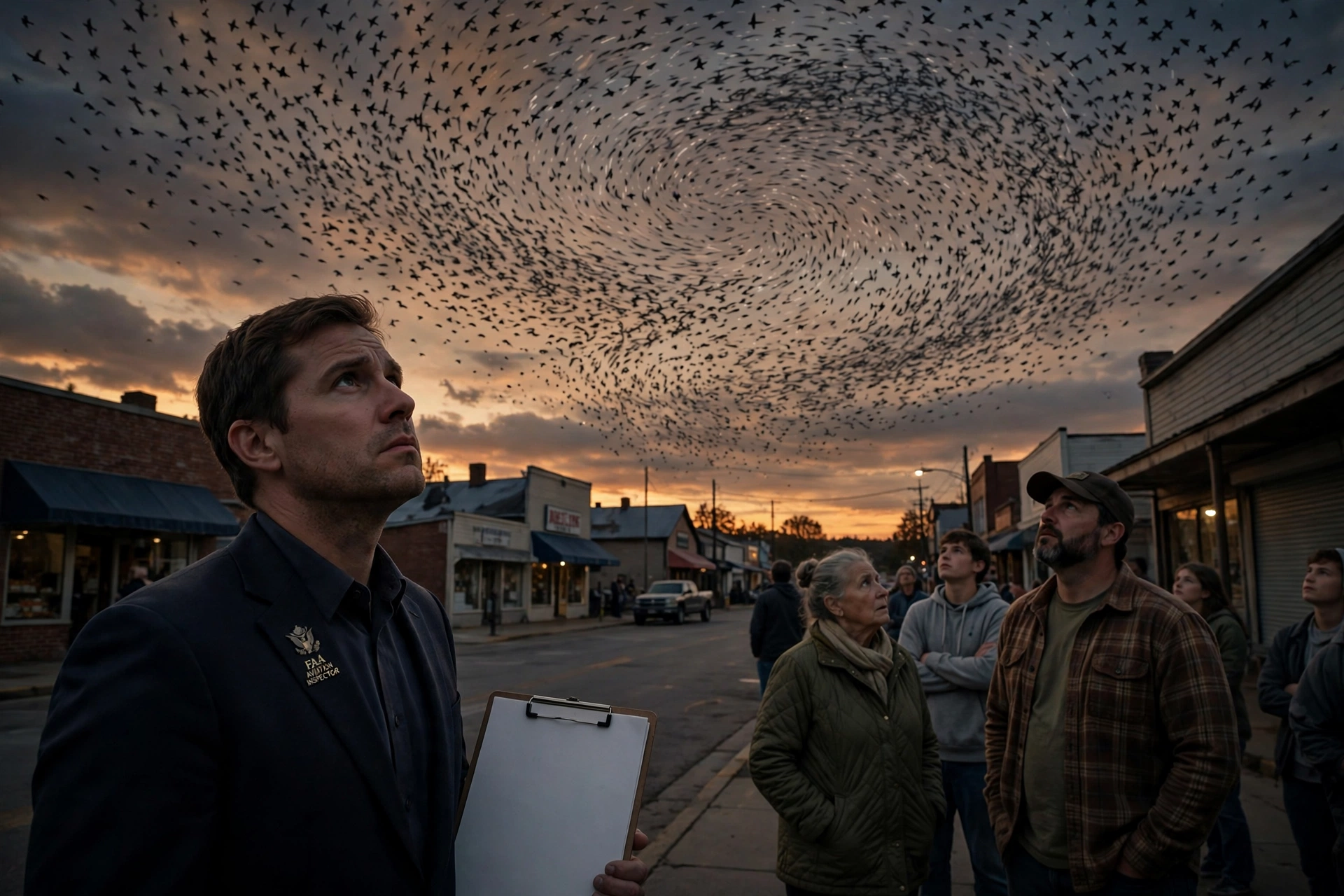
The display itself is not in dispute. On autumn and winter evenings, starlings pour and fold across the sky before they drop into their roost, in shifting patterns that look choreographed and are not. The scientific account begins in Rome, in the winter of 2005 to 2006, when a team of physicists stood on a museum roof facing the trees where starlings roost by the Termini station, with cameras twenty-five meters apart shooting ten frames a second, and reconstructed the position of every bird in three dimensions in flocks of up to 2,600.9
The finding, published in 2008 in the Proceedings of the National Academy of Sciences by Ballerini and colleagues, was that each starling responds to its six or seven nearest neighbors, 6.5 on average, and that what counts is how many neighbors, not how far away they are: across flocks where the average spacing to the nearest bird ranged from about 0.7 to 1.5 meters, the number of influential neighbors stayed the same.10 A summary of the work puts it plainly: starlings seek to match the direction and speed of the nearest seven or so neighbors, rather than responding to the movements of all the nearby birds around them.11 There is no leader. There is no choreographer. There is no flight lead giving radio calls. Each bird watches seven birds, those seven watch seven more, and the turn propagates through the flock as a wave, folding thousands of performers through abrupt changes of attitude that no single performer ordered and no single performer can stop.
The maneuvers themselves are the regulation's definition made visible. When a peregrine falcon attacks, the flock flashes outward, darkens, sends waves rippling away from the falcon, opens a hole around the attacker, strings out into a thin cordon, or splits outright.12 These are intentional maneuvers, in the sense that they are performed deliberately in response to a stimulus, involving abrupt changes in attitude and abnormal accelerations, and they are not necessary for normal flight, in the sense that a starling traveling from a field to a roost does not need to fold itself inside out to get there. The falcon is the heckler that improves the show. In one Rome study, only 23 percent of 328 falcon hunts ended in a catch, which means the display succeeds as evasion roughly three times out of four, and fails, fatally, for at least one bird almost every evening.13 The regulation worries about what happens when aerobatics go wrong. In the starling display, going wrong is the point of the exercise, and it happens nightly, in public, at low altitude, over spectators.
IV. The Formation
Section 91.111(b) is the quiet catastrophe of this investigation. Formation flight is permitted, but only by arrangement with the pilot in command of each aircraft in the formation. The rule contemplates a small number of aircraft, each with a pilot in command, each of whom has agreed to the arrangement. Apply it to a murmuration and the arithmetic collapses.
Take the largest display on record. The Sort Sol, the Danish "black sun," is a murmuration in the marshlands of southwestern Jutland, near Tonder and Ribe, in which very large numbers of migratory starlings gather in spring and autumn, in the hours just after sunset, forming huge formations in the sky just before roosting, so numerous that they seem to obliterate the sunset.14 A formation near Tonder can occasionally comprise up to one million birds, and flocks usually break up when the number exceeds about half a million, due to excessive internal disturbances in the flock.15 For a formation of one million aircraft, arrangement with the pilot in command of each aircraft in the formation requires, for each bird, an arrangement with 999,999 other pilots in command, or roughly 500 billion pairwise arrangements for the formation as a whole, on the author's arithmetic.16 The birds, applying their seven-neighbor rule, make at most about 3.5 million pairwise arrangements, on the author's arithmetic, and those arrangements are not made with pilots in command, are not written down, and are not filed with anybody.17 The shortfall is approximately 499,996,500,000 arrangements per display, every evening, for a season that runs for months.
Section 91.111(a) is no kinder. No person may operate an aircraft so close to another aircraft as to create a collision hazard. The Rome flocks flew with average nearest-neighbor spacing between about 0.7 and 1.5 meters.18 A piloted aircraft flown at a separation of less than a meter from its neighbor, at dusk, while banking through abrupt turns, would be described by any inspector as a collision hazard, and the inspector would be right, except that the starlings almost never collide. Their compliance with the collision rule is perfect in outcome and nonexistent in procedure: they achieve the safety the rule demands by a method the rule does not recognize, which is watching seven neighbors and trusting the wave. Section 91.113(b) requires vigilance so as to see and avoid other aircraft. The starlings see and avoid, constantly, brilliantly, and without ever having been told to. The regulation demands a lookout. The flock is a lookout with a million eyes and no logbook.
V. Six Prohibitions, Six Violations
It is worth taking Section 91.303 paragraph by paragraph, because the display violates it the way a checklist violates a pilot: completely, and in order.
Paragraph (a) prohibits aerobatic flight over any congested area of a city, town, or settlement. The Rome study flocks roosted by the Termini station, in the center of a capital city.19 The Belfast display gathers hundreds of thousands of birds over the Albert Bridge in the center of the city.20 The Brighton display, up to 40,000 birds at peak season, performs over a seaside town's pier and promenade.21 These are not remote practice areas. They are settlements, and the display is the reason people look up.
Paragraph (b) prohibits aerobatic flight over an open-air assembly of persons. The spectators are the assembly, and they assemble precisely because the display is happening. At Brighton, at the Somerset Levels, at Gretna Green, crowds gather at dusk to watch, which means the prohibited condition is created by the performance itself: the better the show, the larger the assembly, the clearer the violation. A licensed airshow keeps the crowd 500 feet from the show line. The starling show has no show line, and the crowd stands under it.
Paragraph (c) prohibits aerobatic flight within the lateral boundaries of the surface areas of Class B, Class C, Class D, or Class E airspace designated for an airport. The investigation concedes this one in part: most famous displays are over marshes, piers, and reedbeds, not over airport surface areas, and the author will not pretend that every murmuration sits inside controlled airspace. But the concession is narrow. Displays over city centers, including Rome and Belfast, occur within metropolitan airspace complexes where airport surface areas are a routine feature of the chart, and no starling has ever consulted a sectional chart to confirm that its reedbed sits outside the lateral boundaries. The display does not check. That is the point.
Paragraph (d) prohibits aerobatic flight within four nautical miles of the centerline of any federal airway. The same concession applies, and the same answer follows: the performers do not know where the airways are, have never plotted one, and perform wherever the roost is, which is wherever the reeds, the pier, or the station trees happen to be. A regulatory system that depends on the performer checking the chart fails completely against a performer that cannot read a chart and has never tried.
Paragraph (e) prohibits aerobatic flight below 1,500 feet above the surface. This is the violation that cannot be argued away, because the display ends at the surface. The birds perform over the roost and then drop into it, descending to reed level, pier level, and ground level, in a final plunge that takes two to three minutes.22 The entire performance takes place in the band the regulation reserves for recovery from failed maneuvers: below 1,500 feet, mostly below a few hundred feet, ending at zero. There is no altitude at which a starling murmuration complies with paragraph (e), because the display is defined by its descent into the roost. To comply, the birds would have to perform above 1,500 feet and then commute down without maneuvering, which is not a display at all. It is a commute.
Paragraph (f) prohibits aerobatic flight when flight visibility is less than three statute miles. The displays occur at dusk, in the hours just after sunset, as light fails.23 The investigation does not claim a measured visibility figure for any particular evening, because no starling has ever measured one, which is itself the violation in miniature: the regulation requires the performer to know the visibility and to stand down when it falls below three miles, and the performer neither knows nor stands down. The show runs as the light goes, night after night, into the dark, until the birds are in the reeds and the spectators can no longer see them. A licensed performer files a weather briefing. The starlings file nothing and fly into the dusk anyway.
VI. The Parachute File
Section 91.307(c) provides that, unless each occupant of the aircraft is wearing an approved parachute, no pilot of a civil aircraft carrying any person other than a crewmember may execute any intentional maneuver that exceeds a bank of 60 degrees relative to the horizon or a nose-up or nose-down attitude of 30 degrees relative to the horizon.24 The starlings bank through their turns, roll through their folds, and dive through their evasions, and no starling has ever worn an approved parachute, packed one, inspected one, or repacked one within the preceding 60 days as the parachute rules require for silk, pongee, or other natural fiber components. The author's application is straightforward: a performer that banks past 60 degrees without a parachute on every occupant is outside the rule, and a murmuration has, at any given moment, thousands of occupants banked past anything a piloted aircraft would attempt without a parachute check.
The objection writes itself, and it is stated here so that it cannot be said the investigation hid it: a starling is its own occupant and its own crewmember, it does not carry passengers, and it does not need a parachute because it has wings, which are a considerably better recovery device than a parachute and are deployed at all times. The regulation's parachute rule exists because a piloted aircraft that loses control needs a way out. A starling that loses control is already in its way out. The rule is therefore satisfied in spirit by anatomy and violated in letter by paperwork, which is the recurring verdict of this entire investigation: the birds do the safe thing by the wrong method, and the regulation, which cares about method, has no box to tick for wings.
VII. The Quantification
The scale is what separates a violation from a system. The Somerset Levels displays regularly exceed 100,000 birds, with the largest recorded displays in recent years reaching several hundred thousand.25 The Gretna Green roost is described as a mobile roost of about a million birds.26 The Danish Sort Sol reaches up to one million.27 The largest recorded murmuration in the world was in Denmark, with over a million starlings.28 A single evening's display can therefore involve more performers than every licensed airshow in the United States combined, in a single formation, with no waiver, no briefing, and no crowd line.
The density compounds the arithmetic. Starlings can pack themselves into a roosting site at more than 500 birds per cubic meter, sometimes in flocks of several million birds.29 Five hundred aircraft per cubic meter is not a formation. It is a traffic jam with wings, resolved nightly by the seven-neighbor rule into an orderly descent that no air traffic controller has ever managed, because no air traffic controller has ever been asked to sequence a million arrivals into a reedbed in three minutes. The regulation's answer to dense traffic is separation: altitude, distance, and time. The starlings' answer is density, simultaneity, and trust. One of these systems moves a million performers a night. The other one writes the rules.
The season multiplies everything again. Murmuration displays peak in late autumn and winter, when migratory birds from Europe join resident populations, and displays begin showing activity in late October as starlings arrive from continental Europe, continuing into early March before the birds disperse to breeding grounds.30 A display that runs nightly for four months, at a million birds a night, is not an event. It is a schedule, published by no one, adhered to by everyone, and enforced by nothing except dusk. If each evening's display counts as one unwaivered performance, the season produces more than one hundred unwaivered performances per roost, and there are roosts on two continents, performing simultaneously, in the same hour, under the same missing waiver.
VIII. The Founding Flight
The American chapter of this violation has a founding document, and it is a release form of a different kind. In 1890 and 1891, the New York pharmaceutical manufacturer Eugene Schieffelin released about 100 European starlings into Central Park: 60 birds in 1890 and 40 in 1891, according to Smithsonian records.31 Their descendants spread across North America, reaching roughly 200 million birds within a century before declining to a more recent estimate of about 85 million to 93 million.32 The founding flock was therefore 100 birds, the peak was roughly two million times the founding flock, and the current population is still roughly a million times the founding flock, on the author's arithmetic.33
The popular story says Schieffelin acted to bring to America every bird mentioned by Shakespeare, the starling earning its place with a single line in Henry IV, Part 1, in which Hotspur imagines teaching a starling to speak nothing but "Mortimer." The investigation reports this story and declines to endorse it: researchers Fugate and Miller, in a 2021 article, found no recorded words from Schieffelin, no firsthand account, and no secondhand account corroborating the Shakespearean motive, and Schieffelin's 1906 obituary emphasizes pest control in his Madison Square garden, not theater.34 The motive matters less than the mechanism. A private citizen released 100 unregistered performers into American airspace in 1890, before the Federal Aviation Administration existed, before Part 91 existed, and before any waiver form existed to be left unfiled. The performers then spent 130 years building the largest unwaivered display fleet on the continent, without ever applying for permission, because permission did not exist when they arrived and they have never noticed that it was invented since.
The irony is precise. Schieffelin was chairman of the American Acclimatization Society, an organization founded to introduce European species into North America for economic and cultural reasons, at a time when the ecological consequences of introduction were not understood.35 He introduced a species that now performs nightly aerobatics over American towns, in formations descended directly from his 100 birds. The FAA regulates the airspace his birds now occupy. The birds were here first, by 13 years before the Wright brothers and by more than a century before Section 91.303, and they have behaved ever since as though the airspace were still unregulated, which, for them, it effectively is, because no enforcement action has ever been taken against one.
IX. The Objection
Three objections present themselves, and intellectual honesty requires stating them plainly. First, the regulations bind persons operating aircraft, and a starling is neither a person nor, in the sense the FAA uses the word, an aircraft with a pilot in command, a certificate, and a registration number. The FAA wrote Part 91 for machines with logbooks, and the starling has no logbook, which suggests the regulation was never meant to reach it. Second, the aerobatic definition requires a maneuver not necessary for normal flight, and the starling's folds, waves, and dives are arguably normal flight for a starling: they are predator evasion and roost approach, performed for survival, not for applause, and scientific models suggest the birds fly at a steady speed, with the appearance of slowing and thickening largely an optical illusion created by projecting a three-dimensional flock onto a two-dimensional view.36 If the speed is steady and the purpose is survival, the abnormal acceleration element weakens, and the maneuver starts to look like commuting with style rather than aerobatics.
Third, the famous displays are disproportionately European: the Sort Sol in Denmark, the Somerset Levels, Brighton Pier, Belfast. The regulation is American, and a Danish murmuration violates no American rule, however spectacularly it would violate it if it moved. The American displays exist, the species is spread across the continent in the tens of millions, but the investigation's most photogenic evidence comes from jurisdictions the FAA does not govern, which is a jurisdictional weakness the author will not hide.
These objections have never been tested, because no case has ever been filed, no waiver application has ever been submitted, and no starling has ever been served. The objections also miss the regulation's stated concern, which is control of the airspace over people: separation, altitude, visibility, and briefing, so that a mistake over a crowd is survivable and a crowd is never beneath a maneuver in the first place. No performer in the national airspace system exercises less accountable control over more maneuvers over more crowds than the starling population. A person who watches a murmuration over Brighton Pier is standing in an open-air assembly beneath an aerobatic display at low altitude at dusk, and the person cannot opt out, cannot request a briefing, cannot review the waiver, and cannot appeal to any crowd line, because none exists. The objection that starlings are not aircraft is, in the end, an objection that the regulation failed to imagine its largest display. That is a defect in the regulation, not an acquittal of the birds.
X. Conclusion
Section 91.303 prohibits aerobatic flight below 1,500 feet, over congested areas, over open-air assemblies, and when visibility is less than three statute miles, and defines aerobatic flight as an intentional maneuver involving an abrupt change in attitude, an abnormal attitude, or abnormal acceleration, not necessary for normal flight. Section 91.111 requires an arrangement with the pilot in command of each aircraft in a formation. Section 91.307 requires an approved parachute for maneuvers past 60 degrees of bank or 30 degrees of pitch. Section 91.905 makes all three rules waivable, on Form 7711-2, with a briefing for every participant.
The European starling performs abrupt folds, waves, rolls, and dives every evening at dusk, below 1,500 feet, over towns and over the crowds that gather to watch, in formations of up to one million birds coordinated by a seven-neighbor rule with no leader, no flight lead, and no radio, descending into roosts packed at more than 500 birds per cubic meter, for a season running from late October into early March, descended in North America from 100 birds released into Central Park in 1890 and 1891. No starling has ever filed Form 7711-2. No starling has ever received a Certificate of Waiver. No starling has ever briefed a participant. No starling has ever worn an approved parachute. No starling has ever made an arrangement with the pilot in command of any other aircraft in the formation, let alone with all 999,999 of them.
The number of waivers in the entire system is zero. The number of briefings is zero. The number of parachutes is zero. The number of enforcement actions is zero. The number of evenings the display will run this season is more than one hundred per roost, and the roosts number in the thousands. The regulation does not contain a starling exemption. The waiver list does not contain a starling exemption. The case law does not contain a starling exemption. The birds continue to perform the largest unwaivered aerobatic display in the world, nightly, at sunset, over every town with a reedbed, a pier, or a station tree, without a single piece of paper.
It should not.
Ergo.
Sources
- 14 CFR 91.303: "No person may operate an aircraft in aerobatic flight (a) Over any congested area of a city, town, or settlement; (b) Over an open air assembly of persons; (c) Within the lateral boundaries of the surface areas of Class B, Class C, Class D, or Class E airspace designated for an airport; (d) Within 4 nautical miles of the center line of any Federal airway; (e) Below an altitude of 1,500 feet above the surface; or (f) When flight visibility is less than 3 statute miles." law.cornell.edu ↑
- 14 CFR 91.303: "For the purposes of this section, aerobatic flight means an intentional maneuver involving an abrupt change in an aircraft's attitude, an abnormal attitude, or abnormal acceleration, not necessary for normal flight." law.cornell.edu ↑
- 14 CFR 91.111: "(a) No person may operate an aircraft so close to another aircraft as to create a collision hazard. (b) No person may operate an aircraft in formation flight except by arrangement with the pilot in command of each aircraft in the formation." law.cornell.edu ↑
- 14 CFR 91.113(b): vigilance shall be maintained by each person operating an aircraft so as to see and avoid other aircraft; when a rule gives another aircraft the right-of-way, the pilot shall give way and may not pass over, under, or ahead of it unless well clear. faraim.org ↑
- 14 CFR 91.905, list of rules subject to waivers, including 91.111, 91.113, and 91.303. ecfr.io ↑
- FAA Order, Chapter 19 (Waivers, Authorizations, and Exemptions): Flight Standards has responsibility for Certificate of Waiver or Authorization decisions under Section 91.303, as appropriate for aerobatic demonstrations and other aviation events. faa.gov ↑
- FAA Order, Chapter 19: compliance with a waiver is the responsibility of the holder, who must be thoroughly informed regarding the waiver, and the holder must ensure that all persons participating in the operation are briefed on the waiver; requests use FAA Form 7711-2. faa.gov ↑
- Murmuration displays last 10 to 30 minutes, with settling into the roost often within 2 to 3 minutes, and total evening activity from initial gathering to final roosting typically spanning 45 to 60 minutes. revellphotography.com ↑
- Rome study, winter 2005 to 2006: physicists on a museum roof facing the Termini station roost, cameras 25 meters apart shooting ten frames a second, reconstructing every bird in three dimensions in flocks of up to 2,600. mariuscomper.uk ↑
- Ballerini et al., Proceedings of the National Academy of Sciences, 2008: each starling responded to its six or seven nearest neighbors, 6.5 on average, and across flocks where average spacing to the nearest bird ranged from about 0.7 to 1.5 meters, that number stayed the same; what counts is how many neighbors, not how far away they are. doi.org ↑
- Summary of the Rome findings: starlings sought to match the direction and speed of the nearest seven or so neighbors, rather than responding to the movements of all the nearby birds around them. phys.org ↑
- Rome falcon studies: flocks flash outward, darken, send waves rippling away from the falcon, open a hole, string out into a thin cordon, or split. mariuscomper.uk ↑
- Rome falcon studies: in another study only 23 percent of 328 hunts ended in a catch, though falcons caught at least one bird every evening. mariuscomper.uk ↑
- Sort Sol: a murmuration in the marshlands of southwestern Jutland, Denmark, near Tonder and Ribe, occurring in the hours just after sunset, with birds so numerous they seem to obliterate the sunset, hence "black sun." wikipedia.org ↑
- Sort Sol near Tonder can occasionally comprise a formation of up to one million birds; flocks usually break up when the number exceeds about half a million, due to excessive internal disturbances. wikipedia.org ↑
- Author's calculation: for one million birds, pairwise arrangements equal 1,000,000 multiplied by 999,999, divided by 2, which equals 499,999,500,000, or roughly 500 billion. ↑
- Author's calculation: one million birds multiplied by seven neighbors, divided by 2 to avoid double counting, equals 3,500,000 pairwise neighbor relationships; the shortfall against footnote 16 is approximately 499,996,500,000. ↑
- Ballerini et al. 2008, via footnote 10: average spacing to the nearest bird ranged from about 0.7 to 1.5 meters across the studied flocks. mariuscomper.uk ↑
- Rome study roost location: trees where starlings roost by the Termini station. mariuscomper.uk ↑
- Albert Bridge, Belfast: city murmuration in the center of the city, home to hundreds of thousands of starlings. countryfile.com ↑
- Brighton Pier: as many as 40,000 starlings during peak murmuration season; the West Pier display draws birds from as far away as Scandinavia. countryfile.com ↑
- Settling into the roost often within 2 to 3 minutes (footnote 8). revellphotography.com ↑
- Sort Sol takes place in the hours just after sunset (footnote 14). wikipedia.org ↑
- 14 CFR 91.307(c), as summarized by AOPA: unless each occupant is wearing an approved parachute, no pilot of a civil aircraft carrying any person other than a crewmember may execute any intentional maneuver that exceeds a bank of 60 degrees relative to the horizon or a nose-up or nose-down attitude of 30 degrees relative to the horizon. aopa.org ↑
- Somerset Levels: counts regularly exceed 100,000 birds, with the largest recorded displays in recent years reaching several hundred thousand. revellphotography.com ↑
- Gretna Green: a mobile roost of about a million birds, usually seen just west of Gretna. countryfile.com ↑
- Sort Sol up to one million birds (footnote 15). wikipedia.org ↑
- The largest recorded murmuration in the world was in Denmark, with over a million starlings. countryfile.com ↑
- Starlings can pack into a roosting site at more than 500 birds per cubic meter, sometimes in flocks of several million birds. phys.org ↑
- Displays peak in late autumn and winter when migratory birds join resident populations; some sites begin showing activity in late October as starlings arrive from continental Europe, continuing into early March. countryfile.com revellphotography.com ↑
- Smithsonian records: 60 starlings released in 1890 and 40 in 1891, totaling 100, into Central Park by Eugene Schieffelin. grokipedia.com ↑
- Descendants spread across North America, reaching roughly 200 million birds within a century before declining to a more recent estimate of about 85 million to 93 million. spacedaily.com ↑
- Author's calculation: 200,000,000 divided by 100 equals 2,000,000 times the founding flock; 85,000,000 to 93,000,000 divided by 100 equals 850,000 to 930,000 times, roughly a million times. ↑
- Fugate and Miller, 2021, "Shakespeare's Starlings": no recorded words from Schieffelin, firsthand account, or secondhand account corroborates the Shakespearean motive; the 1906 obituary emphasizes caterpillar pest control in Madison Square Park. birdsofshakespeare.com ↑
- Schieffelin was chairman of the American Acclimatization Society, founded to introduce European flora and fauna into North America for economic and cultural reasons, before the ecological impact of introductions was known. birdspot.co.uk ↑
- Models suggest the birds fly at a steady speed, and the appearance of slowing and thickening is largely an optical illusion created by projecting a three-dimensional flock onto a two-dimensional view. phys.org ↑