I. The Record
Guinness World Records published the account on October 31, 2024, under the headline that states the fact plainly: an American man had fulfilled his dream of growing a pumpkin big enough to set sail in. Gary Kristensen, 46 years old, of Happy Valley, Oregon, had grown giant pumpkins since 2011. In 2013 he carved his first boat-sized pumpkin to compete in the West Coast Giant Pumpkin Regatta, an event he had won for the last four years at the time of the record. The record attempt was not an improvisation. It was a challenge he had long considered, undertaken in the year he finally grew a pumpkin suitable for the journey.1
The vessel was documented before it ever touched water, and the documentation is precise in the way agricultural documentation is precise. The pumpkin, named Punky Loafster, was pollinated on July 14 and harvested on October 4. It was officially weighed and measured on October 5 at Bauman's Harvest Festival in Gervais, Oregon. Its circumference was 429.26 centimeters, or 169 inches. Its weight was 555.2 kilograms, or 1,214 pounds. Guinness supplies the comparison itself: about the weight of an adult dromedary camel, or a grand piano. The weigh-off slip is the first piece of paper in this story. It is also, with one later exception, the last.2
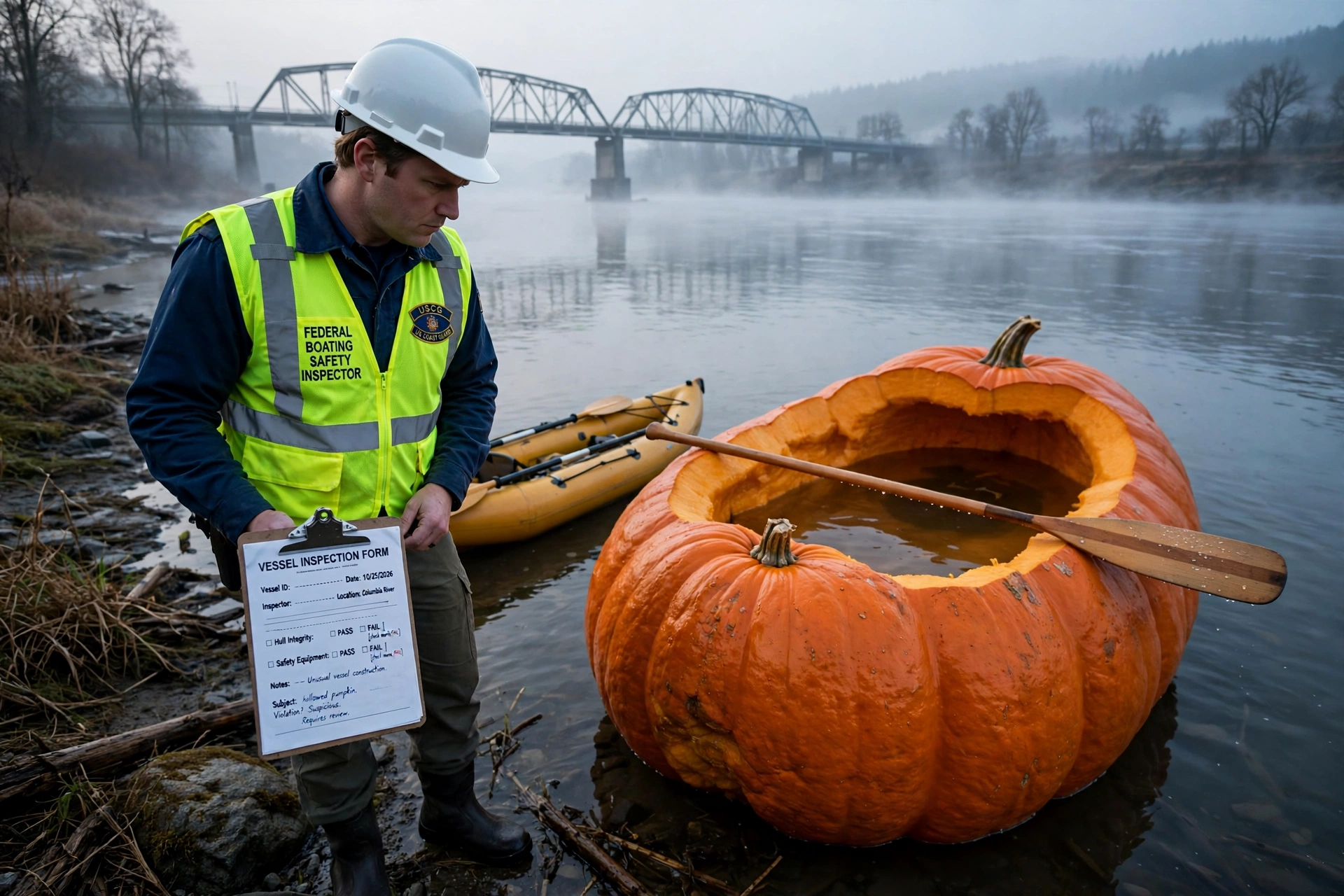
On October 11, Kristensen carved the pumpkin into a boat and mounted a camera to it with a broomstick so he could record the journey. The final touches were the words "it's real," added to each side of the pumpkin so that any stunned passers-by who saw him paddling down the river could have their curiosity satisfied. The hull's only marking, applied by hand, was a denial that the vessel was a hallucination. No number was painted beside it. No decal was affixed. No plate was fastened in a manner whose removal would cause scarring of the surrounding hull, because the hull was a rind, and any fastener would have punctured it.3
The voyage itself ran 73.50 kilometers, or 45.67 miles, along the Columbia River in Washington, completed over 26 hours from October 12 to 13, in three legs. It beat the previous record of 63.04 kilometers, or 39.17 miles, set in 2023. Kristensen launched from a trailer at Hamilton Island Boat Ramp in the city of North Bonneville, Washington. He was followed throughout by others in kayaks and on a pontoon boat. The support fleet, unlike the record vessel, consisted of manufactured boats. The record vessel consisted of a vegetable.4
II. The Fleet
The record did not come from nowhere. It came from a fleet that has raced every October for more than two decades. The West Coast Giant Pumpkin Regatta has been held annually in Tualatin, Oregon, since 2004, on the Lake of the Commons, a man-made lake in the city. It was co-founded in 2004 by Jim Sherwood and Ron Wilson. Sherwood is a founder of the Pacific Giant Vegetable Growers, the organization that supplies the tournament with its pumpkins, and he had been looking for secondary uses for pumpkins after entering them in weighing competitions. He was inspired by the Windsor Pumpkin Regatta, founded in 1999. The Tualatin regatta began as an end-of-season paddle with a handful of giant pumpkins and a few dozen onlookers. By 2007 it drew 2,000 spectators. Today approximately 20,000 people view the event.5
The tournament structure is formal in the way a county fair is formal, which is to say completely. There are multiple heats: one for pumpkin growers, one for the tournament's sponsors, one for local officials, and two for members of the general public who enter by lottery. Before the competition starts, pumpkins are lowered into the lake by forklifts and then carved into boats. The race runs approximately a quarter mile. Competitors must be over the age of 18 and must wear family-friendly costumes. The regatta kicks off the day before the races with a pumpkin weigh-off at the Pumpkins and Pints event. The following day is a full day of pumpkin paddlers plying the shallow lake in giant pumpkin boats. Travel Portland notes that the giant pumpkins are grown over the summer and can weigh over 2,000 pounds.6
The fleet raced again one week before the publication of this article. The City of Tualatin lists the West Coast Giant Pumpkin Regatta Festival for Sunday, October 18, 2026, from 10 a.m. to 4 p.m. at the Lake of the Commons, 8325 SW Nyberg Street, Tualatin, with free admission and pumpkin races at noon and 2 p.m. The 2026 festival program lists pumpkin bowling, pumpkin golf, food, entertainment, and games alongside the races. The boats in the 2026 races were supplied, as always, by the Pacific Giant Vegetable Growers, whose members spend months growing vegetables some weighing more than 1,000 pounds before transforming them into the unusual boats that make the regatta famous. Every boat in the fleet was, by design, unmanufactured.7
III. The Waterway
The Columbia River is not a pond. It is the waterway on which the record was set, and the route proves it. After launching at North Bonneville, Kristensen beached at a spot across the Columbia from Multnomah Falls, where thick vegetation in the water would not allow the pumpkin to float through easily. He used the downtime to carve out more pumpkin meat with an empty soup can, hoping to make the pumpkin float better for the rest of the journey. The reduced weight helped the pumpkin float a bit better for waves. The bailer in this story is not a piece of marine equipment. It is a soup can, and it was empty because its contents had already been eaten.8
The second leg of the journey was supposed to end at a safe beach where Kristensen could camp overnight. It did not. Once darkness fell, he did not feel it safe to beach the pumpkin boat on the sand, because accidentally hitting just one sharp rock could puncture it and end the record attempt. He therefore kept paddling through the night and waited until sunrise for a safe landing spot. At 7:03 a.m. the sun was coming up and he found a safe spot to land and rest on Hayden Island, in Portland, Oregon. After a rest stop of 5 hours and 22 minutes, including time to sleep and eat, he set off on the third and final leg to his finish line at Langsdorf Landing in Vancouver, Washington, where a journalist was waiting and the story was broadcast on news channels in Portland and Seattle.9
The conditions during the night passage were not calm. After a couple of hours of paddling, the wind had strengthened to 56 kilometers per hour, or 35 miles per hour, and waves were starting to come over the sides of the pumpkin. The support kayaks and the pontoon boat followed throughout, which is the reason the voyage can be described as supervised. It cannot be described as inspected. No boarding officer examined the vessel at Hamilton Island, at Multnomah Falls, at Hayden Island, or at Langsdorf Landing. No officer could have examined it without first deciding what it was.10
IV. The Carriage Rules
The federal carriage rules for recreational vessels are not obscure. The Coast Guard's equipment requirements, summarized by the BoatUS Foundation, begin with the same two items on every boat: recreational boats must carry Coast Guard approved personal flotation devices, in good and serviceable condition and of appropriate size for the intended user, one for each person on board, and every vessel less than 39.4 feet long must carry an efficient sound-producing device such as a whistle or horn. The regulation at 46 CFR 25.25-5 states the flotation requirement in the same terms. A life jacket is not optional equipment. A whistle is not a courtesy. They are the first two lines of the federal checklist, before fire extinguishers, before visual distress signals, before anything else.11
The navigation lights rule is the one that governs the night passage, and it contains a special provision for exactly this kind of vessel. Rule 25 of the Inland Navigational Rules, at 33 CFR 83.25, provides that a sailing vessel underway shall exhibit sidelights and a sternlight. Paragraph (d)(ii) then provides that a vessel under oars may exhibit the lights prescribed for sailing vessels, but if she does not, she shall exhibit an all-round white light or have ready at hand an electric torch or lighted lantern showing a white light which shall be exhibited in sufficient time to prevent collision. The rule is lenient for vessels under oars. It is not silent. It requires a white light, exhibited or ready at hand, in sufficient time to prevent collision, on a river at night, in 35-mile-per-hour wind, with waves coming over the sides.12
The published account of the voyage, read end to end, contains no life jacket, no whistle, no horn, no lantern, and no electric torch. It contains a camera mounted on a broomstick, a paddle, a trailer, a soup can, and the words "it's real." This investigation does not claim that Kristensen carried nothing else. It claims that the record of the voyage, the only record that exists, itemizes a camera and a soup can and does not itemize a single item from the federal checklist. A vessel whose documented equipment list consists of a camera and a soup can has not documented compliance. It has documented a camera and a soup can.13
V. The Numbers
The hull identification number is the federal system's answer to the question of what a boat is. Under 33 CFR Part 181, Subpart C, two identical hull identification numbers are required on each boat hull. The primary number must be affixed to the starboard outboard side of the transom, or, on boats without transoms or on boats where it would be impractical to use the transom, to the starboard outboard side of the hull, aft, within one foot of the stern and within two inches of the top of the hull side. The duplicate must be affixed in an unexposed location on the interior of the boat or beneath a fitting or item of hardware. Each number must be carved, burned, stamped, embossed, molded, bonded, or otherwise permanently affixed so that alteration, removal, or replacement would be obvious. The characters must be no less than one-fourth of an inch high.14
The system for issuing those numbers assumes a manufacturer. Each person required to affix hull identification numbers must request a manufacturer identification code in writing from the Commandant of the Coast Guard, indicating the manufacturer's name and United States address along with the general types and lengths of boats that will be manufactured. Persons required to identify boats who are not manufacturers must obtain the required hull identification number from the State Boating Law Administrator of the state where the boat will be principally used. The chain of custody for a hull number runs from a manufacturer, or from a state administrator, to a hull. It does not run from a vine.15
A pumpkin has no transom. It has no starboard outboard side in any sense a boatyard would recognize, because it has no sides that stay in the same place once it is carved. It has no interior location beneath a fitting, because it has no fittings. It has no manufacturer identification code, because no one manufactured it, and no State Boating Law Administrator has ever assigned it a number, because no one has ever presented a pumpkin to a state administrator for numbering. The words "it's real," painted on each side, are the only characters on the hull. They are larger than one-fourth of an inch high. They are not a hull identification number. They are a reassurance.16
VI. The Paperwork Void
Consider the complete documentary record of Punky Loafster. There is a weigh-off result from Bauman's Harvest Festival: 1,214 pounds, 169 inches around, October 5. There is a Guinness World Records certificate, published October 31, 2024, confirming a distance of 73.50 kilometers. There is a news broadcast in Portland and Seattle. That is the file. It contains no title, because no state titled a pumpkin. It contains no registration, because no state registered a pumpkin. It contains no certificate of inspection, because the Coast Guard inspects commercial vessels and passenger vessels, and a pumpkin carrying its own grower is neither in any sense the inspection regime recognizes. It contains no Waterway Access Permit in the name of a pumpkin, because permits of that kind are issued to people, a point to which this investigation will return, honestly, in Section IX.17
The same void covers the entire regatta fleet. The regatta's boats are supplied by growers, lowered into the lake by forklifts, carved in the water, raced for a quarter mile, and then removed. Their service lives are measured in hours. A hull identification number is designed to survive the life of a boat and to identify it after it is stolen, wrecked, or sold. A pumpkin boat's life ends when it rots, which is within weeks, and it is never stolen, wrecked, or sold as a boat, because no one would buy a boat that is also lunch for a pig. The federal numbering system presumes a durable good. The fleet is produce.18
The asymmetry with the support fleet makes the point concrete. The kayaks that followed Kristensen are manufactured boats. The pontoon boat that followed him is a manufactured boat. Both belong to categories the numbering and equipment regimes were written to cover, and both can carry a hull number, a registration decal, a life jacket, and a whistle without structural difficulty. The record vessel cannot carry a registration decal, because a decal does not adhere to a rind that is actively decomposing. It cannot carry a hull number carved into its transom, because it has no transom. It cannot be titled, because a title describes a manufactured good with a manufacturer, a model year, and a hull number, and Punky Loafster has a pollination date instead of a model year.19
VII. The State Permit
Oregon, the state that grows the fleet, has recently closed the one gap in its permit law that a pumpkin could plausibly have slipped through. The Oregon State Marine Board's Waterway Access Permit program, created by ORS 830.615 to 830.630, originally required a permit for nonmotorized boats 10 feet and longer. In 2025, the Oregon Legislature passed HB 2982, which removed the boat length requirement. The Marine Board's own summary states the result plainly: all boat operators, regardless of the length of watercraft, need to purchase a Waterway Access Permit when operating a nonmotorized boat on Oregon waterways. A permit must be provided or displayed from a mobile device when asked by law enforcement. The 2026 permit options are one week for $6, one calendar year for $20, and two calendar years for $35. Failure to show the permit when asked by a marine law enforcement officer is a Class D violation with a $115 fine.20
The timing matters. Kristensen's record voyage took place in October 2024, under the old length-based rule, and it launched and finished in Washington in any case. The 2026 regatta did not. It took place on October 18, 2026, in Tualatin, Oregon, under the new rule, which covers boats of every length. The old argument that a pumpkin boat is too short to need a permit no longer exists in Oregon law. The new rule covers a stand-up paddleboard, a kayak, a raft, and, by its terms, anything else operated as a nonmotorized boat on Oregon waterways. The regatta fleet raced under it one week ago. No pumpkin in the fleet held a permit in its own name. No pumpkin could have, because the permit is carried by the operator and displayed from a mobile device, and a pumpkin has no mobile device. The fleet's permits, if any existed, belonged to its paddlers, not to its hulls.21
The economics of the violation, if violation it were, are precise. A one-week permit costs $6. The fine for failing to show one is $115. The ratio of fine to permit is more than nineteen to one. For a single boat, the choice is $6 against $115. For ten boats, it is $60 in unpurchased permits against $1,150 in potential fines. These are the author's calculations from the Marine Board's published figures, applied to hypothetical fleet sizes, and they are labeled as such. The figures are small. The principle, as always in this publication, is not.22
VIII. The Asymmetry
Consider two vessels on the Columbia River on the same October night.
On one side of the river, a licensed boater operates a manufactured boat. The boat carries a hull identification number carved into its transom and a duplicate hidden beneath a fitting. It carries a state registration decal and a title in a drawer at home. It carries an approved life jacket for each person aboard, an efficient sound-producing device, navigation lights, and, if it has an engine or enclosed compartments, a fire extinguisher. Its operator can produce every paper on demand. The boat will still be a boat next year, and the year after that, and its number will still identify it.
On the other side of the river, a pumpkin weighing 1,214 pounds carries a man, a paddle, a camera on a broomstick, and a soup can. It carries no hull identification number, no title, no registration, and no inspection. Its only marking is the painted reassurance that it is real. It navigates at night, in 35-mile-per-hour wind, with waves coming over its sides, on a river it shares with commercial traffic, and it beaches only when the sun comes up, because a single sharp rock would end the voyage. The pumpkin will not be a boat next year. It will not be anything next year. It will have rotted, and its number, if it had one, would identify compost.
The regulatory burden falls entirely on the vessel that lasts. The vessel that does not last bears none of it, not because it complies, but because it disappears before anyone can ask it to. The federal numbering system was built for boats that endure. The fleet that endures least is the fleet it cannot number.
IX. The Definitional Escape Hatch
A careful reader will have noticed the difficulties, and there are four of them. First, the federal numbering and inspection regimes are aimed principally at manufactured and motorized vessels and at commercial passenger operations. A manually propelled recreational craft carved from a vegetable sits at the far edge of every category the system was written to cover, and in several of those categories it sits outside them entirely. No court has held that a pumpkin is a manufactured recreational boat. No state administrator has ever been asked to number one.
Second, the lights rule for a vessel under oars is, as quoted in Section IV, lenient by design. A vessel under oars need not exhibit sidelights and a sternlight. It need only exhibit an all-round white light or have ready at hand an electric torch or lighted lantern showing a white light in sufficient time to prevent collision. A flashlight satisfies the rule. This investigation cannot show that Kristensen lacked a flashlight, and it does not claim to. It claims only that the published account does not mention one.
Third, the Oregon Waterway Access Permit attaches to the operator, not to the hull. It is transferable from boat to boat, and it is displayed from a mobile device when asked. A paddler who holds a permit for a kayak holds a permit that covers the paddler's pumpkin, to the extent the rule covers pumpkin boats at all. This investigation cannot show that any 2026 regatta paddler lacked a permit, and it does not claim to. It claims only that no pumpkin held one in its own name, which is true in the same way that no pumpkin holds a driver's license.
Fourth, the record voyage launched and finished in Washington, and Washington does not require registration for nonmotorized vessels. The Oregon permit rule governs Oregon waterways. The voyage touched Oregon at Hayden Island, and the regatta is in Oregon, but the longest single voyage in the fleet's history began and ended under another state's law. Washington's exemption list covers vessels powered by human power, such as canoes, kayaks, and rowboats, and separately covers vessels used exclusively for racing, which describes the regatta heats themselves.23 The hatch is wide, well-lit, and clearly marked. It is marked with the words manually propelled, recreational, operator-held, and Washington.
This investigation declines to use it. The facts are what the facts are. The carriage rules say what the carriage rules say. The fleet does what the fleet does, every October, at a quarter mile per heat and 45.67 miles per record, in vessels with no hull number, no title, no registration, and no inspection. The hatch is there for anyone who wants it. The river is not using it.
X. Conclusion
The evidence assembled in these pages requires no interpretive leap. The carriage rules establish that a recreational vessel carries an approved life jacket for each person aboard and an efficient sound-producing device. The navigation rules establish that a vessel under oars at night shows a white light or has one ready at hand. The numbering rules establish that a boat carries two identical hull identification numbers, permanently affixed, in characters no less than one-fourth of an inch high. The state permit rule in Oregon establishes that every operator of a nonmotorized boat on Oregon waterways carries a permit, regardless of the length of the watercraft, and shows it when asked, on pain of a $115 fine.
The same body of law establishes that none of this reaches the pumpkin.
If the pumpkins of a single regatta were a single fleet, it would operate a dozen vessels of more than 1,000 pounds each, race them a quarter mile at a time before thousands of spectators, send one of them 45.67 miles down an interstate river through the night, carry a camera on a broomstick and a soup can as its documented equipment, mark its hulls only with the painted assurance that they are real, and hold no hull identification number, no title, no registration, and no inspection for any vessel in the fleet. The Coast Guard would require it to number its hulls. The state would require its operators to carry permits. The navigation rules would require a white light at night. Instead the fleet is made of gourds, and the law requires of gourds exactly what it requires of any other vegetable, which is nothing, until it is carved, at which point it requires nothing still, but faster.
The regulatory framework that governs recreational boating can be summarized in four propositions. The vessel must be identifiable. The crew must be equipped. The lights must be shown at night. The largest unregistered fleet on American water is grown, not built, and it rots before the paperwork could catch it. Every mile paddled in a pumpkin is a mile navigated without a hull number, without a title, without a registration, and without an inspection. The data exists in a weigh-off slip and a record certificate. It contributes to no vessel database and activates no enforcement action.
The standard protects the point of navigation. The numbering system protects the identity of the vessel. Nothing protects the 45.67 miles of unregistered navigation between North Bonneville and Vancouver, the stretch in which the record was set, in the dark, in the wind, with waves coming over the sides of a vegetable.
The Coast Guard built a numbering apparatus. It pointed it at the people who build boats. It wrote no provision for the people who grow them.
Ergo.
Sources
- Guinness World Records, "Man fulfils dream by paddling pumpkin boat record 73 km down US river," October 31, 2024: Gary Kristensen, 46, of Happy Valley, Oregon, had grown giant pumpkins since 2011 and carved his first boat-sized pumpkin in 2013 for the West Coast Giant Pumpkin Regatta, which he had won for the last four years. guinnessworldrecords.com ↑
- Guinness World Records, October 31, 2024: Punky Loafster was pollinated July 14, harvested October 4, and officially weighed and measured October 5 at Bauman's Harvest Festival in Gervais, Oregon, at 429.26 cm (169 in) in circumference and 555.2 kg (1,214 lb), about the weight of an adult dromedary camel or a grand piano. guinnessworldrecords.com ↑
- Guinness World Records, October 31, 2024: on October 11 Kristensen carved the pumpkin into a boat, mounted a camera to it with a broomstick, and added the words "it's real" to each side. guinnessworldrecords.com ↑
- Guinness World Records, October 31, 2024: 73.50 km (45.67 miles) along the Columbia River over 26 hours from October 12 to 13, in three legs, beating the previous record of 63.04 km (39.17 mi) set in 2023; launched from a trailer at Hamilton Island Boat Ramp, North Bonneville, Washington, followed throughout by kayaks and a pontoon boat. guinnessworldrecords.com ↑
- West Coast Giant Pumpkin Regatta: annual regatta in Tualatin, Oregon, since 2004, on the Lake of the Commons, a man-made lake; co-founded in 2004 by Jim Sherwood and Ron Wilson; Sherwood founded the Pacific Giant Vegetable Growers, which supplies the pumpkins; inspired by the Windsor Pumpkin Regatta, founded in 1999; inaugural event drew a few dozen onlookers, 2,000 spectators by 2007, approximately 20,000 today. en.wikipedia.org ↑
- West Coast Giant Pumpkin Regatta: heats for growers, sponsors, local officials, and two public lottery heats; pumpkins lowered into the lake by forklifts before being carved into boats; race approximately a quarter mile; competitors over 18 in family-friendly costumes. Travel Portland: giant pumpkins grown over the summer can weigh over 2,000 pounds; event held annually since 2004. en.wikipedia.org travelportland.com ↑
- City of Tualatin Parks: West Coast Giant Pumpkin Regatta Festival, Sunday, October 18, 2026, 10 a.m. to 4 p.m., Lake of the Commons, 8325 SW Nyberg Street, Tualatin, free admission, pumpkin races at noon and 2 p.m. Tualatin Life, 2026 regatta preview: races at noon and 2 p.m., pumpkin bowling and pumpkin golf, Pacific Giant Vegetable Growers supply pumpkins weighing more than 1,000 pounds. parks.tualatinoregon.gov tualatinlife.com ↑
- Guinness World Records, October 31, 2024: landing across from Multnomah Falls where thick vegetation impeded floating; Kristensen used an empty soup can to carve out more pumpkin meat to improve flotation. guinnessworldrecords.com ↑
- Guinness World Records, October 31, 2024: after darkness fell Kristensen kept paddling through the night rather than risk puncture on a sharp rock while beaching; landed at sunrise at 7:03 a.m. on Hayden Island; rested 5 hours 22 minutes including sleep and food; finished at Langsdorf Landing, Vancouver, Washington. guinnessworldrecords.com ↑
- Guinness World Records, October 31, 2024: wind strengthened to 56 km/h (35 mph) with waves coming over the sides of the pumpkin; support kayaks and pontoon boat followed throughout. guinnessworldrecords.com ↑
- BoatUS Foundation, U.S. Coast Guard equipment requirements: recreational boats must carry Coast Guard approved personal flotation devices in good and serviceable condition and of appropriate size, one for each person on board; every vessel less than 39.4 feet long must carry an efficient sound-producing device such as a whistle or horn. See also 46 CFR 25.25-5, personal flotation devices required. boatus.org law.cornell.edu ↑
- 33 CFR 83.25, Rule 25: a sailing vessel underway shall exhibit sidelights and a sternlight; paragraph (d)(ii) provides that a vessel under oars may exhibit the lights prescribed for sailing vessels, but if she does not, she shall exhibit an all-round white light or have ready at hand an electric torch or lighted lantern showing a white light which shall be exhibited in sufficient time to prevent collision. law.cornell.edu ↑
- Guinness World Records, October 31, 2024, full account: documented equipment consists of a camera mounted with a broomstick, a paddle, a trailer launch, and an empty soup can used as a carving and bailing aid; the account mentions no life jacket, whistle, horn, lantern, or electric torch. guinnessworldrecords.com ↑
- 33 CFR Part 181, Subpart C, Identification of Boats: two identical hull identification numbers required on each boat hull; primary number affixed to the starboard outboard side of the transom, or where impractical, to the starboard outboard side of the hull aft within one foot of the stern and within two inches of the top of the hull side; duplicate in an unexposed interior location or beneath a fitting; each number carved, burned, stamped, embossed, molded, bonded, or otherwise permanently affixed so alteration would be obvious; characters no less than one-fourth of an inch high. ecfr.gov ↑
- 33 CFR 181.31: each person required to affix hull identification numbers must request a manufacturer identification code in writing from the Commandant, indicating the manufacturer's name and United States address and the general types and lengths of boats to be manufactured; persons required to identify boats who are not manufacturers obtain the number from the State Boating Law Administrator of the state of principal use. law.cornell.edu ↑
- Author's application of footnotes 14 and 15 to the facts of footnotes 2 and 3: a pumpkin has no transom, no fittings, no manufacturer, and no state-assigned number; its only hull characters are the painted words "it's real." ↑
- Author's summary: the documentary record of Punky Loafster consists of the Bauman's Harvest Festival weigh-off result, the Guinness World Records certificate of October 31, 2024, and news broadcasts in Portland and Seattle; no title, registration, or inspection certificate for any pumpkin boat appears in any cited source. ↑
- Author's application of footnotes 5, 6, and 14: regatta boats are carved, raced, and removed within a single festival day, while hull identification numbers are designed to survive the life of a boat. ↑
- Author's application of footnotes 4, 11, 14, and 15 to the support fleet described in footnote 4. ↑
- Oregon State Marine Board, Waterway Access Permit FAQs and Boating Laws to Know: the program under ORS 830.615 to 830.630 originally covered nonmotorized boats 10 feet and longer; HB 2982 (2025) removed the length requirement so all operators of nonmotorized boats on Oregon waterways need a permit, to be provided or displayed from a mobile device when asked; 2026 options are one week for $6, one year for $20, two years for $35; failure to show the permit when asked is a Class D violation with a $115 fine. oregon.gov oregon.gov ↑
- Author's application of footnotes 7 and 20: the 2026 regatta took place October 18, 2026, in Tualatin, Oregon, after HB 2982 removed the length requirement; Waterway Access Permits are issued to operators, are transferable boat to boat, and are displayed from a mobile device, so no permit exists in the name of a pumpkin. ↑
- Author's calculations from the Marine Board's published figures in footnote 20: $115 divided by $6 is 19.17; one boat is $6 in permit against $115 in fine; ten boats are $60 against $1,150. Fleet sizes are hypothetical. ↑
- Washington Administrative Code 308-93-030(4): vessels exempt from registration include vessels powered by human power, such as canoes, kayaks, and rowboats, and vessels used exclusively for racing. City of Seattle boating safety summary: vessels not propelled by a motor or sail, such as canoes and kayaks, are excepted from Washington title and registration, and human powered vessels of any length require neither excise tax nor registration or titling. law.cornell.edu seattle.gov ↑