I. The Certification Regime
The Federal Insecticide, Fungicide, and Rodenticide Act, codified at 7 U.S.C. §§ 136–136y, is the federal statute governing the distribution, sale, and use of pesticides in the United States. Section 11 of the Act, at 7 U.S.C. § 136i, directs the EPA Administrator to establish standards for the certification of applicators of pesticides. The states, in turn, submit certification plans to the Administrator for approval. An applicator who uses a pesticide classified for restricted use must be certified in accordance with an approved plan.1
The implementing regulations at 40 CFR Part 171, revised in a 2017 final rule published at 82 FR 1028, establish the federal standards for certification and recertification. Section 171.1(b) states the operative rule in a single sentence: “A person is a certified applicator for purposes of the Federal Insecticide, Fungicide and Rodenticide Act (FIFRA), 7 U.S.C. 136 et seq., only if the person holds a certification issued pursuant to a plan approved in accordance with this part and currently valid in the pertinent jurisdiction.” The word “only” does the work. There is no alternative path to lawful application.2
The regulation divides commercial certification into defined work categories at 40 CFR § 171.101. They include agricultural pest control, covering crop pest control on grains, vegetables, fruits, cotton, and forage; forest pest control; aquatic pest control; and public health pest control. Aerial application and fumigation were added as concurrent certifications under the 2017 rule. In Texas, where the events of this investigation occur, the Texas Department of Agriculture administers the licensing program under which a commercial applicator selects categories, passes examinations, and maintains certification.3
The examination is not ceremonial. Federal standards require demonstrated competence in label comprehension, safety, environmental consequences, pest identification, pesticide types and formulations, equipment, application techniques, and the applicable laws and regulations. A person who cannot demonstrate this competence may not lawfully apply a restricted-use pesticide. The system admits of no exception for enthusiasm, for good intentions, or for wings.
II. The Unlawful Act
Section 12(a)(2)(F) of FIFRA, at 7 U.S.C. § 136j(a)(2)(F), provides that it shall be unlawful for any person “to make available for use, or to use, any pesticide which is classified for restricted use other than in accordance with the requirements of” the certification provisions. The regulation restates the prohibition at 40 CFR § 171.1(b): “As provided in FIFRA section 12(a)(2)(F), it is unlawful for any person to make available for use or to use any pesticide classified for restricted use other than in accordance with the requirements of this part.”4
The penalties attach per violation. Under 7 U.S.C. § 136l(a)(1), as adjusted for inflation under the Federal Civil Penalties Inflation Adjustment Act and published in Table 1 of 40 CFR § 19.4, the maximum civil penalty for violations assessed on or after January 8, 2025, is $24,885 per violation. The criminal provisions are steeper in kind: a commercial applicator who knowingly violates any provision of the Act faces up to one year of imprisonment, a fine of up to $25,000, or both, under 7 U.S.C. § 136l(b)(1)(B).5
Knowledge is not required for the civil violation. The statute imposes the certification duty as a condition of use, and the use without certification is the violation. A person who applies pest control without the credential has committed the act regardless of motive, regardless of efficacy, and regardless of whether the pests were, in the event, controlled.
III. The Definitions
The statute defines its terms with the precision of a legislature that anticipated evasion. A “certified applicator” is “any individual who is certified under section 136i of this title as authorized to use or supervise the use of any pesticide which is classified for restricted use.” A “private applicator” is a certified applicator who uses such a pesticide “for purposes of producing any agricultural commodity on property owned or rented by the applicator or the applicator’s employer.” A “commercial applicator” is “an applicator (whether or not the applicator is a private applicator with respect to some uses) who uses or supervises the use of any pesticide which is classified for restricted use for any purpose or on any property other than as provided by” the private-applicator definition. The definitions appear at 7 U.S.C. § 136(e).6
The commercial-applicator definition is a residual category. It captures everyone who is not a private applicator. A private applicator works the land of the applicator or the applicator’s employer. A commercial applicator works everywhere else: any purpose, any property, other than the private one. The statute thus divides the universe of applicators into two classes, and the second class is defined as everyone in the first class’s complement.
The statute defines “pest” at 7 U.S.C. § 136(t) to include “any insect” that the Administrator declares to be a pest, and “pesticide” at 7 U.S.C. § 136(u) to mean “any substance or mixture of substances intended for preventing, destroying, repelling, or mitigating any pest.” The corn earworm moth is an insect. It destroys cotton and corn. The thing that destroys it is, by the plain text, intended for destroying a pest.7
IV. The Target
The corn earworm moth, Helicoverpa zea, also known as the cotton bollworm, is among the most destructive agricultural pests in North America. In early June, billions of the moths emerge from the Lower Rio Grande Valley along the Texas-Mexico border. They fly as high as 10,000 feet. They are carried more than 250 miles per night by wind currents, riding the low-level jet north into the cotton fields of the Texas Winter Garden region and onward to the cornfields of the Midwest. The Agricultural Research Service estimated the annual cost to farmers at approximately $2 billion in crop losses and control costs.8
The reproductive arithmetic is what makes the moth a pest rather than a curiosity. Each female moth is capable of laying up to 1,000 eggs. A single night’s migration can seed a county. The larvae bore into cotton bolls and corn ears, where they are shielded from contact insecticides by the plant tissue itself, which is why the adult moth stage, airborne and exposed at dusk, is the vulnerable point in the life cycle.9
The moth shares the night sky with a second major pest, the fall armyworm Spodoptera frugiperda. Dietary studies of central Texas bat colonies have documented both species among the prey, with moth consumption tracking the seasonal emergence and migration of the pests: the percentage of fecal volume composed of moth remains rises sharply on nights when large influxes of migratory moths arrive, and falls when crops senesce and moth populations decline. The predators eat what the farmers fear, on the schedule the farmers fear it.10
V. The Operator
The Mexican free-tailed bat, Tadarida brasiliensis, also called the Brazilian free-tailed bat, is a small insectivorous bat of the south-central United States and Mexico. Its summer maternity colony at Bracken Cave, in the Texas Hill Country northeast of San Antonio, numbers more than 15 million individuals. Bat Conservation International, which owns and protects the cave, describes it as the world’s largest bat colony and one of the largest concentrations of mammals on earth. The bats arrive pregnant in March and April; the pups are born in June; by midsummer the cave holds mothers and young in densities of up to 500 pups per square foot in the nursery crèches.11
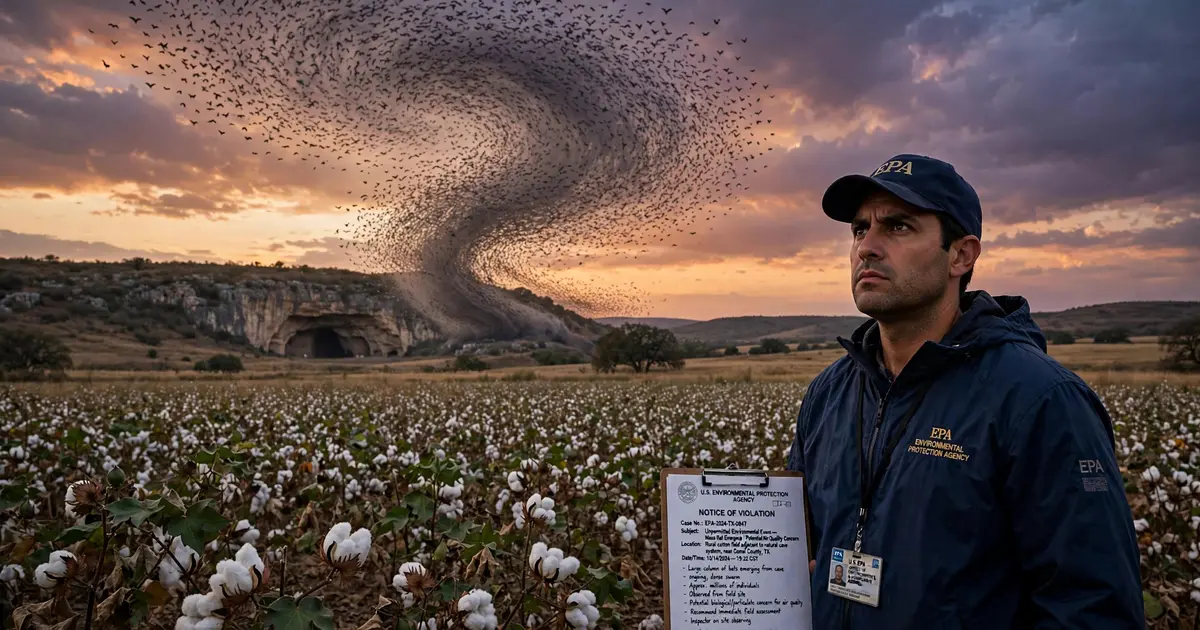
Each evening at dusk, the colony emerges. The emergence can take up to four and a half hours. The column of bats is so dense that it registers on National Weather Service Doppler radar, the same NEXRAD system meteorologists use to track precipitation and that ARS researchers have used to track the moth migrations the bats are intercepting. A single Mexican free-tailed bat eats approximately its own weight in insects each night. Once the pups are grown, the bats of Bracken Cave consume over 140 tons of insects every evening. Bat Conservation International’s field staff report the figure as 140 to 147 tons, nearly 300,000 pounds of insects, on nearly every night of the growing season, the great majority of them agricultural pests.12
The Agricultural Research Service has studied this predation directly. ARS meteorologist John K. Westbrook, collaborating with bat specialist Gary F. McCracken of the University of Tennessee, attached radiomicrophones to helium balloons and recorded the high-frequency feeding buzzes of bats hunting moths at 2,500 feet. Corn earworm moths, the researchers reported, “are one of the bats’ favorite foods.” A million bats can eat nearly 10 tons of insects in a single night. The foraging occurs over huge tracts of land planted in corn, cotton, and sorghum, land the bats do not own, pursuing moths at the same altitudes the moths fly.13
Texas Parks and Wildlife’s former bat biologist has stated that current research shows the bats can save farmers up to two applications of insecticide per year. The bats are not merely eating insects in the vicinity of agriculture. They are displacing labeled pesticide applications, on commercial cropland, on a schedule that tracks the pest pressure, at a scale measured in hundreds of thousands of pounds per night.14
VI. The Scale
The national scale of bat-provided pest control was quantified in a 2011 Policy Forum in Science by Justin Boyles of the University of Pretoria, Gary McCracken of the University of Tennessee, Paul Cryan of the U.S. Geological Survey, and Thomas Kunz of Boston University. The authors estimated the value of pest-control services provided by insect-eating bats to United States agriculture at between $3.7 billion and $53 billion per year, with a mean estimate of approximately $22.9 billion. The estimates explicitly include the reduced costs of pesticide applications that are not needed because of the insects consumed by bats. The authors noted that the figures do not include the downstream effects of the pesticides thereby avoided, on humans, domestic animals, wildlife, or the environment.15
The per-unit figures are as striking as the aggregate. A single colony of 150 big brown bats in Indiana was documented consuming nearly 1.3 million insects in a year. A single little brown bat eats 4 to 8 grams of insects, the weight of one or two grapes, every night. The National Park Service reports that little brown bats can eat up to 1,000 mosquitoes or similar-sized insects in an hour; the Fish and Wildlife Service puts the figure at up to 1,200 mosquito-sized insects per hour.16
The arithmetic for Bracken Cave alone is straightforward. At 140 tons per evening across a season running from March through October, roughly 200 nights of foraging, the colony’s seasonal consumption is on the order of 28,000 tons of insects, the great majority agricultural pests intercepted over commercial cropland. No licensed applicator in the state of Texas applies pest control at this scale. No licensed applicator in the history of the state has.17
VII. The Supervision Void
The statute provides one narrow path for uncertified participation. Under 7 U.S.C. § 136(e)(4), a pesticide is considered to be applied under the direct supervision of a certified applicator if it is applied by a competent person acting under the instructions and control of a certified applicator who is available if and when needed, even though the certified applicator is not physically present at the time and place of application. The noncertified applicator may work. The certified applicator must be reachable.18
No certified applicator supervises the Bracken Cave colony. No instructions have been issued. No competent person stands by. The 15 million applicators depart the cave each evening under no one’s instructions and control, disperse across multiple counties, and apply their pest control at altitudes of up to 10,000 feet, beyond the reach of any supervisor, available or otherwise. The supervision requirement is not merely unmet. It is unmeetable. The operation has no supervisor because the operation has no operator in the statutory sense, only participants.
Federal law separately requires certified applicators to maintain records of restricted-use pesticide applications, including the product, the amount, the location, and the date. The colony keeps no records. There is no log of the 140 tons. There is no entry for the moths. The largest pest-control operation in American history maintains no paperwork whatsoever, which places it in violation of the recordkeeping duty in the same manner and to the same extent as every other duty: completely, nightly, and without exception.19
VIII. The Asymmetry
Consider two pest-control operations working the same Texas airspace on the same June evening.
On one side of the county, a licensed aerial applicator lifts off at dusk in a turbine Air Tractor, holding a Texas commercial applicator license with aerial and agricultural categories, operating under a label whose directions are federal law, maintaining application records for inspection, carrying liability coverage priced against the categories at 40 CFR § 171.101. Every gallon is documented. Every pass is logged. The pilot’s certification is valid in the pertinent jurisdiction.
On the other side of the county, 15 million unlicensed applicators lift off at dusk from a limestone cave, holding no license in any category, operating under no label, maintaining no records, pursuing the same moths at the same altitudes. Their nightly application exceeds the licensed operator’s seasonal total by several orders of magnitude. Bat Conservation International, which owns the cave, describes the service the colony provides to agriculture as “huge, yet mostly hidden.” The hidden part is accurate. The huge part is documented. The licensed part is absent.20
The regulatory burden falls entirely on the operation that applies less pest control. The operation that applies more, several orders of magnitude more, bears none of it. The statute does not distinguish between a pound of insects destroyed by a labeled product and a pound destroyed by echolocation. The enforcement regime does.
IX. The Definitional Escape Hatch
A careful reader will have noticed the difficulty. The statute speaks of “individuals” and “persons.” It speaks of “any substance or mixture of substances.” A bat is not an individual within the meaning of 7 U.S.C. § 136(e)(1). A bat is not a substance or a mixture of substances within the meaning of § 136(u), whatever the plain-text reading of “intended for destroying any pest” might suggest to a reader in a generous mood. Echolocation-guided insectivory is not “application” as the regulation uses the term at 40 CFR § 171.3, where “application” means “the dispersal of a pesticide on, in, at, or directed toward a target site,” and the thing dispersed here is the applicator itself.21
No court has held that a bat is a commercial applicator. No court has held that eating a moth is applying a pesticide. The EPA’s biopesticide program registers microbial and biochemical agents, not mammals. The agency has never suggested that a maternity colony requires certification, has never issued a stop-use order against a cave, and has never proposed to examine 15 million bats on label comprehension. The definitional escape hatch is wide, well-lit, and clearly marked.
This investigation declines to use it. The facts are what the facts are. The statute says what the statute says. The bats do what the bats do, every night, at 140 tons per evening, over land they do not own, without a certificate. The hatch is there for anyone who wants it. The moths are not using it.
X. Conclusion
The evidence assembled in these pages requires no interpretive leap. Section 11 establishes that the application of pest control is an activity of sufficient regulatory concern to warrant a national certification system, defined work categories, demonstrated competence, and approved state plans. Section 12 establishes that uncertified application is unlawful, carrying civil penalties of $24,885 per violation and criminal penalties of a year’s imprisonment. The definitions establish that the commercial-applicator class is the complement of the private one: any purpose, any property, other than the applicator’s own.
The same body of law establishes that none of this reaches the cave.
If the Bracken Cave colony were a single pest-control firm, it would employ 15 million applicators, operate nightly across multiple counties of commercial cropland, displace up to two labeled insecticide applications per year per farm, deliver pest-control services valued in the billions, and hold not one certification in any category. The EPA would require it to certify. The EPA would require it to supervise. The EPA would require it to keep records. Instead the 15 million applicators are distributed across a limestone cave in the Hill Country, and the EPA requires nothing.
The regulatory framework that governs pest control can be summarized in four propositions. The activity is regulated. The applicator must be certified. The use without certification is unlawful. The largest application in the country is performed by animals that cannot read the label. Every moth consumed over a Texas cotton field is a pest destroyed without a certified applicator, without supervision, and without a record. The data exists in 15 million digestive tracts. It contributes to no database and activates no enforcement action.
The certification protects the point of application. The penalty protects the integrity of the system. Nothing protects the 140 tons per night of uncertified pest control between dusk and dawn, the period during which the vast majority of the colony’s pest destruction actually occurs.
The EPA built a certification apparatus. It pointed it at the people who spray. It wrote no provision for the mammals that eat.
Ergo.
Sources
- 7 U.S.C. § 136i (FIFRA § 11, applicator certification): directing the EPA Administrator to establish standards for the certification of applicators; states submit certification plans for approval. law.justia.com ↑
- 40 CFR § 171.1(b): “A person is a certified applicator for purposes of [FIFRA] only if the person holds a certification issued pursuant to a plan approved in accordance with this part and currently valid in the pertinent jurisdiction.” Revised in the 2017 final rule, 82 FR 1028 (Jan. 4, 2017). govregs.com ↑
- 40 CFR § 171.101: commercial applicator certification categories, including (a) agricultural pest control, (b) forest pest control, (e) aquatic pest control, and (h) public health pest control; aerial application and fumigation added as concurrent certifications under the 2017 rule. In Texas the Texas Department of Agriculture administers applicator licensing. kellyinsurancegroup.com ↑
- 7 U.S.C. § 136j(a)(2)(F) (FIFRA § 12(a)(2)(F)): unlawful “to make available for use, or to use, any pesticide which is classified for restricted use other than in accordance with” the certification requirements; restated at 40 CFR § 171.1(b). customsmobile.com ↑
- Civil penalty: $24,885 per violation under 7 U.S.C. § 136l(a)(1), per Table 1 of 40 CFR § 19.4 for penalties assessed on or after January 8, 2025. Criminal: knowing violation by a commercial applicator punishable by up to 1 year imprisonment and/or a $25,000 fine under 7 U.S.C. § 136l(b)(1)(B). jjkellercompliancenetwork.com epa.gov ↑
- 7 U.S.C. § 136(e): (1) “certified applicator” means any individual certified under § 136i as authorized to use or supervise the use of any restricted-use pesticide; (2) “private applicator” means a certified applicator using such pesticides for producing an agricultural commodity on property owned or rented by the applicator or employer; (3) “commercial applicator” means an applicator “who uses or supervises the use of any pesticide which is classified for restricted use for any purpose or on any property other than as provided by paragraph (2).” law.justia.com ↑
- 7 U.S.C. § 136(t): “pest” includes “any insect” declared a pest by the Administrator. 7 U.S.C. § 136(u): “pesticide” means “any substance or mixture of substances intended for preventing, destroying, repelling, or mitigating any pest.” law.justia.com ↑
- USDA Agricultural Research Service: in early June, billions of corn earworm moths emerge from the Lower Rio Grande Valley; they fly as high as 10,000 feet and are carried more than 250 miles per night by wind currents; the pests cost farmers about $2 billion per year in losses and control costs. ars.usda.gov agresearchmag.ars.usda.gov ↑
- Bat Conservation International: each female corn earworm/cotton bollworm moth is capable of laying up to 1,000 eggs; the bats’ prey is primarily moths, especially the adults of corn earworm and cotton bollworm. batworld.org ↑
- Cleveland et al.: diet of Brazilian free-tailed bats (Tadarida brasiliensis) at three central Texas colonies closely correlated to emergence and migration of corn earworm Helicoverpa zea and fall armyworm Spodoptera frugiperda; moth remains rose from ~15% to ~43% of fecal volume on nights of large migratory moth influxes. researchgate.net ↑
- Bat Conservation International: Bracken Cave, Texas, is the summer home of more than 15 million Mexican free-tailed bats (Tadarida brasiliensis), the world’s largest bat colony and one of the largest concentrations of mammals on earth; a maternity colony, with pups born in June at densities of up to 500 per square foot in nursery crèches. batcon.org ↑
- The Nature Conservancy: a single Mexican free-tailed bat eats its weight in insects each night; once pups are grown, the bats of Bracken Cave eat over 140 tons of insects every evening; the nightly emergence can take up to 4.5 hours and is dense enough to appear on Doppler radar. Bat Conservation International field staff report 140 to 147 tons on nearly every night of the growing season. nature.org batworld.org ↑
- USDA Agricultural Research Service: corn earworm moths “are one of the bats’ favorite foods”; a million bats can eat nearly 10 tons of insects in one night; ARS meteorologist John K. Westbrook recorded bats feeding on moths at 2,500 feet using balloon-borne radiomicrophones, in collaboration with Gary F. McCracken (University of Tennessee) and Merlin Tuttle (Bat Conservation International); bats and moths typically fly at the same altitude. ars.usda.gov ↑
- Texas Parks and Wildlife Department (via Passport to Texas): former TPWD bat biologist Meg Goodman reports current research shows Mexican free-tailed bats can save farmers up to two applications of insecticide per year by consuming corn earworm, cotton bollworm, and other crop pest moths. ivoox.com ↑
- J. G. Boyles, P. M. Cryan, G. F. McCracken & T. H. Kunz, “Economic Importance of Bats in Agriculture,” Science, vol. 332, no. 6025, pp. 41–42 (April 1, 2011): pest-control services of insect-eating bats to U.S. agriculture valued at $3.7 billion to $53 billion per year (mean ~$22.9 billion); estimates include reduced pesticide-application costs but exclude downstream pesticide effects. eeb.utk.edu ↑
- Same study: a single colony of 150 big brown bats in Indiana consumes nearly 1.3 million insects per year; a single little brown bat eats 4 to 8 grams of insects nightly. National Park Service (Yosemite): little brown bats can eat up to 1,000 mosquitoes or similar-sized insects in an hour. U.S. Fish and Wildlife Service: up to 1,200 mosquito-sized insects per hour. nps.gov fws.gov ↑
- Author’s calculation: 140 tons per evening × approximately 200 foraging nights per season (March–October) = approximately 28,000 tons of insects per season, the great majority agricultural pests taken over commercial cropland. ↑
- 7 U.S.C. § 136(e)(4): a pesticide is considered applied under the direct supervision of a certified applicator if applied by a competent person acting under the instructions and control of a certified applicator who is available if and when needed, even if not physically present. law.justia.com ↑
- 7 U.S.C. § 136i-1 (FIFRA recordkeeping): certified applicators must maintain records of restricted-use pesticide applications, including the product used, amount, location, and date. No such records exist for the Bracken Cave colony. law.justia.com ↑
- Bat Conservation International: the Bracken Cave bats, foraging over corn, cotton, and sorghum in south-central Texas, provide “a huge, yet mostly hidden, service” to agricultural communities, consuming 140 to 147 tons of insects, mostly agricultural pests, nearly every night of the growing season. batworld.org ↑
- 40 CFR § 171.3: “application” and “applying” mean “the dispersal of a pesticide on, in, at, or directed toward a target site.” No court has held a bat to be a “person” or “individual” under 7 U.S.C. § 136(e), or echolocation-guided insectivory to be pesticide application. EPA’s biopesticide program registers microbial and biochemical agents, not mammals. customsmobile.com ↑